Slashdot Mirror
Domain: hubbertpeak.com
Stories and comments across the archive that link to hubbertpeak.com.
Comments · 57
-
Re:Kinda sad...
Personally, I wouldn't bet on anything but fusion (when/if it is perfected.)
I have read studies that say we have enough nuclear fuel for the next 2000 years (or at least 300-500, if demands increase faster than predicted).
Then again, there are studies that say we could be out of easily accessible ore by the next century.
Examples:
Nuclear power is not sustainable
Nuclear power is sustainable
Is it a good idea to switch over to 100% nuclear, if there is any doubt that it will last beyond 2100s?
Asteroid mining could potentially solve this (IMO), or maybe just skip nuclear and invest in fusion more.
Anyway, my $0.02 -
Re:Woot for me
first models predicted peak oil between 1965 and 1970 http://www.hubbertpeak.com/hubbert/1956/1956.pdf
...in the US. And that's when it peaked.
-
Re:Woot for me
first models predicted peak oil between 1965 and 1970
http://www.hubbertpeak.com/hubbert/1956/1956.pdf -
Like giving $700,000,000,000 to banksSuppresses symptoms in a way that encourages exacerbating the root problem.
If we computer-model the effects on agricultural output, public opinion, and public policy, I think we'd see that gimmicks like this would stabilize temperature in the short term, but increase energy consumption, without any built-in preference for clean sources of that energy, which in turn will worsen the root problem it purports to help "solve" in a long term that is less than two decades. That timeframe is only an estimate, but this looks like a stupid idea that will only benefit partners/shareholders/patent holders and the like. Besides, solar energy is now competitive in price with petroleum and its advantage will only grow as oil reserves continue to be depleted, reducing the total amount of easily-available petroleum.This [original "peak oil" theory, or "Hubbert's peak"] does not mean that the world is running out of oil: it means that we are running out of the cheap pumpable oil that has fueled the economic development of the 20th Century.
The global oil production curve is simply a composite of the contributions of individual nations. However, different countries are in varying stages of production. Some peaked long ago (the USA peaked in 1970 -an event predicted by Dr. Hubbert in 1956), some will peak very soon (the UK in 1999), and some are a long way away from peaking - see graph below. These latter countries will soon find themselves supplying an ever increasing proportion of the world's oil needs as we pass the global Hubbert Peak.
They are of course the major Middle East producers, the largest of them being Saudi Arabia. Their share of the world oil market will probably exceed 30% in 1999. The last time this happened, in 1973, it allowed them to trigger a world oil crisis. In contrast with 1973, the changes in 1999 will be permanent, as they will be based on resource constraints as opposed to politics. -
Re:Fearmongering is not the way to do this.
You seem to be arguing that it doesn't matter that we put as much CO2 into the air as we do, that the 6 or 9 digit CO2 emissions figure is consistent with the planet's scale, so we shouldn't be concerned about it.
That's exactly it. Whenever we strongly reduce CO2 production, the earth will recover its regular levels within a century.
What sort of change will it take for you to be afraid?
In a short answer: none. We have much much larger problems at hand. Oil is already past the Hubbert Peak. This will force us to find an alternative source, and all current alternatives have zero CO2 emissions. While it sounds ridiculously simple, this time around we were plain lucky. There weren't enough fossil fuel reserves for us to destroy the earth.
Note that I'm not ignoring coal. Although there is lots of coal, the emergence of cheaper energy alternatives should render coal economically inefficient. My personal bet for the energy of the future is Nuclear Fusion, which should be available in no more than fifty years.
Environmentalists would do a lot better to concentrate their efforts into preventing a nuclear war. G.W. Bush with its Iraq invasion while allowing North Korea to do what it pleases is doing its best to launch WWIII.
-
Re:Oil FUD
My understanding is that many of those techniques *are* being used today - horizontal wells, etc. The idea that we have a bunch of technological tricks up our sleeves is comforting but may not be true.
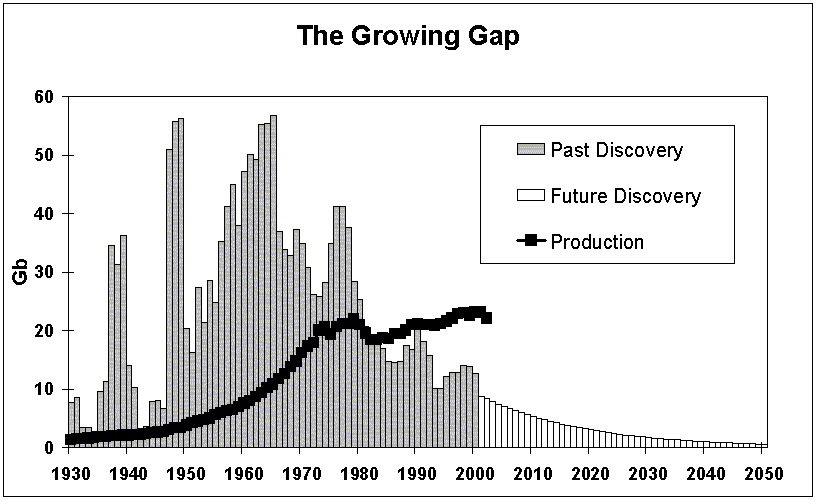
Regardless, even with vastly greater recovery techniques (I think we only extract 30% or so of a well these days), discovery peaked long ago. The writing's on the wall folks!
http://www.hubbertpeak.com/campbell/images/growing GapB.gif -
Re:World population will be 6x10^9 by the year 200
The sad fact is that this time around we've burned up many of the resources that a resurging civilization would need. Rome at its peak wasn't obliterating non-renewable resources the way we are.
Fred Hoyle pointed this out over 40 years ago in his book "Of Men and Galaxies". For our world this is intelligent life's only chance to become advanced technologically. I found it very depressing when I first read, primarily because it was so logical
A similar, more recent, effort at this kind of depressing analysis is an essay titled "The Road to Olduvai Gorge".
-
More info here, US production peaked in the 70's
Site showing a graph of U.S. oil production since 1973: www.hubbertpeak.com/us/
Rep. Roscoe Bartlett's congressional peak oil presentation is also quite good.
-
Re:Which oil peak are we on? Deja vu!
'In 1855, an advertisement for Kier's Rock Oil advised consumers to "hurry, before this wonderful product is depleted from Nature's laboratory."'
Since when do you believe an advertisement?
"In 1874, the state geologist of Pennsylvania, the nation's leading oil-producing state, estimated that only enough U.S. oil remained to keep the nation's kerosene lamps burning for four years."
Even though this is not an advertisement it was in the 19th century. Technology and science progressed enormously since then.
"In May 1920, the U.S. Geological Survey announced that the world's total endowment of oil amounted to 60 billion barrels."
The USGS was proven to be wildy inaccurate even in their own country, I quote: "As recently as 1972, the USGS was releasing circulars that estimated US domestic oil production would not peak until well into the 21st century, and possibly not until the 22nd century. (See Theobald, Schweinfurth & Duncan, U.S. Geological Survey Circular 650)
This was despite the fact US production had already peaked in 1970, just as Hubbert had predicted. Richard Heinberg reminds us, "in 1973, Congress demanded an investigation of the USGS for its failure to foresee the 1970 US oil production peak.""
You say, that: "In 1950, geologists estimated the world's total oil endowment at around 600 billion barrels.
From 1970 through 1990, their estimates increased to between 1,500 and 2,000 billion barrels."
Source?
"In 1994, the U.S. Geological Survey raised the estimate to 2,400 billion barrels, and their most recent estimate (2000) was of a 3,000-billion-barrel endowment."
Actually, no. Please see this link, I quote: "The USGS 2000 divides the petroleum assessments into 'categories of probability': F95, F50 (i.e. median), F5, and Mean (i.e. arithmetic mean). "F" means fractile, as defined by the USGS", and then "TOTAL GCOE at F95 = (approx.) 2,000 Gb
TOTAL GCOE at F50 = (approx.) 2,700 Gb
TOTAL GCOE at F5 = (approx.) 4,900 Gb
TOTAL GCOE Mean = (approx.) 3,000 Gb".
This means, by their EXTREMELY flawed logic, that if they take the probabilities and get a mean value from them, then thats how many oil is out there, while anything below F50 probability is wishful thinking only, if not outright dreaming. I'd say that the quote: "and the estimates for the world Grown Conventional Oil Endowment will converge somewhere between 2000 and 2200 BBO (i.e. near the F95 estimate in the USGS 2000 report). The peak of world oil production is within sight." is very accurate in describing the real reserves.
"By the year 2000, a total of 900 billion barrels of oil had been produced. Total world oil production in 2000 was 25 billion barrels. If world oil consumption continues to increase at an average rate of 1.4 percent a year, and no further resources are discovered, the world's oil supply will not be exhausted until the year 2056."
The problem is not that oil is gone, but that consumption is bigger than production and that production cannot be increased by any significant numbers!
We currently need 83.5 million barrels per day. We are projected to need 120 million barrels per day by 2020. On the other hand, when|since we hit peak oil production (will) decrease by around 1 million barrels per day of production per year. We just cannot tap into the remaining oil reserves quickly enough and in such way that it would be worth the costs (in monetary and energy terms)!
Dick Cheney said, that "By some estimates, there will be an average of two-percent annual growth in global oil demand over the years ahead, along with, conservatively, a three-percent natural decline in production from existing reserves.That means by 2010 we w -
Re:Wrong wrong wrong
-
And slashdot jumps the shark...
Oh nooo... we've reached peak oil! Oh wait... we already reached peak oil... last year. Or was it the year before that? No, it was definitely 1974... yeah...
See?
http://www.hubbertpeak.com/hubbert/
1970's... -
Re:Welcome to 2006
-
All's fine now (was Re:Bye Bye Apple)
After the initial shock & awe, a few brewskys later and a cooler head, the "cataclismic" event that really happened to Apple a few years back and was just announced today is of little consequence.
Really !
By the time the "transitioning" is over, we'll have passed the Hubbert oil peak for sure and having the very latest in high speed portable computing will not matter anymore to most of us, since we will be more preoccupied with finding enough rats and stray dogs to eat and survive one more miserable day.
So relax, play some good vibes on your iPod, download some of the good OSS software around and enjoy. Heck, if you've a few extra bucks, indulge yourself and buy the best and biggest PPC Mac you've been craving. After we go over the edge, it all won't matter anymore... -
Considering recent news...
-
Re:Cost ?Due to the Hubbert peak, the oil economy is going to look very different. How different and how quickly can be argued, but it is going to happen.
My point being; We are not going to meet increasing world energy needs. We are not even going to be able to meet our present needs. The best case scenario involves massive cuts in production and consumption. Capital intensive generation methods will become so expensive as to be undoable. I think we are engaging in a mass self-delusion by pretending otherwise, and just digging our hole deeper.
-
Re:What is that supposed to accomplish?It is a war for oil;
Read this. Take note of the "Time to Depletion Midpoint" graph. Now look at this graph from a DOE report.The war is part of a longer-term need to ensure access to the only oil fields that will be producing in the (suprisingly near) future. It's not about oil prices this summer, but in the decade or two to come.
If that isn't depresing enough, this guy has the full doomsday scenario worked out.
-
Re:light pollution
And in 2029 what exactly will be powering all those lights?
-
Future Fuel Availability
I'll no doubt get modded down to a (-1, Flamebait) for daring to suggest that the future may not be as rosy as we all wish, but have the relevant people taken peak oil into consideration when making such plans? It just seems a little ill thought out to be building new roads on such a scale if they aren't going to be of much use in another 15-20 years time.
See 1 2 3 4 5 or just Google for peak oil. -
ITER needs to be built ASAP
Our goal should be to have commercially useful fusion energy in operation by the end of the 21st century
We don't have that much time. Way too much of the world's economic infrastructure is based upon the availability of easily extractable oil. Visit http://www.hubbertpeak.com/ for more details. -
Re:Who Did What When How?Just for fun, I've compiled a list of misc "terrorist" links myself:
- Assassination Politics by Jim Bell
- The American Holocaust
- Anarchist's Cookbook
- Icky, unpatriotic, morbid beheading videos and such
- Bias to balance U.S. news bias
- Map of the White House
- Location of NYC water resevoirs
- Alex Jones loves progress!
- Economic terrorism #1 - buy nothing day
- Economic terrorism #2 - evil ad-skipping Tivo
- Economic terrorism #3 - running out of oil isn't a conspiracy theory.
- Economic terrorism #4 - the top 10 most fuel efficient cars of 2005
- The widening wealth gap
- Paper trails make it much harder to steal elections
- Hamster dance!
If jackboot thug out there wants to arrest me for "implicitly supporting" the content of any of these links, feel free to abuse the PATRIOT ACT in order to force slashdot.org to reveal the IP address associated with this post, and in turn my ISP will reveal my name and home address associated with the DHCP lease (because I didn't bother to post through an anonymous proxy(s)). tinfoil_hat_mode off.
--
-
you think oil will last longer?
Um, what about oil's longevity? Funny that you would point out others' ignorance of the availability of uranium.
You think oil will "way outlast" 117 years?
Try 40 years. And the tail end of the reclamation curve will have oil being unaffordable. So, less than 40.
http://www.hubbertpeak.com/ (go to)
http://www.hubbertpeak.com/hubbert/ (go to)
By some estimates, we've used half the oil reserves since we began a hundred years ago. You might think that means another 100 to go, but take into account our exponential growth. If you've done any biology, you have probably seen what happens to the limited food supply in a petri dish with exponentially growing bacteria. More importantly, you know what happens to the bacteria.
Bye bye, bacteria! (I'm talking to you.) -
you think oil will last longer?
Um, what about oil's longevity? Funny that you would point out others' ignorance of the availability of uranium.
You think oil will "way outlast" 117 years?
Try 40 years. And the tail end of the reclamation curve will have oil being unaffordable. So, less than 40.
http://www.hubbertpeak.com/ (go to)
http://www.hubbertpeak.com/hubbert/ (go to)
By some estimates, we've used half the oil reserves since we began a hundred years ago. You might think that means another 100 to go, but take into account our exponential growth. If you've done any biology, you have probably seen what happens to the limited food supply in a petri dish with exponentially growing bacteria. More importantly, you know what happens to the bacteria.
Bye bye, bacteria! (I'm talking to you.) -
Re:Cue standard issue global warming denierThe problem in 1978 was not that we did not have any more oil in the ground, it was because the US oil production could not match the demand. The US became dependent on foreign oil at that point. That point is called Hubbert's Peak(the point where oil demand surpasses production). The amount of oil that we pump out of the ground is about the same amount of oil that we discover only delayed. The amount of oil discovered in the US reached it's peak in the 30's or so according to that graph.
According to this graph Saudi Arabian oil discovery hit it's peak in the 50's. That means that the Saudis will be reaching their oil production peak pretty soon.
All of this is summed up in a great book by a Caltech professor called Out of Gas. I highly recommend the book.
With all of this said, my next car will be a biodiesel.
-
Re:After ....Oil supply rate is suspected to already have peaked in the USA oil fields OR is forecast to peak in the about the next 10 years. IF this prediction is correct the cost of oil production will increase irrepsective of the instability in Iraq.
Visit http://www.hubbertpeak.com/ or, http://dieoff.org/42Countries/42Countries.htm for some brief but interesting overviews. Talk a grain of salt with you and open mind.
However you don't need to be an Economist to know that as Iraq stabalises and it will eventually oil product will ramp back up again under US supervision and the price at your "pump" will come back down.
As for the remarks on China. China's economy isn't as susceptable to the woes of the World economy because its currency and markets still are not as exsposed as many other economies. Although this is changing slowly, with their accession to the WTO http://www.wto.org/english/thewto_e/countries_e/ch ina_e.htm
and changes to the position of thier currency,
http://straitstimes.asia1.com.sg/commentary/story/ 0,4386,275733,00.html
Its fairly safe to say that China will play this game carefully because they understand the risks of exposing their economy.
Is this enough facts for you to take this spin of what appears to be a reasonably logical theory. I don't think the author meant to do more than postulate a theory. Probably the best I've heard about the situation to date.
Hey even the Chinese news media a reporting a dependency on crude oil imports...
http://www.chinadaily.com.cn/en/doc/2003-12/11/con tent_289499.htm
For more info go and google with things like Chine , WTO, G7, yuan, currecny exchange etc etc. -
GPM
That's what we need: gas guzzling flying cars right when our oil production drops forever from its global peak production. Trains? That's so 19th Century. And 22nd Century.
-
Alternative energy is wonderful, but ..Bioenergy is wonderful. Solar energy is wonderful, Wind energy is wonderful. I am all in favor of them, but a current article in Physics Today shows that none of them can completely supply our energy needs. See Physics Today -- the site is down right now and I cannot get the articles's URL.
Just one example which I remember from the article. To supply 10% of the current US energy consumption from solar cells, one would need enough collectors with an area equal to the state of Massachusetts. We need to rethink our whole life style. Low cost energy fueled the economic boom of the last two centuries. The party is over. We are near the worldwide peak in oil production. See Hubbert Peak. As this is happening, China, India and other developing countries are increasing thier consumption.
We have enough coal to last a century or so, but we cannnot afford to put that much carbon dioxide into the air with making global warming totally intolerable.
If you think this is far into the future, check the current price of oil. Not only in dollars but in instability. While I do not think that oil is our chief reason for being in Iraq, it is obvious that if Saddam Hussein's chief export had been pistachio nuts, we would not be there.
-
A small point about oil
Well, was Desert Storm to preserve our freedom? If Saddam had continued to occupy Kuwait after we gave him the green light to take it, would anyone here in America have lost any freedom whatsoever? Well, we might have ended up paying higher prices for gas or -- oh the horror -- been forced to employ Americans to work here in America to pump up American oil.
Does anyone remember the economy in Texas when oil was a booming industry here? I do, and it was nice. Having jobs to put food on the table and keep a roof over your head...with enough left over to save up for the future or send your kids off to college, that sounds like freedom; and instead of keeping that here in America, we closed down entire towns and exported the jobs to the OPEC nations...the very nations that openly despise us.
The reason the oil jobs were "exported to the OPEC nations" was because the oil supplies in the US peaked in 1970 , which is why there was a crisis in '73 when OPEC put the squeeze on the supply.
Now the US under "president" Bush has used the excuse of the "war on terror" to invade and take control of a country which has an estimated 25+ years until it's oil production will peak. -
what's it good for......as long as those nanotech cars still run on fossil fuels?
for those who haven't heard it yet:
tabloid style -
Re:Not very optimistic about it...
Oil gives more bang for the buck then any other fuel source
This is not true. Coal is the least expensive fossil fuel on energy-per-Btu basis
However, oil has a higher btu to weight ratio (see here), and comes naturally as a liquid, which makes it easier to transport. -
BP statistical world energy review
You can find it on the BP website and specifically look here: BP reports
While there is a LOT of energy falling on planet earth and alternate energy forms can yeild a significant source, it is unlikly that these sources combined with reduced wastage can make the kind of difference we need.
The BP reports show 2002 oil ouput in ALL middle eastern countries has been in decline since 2000 and that Norway and North Sea have been in a rather serious decline since 1999.
The 2004 report showing 2003 production is expected shortly. What I hope this report shows is an increase in production in certain countries like Saudi Arabia. I suspect it will not show this. This will put us more than 3 years past the peak.
If within the next couple years we do not see an increase in world oil ouput then I supect we can conclude that looking through the rear veiw mirror we have seen the Peak of World Oil Production. THere is a lot of information to be found at the Hubbert Peak Website
If one assumes a 5% reduction per year and this might be generous, then consider how much the world consumption is cut back within say 10 years or 20...
I am sure slashdotters can do this math and can add the number of years to their age. The bottom line is they may be growing old in world without oil.
However you slice it, do not expect Alberta to be able to pick up much slack with Tar Sands, even though we have about 1.8 trillion barrels in resources. The trouble is our tar sands reserves are only about 300 billion barrels and our TOTAL natural gas supplies (which are needed to supply hydrogen so the bitumin can be chemically lightened) are not even sufficient for 10% and North America is already in a Natural Gas crisis.
WE NEED nuclear plants (CANDU, not enriched, because CANDU burns natural uranium unlike the stoopid USA enriched reactors which I think were designed that way to justify enrichment facilities so bombs could be made)
Not only this, we needed to start building them 10 years ago. We are going to have some major power problems over the next few years.
-
Re:What about using the most obvious Nuclear Energ
current situation:
we use oil for energy. Problem, oil is a finite resource, it WILL run out. Alternatives are needed. Okay, we agree so far.
What about using the most obvious Nuclear Energy..The Sun?
No viable alternatives exist yet. To quote verbatim:
Direct conversion of sunlight to electricity by solar cells is a promising technology, and already locally useful, but the amount of electricity which can be generated by that method is not great compared with demand. Because it is a low grade energy, with a low conversion efficiency (about 15%) capturing solar energy in quantity requires huge installations--many square miles. About 8 percent of the cells must be replaced each year. But the big problem is how to store significant amounts of electricity when the Sun is not available to produce it (Trainer, 1995), for example, at night. The problem remains unsolved. Because of this, solar energy cannot be used as a dependable base load. And, the immediate end product is electricity, a very limited replacement for oil. Also, adding in all the energy costs of the production and maintenance of PV (photovoltaic) installations, the net energy recovery is low (Trainer, 1995).
If you can think of a way to store this energy, fantastic, please share. Otherwise, back to the drawing board.
-
End of Cheap Oil been predicted since 1998
I said that in another discussion. but it is worth repeating here in a more appropriate topic.
Several years ago, there was this article in Scientific American that stated conventional wisdom said that oil supplies will be steady and shortage would only happen in half a century or so, and by then there will be alternative sources. They gave several convincing arguments that the shortage would happen within a decade.
Here is a link to the article, The End of Cheap oil by Colin J. Campbell and Jean Laherrere, March 1998.
This web site, Hubbert's Peak seems to be dedicated to the same premise.
-
Other links of interest regarding this issue...
I don't mean to attract flamebaiting or troll mod points - just take a look at these with a fairly open mind.
An aggressively liberal and unfortunately, anti-Bush viewpoint It still manages to raise interesting points.
Basic Education about the concept of Hubbert's Peak
A Dim View of what this change will mean
There is little doubt that life just two generations removed from ours will bear scant resemblance to the rich lifestyle we currently enjoy. Sobering but as true as tomorrow's sunrise, IMHO. -
Re:Reasons for Iraq invasion and who is behind it?
Yup.
We are all paying thru the nose at the pump now for gas.
Like the assumption that reconstruction contracts and defense work would jumpstart the economy, the cheap oil dream did not pan out at all. Put it up there on the board with Iraqis welcoming the US forces with flowers. A year now, and it is a worst nightmare scenario.
That is what you get when you are driven by sheer ideology, and do not listen to others raising red flags along the way.
Back to oil: Iraq war is sure one factor, but perhaps not the only one.
Several years ago, there was this article in Scientific American that stated conventional wisdom said that oil supplies will be steady and shortage would only happen in half a century or so, and by then there will be alternative sources. They gave several convincing arguments that the shortage would happen within a decade.
Here is a link to the article, The End of Cheap oil by Colin J. Campbell and Jean Laherrere, March 1998. This web site, Hubbert's Peak seems to be dedicated to the same premise.
So, the future is somewhat bleak, if this sharp spike is really the ushuring of that prediction, and not just an anomaly reaction to the war in Iraq.
-
Mexico's oil
No, Mexico's reserves are around 20th internationally; not very much.
-
Re:It's all a conspiracy!
Well, the point is they were right in the seventies (Club of Rome) when they first brought that up and your answer reminds me of the shortsightedness of someone falling from a rooftop calmly contemplating that nothing bad happened for the last 40 floors he passed.
Oil exploration peaked in the sixties, oil production probably peaks about now and - unlike the metapher of falling - oil production won't just stop after that, but will decrease slowly while production costs rise.
There is a lag between exploration and actual production so even miraculous new findings now would hardly solve the coming problem.
But, quite to the contrary, large oil companies adjust their numbers in the opposite direction.
-
Die-off
And it can only get worse as these finite reserves of oil are consumed. What is the end game we are heading towards? Surely it is nuclear war or nuclear terrorism. We cannot tolerate where this is heading, yet we seem to ignore the clear signposts.
Some people believe we're at Peak Oil now, and the crash will hit us in the next 3-8 years.
This is why I said a rise in the price of oil is a good thing.
If we are at the peak, then the price of oil will continue to rise, as will food prices, the prices of anything made with the use of electricity. Life as we know it will dramatically change.
In my worst case scenario, I foresee a global conflict with no holds barred, including the use of WMDs (Nuclear and Biological) by every country in attempts to seize the remaining valuable oil supplies. World War III.
Of course, it won't be enough, and after further damaging our already fragile planet, we'll be at a tech level roughly equivalent to the mid 1700's, but worse off, as we've largely forgotten how to do things for ourselve to ensure survival. Do you know how to grow enough food to last a year? Make clothes from raw cotton or wool? Build a shelter? Make a fire? I know I don't have much of a clue about these things, and they are just the basics to survive. Food, shelter, warmth. I think we'll come to appreciate them..
Further problems: diseases running rampant, no emergency services of any kind available. Looting, riots, fires raging through cities. Billions dead or dying (it's estimated the die-off will reduce the global population to around 500 million). Anarchy. People killing each other to get their hands on food.
*sigh* I hope things turn out better than this, but with people like Bush in charge of the US (let's hope he is defeated and the new president of the USA is better), I see no hope for humanity.
-
Re:UCS isn't exactly an unbiased organization...
-In 1980 UCS predicted that the earth would soon run out of fossil fuels. "It is now abundantly clear," the group wrote, "that the world has entered a period of chronic energy shortages." Oops! Known reserves of oil, coal and natural gas have never been higher, and show every sign of increasing.
Oil reserves show every sign of increasing?
You might want to look
here: http://www.hubbertpeak.com/
here: http://www.peakoil.org/
or here: http://www.fromthewilderness.com/free/ww3/061203_s immons.html -
Re:You need to diversify your info sources
For those curious: Hubbert curve.
-
Re:Evolution will take over
No one credible has said there's 20 years of fossil fuels left, ever. In fact, anyone credible knows there's enough coal to choke us all for generations, if we spend $50:barrell to convert it to petroleum, and kill the sky with all the pollution. But the truth in your fantasy is that a very credible person, Dr. M. King Hubbard has the consensus of the oil economists. In the early 1970s, he predicted that the global peak oil production would come in 2012, after which it will only decline (eventually to zero). As demand increases, the decline will accelerate rapidly. Among other achievements, the economist had previously predicted (in the 1950s) that US production would peak in (I believe) 1973, a 100% accurate prediction.
-
Re:fusion is a gating technology
The only practical candidate actually is fission since fusion doesn't yet work. The only way fusion can work right now is to produce fuel for fission reactors in a hybred cyle. This puts say a thorium cadding around the fusion reaction. The neutrons from the fusion reaction transmute the thorium into U233.
You can check ITER if you wish from some information on fusion. This reactor is suppose to have Q=5 when it is built - about 15 to 20 years from now.
It is hard to say if this will be a practical reactor mind you. One thing to note is that it is not planned as a hybred and hense the neutron flux from the fusion reaction will end up irradiating the sheilding materials and magnets and hense it will produce a lot of radioactive waste just as fission reactors do.
A better method that we can use right now is to build a spallation recactor. In a spallation reactor we have a high energy proton source (basically an accellerator) that is directed at a fuel target. The protons crash into the nucleus of the target atoms and release a very large flux of neutrons which in turn fission more atoms. Such a reactor is inherantly safe because the moment you turn off the beam, the reaction shuts down.
Another advantage of spallaton technology is that it can burn the wastes as well. What you need to check is actinide transmutation. Not only can we get power from the wastes.. we also transmute long lived isotopes to not radioactive and very short lived isotopes.
Of course.. the whole area of nuclear energy is the subject of a great deal of disinformation and underfunding.
Within a few years I personally expect this to change because we are running into a fossil fuel shortage that will grip the world. Check the Hubbert peak website for more information. Pay close attention to North American Natural Gas Supplies as well because they peaked Q1 2001. It is possible this will turn out to be the historical peak as well because supplies are still dropping in spite of intense drilling.
The idea that MacKensie Valley gas will relieve the problem is a pipe dream. With the expected output increases of Syncrude operations in the Tar Sands of Alberta, the expected gas demand is going to exceed what a Mckensie Valley pipe line can carry.
In fact... another way of looking at this is as follows. THere are about 1.7 tillion barrels of oil in the tar sands with about 300 billion barrels recoverable through conventional technology (mining and insitu). The problem is that the molecules need to have the hydrogen to carbon ratios increase. Gasoline for instance has a ration of about 2:1 (two parts hydrogen to 1 of carbon and the exact formula for the largest consituant component of gasoline is H(2n+2)C(n)... )
So you see, really what tar sands is all about is that it is a mining operation to get the carbon so that hydrogen can be added to it. In this sense we have already entered the hydrogen technology era.
Now... if 1/2 the carbon is disposed of (possibly via CO2 emissions) then that 300 billion barrel resource drops to 150 billion barrels.
Note that the USA burns about 20 million barrels of oil per day. This means tht 150,000 million barrels will keep the US supplied for only 7500 days or about 20 years. Then it is all gone basically.
However, the total Canadian supply of natural gas is enough to only lighten about 10% of this resource and this means that natural gas could not be used for anything other than chemically lightening bitumen.
So any way we look at it we're going to be in deep shit in short order unless we start building alternative plants now. -
It will happen sooner than your estimate
Consider the basic argument that resource production/depletion tends to follow a bell-shaped curve. See this page (in particular and the whole site in general). Now that data is 5 years and a relevant war out of date, but the general concept is still valid.
Scientific American has a followup that is only 2 years out of date and it puts the peak between 2004 and 2008. I haven't seen any huge discoveries of new oil fields in the last two years so -
Short-sightedI say we run out of cheap energy first and robotization doesn't get to the stage that Brain predicts. Virtually the entire Western lifestyle is predicated on globalisation facilitated by the availability of cheap energy. Without it, everything changes.
I'm not just talking about your yearly flight to a foreign vacation and having to use public transport to commute (if at all), but your means of entertainment (computers, home entertainment, cinema, amplified music), foods that are available at modest prices (anything that isn't locally grown and distributed will become "exotic" and command a higher price - expect to eat less meat and more seasonal fruit n' veg) and lots more - including your free time (you probably won't be able to afford to run a fridge/freezer, so you'll need to shop more often for fresh food or grow your own, labour-saving devices such as washing machines and vacuum cleaners become too expensive to run).
And to anyone who says that we can start using alternate forms of energy (e.g. nuclear, renewables), yes, that's possible, but only if we build the necessary infrastructure whilst we still have sufficient hydro-carbon fuels, otherwise we'll only find it increasingly harder to do (try building/expanding a alternative powerplant without using powered machinery!)
--
-
Re:ConflictsThe Middle East has approximately 65% of all known reserves (and the largest amount of probable reserves in structures that have not been tapped). The Former Soviet Union possesses about 7% of World reserves of which a large amount can never be tapped due to bad management of reserves in the past. North America (which includes large reserves in Canada) comes in just below that with 6.7%. Europe trails in with a pitiful 2%, most of which is in Norway.
In recent years, just about all of the new big discoveries have been in the Middle East. America production is in steady long term decline no matter what those fantasists who want to dig up Alaska and the national parks like to think. The US is one of the best known geological regions in the World - there are no new 'giants' waiting to be discovered.
World production is increasingly concentrated in fewer large fields. 14% of World reserves lie in 8 enormous oil fields with more than 30 billion barrels apiece. Of the 50 000 or so oil fields in the World, more than 1/2 of production comes from just 120 fields. Almost none of which lie inside America.
No matter what, we are at the point where oil production is peaking. Fewer fields are being discovered and the average size of the new fields is falling. Billion barrel discoveries have been on a falling rate since the 1940s, 500 million barrel discoveries since the 1960s. More than 80% of global oil production is coming from fields discovered before the energy crunch of 1973, current discoveries are less than 1/3 of usage and falling.
All the time of course, oil consumption is rising.
If that wasn't gloomy enough there is the really worrying possibility is that almost all reserves have been inflated. The USGS has a long history of upping reserves without good reason and many members of OPEC have inflated their reserves to gain larger production quotas. We might actually have less oil than we think.
And as for Britain, well all that oil and gas which has been helping balance the government's books is really starting to run out. The big downturn in production is less than 10 years away.
Sooner or later we're all going to be looking in the same direction for the lovely stuff. One of the new big players in the Persian Gulf is the Chinese State Oil Company, the PRC has already declared that the Persian Gulf is a region of strategic interest for the Chinese. Oh good - the current superpower and the next superpower both looking hungrily at someone else's oil.
Best wishes,
Mike. -
tripe
this is such a bunch of tripe!
First of all.. if we were to take the encylopeadia Britannica and stack all the books up.. then the thickness of each page would represent more than 100,000 years of the earth's history. This means that the last ice age which ended about 10,000 years ago and was at peak 18,000 years ago would be within 1/5 of the thickness of the last page.
There were 8 ice ages in the last 2 million years and that is within the last 20 pages.
Within the last 2,000 years (2% of the thichness of the last page) there have been several warming and cooling periods denoted by such names as the little ice age and the medieval warm period . Crocs were in the themes during Roman times... (little warmer).
look here to see a chart showing global temperature over the last billion or so years. This is the paleomap project an they have done increadible work.
Check out the university of Carleton, Tim Patterson has an excellent course on climate change and this is being broadcast on TLC as well.
On Chris Scotese's web site you will see that for 90% of the history of the planet for the last 650 million years or so, the earth was about 20 degrees warmer than now. If you look at the miocene maps you will see that 14 Million years ago the planet was warmer.. and a lot wetter..
BTW... the time scale on Chris's chart is not linear. If the chart is re-scaled it tells the same story but is even more dramatic. (We leave the re-scalling to the student as an excersize).
Look here if you want to know why Britian is so keen on renewable energy and specifically look at these charts which show the decline rate of North Sea oil production. Britain will become an oil importer within 2 years. The decline rate of North Sea oil production is more than 15% per year. The chart shows how feilds deplete. You can see how the big plays are drilled first and last the longest... and thereafter smaller and smaller fields are brought online until they give up and stop drilling. This is where Britian is now. One of the stats is that Britian has about 250 barrels of oil per capita. That is it! On to renewable because the oil resource is gone.
The real issue of climate change is this. Water in the atmosphere is far more significant than CO2. Firstly H2O is at a far greater level so the question becomes... how would we express the level of H2O in the atmosphere? Secondly there is uncertainty in the measurements. Thirdly, irrigation and agriculture increase the H2O levels. Most of that water pumped onto the fields will evaporate and plants do transpire!
CO2 levels are in the range of 0.036% and this of course is a plant nutrient.
So we are left with adding 2 numbers for instance.
H2O = 0%-4.0% +/- what? a percent?
CO2 = 0.036% +/- 0.0005
You can see these numbers here in table 7a-1.
Since the warming response is most likely due to the weighted "sum" of the CO2 and H2O and all the other green house gasses of course, then we need to "add" the H2O levels to the CO2 levels. Well - the numbers are in the preceeding paragraph and I don't know how to add them. We don't even have a good handle on the uncertainty of the H2O levels... but, My guess is that irrigation and agriculture have increased the H2O substancially.
So - we end up with the anaolgy to the encyclopeadia. Almost all of the data for climate modeling has been collected in the last 100 years and this represents 1/1000'th of the thickenss of the last page of the stack of books. Meanwhile all the other pages are basically ignored. The geological history of the planet shows that the planet is usually (90% of the time) about 20 degrees warmer than now. So most likely the planet will warm back up. But we don't know when and we might get another ice age or several before this happens. Anyone for 10,000 feet of ice over Toronto? Who votes for palm trees in the artic circle? -
tripe
this is such a bunch of tripe!
First of all.. if we were to take the encylopeadia Britannica and stack all the books up.. then the thickness of each page would represent more than 100,000 years of the earth's history. This means that the last ice age which ended about 10,000 years ago and was at peak 18,000 years ago would be within 1/5 of the thickness of the last page.
There were 8 ice ages in the last 2 million years and that is within the last 20 pages.
Within the last 2,000 years (2% of the thichness of the last page) there have been several warming and cooling periods denoted by such names as the little ice age and the medieval warm period . Crocs were in the themes during Roman times... (little warmer).
look here to see a chart showing global temperature over the last billion or so years. This is the paleomap project an they have done increadible work.
Check out the university of Carleton, Tim Patterson has an excellent course on climate change and this is being broadcast on TLC as well.
On Chris Scotese's web site you will see that for 90% of the history of the planet for the last 650 million years or so, the earth was about 20 degrees warmer than now. If you look at the miocene maps you will see that 14 Million years ago the planet was warmer.. and a lot wetter..
BTW... the time scale on Chris's chart is not linear. If the chart is re-scaled it tells the same story but is even more dramatic. (We leave the re-scalling to the student as an excersize).
Look here if you want to know why Britian is so keen on renewable energy and specifically look at these charts which show the decline rate of North Sea oil production. Britain will become an oil importer within 2 years. The decline rate of North Sea oil production is more than 15% per year. The chart shows how feilds deplete. You can see how the big plays are drilled first and last the longest... and thereafter smaller and smaller fields are brought online until they give up and stop drilling. This is where Britian is now. One of the stats is that Britian has about 250 barrels of oil per capita. That is it! On to renewable because the oil resource is gone.
The real issue of climate change is this. Water in the atmosphere is far more significant than CO2. Firstly H2O is at a far greater level so the question becomes... how would we express the level of H2O in the atmosphere? Secondly there is uncertainty in the measurements. Thirdly, irrigation and agriculture increase the H2O levels. Most of that water pumped onto the fields will evaporate and plants do transpire!
CO2 levels are in the range of 0.036% and this of course is a plant nutrient.
So we are left with adding 2 numbers for instance.
H2O = 0%-4.0% +/- what? a percent?
CO2 = 0.036% +/- 0.0005
You can see these numbers here in table 7a-1.
Since the warming response is most likely due to the weighted "sum" of the CO2 and H2O and all the other green house gasses of course, then we need to "add" the H2O levels to the CO2 levels. Well - the numbers are in the preceeding paragraph and I don't know how to add them. We don't even have a good handle on the uncertainty of the H2O levels... but, My guess is that irrigation and agriculture have increased the H2O substancially.
So - we end up with the anaolgy to the encyclopeadia. Almost all of the data for climate modeling has been collected in the last 100 years and this represents 1/1000'th of the thickenss of the last page of the stack of books. Meanwhile all the other pages are basically ignored. The geological history of the planet shows that the planet is usually (90% of the time) about 20 degrees warmer than now. So most likely the planet will warm back up. But we don't know when and we might get another ice age or several before this happens. Anyone for 10,000 feet of ice over Toronto? Who votes for palm trees in the artic circle? -
Re:Conservat-tives? Hel-lo-o?
Whoo hoo! Economists can rewrite the laws of thermodynamics!
Just as soon as they explain why oil production in the US has fallen every year since 1970 regardless of the market price, I'll believe them.
-
Re:Year without a summer
Demand would go up. Sadly, supply won't...
Amid the greenhouse debate, no one seems to be noticing the fact that nature is going to implement Kyoto for us. Good for the environment, bad for those of us who like cars and electricity.
-
Re:50 years? Or 5000 years?While I agree that some of the early predictions of total oil production were well off the scale, those predictions were made in days when we really didn't understand the processes behind the formation, trapping and extraction of oil. We do now have a good model of all three.
Geologists are near unanimous that oil is produced from the decomposition of plant remains (only Thomas Gold seems to hold out for an abiotic source, but his 'evidence' is lacking). We understand how these remains are converted into oil by heat and pressure. There is a minimum depth to which sediments must be buried before the oil generation process starts. We also understand that there is a maximum depth after which oil molecules are thermally cracked into natural gas. This 'oil window' allows us to demarcate areas of the planet where oil could have formed.
We understand traps that hold oil. The planet has now been pretty much entirely surveyed for such structures. There are very few provinces where undiscovered oil is likely to exist in quantity - the Central Asia, Middle East and South China Sea are the most likely regions for more discoveries.
We have mathematical models showing the distribution of sizes of oil fields. Put bluntly, the big ones are in the Middle East and there is next to no chance of finding large new fields in the US and Europe. We can predict the size and distribution of new fields with some accuracy.
Therefore we can start to draw up models of oil reserves for the entire planet. Indeed this has already been done by geologists, starting with Doctor M King Hubbert, whose 1956 model predicted US oil production would peak in the early 1970s (it peaked in 1970). His model has also been used to predict production in Europe and global production. In each case the model seems to hold.
Hubbert predicted global oil production would peak in the 2000 to 2010 range. Most geologists now concur with this figure - but some are arguing that the World reserves have been grossly inflated by countries trying to maximise production quotas, (some estimates put the inflation of reserves at 180 billion barrels - about twice the reserves of Kuwait) and production may peak in the 2003 - 2004 time frame.
If the Hubbert model is correct, then we are in a nasty situation, even grossly increasing the amount of oil in recoverable reserves, say by 500 billion barrels (that's more than twice the reserves in Saudi Arabia), only defers maximum production by ten years. And there is no belief that these sort of reserves exist.
On to your other points. We are using more fuel each year. Whilst an engine of a given size is becoming more efficient, more people are driving cars, more of them are driving cars more frequently and more vehicles are being built that have larger engines consuming more fuel. World fuel demand is rising. And the fastest growing section of demand is air travel which uses prodigious amounts of (untaxed) fuel.
Hybrids are a good idea, but they require liquid fuels. Oil is the best fuel - it is incredibly energy dense and convenient. Alcohol is less energy dense (and may not make economic sense when you factor in the energy costs of production) and the alternative fuels are environmental disasters. Oil shale and oil sands need huge amounts of energy to become usable, consume vast amounts of water in the process and pump incredible amounts of CO2 into the atmosphere.
We will have to get really radical. But first, the problem is that the developed economies are being forced to import more of their oil from the Middle East. It is the single largest reserve in the World and will become increasingly important as the Alaskan, Texan, Mexican and North Sea fields run down. In a few years the UK will become an oil importer once again (with god knows what consequences for our already horrendous trade deficit); imported oil is already the US's single largest bill and will continue to rise no matter what happens in the Alaskan National Reserve. China is demanding more oil imports as is India, and we all know what happens when things start to get scarce...
Best wishes,
Mike. -
Re:Right.