Slashdot Mirror
Domain: hubblesite.org
Stories and comments across the archive that link to hubblesite.org.
Comments · 269
-
Re:Good Promo for HubbleThe picture. This site has bigger versions of the image as well as a more in-depth story.
On an unrelated note, they also have an awesome wallpaper gallery.
-
Re:Good Promo for HubbleThe picture. This site has bigger versions of the image as well as a more in-depth story.
On an unrelated note, they also have an awesome wallpaper gallery.
-
Re:Good Promo for HubbleThe picture. This site has bigger versions of the image as well as a more in-depth story.
On an unrelated note, they also have an awesome wallpaper gallery.
-
Re:Good Promo for HubbleThe picture. This site has bigger versions of the image as well as a more in-depth story.
On an unrelated note, they also have an awesome wallpaper gallery.
-
Re:where are the high-res photos?
Try HubbleSite - their article includes a full-res JPEG/TIFF image.
(N.b. Apologies to their webmasters/hosting company) -
it is a shame...Enjoy the pics while you can
I think this is on of the worse choice that Nasa could make. It is about the final choice to make science no longer an issue. Even if it is a saftey risk, so is going to the ISS, they are just sitting on a big bomb if something goes wrong. Safety is not the issue, engineers are saying so. But we should enjoy the pics while they are still around, this website is a news release center with high res pics of hubble pics. http://hubblesite.org/newscenter/newsdesk/archive
/ releases/year/ -
Re:She was good while she lasted
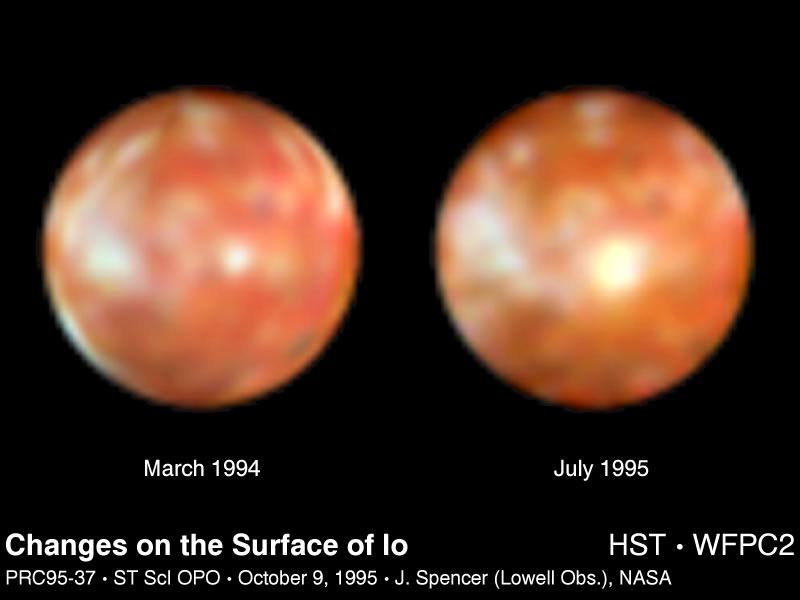
Well, you're wrong about that. Here's a hubble shot of IO. If you can see a poker game there you're the king of ink-blots. Here's another. Compare those to the keck observations I posted earlier and you'll see that hubble's strong point isn't observing planetary bodies; ESO's OWL should be much better for looking at that sort of dim object. And as it turns out, really disant galaxies are better observed in the X-ray spectrum, and NASA has a couple of other satellites for that purpose.
-
Hubble Links!
With all those links, you'd think maybe a Hubble link would surface... Here's a couple good ones:
Hubble For General Public
Hubble For Scientists
--
For news, status, updates, scientific info, images, video, and more, check out:
(AXCH) 2004 Mars Exploration Rovers - News, Status, Technical Info, History. -
Re:Budget -- Mars plan is wildly UnderfundedBush Sr's Mars plan would have cost $500 billion. Bush Jr claims Mars could be done by "spending an additional $1 billion over five years." As these folks report, this is so small, it is almost embarrassing: a single space shuttle mission costs roughly $500 million. In contrast to Bush's Mars proposal, "the original Apollo program cost $150 billion to $175 billion in 2003 dollars."
News Flash: most of our space science comes from unmanned machines such as the Space Telescope, the Mars Spirit Rover, the Stardust comet explorer, and others. Did I mention the Mars Global Explorer, the Wilkinson Microwave Anisotropy Probe satellite, GALEX, the Cassini mission to Saturn, Genesis solar wind sampler, the New Horizons Pluto-Kuiper Belt mission (planned for 2006), etc, etc. Voyagers 1 and 2 have been operating since 1977 (are they older than you?) and are approaching the heliopause. Now that's what I call space exploration. The truth is, in space, robots rule!
Folks, I'm sorry to inform you; but unless there's serious funding, this is at best a publicity stunt, and at worst a president micro-managing NASA in a way that will get rid of the few remaining actual science programs.
-
Re: Yet another nail into Big Bang's heart...
> Well, the BB story has gone along for so much time... some new data whacks it, ok... small nudge and it's consistent.
Can you give an example?
*laugh* I'll bite
* The "flat universe" case gives a Hubble constant of 65 km/s/Mpc (megaparsec). This amounts to an age of the universe of ~10 billion years. This is one of the "age paradoxes" that have led to some of the more interesting revisions and proposed revisions.
* The temperature of the cosmic background radiation was a retrodiction, not a prediction. Alpher and Herman got the closest, with a prediction of 5 Kelvins, but what you don't often hear is that the prediction was later adjusted to 28 Kelvins.
* Inflation theory was introduced by Linde in the mid 80's to help solve the "bubble" problem by having a massive FTL expansion in space for 10^-30 s, and co-opted to help squeeze in some extra universe age. The theory, as it got refined, placed more constraints on the universe (e.g. it has to be flat, not open or closed, for inflation theory to work), and gives us our "refined" universe age of 13.7 billion years
* The age problem, in light of recent Hubble observations, has caused a few new proposals to sprout. The "cosmological constant" as a repulsive force has sprouted up on a few a occasions. It has been proposed in the past year that the universe may have decelerated in the past and is now accelerating.
There's a lot more, and I can get you sources
The Big Bang model makes no predictions whatsoever about the existence of any hypothetical particles, let alone a "nasty slew."
I think what he's referring to is the tack a number of scientists have gone off on in the search for enough dark energy to make the universe "flat" or "closed", and they have invoked a nasty number of theoretical particles. He might also be referring to the slew of theoretical particles some scientists are hypothesizing to explain how galaxies managed to form so soon after the big bang (with quotes like "The majority, perhaps a sea of "non-baryonic," exotic particles, is likely to have played the key role in assembling the first galaxy-sized masses." from NASA's Origins page).
I love quantum physics, myself. It makes some pretty interesting (and good!) predictions, but (as you say), the Big Bang Theory doesn't 'predict' them per se.
Personally, I find it strange that the particles from quantum physics and its forces have been been apportioned a timeline in Big Bang Theory for times of creation and symmetry-breaking. I've seen some folks imply that the two line up well, and by implication that the successes of quantum physics should prop up the Big Bang Theory as well. However, Big Bang Theory just apportions particles a time closer to t=0, the more MeV they require to manufacture in a cyclotron, so it's a lot more 'arbitrary' than would be implied. What it means for me is that quantum physics cannot 'falsify' BBT, by definition.
H, He, and Li concentrations
These are also numbers that have "floated" with time, and the baryonic numbers have been kept consistent with observations. Observed deuterium levels are ten times below BBT predictions, and distant young stars have proved out to have much too much boron and beryllium (which are not in BBT nucleosynthesis as a general rule) in them.
Hubble expansion
Most cosmologists selectively quote Hubble from around 1929. If you read some of his later work, you'll find more of an emphasis on the "apparent velocities" from the redshift not being actual velocities. He had a graph from one of his presentations in the early 1940s showing how luminosities would have to decl
-
Re:I've heard this before (link)
Here's an example of the blue edges of Mars: http://imgsrc.hubblesite.org/hu/db/2003/22/images
/ f/formats/print.jpg -
Re:It's a photoshop job.
Peter,
I am not usually this relentless, but as an employee at STScI, your accusation of fraud really annoys me.
Anyway, I am prepared to prove you wrong. Please examine the animated GIF image I have placed at the following URL:
http://www.stsci.edu/~jharris/sombrero.gif
In the image, I have stacked the HST image and the VLT image on top of each other, and I am displaying each with the same scale and orientation. The first frame shows the HST image, the second frame shows the VLT image. You may need to set your browser to "loop" animated GIFs, or save it to disk and use a tool like gifview.
The rotation and scale are not perfectly matched, but it's good enough to see correspondence between the images.
Oh, wait. I think I see what you are on about. The "missing" stars are all in the dusty disk, right? If you look closely, they aren't gone in the HST image, just much fainter. The reason is simple: the intervening dust absorbs blue light much more than red light. These disappearing-objects are not foreground stars, they are probably star clusters in the galaxy.
If you read the technical data about each image:
ESO, HST, you'll see that the ESO image was taken through redder filters than the HST image (V,R,I compared to B,V,R), so it's no suprise that the ESO image is going to see through dust better! -
Dust, and a whole bloody lot of it
Indeed, it's dust. In order to get just a rough idea of how much dust that is, picture the following:
The Messier 104 (Sombrero) galaxy contains anywhere between 210,000,000,000 and 800,000,000,000 stars (although the latter figure seems more likely to me, mostly because the estimate is newer). That is a whole lot of mass!
Look at the image: given that the galaxy is about 50,000 lightyear across, the dust-band must be about 1,000 lightyears across. Just, for the sake of argument, assume that the dust is located in a ring with a diameter of 50,000 lightyears, 1,000 lightyears high and 1,000 lightyears thick. Then this ring has a volume of 1,000*pi*(51,000^2-50,000^2) is about 3e+11 cubic lightyears, which is 2.5e+59 cubic meters.
Is there any astronomer out there who can shed some light on the density of these clouds? Think about it: even if you assume only 1 (hydrogen) atom per square meter, there are 2.5e+59 hydrogen atoms there, which weight 4e+34 kg, and that's a very, very low estimate!
To put that into perspective: the earth weights about 6e+24 kg.
-
Don't just glance...
Does anyone else stare at this picture for >1 minute while readjusting their perspective?
This would be an amazing picture even if it were only fictional artwork. The fact that it's real makes it all the more amazing...
If you only glanced, then go back and pause for a moment. Make sure you view the 435kiB version so you can see the details... -
Hey neat
There's also some nice video footage
-
Brave, brave people.
Very brave of them to make a 211 MB TIFF file available for download on this page.
-
Links to concentric galaxy stuffA chap named Halton Arp started making a collection a peculiar galaxies which seemed to be (and still are) doing bizarre things to our notions about redshift, eventually building his collection to 338 entities (if you follow the links on that page you can see images of every one of them).
One of the things he noticed was that galaxies happen in statistically significant concentric shells, at least according to the redshifts. One of the less heated discussions I've seen of the consequences is at the University of Alabama's Astronomy department. Bill Keel, the astronomer here commenting, finishes "The evidence in favor of the standard picture is hardly compelling [...]. It survives mostly because nothing better has shown up;". Bill is the bloke who (which Ray White) brought us the silhouetted galaxy shot from Hubble, and has a huge collection of astronomically interesting stuff on his site.
-
Read article, interferometer != telescope
I wish I could tell you the difference between the two, but I'm just now looking it up myself. Obviously, we've "detected" objects much, much, much further away. Even more importantly, we even have "Artist's Depictions" of those too!
-
AHH HAAAAAAA!!!! HAHAHAAHHAAA!
if said 'big object' is a 'ball of hydrogen which never got quite big enough to ignite' it would be called a brown dwarf (that is what brown dwarfs are!) and as big as jupiter (same size larger mass, denser etc)
basic facts
and we would have seen it by now!!!
OK
remember geeks, google is your friend!!
see also
http://www1.msfc.nasa.gov/NEWSROOM/news/releases/2 000/00-206.html
and
http://hubblesite.org/newscenter/archive/1995/48/ -
Re:No Uranus jokes?
no but they are spying on our butts Hubble Watches Uranus
-
/. what's going on?
I dont know what is happening here at Slashdot, but I seriously hope taco, michael, and the others get off the SCO bandwagon... Why the hell do they only seem to accept mainly SCO, LINUX, and Anti Microsoft articles is becoming so yesterday, and I hope they (and I know some of you are reading this) start accepting things outside of the typical media whore range of articles that have appeared here for the past few months.- 2003-08-11 NSA's Statement on Cybersecurity (articles,security) (rejected)
- 2003-08-19 DNA based game playing computer (science,science) (rejected)
- 2003-09-06 Brown Dwarfs fingerprinted (radio,science) (rejected)
- 2003-09-06 Study Indicates Possible Surface Water on Mars (science,science) (rejected)
- 2003-09-07 GSM cellular phone encryption cracked (articles,security) (rejected)
It has been 14 years since two little-known electrochemists announced what sounded like the biggest physics breakthrough since Enrico Fermi produced a nuclear chain reaction on a squash court in Chicago. Using a tabletop setup, Stanley Pons and Martin Fleischmann, of the University of Utah, said they had induced deuterium nuclei to fuse inside metal electrodes, producing measurable quantities of heat. That was the opening bell for one of the craziest periods in science. Cold fusion, if real, promised to solve the world's energy problems forever. Scientists around the world dropped what they were doing to try to replicate the astounding claim. Full story
Astronomers using NASA's Hubble Space Telescope have discovered three of the faintest and smallest objects ever detected beyond Neptune. Each lump of ice and rock is roughly the size of Philadelphia and orbits just beyond Neptune and Pluto, where they may have rested since the formation of the solar system 4.5 billion years ago. The objects reside in a ring-shaped region called the Kuiper Belt, which houses a swarm of icy rocks that are leftover building blocks, or "planetesimals," from the solar system's creation. The results of the search were announced by a group led by Gary Bernstein of the University of Pennsylvania at a meeting of NASA's Division of Planetary Sciences in Monterey, Calif. Full article
-
Re:Amusing
People (including companies, since they are counted as "people" ine this sick ass world we live in) can and do change over time.
I used to do all kinds of fucked up stuff as a kid I wouldn't dream of doing today.
I bet you did too.
If tomarrow microsoft started being a part of the community, and released this same fucking ad but at the end it said "Microsoft" instead of "IBM" the meaning would still be the same.
The basic concepts still would have given me the feeling I get looking at some of these or reading a really good SF book, say by asimov or heinlein or explaning to my 4 year old how stars work.
just because something or someone is evil now doen't make them always and perpetually evil.
IMO microsoft is NOT beyond redemtion. It would take a lot, but doable.
The only exception I can think of is SCO. They crossed too far into the "dark side" =) -
Nice close-up for wallpaper
If you want a great Mars pic from last night for your wallpaper (suitable for 1024x or 1280x) today, get it here:
wget http://hubblesite.org/db/2003/22/images/a/formats/ full_jpg.jpg
It's pretty slow loading, but wget will get it for ya.
CB -
Re:Hubble
-
Isn't two better then one?From the article
Moreover, the Webb is being designed for the infrared wavelengths that very distant galaxies would be emitting as they sped away in the expanding universe, not the visible wavelengths that Hubble sees so exquisitely.
Does that mean that if it goes down the Webb wont be able to provide us with images such as the ones found at the hubblesite archive?
If this is the case, then I hope every effort is made to keep the Hubble up there as long as possible. Perhaps it would be better for astronomy if the Hubble and the Webb would complement each other instead of having one replace the other.
Just my 2 cts. -
Isn't two better then one?From the article
Moreover, the Webb is being designed for the infrared wavelengths that very distant galaxies would be emitting as they sped away in the expanding universe, not the visible wavelengths that Hubble sees so exquisitely.
Does that mean that if it goes down the Webb wont be able to provide us with images such as the ones found at the hubblesite archive?
If this is the case, then I hope every effort is made to keep the Hubble up there as long as possible. Perhaps it would be better for astronomy if the Hubble and the Webb would complement each other instead of having one replace the other.
Just my 2 cts. -
Parent post is incorrect (Hubble Pics Of Moon)There are hubble pictures of moon craters. See here, young man: Hubble shoots Ze Moon.
I seriously therefore doubt all the posts about the Earth, even the nightside of the Earth, being too bright for Hubble to image. Too bright? Reduce your shutter speed !
Also, one poster said the Earth is too close to focus on. Probably also incorrect. Remember the Hubble is ? a few hundred miles up ?. Typically with telescopes or camera lenses, the focus difference between "infinity focus" and "a few hundred miles" is non-existent. Not like the Hubble is exempt from being a telescope. As a matter of fact it's a Ritchey-Cretian telescope just like you can buy here on Earth from these dudes.
-
Let's keep adding terms to the equations
Now we've been decelerating...then accelerating?
This is the thing that has been driving me absolutely crazy vis-a-vis the Big Bang theory, is that the practitioners seem to operate under the maxim:
"Keep adding terms until the data fits"
That's not the way science is supposed to work.
We've had a fair share of juggling of terms, including:
- "Big Crunch" - gravity will let the universe collapse again
- "Flat Universe" - universe will expand forever, but keep slowing down
- "Inflationary Universe" - universe expanded faster than the speed of light for a tiny moment (addressing the age and isotropy problems)
- Not sure what to call this... "Second wind universe" - universe slows its acceleration before dark energy becomes the reigning cause of repulsion
The Hubble telescope observations are getting awfully close to the predicted age of the universe. I wonder what age-of-the-universe estimate this new theory will predict; something more than 13.7 billion years?
The missing mass in the form of dark matter is, by all accounts, supposed to be mass that attracts; the inflationary universe theory depends on it for flatness. This might be another move 'around' the problem.
The Big Bang theory fell from grace for me over a period of fifteen years. While I don't subscribe to the notions of Velan, I'm curious, yet ambivalent about Alfven's plasma cosmology, there are a number of viable cosmological theories that don't have age, mass or exotic physics problems. It seems we closed the book on alternatives too soon, and are constantly interpreting data so it fits with theory, instead of breaking the back of theory on data.
Proving mathematically that you can never hit a wall must be tempered with observations of a hole in the wall and drunk in front of said wall on his back at a frat party
-
Re:MARS
What's wrong with these?
-
Re:Having taken one semester of astrophysics...
Thanks. Science is a bit of a challenge to write for, because of the tight page constraints, but we do try to keep things as readable as possible.
It has been very interesting to me to watch the NASA publicity engine on this one from the inside. A press release like this is not written by the scientists who are involved. Space Telescope has professionals who do this. In general, though, they do a pretty good job. The best site may be this one, which has much more detail than the short version of the press release.
For those who want more technical detail, our 1999 paper discusses the observations that really confirmed the presence of the planet. The new paper updates this slightly with new constraints based on the white dwarf mass. Together with some work in the intervening years on explain the slight ellipticity of the neutron star/white dwarf orbit (using something called Korzoi pumping), these new results have led to the slightly smaller estimated planet mass.
PS. All of the pulsar timing analysis is done on Linux... -
Re:I wonder...
The neutron star was _much_ farther away when the planet formed, and would not have been irradiating the planet significantly. Here's a graphic showing the sequence of events
-
Read before speaking.
Why do people assume that you see flares around stars? Could it be because you get them in pictures, even those taken by the Hubble? The longer an exposure is, the more at risk you are for lens flare from light sources. And, since stars are all light sources (a hard concept, I'll admit), the brighter stars in a field of view are always a risk for flares when the exposure time is set to bring out the fainter stars. Granted, nobody wants the lens flares showing up, particularly the scientists, but you can't eliminate them without eliminating some of the data as well.
And then there's the bitching about color photos being from multiple images. Well, the Hubble only takes monocrome photos, so it has to be a composite image. Geez, they even tell you how some of the photos are manipulated to enhance details to make it easier to detect structures at particular wavelengths. That's hardly a 'fabrication'. Instead, it's basic science. Not to mention the photos taken at non-visible-light wavelengths; it's kind of hard to have a UV photo that people can see without using a 'fake' color.
And finally, why is cheerleading bad? The pictures are great; people should see them. Maybe they'll even tell Congress they want to see more. Heaven knows we don't fund NASA's science programs well enough.
-
Re:What's with all these doctored photos?!?
These images are not "doctored", at least not in the way you imply.
You are correct that they are composed from a set of single wavelength images (well, strictly, each individual image has a certain fairly narrow wavelength range defined by a filter). If you're viewing this on a three-colour RGB rather than monochrome display, that's not such a bad way of getting a quick look at three observations in one.
The colours are so vibrant you have to assume they're retouched, and the stars in the background were added.
Why do you "have to assume they're retouched"? To be fair, if you're putting together an RGB image from three individual images, you will need to make some decision about the scaling for each channel. Also, the caption says that the stars are from an image of stars in the same field, also taken with Hubble. That seems fair enough for a composite image like this.
In addition many of the stars have lens flares which would destroy any scientific value they had which means the lens flares were Photoshopped in afterward!
No. They are not lens flares, and they are not added for effect.
The artefacts you can see around the brighter stars are diffraction patterns, probably caused by the support structures for the secondary mirror (note: Hubble uses mirrors rather than lenses for its optics anyway). You will see them in many telescope images. You're quite right that the stars do not have that shape, but they are an unavoidable artefact of the observation process. They can be inconvenient, but they do not necessarily "destroy any scientific value".
Whilst I would always go to the original data (images of which are available) to do actual analysis for research purposes, I can also appreciate the aesthetic qualities of one of these "public outreach" images.
-
For those looking for wall paper or a poster
click HERE for various resolutions of this image.
-
Re:Final Fontier
Very good points. There are also many other galactic objects that block our view, like Bok Globules, and large nebulae like the Eagle Nebula.
-
Re:ComfortIt's quite humbling when a telescope, probing the deepest regions of space, produces an image showing hundreds of thousands of stars, each of which could have solar systems with the right parameters to harbour life.
Not only that but in the background through the stars are glimpses of thousands of galaxies, each containing hundreds of millions more stars.
Everywhere we look in the universe the picture is the same. Billions of galaxies, countless trillions of stars. Was the universe "created" so only one planet orbiting just one of these stars would produce life? I don't think so.
-
Re:Junk the Shuttle -- and ISS while you're at it.
One example: the ISS (which is an utter joke compared to Skylab or Mir) was placed into a rapidly-decaying orbit not because that was a good idea (it isn't) but because the shuttle could get there.
Skylab was intended for exactly three missions, with no intention of resupply or re-use. The vehicle itself had severe problems -- one solar panel tore off at launch -- which limited its usefulness (the first mission ended up being largely wasted on rescuing the station). Mir was no picnic, either -- there was a major fire, and the collission with a resupply ship. The ISS has, so far, been comparatively problem-free.
Skylab's orbit was not that high -- roughly 270 miles -- in any case it was launched in 1973 and crashed to Earth only six years later, in 1979. The ISS's current altitude is 242 miles. I can't find any orbital data on Mir, but the space shuttle got there, too, and it didn't take more than a few years to crash back to Earth after maintenance ended.
Most of the satellites that are "launched" by the shuttle suffer from the design constraint that they have to fit into the friggin' bay AND have room for the accompanying boosters that will put them into their real orbit once the shuttle lets them out. Again, the shuttle can't go high enough for real deployment.
I don't know what you mean by "real orbit", but the shuttle deployed Hubble at an altitude of 368 miles and has visited it several times since. No current manned vehicle can go much higher than this; and none can reach geosynchronous orbit. Shuttle deployment is not a good idea for commercial satellites, but it makes sense for large, multi-billion-dollar one-shot spacecraft (like Hubble) because if something goes wrong there is an option to bring it back to Earth or do on-orbit repair.
The safety record sucks.
The claimed accident rate of one-in-400 is clearly off. The demonstrated accident rate of 2-in-113 is not atypical of comparable launch vehicles, such as Soyuz. It's even more impressive given that the shuttle system is intended to be reusable, while Soyuz is launched new each time.
It's a white elephant without a mission
Its mission has been and always will be to service the ISS.
It's very tempting to look at any complicated system that has problems, and say, "Bah, this is useless, let's start over". The reality is that experience gained using the shuttle and the ISS is crucial to the continued exploitation of space.
Space flight is a risky business and will continue to be so. There is no guarantee that a new system with untested hardware will be any safer. -
Re:How many stars are in the "visible" sky?
Afraid I don't quite agree with your detective work, there
Your mistake is the assumption that this image is representative of the entire sky's stellar density. HST was pointed near the Andromeda Galaxy for this image; almost all of the stars you are seeing are in the Andromeda Galaxy. Most points on the sky will have a much lower density of stars. See, for example, the Hubble Deep Field, which was purposely pointed at an "empty" region of sky, and which contains only a handful of stars. -
122.75 MB TIFF and More!This is the official site where the photos are.
-Lucas
-
Idiotic resolution
Or you can download the 738.4 kB version and do the pixel doubling yourself.
-
Re:WOW
Yea. The hubble site has it in multiple formats. The 738K "large print" format would make a decent bit of wall paper, but if you're a masochist, or just really into astronomy, you can tweak your own from the 127Meg raw tiff...
-
What's up with the points?
Something I've wondered for a while... what's up with the points coming off the stars? I've always accepted it when I see it with my own eyes because I don't expect my own eyes to be optically perfect, so I always thought it was distortion, but looking at the full image I see that the brightest stars once again have points coming off of them in four directions. Typically they are directly up, down, left, and right, but in that image, they appear to be about five to ten degrees off that.
The biggest example I see is about 3/4s of the way to the right and about 1/5 of the way down on the image, where there is a huge-looking star.
Why four points? Why do we see them even when the star itself is not in the picture (look on the top border for examples, like the one almost directly in the middle)? I guess I would expect that if the light source is too bright the spread would be in a circular formation and simply blur the star, not blur it in just those four directions so much stronger then the rest.
Is it just QM at play? If so, why it is almost always directly up, down, left, and right, instead of random and perhaps even changing over time directions (which probably would get right back to simply looking blurred)? Detector flaws? -
exposure time misleading
The image is not actually a single exposure of 3.5 days in duration, but is actually made from 250 separate exposures taken from Dec. 2 to Jan. 11, 2003. The total exposure time was 3.5 days.
For those who are interested, the original hubble press release is located here.
The site includes the image in a variety of different formats, including a 123 MB tiff file. -
hubblesite.org
Here is a link to a higher resolution image.
Hubblesite.org -
hubblesite.org news release
See also the press release with tons of photos. Enjoy your new wallpaper !
-
Shameless karma whoring:
Direct link to the full-resolution JPEG. (~4.9MB)
http://imgsrc.hubblesite.org/hu/db/2003/15/images/ a/formats/full_jpg.jpg -
Re:Original Image
The photo is a processed visible light image according to the hubbleste/
-
Here's a non-cookie siteGo to the source if you want to view the pictures without Sky and Telescope's insistence on putting a cookie on you system.
-
Re:Any _CLEAN_ Images of this event?
Since when have CCDs bled "in two perpendicular directions"? If I posted enough links of CCDs bleeding in only one dimension, would you eat a crow? From one of my favorite satellites, Yohkoh. From a random web page. A great shot of the infamous UFOs from SOHO. And finally, from the Hubble website itself, a great example of CCD bleed and diffraction spikes in the same photo! The CCD bleed is the bar, and the diffraction spikes are the crosshairs. Check your facts before you post.
-
Any _CLEAN_ Images of this event?
While I love the Astronomy Picture Of The Day and the similarly-cool Hubblesite pics of this event, All the good-sized images have that annoying twinkly-crosshairs look to them. The Hubblesite pics include this small image without them, but all of the large-format images that I can find have the "star filter" applied. Does anyone know where I could find a large, unaltered image or images?
--