Slashdot Mirror
Domain: hubblesite.org
Stories and comments across the archive that link to hubblesite.org.
Comments · 269
-
Re:One quibble
It is incorrect to say that the Hubble is currently flawed in any optically significant way.
I suppose that you might say that depending on how you define flawed. I need corrective optics to allow me to see with proper vision. In my estimation, my eyes are flawed, and the lenses I use - no line bifocals and computer glasses make a big difference. Note to Slashdotters - Computer glasses are wonderful. Corrected for the distance from eyes to screen, they are a big help, and surprisingly inexpensive. They aren't reading glasses. Mine focus at ~ 30 inches and are sharp as a tack
http://hubblesite.org/the_tele... Here's the first corrective optics, or COSTAR. Amazing work.
-
Re:Not knowing anything
There are...
This study identified 675 stars on the outskirts of the Mily Way galaxy that appear to have come from the inner galaxy.
In 1997, it was found that in the Virgo cluster of galaxies, there may be over one trillion extragalactic stars, or more than 10% of the total stellar population of the whole cluster.
And finally...Half the stars in the universe may be intergalactic wanders, which might solve a large part of the dark matter problem.
-
Re:Pics or it didn't happen
The story sounds neat and all, but I can't actually see the purported images.
This, this and this might be the images.
I did a Google on
5 asteroids "hubble space telescope" 2017 "frontier fields"then picked the link
News - HubbleSite: Images
hubblesite.org/images/news - Cached
Compass Image for Asteroids in Hubble Frontier Fields. Nov 2, 2017.
Compass Image for Asteroids in Hubble Frontier FieldsThat web page has three images dated Nov 2, 2017, whose captions include the word "Asteroids". I'm guessing those images show the newly-discovered asteroids.
-
Re:Pics or it didn't happen
The story sounds neat and all, but I can't actually see the purported images.
This, this and this might be the images.
I did a Google on
5 asteroids "hubble space telescope" 2017 "frontier fields"then picked the link
News - HubbleSite: Images
hubblesite.org/images/news - Cached
Compass Image for Asteroids in Hubble Frontier Fields. Nov 2, 2017.
Compass Image for Asteroids in Hubble Frontier FieldsThat web page has three images dated Nov 2, 2017, whose captions include the word "Asteroids". I'm guessing those images show the newly-discovered asteroids.
-
Re:Pics or it didn't happen
The story sounds neat and all, but I can't actually see the purported images.
This, this and this might be the images.
I did a Google on
5 asteroids "hubble space telescope" 2017 "frontier fields"then picked the link
News - HubbleSite: Images
hubblesite.org/images/news - Cached
Compass Image for Asteroids in Hubble Frontier Fields. Nov 2, 2017.
Compass Image for Asteroids in Hubble Frontier FieldsThat web page has three images dated Nov 2, 2017, whose captions include the word "Asteroids". I'm guessing those images show the newly-discovered asteroids.
-
Re:Pics or it didn't happen
The story sounds neat and all, but I can't actually see the purported images.
This, this and this might be the images.
I did a Google on
5 asteroids "hubble space telescope" 2017 "frontier fields"then picked the link
News - HubbleSite: Images
hubblesite.org/images/news - Cached
Compass Image for Asteroids in Hubble Frontier Fields. Nov 2, 2017.
Compass Image for Asteroids in Hubble Frontier FieldsThat web page has three images dated Nov 2, 2017, whose captions include the word "Asteroids". I'm guessing those images show the newly-discovered asteroids.
-
Re:Pics or it didn't happen
*I found a set of images on the Hubble site, accompanying the press release which this story regurgitated.
Argh. You know what I meant.
-
Re:Pics or it didn't happen
*I found a set of images on the Hubble site, accompanying the press release which this story regurgitated.
Argh. You know what I meant.
-
Re:Pics or it didn't happen
It is a particularly crappy post. There's not much to the story except for the images, which as you say were not included (bar one) or linked. And science stories should always post references; none in this story.
I found a set of images accompanying the press release on the Hubble site, accompanying the press release which this story regurgitated.
-
Re:Pics or it didn't happen
It is a particularly crappy post. There's not much to the story except for the images, which as you say were not included (bar one) or linked. And science stories should always post references; none in this story.
I found a set of images accompanying the press release on the Hubble site, accompanying the press release which this story regurgitated.
-
Re:Fuck Forbes, and in particular Ethan Siegel
Clickbait, no: there's actual, real, high-quality content to what he writes.
No, it isn't.
Cosmology is complicated. The Black_Hole at the center of our galaxy is an awesome thing, but it's just a little bitty baby compared to the clickbaiting monster at the center of M87, which is 3.5 BILLION solar masses!
These links are also well-written and also have pretty pictures. If I write a few dozen paragraphs of drivel like that and loosely tie it in to a one-sentence summary of whatever Hubble or Chandra discovered this week, do I get two front-page articles on Slashdot every day?
-
Re:Modern day epicycles
The one thing I will never understand about the
Yep, looks like epicycles to me.
[Top] - Three slices through the evolving distribution of dark matter. The dataset is created by splitting the background source galaxy population into discrete epochs of time (like cutting through geologic strata), looking back into the past. This is calibrated by measuring the cosmological redshift of the lensing galaxies used to map the dark matter distribution, and binning them into different time/distance "slices". Each panel represents an area of sky nine times the angular diameter of the full Moon. Note that this fixed angle means that the survey volume is a really a cone, and that the physical area of the slices increases (from 19 Mpc on a side to 31 Mpc on a side) from left to right.
[Bottom] - When the slices across the universe and back into time are combined, they make a three-dimensional map of dark matter in the universe. The three axes of the box correspond to sky position (in right ascension and declination), and distance from the Earth increasing from left to right (as measured by cosmological redshift). Note how the clumping of the dark matter becomes more pronounced, moving right to left across the volume map, from the early universe to the more recent universe.
Please enlighten us with your elegant theory that will explain the current observations. Bonus points if it allows for warp drive.
-
The only thing missing
Is a good clean view and commentary on Abell 1689, the place where any comments on gravitational lenses should end up.
http://hubblesite.org/gallery/... -
Re:Colours in pictures?
As pointed out by someone else, the fast facts page mentions which filters they mapped to which rgb color channels in the picture.
-
Re:Cool 3D effect...
Lens flares? You probably mean the lines that are a result of Fraunhofer diffraction. As for the post-processing, You might want to have a look at the fast facts (not much detail though).
-
Just a simple question...
You can download the full resolution image from NASA.
http://hubblesite.org/newscenter/archive/releases/2015/02/image/a/warn/ -
Re:Cool 3D effect...
I don't think the comparison image is from Hubble. It's got six spikes on the stars, Hubble only has four spider vanes.
Here's the "fast facts" of both the new picture and IR picture http://hubblesite.org/newscent...
Yes they're from Hubble. -
Re:Just a simple question...
Gotta give credit to NASA. They made a 25 year old space telescope that is still better than anything that anyone else has.
-
HST's M31 vs R.Gendler's M31
This image is so cool : http://hubblesite.org/newscent...
Robert Gendler's gallery is visible here -
Scientists "know"?
"The origin of the heat generated inside the Earth is one of the great mysteries of geophysics. Researchers know..."
Researchers don't "know" squat. They have lots of theories, none of which have supporting data. That's what makes the heat of the Earth's core a mystery. By all rights it should not be this hot. It should be dead cold like the moon.
In the 1800s, famed physicist Lord Kelvin (for whom the absolute Kelvin temperature scale is named) was the first to calculate that even if the earth was born in an incandescent molten state (and there is no evidence for this), it would have cooled to its current temperature billions of years sooner than the 4.6 billion years accepted today. Even using generous assumptions about the thermal energy produced by radioactive decay (which also have no direct evidence), the earth would still cool to its current temperature much sooner than 4.6 billion years.
A related mystery is how planets form at all. The conventional theory is that they "clump up" from smaller particles, eventually achieving enough critical mass form an accretion disk that gains heat from compression, gradually acquiring a gravitationally-optimal spheroid shape. But that model has been shown to be inadequate: "Growth beyond meter size via pairwise sticking is problematic, especially in a turbulent disk. Turbulence also prevents the direct formation of planetesimals in a gravitationally unstable dust layer."
So when someone says "scientists know", they are often flat out wrong, as is this story's author.
The three little words so many scientists are deathly afraid to say: "We don't know." -
"snaps"
Funny use of the word "snaps", considering the exposure time of 103 hours (TFA). But I guess, on a cosmological scale...
-
Source link
http://hubblesite.org/newscenter/archive/releases/2014/02/image/
Stop with space.com slashvertisements already, it's nauseating.
space.com are leeches who are not competent enough to link to the frigging Hubble site. You know, the very minimum of what one can do to credit the work of the people who actually built the space telescope, took these amazing pictures, processed them, and brought them to the masses.
-
Re:Explain the usage restrictions on image?
If it is so crappy, why do you care? If you actually cared anyway, you could have gone to the source and gotten higher resolution images (and even allows you to embed them in your own website) and checked out the copyright page and see that such images can be treated as public domain (although they ask that you let them know you are using it voluntarily, but you could legally ignore that). Sounds more like whatever website you looked at for reposts of PR pieces just automatically sticks usage notices on images without checking the details, not some issue with the original institute.
-
Re:Explain the usage restrictions on image?
If it is so crappy, why do you care? If you actually cared anyway, you could have gone to the source and gotten higher resolution images (and even allows you to embed them in your own website) and checked out the copyright page and see that such images can be treated as public domain (although they ask that you let them know you are using it voluntarily, but you could legally ignore that). Sounds more like whatever website you looked at for reposts of PR pieces just automatically sticks usage notices on images without checking the details, not some issue with the original institute.
-
It could be the repeat of Comet Linear
The Hubble Telescope, back in August 2000, captured the broken remnants of the of the Comet Linear which exploded
http://hubblesite.org/newscenter/archive/releases/2000/27
Picture of the remnants is at http://imgsrc.hubblesite.org/hu/db/images/hs-2000-27-a-print.jpg
-
It could be the repeat of Comet Linear
The Hubble Telescope, back in August 2000, captured the broken remnants of the of the Comet Linear which exploded
http://hubblesite.org/newscenter/archive/releases/2000/27
Picture of the remnants is at http://imgsrc.hubblesite.org/hu/db/images/hs-2000-27-a-print.jpg
-
probably death of Hubble too
The gyros have been replaced on four of the Hubble servicing missions.
-
Re:Out of curiosity...
How much of a penalty, relative to the penalties incurred for things like small size, subpar optics, etc. does putting up with the atmosphere impose?
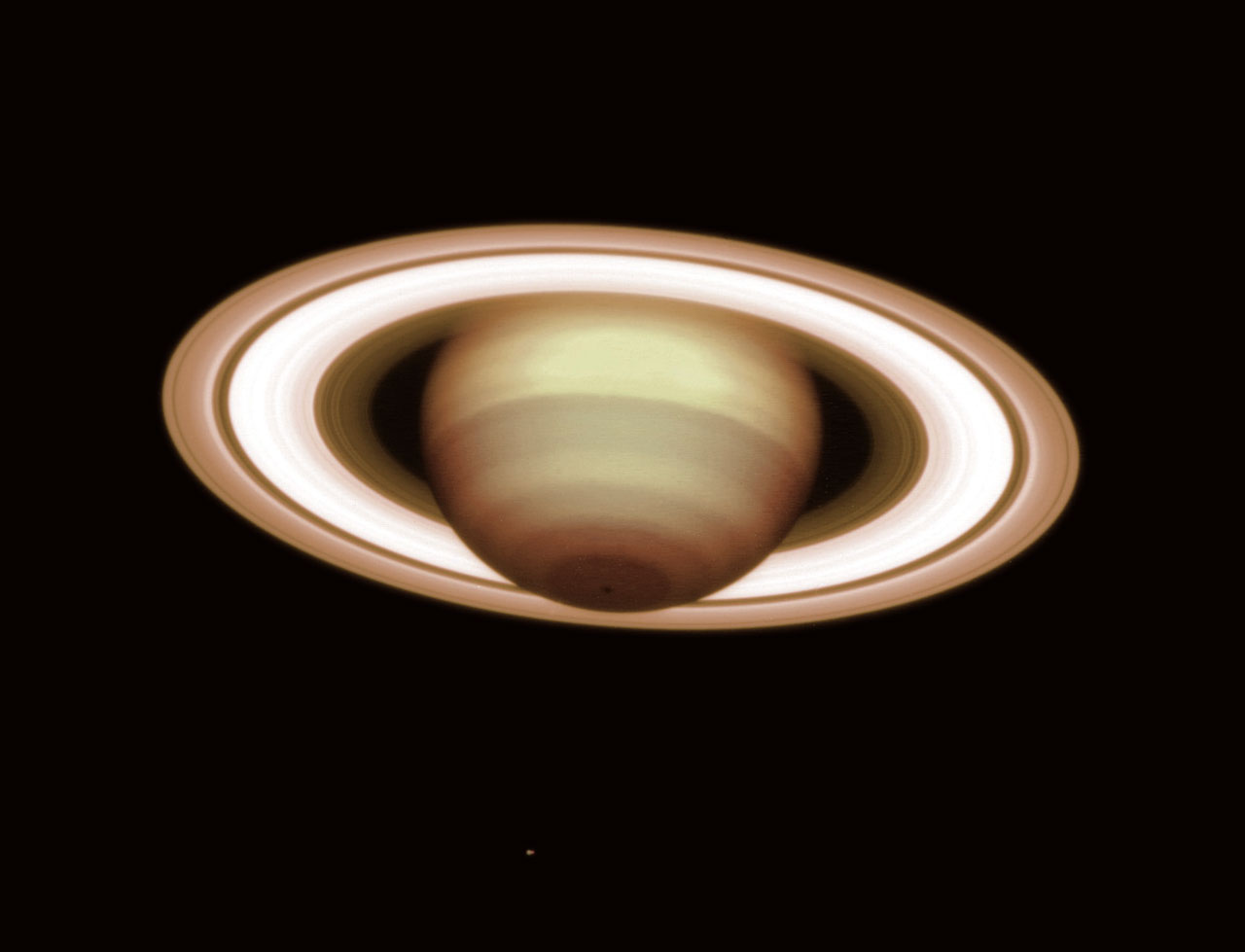
Here's Saturn as seen by ESO's Very Large Telescope in Chile (8.2m mirror, though it can combine 4 of them into an interferometer). The observatory is at 2635m above sea level, so is looking through about 70% of the air you'd be seeing through at sea level (air decreases in density with altitude, so there is diminishing returns for getting up high). The observatory's location was chosen for its perennial clear skies. The photo was taken with what was state of the art adaptive optics a decade ago (2002). I wasn't able to find a more recent photo of Saturn from a large, ground-based telescope in 15 minutes of googling.
Here's Saturn as seen by Hubble (2.4m mirror). Not much of a contest.
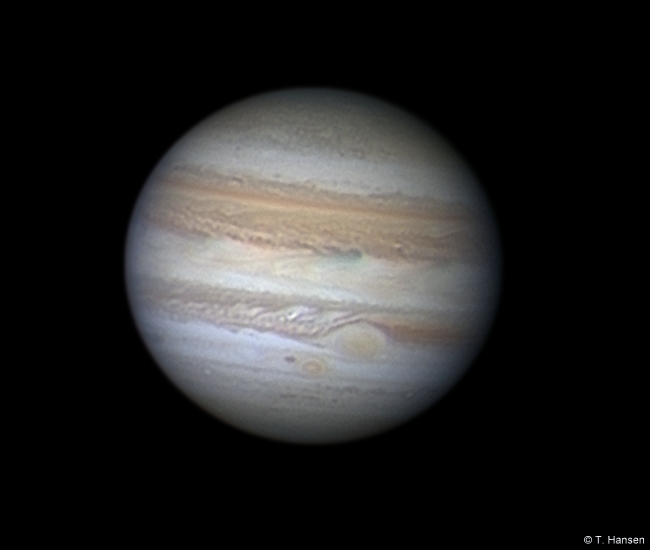
I picked Saturn as an example instead of Jupiter because Jupiter is bigger and closer than Saturn. So even at low resolution you can still get some impressive shots. Here's one taken by an 11" (28cm) telescope.I'm told, by people more closely involved with amateur astronomy than I, that a 200mm aperture is a pretty small instrument, especially for reflector-based designs.
200mm (about 8 inches) is about the size of your basic cheap but serious reflector for an amateur astronomer. It's pretty much the minimum you'd expect anyone doing astronomy as a serious hobby would own.
A quick calc of the Rayleigh criterion says a 200mm scope would have a maximum angular resolution of 0.6 arc-seconds (i.e. two stars closer than this separation would appear as a single dot). Hubble's Rayleigh criterion limit is 0.05 arc-seconds, so Hubble can resolve objects 12x smaller. The Hubble photo is 2150x1000 resolution. Reduce it by 12x to about 180x83 resolution, and that's about the amount of detail in you'd expect in a Saturn pic from a 200mm scope in orbit. IMHO it's not really worth it in the visible band. They'd better be planning to do a lot of UV work with it. -
NASA doesn't discover galaxies: astronomers do
I realise that the title of this article was carried over from the CBC article, but could we at least try to remember that it's astronomers that discover things like this high-redshift galaxy, not an administration like NASA in isolation? I don't mean to diminish the absolutely central role played by NASA in both Hubble and Spitzer, of course, but at the same time, a whole range of people, institutions, and organisations come together to make scientific discoveries like this possible, and I think it's important that we recognise that science is often a highly collaborative and international endeavour.
For example, there are 23 astronomers who co-authored the paper on this galaxy: 11 are from US institutions, 11 from European institutions, and 1 from a Chinese one. Note, I didn't say that they were (necessarily) American, European, and Chinese: in the list of co-authors, there are at least some Europeans working in the US and vice versa.
Also, the Hubble Space Telescope is a collaboration between NASA and ESA, the European Space Agency, albeit with NASA in this instance contributing the majority. There are other space missions including Herschel and Planck which are led by ESA, but in which NASA plays a minority role. Many space missions are collaborative in this way, in essence underpinning the mix of US-based, Europe-based, and other international astronomers who've written this paper.
In more detail, it can get even more complicated when you realise that NASA, ESA, and other space agencies themselves employ astronomers and other space scientists, so in that sense, discoveries can be made by those organisations too.
Speaking of which, it might have been more appropriate to give the links to the original US and European press releases from the Space Telescope Science Institute, NASA, and ESA to get the full story.
Anyway, despite the (important, I believe) pedantry, this is is an interesting discovery
-
Re:centrifuge
Interesting comments, but two things to consider:
1) You don't need to rotate the entire vehicle, just a small module inside it to provide a little artificial gravity when needed.
2) The problems have been worked out long ago. Hubble and spy satellites use gyros to aim the vehicle at whatever is being imaged. It's a very cool system, just transfer momentum between the gyros and the vehicle whenever you need to point it, takes almost no energy to move even a huge telescope.
-
Re:*700* instruments off *6* different coastlines?
8 terabytes per day, according to TFA. Add the ability to effectively query, slice, dice and present that much data on a long-term basis... yeah, that's a hell of a lot of vacuum tubes.
For comparison, the LHC does upwards of 27TB/day[1], Hubble 3-5[2].
[1] http://en.wikipedia.org/wiki/LHC_Computing_Grid
[2] http://hubblesite.org/the_telescope//hubble_essentials/ -
Re:Color?
I always wonder about these pictures, and I hate to sound like an idiot, but why don't they ever seem to take color photos on these things? Is there not enough light, and they have to use infrared?
Like I know that pictures of structures in space (e.g. nebulae) are colored in because they're being captured with radio telescopes rather than optical ones, but I'm imagining that these pictures are taken with a relatively normal digital camera. I know adding color would increase bandwidth, but I can't imagine that alone is the problem.
Try out this link... http://hubblesite.org/gallery/behind_the_pictures/meaning_of_color/index.php
-
Re:Don't we have telescopes?
Not even Hubble can resolve that from LEO: http://hubblesite.org/reference_desk/faq/answer.php?id=77&cat=topten
-
Re:Nuke it from orbit
INAL but a complete wipe could be construed as destruction of employer owned data. I suggest a less invasive approach using Eraser from http://sourceforge.net/projects/eraser/ Uninstall the non standard software, use Eraser to wipe the personal and non business related files. Shrink the paging file to minimum size and run an erase of free space. A single pass should be adequate*. Then go to http://hubblesite.org/gallery/album/entire/pr2003011a/warn/ and download the 16,000x16000 pixel image of the Helix nebula. Open multiple copies of this image until the system forces an expansion of the paging file. While this isn't a military grade approach it will leave the system intact. An intact system with business docs isn't suspicious. A freshly wiped system might draw attention.
* Guttman only proposed his thirty-five pass hypothesis; so far as I can tell the hypothesis has never been tested on a real hard drive. The original hypothesis was based on disk drive technology in the mid nineties about the time magneto resistive technology entered the supply chain which suggests Guttman's research was on older disk drive technology. Does anyone know if forensics has ever recovered data from an overwritten hard drive? -
Puzzle me this?
If dark matter is actually some effect of the relationship between matter in another universe and this, how is it that the two are typically linked gravitationally, but not always. If you look at this photograph recently taken by the HST, one of the largest galaxy clusters we can see has its dark matter concentrated when the barionic matter is not. Puzzle me that? I'd have to have an explanation that would explain such anomalies.
-
Resolution
From TFA:
We're not just trying to take pictures of stars and see them as disks -- which is something we can do
That was new to me, so I did some digging. The Hubble was the first telescope to do this, in 1996. It's quite incredible that we can now do this.
Annoyingly, searching Google for 'image disk star' gives loads of false positives (protoplanetary disks).
-
Re:Observed Dark Matter?
Here is general description and large annotated Hubble image
-
Re:The videos are amazing
-
Re:They don't really look like that, do they?
There is a great video on the Hubble site that you can view that goes into exactly what goes into a hubble picture and explains the whole concept of colors and the like in it.
-
Re:Albert Einstein, bad-ass
And to think he figured this stuff out around 100 years ago...
About 8 years ago I was using the Deep Field View for my desktop wallpaper - there's a lot of gravitational lensing going on in there, if you look carefully. Ol' Albert was a pretty sharp one, a little sad he didn't live to see these sorts of images - I'm certain he'd be so stoked that he'd pump his fist and shout, "Yesssss!"
In the spirit of science I'll toast to his memory with a pint when I gets home tonight.
-
Re:What's the algorithm like?
The full paper is available here. It has a substantial section on "data processing and methods for astrometry," which again has further references regarding the algorithms used, e.g. (Lafreniere et al. 2007b; in ApJ (= Astrophysical Journal), 660, 770). The paper should be enough to keep you busy for an hour or so (and it has pretty, scientific pictures visualizing the process), the references should be enough for the rest of the year.
-
Re:You may also remember
That Hubble also went WAY over budget, not to mention the incurred cost of sending a shuttle up not once but twice to fix and upgrade it.
Five times actually...
SM-1 in December 1993
SM-2 in February 1997
SM-3A in December 1999
SM-3B in March 2002
and the most recent and final mission,
SM-4 in May 2009
http://hubblesite.org/the_telescope/team_hubble/servicing_missions.php
http://en.wikipedia.org/wiki/Hubble_Space_Telescope#Servicing_missions_and_new_instruments -
Re:Bugs, memory leaks, and poor performance.
I just ran leak test of my own on Firefox 6.0.0.4240 (as reported by Process Explorer). Here's a link to the image I mentioned above. The file is nearly nine meg in size and renders as 16,000 by 16,000 pixels. http://imgsrc.hubblesite.org/hu/db/images/hs-2003-11-a-full_jpg.jpg. Irfanview reports its rendered size as 732.42 MB (768,000,040 Bytes). I opened the image in Firefox, opened fifteen tabs on
-
Re:Naaaa. not gonn happen like this
I personally dont believe that its possible for a star to be "elongated" and stretched..
If a star can contort itself into odd shapes, what makes you think a black hole can't stretch one out of shape?
-
Re:Physics Simulators
Don't forget these:
http://www3.gettysburg.edu/~marschal/clea/CLEAhome.html - If you have smart 8th graders, they can do simulated astronomy and learn how we know some of the things we know
Stellarium and Skycharts (Cartes du Ceil) are among the best sky simulation and mapping software and well worth a look along with Stellarium. Or try Kstars on Linux
http://www.stellarium.org/
http://www.ap-i.net/skychart/en/download (newer more comprehensive
http://www.stargazing.net/astropc/oldversion/index.html - Version 2 (older, easier on the PC)NASA World Wind
http://worldwind.arc.nasa.gov/java/Hubble for pretty pictures and the stories behind them
http://hubblesite.org/If they don't mind math try a gravity simulator
http://www.orbitsimulator.com/gravity/articles/what.htmlVarious Roller Coaster Simulators
Rasmol Molecule simulator
http://rasmol.org/
http://www.umass.edu/microbio/rasmol/Scorched Earth style artillery games may get their imagination fired (but be careful as political correctness may mean you're fired)
Much more. No time to post right now though.
http://www.umass.edu/microbio/rasmol/ -
Re:Look at the price tag
I totally believe you when you say that surveys provide more and better scientific data, but as a tax-payer I am thrilled with HST's performance, and I could hardly be happier about this wealth of data, which is useful to everyone, professionals and amateurs alike. The only thing I dislike about JWST is that we cannot service it, as so we miss an opportunity to launch more people into space. You guys could turn the surveys into PR machines too, you know. In KStars, for example, there are shortcuts to download DSS and SDSS. I click on the star map and a DSS picture for that place gets pulled. But it could be so much better: DSS is slow to the point of being unusable, and the available SDSS data doesn't seem capture that much of the sky. With a bit of tweaking, I bet we could have a google-map-like app for the surveys to blow everyone's mind, and then you'll see more cash pouring in for these kinds of projects.
-
Re:Mark my words
Actually, they do form gravitational lenses, and we've measured this.
Basically, the process is to find a galaxy cluster, measure the lensing to determine where the mass is, and subtract out the mass of the individual galaxies. What you're left with is the location of the dark matter.
http://news.discovery.com/space/hubble-3d-map-universe-dark-matter.html
Where you're wrong is that there's no "central galaxy." Dark matter is still closely associated with normal matter (after all, they do attract each other gravitationally). I think maps like this have shown that most galaxies actually have a "halo" of dark matter surrounding them.
Of course, the shape of this halo can vary quite a bit:
http://hubblesite.org/newscenter/archive/releases/2007/17/
Wow! Are those gorgeous pictures or what!
-
For those without 3D glasses
-
Re:Youtube it please
The 2D version of the movie is available as well: http://hubblesite.org/newscenter/archive/releases/2010/29/video/a/
-
Re:"and speeding it up..."
Doesn't seem any different to me, in spirit, to the color-enhanced photos taken by the Hubble telescope.
http://hubblesite.org/gallery/behind_the_pictures/meaning_of_color/index.php