Slashdot Mirror
Domain: ibiblio.org
Stories and comments across the archive that link to ibiblio.org.
Comments · 1,708
-
Speeding
Speeding, that is, exceeding a posted limit set by political forces and not traffic surveys, is an administrative offense with no chance of causing physical harm to anyone. If people are driving at unsafe speeds, then the risk of injury to others may increase, depending on traffic conditions.
Well, that's your opinion. I for one, am inclined to take the word of "trained professionals" over some random
So instead, let's read Report FHWA-RD-92-084, by the Federal Highway Administration of the U.S. Department of Transportation.http://www.ibiblio.org/rdu/sl-irrel/index.html
From the summary:
- Accidents at the 58 experimental sites where speed limits were lowered increased by 5.4 percent.
- Accidents at the 41 experimental sites where speed limits were raised decreased by 6.7 percent.Oh dear, they seem to agree with you...
-
Re:Too late!
Umm.. you mean like this?
-
Re:Scientists are human.Have you not seen some of the source code found in the dump? Take a look at Eric Raymond's analysis of some of this:
http://esr.ibiblio.org/?p=1447
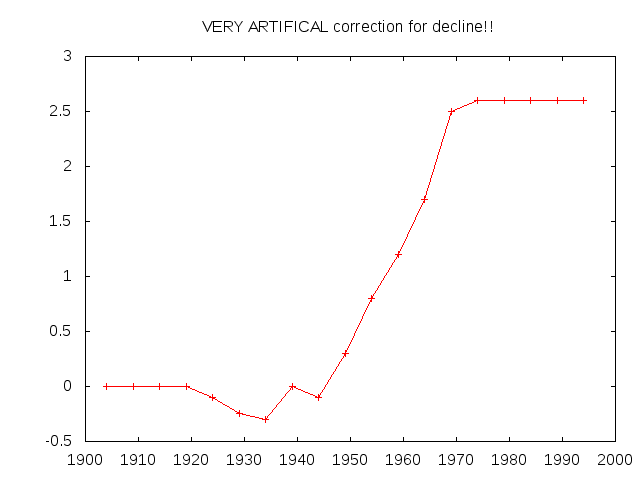
I particularly like the source code comment that states "Apply a VERY ARTIFICAL correction for decline!!"
You cannot dismiss this as just email bickering. You can see the SOURCE CODE where they artificially change the data to suit their agenda! Why are people not more ticked off about this??? This is an offense to both science in general and programming,
-
Hockey Stick
How do you get a hockey stick graph from climate data. One way is to apply a hockey stick filter to the data! See ESR's blog for details.
-
Re:This is Slashdot . . .
If there is evidence of the books being cooked, then present that evidence.
Go check ESR's notes on what he's found in the code.
What really galls me is that the screeching harpies declare themselves to be "skeptics"
Funny, what really galls me is people like you claiming that "the science is settled" and pretending that those of us who disagree are equivalent to holocaust deniers.
-jcr
-
Science is a process
Have you ever tried to have a rational discussion about climate change with someone who's either unaware of willfully ignorant of the science?
Have you ever tried to have a rational discussion about science with someone who's unaware of statistical analysis or the importance of reproducibility? It's like talking to a wall.
Take for example the raw climate data. It's level noise. Unless you add in adjustments like this and this it's completely boring annual measurements that vary but don't trend.
Adjust them, and they're sexy. They are alarming. They're a cause for action that makes the science interesting and important. We all like to be important, don't we?
-
Re:RC != CRU
Here's NOAA's "adjustment" graph: graph.
Compare and contrast to UEA's "Adjustment" graph.
The diff on these two graphs is negligible. These two graphs constitute the entire alarm about AGW. Without these adjustments the source data is level noise whether you read it forward or backward, or substitute for it any random noise of your choosing.
These adjustment graphs have serious credibility issues involving the determinism of increasing error.
It's neither flamebait nor trolling to insist that these adjustments be explained before we scuttle the entire world economy to manually adjust the global ecosystem to fit a model that corrects problems found only in these "adjustments" of uncertain provenance.
-
Not a chance. Not just one university.
Here's a nice graph of the NOAA's "adjustments". If you subtract these "adjustments" (their term, not mine) from every OMG Global Warming Will Kill Us ALL graph you've ever seen, you get noise. It doesn't matter whether you add the noise back in forward or backward, or substitute it with properly scaled level data from your favorite MP3: the result is the same alarming graph. But if you reverse the timeline on this "adjustment" and feed in your favorite source of noise you get a chart that looks like a precipitous drop in temperature in 1900-1909 that levelled off. Why did they make these adjustments? Was it because their raw data didn't agree with someone else's observations? I find it difficult to believe that NOAA's measurements became increasingly inaccurate over time with a determinable bias and that at the precise moment their instruments became reliable, the temperature increases stopped. That doesn't jive with my understanding of modern technology and error measurement, nor with my understanding of thermodynamics.
In short since the adjustments are the cause for alarm it would be best if they were examined closely. Most especially since several of the presumably credible sources use such similar "adjustments". The cause for alarm does not appear to be in the raw data. If you know of some credible source of uncooked raw data that does show this cause for alarm continuing to the present day (not ending in 1999), I'd love to see it. Be careful though - adding in these "adjustments" and throwing away the raw data appears to be the order of the day. If that raw data isn't out there, this is just the most amazing piece of pseudo-scientific groupthink I've ever seen.
The story now is that they've only lost 5% of the data, and the rest is good - trust us. This situation is fluid and there will be much more back-and-forth before the truth is finally heard. With the basic facts this dynamic, now is not the time to take bold action on questionable information.
-
Found it - with links
Ah, there it is. ESR is a respected member of the community and I'll take his word for it absent definitive proof.
You can quite clearly see the "fudge factor" (actual code comment) where it was calculated to produce the desired result. Presumably this factor was computed, then munged into the raw data and the code commented out. Here you can see the hockey stick being built in the factory.
There are nice graphs where the "no trend" raw data is added to "a VERY ARTIFICAL correction for decline!!" to create the results graph we have all seen that has no relation to the raw data but does show what would be an alarming trend if it were not for the fact that it's entirely made up. Since you clearly won't believe me, here's The NOAA's own fudge-factor chart by dataset and in total. They're from this page, and here's an official quote on that page from the NOAA:
The cumulative effect of all adjustments is approximately a one-half degree Fahrenheit warming in the annual time series over a 50-year period from the 1940's until the last decade of the century.
Here's another nice link. Enjoy.
This is not science, to my understanding of that symbol.
-
Found it - with links
Ah, there it is. ESR is a respected member of the community and I'll take his word for it absent definitive proof.
You can quite clearly see the "fudge factor" (actual code comment) where it was calculated to produce the desired result. Presumably this factor was computed, then munged into the raw data and the code commented out. Here you can see the hockey stick being built in the factory.
There are nice graphs where the "no trend" raw data is added to "a VERY ARTIFICAL correction for decline!!" to create the results graph we have all seen that has no relation to the raw data but does show what would be an alarming trend if it were not for the fact that it's entirely made up. Since you clearly won't believe me, here's The NOAA's own fudge-factor chart by dataset and in total. They're from this page, and here's an official quote on that page from the NOAA:
The cumulative effect of all adjustments is approximately a one-half degree Fahrenheit warming in the annual time series over a 50-year period from the 1940's until the last decade of the century.
Here's another nice link. Enjoy.
This is not science, to my understanding of that symbol.
-
Found it - with links
Ah, there it is. ESR is a respected member of the community and I'll take his word for it absent definitive proof.
You can quite clearly see the "fudge factor" (actual code comment) where it was calculated to produce the desired result. Presumably this factor was computed, then munged into the raw data and the code commented out. Here you can see the hockey stick being built in the factory.
There are nice graphs where the "no trend" raw data is added to "a VERY ARTIFICAL correction for decline!!" to create the results graph we have all seen that has no relation to the raw data but does show what would be an alarming trend if it were not for the fact that it's entirely made up. Since you clearly won't believe me, here's The NOAA's own fudge-factor chart by dataset and in total. They're from this page, and here's an official quote on that page from the NOAA:
The cumulative effect of all adjustments is approximately a one-half degree Fahrenheit warming in the annual time series over a 50-year period from the 1940's until the last decade of the century.
Here's another nice link. Enjoy.
This is not science, to my understanding of that symbol.
-
Re:Let's Do That
Fuzz testing can still be valid. Does the hockey stick still appear with range-limited random data (like, say, -10C to 40C)?
Eric Raymond says yes. -
Re:Science as Open Source
No obvious "cooking" was there, at least to my eyes
Many eyes make all bugs shallow. Read what ESR has to say about *specifically* cooking the data. Now your eyes see it too.
-
Re:Uh yeah, whatever...
A good place to start from a programmers perspective is Eric S Raymond:
http://esr.ibiblio.org/?p=1447
Not sure how else to take it.
-
ESR said it very well - Open Source Science
Open-sourcing the Global Warming Debate:
AGW true believers and "denialists" should be able to agree on this: the data get the last word, because without them theory is groundless. The only way for the CRU researchers to clear themselves of the imputation of serious error or fraud is full disclosure of the measurement techniques, the raw primary data sets, the code used to reduce them, and of their decisions during the process of interpretation. They should have nothing to hide; let them so demonstrate by hiding nothing.
In short, if computer models are the primary tool in making all sorts of climate predictions, then let's have transparency in building the models and getting conclusions from them.
-
Re:Much bigger issue with uTorrent still unsolved
In essence, uTorrent connects to clients randomly, and makes no attempt to prioritize "nearby" clients.
You might be interested in this thread I started on the topic in '05 - it covers some pros and cons. My intent at the time was to avoid the whole problem we wound up with at Comcast (that took the FCC to fix). Somebody mentioned to me once that there was a problem with traceroute on Windows, not sure if that's really true.
-
Personal Experince
I can attest to BasicLinux on old hardware like yours, at 2 Floppys worth of space, X and Links pre-iinstalled http://distro.ibiblio.org/pub/linux/distributions/baslinux/
-
xinvaders
-
Re:Effective way to keep screens locked
Google seems to be doing a worse and worse job of finding specific things.
-
Re:Even worse stuff!
One developer I worked with liked using the following for code he wasn't using right away: if (1 == 2).
Don't judge him too harshly. It was possible in early FORTRAN implementations to do `1 = 2' and thus modify a constant making the constant `1' in the source code `2' in the running code. It was a bit more complicated than that, but that was the effect. As I recall, though I can't find it now, people did that to fix last minute bugs when certain "constants" needed to be changed.
-
Re:Not the best choice of languages
Carefully coded C (or some other high-level languages) can approach (though not meet) the performance of carefully coded assembler, and is much more portable and maintainable.
You "approach (though not meet)" the truth - carefully coded C will exceed the performance of 99.999% of the work of an assembly language coder.
Please read up on the history of the most important compiler of all time - the first FORTRAN compiler. Start here - http://www.ibiblio.org/pub/languages/fortran/ch1-1.html
Now, get off my lawn!
-
A mature example
Tony Kuphaldt has created a series of electrical and electronic textbooks suitable for use at a technical college. The project has developed over (afaict) about nine years.
I first stumbled over into the books through an educational website that doesn't seem to exist anymore. The textbooks seem to be a stand-alone project but a google search shows that they can be downloaded from about a zillion other sites. The books are open source and there are many contributors.
In particular, check out the contributor guidelines. That's where you will see how Tony manages the process.
-
Re:Hogwash
About 15 or 16 years ago, there was a debate in Microsoft (and other places) as to whether 24-bit framebuffers would ever be used by game developers or whether everyone would stick to use 8-bit color palettes.
The Future of Gaming in OS/2Then there was the Talisman project which aimed to optimise 3D rendering using image based techniques Talisman.
Now the current battlefield seem to be wide-gamut displays.
-
Re:What do you bet...
That's why, thanks to recent laws, only criminals carry guns.
-
The Battle Between Purists and Pragmatists
On a related note I think the whole community is becoming more pragmatic. when Eric Raymond commented on the usefulness of the GPL licence and it was covered in a slashdot article peoples arguments were pragmatic. Examples being the GPL is better for business, not religious war on which licence was more free.
I don't agree with everything he says but, if Richard Stallman had not have taken the stance he had, there would not be any free/open source software. A GPL licence is one thing but it wont protect you if there is not an actual threat of legal action, or many eyes watching you're every move.
Don't think were in a natural environment, modern open source software, had to be built and nurtured by Stallman and those he inspired. Before anyone mentions software used to be free, that world was changed with the advent of companies such as Microsoft, who incidentally had to work very hard to change that world. -
Interesting story on the virtualAGC page
Next time you think you have a tight deadline:
"Final exam (for the advanced student)
Prior to the descent of Apollo 14's LM to the lunar surface, a short in the LM control panel caused the abort switch to be triggered intermittently. If this actually happened during the landing, an abort would have automatically occurred (meaning that the lower stage of the LM would have been jettisoned and the upper stage would have blasted back into space). No landing would have been possible, and the astronauts would have faced the grave situation of needing rescue by the command module. It was therefore necessary, in the orbit or two before descent, for the some of the software designers to work out a fix for this problem that allowed a software lockout of the abort switch during the initial phase of the descent, but also allowed reenabling the abort switch later in the descent, in case the astronauts needed to use it. They did, in fact, work out such a fix. Your mission, should you choose to accept it, is this: Work out such a fix and send it to me. Remember, your fix can only involve erasable memory, since the core-rope containing the program cannot be altered. The fix needs to be keyed in at the DSKY by the astronauts. You have about 90 minutes to figure it out. Go!"http://www.ibiblio.org/apollo/index.html#Final_exam_for_the_advanced_student_
-
Eric S. Raymond!
It's a good job we have someone sensible and balanced with an eye for the nuances of politics on the job, rather than a weirdo who has believed he's on a Jihadi hit-list since 2006, and who is packing a gun 24-hours-a-day loaded with bullets soaked in pork fat (maybe he thinks it makes them more effective in some werewolf-silver way, or maybe he's just really good at offending the people he says he's trying to help...)
-
Re:Jury RightsBut does the jury's power to veto bad laws exist under our Constitution? It certainly does! At the time the Constitution was written, the definition of the term "jury" referred to a group of citizens empowered to judge both the law and the evidence in the case before it. Then, in the Februar term of 1794, the Supreme Court conducted a jury trial in the case of the State of Georgia vs. Brailsford1. The instructions to the jury in the first jury trial before the Supreme Court of the United States illustrate the true power of the jury. Chief Justice John Jay said: "It is presumed, that juries are the best judges of facts; it is, on the other hand, presumed that courts are the best judges of law. But still both objects are within your power of decision." (emphasis added) "...you have a right to take it upon yourselves to judge of both, and to determine the law as well as the fact in controversy".
http://www.fija.org/docs/JG_Jurors_Handbook.pdf
****
Our third president, Thomas Jefferson, put it like this: "I consider trial by jury as the only anchor yet imagined by man by which a government can be held to the principles of its constitution."
John Adams, our second president, had this to say about the juror: "It is not only his right, but his duty...to find the verdict according to his own best understanding, judgement, and conscience, though in direct opposition to the direction of the court."
http://www.ibiblio.org/fija/fijaintr.htm
****
-
Re:FFx2
Fortran 1977 was the 1977 successor to Fortran I (1954-1957), Fortran II (1958), Fortran III (1961), Fortran IV (1961) and Fortran 66.
Fortran 66, Fortran 77, Fortran 90, and Fortran 95 were all based on standards published in 1966, 1977, 1990, and 1995, respectively.See A brief history of fortran.
If Microsoft had been broken up shortly after the publication of Windows 3.11, we might have seen Corel Windows 95, Microsoft Windows 95, Novell Windows 95 etc, Lotus Windows 95, IBM Windows 95... all competing implementations of the Windows Standard released in 1995.
-
Re:New MS browser
-
Yes, it runs FreeDOS
"Classic DOOM and DSL Linux Desktop inside your Java-enabled browser! The latest JPC, the fast 100% Java x86 PC emulator, is now available with online demos and downloads. JPC is open source [...] Visit the website to try out some classic games and [...]"
Where it mentions playing DOOM and other DOS games, JPC is booting FreeDOS. So yes, this can run FreeDOS.
Here's a screenshot of FreeDOS in action on JPC, if you need one.
In fact, we've discussed the Java PC emulator on the FreeDOS web site since JPC was first released. We even link to it on our "About" page and "Links" page. It's a great way to introduce new users to the idea of running DOS, without asking them to install their own PC emulator, or even install FreeDOS at all.
Java PC has been released under the GNU GPL since May 2007, so to answer your question: source code is available. We mirrored an old copy of the source code from 2007, but looks like we haven't made further copies. But maybe it's enough to interest folks who don't want to wait for the JPC site to recover from its slashdotting today.
-
Please don't feed him.
Eric "I now expect to remain continuously armed for the duration of the Iranian crisis" Raymond is already paranoid enough, thanks.
-
Re:You can help.
Also, see this blog entry and especially the comments for up-to-the-minute information.
-
Re:I'm glad someone's pointing out this fraud
O'neills - online? oooh... (Am a fiddle-player).
Yeah, me, too, plus accordion and whistle. And you're a bit behind the times. The O'Neill's Project was, as far as I can tell, the first attempt like this to put such a historical tune collection online. It was started by Dan Bornbeim in 1997, and with the help of about two dozen people, was finished in early 1999. So it took you a decade to find it.
Since then, a lot of other similar projects have been organized, to transcribe other historic music collections and put them online. Most of them have been mirrored at several sites, for all the obvious reasons. I organized the project to put the Ryan/Cole collection online, and with the help of about a half dozen others, it was finished (I think
But to get more on-topic, these projects have all had similar discussions of copyright issues. The consensus seems to be that there haven't been any real problems so far with putting older music online, especially in a computer notation like ABC or LilyPond. The few problems that have popped up mostly seem to be what some poster here called "copyfraud", which is a good portmanteau term for the topic we're discussing. Publishers like to claim ownership of music by merely reprinting it and maybe doing a bit of editing to convert it to modern notation standards. But this hasn't worked out so well for them, because there are a lot of us willing to do the historical research. And see the Fiddler's Companion site for a good source of the historical data.
Meanwhile, a few publishers have cooperated, and when we reciprocate by referencing their published versions in our files, it makes everyone happy. After all, well-done music books (with a binding that lies open on a music stand) has many advantages over a computer screen. The screen is OK for small works of a few pages. But for a collection like Ryan's Mammoth Collection, most musicians who play that sort of music will want a good hard-copy version. You can download all the online tunes from any of the mirrors, convert them to PS or PDF, feed them to your printer, and put them in a binder. Or you can pay Mel Bay $22.95 (plus shipping) for a nicely-done wire-bound copy with several pages of historical notes, and spend the saved time playing music. That's an easy decision for an Irish-music addict.
Actually, it's unfortunate that they don't yet have O'Neill's three books in wire-bound editions. Maybe in a few more years.
-
Whew!
When I saw the words "sheep" and "wolves", I was certain that the word "sheepdogs" would inevitably follow. Dodged a bullet, there. Whew.
-
They're working on it
-
Re:FOSS Zealotry at its finest
Agreed. It doesn't matter. If what some are saying is true, SAP, Microsoft, and all other publishers of closed-source software are slowly becoming irrelevant.
-
The case of the 500-mile email
I guess many would be aware of the case of the 500-mile email. An office was not able to send emails to places which were physically located at a distance greater than 500 miles from the office! Entire story and the logic behind it can be read here - http://www.ibiblio.org/harris/500milemail.html
-
Re:All I have to say is...
[citation needed]
Perhaps you would like to read Report No. FHWA-RD-92-084 by the U.S. Department of Transportation, Federal Highway Administration, titled "Effects of Raising and Lowering Speed Limits".
For your convenience I will quote and highlight some interesting facts from the summary of findings":
- Accidents at the 58 experimental sites where speed limits were lowered increased by 5.4 percent.
- Accidents at the 41 experimental sites where speed limits were raised decreased by 6.7 percent.
- Lowering speed limits more than 5 mi/h (8 km/h) below the 85th percentile speed of traffic did not reduce accidents.
Read the complete report for the methodology, statistics, etc.
One interesting quote from the conclusion:
Based on the sites examined in 22 States, it is apparent that the majority of highway agencies set speed limits below the average speed of traffic as opposed to setting limits in the upper region of the minimum accident risk band or about 85th percentile speed. This practice means that more than one-half of the motorist are in technical violation of the speed limits laws.
So here you have it, straight from the horse's mouth.
-
Re:All I have to say is...
[citation needed]
Perhaps you would like to read Report No. FHWA-RD-92-084 by the U.S. Department of Transportation, Federal Highway Administration, titled "Effects of Raising and Lowering Speed Limits".
For your convenience I will quote and highlight some interesting facts from the summary of findings":
- Accidents at the 58 experimental sites where speed limits were lowered increased by 5.4 percent.
- Accidents at the 41 experimental sites where speed limits were raised decreased by 6.7 percent.
- Lowering speed limits more than 5 mi/h (8 km/h) below the 85th percentile speed of traffic did not reduce accidents.
Read the complete report for the methodology, statistics, etc.
One interesting quote from the conclusion:
Based on the sites examined in 22 States, it is apparent that the majority of highway agencies set speed limits below the average speed of traffic as opposed to setting limits in the upper region of the minimum accident risk band or about 85th percentile speed. This practice means that more than one-half of the motorist are in technical violation of the speed limits laws.
So here you have it, straight from the horse's mouth.
-
Re:All I have to say is...
No you didn't; you dug your head into the sand because you don't want to believe otherwise. The last one should be of special intrest to you, because you believe speed limits are for saftey. From that link:
"Lowering speed limits more than 5 mi/h (8 km/h) below the 85th percentile speed of traffic did not reduce accidents."
and
"Based on the free-flow speed data collected for a 24-h period at the experimental and comparison sites in 22 States, posted speed limits were set, on the average, at the 45th percentile speed or below the average speed of traffic"
http://findarticles.com/p/articles/mi_qn4179/is_19990425/ai_n11718981/
http://www.motorists.org/speedlimits/home/higher-65-mph-save-lives/
http://www.motorists.org/speedlimits/home/did-raising-freeway-speed-limits-affect-traffic-safety/
http://www.motorists.org/speedlimits/home/new-york-dot-study/
http://www.ibiblio.org/rdu/sl-irrel.htmlBut please, keep telling yourself speed limits are all about safety, when studies show the opposite.
-
ESR Agrees, It Must Be True
-
Re:About time
Do you care to expand on your argument, this time laying out your reasons for making it in clear, concise manner with appropriate references? Because I can.
- MP3 and other patents will be expiring within the next 2-3 years.
- Microsoft not having the same teeth: here, here, here, and here, and here.
OTOH, you have given us no reason to accept your argument.
-
Re:About time
Do you care to expand on your argument, this time laying out your reasons for making it in clear, concise manner with appropriate references? Because I can.
- MP3 and other patents will be expiring within the next 2-3 years.
- Microsoft not having the same teeth: here, here, here, and here, and here.
OTOH, you have given us no reason to accept your argument.
-
Re:Where can I get the Slackware 1.0 ?
I wanted to download a slackware 1.0 (hence 1993), the first distribution I ever used, to try it on an emulator. After 15min of google, nothing. Is there a canonical place to find old distributions ?
Ibiblio (aka sunsite.unc.edu) has a
historic repository which has what you're looking for. -
X10 Tie-in
Would someone let me know when this product is available in the form of an X10 camera that will NEVER catch any naked girls in my house, spy on evil relatives, and see who dropped that toilet-clogger at my last party.
-
Re:batteries?
You misunderstand quite completely. A capacitor (or any power source for that matter) will only release energy as fast as its demanded. If you had the ideal 12V voltage source (i.e. a 12V voltage source that could give infinite current given the ideal short circuit), and put a 12 watt bulb across it, only 1 amp will flow at 12 volts.
Read about Ohm's Law here to get a deeper understanding: http://www.ibiblio.org/kuphaldt/electricCircuits/ (and if you want further understanding still, read about the Thevenin Equivalent Circuit).
-
Re:It's a scam by Elsevier WRT bundling subscripti
cool. ibiblio.org is more of a digital archive & online library provided freely in the spirit of open information exchange (they're part of the University of North Carolina, i believe), but they also maintain a collection of open access journals and allow users to submit their own research papers to the collection.
hopefully these kinds of open access archives will catch on at more universities and convince academia that commercial journals aren't necessary.
-
Re:Parent is actually insightful.
Uh huh. They've already caught on, so much so that they're eating into Microsoft's bottom line.
Netbooks make a difference because they aren't running Windows. It has nothing to do with hardware and everything to do with software.
-
Link to discussion
I brought this up on the bittorrent list in, lessee.... 2005 and there was some brief discussion in the thread about factors that might be in play.
I've written here before that Comcast could've saved a hell of a lot of money (and now time before the FCC) by optimizing bittorrent rather than fighting (and denying fighting) it. Who knows, maybe they contributed to the recent Azureus/uTorrent plugins.