Slashdot Mirror
Domain: imaging-resource.com
Stories and comments across the archive that link to imaging-resource.com.
Comments · 96
-
Re:SD card feature?
Perhaps an add-on that allowed you to attach professional lenses to your iPhone (which already has a pretty good CCD.)
People already do make add on lenses for iPhones and while they will give you some telephoto abilities they will never produce professional results. The reason is that the sensor in the iPhone and stock lens are already diffraction limited so any lens with a greater f-stop than the factory one will only make that worse. Also since no lens is perfect adding another one will only introduce additional optical defects and aberrations into the final image. Now some times this is acceptable (look at 1.4x and 2x telephoto converters) but the results are not as good as just using a larger lens to begin with. For example I have a very nice SMC Takumar 200mm lens and a really cheap 400mm lens, I get better results with the cheap 400mm lens than using the 200mm with a 2x telephoto converter. That said before I got the 400mm I would use the 200mm + 2x converter for that extra reach as the results were still better than a tighter crop of an image taken with just the 200mm lens. So don't expect adding more glass in front will work miracles.
Moving on to sensors the iPhone has a very good sensor for its size but it is still a tiny sensor (about 6mm x 5mm). Compare that to a professional full frame sensor that is 24mm x 36mm, APS-C 22mm x 14mm, medium format (43mm x 32mm or 53mm x 40mm) sensor. The light gathering ability of those larger sensors is substantially better that the tiny sensors in cellphones. The iPhone does use a back illuminated sensor which does help it out with high ISO noise but even then the high ISO performance of the larger sensors is vastly superior. It looks like the iPhone tops out at ISO 1250 which is pretty damn low compared to even an old DSLR (I have a 10 year old one that tops out at ISO 3200 and one less than 2 years old that tops out at ISO 51,200) and the amount of noise in the image from the iPhone is comparable to my newest camera at ISO 25,600 or the older one at ISO1600.
Then you have the combination of the existing lens plus sensor on the phone which produces a very deep depth of field, even with the "telephoto" lens on the iPhone. Yes software can fake it but there is a reason that professionals like a mild telephoto (in the 70mm to 150mm range) with a nice f/2 aperture on a full frame camera or better yet a 200mm on a medium format for portraits. The depth of field comes about because of the sensor size and focal length so a big sensor with a big lens will give you a shallower depth of field while the tiny sensor (crop factor of about 7) with tiny focal length (about 4mm) give a very deep depth of field. If I want that I will stick my 17mm fish-eye or 28mm wide angle on my full frame camera, set the f-stop to f/11 or f/16 spin the focusing ring over to about 2 meters and not bother focusing it again and go do some street photography. In looking at a lab test of the iPhone 8 image quality I'm not impressed with what it produces under ideal circumstances but there one is a pixel peeper.
All that aside a camera like what one finds on a modern good quality cell phone will be all most people, 99% of people fall in this category, will ever need and they will never find the camera being the limiting factor in their photography ability. The only area that these cameras could really improve would be in noise reduction, especially at high ISO, as they are at the limits of what can be done to improve image quality with optics and pixel densities. Even there they may be rapidly approaching the limits but I don't know much about that area of senso -
Re:New A9 camera body is no slouch
Oh, look, where did all the pro photographers go?
Well, given that the A9 supports SD, SDHC, and SDXC cards in addition to Memory Stick, I guess all the pro photographers are out buying the Sony A9. Can't really blame them.
-
Re:What happened?
On my Canon 30D, you press the button, and within microseconds the shutter opens.
Yes. At least 68,000 microseconds according to one source.
1/15th of a second is a far cry better than 1 or 2 seconds like on a smartphone. Also note that the reviewer indicates that 68,000 microseconds is "very fast".
-
Re:What happened?
On my Canon 30D, you press the button, and within microseconds the shutter opens.
Yes. At least 68,000 microseconds according to one source.
-
Re:Overkill much...
Well I seem to be both right and wrong, it's 42 bits from the camera but it's losslessly compressed so an actual RAW file is still around 70 MB/photo (listed under cons) so the card does hold 70,000+ photos.
-
Re:Classic selective reading, or idiocy
Using the wrong terminology shows your ignorance. It shows you're as ignorant as the news media. You need to open a dictionary. They aren't Borg, or bees. Your insistence on calling them drones just brings up the fact that you're ignorant of the field completely.
So your mini camera now holds as much video as a fixed device?
I don't USE a mini camera. Thats the point. My smallest outdoor UAV carries a Sony RX100 Compact camera. Its a 20 mega pixel camera with a 1" sensor. It stores roughly roughly 16 hours of 1080p video on a SD card with the right compression, and I can stuff in larger ones if I had any need. It is considered one of the highest quality 'compact' cameras you can buy. My larger drones carry DSLRs where the body alone costs roughly $2500, and that doesn't include the optics. They sit on gyro stabilized gimbals that are more stable than implanting one in the wall of a California building! A human can't physically hold a camera a still and stable as my UAVs do. Your body is incapable of doing so. That said, the RX100 is a shitty video camera, but its only $500 so I don't worry about it being over water following me around on full-auto when I'm in my boat fishing so that I can get video of myself.
http://www.imaging-resource.co... is a quick example of the CHEAPEST and SMALLEST camera I carry.
You don't know anything about UAVs, they don't use the shitty little mini cameras you think they have to carry and thats the point, you have have any idea what you're talking about or what they are capable of. Hell, you can't even read or you would have known from my first post that I don't use shitty little 'mini' cameras since that was the point I was making. You think UAVs carry crappy low level equipment because you saw some black and white footage on some TV show or something stupid. My UAVs carry the same equipment as professional photographers, partly because I get paid for it on occasion.
I do almost exclusively still photos so I don't carry any high end video cameras, but theres nothing different about them that prevents me from doing so. Its not like they are bigger or heavier than a full sized DSLR with full sized optics.
Your personal experience has absolutely nothing to do with Police work (except for perhaps in your imagination).
Except that my 'hobby' experience is more than capable of doing everything you claim they aren't, and more. My 'hobby' experience shows your utter ignorance of the subject. And for reference, its not a hobby when you do it as a job, so please, go ahead and tell me all about what I do for a living. The point is that my hobby gear is light years beyond what you think the high end commercial gear can do.
I have personal and professional experience. You have none what so ever.
In Police work, humans do it better.
No, they don't, not for certain things. A UAV can't arrest a suspect, but for certain types of surveillance they are better than 10 well trained men, and they don't require people to risk their lives. This is a simple fact. The military knows it. The FBI knows it. The CIA knows it. The Immigration and Customs service know it, and many police departments know it. You seem to be incapable of accepting that you don't know what you're talking about.
Grow up. You're wrong. Deal with it and move on.
-
Re:The better solution is to buy Nikon
That said, Canon's sensor tech have been rather stagnant the last few years, it's needs some revitalization.
The 70D has a new sensor, the Dual Pixel CMOS AF, which Canon will likely bring to their higher-end/full frame sensors as well.
-
Sony's CCDs failed for many digital cameras
The warranty didn't matter. The various camera manufacturers that used the Sony CCD issued a recall and replaced the CCDs. I believe Sony picked up the tab.
CCD Sensor Problems in Consumer Imaging Products Fall, 2005 .
-
Re:Rtriever
...and the long-defunct Bulldozer Software's Diggit was doing the exact same thing in 2001. I can't link to them any more since they no longer exist, but here's a citation noting the sketch search function, and that it worked:
http://www.imaging-resource.com/NEWS/993764344.html
They went out of business just a few weeks later, it seems:
http://searchenginewatch.com/article/2067963/Image-Search-Faces-Renewed-Legal-Challenge
-
Re:Sony TV business a loss?
Serious question:
Are you aware of any mirrorless camera, available now or in the near future, that can give the coming Sony NEX-7 a run for its money?
I see nothing on the horizon. -
Re:More details
I'd also like to know how good the projector quality is... I mean some projectors can display at 1080p, while some can barely do a blurry VGA. Considering the size of the camera, even projecting images at VGA would be a big accomplishment.
VGA, ten lumens, 30:1 contrast ratio, 5" to 40" image with projector at a distance of 10" to 6.5'.
-
Mod parent up
Mod parent up. That's the big weakness of digital cameras today - not enough dynamic range.
Whatever happened to Fuji's dual-pixel system, with a big cell and a small cell at each pixel location? That was back in 2003.
-
Re:SATA, not IDE
Yeah, it's a joke. Bah haw haw!
Haw haw.
But there's a seed of real truth underneath, that this joke betrays: The beauty of digital media is that the physical media is largely irrelevant. The only real considerations are preserving sufficient accuracy/reliability, and some means to read the data.
This truth is why the Internet is ever-pervasive. You don't care if I'm using Ethernet, Wifi, token-ring, Modem, bi-directional serial, or parallel-port hack to connect to the Internet. IP can rest on all of these. Physical media is no different. A file can be stored on flash, CD, DVD, Magneto-Optical, magnetic, floppy disk, 8-track tape, scratchings zeros and ones on a piece of paper, or by carefully organizing old shoes laid out in your office parking lot.
The medium is irrelevant, so long as a means of re-obtaining a pattern of zeros and ones is possible.
The other day, I went to my Mother-in-law's 60th birthday. Our present to her was a collection of a few hundred photographs in an album, along with a preface and pictures to hang up on her wall. All of these were prints that we bought at the local Rite-Aid of digital photographs. I've had a digital camera since a 1 Mp camera was "affordable". (eg: under $1,000, I love you Kodak DC-210!) I've also digitized every photograph I can with a flatbed scanner.
The resulting image library has gone from hard drive to hard drive to CD/DVD and flash drives. They've been all over the place. I've long ago thrown away the HDD they were first stored on, as well as a number of CD-Rs and DVD-Rs. I keep them online so that all my family can enjoy them, and they do.
Countless T-shirts, albums, coffee mugs, DVDs, CDs, screen-savers, desktops, digital picture frames, etc. have been made from this now 10+ year old photo archive of photographs, some as old as 70 years. The medium doesn't matter as soon as you go digital. As old physical mediums are antiquated, data is transferred to new physical mediums, usually with almost no negative, real-world impact except a boost in performance and capacity.
In this environment, the lack of a durable physical medium isn't the problem, it's the point!
-
Re:Can ISO de-recognise standards?Standards can be withdrawn by committee. From the ISO website:
All International Standards are reviewed at the least three years after publication and every five years after the first review by all the ISO member bodies. A majority of the P-members [participating members] of the TC/SC [Technical/SubCommittee] decides whether an International Standard should be confirmed, revised or withdrawn.
Withdrawing standards isn't unprecedented, and they've even considered withdrawing JPEG entirely. -
Re:Schiphol Amsterdam using same kind of technolog
Anyone remember around 1999, when Sony camcorders were being recalled because their cameras could "see through clothing"?
http://www.hoax-slayer.com/see-thru-lens.html
http://www.kaya-optics.com/devices/sony_nightshot.shtml
http://www.spy.th.com/camcorders3.html
http://www.imaging-resource.com/PRODS/H9/H9A.HTM
http://www.imaging-resource.com/PRODS/V3/V3A2.HTM
Would any of this Sony technology have any silent (via shadow investors/subsidiaries) part in resurrecting Sony income stream? Would this technology in the news today be very good for random and equidistant surveillance points for bridges, office towers and infrastructure.
I can imagine a whole new slew of patent-evading startups (not counting some failed or badly-focused ones in the SillyConJobAlley area just north of San Jose/Milpitas...). Might be JUST what Boston and Santa Clara need.
However, if:
http://www.npr.org/templates/story/story.php?storyId=88031211&ft=1&f=1001
is any indication, countries like the USA will have the hopeless task of putting such cameras EVERY WHERE (good for business income from DOD/DHLS contracts...) until policy or attitude toward people OUTside of the US changes.
Maybe it WILL be good for police to use. Now, they will have no reason to cavity or strip search people. It could reduce the number of unjustified shootings/killings of people. No more claims of "S/he had what appeared to be a firearm aimed at me/my partner/a civilian bystander...". It could even protect police when approaching vehicles. No more being shot just for trying to issue a traffic citation for a vehicle code violation.
Stores and offices could use them for silent reporting and logging of robberies or undesired proliferation of weapons in neighborhoods. I wouldn't be surprised if places like SF's Tenderloin and Bayview/Hunters Point and Fillmore district get these things.
But, the train stations/undergrounds will be clamoring for federal funds (matching?/challenge grants?) to get these new gadgets installed.
HEHEH.... Captcha: Positron (how coincidental...) -
Re:Schiphol Amsterdam using same kind of technolog
Anyone remember around 1999, when Sony camcorders were being recalled because their cameras could "see through clothing"?
http://www.hoax-slayer.com/see-thru-lens.html
http://www.kaya-optics.com/devices/sony_nightshot.shtml
http://www.spy.th.com/camcorders3.html
http://www.imaging-resource.com/PRODS/H9/H9A.HTM
http://www.imaging-resource.com/PRODS/V3/V3A2.HTM
Would any of this Sony technology have any silent (via shadow investors/subsidiaries) part in resurrecting Sony income stream? Would this technology in the news today be very good for random and equidistant surveillance points for bridges, office towers and infrastructure.
I can imagine a whole new slew of patent-evading startups (not counting some failed or badly-focused ones in the SillyConJobAlley area just north of San Jose/Milpitas...). Might be JUST what Boston and Santa Clara need.
However, if:
http://www.npr.org/templates/story/story.php?storyId=88031211&ft=1&f=1001
is any indication, countries like the USA will have the hopeless task of putting such cameras EVERY WHERE (good for business income from DOD/DHLS contracts...) until policy or attitude toward people OUTside of the US changes.
Maybe it WILL be good for police to use. Now, they will have no reason to cavity or strip search people. It could reduce the number of unjustified shootings/killings of people. No more claims of "S/he had what appeared to be a firearm aimed at me/my partner/a civilian bystander...". It could even protect police when approaching vehicles. No more being shot just for trying to issue a traffic citation for a vehicle code violation.
Stores and offices could use them for silent reporting and logging of robberies or undesired proliferation of weapons in neighborhoods. I wouldn't be surprised if places like SF's Tenderloin and Bayview/Hunters Point and Fillmore district get these things.
But, the train stations/undergrounds will be clamoring for federal funds (matching?/challenge grants?) to get these new gadgets installed.
HEHEH.... Captcha: Positron (how coincidental...) -
Re:A Great Camera?
SLR's have one strong advantage over your typical PHD (push here, dummy) camera......speed. The biggest complaint I hear from most people is that when something is happening, it takes too long for their camera to turn-on / focus / take the picture. Granted, lugging around a hefty SLR (not to mention a bevy of lenses) is not for travelling, but for certain shots, it's almost impossible to get them with a small camera. I now point people to www.imagaing-resource.com to read some in-depth camera reviews and for them to pay close attention to the lag speeds in the details section when asked what camera to get.
My "travelling" camera is the Panasonic DMC-FZ7 (this link is to the newer model, the FZ8: http://www.imaging-resource.com/PRODS/FZ8/FZ8A.HTM). Tons of great features and a pretty fast camera. It's not small enough for a shirt pocket, but it's not as large as my SLR.
Layne -
I voted with my wallet...
I voted with my wallet, and Canon is now about $1,000 richer.
I was in the market for a decent new videocamera. In the end, it came down to two products--the Sony HDR-HC7 and the Canon HV20. The Sony had some features that the Canon didn't, but seeing the original yet-another-DRM-scheme story on Sunday pushed me over the edge. As a result:
- I am not stuck into a proprietary memory format. The Canon will take the same PQI miniSD card that I use in my HTC phone. The Sony won't even take the same memory that my Sony digital camera takes.
- About that digital camera... I am not supporting the company whose screw-ups led to a recall of over 150 camera models from 10 different companies. I got bitten by this.
- Batteries, rootkits, etc.
The Sony product may have been technically superior (arguable), but you know what? This is the only way they'll begin to feel the pain.
It's been said before, I'll say it again: Vote with your wallet and with your voice.
-
Sony CCDs?
-
Re:Fire Marshall Bill
I would not buy a sony li-ion battery as
H TM [imaging-resource.com] The Radioshack batteries listed here are 1600MAH model wich they do not sell anymore its a 2000mah now. So performance is greater. -
Comparison site
http://www.imaging-resource.com/ACCS/BATTS/BATTS.
H TM has comparisons of various brands from a year or two ago. It seems like basically PowerEx is the way to go, particularly when you take into account that they are now available in 2700 mAh versions. The highest mAh AA NiMH battery that I could find is from Accupower at 2900 mAh. However, they don't seem to perform as well as Sanyo 2700 mAh batteries, and so I would guess that they are also inferior to the PowerEx 2700 mAh ones.
The important thing to remember is that anything towards the top of a comparison list is probably going to work fine; you don't necessary need the very finest NiMH battery available on the market today. For instance, I have some Sanyo 2300 mAh batteries that work just fine.
It seems like www.thomasdistributing.com is the place to buy batteries if you're looking for a reputable online store. -
Re:Dupe?
Nope, no dupe - this is a new advisory:
http://www.imaging-resource.com/NEWS/1164379168.ht ml
Canon also added more models to its previous advisory recently:
http://www.imaging-resource.com/NEWS/1164376280.ht ml -
Re:Dupe?
Nope, no dupe - this is a new advisory:
http://www.imaging-resource.com/NEWS/1164379168.ht ml
Canon also added more models to its previous advisory recently:
http://www.imaging-resource.com/NEWS/1164376280.ht ml -
Dupe?
From last year http://hardware.slashdot.org/article.pl?sid=05/10
/ 10/2235206.
Sony, a year ago, admitted that some digital cameras (not only Sony's digital cameras but all that had Sony's CCD) had a defect on theirs CCD http://www.css.ap.sony.com/consumer/template/ANDet ails.aspx?Id=45536.
More about the subject from last year http://www.imaging-resource.com/NEWS/1128958202.ht ml
I have a Cyber-Shot DSC-U30, and this year occurred the problem on CCD. Sony (Portugal) repaired the camera, I had to pay just the postal charges. -
Not even the first Sony digital camera problemRemember the CCD deterioration fiasco caused by faulty CCD arrays manufactured by Sony?
It's echoing what others have already said, but there was a time I looked for the Sony name on electronics and bought their brand (or others that used their components) almost exclusively. Sony Walkman, Sony stereo, Sony Trinitron TVs and monitors...
Since my wife got hit by the Suncomm DRM on a Sony/BMG CD about a year ago, I've still looked for the name -- to avoid it. No one I know is buying a PS3 -- everyone wants a Wii and has or wants an Xbox 360. No one I know is buying high-def movies because they're waiting for Blu-Ray to inevitably crash and burn so the format war will be over. Seems like the last year or two Sony has lost it so badly it may be impossible for them to get it back.
We're a long way from "Sony -- because Caucasians are just too damn tall."
-
Re:BOYCOTT SONY!
I'd like to throw the bad CCD issue in for consideration. I finally got an honest refund for my dead camera, after ~6hr on the phone to sony, being told i would have to pay for a repair twice; and finally being told a repair was impossible after a couple month's delay. Yeah, they could've handled it worse, but they damn sure could've handled it better, too.
Sony has always been an industry pioneer. they're just currently the market leader in slime, evil, greed, and lame. -
Re:Reminds me of the Sony CCDs that prompted recal
Indeed it was: http://www.imaging-resource.com/badccds.html
-
Re:Product of Intellectual Property System
With an exclusive a Mac isn't even *on* the news agenda for Time.
Bzzzzzzzzzzzzzzzzzzt.
Wrong.
Look at the date on the cover that I linked to. (Jan 14th 2002)
Now, look at the date of the macworld expo where the iMac was announced and demod (Jan 7th, 2002).
I think you need to understand how the publishing industry works (or perhaps the definition of the word 'exclusive'). -
Re:Overkill? I've got it right here!
Pardon the self-reply, but I took a moment to look into film scanners.
Check out this review site for some good info. An excellent Nikon film scanner went for about $3,000 a few years ago, and there were several sub-$1000 film scanners on their list. Presumably something better or cheaper can be found now. -
Re:So let me see.
It's not all that cut and dry. If I got a bit since I went through. Typical exercise involves 6-8 guys in a combat situation I would have wrote it.
I don't understand why the Arriba Soft precedent didn't make this one cut and dry in Google's favour... -
Raw data
One of the topics listed in the book is the raw file format. Why do camera manufacturer encrypt our pictures? Our pictures belong to us. We are the copyright holders of our pictures, not the manufacturers of cameras. There is probably no acceptable answer. So, let's just list the culprits. I start with one of them:
Nikon. -
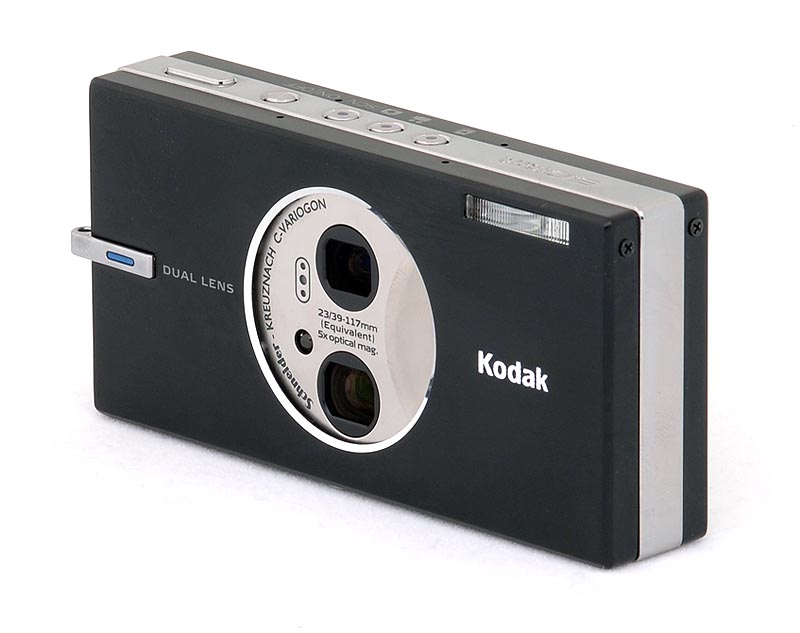
nicely designed casing too
http://www.imaging-resource.com/NPICS1/kodak_v570
_ 34.jpg
looks like something you'd find laying around a star destroyer or something.
(or an imperial ice cream sandwich!) -
Re:Why Sony?
But wait, Canon also uses Sony's CCD... I only learnt that during the defective-CCD-debacle which was also covered here in
-
Olympus had live DSLR preview...In the E10/20 cameras years ago.
http://www.imaging-resource.com/PRODS/E20/E20A.HT
M /
http://www.imaging-resource.com/PRODS/E10/E10A.HTM / -
Olympus had live DSLR preview...In the E10/20 cameras years ago.
http://www.imaging-resource.com/PRODS/E20/E20A.HT
M /
http://www.imaging-resource.com/PRODS/E10/E10A.HTM / -
Re:What is this? A tabloid?
This is certainly NOT normal for the console industry.
It is too: PS2 "Disc Read Error"(s), bad PSP pixels, bad Nintendo DS pixels.
It's also par for the course for most home electronics; remember the bad Sony camera CCDs, or the faulty batch of IBM hard drives, or the bad caps on motherboards? -
Re:DPI is (almost) meaningless
Yes, the DPI number is technically meaningless (some might say mostly harmless). What people really want is not DOTS per inch, but PIXELS per inch. Unfortunatly, that's not a number that is usually advertised, instead they give the deceptive dots per inch.
First, let's look at the pixels... A standard consumer P/S and low end professional DSLR camera would take images at around 6MP (Nikon D70), a high end professional would be closer to 12MP (Nikon D2X)
The 12MP D2X can take images at 4288 x 2848. Scaled landscape on an 8x10 (what most people end up printing at home, either 8x10 or 81/2x11) we get a resolution of (4288/10) x (2848/8) or 428.8 x 365 in true pixels per inch.
For the D70, it's native resolution is 3008 x 2000. Scaled landscape on an 8x10 we get (3008/10) x (2000/8) or 300.8 x 250 pixels per inch.
Of course if we, say, print a 5x3 which would give us 601.6 x 666 2/3 pixels from the 6MP D70. If we enlarge to say 13x19 we'd get about 153.8 x 158.3
Now the problem here is that Pixels per inch does NOT directly translate into Dots per inch. See http://imaging-resource.com/TIPS/PRINT1/PRINT1A.HT M for a more detailed description on why this is, and why, say, 720 DPI on a printer might translate into only about 130 true pixels depending on how accuratly the printer can place those dots. In short, it usually takes many DOTS of varying colors to make a single pixel. Plus there may be some interpolation and smoothing going on too.
PPI can be a factor of DPI but DPI by itself is meaningless. Printer manufacturers advertise DPI because they want the big numbers to impress uninformed consumers. With most of the high end, high resolution photo printers will give you comparable output in terms of resolution quality so you can't really go wrong there. What you really want to do is look at real photo printout samples if you can, not just for resolution but for things like color quality at different angles, the shine of the gloss for glossy inks, how much it smears/water solubility, etc. Those that plan to do any black and white need to be sure to look at black and white output, particulatly on the papers they plan to use. A printer that can do amazing color might do a poor job of B/W and something that can do great output on glossy paper might not do as good a job on matte paper.
My personal recommendation is to either go with the Epson R800 for up to the standard 8 1/2" wide prints, or the R1800 if you want to do larger prints (up to 13" wide). I have the R1800 and have used an R800 as well. The two printers are virtually identical other than a few things such as the position of the buttons and the maximum paper size. They use the archival quality UltraChome Pigments which are resistant to water, smearing, and are supposed to be fade resistant for 100-200 years depending on paper and environment. They can print on CDs and roll paper. The output looks great. -
Quit posting old news
*YAWN* Old news. Been around since Sept 16
http://www.imaging-resource.com/NEWS/1126887991.ht ml -
Re:Don't let your wedding photographer bully you!We got a Nikon Super CoolScan 4000 ED. I'd recommend it; here's a review:
-
Re:RAW format
The thing that is particually noticible is that manufacturers are now being actively co-opted into sharing this information under NDA with MS to allow the hardware to work seamlessly with Longhorn.
Actually, that's incorrect. The Longhorn interface is binary-only (no source code or format information is communicated to Microsoft or to the OS). Basically, the manufacturer (or third-party developer) writes a driver with an API that makes processed RGB data available to the OS. This is the same basic mode of operation as Canon and Nikon (and probably others) have implemented already in their free SDKs. Here's a brief interview with a Microsoft exec about the Longhorn interface and the shortly forthcoming "powertoy" RAW thumbnailer/viewer that's coming for XP. -- Not likely the level of detail
Of course, this means that the proprietary RAW formats remain entirely proprietary in the Longhorn era.
For the record, I personally think that some level of open documentation of RAW formats makes a whole lot more sense than trying to come up with a common standard. A number of people (Adobe prominent among them, of course) have proposed Adobe DNG as a "universal" format. This sounds like a wonderful idea until you look at the assumptions underlying the format: It assumes a rectilinear pixel array, with a Bayer color filter array pattern (a checkerboard of RGB color filters on the pixels, with twice as many green pixels as red or blue). This is indeed the format used by the majority of cameras out there, but it completely misses innovations such as Foveon's full-RGB-in-every-pixel sensor, Fuji's hexagonal-pixel/diagonal-array "SuperCCD", and Fuji's latest "SR" sensors, which combine low- and high-sensitivity sensors in each pixel.
While a "universal" RAW format would help with the issue of access to the underlying data, so would simple documentation of the structure of various proprietary RAW formats, and the latter wouldn't have the negative effect of stifling innovation in sensor technology. -
Re:Canon 300D, 350D, 10D, 20D vs Nikon D70.
Well, you're entitled to your opinion, but when I go to http://www.imaging-resource.com/ and pull up comparison shots (e.g. the "house" shot), to me the Canon looks better. Look at the sharpness of the right-hand window, and the lack thereof on the Nikon image.
-
I've got a simpler solution...
If you don't like a site's ad policies, then don't use the site.
The terminology gets people fouled up, I think, using words like "contract," which has a specific legal definition. This leads to all sorts of hair-splitting legalese by people trying to argue their way out of their own moral discomfort.
Bottom line, if you use something of value that costs somebody else something to create and maintain, you ought to pay for it. Payment can be by subscription, for sites that offer that, but subscription-based sites generally haven't done well on the web. If not by subscription, there are two other main ways that sites earn money to keep the lights on, namely advertising or shopping clicks on price-comparison pages. (The latter just another form of advertising, but the business model is different enough to warrant a separate category.) If sites aren't supported by one of these three sources of income, they stop existing. (And yes, of course, people can always publish information for free, but that places significant limits on what can be accomplished, and would result in a whole lot less information being available on the web.)
No, there's no contract, but if someone sets up a site with revenue based at least in part on advertising, and you use the site while disabling the ads, there's no question that you're not supporting them in exchange for your usage. If you don't like their ads, the solution is easy - Don't visit their site. If you're feeling magnanimous, drop the site publisher a line saying you were turned off by the ads and so won't be visiting again. Believe me, it wouldn't take very many emails like that for any halfway intelligent site publisher to wake up. If you use a site's content without accepting their ads though, you're just freeloading off the other readers who aren't blocking.
People seem to think that because something is electronically based, it's subject to a different moral code. What do you do when you come across a hotel that you think charges too much for its rooms? Stay there anyway, and then write them a bad check? I suspect not. The same principle applies for any other product or service you avail yourself of, the web included. The only thing that's different about the web is that there's not an explicit contract, and nobody will come knocking on your door if you disable ads.
As you might guess from my comments, all this hits pretty close to home for me. - I run a site about digital cameras, and advertising is a pretty important part of how I keep my family fed and the people who work for me paid. The site is a huge amount of work, my typical work week is 70+ hours (try it yourself sometime, for say, 7 years or so), and the people who work on the site with me all work hard in exchange for their pay as well. I'd naturally love for every last digital camera buyer on the planet to pass through our portals, but if they don't want to, that's fine too. But people who think they're somehow entitled to spend hours browsing the site without supporting us in any way, shape, or form really raise my hackles.
The big problem in all this of course, is that a relative minority of sites are spoiling things for the rest of us. Popunders are a case in point. Used appropriately, they can be a very good thing, as they can communicate much more information than a simple tower or banner ad can. Ad content that's related to the topic of a site is very likely going to be of interest to a reader, so more information in a more concentrated package (a well-designed popunder) would be a good thing. Popunders also work extremely well for the advertiser and site publisher, as the response rates from them are often literally 10x that of conventional baners or towers. The problem comes when sites throw up dozens of these things, advertising products or services of virtually zero interest to their readers. People have very rightly gotten tired of this sort of thing.
On our site, we set a cookie, so -
Read the article?
As long as this is NOT some sticker that creates a magnetic flux in the battery via the Hotzman effect, then I will be willing to say it might not be snakeoil.
Read and judge for yourself -
Good site for digital cameras
I found this site to be extremely helpful while shopping for my own camera - http://www.imaging-resource.com/WB/WB.HTM.
-
much better digital camera resources
For reviews:
http://imaging-resource.com/
http://steves-digicams.com/
http://dpreview.com/
http://dcresource.com/
All of these places have great and thorough reviews.
For those who don't want to go through the hassle of reviewing that much in depth information, My Product Advisor is a wonderful place to input fields of things you would like in a digital camera and then spits back cameras that match the closest. You can even say I like this camera, show me others like it. It's one of the best tools out there for users who are new to digital cameras and don't want to read a 10 page review.
http://www.myproductadvisor.com/mpa/camera/inputSu mmary.do
hope that helps someone out there. -
a really good site for digital camera info
Another really good resource for selecting and learning about digital cameras can be found at imaging-resource.com.
It has quite detailed reviews of pretty much every digital camera out there as well as sample images (there are even pages that allow you to compare images of the same thing taken by different cameras) and discussion forums.
I found it particularly useful when I was picking out my camera. -
For archival scanning - HP PhotoSmart S20
Quite a while ago I was going to start a scanning project of scanning all my family's photos, slides and negatives in so they could be preserved. I ended up buying the HP PhotoSmart S20 and it's been great. The nice thing is that it adjusts to different negative sizes, slides, and even 5X7 prints. Scanning speed is reasonable, and the results are very good. After about 6 months my brother and I have scanned in almost all the old photos and now they're easily indexed and found on a Gallery Photo Server.
I'm not sure that HP makes this model any more, but maybe something out there will be as useful as it has been. Over 10,000 scans and more to go! -
Not quite so sure....
{Stupid Joke Mode:ON}
So, now, when's Xiph.org going to add a lossy codec for photorealistic picture in it's OGG software ?
And then we'll start again some kind of "OGG/Twoflower" vs. "WindowsMedia/MS-JPEG-2004.NET" codec war.
{/Stupid Joke Mode:OFF}
Actually, I realy mean it !
According to the foot note of this article,
they don't have a patent for the JPEG compression standart it self,
but for the run lenght encoding (RLE) compression which is used in one of the latest stage of JPEG compression.
Which means two things
- It is not a threat to lossy compression.
All the strenght of JPEG comes from the DCT (discret cosine transforme) and the subsequent quantization, which convert the picture into a stream of more compressible values repetitive values (and thus perfom the actual "lossy" steps).
RLE isn't the only way for compress these values,
One can use algorithms similar to those used in the final steps by Xiph's (!) Speex or by Monkey Audio (=Rice).
So one can imagine that Xiph could easily create a temporary JPEG replacement until some realy better (Wavelet based ?) patent-free format is created.
(Hence my stupid joke at the begining).
- Second thing
There's probably A LOT of prior acts for this patent, as LZW was one of the most popular compression algorithme on the old personnal computers of the 80s. -
The Great Battery Shootout
You should take a look at this. I followed the advice therein and bought a Maha charger and Powerex batteries and have been pleased with their performance (I have an Olympus E-10 which is notoriously hard on batteries, standard batteries, e.g. Duracell, die in the middle of taking the first picture with it!)
-
Kinda of a dupe
This subject was covered a while ago in this ask slashdot. I remember because I bought my charger just after it being published.
My advice is that you just buy whichever one that *clearly* states that is microchip (that is deltaV) controled rather than stopped by timer. Mine is a Hama and it works well.
For the batteries, check this comparison. To sum it up, the more mAh the better, brands are usually not that important.