Slashdot Mirror
Domain: inch.com
Stories and comments across the archive that link to inch.com.
Stories · 72
-
Sequoia Threatens Over Voting Machine Evaluation
enodo writes "Voting machine manufacturer Sequoia has sent well-known Princeton professor Ed Felten and his colleague Andrew Appel a letter threatening to sue if New Jersey sends them a machine to evaluate. It's not clear from the letter Sequoia sent whether they intend to sue the professors or the state — presumably that ambiguity was deliberate on Sequoia's part. Put another clipping in your scrapbook of cases of companies invoking 'intellectual property rights' for bogus reasons." Sequoia seems to be claiming that no one can make a "report" regarding their "software" without their permission. -
Stimulated Gamma Decay Weapons
ExRex writes "New Scientist is reporting on a USDOD project to produce super explosives. 'An exotic kind of nuclear explosive being developed by the US Department of Defense could blur the critical distinction between conventional and nuclear weapons. The work has also raised fears that weapons based on this technology could trigger the next arms race.'" -
Doug Michels & Ransom Love speak pre-Caldera Forum
A reader writes "Now that SCO Forum has been rebadged as Caldera Forum, I decided to duck out of it this year. But according to this interview, Ransom Love doesn't want to make too many changes. The same cannot be said for Linux and Unix though, where it looks like he's pretty much given up on Linux on the desktop except as a thin client with Tarantella. Coincidentally, there's an accompanying interview with Doug Michels, where he talks about life post-Unix. Seems like the two companies are pretty tight. " Update: 08/17 6:29 PM by M : Jason Perlow wrote in with his review of OpenUNIX 8. -
Recent Evidence Of Water On Mars Near Equator
mkasei writes "SpaceRef has an early press release with image from Brown University which reports evidence of recent liquid water near the surface of mars. What's important about this find is that it is near the equator making it more readily accessable for a mission, be it robotic or manned." Update: 07/25 09:49 PM by M : There's also a BBC story about water on Mars as well, and a brief Nature article about the possibility of water on Callisto. -
Posthumous Webbys
Logic Bomb writes: "The Los Angeles Times takes a look at the nominees for this year's Webby Awards. The most obvious, and at this point predictable point of interest is the large proportion of nominated sites that no longer exist. But it seems people are finally acknowledging that beyond just being a shakedown, the last few months may be showing us what the web is most useful for. As the story says, "Take Activism nominee VolunteerMatch.org. It links do-gooders with opportunities, a use of the Web that, in retrospect, makes a lot more sense than selling dog food."" Hey, I bought cat litter from a certain online retailer which is now closed. Efficient? No, but it was amusing to see the UPS guy hauling 35-pound tubs of litter. Update: 07/19 8:31 AM by michael : The winners are now listed. -
SJGames Layoffs
Robotech_Master writes: "Citing financial difficulties (stemming from a CFO who apparently didn't keep the books in sufficiently good order), Steve Jackson has announced the layoff of 13 employees from Steve Jackson Games today. (Long-time Internetters will recall that the FBI raid on SJG was one of the first causes celebre of the Electronic Frontier Foundation.)" Update: 07/07 12:32 PM by michael : It was the Secret Service, not the FBI, of course. We've had several stories mentioning the raids on the Illuminati Online bulletin board and SJG. -
The Great Computer Language Shootout
kato writes: "Doug Bagley has posted results from benchmarking of 29 different language implementations solving 25 different problems (he's written ~600 of the 725 programs so far). The languages include C/C++, Perl, Python, Eiffel, BASH, Tcl, and OCaml. The problems range in complexity from "Hello, World!" to the Sieve of Eratosthenes and Matrix Multiplication. The results can be sorted by speed, memory usage, or lines of code. You can also give one particular program more weight than another (if you are doing more client/server code than "Hello, World!") and find the faster/smallest/shortest language implementation. I can see many of my programs being written in OCaml from now on." Update: 07/04 12:42 PM by CT : The site is apparently now redirecting people back here. I guess technically thats an error message, just not a helpful one. Update: 07/05 8:40 PM by M : Please don't email. The link is broken. We know. The guy is running a server at home on a metered connection, and doesn't want any more traffic. -
Scramjet Test Flight Less Than Successful
Sunthorn writes: "After much hype NASA was forced to destroy the X-43 prototype seconds into the flight after the launch rocket went out of control." The BBC has another story with some pre-flight pictures. Anybody have actual flight photos? Update: 06/02 8:28 PM by michael : Emperor writes "The official NASA take on the X-43 destruction." Update: 06/03 10:18 AM by michael : And someone else sent in this photo gallery, with some really nice close-ups. -
Scramjet Test Flight Less Than Successful
Sunthorn writes: "After much hype NASA was forced to destroy the X-43 prototype seconds into the flight after the launch rocket went out of control." The BBC has another story with some pre-flight pictures. Anybody have actual flight photos? Update: 06/02 8:28 PM by michael : Emperor writes "The official NASA take on the X-43 destruction." Update: 06/03 10:18 AM by michael : And someone else sent in this photo gallery, with some really nice close-ups. -
2600 Responds to Appellate Court
BlueTurnip writes: "The defendents in the MPAA vs 2600 case regarding the dissemination of the DeCSS program have filed their response to the court's questions. The brief does an excellent job of answering the issues raised. I won't repeat them here as one can read them directly." Background: hearing transcript. Update: 05/30 7:19 PM by michael : The brief filed by the MPAA, giving their rather different responses to the same questions, is also available. -
MPAA vs. 2600 Transcript
Cryptome has a full transcript of the recent 2600 appeal hearing. Good reading - you can see the arguments each side made in their own words, and see the judges' reactions to them as well. Update: 05/10 12:34 PM by michael : The court has also put out a list of further questions for both sides to answer in written briefs, and given them additional time in which to answer - see the court order. -
Caldera Mulling Alternate Licenses
edoug writes: "Ransom Love (CEO of Caldera) said he thinks Microsoft was right in its claim that the GPL doesn't make much business sense. And so, Caldera is mulling a non-GPL licensing mechanism -- most likely one based on the BSD license. Love said: "Microsoft is attacking open source at its weakest point: the GPL." Check out the article here ." Update: 05/10 7:30 AM by michael : Newsforge has an interview with Love. -
MS VP Speech Online
mpawlo writes: "The widely debated Craig Mundie speech is now online." We tried not to run this, but there are too many submissions to ignore. Yes, much of what the guy says is nonsensical. Why not translate it into terms your boss can understand? For example, Mundie says forking code is bad. Here's the same thought translated into manager-speak: "Having multiple vendors competing to offer us the best product at the lowest price is worse than having one vendor who can sell the product to us at monopoly prices." Update: 05/03 8:19 PM by michael : Alan Cox has a response. -
Robot Plane Makes Unaided U.S.-Australia Crossing
PenguinRadio writes: "Yahoo Australia is reporting an unmanned U.S. aircraft recently flew from the US to Australia, smashing an endurance record for remotely controlled aircraft. The Global Hawk reconnaissance jet arrived in Adelaide 14 minutes ahead of schedule after a non-stop flight of more than 23 hours. The Air Force has some pictures and more news on their site as well." Update: 04/24 7:26 AM by michael : This is a follow-up to our story a few days ago. -
Vostok 1 40th Anniversary
ehintz writes "40 years ago today, 4-12-61, Lt. Yuri Gagarin slipped the surly bonds of Earth to become the first man in orbit. His 108 minute flight aboard Vostok 1 from Baikonur Cosmodrome was the stimulus causing Kennedy to make his famous Man on the Moon speech of 5-25-61, resulting in the moon landing of 7-20-69. We owe our comrades thanks for providing the competition that made it happen." ( michael : More links! The APOD notes that this is also the 20th anniversary of the first Shuttle launch. And NASA provides this image of a newspaper front page, which ought to convey the momentous nature of the event to those of us who weren't born at the time.) -
New Evidence for Open Universe
Observations made by the Hubble telescope have produced evidence that the universe is full of "dark energy", stuff that has mass but does not emit nor block light, and that a disregarded theory first postulated by Einstein about "negative gravity" is actually valid. If true, this would provide firm evidence that the universe will not collapse in a "big crunch" but will expand indefinitely. See the SF Chronicle, New York Times, MSNBC, or CNN for stories (the Chronicle story is the best, IMHO). For background information, you may want to check out the cosmology FAQ or more information about negative gravity. (Update: 04/04 11:03 AM by michael : A couple of people have pointed out that this write-up is inaccurate; I'm not going to try to correct it, but read the comments for more information.) -
Secret Service Raids Gold-Age
Wired has a story about the Secret Service raiding one of the several firms that promise to exchange your old-fashioned greenbacks for even more old-fashioned gold - the idea being that E-gold is a better medium of exchange than those boring currencies backed by national governments. Unfortunately it seems that the primary use of e-gold seems to be turning stolen credit cards into cold, hard, ca.... errr, gold. (Update: 03/30 5:19 PM by michael : The headline has been changed to make it clear that the raided company is a company distinct from E-gold. The business relationship between the two companies is not entirely clear.) -
FPGA Supercomputers
olafva writes: "You may be interested in this new breakthrough! See NASA Press Release and a couple of today's local stories for a remarkable paradigm shift in "Computing Faster without CPUs"." CmdrTaco said he'd believe it when he saw it. Well, they've got pictures. (Update: 03/29 5:02 PM by michael : At NASA's request, we've modified the links in the above story to reduce the load on their Public Affairs website. The same content is at the new links.) -
Programmers for Scientific Research?
An AC submits: "We have recently had a lot of trouble trying to hire competent programmers for a research project. We are not programmers, so it is somewhat difficult to evaluate the competence of CS graduates. However, it seems that many of them are quite business oriented and that is not what we are looking for. On the other hand, the ones with adequate math skills etc. are often interested only in 'pure' CS. We would desperately need some kind of 'all-around lab hackers' capable of scientific problem solving, and confortable working with all sorts of software and hardware, but have not been able to find such persons. Does the Slashdot audience have any suggestions of how to attract the hackers having 'by programmers for scientists' - attitude?" [Update: 03/24 09:24 AM by michael : Note that although my email address is the only one on this submission, I'm not the one looking for programmers - I work for slashdot (although I used to program for a DOE laboratory, and that's why I found this question interesting and posted it). I've received a bunch of misdirected emails from people who thought this was interesting work, so if the submitter is reading this story, he/she might want to put contact information in a comment below.] -
Harlan Ellison on Copyright Infringement
An AC sent us this: "It seems that Harlan Ellison is hopping mad about copyright infringement regarding his works. You've seen this class of beef before, but it's, well, Harlan Ellison complaining, and man is he spitting venom. Just read the dag essay." Wow. See also the site's main page, which has some responses from other authors who don't feel quite as strongly as Ellison. Update: 03/07 10:22 PM EST by michael : Some readers say they don't know who Harlan Ellison is. Haven't any of you ever seen Twilight Zone? -
Supersonic Submarines
Daktaklakpak writes "Not really new stuff, but it's too cool to pass up. Researchers are developing a method called supercavitation which may one day allow submarines to break the sound barrier. It works by placing the entire vessel in a gas bubble except for the tip, thus reducing the total drag." We've run an article about this before, but this is a bit more informative, with a lot of speculation about possible uses... Update: 03/07 03:24 PM EST by michael : Note that space.com does not use permanent URLs for these "breaking news" stories, so the link above is wrong, but should be findable, for a time at least, on the space.com site. -
IBM CPRM Plan Replaced with Similar Copy-Prevention Plan
Several people submitted the news that IBM withdrew its CPRM plan yesterday - some of them with blurbs like "We Won! Yay!". But only a few people got the additional information that it was simply replaced with another extremely similar copy-prevention scheme, this one from Phoenix Technologies, well known for their widely used BIOS's. Even though the committee responsible for this has been deluged with email in opposition, the CPRM group (led by Paul Anderson and Jeffrey Lotspiech of IBM) continues to press forward, distributing propagandistic lies about how the system will protect [sic] your fair-use right to access and use digital content. Update: 02/24 7:20 PM EST by michael : The Register has even more information from Andre Hedrick. -
Follow-Up On TuxTops
Some of you may remember the TuxTops story concerning their exit from the laptop business. We've heard from QLITech regarding their acquisition of the TuxTops line -- it's good to see someone will still make it. [Update: 02/22 03:08 PM EST by michael : Newsforge has a story. Looks like QLITech will be taking over support of TuxTops' customers as well - good.] -
Making Small Change
dimnet writes "The Quarter Shrinker uses a technique called high velocity electromagnetic metal forming, or "Magneforming". This technique was originally developed by the aerospace industry, and has been popularized by Aerovox, Grumman, and Maxwell. It involves discharging a high energy capacitor bank through a work coil to generate a very powerful, rapidly changing magnetic field which then interacts with and "forms" the metal to be fabricated. It only works with metals of relatively high conductivity, such as copper or aluminum alloys, although it will work to a more limited extent with sheet steel...." The site has some awesome pictures of small metal objects which have been victimized. [Update: 02/22 by michael : Note that the entire original site has been taken down and replaced with banner ads - however, there are working mirror links in the comments below.] -
Mir on Death Row - No Clemency Expected
-
Slackware 7.2 [Not] Released
Pete Blackley writes: "The best Linux distro out there has just released a new version; check out the README. And it comes with kernel... 2.2.18! Some things never change, and I am glad it works that way. Don't forget to check the autoslack package in the unsupported dir: it means the imminent death of all the "Slack lacks apt-get" arguments. PS: If you browse the ftp.slackware.com/pub tree, you'll see that Slack currently runs on vanilla x86, SGI VisualWorkstations and SunSparcs; I'm just waiting for the PowerPC port! PPS: All the crap about Slackware's death really is an exaggeration." That's what I like: a distro that isn't afraid to say that its death is an exaggeration. Update: 01/13 01:47 PM by michael : Slackware says - rudely - that 7.2 isn't released yet. This situation - confusion about what is released and what is not - is one that most software developers avoid by utilizing new-fangled conventions such as "beta". -
Undernet In Serious Trouble: Any Suggestions? (Updated)
An Undernet admin writes: "For the past 4 days, many of Undernet's servers have been hit with constant DDoS, massive stuff on the order of 100M/sec that doesn't look like it will clear up anytime soon. The major services with which Undernet is associated, including Uworld and the channel service bots X and W, have been removed because the ISP that hosts them cannot afford to have them online, and even with them offline, the ISP has continued to be hit with the DDoS. Several servers will be forced to delink permanently if this continues. And all of it's happening because a script kiddie in Romania has nothing better to do with his time, and with his head start, many other groups have decided to lend a hand and take out other servers while his main pummelling is going on. We're about to run out of new ideas, since we can only code in so much security so fast, and law enforcement isn't terribly effective. What does the Slashdot community say?" There's a notice on their Web site. Update: 01/08 09:49 PM by michael : The news story we linked to was ancient. -
GPL'd Code Finds New Home
A few days ago, we were contacted by one of the developers of Everybuddy, a "universal" instant messenger client for Linux. It seems that they were scoping out the competition, and found a Windows-only program offered by a company called DSF Internet. Many users of Everybuddy had asked for a Windows version of the software, but none of the Everybuddy developers were very familiar with the Windows platform, and so a port had never been completed. This program, MessengerA2Z, seemed to offer all the functionality of Everybuddy for Windows machines. Probably because it was based on Everybuddy's GPL'd code.The proof was in the pudding, so to speak. Or at least, the proof was in downloading and installing the Windows version, then running the
stringscommand against their compiled binary. Lo and behold, some of the strings of text included such gems as "Visit the Everybuddy website at http://www.everybuddy.com". Now how did that get in there?(You could go a step further and dissassemble the Windows executable, examining the flow of their code and comparing it to the Everybuddy code. But it seems to me that the reference to Everybuddy is sufficiently damning already.)
Someone at DSF Internet took a shortcut to developing their own interoperable instant messenger client, and ported the Everybuddy code instead of starting from scratch. This isn't a bad thing - it's the whole purpose of open source, duh - but since the code was licensed under the GPL, a price was demanded in return: the Windows source code should be made available. It wasn't, of course.
Both Slashdot and the developer contacted this company, which is based in New Delhi, India. They initially denied that there was any GPL'd code in their product, but when presented with the evidence, the story changed, and it now seems that they're going to take some action. The final outcome isn't known - perhaps they'll publish the Windows code, perhaps they'll rewrite the whole thing from scratch, perhaps they'll just edit out the Everybuddy references and recompile. <shrug>
This situation seemed to be one tailor-made for the GPL. Code existed for one platform, there was the desire but not the ability to port it to another, and someone else saw the same opportunity and the usefulness of the code base, and had the ability to port the code. In theory, this should have been a win-win: the company in India gets a fast-track to development, and the open source project gets a Windows port of their code. But there isn't much of an enforcement mechanism to make everyone play fair.
Are the developers of Everybuddy likely to file a suit in India for violations of their license agreement? My guess is, no. Protest march outside their offices? Brick through the window? Hire some guys named Guido, errr, Rajanav, to go and break some kneecaps? No, and no, and no. The only real enforcement mechanism is a sort of peer pressure or the threat of public exposure, and this may or may not be sufficiently persuasive.
Incidents like this are only going to increase. There's at least a few possible responses:
- Just ignore it. The objective is to get the code out there, that's working, and generally enough people will obey the rules that the GPL will be effective in its goals.
- Spaz out over it. Scour the web looking for possible GPL-infringers and mailbomb them into submission.
- Send email to slashdot. Preferably misspelled email with unique grammatical qualities.
- Send email to Richard Stallman. Don't use pine to send it.
- CowboyNeal.
Seriously, this is an open question which needs to have some thought put into it. I can imagine some possibilities - perhaps a sort of "GPL Insurance", where GPL'd projects can pay into a pot of money to be used for sending legal nasty-grams and other enforcement. But I'm not sure that that's really the right course of action. Fundamentally, enforcing the GPL would be an extraordinarily difficult task - it's very difficult to detect abuses in the first place, and then you face national borders and other obstacles. Perhaps it is better to not worry about it too much, to save the collective energy of the community for more important purposes, and to simply realize that there will be abuses.
Update: 01/02 01:02 PM by michael : About five minutes before this story went live, I heard back from Ben Rigas of Everybuddy that DSF Internet is going to do the Right Thing and post the source code to their messenger program. This is excellent news, and hopefully will result in a robust cross-platform instant messenger program. However, I think the point I made above still stands: there will be cases where persuasion doesn't work, and the community should have a plan for dealing with those (even if the plan is "do nothing"). -
Linux Cluster For Processing DSP Effects?
SpLiFFoRd asks: "I'm a MIDI musician and songwriter who seems to be constantly running out of processing power for my VST effects when I'm working in CubaseVST. Coincidently, I've also been working on explorations into Linux clusters and parallel processing. As I watched my CPU meter in Cubase hit 95% one night, I began thinking...'What if there was a way to farm out the work of my single processor to an outside Linux cluster with multiple processors to speed things up as well as enable me to run more simultaneous effects without straining the system?' I've been looking around, but don't seem to see any others who might have had this thought. This would be a tremendous real world application to me, and probably to others as well. Do you know anyone who might want to tackle such a project?" Sounds like a worthy project, but sound processing is still in its infancy under Linux, and while the horizon looks good with projects like GLAME and ecasound, I'm wondering if it may be a while before something like this will be feasible. That issue aside, however, I think something like this would be really cool. What about you?"As a side note, when I say 'VST effects', I mean both the original and third party plugins for audio effects such as digital delay, reverb, tapped delay, pitch shifting etc. that work with Cubase."
-
Yahoo Offering Encrypted Email
James Salsman writes "Now that Yahoo delivers encrypted email, I would sure like to know what the Slashdot fray thinks of that, especially in light of Carnivore's vulnerability to some forms of encryption (but not this one?)." michael adds: You might also want to check out Cyber-Rights.net, which is a UK civil liberties group offering encrypted email through a deal with Hushmail. -
Gutenberg Bibles Online
Richey writes: "The British Library is making the Gutenberg Bible, the first major bible printed in the West available online. (Direct link to the book)." This isn't the first high-res copy of the Gutenberg Bible online; a German university library has already done it with their copy, but it's still cool. Update: 11/23 8:25 AM by michael : For the people that skipped those boring history classes, this was the first book printed in the western world with movable type, a huge leap in printing technology. -
Voter Records Exposed
The current edition of Lauren Weinstein's PRIVACY Forum has a cautionary tale about online voter registration in one Texas county. It seems your username is your first and last name, and your password is your year of birth. Not many bits of security there. Guess that information and you can learn any Denton County voter's home address and some trivia -- but at least not their credit card numbers ... yet. michael : A silly privacy overreaction, IMHO. I believe voter records are public in every state and county in the U.S., and they are routinely used by police, journalists, political bulk mailers, etc. If the objection is that they're now "on the Web", that seems like a silly hair-splitting, since for a few dollars you can get the records for an entire county on CD-ROM anyway. Behind the scenes, the voter registration records of the entire country are used by the major political parties to coordinate mailings - this information is not and has never been private. -
License To Spam?
Anonymous Coward writes: "This was posted to spam-l today: what you are looking at is a copy of a contract given to known spammers that says, 'We agree not to nuke you for spamvertizing your sites,' regardless of what the AUP says. It says people penned into these contracts are not beholden to rules against spamming." Sanford could have used one of these. Update: 11/02 5:31 PM by michael : The JPEG has been updated - looks like AT&T isn't really a big fan of spam after all. Good for them. -
D&D Trailer
hubersan writes "The new trailer is up at http://www.seednd.com Oh MAN. Lotsa nice CG.." I suppose it would be rude to link directly to an Akamai URL, so I won't do it. Quicktime, naturally. Conscience strikes: should I see this movie and give my money to Time-Warner? Update: 10/26 6:09 PM by michael : Sadly, we've been asked to take down the direct link to the file. -
Carnivore Demo Report
An anonymous reader sends: "Here's an archived copy of an anonymously remailed report on a demonstration of two versions of Carnivore by an FBI agent, at the recent NANOG 20 meeting."michael : People are really interested in the "inner workings" of Carnivore, as shown by the many submissions. I never thought it was anything special - from the start, when I first knew that the FBI had an Internet interception box, I just assumed that it would neatly sort and deliver all Internet traffic of a particular target. I can spec out how I would design such a box; and the FBI isn't stupid; so I assume they would do it in a similar fashion. I think there's still a lot of disbelief out there, though - "You mean the FBI can really track both Web access AND email? And IRC? And Usenet? ...." People just don't believe it, because they're used to thinking of Internet traffic in different terms than phone or whatever.
The only important design aspects of the carnivore box are things like "Can the FBI set it to snoop on traffic it isn't supposed to? Can I dial into the box and snoop on my neighbors?" and other questions like that, which we'll *never* find out from any powerpoint presentation.
So get used to it, people. Assume that Carnivore neatly captures, sorts, and delivers all traffic that passes through it, and that the FBI can just type in your name and plug it in. Assume that there's a user-friendly, point-and-click interface. Assume that it will pretty-print reports, ready for filing with the court if/when you are prosecuted. Assume that there's essentially no oversight of the FBI's use of this device - after all, judges exercise almost no oversight over wiretaps, there's no reason to believe that Internet-tapping will be overseen any more diligently. The FBI and police approach wiretapping requests in the same way that conniving children approach their parents - it only takes one judge to approve a request, and the FBI can approach as many different ones as needed until they find the one that just doesn't care and rubber-stamps everything.
Get used to it. Want more data about how Carnivore works? Push for the source code to be opened. Nothing else will provide any more information about the system. You can't tell how secure it is (against the FBI, or against anyone else) from a presentation.
As for me, I'm steadily moving toward encrypting as much of my traffic as possible. I set up ssh for my home network recently. I'm setting up SSL. I'm reading up on IPSEC. I guess I just don't have a very trusting nature. The way I figure it, the time to set up countermeasures is before you expect to need them.
-
Froomkin Examines ICANN Legitimacy
cygnusx writes: "First saw this in the TBTF blog: an excellent 2-part article on the legal legitimacy of ICANN itself. You can read the (PDF) drafts: part 1 and part 2. The article (being a draft) forbids quoting without permission, but the essential argument is that the U.S. government has acted irresponsibly in exercising federal power, whether ICANN is an independent entity or not. Incidentally, Part 1 contains one of the best for-laymen introductions to the DNS I have read so far." Professor Froomkin is an occasional Slashdot contributor who has kept a closer eye on ICANN than ICANN would have preferred. This is an excellent paper for anyone who cares about how the Internet is and will be governed. Update: 10/13 5:58 PM by michael : Only the first link works; it contains the entire paper. -
Barnes & Noble Challenges Amazon 1-Click Patent (UPDATED)
Smitty825 writes: "Barnes & Noble is challenging the Amazon 1-click patent. Hopefully this will invalidate that lame patent, and hopefully this will clarify what is a valid patent. Full story here." There may be certain business methods worth patenting (or at least keeping secret, if you're so inclined), but "one-click" anything seems too silly for consideration, doesn't it? Update: 10/03 4:26 PM by michael : See also this easy one-click exploit of Amazon's one-click system. -
Slashdot Database Compromised!
Today the the Slashdot database was compromised by 2 hackers from the Netherlands. !(Nohican && {}) They secured the hole and send an email to the admins, they even should be reading it now. Update: 09/29 11:04 PM by michael : We know about it, blah-blah-blah. Don't email us. I think it's safe to say that whatever happened, you'll hear the full details soon enough. Thanks. -
Set Digital Music Free
The latest issue of EFF's newsletter covers the HackSDMI challenge. Probably not surprisingly, they're urging the same thing as Don Marti, who Salon interviewed.Update: 09/19 3:33 PM by michael : The RIAA, EFF, and 2600.com debated SDMI on Pacifica radio today. -
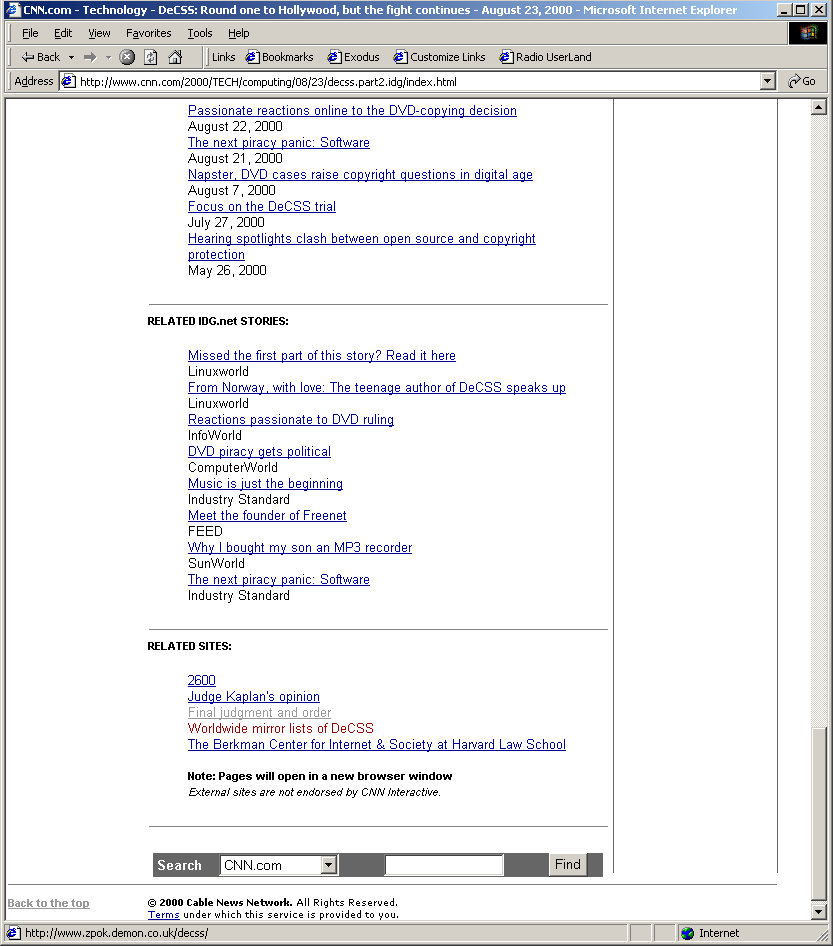
More DeCSS Time-Warner Hypocrisy
Sethb writes "Scripting News has the scoop about CNN linking to the source code for DeCSS. CNN is a subsidiary of Time-Warner, so in effect they're suing 2600 and others for something that they are doing themselves!" Update: 08/26 02:05 AM by michael : CNN has deleted the link from their story after reporters asked about it. But the screenshots are out there. -
ICANN Elections
ICANN's elections are now underway. (We've covered this before.) ICANN's Nominating Committee has picked several candidates for each of the five open seats in a closed primary process; now there is a "member nomination" process underway where several more candidates will be selected to run for each seat. Civil liberties groups are actively attempting to promote democratic involvement in ICANN, such as the Civil Society Democracy Project being spearheaded by CPSR. We've asked each of the people seeking to be candidates for the North American region board seat to answer one question; here are the responses we've received. Update: 08/17 14:04 by michael : Two more responses added.This is equivalent to a "primary" election - it is selecting the people who will run for the election. We are concentrating only on the election for the North American region, since the majority of Slashdot's readership is from this region. ICANN's nominating committee picked four candidates to run for the seat:
- Lyman Chapin
- Donald Langenberg
- Lawrence Lessig
- Harris Miller
The Internet Democracy Project (www.internetdemocracyproject.org) and the Civil Society Internet Forum (www.civilsocietyinternetforum.org) have been involved in attempting to promote democracy and representation of individual Internet users at ICANN. The Civil Society Statement on ICANN Elections -
http://www.cpsr.org/internetdemocracy/Statement_July-13.html
- is an attempt to spell out what attributes are desirable in ICANN from such a perspective.
Distinguishing between 50+ possible candidates, with only one endorsement to cast, is likely to be difficult for ICANN's registered voters. Slashdot has talked with Hans Klein of CPSR (www.cpsr.org) and we feel that a reasonable way to allow the candidates to distinguish between themselves is to ask them an open-ended question:
-- What is your response to the Civil Society Statement on ICANN Elections?What follows are the responses we received, edited only for HTML formatting. If you, as an ICANN registered voter, decide that you'd like to see one of these candidates run for the seat, you can endorse them on the ICANN Web site. Whichever three candidates receive the most endorsements (and are endorsed by more than 2% of the voter pool, and from at least two countries) will be on the ballot for the real election, which begins Sept. 1. You may change your endorsement before Sept. 1 by simply endorsing a different candidate. The candidate listing displays a running total of endorsements.
Clear enough? On to the candidates! These responses are listed in the order they were received.
Teri Powell
[Editor's note: Teri Powell informs me she has withdrawn from the ICANN election. --michael]
I have participated heavily and strongly re: ICANN issues on the Public Forums.
I have read and fully understand the position paper you reference. This has been evidenced in my opinions already expressed via any route I can. With this in mind, I have to admit the following: I can Not say it any better than as the Actual Statement linked below.
This will be short and sweet. I will reference (as a link) the Statement which I Totally Agree with.
http://www.cpsr.org/internetdemocracy/Statement_July-13.html
My web site can be found at:
http://www.brittany-technologies.com
The Prime Objective is to get Proper Representation onto the ICANN Board which Will Reflect ALL Internet Users.
My Very Best to the Other Candidates! I Believe the At Large Members Will Choose Wisely. I Will Support Whoever is chosen since this will, at least, be a Start in Representation for Us. Liz Bartlett
My candidate page can be found at http://www.khyri.com/icann/ and contains the information on my ICANN page, together with expanded sections on my qualification, background and viewpoints. I intend to add relevent content and links to it at intervals, so feel free to bookmark and return.
1. I strongly believe that ICANN must represent all. I feel I can represent many interests, being female and having lived in England, France and (currently) the U.S.A. I am heavily involved in web accessibility issues, making sure that web content is available to everyone regardless of physical disability, method of accessing the Internet, or level of technology.
2. I have had indirect experience of organizations whose leadership have resisted such transparency, and I know that this mentality is a fast road to destruction. I have always held the view that information must be shared with all interested parties, unless there are very good reasons to withhold it.
3. One of the strongest bases for an organization such as ICANN is the strength of its core membership. I believe the board should be drawn from the membership, that the board should then exercise the proper oversight of the staff, and that the ICANN staff should not be employed from the ranks of board members in order to maintain a proper employee-employer relationship.
4. I believe that only in the clearest cases of intentional misleading or profit motivation should the "first come, first served" domain name policy be overturned.
5. I do not have strong views on the organizational split of IP address and DNS root server management. I feel this issues are best solved on a "what is technically best" basis.
6. I do not believe governmental control over domain name space can be a practical solution, given the global nature of the internet, the increasing abuse of the two-letter country codes, and the absence of a global government.
7. I am strongly against artifical scarcity of names. However, I am ambivalent on the decentralizing of some functions, as I realize that the independent operation of many registration/name lookup/routing functions can cause technical chaos. However I feel, (maybe naively) that it must be possible to retain a single, core central registry without giving any individual, organization or company the temptation of "abuse of power". I see no great problem with the current system.
8. Privacy policies as generally adopted by organizations that hold elections should apply to all ICANN operations.
9. The costs of participating in ICANN activities, and the costs that ICANN itself incurs in its operations should be kept as economically low as possible. Expenses should be looked at with a view to "does this further the ICANN objective" before approval. Adam L. Beberg
I believe the first 3 values aim at something deeper which is that the membership base needs to be informed and educated about the issues they will vote on. Any issue that the members must decide needs to include the technical details, as well as a pro and con argument, all translated into multiple languages. The membership also needs to remain vigilant of the things happening in ICANN that have a public effect, and this can only be done with complete information.
One problem I have seen emerging due to ICANN's relatively few issues to deal with, but of high complexity and with extended impact, is that of "if I can get 50 non-technical friends to sign up, I can tell them all how to vote because they cannot understand the geekspeak". This is just as dangerous as the commercial makeup of the DNSOs, but far more insidious. Unfortunately this will probably be the operating mode for the At Large membership base.
Trademark laws as a social convention are an important thing if people are to know who they are dealing with, and that others with be prevented from pretending to be someone they are not. That said, I don't see how domain names or IP numbers affect free expression or privacy, other then the help privacy by limiting pretenders. Governments do not need ICANN's help to limit freedoms.
The scarcity of domains of any kind is completely artificial, and should be reduced or removed. Any TLD should be allowed, and is technically possible, but should be subject to some critical mass (N people want TLD .xyz) to avoid all domains turning into TLDs. Since other TLD's are not scarce, ccTLD's being a pain to get, if not scarce, doesn't seem to be a large problem. The ccTLD registrars must compete next to the generic registrars, and the market will eliminate the inefficient and unresponsive registrars. ICANN does need to take a role to insure that domain owners can easily change registrars, without hassle or loss/theft of their domains, which several registrars now prevent. Emerson Tiller
I will address each of the guiding principles put forth by the Civil Society.
1. ICANN must be representative.
I agree. In fact, I propose that:
- the majority (not just 9), if not all, of the board members should be elected by the at-large membership.
- Email, fax, and regular mail member registrations should be accepted. Registration should be 1-step.
- ICANN members should enjoy the protections of being members under California's non-profit laws.
2. ICANN must be transparent.
Absolutely.
3. ICANN must use bottom-up processes.
I agree. I suggest that petition processes be allowed to bring issues up for a membership wide vote. The membership should also vote on whether the Uniform Dispute Resolution Policy (UDRP) passed in 1999 should be reauthorized.
4. Intellectual property rights should not be privileged over other rights.
Political, religious, anonymous, and other forms of free speech, as they reveal themselves in domain names or other web content, should be accorded equal standing with intellectual property rights.
5. ICANN should strive at all times to minimize or avoid policy-making on non-technical topics.
I agree. However, we should recognize the in an electronic age, technical decisions produce policy results, and thus in some sense the technical decisions are often policy decisions (much like decisions on process often determine the policy). Rather than ignoring this critical relationship, we would be better off to acknowledge the connection, and then be specific about which technology-driven policy areas ICANN should and should not involve itself. Any expansion of policy making should be authorized by both broad membership voting and broader international representation on the board.
6. The domain name space is a globally-shared public good with public and private functions.
I agree. And the more we can open the TLD space, the more effectively these multiple uses can be met.
7. Artificial scarcity and centralization should be avoided.
I believe that the expansion of the domain name space through the creation of new TLD registries should be one of ICANN's highest priorities. To the extent centralization occurs, or is necessary, it should be legitimized by broad public approval and international representation.
8. ICANN must respect privacy.
I agree. ICANN should avoid technical/policy decisions that compromise anonymity and the security of personal information.
9. Costs should be minimal and equitable.
And shared fairly among all countries, on condition that they have a fair chance at representation on the ICANN board and enjoy the services that ICANN performs.
Final Comments: ICANN is not beyond repair. There are a lot of good people who have worked to make it a forum that responds to the new demands of the Internet society. But ICANN is in need of restructuring, both in terms of process (election procedures, for example) and substance (the UDRP, for example). My platform: http://64.82.55.205/tiller.html. Barbara Simons
I state on my election web page http://barbara.simons.org/:
"I support the values enunciated by the Civil Society Internet Forum. These include 'democratic participation in decision-making, open processes, the right to communicate, and a fair balance between rights of privacy, speech, consumers, and property in Internet governance'. I shall work to defend privacy, speech, and the needs and rights of the smaller players; I sincerely hope that the other candidates will demonstrate their support for these important principles."
I also signed the Civil Society Internet Forum Mission Statement in Yokohama. (See http://www.cpsr.org/internetdemocracy/csif/signatories.html).
I am very pleased that you are asking this question of all the candidates. I hope that people will honestly state whether or not they will support the Civil Society principles. My support is public and long standing.
On my web page I also pledge to:
- be accessible and responsive to the members of the at-large community,
- create an advisory group of experts in technological, policy, economics, and the law,
- work to build a decision-making process that is open and inclusive.
- testified before a Senate subcommittee in favor of the legislation that would significantly reduce export controls on encryption,
- worked to defeat the Digital Millennium Copyright Act (DMCA),
- spoken out and written letters in opposition to UCITA,
- opposed attempts to censor the Internet,
- submitted a supporting declaration for the defense in the New York DVD trial (See http://eon.law.harvard.edu/openlaw/DVD/filings/NY/0503-reply.html#Simons),
- fought efforts to establish wide-spread monitoring by law enforcement of the Internet,
- worked to support privacy.
I hope that the readers of Slashdot will read my statement on the ICANN web page and the material I have posted on my web site. If anyone has comments or suggestions, he or she can reach me at simons@acm.org. Karl Auerbach
I helped write it - I think its a darn fine statement. ;-)
(One can compare it to my rather long set of views as expressed on my election web page at http://www.cavebear.com/ialc/ )
ICANN as it is now constructed and operated seems to be premised on the notion that the Internet is there for the benefit of commercial interests and that ICANN ought to treat those who "merely" use the Internet as babes in the woods who can't be trusted to make decisions and who need paternalistic protection.
The Civil Society Statement is, to my mind, a roadmap of how ICANN can return to a more balanced state - so that the users of the Internet will be respected as people who can make their own decisions about their own interests.
Governance is hard. And ICANN is undertaking something new and difficult. ICANN cripples itself by creating a body of people who feel that they have been disenfranchised. The Civil Society Statement is a reminder to ICANN that it has forgotten to be inclusive of all those who believe they have role in these matters.
If you compare the Civil Society Statement with my own platform, you will see that I have gone rather further in certain areas - particularly with regard to procedures and ICANN structure. It is very much my belief that inclusive processes - even if they appear somewhat more chaotic than today's ICANN staff choreographed dictates - are at least as important as any substantive policy decision.
As a practical matter, whoever wins the election for a board seat is going to be but one person out of 19. So any single candidate's platform is probably not going to become fact, at least not immediately. ICANN's staff has become so entrenched and has taken control of the corporation so completely, that reform of ICANN is going to be a major effort. The Civil Society Statement serves as something we can always look to to see whether ICANN is improving.
Tom Lowenhaupt
Guiding Value 1. ICANN must be representative.
The ICANN needs to represent all of the Internet's current users - not just business interests.
But more than this, the ICANN needs to acknowledge the immense impact the Internet has on all people, and it needs to reserve representation space for those not yet on the net. When America was young it excluded women, workers, and African salves from its representation system. Let's learn from the 150 year struggle to remedy that stupidity. Let's set aside representation space now.
But representation on the ICANN is not a simple matter. How do you represent 5 billion people? I don't have all the answers to this question, but I began my search by asking the following. Who runs the military? Who sets water and air pollution standards? Who determines the direction and usage rules for our roadways? It's not the army or the air and highway bureaucrats. It's civil society - you and me. (Or at least it should be!)
Business might own the net, but it's you and me that pump in the cash that allows them to operate. Let's take control and make sure the net's something that's good for our families and good for our communities.
Guiding Value 2. ICANN must be transparent.
Guiding Value 3. ICANN must use bottom-up processes.
The ICANN's operation and its decision making process must be transparent and inviting to the public. Issues should be framed and brought to the public within a context and with comprehendible background information. Everyone should have the opportunity to comment on upcoming decisions using online forums, listservers, and polling systems.
Guiding Value 4. Intellectual property rights should not be privileged over other rights.
Guiding Value 8. ICANN must respect privacy.
First and foremost the net should be about communication that empowers the individual. It shouldn't be turned into TV 2. When intellectual property rights are treated with undue importance, our access to information and our privacy rights are reduced.
Guiding Value 5. ICANN should strive at all times to minimize or avoid policy-making on non-technical topics.
Rapid growth and technologic change guarantees a tumultuous future for the net. Unsettling developments will be thrown into the ICANN's waiting lap on a regular basis. And human nature will have the organization's employees accreting power.
So I support an open governance system with separation of powers and independent review mechanisms.
Guiding Value 6. The domain name space is a globally-shared public good with public and private functions.
Guiding Value 7. Artificial scarcity and centralization should be avoided.
There needn't be any shortage in the domain name space. Look at Karl Auerbach's page for a discussion this. (Karl's also an At Large candidate, see his page at http://www.cavebear.com/ialc/).
An acknowledged expert in the field, Karl's proposed adding 10,000 new names - per year. He says the net should be able to support somewhere between 1,000,000 - 7,000,000 new TLDs.
IP numbers need to the distributed equitably, with set asides for future net users.
Guiding Value 9. Costs should be minimal and equitable.
I agree that we should keep costs to a minimum - who wouldn't? But good governance doesn't come cheep. If you want an open decision making process, you need qualified and well paid employees to create and present balanced presentations. You need good systems to keep the communication channels opened. And you need checks and balances to prevent centralization of power and undue influences by a moneyed class.
The money to pay for the net's operation is coming out of our pockets - ain' t no two ways about it. Let's invest our pennies in a governance system that empowers its users and respects their privacy.
I'll conclude by saying, "Vote for me and I'll do my best to see that the net works for us all." Ted Phipps
The CIVIL SOCIETY STATEMENT ON ICANN ELECTIONS addresses 7 guiding values.
I will discuss each in turn.
1. Representation.
ICANN should mirror the people it represents. There needs to be a better balance between technical/non-technical capabilities. I've been involved with advanced IT aviation systems. However, it's my capabilities in understanding and handling international issues that ICANN is most short of.
2. Transparency.
We demand this from 'public for-profit' companies, why would we expect anything less from a 'non-profit?'
3. Bottom-up processes.
ICANN must be of the members, by the members and for the members. Directors must be diligent in protecting your interests. If they don't, then not only should they be removed; but 'you' have an obligation to remove them. This is your global village, not theirs!
4. Intellectual property rights.
Throughout history, property issues have been at the forefront of any new frontier. Interestingly, this virtual property issue was dealt with in 1776. It's roots evolved out of Englishman John Locke's Treatise on Civil Government. Locke identified three rights: life, liberty and property. Jefferson took property a step further. He replaced the word property with "the right to pursuit of happiness." Jefferson wanted to make certain that the rights were not limited to land. In effect, Jefferson made a momentous step toward recognizing virtual rights. James Madison cemented the concept when he said we must "equally respect the rights of property and the property in rights." [Madison went on to list some virtual property examples in a 1792 essay].
For speculators, there are rights in property. For the trademark holder there's property in rights. ICANN must balance these rights. Fortunately, there is a solution- release more gTLD's under different classifications.
5. Policy-making.
The 'White Paper' identifies 4 guiding principles: stability, competition, bottom-up coordination and representation. The directors should follow this course.
6. Domain-space.
I agree that, multiple, parallel and overlapping TLDs registries for various stakeholders should not be excluded from the root. This is not only the basis of a vibrant society, but an empowered one.
7. Artificial scarcity and centralization.
We don't need a DeBeers of the Internet. Holding gTLD's back is like building trade barriers - no one wins! Releasing new gTLDs is good for trademark holders, good for ebusiness, and good for the global village as a whole.
8. Privacy.
Information must flow freely across borders. This goes without saying for private users. For commercial users, ICANN's policies and procedures should adhere to Fair Information Practices. A good starting point is the OECD Privacy Guidelines. This policy actually makes life easier since companies' wouldn't have to guess whether they're violating a 'human rights' law.
9. Costs.
ICANN's operations should be transparent. If fees are charged they should be limited to commercial users. I polled the board members of ColorMeHome.com. They agree, as I believe most companies do: that it is better for businesses to contribute, than limit any individuals' access. Eric Grimm
Thank you for this chance to introduce myself and my candidacy to /. In response to your question, the Civil Society Statement reinforces and corroborates my opinion that the ICANN at-large elections, while certainly a welcome development, still are too little, too late. They only represent the first step toward reintroducing ideals of open and equitable decision-making -- including broad-based and fair representation of all interests, transparency, democracy, and freedom - into Internet governance generally and ICANN in particular.
I fully support the ideals of transparency, freedom and democracy not only in this context, but in other trans-national contexts, such as trade regulation, which should serve the long-term interests of the world's population as a whole, including future generations, and not the narrow interests of a tiny minority residing principally in industrial countries.
Following the ICANN vote, representatives of corporate power still will command super-majorities both on the ICANN Board and on every ICANN subcommittee. Therefore, the first at-large representatives will have to shoulder tremendous responsibility to keep things moving in the right direction. The costs of the status quo are already too evident. For example, the dispute resolution process that ICANN has established *COULD* have been designed to be fair and to promote impartiality, and should have included the following simple and obvious safeguards of fairness:
- Respondents should have the right to exercise a peremptory "strike" against the complainant's initial choice of forum. At present, the multiple Fora (WIPO, NAF) have every economic incentive to cater solely to the interests of trademark complainants, because they realize that complainants alone have the choice as to where the arbitration business will go. Respondents, at present, have no choice whatsoever in the process. Complainants naturally will select among fora based on their perception that, with respect to the issues in their particular case, one forum or another happens to be the most biased and unfair in complainants' favor. I have even had counsel for complainants admit this to me directly in particular cases that I have defended.
- Both complainants and respondents should have the right to exercise a limited number of peremptory "strikes" against individual arbitrators, whose track record demonstrates that they disregard the law and clearly fail to measure up to the standard of objectivity and impartiality. Yet, the people in control of ICANN omitted this important and obvious procedural safeguard.
- Complainants should be required, as a condition of invoking the ICANN dispute resolution process, to post a monetary bond, in case the complaint turns out to represent a bad-faith effort to engage in extortion, theft, and "reverse domain name piracy." Defending such a case is expensive, and the process was intended only to be invoked in "clear-cut" cases. In cases where the complainant has initiated arbitration in bad faith or for extortionate purposes, the arbitral panel should have broad discretion to compensate the respondent for the financial burden of defending a frivolous case.
- Each of the arbitration providers - like judges and courts in most forward-thinking jurisdictions - should be forbidden from commenting outside the arbitral process (i.e., to the press) on the merits of pending cases. They certainly should be prohibited from issuing press releases for the evident purpose of trying to drum up more business from new complainants by obliquely promising to "evict" respondents as often as can be managed. Specific press releases issued by more than one of the current arbitration service providers create a clear appearance of impropriety, and arguably constitute conclusive evidence of actual impropriety.
- The process should have a more robust mechanism for appeal from, and correction of, erroneous decisions. Also necessary is a mechanism for removing individual arbitrators who demonstrate a persistent inability to apply the rules fairly, and as those rules were written and intended to be applied. Even the most cursory examination of the output of the two most popular tribunals shows that their decisions are all over the map. Most decisions are mutually irreconcilable with one another. The ICANN process, as it is currently working, more resembles a random "domain name lottery" than a legitimate and balanced effort to administer fair rules in a consistent manner.
This is not to say that I believe that commerce is "bad," or that I am opposed to trademark law, or that I have any desire to banish commerce from the Internet. Quite the contrary, I strongly favor the application of TRADITIONAL principles of trademark law, within appropriate contexts. I firmly oppose the unnecessary EXPANSION of IP rights, however, and will fight to roll back the special rights that trademark owners have demanded. I also strongly favor commerce on the Internet -- both by small business as well as by big business. However, commerce is not entitled to a special place among the pantheon of Internet constituencies, and should assume its proper place among all constituencies of the Internet community as a whole.
In short, after reviewing the Civil Society Statement, I wholeheartedly agree with it and promise, if elected, to uphold every single principle listed in the document. I also pledge to work continuously to ensure that the process of democratization and open governance continues to move forward, rather than stagnating or moving in counterproductive directions.
A short biography is probably in order. I am an attorney who specializes in Internet law (including privacy, First Amendment, trademark, encryption, online commerce, and other issues). I represent clients from many different countries, with multiple perspectives on many of these issues (but never any clients in whose causes I do not believe). I live in Ann Arbor, Michigan, and practice in courtrooms all over the United States. I have experience working for the United States government, as well as for a state Supreme Court, for a large law firm that represents multinational corporations, and for a federal trial court judge. At present, however, I work in a small firm setting by choice principally because of the autonomy it gives me to choose to take positions because I believe in them, and not because a large client representation requires me to subordinate my principles to "the firm's" financial interests.
I have both the time and desire to contribute constructively to improving ICANN and Internet governance, and I thank all of you who choose to give me the opportunity to serve your interests as your ICANN at-large representative. John Alexander
At the outset, I should note that I strongly support the efforts of the CPSR, and the Internet Democracy Project, to keep our civil rights in the forefront at this formative stage of international internet governance. Bodies such as ICANN have a natural tendency to be driven by the most substantive financial interests in a controversy more strongly than by such notions as free speech and diversity.
I wholeheartedly agree with the Yokohama Statement's preamble. Indeed, ICANN must consider how its actions impact the global exercise of free speech and association, as well as the ability of those in the minority to take their places at the internet table.
In fact, this notion not only describes my own deeply-held beliefs, but also my very rationale for volunteering my most valuable asset - time and expertise - to the task of internet domain governance.
My online ICANN candidate statement and web page - http://www.netgaincc.com/icann - give more detail on my professional background and training. I have a great deal of experience as a journalist, attorney and, for the past four years, web designer. Throughout, I have donated my time to the assistance and representation of those whose civil rights have been threatened - in the arenas of federal and state court, and the internet. My company, Net Gain Communications Consultants, designed and hosted the website for a leading affirmative action organization founded by Martin Luther King III, as one example.
Most of the nine issues articulated in the Yokohama Statement describe values over which I suspect there may little debate, if just as little current compliance, by ICANN.
For example, ICANN President Mike Roberts likely would not argue with the second proposition, that ICANN must operate transparent to public scrutiny. Yet the group is woefully deficient in communicating the substance of ongoing issues and proposed resolutions to the impacted internet public with sufficient time to secure meaningful response from all factions.
That is why the first "plank" of my "platform" is Communication: I pledge a commitment of my own time and expertise to ensuring ICANN communicates in a more complete and timely fashion, using with some degree of sophistication the very technology it seeks to regulate. I feel well suited to do this, given my background in journalism, law and the web.
I cannot claim complete consonance with the Yokohama Statement, however. Some of the language is so vague as to be nothing more than the start of a conversation about the topic, while other particulars are simply off-course. For example, within principal number five, the proposition regarding separation of IP address and DNS root server management would simply complicate an otherwise complex process with more bureaucracy serving no reasonable purpose. The stated goal of "decentralizing authority" really does not articulate a valid reason for this move.
While I could take issue with several specifics of this sort, I think what is important is that I generally support the goals of the Yokohama Statement, and of the CPSR. If elected an at-large director, I will listen carefully to the CPSR's views on all issues before ICANN. Robin Bandy
While I certainly think that the CPSR Statement points in the correct direction, I also think that it ignores a few fundamental issues and, on the important issues it does address, it does not go far enough. The focus of most of the Statement can be grouped under the broad heading of "Democratic Representation", and as such they miss a few important considerations.
First and most important, is that ICANN (as a company incorporated under American, and Californian, law) cannot actually be representative of a global usership. ICANN's freedom to structure itself is proscribed by American and Californian laws governing the organization and operation of non-profit corporations and its actual existence is dependant upon the sufferance of these two governments, either of which could revoke its corporate existence at will. An organization so dependant on one country cannot, and should not be expected to, represent the users from or residing in other countries. By ICANN's control of the default DNS root it also illegitimately extends the jurisdiction of American and Californian law to governing interactions between Americans in other states and between citizens or residents of other countries.
While transparency and openness are obvious necessities of a democratic structure, CPSR also does not extend their call for a more democratic ICANN to including procedures for member initiative and referendum nor for member initiated recall of elected Board members, all features of any truly democratic system.
Additionally, a truly democratic ICANN should have no representation of government or corporate interests. Governments and corporations are already representative organizations, the first represent their citizens and the second represent their owners; these interests are already represented by the voting members who are also constituents of governments and corporations. To allow the U.S. government, for example, a representative in ICANN is to multiply the votes of the U.S. ICANN members by giving them two Board members (one shared with Canada and one of their own) while devaluing the votes of all non-American members. To allow NSI or CORE, to take another example, representation is to grant the owners of the corporation, as individuals, vastly greater influence than all other individual members. These are clearly not democratic scenarios, as they are basically the same as if R.J. Reynolds or any other special-interest lobbying group were given a direct seat in the U.S. Congress, but they are the essence of how ICANN now functions.
That CPSR calls for opening the current monolithic DNS root to a collaborative root shared between the ICANN and alternative namespaces is marvelous. In my capacity as a root server maintainer with the OpenNIC, I have been involved in discussing exactly that with several of the existing alternates and obviously am fully in support of that scenario. Though we have already begun discussions with several Linux and BSD distributions about the possibility of their installers supporting the alternative roots, we would obviously much prefer that the current root also support them.
That they also call for an end to the artificial domain name scarcity is also good, but I think they don't consider exactly how it needs to be managed. Simply adding new generic Top-Level Domains (TLDs) would not help solve another of their concerns, that of the over-focus on "Intellectual Property" (i.e. trademark) concerns. By implementing new TLDs with well defined charters, such as the .parody TLD served by OpenNIC, the trademark concerns can be properly confined to appropriately chartered TLDs, leaving space available for parody, criticism and personal sites which would be free from the current ever- present threat of trademark lawsuits. By chartering a geographic series of TLDs, trademark concerns could also be confined to their appropriate geographical regions rather than, as the current system does, allowing conflicts between properly registered trademarks in various countries and regions.
Since Slashdot asked us to keep these down to around 500 words, and I've already gone over that, here are a few additional informational links:
- My Candidacy page
- The OpenNIC, an alternative namespace which, I think, provides a good model
Response to Civil Society Statement on ICANN Elections
by Sondlo Leonard Mhlaba, PhD
I appreciate the opportunity to respond to the Civil Society Statement of July 13, 2000.
I have followed the work of CPSR for several years and, more recently, have benefited from the work of the Democracy Project. It should, therefore, come as no surprise to many that I support the nine Guiding Values of the Civil Society Statement. I do have some reservations about some details in Values 1, 7, and 8.
Value #1: Representativeness. The basis of my questions and my perspective on this item can best be appreciated through the mission of The New Franchise Institute at http://www.NewFranchise.Org which I am currently building . I see development of the internet as a momentous event in the history of the world. In 500 Years of Eurocentric Diplomacy: Prospects for the 21st Century (1999), I dared to suggest that the internet may become as integral to human life as the heavy coat is to the polar bear. Looked at in this light, the internet has the potential to separate "internet haves" from the "internet have-nots" so far apart as to constitute separate species. I am a naturalized American citizen and Zimbabwe native, having come to the US in the mid-60s. From where I sit, therefore, the work of ICANN and all the parties to internet development, is epoch-making.
In light of the above perspective, I believe that, at some point, ICANN needs to re-examine how the world is divided for purposes of representation. Should, for example, representatives be assigned in proportion to the at-large members, or in proportion to the population of the region (irrespective of the level of internet participation)? Readers may know that of the 58,000 at-large registrants for the purposes of this up-coming election, only 1,000 came from the Continent of Africa. How should language and the attendant worldview be factored in? A year ago, according to a study cited in my book, about 58% of internet communication was in English and 83% was in European languages. In the long term, I believe that a Eurocentric, and North-American dominated internet is not in our (North America's) political, civic, or economic interest. The North American representative must provide a more globalist, and future-oriented perspective, as he or she endevors to be responsive to his or her North American internet constituency.
Value #7. I believe that some domain name categories ought to be reserved for civic and governmental entities, while other categories are left to the market. Cyber-squatting and the after-market ought to be disallowed in the governmental and civic categories. However, I believe that cyber-squatting and related market techniques should be allowed in the market category. In order for this distinction to work in the interest of the general public, a great deal of care would, of course, need to go into defining the two categories.
Value #8: I support respect for privacy, but I also realize that there are differences among cultures as to what level of privacy is necessary or adequate. I believe that some of the OECD prescriptions, if they become a world standard, could dampen critical debate in the civic arena and complicate normal international market activity.
My major problem with Value # 8 is in the area of member voting. I strongly believe that ICANN board member voting must be open, and not through secret ballot. I think at-large members must be able to hold board members accountable for their votes, and a secret ballot process is inimical to the concept of transparency (Value # 2). Marty Freeman
As far as the Cival Society sataement, I agree completly. I think they sould have included some links or examples, however, to information sugsting that ICANN is not working in the manner it should. www.WIPO.org.uk (World Intelectual Piracy Orginization) has some more info. and examples.
Reading the statement did help me realize the depth of the problem though. The internet is so interseting and usefull because of the content provided by its users. If it becomes too dificult for someone to set up a server and give it an easy to find address, then the internet will loose the very thing everyone loves it for -- ridiculous ammounts of usefull, useless, interesting and funny information. It will become a homogonized channel for the distribution of U.S. corporate propaganda. That sucks. I don't want surfing the internet to be like watching TV. I am really glad to have a chance to change things and hope for at least a chance to be on the final ballot. I would like to note that the ICANN has put the 158,000 people who actually managed to sign up in a tight position. They have only two weeks to decide among the candidates for their area. Plus, the first few people to gain enough support in a area are the only ones to make it. That seams sort of unfair. On one hand you have to study info on 50 people and decide who is best for the job, on the other, you have to decide quickly which candidate to vote for, or all the slots may already be full. This is one of the first things I would change. It makes more sense for the top supported few to make it than the first few to get 2% of the total support. Anyway, thanks for giving me a chance to voice my oppenion. I hope you will all make an informed and responsible decision. Chris Stewart
The Civil Society's "Statement On ICANN Elections" addresses a number of issues that are quite popular amongst candidates seeking member-nomination. The paper focuses on a need for transparency, proportionate representation, fundamental rights, and the "bottom-up" process of administration. However, I am extremely disappointed that, once again consumer rights issues are not mentioned in the context of purchasing, owning, selling, or the security of a domain name.
As well, the paper does not address the need for ICANN to review its accreditation process, or the continued technical and administrative negligence of registrars. It is also disconcerting to conclude that the Civil Society opposes the current practice of selling, renting, or leasing a domain name in excess of its original registration cost incurred by the registrant. The following point taken from the paper's "Guiding Values" supports this conclusion,
Section 7. Artificial Scarcity and Centralization Should Be Avoided
The Civil Society also argues that a "scarcity in domain names creates opportunities for control". However, the solution to this "artificial" scarcity should not be, as suggested by the paper, an unconstrained expansion of the Internet domain name space.
"The use of domain names as a marketing device to index content creates excessive value in domain names and creates disincentives to innovation."
It can be agreed that a greater number of new gTLDs would benefit consumers by potentially reducing registration costs and allowing an increased selection of domains and registrars. However, it is irresponsible to ignore the incidents of technical and administrative negligence that currently hounds registrars and the domain registration/ownership process. These are the issues that need to be addressed prior to any consideration of an "unconstrained" expansion. I refer to two examples of registrar negligence and the lack of accountability on their behalf in the following two articles.
http://www.wired.com/news/business/0,1367,32974,00.html
http://www.zdnet.com/intweek/stories/news/0,4164,2615087,00.html
Consumers want a system that will allow them to purchase a domain, maintain its security via an accredited registrar, use the domain in any context they wish without restrictions that impede upon their civil liberties, and the right to profit from the use or sale of that domain. This paper does not address these fundamental concerns with any conviction.
The Civil Society does however appeal to the interests of the Internet community in many aspects of the statement. The need for proportionate representation rather than "democracy deficit", and the minimization or avoidance of ICANN policy-making on non-technical topics are extremely favourable arguments. The latter of the two directly refers to policies such as the UDRP, which has attempted to handcuff the abuse of trademark infringement in the domain registration environment.
However, the paper does not comment on the use of the arbitration system (such as the WIPO) in order to settle disputes. This system has been fraught with negative response from domain name owners and the media alike. The absence of support for or against this system of dispute resolution is unsettling. Decisions from this arbitration panel have been inconsistent, extremely unfair, and unjust in many of the cases, suggesting that the scope of the UDRP has been abused and sometimes ignored altogether. I offer the following site, which addresses some of the specific cases. http://www.domainshame.com/
To view the issues I feel need to be addressed in this election, please visit http://www.iknowicann.com
Sincerely, Christopher Stewart Lee Fulmer
I fully endorse and support the intent of the Civil Society's statement on the ICANN elections.
It seems that since its inception, the internet has been driven by government and corporate interests. I think that ICANN needs to be fully transparent in its operation and accountable to the entire internet community. One of the most important tasks ICANN faces is to deal with the current problems of "scarcity" of domain space by clamping down on speculators and creating new gTLDs. It is equally important the ICANN is representative of the internet community and should include equal representation from all regions as well as from all interest groups (business, government, academia and individuals).
As an individual who has lived and worked in North America, Europe and Australasia across all the interest groups, I feel I have a unique perspective I can contribute to the process. The domain space should be more distributed among the registrars to help keep costs (including ICANN's) down. I certainly don't expect to paid for my work and I would strive to ensure that a balance between public, private, and personal interests is taken.
Please read my candidacy statement on the ICANN site at http://members.icann.org/nom/cp/47.html and visit my site at http://www.fulmer.com/ before you case your vote! Patrick D'Acre
The issues raised by the Internet Democracy white paper have significant merit. As such, they would need to be included in a larger conversation, involving activated participants, with the intention of finding the middle ground. The 'revisionist' approach to providing a 'FREE Internet' for every person, hints at some policies of the past (e.g. Commerce Secretary Hoover in the 20's).
For the Internet to progress, and be made available to the largest population, business practices are mandatory. And attempt to revert to the origins of the Internet would be woefully out of place and inadvertantly restrict access to the most deserving.
I can appreaciate some of the points in the white paper, yet look for more 'centrist' approaches to implementing those same objectives.
For information on my interests see http://www.letsdobizradio.bizland.com/personal/resume.htm. Laurie Williams
1. ICANN must be representative--Agree. Further, consideration should be given to not only developing countries, but also to developing areas within developed countries. For example, interests of those in rural Oklahoma, North Dakota, or in the furthest reaches of Canada, may be more aligned with those of a remote island or developing country, than with the metropolitan areas of the USA or Canada.
2. ICANN must be transparent--Agree.
3. ICANN must use bottom-up process--Agree
4. Intellectual property rights should not be privileged over other rights--ICANN should foster collaboration and cooperation instead of creating antagonism and divisiveness. Domains are not synonymous with trademarks--otherwise the system would have been called the TNS (Trademark Name Service) and not the DNS (Domain Name Service).
5. ICANN should strive at all times to minimize or avoid policy-making on non-technical topics--Agree.
6. The domain space is a globally-shared public good with public and private functions--Agree.
7. Artificial scarcity and centralization should be avoided--Agree, with the caveat that the technical efficacy of the internet should be guaranteed before expansion and diffusion is promoted. Further, registrars should continue to enhance their processes to streamline the needs of clients. In addition, registrars, portals, and search engines should expand to include more effective searches for domain names.
8. ICANN must respect privacy--Agree.
9. Costs should be minimal and equitable--Agree. In addition, the Berkman Center does an excellent job in providing remote participation of ICANN meetings. Emphasis should be placed on enhanced technology to make ICANN webcasts even better in the future so that individuals without the resources of large companies, can participate more effectively.
-->
-->
-->
--> -
Techno Jacket
Feersum Asura writes "Clothes equipped with fully integrated computer networks have been designed and developed in a joint venture between clothing company Levi's and electronics company Philips, following three years of intensive research. For more information visit the BBC website." I wouldn't be caught dead in one of these. Update: 08/16 11:11 AM by michael :More photos! -
Sony Announces Transmeta Notebook
VF/VT Hunter was first with the news. Could you gush about a product announcement for us, Mr. Hunter? "Oh hell yes :) This link over at C|Net details Sony's plan to release a Transmeta-powered notebook by year's end. I KNEW I should wait! What's better, it will include a built-in digital camera. Add standard USB and iLink (aka Firewire) support which seem to be prevalent on most Sonys, plus Sony's reputation for making the coolest looking gizmo's, and I think I've found my next big purchase. It just better not come with a Winmodem." But since it's not a full-sized laptop, should we assume it will be full-featured? Update: 08/15 11:15 AM by michael : The Picturebook line of Vaios doesn't sell very well - it's too small to be useful as a "real" laptop. If only Sony were smart enough to put this chip in their regular Vaios, they wouldn't be able to keep them on the shelves. -
@Home Stops Allowing VPNs
cwilson writes: "I just got a message from my cable modem provider, Comcast@Home (a member of the Excite@Home network) that the terms of service were being changed. The interesting bit: Section 6. Prohibited Uses of the Service. This section specifies that use of the Service in conjunction with a VPN (Virtual Private Network) or a VPN Tunneling Protocol is a prohibited use of the Service. See for yourself here in section 6." Apparently @Home is looking for the little bit of extra revenue they can get by selling additional IPs to people (like me) who have more than one computer. This might not be so bad if @Home provided reliable e-mail and DNS servers and other "basic" services one expects from an ISP, which they don't. This is just another piece of woe for those of us whose only broadband choice is @Home. Bah! Update: 08/14 14:16 by michael : Yes, Robin confused NAT and VPN. TLA's are a PIA. -
NYT On DeCSS Case
The New York Times has a nice summary of the DeCSS case and the issues at stake with the Digital Millennium Copyright Act. Reporter Amy Harmon managed to put together the facts correctly, probably because she didn't spend too much time talking to the plaintiff's lawyers. There's a nice picture of Emmanuel Goldstein and Macki from 2600.com (mislabeled as Jon Johansen). See our last story for transcripts and other info from the trial. (Last day to sign up to vote in the ICANN elections!) Update: 07/31 15:32 by michael : The NYT has changed out the single picture of Macki and Goldstein to two separate pictures of Johansen and Goldstein. It's good to know they read slashdot. :) -
Who Does the DMCA Really Protect?
Kirch asks: " Company XYZ Encryption Technologies creates an encryption package (read anti-piracy) that will encrypt your data (read IP) for you and can only be read through licenced decrypted produced by XYZ. Now, the encryption used is very, very weak. It 'encrypts' by offsetting every bit by one and then 'decrypts' by offsetting every bit again by one. Or yet even better 'encrypts' everything by the Pig Latin method. Now the encryption is kept secret by XYZ. Users use this assuming they are protected by the encryption technology touted by XYZ. A semi smart user looks at the encrypted data and says 'Oh Look it's Pig Latin!' The user posts this on forums, makes a Web page exposing XYZ for using Pig Latin and writes a DePigLatin program. Who is liable here? The company, for producing a product with weak encryption, or the user for posting the DePigLatin program?" Sound familiar? It should, but not necessarily for the reason you expect.ESRI makes a product called ArcView. Arcview has a feature that allows developers to customize it with Avenue. Developers can also encrypt their scripts so they can sell them to users. Dr. William Huber found out a way to decrypt the "encrypted" scripts using the Avenue scripting language. You'll find his findings here. It seems that he stumbled upon this a year ago. Again, who's at fault? ESRI or Dr. Huber? You'll notice he hasn't actually given out the code but does give out a few hints to those who know Avenue.
My limited understanding of the DMCA is that it is a crime to circumvent anti-piracy measures built into most commercial software. This would make the user a criminal for circumventing an anti-piracy measure. There is no provision saying, well if it's weak, then it's OK. So, according to the DMCA, was circumventing the XYZ Pig Latin Encryption technology a crime?"
The similarities to DeCSS should probably come as no surprise to you all at this point. What is a consumer to do when the very laws that are designed to ultimately protect us (as the software publishers keep saying) can be used as a bludgeon to silence the act of discovering what can and should be considered design flaws? Sure the DMCA protects someone, but the answer most assuredly isn't 'us' in any way shape or form.Of course, that last bit shouldn't come as any surprise to you, either.
Update: 07/13 12:43 AM by C :Some information for those of you who are still looking for ammunition against the DMCA: here's a lengthy paper from Pamela Samuelson, a professor at UC Berkeley, and another article from Openlaw . Finally, this bit from Michael Sims: "Sachems, grandmothers, and hackers of all ages have obtained a New York City Official Media Event Permit to peacefully assemble for the redress of wrongs:
Monday 17 July 2000
10:30 am to 5:00 pm
Court Yard of the Federal Court
500 Pearl Street"
(Manhattan, New York City, obviously)
Also, Martin Garbus (the famous lawyer who's representing the DVD defense) will be speaking at H2K, the hacker's conference this weekend. More precisely, he's speaking this Friday at 3PM at the Hotel Pennsylvania (you can go to Hope.Net for more info)." -
ICQ Banishes Children Under 13
BubbaFett writes: "I received a GnomeICU message this morning from UIN #1 stating: 'To address a U.S. law aimed at protecting children's privacy, we cannot permit children under age 13 to use the ICQ service. Your profile presently shows your age as under 13. Therefore, we will close your account within 48 hours. If you are under 13, you may open an account only after your 13th birthday. We regret any inconvenience.' ICQ's privacy policy stating the same thing is here. I guess I should go change my age in the profile."Update: 07/01 17:33 PM by michael : Several readers are confusing COPA, the Child Online Protection Act, which was an internet censorship law passed after the Communications Decency Act was struck down, and has itself been ruled unconstitutional, with the similarly-acronymed COPPA, the Children's Online Privacy Protection Act, which regulates what websites can do to invade the privacy of children under 13, and which has not been struck down nor even challenged.
-
Software That Can Censor 'Sexual Images.' Or Not.
Halster writes: "Here's an interesting story on Newswire about censorware that detects excessive skintones in images, and implements blocking accordingly. What next?" What's next is (you'd hope) the realization that image-analysis heuristics are inherently limited, and not the best thing on which to pre-emptively base system-admin decisions. ( michael : That story is a company press release. For a much better evaluation of how this software works, see this Wired expose detailing the fraudulent nature of image-filtering "artificial intelligence," or an older review from Businessweek on Eyeguard.) -
Data Haven To Open For Business - Today
pq writes: "The real world catches up with Neal Stephenson's 'Cryptonomicon' on Monday, June 5th, when a data haven opens on a WWII military fortress six miles off England's coast. Read the (nologin) NYT article here about the strange case of HavenCo and the independent principality of Sealand: yes, they'll host DeCSS, Metallica songs, even pictures of Natalie, all for a price." (More below.)And reader JazFresh writes: " ... I went to Monkeybagel.com to find out what was new, and the site owner said he's stopped work on Monkeybagel to work on this new site instead. From the Web page:
'HavenCo will soon be offering the world's most secure managed colocation facility based in the world's smallest sovereign territory, the Principality of Sealand. As the security of sensitive data over public networks grows in importance, businesses, governments and organizations worldwide are realizing the need for a suitable facility from which to host their financial transaction, B2B and e-mail servers as well as sensitive data backups. A large part of a server's physical security is dependent upon the political system of the country in which the server is located. We will be providing the business structure in the world's first free-market location.'"
These were just some of the many submissions about this company. The story of Sealand is almost too bizarre for comprehension; read this April 3rd Sunday Telegraph piece for an eyebrow-wrinkling summary. All I know is, I'd like one of these passports, too, please.
Update: 06/05 13:53 by michael : Thought I'd update this with some pictures and diagrams. Nifty.
-
Privacy vs. Anonymity
Snibor Eoj writes "There's an article at CNet about the desire of some to reduce or eliminate anonymity on the Internet. There is a fine line, so it seems, between respecting privacy, and providing anonymity behind which crimes may be committed without fear of reprisal. "