Slashdot Mirror
Domain: inquinamentoluminoso.it
Stories and comments across the archive that link to inquinamentoluminoso.it.
Comments · 10
-
Re:Better than they need to be?
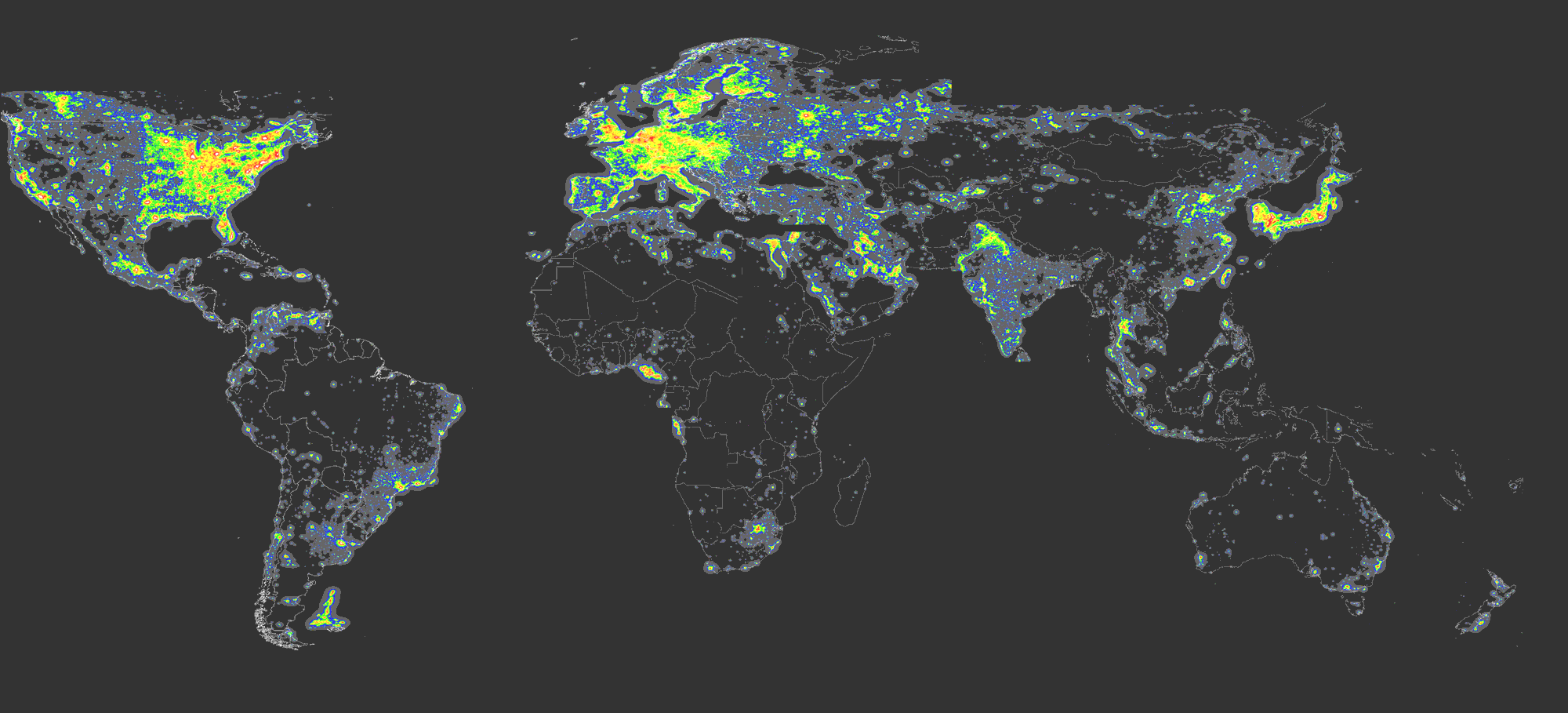
Here is a map showing the amount of light pollution. Notice that you can find pretty dark areas in some rich countries as well, including about half of USA. (The next darkest colour in the map means you can still see the Triangulum Galaxy easily with the naked eye.)
-
Re:falklands so bright?
what's that bright thing near the shore of Argentina in South America?
Good question. See the FAQ.:
Satellite data also record the offshore lights where oil and gas production is active (visible e.g. in the North Sea, Chinese Sea and Arabic Gulf), other natural gas flares (visible e.g. in Nigeria) and the fishing fleets (visible e.g. near the coast of Argentina, in Japan Sea and near Malacca). Note that their upward emission functions likely differ from the average emission function of the urban night-time lighting that we use so that the predictions of their effects have some uncertainty. -
falklands so bright?
what's that bright thing near the shore of Argentina in South America? did anyone nuked the Falklands?
-
Re:won't someone think of the astronomers
they can always go out to the countryside.
Not really. Artificial light affects limiting magnitude far from cities, and for many people, traveling to a place where the sky is really dark is practically impossible.
Take a look at these color-coded maps of artificial sky brightness, or read up on the Bortle dark-sky scale.
-
Re:Seems Like a Cool Idea
But can't we just view how much light there is in space from satellite photos and guess what the light pollution would be (like in http://upload.wikimedia.org/wikipedia/commons/archive/8/86/20040921144929!Usa_night.gif)?
We can. In fact, it's been done. This isn't the real goal of the project, though:"This Windows to the Universe Citizen Science Event is designed to encourage learning in astronomy!"
They're trying to increase awareness of astronomy and the detrimental effects of light pollution. If it just gets people aware it's worth it. I might just do it myself so I have a measure of how much light pollution there really is in my backyard. -
Re:Now we know
Light pollution is a problem even in places we think there is none (mountains, deserts, etc). You have to go pretty far to get away from it. Here's a full-size map of light pollution in the world. [inquinamentoluminoso.it] Most people in the US are going to have to drive pretty far to get a truly dark sky.
-
Light pollution
I sure love meteor showers (as everyone does I guess; I mean, free wishes!), but observing them in non-light polluted areas ain't easy. You have to get out of town, and even then, finding a 100% dark place is an adventure nowadays.
-
Light Pollution at it's bestThat image is a newer one that highlights LightPollution. You can find out more about light pollution at the IDA's website.
Actually this is gives just a rough idea of what light pollution you might experience. If you want to find out more, you can look at the The World Atlas of the Artificial Night Sky Brightness.
If you are in north america, the Clear Sky Clock gives you an quick way to see what light pollution is like on your clock having extracted sections from the atlas. For instance the Montreal clock clock gives this map for Montreal. Clearly not a great location for astronomy.
But the worst, is to realise that this loss of light results in actual light pollution since much of this electricity has been generated with fossil fuels which produces the CO, NOX, CO2 and eventually SMOG.
-
There's an entire country in Asia...
Is there a usable spot for a large telescope in the US or Canada that isn't affected by light pollution?
Not in North America, but all the light pollution maps show a great location in Asia.
It's a very short drive (as the missile flies) due North of a major commercial center, but the skies are amazingly dark. It's as though there were no industry at all -- at least, not the kind that requires nighttime illumination.
There are even reasonably high mountains, complete with pre-existing infrastructure. And during the astronomers' free time, there's a nearby "Treasure House of Wildlife!"
After all, our entire planet is but a miniscule speck of dust in the cosmos. Why should we let a little treaty matter stand in the way of discovery? -
Re:Better off?
This organization focuses on preventing our skies from being polluted with too much light at nighttime. Light pollution is a problem for astronomers the world round, as it makes it difficult to observe the sky when nearby towns are pumping light into the local atmosphere.
Organizations like this one focus on making outdoor lighting point downwards towards the Earth and shielding the bulbs from putting out light into the atmosphere. One might be surprised how much energy is wasted by outdoor lights without shields on them. All it takes is a reflective surface (read: shiny metal) just above a light bulb/tube to reflect the light down instead of skyward. It not only protects our skies from light pollution, but it makes more efficient use of the energy and light.
In this case, the WLEDs are probably not being used outdoors, and even if they were they are a highly directional light source that would cause few light pollution problems due to their limited angular spread (you wouldn't be pointing these things straight up, you'd shine them on your book or whatever).
Of course, if all of our cities had shielded outdoor lighting or LEDs instead, we wouldn't have the pretty nighttime maps of the Earth's surface that show where all the major cities are.