Slashdot Mirror
Domain: jaxa.jp
Stories and comments across the archive that link to jaxa.jp.
Comments · 127
-
Re:Spacecraft visiting the ISS
-
Re:Spacecraft visiting the ISS
-
Half an hour until launch.
It should be launching in half an hour
Live video from JAXA
Live video from NASA -
Half an hour until launch.
It should be launching in half an hour
Live video from JAXA
Live video from NASA -
Didn't Japan just do this?
Maybe the difference is that they didn't create a monster explosion, but... Japan just crash landed their "Kaguya" (SELENE) lunar orbiter into the Moon. The Kaguya had been orbiting the Moon for 17 months since its launch in September 2007. Strangely (to me) they are not released pictures until this November.
-
Re:Any news on lost Apollo 11 tapes?
. but so far we haven't seen ANY of the HD footage...
http://www.jaxa.jp/press/2007/11/20071107_kaguya_e.html
http://www.planetary.org/explore/topics/kaguya/hd.htmlA lot are downsampled, but I'm guessing the HD footage is available in some way. I just picked the first couple search results.
I don't know about the tape machine but I read they had to restore one of the only available machines left to working order before beginning at all. Luckily they managed to fix it. I'm guessing you can't just use any read head or machine for any tape.. either that or it does processing that would be expensive and infeasible to recreate in software. I'm sure they would have gone an easier route if there was one. These aren't dumb people. The tape reader didn't cost them $300k (or anything) so there's no point to including that.
As for a lunar rover, lunar orbiting robotic satellites would be a much better way if you want to film the entire surface of the Moon. JAXA's Kaguya is doing that and the Indian Chandraayan I believe too. For example, Mars is bigger than the Moon, but the Mars Rovers haven't seen that much of Mars as an overall percentage.
Also:
http://nssdc.gsfc.nasa.gov/nmc/masterCatalog.do?sc=LUNARROThe Lunar Reconnaissance Orbiter (LRO) is a Moon orbiting mission scheduled to launch in May 2009. The first mission of NASA's Robotic Lunar Exploration Program, it is designed to map the surface of the Moon and characterize future landing sites in terms of terrain roughness, usable resources, and radiation environment with the ultimate goal of facilitating the return of humans to the Moon.
It will have a high-res camera. I don't see any specs though.
-
Re:Plants grow in microgravity.
I beg to differ. Differences do exist, and we have no idea what differences there will be under Moon's gravity. Will it be enough for the plants to recognize the vertical orientation ? Will they grow 6 times higher ? Same height ? Will the stem be thiner ? thicker ?
We can make educated guesses, but we are almost guaranteed to have surprises. -
automated H-IIhmmm, I note they will be preparing the Canada arm to grab a new supply vessel from Japan the H-II from free flight.
I wonder if we will ever be able to do automated builds of space stations? make install space station!
-
I don't see this mattering too much...
I don't know if its really different or whatever, but Japan has a satellite they managed to get off the earth that sounds like its going to do about the same thing. http://www.jaxa.jp/projects/sat/gosat/index_e.html
-
re
nothing that new i have been making maps for Celestia for quite a few years and for the most pare the imaging is just NOT available to be able to do this the Japanese craft to the moon can http://www.selene.jaxa.jp/index_e.htm it uses a forward and backward looking cam. to do this the "Mars Express High Resolution Stereo Camera" can http://www.esa.int/esaSC/SEM8Q2PR4CF_index_0.html the mars HIRISE can http://hirise.lpl.arizona.edu/anaglyph/ but in all cases so far only a small patch of ground is able to be maped will get better in time.
-
Not exactly a webcam and not exactly live, but...
-
That's odd.
Probably the more interesting thing to note here is that JAXA even *has* a spacecraft for something of that sort. They aren't really known for that, more so for their satellites. At any rate, NASA has a lot more resources for these kind of missions under their belt.
You can see their current (and future planned) rockets and spacecrafts on their site. The spacecraft in question, H-II, was only announced recently in 2008, and I guess that's why I couldn't find any other similar ships on wiki, etc.
And what happened to Russia? I thought they were a huge part of the ISS, and just recently the RSA received a lot more interest from their government if I recall correctly, so why aren't we poking sticks at them? -
That's odd.
Probably the more interesting thing to note here is that JAXA even *has* a spacecraft for something of that sort. They aren't really known for that, more so for their satellites. At any rate, NASA has a lot more resources for these kind of missions under their belt.
You can see their current (and future planned) rockets and spacecrafts on their site. The spacecraft in question, H-II, was only announced recently in 2008, and I guess that's why I couldn't find any other similar ships on wiki, etc.
And what happened to Russia? I thought they were a huge part of the ISS, and just recently the RSA received a lot more interest from their government if I recall correctly, so why aren't we poking sticks at them? -
Re:What has happened to us?
-
Re:Transparent aluminium?
What you were thinking of is Transparent Alumina, an Aluminium Oxide Ceramic.
http://physicsworld.com/cws/article/news/20033
It does *NOT* conduct electricity (at least at room temperature) and if it's a superconductor at lower temperatures I don't know.
However, you *could* coat a window made from Transparent Alumina with a Photovoltaic ink ( http://physicsworld.com/cws/article/news/20033 ) and get a stronger, more durable window with photovoltaic properties. Maybe for those impractical windows shown in the 1950's concept art for habitations on the moon. ( http://moon.jaxa.jp/ja/gallery/moon_base/IMAGE/moon_base06_s.jpg ). -
Re:The Right Stuff
http://www.apg.jaxa.jp/res/stt/0a01.html
Insightful, but look at this and tell us with a straight face that it isn't vaporware. Hasn't somebody heard of these designs before? -
Bouncing single photon's off of the Moon
People have been bouncing single photon's off of the Moon for almost 40 years, using Lunar Laser Ranging, or LLR.
Typically, with LLR a dense "pancake" of photons (maybe 1 meter across and a few mm deep) is shot at the LLR site on the Moon, and one photon returns per shot.
Ajisai is a relatively large Japanese satellite intended for Satellite Laser Ranging (SLR). Even though the SLR return is typically many photons, not just one, the ratio of (photons received back / photons sent) is still extremely tiny, and I rather doubt that they are sending one photon up to get one back.
So, this sounds more like a press release than an actual advance. -
Re:Kizuna = "Bonds" not "Winds"
It seems to be somewhat of a JAXA convention to have a Japanese nickname and an English official name. If you take a look at their lunar probe project, it is referred to as KAGUYA(SELENE).
-
Re:Kizuna = "Bonds" not "Winds"
I had thought the same thing, but that's not correct. If you look at the JAXA page on the nickname, Kizuna is the nickname and the official name is WINDS (spelled all uppercase) which is an acronym. It's very confusing though.
-
Image copyrights - addendumI said: yet at least some of the images used have copyrights of their own On further investigation, it seems that only one of the images^ whose sources I have been able to find has a copyright (there are some - such as the one on page 1 - that I have so far been unable to source).
However, several have usage statements.
For example, the Comet Linear image, from the STScI: "it is requested that in any subsequent use of this work NASA and STScI be given appropriate acknowledgement." (http://hubblesite.org/copyright/)
And the Comet NEAT image, from SOHO: "It is requested, however, that any such use properly attributes the source of the images or data" (http://sohowww.nascom.nasa.gov/data/summary/copyright.html).
^ The image of asteroid Itokawa, from JAXA, has this: "When using materials, JAXA should be credited as the source. (Unless noted otherwise, the copyrights of the materials in the Photo Archives belong to JAXA.)" (http://jda.jaxa.jp/jda/service_e.html) -
Re:country with no PD law
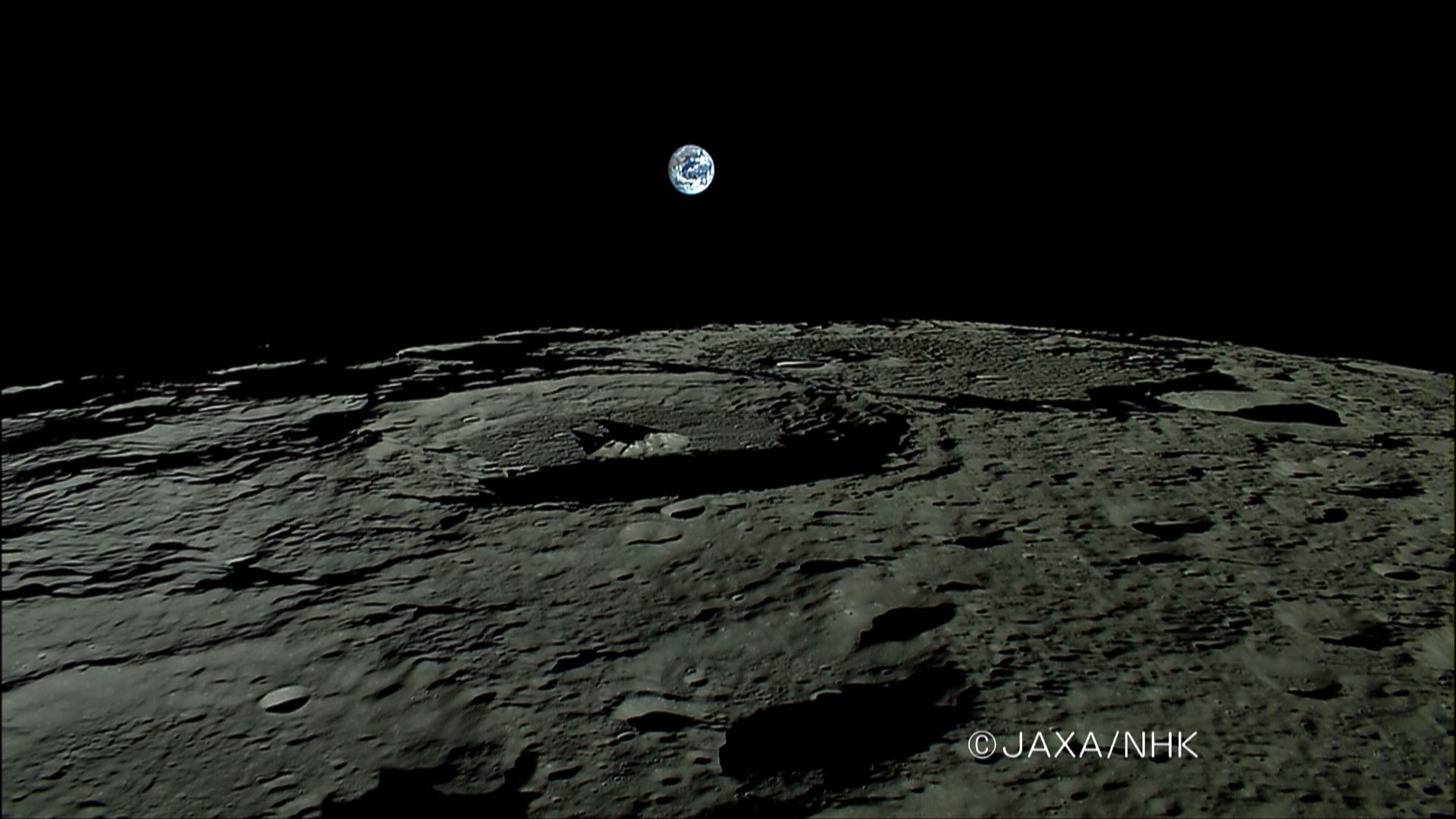
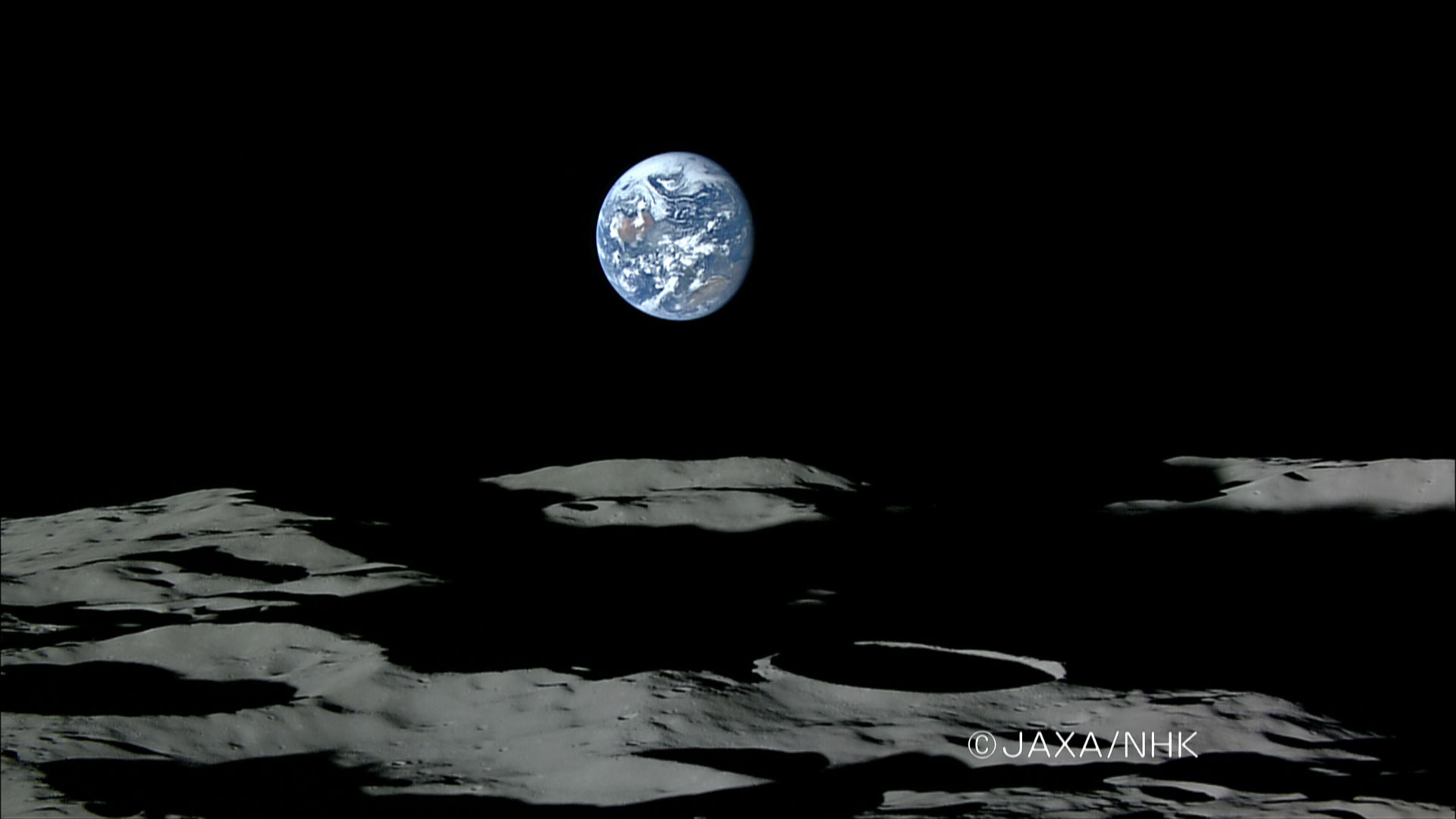
Here you go, 1920x1080. Large enough to crop or take the earth from #2 and paste it over the one in number 1 for a cool wallpaper.
http://www.selene.jaxa.jp/image/communication/img_071114_01.jpg
http://www.selene.jaxa.jp/image/communication/img_071114_02.jpg -
Re:country with no PD law
Here you go, 1920x1080. Large enough to crop or take the earth from #2 and paste it over the one in number 1 for a cool wallpaper.
http://www.selene.jaxa.jp/image/communication/img_071114_01.jpg
http://www.selene.jaxa.jp/image/communication/img_071114_02.jpg -
Re:a bit misleading
Don't be let down, here it is:
http://space.jaxa.jp/movie/20071113_kaguya_movie01_e.html -
Max resolution
1920x1080 is the camera max resolution, you won't find anything better from this spacecraft. Info extracted from the bottom of this page: http://www.jaxa.jp/press/2007/11/20071113_kaguya_e.html
-
Re:Apollo
There are some specs on the sensor here: http://www.jaxa.jp/press/2007/11/20071113_kaguya_e.html
CCD(1920x1080)
Fixed lenses (T: tele camera, W: wide camera)
FoV T: 51.23(horizontal) 30.17(vertical)
W: 15.60(horizontal) 8.80(vertical)
So if I'm doing this right then,
T: tan(51.23*pi/180)*100km/1920 = 64.8m/pixel (horizontal)
tan(30.17*pi/180)*100km/1080 = 53.8m/pixel (vertical)
W: tan(15.60*pi/180)*100km/1920 = 14.5m/pixel (horizontal)
tan( 8.80*pi/180)*100km/1080 = 14.3m/pixel (vertical)
Neither anywhere near 3m^2.
-brandon -
Public Relations
The HD camera on SELENE is a PR instrument. Video is useful for things that change. The moon, for the most part, does not change, and the HD camera does not produce scientifically useful images of the moon. SELENE can only take about a minute worth of video.
High Definition as a proper noun generally refers to 1920x1080 resolution, but the various space agencies have produced much higher resolution images for years. The 35mm film shot during the Apollo missions is being scanned into 3070x2044 pixel images, for example, and the medium format film is being scanned at a huge 12800x12800 pixels. The Mars rovers carry 1 MP (1024 x 1024) cameras, and the images are often stitched together into far larger mosaics. I've seen some that even as JPG's take up over 100 MB (and crash IE). The Hubble Space Telescope's highest resolution camera is also only 1024x1024 pixels, and I believe this was chosen to approximate the maximum resolution of the optics, but again, large mosaics are common.
The High Resolution Imaging Scientific Experiment (HiRISE) camera aboard the Mars Reconnaisance Orbiter takes a different approach and is what's called a "push broom camera." Instead of taking rectangular pictures every so often, it scans a single line of up to 20,000 pixels continuously at the rate the spacecraft moves over the ground. In this way it builds up images up to 40,000 pixels long (800 megapixels...now that's high def!), at which point the file has to be transmitted to earth or the camera runs out of memory. -
Re:a bit misleading
Of course, there are vids...
http://space.jaxa.jp/movie/20071113_kaguya_movie01_e.html -
Re:Need better images
I like this one:
http://www.jaxa.jp/press/2007/10/img/20071001_kaguya.jpg -
Some movies
Look on this page for High Res Pics
http://www.jaxa.jp/press/2007/11/20071113_kaguya_e.html#pict01
and these movies of EarthRise and EarthSet
http://space.jaxa.jp/movie/20071113_kaguya_movie01_e.html
http://space.jaxa.jp/movie/20071113_kaguya_movie02_e.html -
Some movies
Look on this page for High Res Pics
http://www.jaxa.jp/press/2007/11/20071113_kaguya_e.html#pict01
and these movies of EarthRise and EarthSet
http://space.jaxa.jp/movie/20071113_kaguya_movie01_e.html
http://space.jaxa.jp/movie/20071113_kaguya_movie02_e.html -
Some movies
Look on this page for High Res Pics
http://www.jaxa.jp/press/2007/11/20071113_kaguya_e.html#pict01
and these movies of EarthRise and EarthSet
http://space.jaxa.jp/movie/20071113_kaguya_movie01_e.html
http://space.jaxa.jp/movie/20071113_kaguya_movie02_e.html -
Need better images
I'm still looking for the huge versions of these pictures. The best I've found are two 1920x1080 images on the agency website. While these are HD, I need something I can fit nicely on to my desktop (3840x1200). Some of the stills coming from the ISS are great for this.
-
Re:country with no PD law
I would say 984x554 was reasonably high res. Fine, it's not ultra high res, but it's not bad.
-
Re:Not in HD
I was able to find two HD pictures:
http://www.selene.jaxa.jp/image/communication/img_071114_01.jpg
http://www.selene.jaxa.jp/image/communication/img_071114_02.jpg
1920x1080
Couldn't find anything else though. Disappointing. -
Re:Not in HD
I was able to find two HD pictures:
http://www.selene.jaxa.jp/image/communication/img_071114_01.jpg
http://www.selene.jaxa.jp/image/communication/img_071114_02.jpg
1920x1080
Couldn't find anything else though. Disappointing. -
Re:Where's the HD?
Not so tricky. A Flash grabber like Replay Media Catcher downloads the
Why they downsized it to shitty 480x270 is beyond me -- bandwidth shouldn't be an issue nowadays. Is there anything secret about the surface of the moon? -
The press release
It's shot at 8-fold speed, the following is from: http://www.jaxa.jp/press/2007/11/20071107_kaguya_e.html
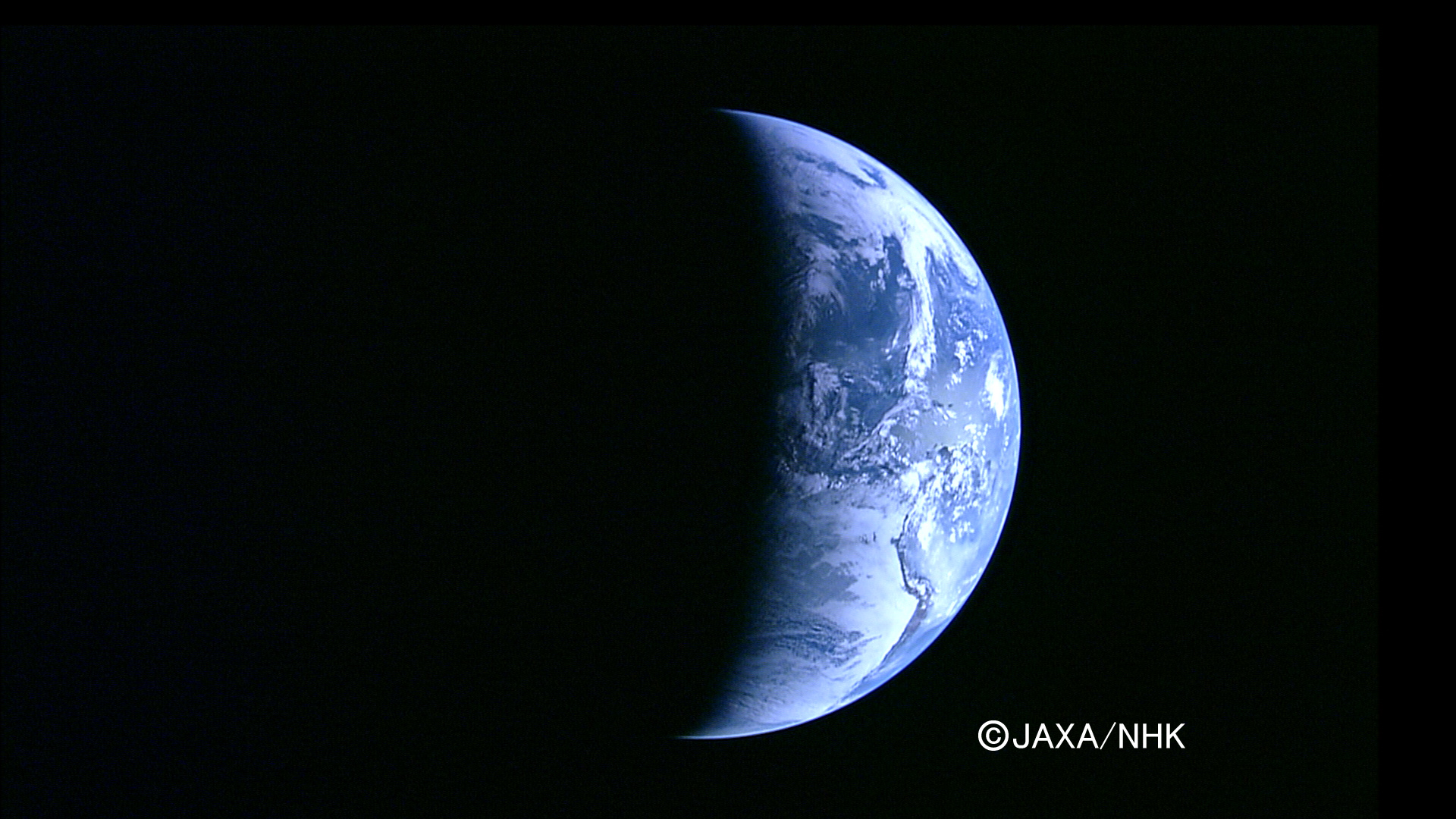
The Japan Aerospace Exploration Agency (JAXA) and NHK (Japan Broadcasting Corporation) have successfully performed the world's first high-definition image taking by the lunar explorer "KAGUYA" (SELENE,) which was injected into a lunar orbit at an altitude of about 100 km on October 18, 2007, (Japan Standard Time. Following times and dates are all JST.)
The image shooting was carried out by the onboard high definition television (HDTV) of the KAGUYA, and it is the world's first high definition image data acquisition of the Moon from an altitude about 100 kilometers away from the Moon.
The image taking was performed twice on October 31. Both were eight-fold speed intermittent shooting (eight minutes is converged to one minute.) The first shooting covered from the northern area of the "Oceanus Procellarum" toward the center of the North Pole, then the second one was from the south to the north on the western side of the "Oceanus Procellarum." The moving image data acquired by the KAGUYA was received at the JAXA Usuda Deep Space Center, and processed by NHK.
The satellite was confirmed to be in good health through telemetry data received at the Usuda station. -
Re:"far more rapidly"
I'm not sure what a HDTV feed from Mars would give us.
Funny you should say that, given that Japan's latest lunar orbiter offers HD resolution.
Frankly, the comment is a little silly. Why *wouldn't* you want a larger pipe through which you could transmit larger quantities of scientific data? Given the amount of imagery and telemetry we're getting from the various probes orbiting Mars, I would think the more bandwidth the better. -
Re:HD
As has been said above: http://www.jaxa.jp/press/2007/10/img/20071001_kaguya.jpg
-
Re:Anyone for Engrish?The whole Communication - Information page is a hoot!
March 26, 2007 It carries out from Tsukuba Space Center
SELENE, obtaining the job at Tsukuba Space Center, being placed by large-sized trailer 5 containers in nighttime, was carried out in order to face to Tanegashima. SELENE was waived from the project manager and the authorized personnel in nighttime .
While the large-sized trailer, counterattacking the wide Tsukuba road, observing at that it keeps being carried out, while asking safety, we in the driver continued to shake the hand.
On the other hand, there are some cool cultural references on the page. For example, it was fun playing the Katamari Damacy level where you pick up the paper cranes. But I had no idea that the crane and the tortoise are traditional Japanese symbols of longevity -- this was explained in a posting about a 2,000-long crane chain given to the project for good luck.
Besides, it's not like English speakers fare any better when communicating outside their native tongue... like translating a soft drink slogan into "Pepsi brings your ancestors back from the grave". -
Re:Prettier webpage
More than that, there's an HDTV camera, apparently shooting at 1920 x 1080 pixels. Lunar observation is scheduled at 19th of October.
-
Re:HD
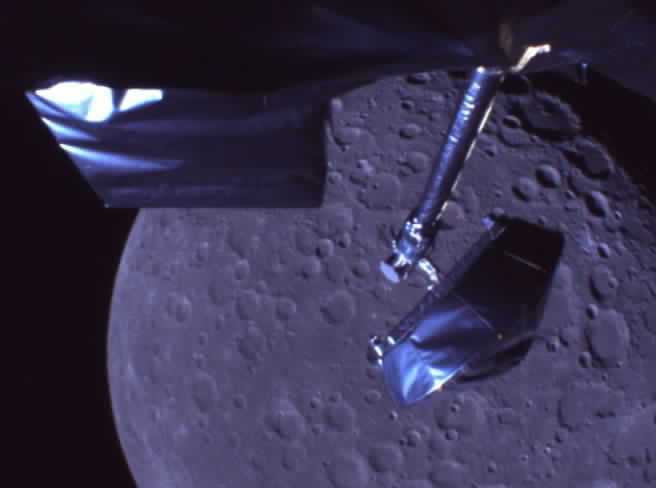
You are correct, it is an engineering camera. The article states (http://www.jaxa.jp/press/2007/10/20071009_kaguya_e.html#at01) that the images are from a camera specifically there to monitor the high gain antenna. I can't wait for the HD camera photos, those ones will probably be really nice!
-
Re:Hey! Down in front!
Don't worry; Kaguya has a better camera, too.
-
Re:WOW slashot got way less hard to reply
Regrettably, "baby" satellites doesn't have the ability to find the Magnetic Anomaly.
The main satellite has the ability. Lunar Magnetometer -
Re:Prettier webpage
Can anyone explain why the photos are extremely low resolution? Here's the largest I could find: http://www.jaxa.jp/press/2007/10/img/20071009_kaguya_07l.jpg
Judging from the lack of detail even at this relatively small size, it looks like these photos are the original resolution it was captured at.
Why not install a higher resolution camera? Are space cameras much different from Earth cameras?
-
HD
These pictures are fairly low quality, probably from an engineering camera rather than a scientific one.
One thing I noticed on the website is that they also carry an HDTV camera! Can't wait to see some nice HD video from lunar orbit. -
Prettier webpage
More user friendly version here: http://www.selene.jaxa.jp/index_e.htm
-
A First: USA Trails Japan in AerospaceIn the development of aerospace technology, Japan has always trailed the USA until now. For many years, the Japanese have been working on an unmanned space shuttle, nicknamed "HOPE-X". The craft somewhat resembles the American space shuttle.
NASDA, the Japanese space agency that has morphed into JAXA, successfully tested a protoype. The program has been canceled due to lack of funding. JAXA intends to use the experimental data and the design schematics for this prototype to develop a manned space plane.
Did the United Force Air Force somehow "borrow" the Japanese experimental data and design schematics to develop the American version of an unmanned space plane?
-
Soylent EngrishLooks like they've also made another amazing discovery: Carbon, nitrogen, and oxygen are MADE OF PEOPLE!
The beautiful XIS spectrum demonstrates that Suzaku has an ability to attain to new knowledge on the chemical evolution of the interstellar materials of carbon, nitrogen and oxygens, the vital elements consisting of the human bodies. http://www.jaxa.jp/press/2005/08/20050817_suzaku_
e .html -
Exotic Projects Capturing the Public's ImaginationMy perception of NASA (and other space agences like JAXA) is that it focuses solely on run-of-the-mill projects seeking incremental but significant advances in technology. That sort of research is useful but does not capture the imagination of young adults contemplating a career in science and engineering.
When President Kennedy pledged that Washington would put an American on the moon, the pledge captured our imagination. We Americans would do something that had never been done in the past. Further, putting an American on the moon was not an incremental advance in technology but was a huge leap that faced a high risk of failure.
NASA should go back to its adventurous roots by devoting 25% of its budget to exotic, high-risk projects. The remaining 75% would go to run-of-the-mill projects.
NASA, not the American military, should be splurging money on building a prototype of a hyperdrive, enabling faster-than-light travel. Even if the prototype does not work, it would significantly facilitate the breakthroughs that will be necessary for a successful hyperdrive,.