Slashdot Mirror
Domain: jdkoftinoff.com
Stories and comments across the archive that link to jdkoftinoff.com.
Comments · 18
-
Re:mk-configuremk-configure is great!
Over the years I also had made a meta-makefile which does much of what I needed.
Latest version is on github at
But even then quite often I just use qmake!
--jeffk++ -
Re:Q&AFor the lazy criminal here is a map to Jeff Koftinoff's apartment:
1131 Burnaby StNote the parks within easy running distance if the police should happen to interrupt your B&E and the hospital if you throw out your back hauling all that stuff out to your truck.
Also, Jeff is a contributer to Open Source software so please don't steal any of the media (CD's, thumb drives etc) since you can probably download much of it from Freshmeat or his own website
I found two odd things when googling Jeff; first, that he lives in apt #5, not #4 so perhaps Jeff is trying to arrange that an annoying neighbor get robbed?
Second, he once posted a number of conspiracy theory pages that are now all 404. So perhaps this isn't really Jeff issuing this invitation? perhaps it's the CIA looking to take him down for posting the Truth?
I'd post more but it is really hard to do invasive, privacy violating searches while bouncing a toddler on one's knee and keeping him away from the keyboard. -
Re:Apple II? Gaming platform?
Reading from write-only registers would give you weird numbers. Then someone figured out that these numbers being read were the last byte being read at that time by the video circuitry. Using this concept, I could fill a horizontal line with an oddball text character, then run a tight loop which polls $c0x0. When it sees this special byte, it changes display modes to hires. Then it searches for another oddball character expected in a horizontal line in hires more. At that point, switch back to text mode.
The net result was a solid image with text mode up top and hires (or lores) mode at the bottom of the screen!
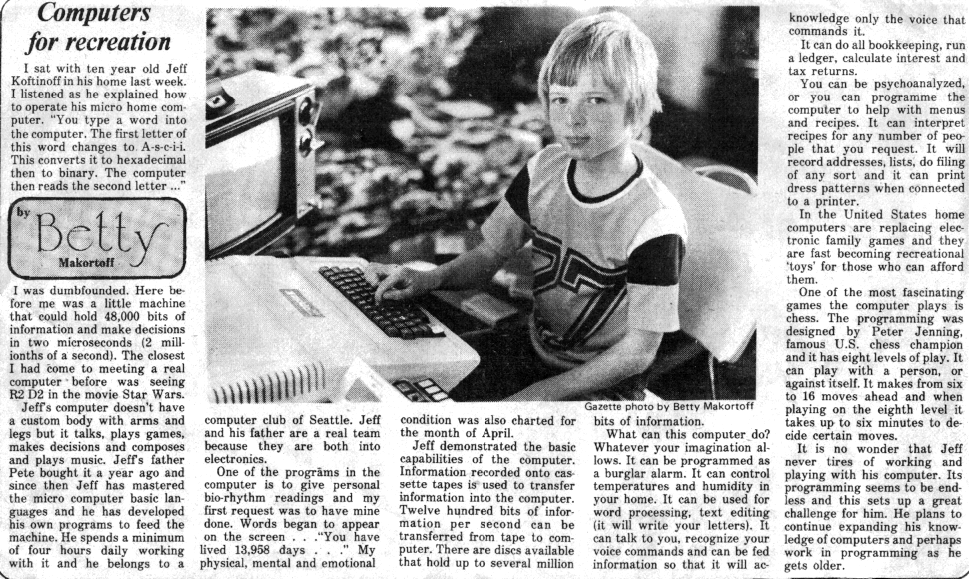
Now, get off my lawn! http://www.jdkoftinoff.com/main/Information/About_Jeff_Koftinoff/1979_Article
--jeffk++ -
Re:How does this save money?
Sony's choices make it less likely that I will get a PS3, even though I have a PS2, and do CELL PPU/SPU programming at work for non-game systems, and at work we have a PS3 running linux for tests. It is a bad choice that sony made, and sony most definitely has the tech and people power to implement a ps2 in a few CELL SPUs. What does make install not war actually mean for you? Is that just a slogan that you repeat but don't live? My History --jeffk++
-
Re:The first computer I ownedI feel old too
My Apple ][ was something that challenged and taught me.
Woz is brilliant and I spend countless hours pouring over the big red book with the fold out schematic of the Apple ][. Not only open source but open hardware too. The Apple ][ was fundamental in my development as a computer programmer.
Computers now have lost the special aspects of the Apple ][... simplicity and understandability.
--jeffk++
-
Re:Labtop as an instrument?Cool!
You may want to use my GPL'd MIDI Library in it: http://opensource.jdkoftinoff.com/jdks/trac/brows
e r/trunk/libjdkmidi--jeffk++
-
Re:Labtop as an instrument?Back in 1986 I wrote the Pro MIDI Player which was a live performance oriented MIDI sequencer. It allowed you to control the sequence in a live sort of way. I originally wrote it because my band was performing at Expo '86 in Vancouver and we needed some parts sequenced but wanted to be able to repeat parts at our whim during the song. It also controlled lights and flashpots via the parallel port via midi messages in the sequence!
It turned into a product for a while. The old atari-st 'typeset' manual is at: http://www.jdkoftinoff.com/main/Historic_Projects
/ The_Pro_MIDI_Player/Documentation and the source code is now GPL'd and available at http://www.jdkoftinoff.com/main/Historic_Projects/ The_Pro_MIDI_Player/Source_Code/I've always wanted to rewrite this for a newer platform but found the market and the music scenes lacking.
--jeffk++
-
Re:Labtop as an instrument?Back in 1986 I wrote the Pro MIDI Player which was a live performance oriented MIDI sequencer. It allowed you to control the sequence in a live sort of way. I originally wrote it because my band was performing at Expo '86 in Vancouver and we needed some parts sequenced but wanted to be able to repeat parts at our whim during the song. It also controlled lights and flashpots via the parallel port via midi messages in the sequence!
It turned into a product for a while. The old atari-st 'typeset' manual is at: http://www.jdkoftinoff.com/main/Historic_Projects
/ The_Pro_MIDI_Player/Documentation and the source code is now GPL'd and available at http://www.jdkoftinoff.com/main/Historic_Projects/ The_Pro_MIDI_Player/Source_Code/I've always wanted to rewrite this for a newer platform but found the market and the music scenes lacking.
--jeffk++
-
Re:Labtop as an instrument?Back in 1986 I wrote the Pro MIDI Player which was a live performance oriented MIDI sequencer. It allowed you to control the sequence in a live sort of way. I originally wrote it because my band was performing at Expo '86 in Vancouver and we needed some parts sequenced but wanted to be able to repeat parts at our whim during the song. It also controlled lights and flashpots via the parallel port via midi messages in the sequence!
It turned into a product for a while. The old atari-st 'typeset' manual is at: http://www.jdkoftinoff.com/main/Historic_Projects
/ The_Pro_MIDI_Player/Documentation and the source code is now GPL'd and available at http://www.jdkoftinoff.com/main/Historic_Projects/ The_Pro_MIDI_Player/Source_Code/I've always wanted to rewrite this for a newer platform but found the market and the music scenes lacking.
--jeffk++
-
Re:Prior artRight, I had an apple ][ before there was DOS: newspaper article
And at that point, Microsoft's AppleSoft had hires graphics and integer basic did not. So AppleSoft had prior art, at least with regards to this.
One could always use pokes to change mode and fill memory, and the applevision program worked by poking a 6502 program into memory which performed the animation and music...
--jeffk++
-
Re:Along those lines...
Interesting to note that Duff's device causes enormous slow downs on different architectures. The real problem here is that duff's code is too low level for any compiler to properly infer the original purpose, and the manual pointer arithmetic makes it tough because of the aliases problems that C has. Things are a bit better with the 'restrict' keyword, but it still limits you to optimise only on architectures that have one execution unit.
As an example, I wrote My Little Article on Duff's Device for you to read. I specifically tested it on a platform that has 8 explicit execution units and software pipelining, and duff's version is 48 times slower than the simpler for loop with array indexing if count is much larger than 5.
With the array indexing, the compiler can be smart about re-ordering the calculations. With the pointer arithmetic it is forced to not be!
--jeffk++
-
Re:Emulation and ASM
-
the best console apps IMHO
1.- pine and pico (yes, I know the license issue)
2.- jdkchat (a telnet based chat system) -
The MT-32I developed an Patch Editor for the Roland MT-32, and know it quite intimately.
I believe that the MT-32 Emulator is a worth while project - But I am confused as to why the ROM needs to be copied at all. Why not record your own samples instead? It is not like those original samples are that great anyways. If the open source community (me included) recorded and processed our OWN samples, then none of these issues would have come up. The copyright on the originals would not be an issue at all.
--jeff++
-
Re:From a similar experiment I've read about
Yes, I TOTALLY agree with you. Being well-rounded (not physically!) is of the utmost importance.
At the same time that I started with computers I also started with a dirt bike, and expanded into motorcross racing. I then moved to music (eee!) and MIDI and other live performance projects which merged back into the computer.
I wish I did continue with motorcross and other sports to become more well-rounded - as it was, I was forced in my mid 20's to become more socially active and well rounded, probably with still more to go.
--Jeff
-
Re:From a similar experiment I've read about
Yes, I TOTALLY agree with you. Being well-rounded (not physically!) is of the utmost importance.
At the same time that I started with computers I also started with a dirt bike, and expanded into motorcross racing. I then moved to music (eee!) and MIDI and other live performance projects which merged back into the computer.
I wish I did continue with motorcross and other sports to become more well-rounded - as it was, I was forced in my mid 20's to become more socially active and well rounded, probably with still more to go.
--Jeff
-
Re:From a similar experiment I've read about
I think you are misunderstanding the issue here. I also have been using computers since an early age.
There is a difference between what you and I did and what the kids in elementary school do now.
You and I hacked video games, learned 6502/6510 on our own, and learned how the computer worked intimately.
In the typical school setting nowadays, none of this happens. The schools usually present the computers as a fixed system in a class running a specific program. Not as an interesting tool to examine, understand, or learn to build or hack.
The difference is that you and I were pulled by the computers to learn them. I believe that kids being 'pushed' to learn specific apps would get nothing out of them. Imagine if in 1983 all the schools had computers - Probably all they would have done with them is teach the students the control codes for WordStar. Hardly useful later on in life. Any student who learned how to run the CP/M assembler to create command files would be told 'Stop that! It is not on the final exam!'
It really comes down to how the computers are presented to the students.
As an aside, one of my very good friends is an accomplished musician with a geophysics degree.
--Jeff
-
Re:more! more!
There already is a standard for 96 KHz, 24 bit DVD audio. Problem is, hardly anybody uses it for distribution. And unfortunately I suspect that no one ever will - Any new audio distribution standard will focus on digital rights limitation crap above audio quality.
All the D/A converters in use now are 1 bit with many times oversampling. The filters used with them are very good too. What really matters at this point are their effective bits - even though a converter may be labelled as a 24 bit converter, it does not mean you will actually get 144 db dynamic range!
Take a look at my old sample alias viewer program for win32 here (beware of ugly gui colours though!)
The results are deceiving because the program doesn't display what really happens when you have a proper filter on the output.
When all is said and done, what really matters is how it sounds. I personally can tell the difference between 16 bits and 24 bits. I can not tell the difference between 48 khz and 96 khz. I suspect that anyone who says that they can tell the difference is actually hearing the artifacts due to a crappy resonant filter at 22 khz or whatever.
Also, beware of some gear that says it supports 96 khz - Some devices may receive or send it via AES/EBU or SPDIF, but are actually discarding incoming samples or interpolating outgoing samples. Seriously, some companies are scamming the customers with regard to 96 khz.
--jeff