Slashdot Mirror
Domain: kde.org
Stories and comments across the archive that link to kde.org.
Comments · 3,588
-
who?
Who the hell is Digsby and why should I care, when there's other perfectly free alternatives available that don't bundle crapware with them.
-
FOSS, maybe?
-
Here is a comparison table for those interested
Folks at KDE have a comparison table for various software licenses. The table might throw some light on the reason why the GPL is where it is today.
-
Boring Story
Google also puts "Why are Macs so expensive?" on the first page of its search, although the first 4 hits are for various Microsoft products including Windows and Office. Frankly, this is the standard sensationalist crap that Slashdot excels at now a days... Hey Slashdot, how about covering the fact that KDE 4.3 was just released today? Oh I forgot, this site is about nitpicking and hating everything Microsoft does, while still secretly using there software and never contributing anything of value to open-source.
-
There's no accounting for taste
> Because that's one of those things that would be instantly recognizable and universally agreed-upon as a UI fuck-up.
Not really. See:
http://bugs.kde.org/show_bug.cgi?id=99905
Worse, when I tested on kubuntu 8.04 it's still the same behaviour, BUT with the addition that they've got it to sort by alphabetical order by default.
That's worse since if I have say 20 tasks, alphabetical would mean the new window is inserted in the middle of "somewhere". Close one window and open two new windows and it's hard for me to predict where the resulting tasks will be on the taskbar.
Maybe I've strange tastes, but I don't see how the addition of alphabetical sorting on top of "top-down-left-right sort" is an improvement in UI terms.
KDE used to be better than GNOME. This and other stupidity makes KDE a sad joke to me.
-
You can check it out on Windows tooI'm stuck with XP all day, but courtesy of the folks at KDE on Windows it's still possible to check out the release candidate for 4.3, and soon 4.3 itself should be available too. As detailed on my blog, it's as simple as:
Go to the website and grab the installer (kdewin-installer-gui-latest.exe). Should download in seconds, then you can run it to start the REAL downloading and installation process.
Stick with all the default unless you have good reason not to. Apart from anything else, most servers don't seem to have the "unstable 4.2.95" package. I got mine from ftp-stud.fht-esslingen.de
Skip all the language packs unless you really need them, install the rest. Let it get on with it. When it finishes, check the "run system settings after exit" box and finish.
It has some slightly odd choices for the defaults, so I went through and set everything to "Oxygen" to make it consistent & easy. But the main reason to run this thing is just to check that the QT apps work on your machine before you try and run the full KDE environment.
Assuming it works, try a few of the other KDE apps that will have appeared in your Start menu. It has games!
To get KDE itself running, you need to run something which is, for some reason, not in the options in the KDE submenu in the Start menu. Go figure. Why would they want to make it easy to run KDE on Windows after you've downloaded KDE for Windows..?
To get the actual desktop environment, you need to run plasma-desktop.exe, which in a default install will be in C:\Program Files\KDE\bin
That should launch your KDE experience, and you can have a play from there. So far, it's a little unstable (Should be better once 4.3-proper is available) but otherwise performing fairly well.
-
Re:I bought an ipod touch today, it's going back.
Yep. There's absolutely no way to use an iPod under Linux
Now, don't you start your whining about your precious Ogg and FLAC or-anything-else-support neither!
Now STFU, you fucking Troll... -
Re:Rewarding incompetence
Sumatra is a piece of shit that simply crashes on many many PDFs that Okular, for example, handles perfectly.
-
Re:OLPC = One License Per Child
The answer is very simple, and strikes at the heart of what is wrong with the open source movement: regular folks prefer products they can use without much effort. It's called "usability" and for-profit companies invest a lot of money and time always finding ways to make their products more "user-friendly".
It seems to me that open source developers have heard of that "usability" thing, just two examples here:
http://usability.kde.org/hig/
http://library.gnome.org/devel/hig-book/stable/And where did you get the fact that for-profit companies don't use open source development method? Just a one example, search here for 'Who is sponsoring the work'.
http://www.linux-foundation.org/publications/linuxkerneldevelopment.php. Personally I think that nobody wants this great OS is because people aren't ready to risk their existing pre-installed OS since switching an OS is a non-trivial risky thing which takes time, however good the new OS might be. And people are often content if something works just enough even tho something else might be more productive in the long run. "NOBODY in a for-profit company like Apple, Microsoft, Dell, Intel, IBM, ect., would ever let a new computer ship without the capability to install a printer and print from within applications out-of-the-box."Can you honestly argue that every single device that you have plugged into a computer shipped by the above companies has worked out-of-the-box? If you can you're an extremely lucky individual. I myself have had nightmares with getting devices to work with, for example, Windows 98, ME and even WinXP even tho it has good hardware support. And computer/OS distributor can't have perfect hardware support because printers have drivers which need to be specifically programmed for a certain OS so if a device company decides so, it can make drivers for its device only for one OS leaving the others without support (which might be added by someone else who is willing to do reverse-engineering). "Open source projects are the opposite: they concentrate on pleasing the "experts", with the result that the products are usually good, but of no interest to the general population." The GNOME project, the other one of the biggest desktop environments for Linux, focuses on simple interfaces and actually annoys power users since cutting down on choices makes for less features. For example I am a power user and dislike GNOME applications and I also think that most open source applications are nowadays made for non-power users. As an example here, Mozilla Firefox is an open source project and it seems to be quite good for newbies too.
"One more example: installing applications on the XO often requires making use of the command line. well...99% of people out there have no idea what a "command line" is. How clueless can a team be?" I thought that 99% of people in the target areas also have no idea what a "graphical user interface" is. Command line is efficient, flexible, fast, consistent and lets user automate tasks easily so it might not be that horrible if people would learn it. But I agree that applications might be good to be installable with a GUI tool like synaptic.
(Sigh, you are a fucking troll..."Niggerponte" indeed...)
-
Re:Blue screen
I suspect kmail/kontakt does autosave periodically, but apparently it's broken in some way: http://lists.kde.org/?l=kde-bugs-dist&m=122605713921371&w=2
Anyway the last I used it, when I try to save an email draft while working on it, it closes the draft. The KDE people seem to think that just because I want to save my work it means that I want to close it too.
Then there's Openoffice:
http://user.services.openoffice.org/en/forum/viewtopic.php?f=7&t=10604&hilit=autosave
It should probably be fixed by now, but what it shows to me is how seriously they value their users work - not seriously enough.
As it is, I'm going to have to assume that most apps are NOT written sensibly.
FWIW, so far my windows, Linux and *BSD machines have not crashed on me for months
-
Re:Not the KDE4 way, plase
> I am on KDE 4.3 RC2, so things may have been fixed from whatever KDE you were using. Which
> version have you? Can you test with KDE 4.3?I'm using 4.2.96 (4.3 RC2) as packaged for Kubuntu 9.04.
> > Konqueror: (1) Ctrl-C doesn't copy the selected text; I have to use the context menu.
> > This only seems to affect pages in frames.
>
> I cannot reproduce, and you point to a specific site?Any site with frames (that I've tested):
http://www.w3schools.com/HTML/tryit.asp?filename=tryhtml_frame_cols> > (2) Websites seem to use the KDE-wide "View Background" colour as the default background:
> > this can lead to black text on a dark/black background. Decoupling the default website
> > background colour and the View Background colour would help.
>
> Again I cannot reproduce. What site, and what is your background colour setting?Black or blackish. It probably affects any site that doesn't have a background colour of its
own, for example:
http://tldp.org/HOWTO/4mb-Laptops.html> > Application launcher (classic, not Kickoff), "Computer" submenu: (1) displays storage media
> > along with Places under "Places", not under "Removable Storage" (which displays the Places
> > instead). (2) Both types of misplaced entry are dead to mouse clicks.
>
> Is this an English installation, or translated? I do not have that issue in neither my English nor
> Hebrew interfaces.English. The equivalent tab in the Kickoff menu works, by the way.
> > Kate: (1) I don't think the "Open Recent" list is working properly. (2) Sometimes cursor
> > colour = background colour, especially (exclusively?) after (highlighted?) braces and after
> > search or replace operations (which may also highlight text... hm).
>
> I don't have this issue, either! And I use Kate a lot.Hm again. I've seen complaints about both (1) and (2) before, so it's not just me... black background
again; it's possible the cursor turns black rather than background-coloured.> > KRunner/Quicksand: In the "Task oriented" interface mode, results are displayed in black no
> > matter the background colour.
>
> Which theme? I cannot reproduce this, either!Any theme I've tried! The results list box that pops up to the right of the main search box always uses
the "View Background" colour (black, unsurprisingly) with black text (except for the highlighted entry)."Command oriented" mode has readable text, although I don't understand its autocomplete function.
I type "fetc", it completes "fetchmail" and puts the cursor at the end of it, but I still have to type
"fetchmail" before "Run fetchmail" appears below.> > Windows List widget: Right-clicking an entry and picking "Move" or "Resize" just teleports the
> > pointer over to the respective window without going into move/resize mode. It works fine via the taskbar.
>
> I cannot find that widget, though I have seen it in the past. Again, I am useless!
>
> > PowerDevil: DPMS settings don't seem to take effect. Can use separate Display control,
> > though. (Haven't tested this on 4.3 RC2 yet.)
>
> I don't use those features, so I don't know. Sorry.
>
> > Kwin cube: With "hovering windows" activated, panels sometimes poke through or overlap windows
> > on rotate.
>
> I don't use those effects.
>
> > kded4: Sometimes this process jumps to about 50% CPU and stays there until I kill it. (May have
> > been fixed with the recent upgrade to 4.3 RC2, bit early to tell.)
>
> This sounds serious, please file a bug!There's this: https://bugs.kde.org/show_bug.cgi
-
Re:Not the KDE4 way, plase
OK..... heres my first problem.
I have disable idiotic plamsaoid and returned to the NORMAL desktop interface.
As much as I hated the new desktop at first, I really like it now. But to each his own, and since you can configure it how you like it, we will concentrate on the other matters.
I have disabled the $!^$!%!^% dolphin and Konqi is now the file manager.... How the ^&%#^&@!%$!@^& I am supposed to see the other drives etc. in my system!????!!!!?
I really don't know! Have you tried asking on the KDE mailing list? Below...
Please don't tell me its under places! ITS IS NOT &*!^#&*@!^#&*!^ THERE!
The ONLY WAY to get Konqi to show these is to access them at least once via that !^&!$%!^&% dolphin and then they show via mount.
I should be able to: media:/ in Konqi and see my drives!
Please comment (calmly, not cursing like on
http://bugs.kde.org/show_bug.cgi?id=200221So how do you do this ? ? ? ? ? ? ?
Remember dolphin is out I hate it! Konqi is my browser and file manager, period.
That is fine, Konqueror is still considered an official KDE file manager. Thank you for pointing out this issue, it will be taken care of.
-
Re:oooh i wonder if liqbase will run on it
Just a brief list of linux stuff that runs on top of OS X:
X11
kde
e17
For everything else there's fink and darwin ports.
In fact, darwin itself is open source, meaning if you really, really have a hard on to run just linux apps, you could run the core OS with the drivers and all with X11 on top of it. Beeslebob's point is spot on, there's no reason to take a perfectly good unix that has drivers custom written for it to replace it with a one-size fits all OS like linux (as awesome as linux is, hardware drivers are its Achilles' Heel because the hardware is often propietary). -
gnu
Look into GNU projects! http://www.gnu.org/ for example, kde is always looking for developers
-
Re:make your own stuff
I wish more projects were as well-organized as KDE.
http://techbase.kde.org/Projects/PIM/KMail_Junior_Jobs#KMail_Junior_Jobs
-
get mentor
-
Re:Thank you!
some projects have so called "junior jobs" - bugs or improvements that are easy enough so that a new contributor can tackle them - for example, http://techbase.kde.org/Contribute/Junior_Jobs
-
scratch an itch
the best course ? find something that interests you, maybe something that you use every day - and find something you don't like about the product, or maybe think of how it could be improved.
it's famously called scratching your own itch.
why is that an effective way ? because you are interested, of course ! you see the results of your work, you use them.what project to choose ? it's completely up to you. pick one, look at what they have on their web, wiki, join their irc channel, talk with people. see whether you like them - because that is important.
you could look at major projects who have specific sections to help new contributors like http://contributing.openoffice.org/ or http://techbase.kde.org/Contribute, or take a look at the many smaller projects in various categories like personal or system management software, games or... anything.
but really, basic requirements :
1. you are interested;
2. you can work with the people on the project.everything else will come itself.
also, you are in no way limited to a single project - actually, it is beneficial to participate in multiple projects because you'll get familiar with various organisational, code versioning, documentation and communication practices. contributing a few fixes here and there can be very eye-opening on how these things come together.good luck
-
Re:GNOME
KDE is a highly integrated, cohesive environment, whereas GNOME mostly is a desktop, a file manager, a few applets and a bunch of assorted applications that happen to use gtk for drawing their ui stuff.
Gnome is also a project with decent "Human Interface Guidelines". Which KDE lacks. Badly.
You mean like these??
-
Re:No need
It is, to us Yakuake users.
-
Try Magnatune.
Try Magnatune. They:
- treat their artists far better than any of the major labels
- let artists license, not sign over, music for distribution so artists keep their copyrights
- let you listen to their entire catalog without charge
- work with music player programs (Rhythmbox, Amarok, Songbird, and proprietary software including iTunes)
- offer purchasing by the track, subscription (for streaming or download), and all-you-can-hear prices
- offer downloading in multiple formats including FLAC
- offer redownloading without hassle (compare this to what Apple told Wil Wheaton after Apple's software erased purchased tracks from his iPod)
- offer all tracks without DRM
-
Re:On the plus side...
-
so use basket...http://basket.kde.org/
oh, wait, that's a kde thing... I forget, is that evil or not now?
-
Re:Innovate is the wrong word
Here's a shorter version: Not everyone likes to do design. F/OSS tends to attract people who like to work on the backend--more interesting and challenging things, that is--than to work on the user interface. They'll do the latter, usually because no one else will, but it's not necessarily something they're going to enjoy.
I don't think I agree with this, or at least I don't agree with it anymore. Just looking at the new KDE, the thought and labor that went into the interface has been incredible. It's not just coders doing this stuff for themselves anymore. Take a look at the credits. That's a hell of a lot of people.
I suspect you're probably from either the left or right coast. Only stuffy Urbanites would find "cowboy" derogatory.
As a midwesterner, I had to smile at this. Well said
-
Ideas
Russell,
Here are some ideas:
Size the job. In this case your focus is too narrow. You are focusing on yourself, when you should focusing on the entire human condition.
Examine your assumptions. Are you making assumptions? Are your assumptions justified?
In this case, you are making assumptions that are not justified. You think the problem is you, but look more closely. Is that actually true?
You are excellent at expressing yourself. You have made kind (1) (2) and gentle and humble (1) (2) statements.
People think "geek" means someone who has been psychologically damaged by bad parenting. Maybe that happened to you, but you have grown a lot in recent years.
Use words carefully. Often technically-knowledgeable people are self-defeating. On Slashdot, you call yourself "JustShootMe". You say you are a "geek". You say, "meatspace", a term sure to be misunderstood by most people.
Women want to meet you. Single women partly have the same problems you have. They need to meet a suitable person of the opposite sex. If you look like you are seriously looking, they will sense that immediately. If you give the impression you are only interested in seriously interesting women, a seriously interesting woman will realize that immediately.
Resolve your unhealthy fears. Talk with every woman who wants to talk with you.
Advertise your availability. Finding a significant other is a huge problem. Most people can sympathize. Make sure everyone, even people you meet casually, know you are serious about finding a significant other.
The Los Angeles area is an extremely difficult place to meet a woman who wants a serious relationship. I thought about this for many years when I lived in Huntington Beach. My best theory is that the phoniness and dishonesty and artificiality of the Hollywood film industry has infected the entire culture of Los Angeles.
The U.S. culture is undergoing a cultural breakdown. No one understands completely why, but sometimes countries become self-destructive. When there is a cultural breakdown, the level of anxiety increases. It becomes far more difficult to make stable relationships.
The U.S. government has invaded or bombed 25 countries since the 2nd world war, all apparently for profit for weapons and oil investors, and other private interests. For example, read the book, House of Bush, House of Saud. The Bush family supported the interests of whomever gave it money, against the interests of the United States. The Saudis were willing to provide 1.4 billion dollars, so they got what they wanted.
Other examples: 1) The Savings and Loan crisis was arranged to steal money from taxpayers. 2) It was arranged that, instead of pensions managed by professionals, taxpayers would have "IRAs" they managed themselves. Since only highly trained professionals who spend all day thinking about investments can compete in the stock market, most taxpayers lose money to the professionals. 3) Warren Buffett very publicly called derivatives "financial weapons of mass destruction" beginning in 2002. However, the laws designed to prevent fraud were removed at the beginning of George W. Bush's first term. They were not re-instated. The forces of corruption were greater than the forces towar -
Re:WORKSFORME is far from INSANELYGREAT
But are the issues resolved in KDE4? I doubt it judging from: http://bugs.kde.org/show_bug.cgi?id=167488
Users don't really care whether it's KDE3 or KDE4 or whatever, what they see is "still not fixed after 6.5 years".
If the problem is still present in version 4.x, saying "version 3.x is unmaintained you can look to your distro for help" years later just says:
"WORKSFORME, go bother someone else."
If that's not what they want to say, then they should be doing things differently.
As for innovation, I found KDE4 (on kubuntu) far worse than KDE3 - bad enough that I installed GNOME on a system because I didn't want to inflict KDE4 on someone else (who would end up calling me for help anyway). I guess KDE4 is trying to be the Vista of Desktop Linux or worse (vista seems to require a lot more clicking to do stuff that was simple in XP - and I'm not talking about the "UAC" stuff ).
-
WORKSFORME is far from INSANELYGREAT
> No, the product seemed pleasant looking and very usable from my standpoint.
Yeah that's the problem, many OSS developers will just say "WORKSFORME", or not even bother marking it as "WORKSFORME", just go off and do something else "more important".
See: https://bugs.kde.org/show_bug.cgi?id=50457
Or: https://bugs.kde.org/show_bug.cgi?id=99905Yes, what they do decide to work on is more important in some ways. But I daresay adding that little extra can be just as important if not more so in other ways.
Apple understands very well how the perception of "insanely great" can cover a multitude of problems under the hood.
There's a vast difference between the users perceiving your product as "oh well it works", "this is nice" and "hey this is sooooo coool! (must have ASAP!)".
Whereas KDE says:
"Kicker is currently unmaintained, you can look to your distribution for help, however."
Look to your distribution for help? A lot of people might just look to (or stay with) OSX/Windows for help instead. And tell the Linux Desktop Zealots who try to "convert them" that OSX "WORKSFORME", or Windows "WORKSFORME", and who the fuck cares that it's not OSS and it's an "evil proprietary OS".
As for innovate too much, a lot of what they do is not innovating at all. For example: "wobbly windows"?! How the heck does that help? If I want to play with stuff that wobbles, I load up World of Goo or something.
Without a good Human Interface Engineer or someone who understands that stuff with a lot of say, they'll end up producing tons of "innovations" are not actual innovations in UI. Stuff like initially attractive cutscenes in a game, that the users eventually try to skip because they end up being annoying or getting in the way.
-
WORKSFORME is far from INSANELYGREAT
> No, the product seemed pleasant looking and very usable from my standpoint.
Yeah that's the problem, many OSS developers will just say "WORKSFORME", or not even bother marking it as "WORKSFORME", just go off and do something else "more important".
See: https://bugs.kde.org/show_bug.cgi?id=50457
Or: https://bugs.kde.org/show_bug.cgi?id=99905Yes, what they do decide to work on is more important in some ways. But I daresay adding that little extra can be just as important if not more so in other ways.
Apple understands very well how the perception of "insanely great" can cover a multitude of problems under the hood.
There's a vast difference between the users perceiving your product as "oh well it works", "this is nice" and "hey this is sooooo coool! (must have ASAP!)".
Whereas KDE says:
"Kicker is currently unmaintained, you can look to your distribution for help, however."
Look to your distribution for help? A lot of people might just look to (or stay with) OSX/Windows for help instead. And tell the Linux Desktop Zealots who try to "convert them" that OSX "WORKSFORME", or Windows "WORKSFORME", and who the fuck cares that it's not OSS and it's an "evil proprietary OS".
As for innovate too much, a lot of what they do is not innovating at all. For example: "wobbly windows"?! How the heck does that help? If I want to play with stuff that wobbles, I load up World of Goo or something.
Without a good Human Interface Engineer or someone who understands that stuff with a lot of say, they'll end up producing tons of "innovations" are not actual innovations in UI. Stuff like initially attractive cutscenes in a game, that the users eventually try to skip because they end up being annoying or getting in the way.
-
Re:In related news
Say what you want about the glacial speed with which GNOME progresses. Their developers don't rip out 2/3 of the features of their applications, and call it a " major upgrade."
There's also a key difference between 'minimalism' and 'feature-deprived'. Apple understand this, and the GNOME team seem to be catching on. XFce's flexibility also makes it a surprisingly good environment to work in, despite being billed as a 'bare bones' environment. KDE almost certainly doesn't understand this distinction, and I'd frankly be surprised if they had any sort of UI-design review process in place.
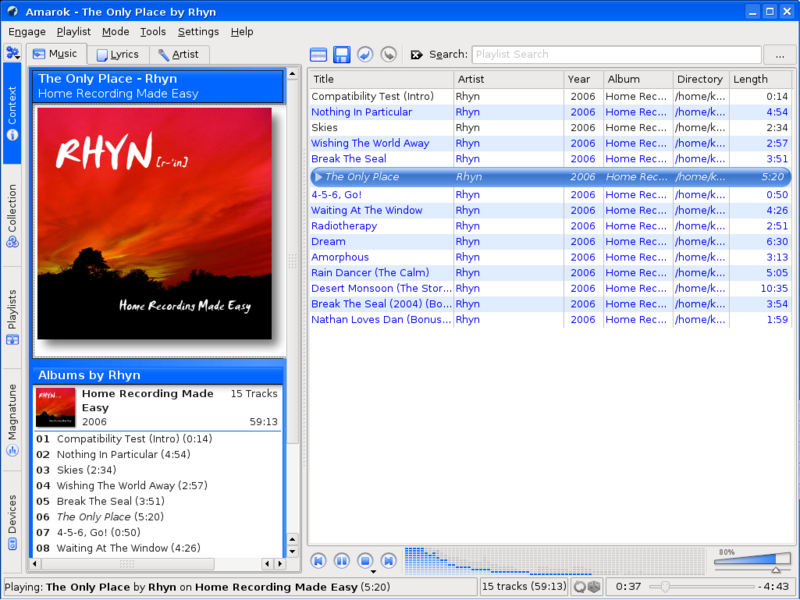
Take a look at the most recent release of Amarok, and tell me how the user interface effectively helps the user complete the task that the program was designed to accomplish. Now consider the percentage of screen real-estate that the application devotes to this task (it's around 30%, although you could argue that it's even less than that).
Now compare it to Winamp's famous classic skin, which only takes up a fraction of a 640x480 monitor, has collapsable UI elements to make it smaller if desired, and offers more options to the user up-front with textually-labeled controls. I can only guess what 1 of the 7 icons on the bottom right corner of the previously-linked screenshot actually do. I'll give credit to the KDE team for moving away from the 'Dozens of identical-looking blue icons' paradigm, although the new standard frankly isn't much better.
-
Re:After 20 minutes of use...
Yes of course the original KHTML code was the original constituent that was used to create WebKit... but WebKit is a lot more than just html rendering (which is all that KHTML was) and Apple's engineers significantly refactored both the original KHTML and the KJS scripting engine (in fact there is no longer any trace of the original KJS scripting engine in WebKit, that is why everyone only makes reference to the original KHTML now). http://en.wikipedia.org/wiki/WebKit#History. This was the original bone of contention - Apple built completely new engines and was trying to force these back into the main KDE streams
What many people do not realise is that Apple didn't publish their folk for a year, while they worked on it. By the time Don Melton (the lead engineer at Apple) announced it to the KDE community on 7 Jan 2003, over half the original KHTML and KJS code had been replaced because it required other components from KDE and Qt. Don informed the KHTML/KJS teams in an email http://lists.kde.org/?l=kfm-devel&m=104197092318639&w=2 saying: "Both WebCore and JavaScriptCore, which account for a little over half the code in Safari [WebKit], are being released as open source today." The idea was for the KDE team to incorporate WebCore back into the KHTML project. This was only a partial success as some of the WebCore and JavaScriptCore code was never successfully incorporated into the KDE branch.
On 7 June 2005 Apple announced that it was open sourcing all of WebKit [Safari rendering and scripting engines] and not just the abstraction frameworks.
So, already by 2005 (as of Jan 2003, actually) the vast majority of WebKit was already Apple code!
Later in 2005 Apple engineers ported support for Scalable Vector Graphics into WebKit http://dot.kde.org/1121021917/
By the end of 2007, Apple had incorporated HTML 5 Media features http://webkit.org/blog/140/html5-media-support/
A few months later in 2008 the WebKit team announced that they had rewritten JavaScriptCore as "SquirrelFish", a new bytecode interpreter http://webkit.org/blog/189/announcing-squirrelfish/, which was later advanced to SquirrelFish Extreme by the end of that same year. SquirrelFish Extreme compiles JavaScript into native machine code, eliminating the need for a bytecode interpreter and thus speeding up JavaScript execution http://webkit.org/blog/214/introducing-squirrelfish-extreme/. My tip for the future is to watch this space for Apple to out-Pre the Pre with respect to natively compiled HTML5/JavaScript applications that run at machine speed within WebKit.
Keep in mind the fact that there are lots of other bits and pieces that were never part of the original KHTML rendering engine or the KJS scripting engine that now make up WebKit, such as the Drosera a JavaScript debugger, etc.
By this stage, it was clear that Apple's platform abstraction framework and adapter library called KWQ (and pronounced "quack") that replaced the KDE and Qt components that KHTML and KJS relied upon made WebKit the most platform versatile and standards compliant web client; having passed the Acid3 test "with pixel-perfect rendering and no timing or smoothness issues on reference hardware" http://webkit.org/blog/280/full-pass-of-acid-3/. This is when Google, Nokia, Palm, et al started looking in at the true cross platform potential of WebKit.
Now keep in mind that all these developments and innovations to WebKit, since 2003 (at which time half the code was already Apple's code) were added almost entirely by Apple engineers.
Then in June 2007 Ars Technica in
-
Re:After 20 minutes of use...
Yes of course the original KHTML code was the original constituent that was used to create WebKit... but WebKit is a lot more than just html rendering (which is all that KHTML was) and Apple's engineers significantly refactored both the original KHTML and the KJS scripting engine (in fact there is no longer any trace of the original KJS scripting engine in WebKit, that is why everyone only makes reference to the original KHTML now). http://en.wikipedia.org/wiki/WebKit#History. This was the original bone of contention - Apple built completely new engines and was trying to force these back into the main KDE streams
What many people do not realise is that Apple didn't publish their folk for a year, while they worked on it. By the time Don Melton (the lead engineer at Apple) announced it to the KDE community on 7 Jan 2003, over half the original KHTML and KJS code had been replaced because it required other components from KDE and Qt. Don informed the KHTML/KJS teams in an email http://lists.kde.org/?l=kfm-devel&m=104197092318639&w=2 saying: "Both WebCore and JavaScriptCore, which account for a little over half the code in Safari [WebKit], are being released as open source today." The idea was for the KDE team to incorporate WebCore back into the KHTML project. This was only a partial success as some of the WebCore and JavaScriptCore code was never successfully incorporated into the KDE branch.
On 7 June 2005 Apple announced that it was open sourcing all of WebKit [Safari rendering and scripting engines] and not just the abstraction frameworks.
So, already by 2005 (as of Jan 2003, actually) the vast majority of WebKit was already Apple code!
Later in 2005 Apple engineers ported support for Scalable Vector Graphics into WebKit http://dot.kde.org/1121021917/
By the end of 2007, Apple had incorporated HTML 5 Media features http://webkit.org/blog/140/html5-media-support/
A few months later in 2008 the WebKit team announced that they had rewritten JavaScriptCore as "SquirrelFish", a new bytecode interpreter http://webkit.org/blog/189/announcing-squirrelfish/, which was later advanced to SquirrelFish Extreme by the end of that same year. SquirrelFish Extreme compiles JavaScript into native machine code, eliminating the need for a bytecode interpreter and thus speeding up JavaScript execution http://webkit.org/blog/214/introducing-squirrelfish-extreme/. My tip for the future is to watch this space for Apple to out-Pre the Pre with respect to natively compiled HTML5/JavaScript applications that run at machine speed within WebKit.
Keep in mind the fact that there are lots of other bits and pieces that were never part of the original KHTML rendering engine or the KJS scripting engine that now make up WebKit, such as the Drosera a JavaScript debugger, etc.
By this stage, it was clear that Apple's platform abstraction framework and adapter library called KWQ (and pronounced "quack") that replaced the KDE and Qt components that KHTML and KJS relied upon made WebKit the most platform versatile and standards compliant web client; having passed the Acid3 test "with pixel-perfect rendering and no timing or smoothness issues on reference hardware" http://webkit.org/blog/280/full-pass-of-acid-3/. This is when Google, Nokia, Palm, et al started looking in at the true cross platform potential of WebKit.
Now keep in mind that all these developments and innovations to WebKit, since 2003 (at which time half the code was already Apple's code) were added almost entirely by Apple engineers.
Then in June 2007 Ars Technica in
-
Here is more...
http://kde.org/announcements/4.2/screenshots/desktop.png
The hot char of the menus are always visible.
The taskbar and its glass are right off Windows.
The gadgets to the right are right off Windows.
Look at "Settings" word on the menu, See how "S" and "e" goes almost into each other, what the hell kind of design or font is that?
Look at the buttons, the caption/text of them are all out of place!
The grey Windows... need I say more? Cluttered with off place lines, ugly buttons, ugly everything.
All the fonts and their rendering are ABSOLUTELY HORRIBLE LOOKING.
The Maximum button icon does not make sense at all, an up arrow? wtf?
Look at that awful awful battery icon!
-
Re:BSD?
KDE is a powerful Open Source graphical desktop environment for Unix and Unix-like workstations.
-
Re:Use Qt....
The argument is pretty moot when you consider PyQT [riverbankcomputing.co.uk], QtRuby [kde.org].
Have you looked closely at either one of those, especially the way they handle Qt signats/slots? Here are PyQt docs. Highlights:
Qt signals are statically defined as part of a C++ class. They are referenced using the QtCore.SIGNAL() function. This method takes a single string argument that is the name of the signal and its C++ signature. For example:
QtCore.SIGNAL("finished(int)")
...
Qt slots are statically defined as part of a C++ class. They are referenced using the QtCore.SLOT() function. This method takes a single string argument that is the name of the slot and its C++ signature.
QtCore.SLOT("done(int)")
...
Many of Qt's features make use of its meta-object system. In order to make use of these features from Python it is sometimes necessary to make certain Python objects (i.e. QObject sub-classes, properties and methods) appear as C++ objects. In particular it is sometimes necessary to define a C++ function signature that a Python method emulates
@QtCore.pyqtSignature("int, char *")
def foo(self, arg1, arg2):So you have to deal with C++ function signatures while coding in Python - great.
For QtRuby, the situation is exactly the same. I won't go into details, but here's just one example from the docs:
Qt::Object.connect(@colormenu, SIGNAL("activated(int)"), self, SLOT("slotColorMenu(int)"))
It should be noted that QtRuby docs say that "future version of QtRuby will allow Ruby type signatures instead". However, that phrase was already in documentation first time I've seen QtRuby, which was, I believe, about 3 years ago. So far nothing's changed.
And here's how signals are dealt with in PyGtk, for comparison:
def hello_clicked(widget, data):
button_hello.connect("clicked", hello_clicked, None) -
Re:Use Qt....
In general, it is much harder to access C++ APIs from various high-level languages with FFI (Python, Ruby etc) then it is to access a C API.
I don't think that's an argument for Gtk+ vs. Qt as it is an argument for C vs. C++.
The argument is pretty moot when you consider PyQT, QtRuby. The only problem with C++ is name mangling. This can be solved with a pretty simple extern "C" call. -
ext4 / KDE issues overblown
The comments on this thread seem to be a bit mistaken on average on what the hubbub was regarding ext4 and KDE, so I'll try to clear it up a bit (I'm a KDE dev but I'm not speaking for KDE here of course).
The "issue" with ext4 was that it's handling of the standard write(); close(); rename(); idiom for replacing existing files by writing out a new file and then renaming it in-place over the old one could leave zero-length files laying around if the system crashed
ext4 never would spontaneously delete data merely because rename() was used, it was a side effect of its implementation that if the system crashed before the data had been written to disk but after the rename had taken effect then a zero-length file would be left in its place after restarting the system.
Where KDE comes into the picture is that KDE 4 writes its updated settings to disk too frequently (which is a known bug, now fixed, KDE bug 187172 pertains). So, if you were starting up or shutting down your KDE session when the system crashed you'd likely have had quite a few config files written out in the past 60 seconds or so. ext4 is very good about writing out metadata so the renames would have taken effect. But apparently ext4 didn't force the actual file data to disk until 60 seconds had gone by (unless asked to via fsync()). So after the reboot there was a great chance that the $KDEHOME/share/config/*rc files had been effectively truncated, thus causing loss of settings.
Many people have complained that KDE should do "the right thing" and use fsync() everywhere, but most people don't know that KDE had always done that... until ext3 became popular. ext3 suffers massive slowdown in the face of fsync() (although I guess some kernel hackers will have that mostly fixed in 2.6.30?) so KDE actually removed fsync() calls in response to user demand. And there's no less than two fsyncs() that would be required, one to force the file to disk, and a second to force the update to the directory after the rename().
People claim that KDE violates POSIX standards but really the effect we get from using rename() with fsync() is exactly what we want, a kind of lazy "version A or version B, one or the other". At least for rc files, it is not at all important that version B be reflected system wide afterwards at the time the write() happens so fsync() is overkill. Of course ext4 isn't "violating" POSIX either, but most agree that its behavior was undesirable in this situation, so patches have been committed to ensure ext4 adds ordering in this case to ensure that metadata updates happen after data updates.
I actually just converted all my filesystems to ext4 (from XFS) the other day, since it's at least possible with appropriate mount flags to get ext4 to act as a proper desktop FS. (I didn't know about XFS's similar issues with power loss until it was too late). So far everything is working nicely for me, although I haven't intentionally power cycled to test that case either.
-
On windows : Already done. All 3 of them.
Don't bother saying anything about KOffice or any other Office product becoming popular until it can be installed on Windows with a setup.exe or an MSI.
- First as you said yourself in your follow-up : KOffice is part of the KDE software that can be installed on Windows with their package manager.
- OpenOffice.org
Installs on Windows with a very standard installer.
The only minor problem in my opinion is getting the plugins. It uses the kind of plugin manager as the older versions of FireFox (you can't directly search and browse the installable plugins from there, you have to go to a website first). Also the plugin manager doesn't help you to restart the "quicklaunch" if a restart is needed.
It cool be great if I could install LanguageTool with a simple click from within the manager, the same way as AdBlock+ in recent versions of Firefox. But I'm nit-picking. Back to the subject.- Gnome Office :
It's not an actual suite, its a lose collection of separate software that cover the needs of an Office suit. All use the same library underneath (GTK+) which has been ported to windows since ages (back at the begining of the GIMP on Windows port). As such you can find installers for :
- AbiWord (word processing)
- Gnumeric (spreadsheet whose accurate statistic formula are done in collaboration with R projet)
(and probably other GTK stuff if you need them).
In fact, as they are small separate software with a very small footprint (compared to behemoths like OO.o), they are quite popular and often recommended for people wanting to build for free small lightweight Windows installation on underpowered hardware.- For the VI vs. Emacs flamewar combatant out there (the kind who'll immediately scream that they don't need an actual office suite as every needed function and even more is available in some Emacs mode/Vim plugin), both softwares are also available for Windows, if that's your kick. (And yes, I'm not sarcastic. I'm definitely sure that here on
So as we can see, the three major players of Linux/BSD's office suites (and the two editors behind most holy wars) are installable on Windows (and on Mac OS X for that matters too).
Yes they are indeed cross-platform.KOffice was more of a problem until recently the whole KDE switched to Qt4 during is 4.x branch and took opportunity of the major overhaul to be rebuilt with cross-platfrom portability in mind.
-
Re:When?
Amarok can't handle sshfs only nfs and smb. which is the only reason I can't use it.
http://amarok.kde.org/wiki/Dynamic_Collection
I guess I could use nfs or smb to access remote files but take a look at this example of sshfs.
sshfs me@192.168.2.1:/
fusermount -u
the first command mounts the root of the remote file system at
the 2nd command unmounts the remote system when your ready.
very little requires setting up just an empty directory for the mount point.
only fly in this ointment is Amarok it will see the files, catalog the files, but it cant play the files just about any other player will work fine.
-
Re:When?
Well, that appears to be an old sin.
-
Re:When?
They redid the UI for Amarok 2 and made a complete fucking mess. This pretty much says it all.
-
Re:The developers are not end users
Of course developers don't hold users in contempt - they probably use the software themselves. And they use the command line all the time -- it's not broken for *their* "desktop use".
For a lot of projects, the developers just arn't interested in pleasing Joe Shmoe, but they will probably let you do it.
This is open source!
If you want applications to be more friendly to the average windows user, start working. And I don't mean sending troll emails to developer lists, I mean rolling up your sleeves and changing the software.Mergh. Rant off.
Btw, some projects focus on usability.
-
Re:The developers are not end users
Of course developers don't hold users in contempt - they probably use the software themselves. And they use the command line all the time -- it's not broken for *their* "desktop use".
For a lot of projects, the developers just arn't interested in pleasing Joe Shmoe, but they will probably let you do it.
This is open source!
If you want applications to be more friendly to the average windows user, start working. And I don't mean sending troll emails to developer lists, I mean rolling up your sleeves and changing the software.Mergh. Rant off.
Btw, some projects focus on usability.
-
I got an awesome idea
Why don't you talk to the KDE Marble team?
http://edu.kde.org/marble/
This way the entire world could benefit from this as Marble is cross-platform.Once you got the software in place, you could then also talk to the OpenStreetMap project.
http://www.openstreetmap.org/Together with the two linked projects you could figure out a cheap setup that everyone could follow, so we can see more of this stuff happen and you could share your streetview with the rest of the world!
-
Re:forget it
Well, considering that the kindle is already powered by linux, it's completely idiotic to assert that he's "shoving your pet OS down your throat" because you're already running linux on the Kindle.
Also, there is a text-to-speech is a standard package in one of the most common desktop managers for linux. I use the text-to-speech sometimes while I'm doing the dishes, etc. It does about as well as most text-to-speech programs do. You don't have to use kde to do it, ktts is just the front-end, it uses the festival synthesis system, so a front end might be out there can use a less full-featured OS than kde, which might be faster and hence more suitable for an e-book reader device. I wonder if it's possible to get the festival speech synthesis system running on it and bypass amazon's DRMed solution all together. -
Re:Sorry but...
Oh so Office finally started adding some functionality? If they keep trying maybe Microsoft can catch up! Nah, they don't think of anything new...just look at Windows 7
-
Re:That's MY damn email address!
Seriously, if you're a company/whatever, then the email address to contact me is YOUR damn company/whatever name @mydomain.com
So if I get a single godamn piece of spam at that address, I know you're the ones responsible for selling/giving that address to the spammers.
I do this too. You might want to comment on these two Kmail bugs, which will make this method easier:
https://bugs.kde.org/show_bug.cgi?id=72926
https://bugs.kde.org/show_bug.cgi?id=159251Which email client are you currently using?
-
Re:That's MY damn email address!
Seriously, if you're a company/whatever, then the email address to contact me is YOUR damn company/whatever name @mydomain.com
So if I get a single godamn piece of spam at that address, I know you're the ones responsible for selling/giving that address to the spammers.
I do this too. You might want to comment on these two Kmail bugs, which will make this method easier:
https://bugs.kde.org/show_bug.cgi?id=72926
https://bugs.kde.org/show_bug.cgi?id=159251Which email client are you currently using?
-
Re:But running windows would help
4) install KDE
-
Re:But running windows would help
Then maybe you should use Kate? http://windows.kde.org/
-
Re:Existing Features
KNemo? I've never heard of that.
I used to use the KNetworkManager tool from KDE 3.5. I now use the networkmanager-applet plasmoid.Maybe you don't use NetworkManager? You might want to consider it if your home network uses DHCP.
Also, this email
http://mail.kde.org/pipermail/amarok/2008-September/006652.html
seems to indicate that the IPod should work with Amarok 2.