Slashdot Mirror
Domain: khanacademy.org
Stories and comments across the archive that link to khanacademy.org.
Stories · 36
-
Bill Gates Is First Guest Editor In Time Magazine's 94-Year History (geekwire.com)
Long-time Slashdot reader theodp writes: Time invited Bill Gates to be the first guest editor in the 94-year history of the magazine. Among the news Bill deemed fit to print in Time's first augmented-reality-enhanced issue were articles by wife Melinda and pal Bono, both of whom graced the cover of Time with Bill as the 2005 Persons of the Year... Another article reveals that "the four learning hacks Bill Gates swears by" include Khan Academy (a $10+ million Gates Foundation partner), tech-backed Code.org (to which Bill, the Gates Foundation, Microsoft, and Steve Ballmer have given somewhere north of $17M), the Big History Project (to which Bill had contributed a "modest $10 million" as of 2014), and The Teaching Company (which got Bill stoked about Big History).
The issue also includes Gates' "four favorite ways to give back" and "six innovations that could change the world." In fact, the theme of the whole issue is "optimism," with 62-year-old Gates writing that "On the whole, the world is getting better. This is not some naively optimistic view; it's backed by data. Look at the number of children who die before their fifth birthday. Since 1990, that figure has been cut in half. That means 122 million children have been saved in a quarter-century, and countless families have been spared the heartbreak of losing a child."
Another optimistic essay came from Daily Show host Trever Noah, who writes, "Mock millennials all you want. Here's why they give me hope." -
Khan Academy Seeks Patent On Education A/B Testing
theodp writes: The Education Revolution will be patented. USPTO records show that Khan Academy is seeking a patent for Systems and Methods for Split Testing Educational Videos. From the patent application: "Systems and methods are provided for comparing different videos pertaining to a topic. Two different versions of an educational video may be compared using split comparison testing. A set of questions may be provided along with each video about the topic taught in the video. Users may view one of the videos and answer the questions. Data about the user responses may be aggregated and used to determine which video more effectively conveys information to the viewer based on the question responses." Now it's up to the USPTO to decide if something like the test and control studies conducted 40+ years ago (pdf) by the PLATO system to measure the effectiveness of different teaching methods would count as prior art. In response to an earlier post on Khan Academy's pending patents on learning computer programming and 'social programming,' Slashdot user Khan Academy said that the nonprofit is using patents for good, so not to worry. -
Ask Slashdot: Resources For Explaining Statistics For the Very First Time? (thejuliagroup.com)
theodp writes: Teaching multivariate statistics to college students, writes AnnMaria De Mars, was a piece of cake compared to her current project — making a game to teach statistics to middle school students who have never been exposed to the idea. In the interest of making a better game, De Mars asks, "Here's my question to you, oh reader people, what resources have you found useful for teaching statistics? I mean, resources you have really watched or used and thought, 'Hey, this would be great for teaching?' There is a lot of mediocre, boring stuff on the interwebz and if any of you could point me to what you think rises above the rest, I'd be super appreciative." Larry Gonick's The Cartoon Guide to Statistics is pretty amazing, but is it a little too advanced for this age group? Anyone have experience with the Khan Academy Data and Statistics offerings? Any other ideas? -
Facebook's Solution To 'One of Education's Biggest Problems' Is a Dashboard
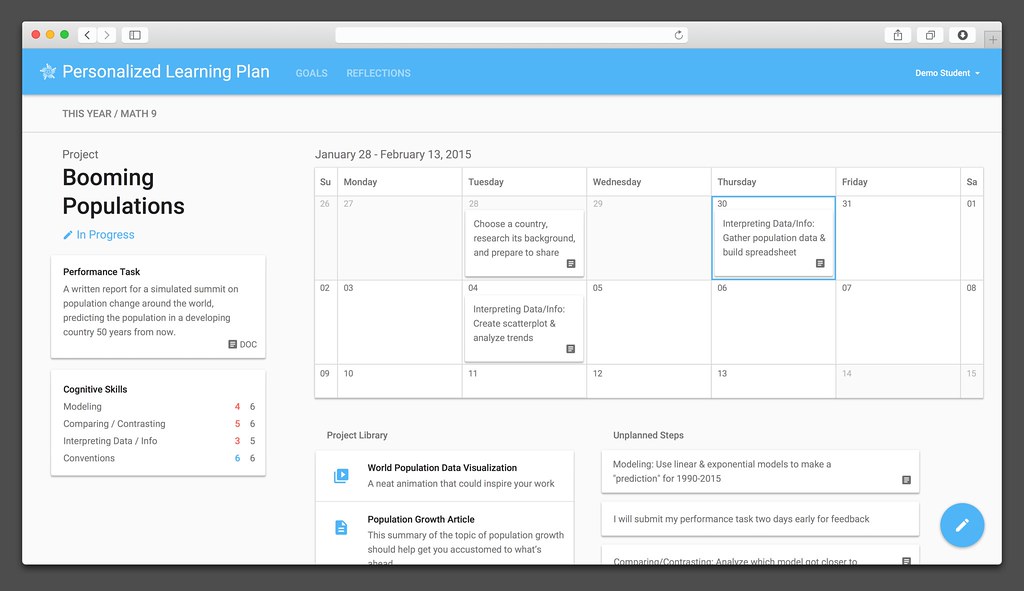
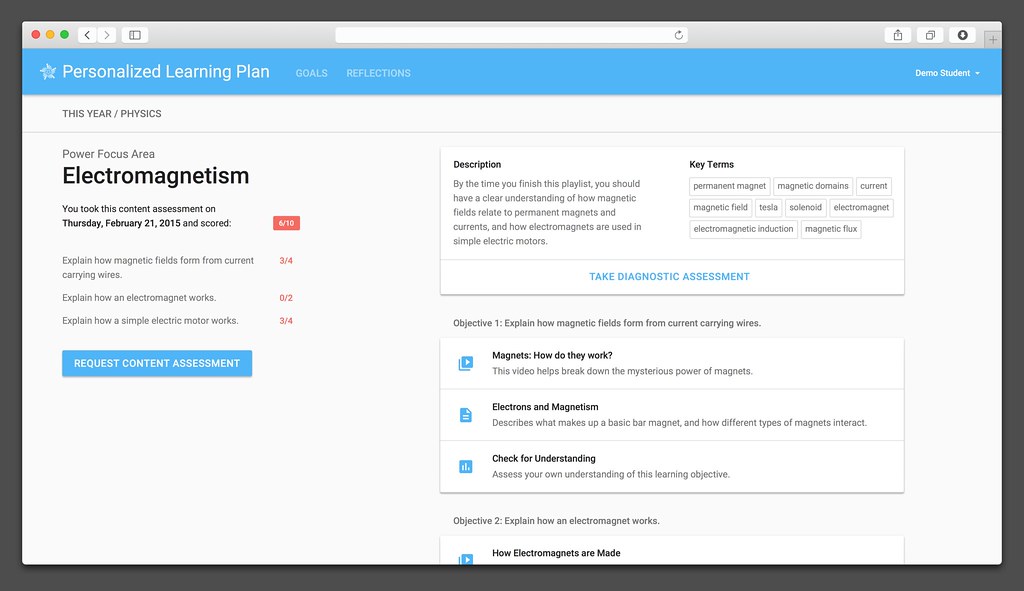
theodp writes: Gushing in July that Facebook engineers had solved one of education's biggest problems, Melinda Gates perhaps set up Segway-like expectations for Facebook's education software. And while The Verge sings the praises of what appears to be progress-tracking dashboards that connect students to mostly free 3rd-party lessons — not unlike Khan Academy or even the 50-year-old PLATO system — it's hard to get jazzed based on the screenshots (1, 2, 3) that Facebook provided in a .zip file accompanying its announcement. The "personalized learning plan" dashboards are a joint effort of Facebook and the Meg Whitman-led and backed Summit charter schools. In a nice circle-of-tech-CEO-education-reform-life twist, the first Summit high school opened in a building in Redwood City after students attending the Bill Gates-touted and backed Silicon Valley High Tech High charter there were evicted to make way, and the Gates Foundation is now spending $8M to bring HP CEO Whitman's Summit charter schools — and presumably Facebook CEO Mark Zuckerberg's personalized learning plans — to Seattle children. -
Khan Academy Seeks Patents On Learning Computer Programming, Social Programming
theodp writes: When it announced its brand new Computer Science platform in August 2012, Khan Academy explained it drew inspiration from both Bret Victor and GitHub (SlideShare). Still, that didn't stop Khan Academy from eventually seeking patents on its apparently Victor-inspired Methods and Systems for Learning Computer Programming and GitHub-inspired Systems and Methods for Social Programming, applications for which were quietly disclosed by the USPTO earlier this year. Silicon Valley legal powerhouse Wilson Sonsini Goodrich & Rosati, which provides a pro bono team of 20+ to assist billionaire-backed Khan Academy with its legal needs, filed provisional patent applications for KA in August 2013 — provisional applications can be filed up to 12 months following an inventor's public disclosure of the invention — giving it another 12 months before formal claims had to be filed (KA's non-provisional applications were filed in August 2014). -
Khan Academy Seeks Patents On Learning Computer Programming, Social Programming
theodp writes: When it announced its brand new Computer Science platform in August 2012, Khan Academy explained it drew inspiration from both Bret Victor and GitHub (SlideShare). Still, that didn't stop Khan Academy from eventually seeking patents on its apparently Victor-inspired Methods and Systems for Learning Computer Programming and GitHub-inspired Systems and Methods for Social Programming, applications for which were quietly disclosed by the USPTO earlier this year. Silicon Valley legal powerhouse Wilson Sonsini Goodrich & Rosati, which provides a pro bono team of 20+ to assist billionaire-backed Khan Academy with its legal needs, filed provisional patent applications for KA in August 2013 — provisional applications can be filed up to 12 months following an inventor's public disclosure of the invention — giving it another 12 months before formal claims had to be filed (KA's non-provisional applications were filed in August 2014). -
Khan Academy Seeks Patents On Learning Computer Programming, Social Programming
theodp writes: When it announced its brand new Computer Science platform in August 2012, Khan Academy explained it drew inspiration from both Bret Victor and GitHub (SlideShare). Still, that didn't stop Khan Academy from eventually seeking patents on its apparently Victor-inspired Methods and Systems for Learning Computer Programming and GitHub-inspired Systems and Methods for Social Programming, applications for which were quietly disclosed by the USPTO earlier this year. Silicon Valley legal powerhouse Wilson Sonsini Goodrich & Rosati, which provides a pro bono team of 20+ to assist billionaire-backed Khan Academy with its legal needs, filed provisional patent applications for KA in August 2013 — provisional applications can be filed up to 12 months following an inventor's public disclosure of the invention — giving it another 12 months before formal claims had to be filed (KA's non-provisional applications were filed in August 2014). -
Google and Gates-Backed Khan Academy Introduces "Grit"-Based Classroom Funding
theodp writes: Their intentions are no doubt good, but some will be troubled by Google and Khan Academy's recently-concluded LearnStorm initiative, which pitted kids-against-kids, schools-against-schools, and cities-against-cities in a 3-month learning challenge for prizes based not only on students' mastery of math skills on Khan Academy, but also their perceived 'hustle' (aka 'grit'). "Points are earned by mastering math skills and also for taking on challenging new concepts and persevering," explained a Khan Academy FAQ. A blog entry further explained, "They've earned points and prizes not only for mastering math skills but also for showing 'hustle,' a metric we created to measure grit, perseverance, and growth. They competed over 200,000 hours of learning and 13.6 million standards-aligned math problems. In addition, thanks to the generosity of Google.org, DonorsChoose.org, and Comcast's Internet Essentials, 34 underserved schools unlocked new devices for their classrooms and free home internet service for eligible families, increasing student access to online learning tools like Khan Academy." Apparently funded by a $2 million Google grant, the Google, Khan Academy, and DonorsChoose grit-based classroom funding comes on the heels of the same organizations' gender-based classroom funding initiative. Supported by some of the world's wealthiest individuals and corporations, Khan Academy's Board members include a Google Board member (Diane Green), spouse of a Google Board member (Ann Doerr), and the Managing Partner of Bill Gates' bgC3 (Larry Cohen); former Board members include Google Executive Chairman Eric Schmidt. -
Google and Gates-Backed Khan Academy Introduces "Grit"-Based Classroom Funding
theodp writes: Their intentions are no doubt good, but some will be troubled by Google and Khan Academy's recently-concluded LearnStorm initiative, which pitted kids-against-kids, schools-against-schools, and cities-against-cities in a 3-month learning challenge for prizes based not only on students' mastery of math skills on Khan Academy, but also their perceived 'hustle' (aka 'grit'). "Points are earned by mastering math skills and also for taking on challenging new concepts and persevering," explained a Khan Academy FAQ. A blog entry further explained, "They've earned points and prizes not only for mastering math skills but also for showing 'hustle,' a metric we created to measure grit, perseverance, and growth. They competed over 200,000 hours of learning and 13.6 million standards-aligned math problems. In addition, thanks to the generosity of Google.org, DonorsChoose.org, and Comcast's Internet Essentials, 34 underserved schools unlocked new devices for their classrooms and free home internet service for eligible families, increasing student access to online learning tools like Khan Academy." Apparently funded by a $2 million Google grant, the Google, Khan Academy, and DonorsChoose grit-based classroom funding comes on the heels of the same organizations' gender-based classroom funding initiative. Supported by some of the world's wealthiest individuals and corporations, Khan Academy's Board members include a Google Board member (Diane Green), spouse of a Google Board member (Ann Doerr), and the Managing Partner of Bill Gates' bgC3 (Larry Cohen); former Board members include Google Executive Chairman Eric Schmidt. -
Google and Gates-Backed Khan Academy Introduces "Grit"-Based Classroom Funding
theodp writes: Their intentions are no doubt good, but some will be troubled by Google and Khan Academy's recently-concluded LearnStorm initiative, which pitted kids-against-kids, schools-against-schools, and cities-against-cities in a 3-month learning challenge for prizes based not only on students' mastery of math skills on Khan Academy, but also their perceived 'hustle' (aka 'grit'). "Points are earned by mastering math skills and also for taking on challenging new concepts and persevering," explained a Khan Academy FAQ. A blog entry further explained, "They've earned points and prizes not only for mastering math skills but also for showing 'hustle,' a metric we created to measure grit, perseverance, and growth. They competed over 200,000 hours of learning and 13.6 million standards-aligned math problems. In addition, thanks to the generosity of Google.org, DonorsChoose.org, and Comcast's Internet Essentials, 34 underserved schools unlocked new devices for their classrooms and free home internet service for eligible families, increasing student access to online learning tools like Khan Academy." Apparently funded by a $2 million Google grant, the Google, Khan Academy, and DonorsChoose grit-based classroom funding comes on the heels of the same organizations' gender-based classroom funding initiative. Supported by some of the world's wealthiest individuals and corporations, Khan Academy's Board members include a Google Board member (Diane Green), spouse of a Google Board member (Ann Doerr), and the Managing Partner of Bill Gates' bgC3 (Larry Cohen); former Board members include Google Executive Chairman Eric Schmidt. -
Google and Gates-Backed Khan Academy Introduces "Grit"-Based Classroom Funding
theodp writes: Their intentions are no doubt good, but some will be troubled by Google and Khan Academy's recently-concluded LearnStorm initiative, which pitted kids-against-kids, schools-against-schools, and cities-against-cities in a 3-month learning challenge for prizes based not only on students' mastery of math skills on Khan Academy, but also their perceived 'hustle' (aka 'grit'). "Points are earned by mastering math skills and also for taking on challenging new concepts and persevering," explained a Khan Academy FAQ. A blog entry further explained, "They've earned points and prizes not only for mastering math skills but also for showing 'hustle,' a metric we created to measure grit, perseverance, and growth. They competed over 200,000 hours of learning and 13.6 million standards-aligned math problems. In addition, thanks to the generosity of Google.org, DonorsChoose.org, and Comcast's Internet Essentials, 34 underserved schools unlocked new devices for their classrooms and free home internet service for eligible families, increasing student access to online learning tools like Khan Academy." Apparently funded by a $2 million Google grant, the Google, Khan Academy, and DonorsChoose grit-based classroom funding comes on the heels of the same organizations' gender-based classroom funding initiative. Supported by some of the world's wealthiest individuals and corporations, Khan Academy's Board members include a Google Board member (Diane Green), spouse of a Google Board member (Ann Doerr), and the Managing Partner of Bill Gates' bgC3 (Larry Cohen); former Board members include Google Executive Chairman Eric Schmidt. -
Google and Gates-Backed Khan Academy Introduces "Grit"-Based Classroom Funding
theodp writes: Their intentions are no doubt good, but some will be troubled by Google and Khan Academy's recently-concluded LearnStorm initiative, which pitted kids-against-kids, schools-against-schools, and cities-against-cities in a 3-month learning challenge for prizes based not only on students' mastery of math skills on Khan Academy, but also their perceived 'hustle' (aka 'grit'). "Points are earned by mastering math skills and also for taking on challenging new concepts and persevering," explained a Khan Academy FAQ. A blog entry further explained, "They've earned points and prizes not only for mastering math skills but also for showing 'hustle,' a metric we created to measure grit, perseverance, and growth. They competed over 200,000 hours of learning and 13.6 million standards-aligned math problems. In addition, thanks to the generosity of Google.org, DonorsChoose.org, and Comcast's Internet Essentials, 34 underserved schools unlocked new devices for their classrooms and free home internet service for eligible families, increasing student access to online learning tools like Khan Academy." Apparently funded by a $2 million Google grant, the Google, Khan Academy, and DonorsChoose grit-based classroom funding comes on the heels of the same organizations' gender-based classroom funding initiative. Supported by some of the world's wealthiest individuals and corporations, Khan Academy's Board members include a Google Board member (Diane Green), spouse of a Google Board member (Ann Doerr), and the Managing Partner of Bill Gates' bgC3 (Larry Cohen); former Board members include Google Executive Chairman Eric Schmidt. -
NFL Releases Deflategate Report
_xeno_ writes: You may remember back in February that Slashdot covered the NFL asking Columbia University for help investigating Deflategate, a scandal where the New England Patriots were caught deflating their footballs in order to make them easier to catch. The Patriots claimed this was simply a result of the weather, while their opponents disagreed. Well, it's been months, but we finally have our answer: the balls were, in fact, knowingly deflated by the Patriots (to no one's surprise). And while science can explain a little deflation, it cannot explain the amount of deflation seen during the game. Which isn't stopping Boston fans from attacking the science. The report stops short of certainty, though, concluding rather that deliberate underinflation was "more likely than not." Not everyone agrees that a conspiracy is necessary to account for the measured pressure readings. -
Education Chief Should Know About PLATO and the History of Online CS Education
theodp writes Writing in Vanity Fair, U.S. Secretary of Education Arne Duncan marvels that his kids can learn to code online at their own pace thanks to "free" lessons from Khan Academy, which Duncan credits for "changing the way my kids learn" (Duncan calls out his kids' grade school for not offering coding). The 50-year-old Duncan, who complained last December that he "didn't have the opportunity to learn computer skills" while growing up attending the Univ. of Chicago Lab Schools and Yale, may be surprised to learn that the University of Illinois was teaching kids how to program online in the '70s with its PLATO system, and it didn't look all that different from what Khan Academy came up with for his kids 40 years later (Roger Ebert remarked in his 2011 TED Talk that seeing Khan Academy gave him a flashback to the PLATO system he reported on in the '60s). So, does it matter if the nation's education chief — who presides over a budget that includes $69 billion in discretionary spending — is clueless about The Hidden History of Ed-Tech? Some think so. "We can't move forward," Hack Education's Audrey Watters writes, "til we reconcile where we've been before." So, if Duncan doesn't want to shell out $200 to read a 40-year-old academic paper on the subject (that's a different problem!) to bring himself up to speed, he presumably can check out the free offerings at Ed.gov. A 1975 paper on Interactive Systems for Education, for instance, notes that 650 students were learning programming on PLATO during the Spring '75 semester, not bad considering that Khan Academy is boasting that it "helped over 2000 girls learn to code" in 2014 (after luring their teachers with funding from a $1,000,000 Google Award). Even young techies might be impressed by the extent of PLATO's circa-1975 online CS offerings, from lessons on data structures and numerical analysis to compilers, including BASIC, PL/I, SNOBOL, APL, and even good-old COBOL. -
It's Dumb To Tell Kids They're Smart
theodp writes Over at Khan Academy, Salman Khan explains Why I'm Cautious About Telling My Son He's Smart. "Recently," writes Khan, "I put into practice research I had been reading about for the past few years: I decided to praise my son not when he succeeded at things he was already good at, but when he persevered with things that he found difficult. I stressed to him that by struggling, your brain grows. Between the deep body of research on the field of learning mindsets and this personal experience with my son, I am more convinced than ever that mindsets toward learning could matter more than anything else we teach." According to Dr. Carol Dweck, who Khan cites, the secret to raising smart kids is not telling kids that they are. A focus on effort — not on intelligence or ability — says Dweck, is key to success in school and in life. -
Google: Teach Girls Coding, Get $2,500; Teach Boys, Get $0
theodp (442580) writes "'Public school teachers,' reads the headline at Khan Academy (KA), 'introduce your students to coding and earn $1000 or more for your classroom!' Read the fine print, however, and you'll see that the Google-bankrolled offer is likely to ensure that girls, not boys, are going to be their Computer Science teachers' pets. 'Google wants public high school students, especially girls, to discover the magic of coding,' KA explains to teachers. 'You'll receive a $100 DonorsChoose.org gift code for every female student who completes the [JS 101: Drawing & Animation] course. When 4 or more female students complete it, we'll email you an additional $500 gift code as a thank-you for helping your students learn to code.' While 'one teacher cannot have more than 20 of the $100 gift codes activated on their DonorsChoose.org projects,' adds KA, 'if the teacher has more than 20 female students complete the curriculum, s/he will still be sent gift codes, and the teacher can use the additional gift codes on another teacher's DonorsChoose.org project.' So, is girls-are-golden-boys-are-worthless funding for teachers' projects incongruent with Khan Academy's other initiatives, such as its exclusive partnership with CollegeBoard to eliminate inequality among students studying for the SAT?" -
Google: Teach Girls Coding, Get $2,500; Teach Boys, Get $0
theodp (442580) writes "'Public school teachers,' reads the headline at Khan Academy (KA), 'introduce your students to coding and earn $1000 or more for your classroom!' Read the fine print, however, and you'll see that the Google-bankrolled offer is likely to ensure that girls, not boys, are going to be their Computer Science teachers' pets. 'Google wants public high school students, especially girls, to discover the magic of coding,' KA explains to teachers. 'You'll receive a $100 DonorsChoose.org gift code for every female student who completes the [JS 101: Drawing & Animation] course. When 4 or more female students complete it, we'll email you an additional $500 gift code as a thank-you for helping your students learn to code.' While 'one teacher cannot have more than 20 of the $100 gift codes activated on their DonorsChoose.org projects,' adds KA, 'if the teacher has more than 20 female students complete the curriculum, s/he will still be sent gift codes, and the teacher can use the additional gift codes on another teacher's DonorsChoose.org project.' So, is girls-are-golden-boys-are-worthless funding for teachers' projects incongruent with Khan Academy's other initiatives, such as its exclusive partnership with CollegeBoard to eliminate inequality among students studying for the SAT?" -
Is the New "Common Core SAT" Bill Gates' Doing?
theodp writes "'I want to explain why Common Core is among the most important education ideas in years,' wrote Bill Gates in a USA Today op-ed last month that challenged the "dangerous misconceptions" of those who oppose the initiative (pretty confident for a guy who conceded there wasn't much to show for his earlier $5B education reform effort!). 'The Gates Foundation helped fund this process,' acknowledged Gates in quite an understatement of his influence. Receiving $6.5M in Gates Grants was Student Achievement Partners, whose founder David Coleman was dubbed the 'Architect of the Common Core.' So it's not too surprising that at last week's SXSWedu, Coleman — now President and CEO of The College Board (no stranger to Gates money itself) — announced a dramatic overhaul of the SAT that includes a new emphasis on evidence-based reading and writing and evidence analysis, which the AJC's Maureen Downey calls 'reflective of the approach of the Common Core State Standards.'" (Read more, below.) "And over at The Atlantic, Lindsey Tepe reports that the Common Core is driving the changes to the SAT. "Neither Coleman nor the national media," writes Tepe, "have really honed in on how the standards are driving the College Board-as well as the ACT-to change their product." In conjunction with the redesigned SAT, The College Board also announced it would exclusively team with Khan Academy (KA) to make comprehensive, best-in-class SAT prep materials open and free in an effort to level the playing field between those who can and can't afford test prep services. In a conversation with KA founder Sal Khan — aka Bill Gates' favorite teacher and a beneficiary of $10+ million in Gates Foundation grants (much earmarked for Common Core) — Coleman stressed that Khan Academy and CollegeBoard will be the only places in the world that students will be able to encounter free materials for the exam that are "focused on the core of the math and literacy that matters most." "There will be no other such partnerships", Coleman reiterated. Game, set, and match, Gates?" -
College Board To Rethink the SAT, Partner With Khan Academy
An anonymous reader writes "According to the NY Times, 'Saying its college admission exams do not focus enough on the important academic skills, the College Board announced on Wednesday a fundamental rethinking of the SAT, eliminating obligatory essays, ending the longstanding penalty for guessing wrong and cutting obscure vocabulary words. ... The SAT's rarefied vocabulary words will be replaced by words that are common in college courses, such as "empirical" and "synthesis." The math questions, now scattered widely across many topics, will focus more narrowly on linear equations, functions and proportional thinking. The use of a calculator will no longer be allowed on some of the math sections.' The College Board will also be working with Khan Academy to provide students with free, online practice problems and instructional videos. The new version of the SAT will be introduced in 2016." -
Zuckerberg Shows Kindergartners Ruby Instead of JavaScript
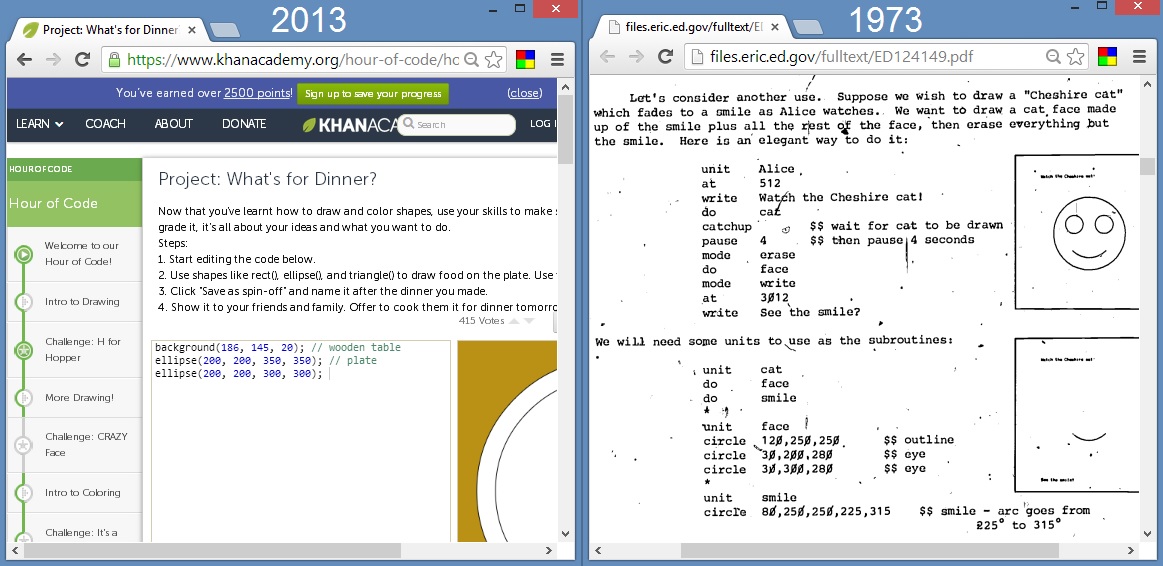
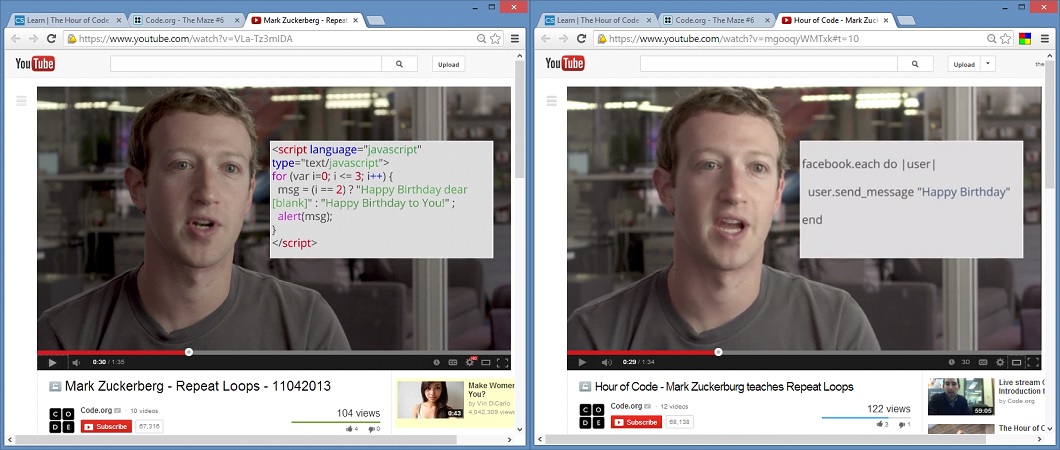
theodp writes "If one was introducing coding to 10 million K-12 kids over 5 days, one might settle on a programming language for examples more than a few weeks before D-Day. But the final tutorials for the Hour of Code aren't due now until the day they're to be taught, so Code.org was able to switch the example Facebook CEO Mark Zuckerberg uses to illustrate Repeat Loops from JavaScript to what looks like Ruby (earlier /. discussion of the JavaScript example), which will no doubt make things clearer for the kindergarten set working on the accompanying Angry Birds tutorial. Khan Academy, on the other hand, is sticking with JavaScript for its Hour of Code tutorial aimed at middle-schoolers, which culminates in a project showing the kids how they can draw a circular plate by invoking an ellipse function with equal major and minor axes. By the way, as Bret Victor might point out, the 2013 Khan Academy lesson looks a lot like circa-1973 PLATO!" -
Zuckerberg Shows Kindergartners Ruby Instead of JavaScript
theodp writes "If one was introducing coding to 10 million K-12 kids over 5 days, one might settle on a programming language for examples more than a few weeks before D-Day. But the final tutorials for the Hour of Code aren't due now until the day they're to be taught, so Code.org was able to switch the example Facebook CEO Mark Zuckerberg uses to illustrate Repeat Loops from JavaScript to what looks like Ruby (earlier /. discussion of the JavaScript example), which will no doubt make things clearer for the kindergarten set working on the accompanying Angry Birds tutorial. Khan Academy, on the other hand, is sticking with JavaScript for its Hour of Code tutorial aimed at middle-schoolers, which culminates in a project showing the kids how they can draw a circular plate by invoking an ellipse function with equal major and minor axes. By the way, as Bret Victor might point out, the 2013 Khan Academy lesson looks a lot like circa-1973 PLATO!" -
Interviews: Khan Academy Lead Developer Ben Kamens Answers Your Questions
A couple of weeks ago you had the chance to ask Khan Academy lead developer Ben Kamens about the future of online education and the academy itself. Below you'll find his answers to the questions we sent and a few extra that he found interesting. Higher Education
by null etc.
Joel Spolsky has famously stated that he prefers software engineers who come from highly accredited universities, preferably Ivy-league. His thought is that one has to distinguish oneself in order to be granted admission to such places. Do you think that Joel's opinion, and those of other elitist employers, will change with the introduction of free, quality online education?
Kamens:Yes. It's not just access to education, it's the ease with which somebody can demonstrate their ability. Ask any developer if they'd sleep better at night having just hired:
A) somebody from a no-name school with an impressive github profile and side projects
B) somebody from an impressive school with no github profile nor side projects
Then take everybody who answered B and keep them away from me. And here's the thing: I'm confident Joel agrees. Joel's most famous edict when it comes to hiring is making sure somebody's "Smart and Gets Things Done." There was a time when a college degree was the best credential for Smart and Gets Things Done. In many hiring situations, it still is.
In the programming world right now? Not so much. There are too many chances to prove your ability before you graduate for that name on your degree to carry all the weight. Sure, between two otherwise equal candidates, neither of whom have littered the internet with blog posts and side projects and bits of their code, highly accredited universities can still help differentiate. It's a helpful filter, especially when sorting through thousands of otherwise similar resumes.
Even at Fog Creek 6 years ago, graduating from a top-tier university only gave you one point (out of 6 possible) in the initial resume screening process...which was the most trivial part of an otherwise lengthy recruiting pipeline designed to figure out if you're Smart and Get Things Done.
Short version: yes, this is changing and will continue to. Quality online education will hopefully continue advancing alongside easier and easier ways to demonstrate your skills to the world. At Khan Academy, we've hired people from all sorts of colleges (even three high schoolers!) who've demonstrated tremendous skill way before a degree credentials it. We'll continue to do so.
Platform For Schools
by GeneralSecretary
I've heard that KhanAcademy has a platform for schools. Students can learn using Khan Academy and teachers can monitor their progress and help students where they need it most. When I last heard about this the platform was a pilot program being launched at select schools. Are there plans to make this platform generally available? or even open source?
Kamens:It's actually for any teacher in any school right now, for free. Our "teacher toolkit" is the best place to start, w/ videos of other schools' usage and tips from their implementations.
When a teacher signs up and gets their class on Khan Academy, they'll get the exact same platform our pilot classrooms receive. Same product a parent would get if they signed up with their child. Those teachers in the pilot program you mention aren't using anything special.
The significant difference is our ability to personally engage with specific teachers and classrooms. We're a small team and have to focus on a (relatively) small number of classrooms. We use these few pilots to get feedback, learn from students, try to understand how our product can empower teachers, etc. But any changes we make as a result are then given to all students around the world.
Verification
by GeneralSecretary
It seems to me that the problem with online education is being able to prove what you have learned. I can learn Calculus online at Khan Academy or at my local community college. I'll probably learn Calculus better at Khan Academy and for less money. But, I cannot use that knowledge to get a degree nor would I have any other way of proving my knowledge to other schools or potential employers. Do you have a solution to this problem?
Kamens:It's a big deal. The MOOCs have already started tackling this. Coursera, Udacity, and edX are working with colleges to provide official credit for their online classes.
There's more than one way to work this issue. The MOOCs are attempting to build an educational brand that's valued in much the same way as, say, Stanford. They can then hand out stamps of approval that serve as signals for employers or colleges who're trying to assess candidates.
There's also the github model. Github doesn't bill itself as an accreditation machine. It doesn't try to hand out branded stamps of approval. But talk to employers about the power of github profiles and you'll hear an interesting story. And they're not the only ones. Sites like Stack Overflow have managed to build systems of reputation that send meaningful signals (disclosure: I'm biased about Stack Overflow).
Bottom line: your question represents an *enormous*, world-changing opportunity, and Khan Academy has some important choices to make. The team is sprinting on this problem as I type.
Where are all the CS courses?
by Anonymous Coward
Where are all the "traditional" Computer Science courses? I'm not asking about the "interactive manual" type courses like how to do loops in Python - there are a ton of materials about that all over the web. I'm asking about theoretical computer science, such as Turing completeness, Chomsky hierarchy, abstract data types, compiler design, that kind of stuff which is the backbone of a university computer science education. The reason I'm asking is not to diminish the value of hands-on courses, but because many (including myself) were not able to get a "traditional" CS degree, coming into programming jobs from other disciplines (or no degree at all) and are largely self taught. Self teaching is great when it comes to practical stuff early on, but once you move on to more senior roles you start feeling the gaps of not understanding the theory behind your tools, design, and implementation, as much as you should.
Kamens:Agreed!
I'd encourage you to check out the computer science section we have. While it's not the high-level content you mention, it's far from those "interactive manuals" you see around the web. John Resig and his team have built something pretty special.
That being said, the most honest answer we can give when asked about missing content is that we've chosen to focus on a few topics (like core math) until we nail them and the experience built around them.
We're opportunistic when we find an incredible person to help us teach other areas while the rest of the team focuses on core math. Examples would be Dr. Beth Harris and Dr. Steven Zucker's Art History content and Vi Hart's brilliant and somewhat indescribable videos.
We are building quite a content team. There's little we don't hope to cover one day. Just not focusing on higher-level CS *yet*.
Explanation vs exploration: Pedagogical challenge?
by fantomas
I've heard a criticism of the Khan Academy pedagogic approach is that it is explanation based (effectively the old model: the teacher talks, the student listens, the student carries out an exercise, listens again) - while schools are moving towards exploration based learning (where students are encourage to try and approach problems from different angles supported by teacher-as-facilitator). To what extent does Khan Academy replicate a very old fashioned rote-learning form of education (albeit delivered and presented via a new media with minor improvements like pause and rewind), and in what aspects does it offer significant new pedagogical advances in learning?
Kamens:Dangit, I just listened to Sal answer this exact question at a dinner yesterday. Now you're gonna make me feel like I'm a puppet. I'll do my best to break free of these puppet shackles and answer with my own words.
The fundamental belief of Khan Academy is that students should engage with content they need on-demand, at their own pace. We agree that any curriculum that forces all students in a class to follow the same, preordained "watch this video, do this exercise, watch this other video" path isn't using technology in a meaningful way. So we design our product and work with teachers to help students feel ownership of the learning process.
Our classrooms see varying implementations, but the best of them try hard to help students move at their own pace. Some students might never need to listen to Sal say a word. They can master content by experimenting on their own. Absolutely. Fine. By. Us. Others may benefit from rewinding one of Sal's videos over and over and over until a concept clicks. But not every student masters content at the same speed.
It takes a fearless teacher to embrace this controlled chaos in a classroom. I've seen it happen. I have the highest respect in the world for those teachers able to do it. They're simultaneously ready to help mentor a student who's stuck working on fractions and another who may've advanced all the way to trigonometry. They let one student run free on her own while giving another strong encouragement to try the next challenge. Watching these teachers in action is a sight to behold.
Khan Academy exists to give students the freedom to engage with the content they need while giving teachers immediate feedback about who's working on what and where they need help. We think we can help teachers by making this acquisition of core skills a more personalized, efficient process.
In doing so, we hope to move teachers _up_ the value chain so they can focus on exploration-based learning and targeted coaching with the rest of their class time.
I personally think that'd be a significant advance in learning. And FWIW, we consider anybody who fights for exploration-based learning to be an ally of Khan Academy.
Plans to make KA easier for researchers to use?
by Anonymous Coward
I'm a middle school teacher experimenting with using KA with my classes. I think it is an amazing tool, especially for differentiation -- helping teachers to help their students who are behind have successes in math and, ideally, work towards getting caught back up to their peers. I think it can allow math teachers to do more interesting and fun (non-drill) types of work in the classroom, such as focusing more on students learning by doing open-ended, authentic, rich projects with each other. The key word there is that I *think* it must be helpful to the type of classroom described above. I want to know it is, and as part of our practice in Ontario, Canada, it is encouraged that teachers engage in personal inquiry projects to get more data on whether what we think is working actually is. It is difficult to get the data I need out of KA. We're having to do a lot of manual grabbing of student usage times and populating spreadsheets with that. Any plans to extend the external API to allow more sophisticated queries? Or, perhaps plans to provide a tool allowing more extensive data dumps which researchers can use? And if you don't have plans at the moment, does this post influence that? ;-) With a more thorough access to student data, I expect there will be researchers who will be more interested in investigating KA in their research and fleshing out the actual benefits (and also any issues that might be addressed). My students and I thank you!
Kamens:Holy crap, I should've just pasted your first couple sentences in response to the previous question! Would've been way more authentic.
Ouch. This one hits home. I want our API to support this type of thing, and I know it's far from perfect. Can you make sure the specific API queries you need are requested here? We haven't had time to do everything we want, but we're always on the lookout for big API wins that'll enable the community to build cool stuff. Thanks for being an early API adopter. Sorry you've had trouble. Please know that we want to help.
The large data dump request is a bit more complicated due to student privacy issues, but it's on our radar.
lead dev
by vlm
I always ask coder/tech types whats their coolest hack / coolest piece of code. Not something else someone else did, not some giant overall project or vague thing like "world peace" just your coolest isolated to one individual "thing" hack. Something they did personally not hired someone else to do, or something their boss did. Maybe in your LOB its an amazing caching technique, or an astounding way to compress video or whatever. Or some astounding workflow thingy. A short story just a paragraph no more. The kind of thing a /. audience would respond with "cool!" when they read it.
Kamens:While I can't promise "amazing" or "astounding" I can at least make you cringe. A couple years ago we had to take Khan Academy down for maintenance. Was gonna take a couple hours. We put up a cutesy little "Shhhh...we're studying!" page to let users know we'd be back soon.
We were Google App Engine novices at the time. The method we used to display that "Shhh...we're studying!" page did something we didn't expect: it returned a caching header that told all downstream clients to cache the page. For 365 days. For _all of our URLs_. And this was _entirely_ our fault (not App Engine's).
Every server or browser between us and our users was now allowed to return "Shhh...we're studying!" for every Khan Academy URL without ever asking us for new content. Our users were gonna sit there, smashing reload, and seeing "Shhh...we're studying!" for a freaking _year_. And our servers would never even see their requests to get a chance to fix the problem. Thankfully, the App Engine team came through in the middle of the night and gave us a way to clear the cache for exactly two URLs on all of their frontend servers, where most of this problematic caching was happening. We chose the homepage URL, www.khanacademy.org, and (here's where the hack comes in), the URL of javascript file that all of our pages, including the static "Shhhh...we're studying!" page, happened to be referencing. Something like khanacademy.org/jquery.js. We replaced that javascript file with a single line that redirected users to a new subdomain we'd set up at www2.khanacademy.org. The www2 URLs weren't cached all over the entire internet, so kids could start learning again!
Once the disaster died down we switched back to www.khanacademy.org and modified our URLs in a different way to avoid any remaining caches. Surprisingly, our traffic didn't take a hit and everything recovered nicely. But we wondered for about a year if anybody was still seeing that "Shhh...we're studying!" page.
Internships
by Niris
As someone who is currently a senior in computer science and looking for summer internships, what is it that Khan Academy developers look for in perspective interns? I've looked over the blog posts from some of the past interns, and their projects all seem pretty amazing. Is it possible for someone who doesn't have a fair amount of professional level experience to jump in to the internship program with Khan Academy? Disclaimer: I currently have an application in for the internship program, hence my curiosity :)
Kamens:Side projects. Blogs. Having built or written things that others find useful. Being passionate enough to find us and ask interview questions on slashdot.
A past filled with creating value will go a long, long way. Rooting for you.
Jude the Obscure
by Quirkz
Discussions about online learning tend to remind me of the book Jude the Obscure, by Thomas Hardy. It's been a couple of decades, but from what I remember it's the tragic story of a poor working man who dreams of pursuing education/knowledge but who can only barely scrape by with the essentials and can rarely afford even the occasional book. Do institutions like Khan Academy mostly or completely erase that scenario in the modern day? Would a modern Jude have been able to educate and better himself? Are there other obstacles that replace the cost as a barrier to taking this free learning and finding advancement or satisfaction?
Kamens:Ever read The Diamond Age? We give a copy to all interns on their first day. Our long-term sci-fi dream is to remove exactly these obstacles. If we can get one small step closer to The Young Lady's Illustrated Primer (sounds like it would've helped this Jude)...well, that's a dream. -
Interviews: Khan Academy Lead Developer Ben Kamens Answers Your Questions
A couple of weeks ago you had the chance to ask Khan Academy lead developer Ben Kamens about the future of online education and the academy itself. Below you'll find his answers to the questions we sent and a few extra that he found interesting. Higher Education
by null etc.
Joel Spolsky has famously stated that he prefers software engineers who come from highly accredited universities, preferably Ivy-league. His thought is that one has to distinguish oneself in order to be granted admission to such places. Do you think that Joel's opinion, and those of other elitist employers, will change with the introduction of free, quality online education?
Kamens:Yes. It's not just access to education, it's the ease with which somebody can demonstrate their ability. Ask any developer if they'd sleep better at night having just hired:
A) somebody from a no-name school with an impressive github profile and side projects
B) somebody from an impressive school with no github profile nor side projects
Then take everybody who answered B and keep them away from me. And here's the thing: I'm confident Joel agrees. Joel's most famous edict when it comes to hiring is making sure somebody's "Smart and Gets Things Done." There was a time when a college degree was the best credential for Smart and Gets Things Done. In many hiring situations, it still is.
In the programming world right now? Not so much. There are too many chances to prove your ability before you graduate for that name on your degree to carry all the weight. Sure, between two otherwise equal candidates, neither of whom have littered the internet with blog posts and side projects and bits of their code, highly accredited universities can still help differentiate. It's a helpful filter, especially when sorting through thousands of otherwise similar resumes.
Even at Fog Creek 6 years ago, graduating from a top-tier university only gave you one point (out of 6 possible) in the initial resume screening process...which was the most trivial part of an otherwise lengthy recruiting pipeline designed to figure out if you're Smart and Get Things Done.
Short version: yes, this is changing and will continue to. Quality online education will hopefully continue advancing alongside easier and easier ways to demonstrate your skills to the world. At Khan Academy, we've hired people from all sorts of colleges (even three high schoolers!) who've demonstrated tremendous skill way before a degree credentials it. We'll continue to do so.
Platform For Schools
by GeneralSecretary
I've heard that KhanAcademy has a platform for schools. Students can learn using Khan Academy and teachers can monitor their progress and help students where they need it most. When I last heard about this the platform was a pilot program being launched at select schools. Are there plans to make this platform generally available? or even open source?
Kamens:It's actually for any teacher in any school right now, for free. Our "teacher toolkit" is the best place to start, w/ videos of other schools' usage and tips from their implementations.
When a teacher signs up and gets their class on Khan Academy, they'll get the exact same platform our pilot classrooms receive. Same product a parent would get if they signed up with their child. Those teachers in the pilot program you mention aren't using anything special.
The significant difference is our ability to personally engage with specific teachers and classrooms. We're a small team and have to focus on a (relatively) small number of classrooms. We use these few pilots to get feedback, learn from students, try to understand how our product can empower teachers, etc. But any changes we make as a result are then given to all students around the world.
Verification
by GeneralSecretary
It seems to me that the problem with online education is being able to prove what you have learned. I can learn Calculus online at Khan Academy or at my local community college. I'll probably learn Calculus better at Khan Academy and for less money. But, I cannot use that knowledge to get a degree nor would I have any other way of proving my knowledge to other schools or potential employers. Do you have a solution to this problem?
Kamens:It's a big deal. The MOOCs have already started tackling this. Coursera, Udacity, and edX are working with colleges to provide official credit for their online classes.
There's more than one way to work this issue. The MOOCs are attempting to build an educational brand that's valued in much the same way as, say, Stanford. They can then hand out stamps of approval that serve as signals for employers or colleges who're trying to assess candidates.
There's also the github model. Github doesn't bill itself as an accreditation machine. It doesn't try to hand out branded stamps of approval. But talk to employers about the power of github profiles and you'll hear an interesting story. And they're not the only ones. Sites like Stack Overflow have managed to build systems of reputation that send meaningful signals (disclosure: I'm biased about Stack Overflow).
Bottom line: your question represents an *enormous*, world-changing opportunity, and Khan Academy has some important choices to make. The team is sprinting on this problem as I type.
Where are all the CS courses?
by Anonymous Coward
Where are all the "traditional" Computer Science courses? I'm not asking about the "interactive manual" type courses like how to do loops in Python - there are a ton of materials about that all over the web. I'm asking about theoretical computer science, such as Turing completeness, Chomsky hierarchy, abstract data types, compiler design, that kind of stuff which is the backbone of a university computer science education. The reason I'm asking is not to diminish the value of hands-on courses, but because many (including myself) were not able to get a "traditional" CS degree, coming into programming jobs from other disciplines (or no degree at all) and are largely self taught. Self teaching is great when it comes to practical stuff early on, but once you move on to more senior roles you start feeling the gaps of not understanding the theory behind your tools, design, and implementation, as much as you should.
Kamens:Agreed!
I'd encourage you to check out the computer science section we have. While it's not the high-level content you mention, it's far from those "interactive manuals" you see around the web. John Resig and his team have built something pretty special.
That being said, the most honest answer we can give when asked about missing content is that we've chosen to focus on a few topics (like core math) until we nail them and the experience built around them.
We're opportunistic when we find an incredible person to help us teach other areas while the rest of the team focuses on core math. Examples would be Dr. Beth Harris and Dr. Steven Zucker's Art History content and Vi Hart's brilliant and somewhat indescribable videos.
We are building quite a content team. There's little we don't hope to cover one day. Just not focusing on higher-level CS *yet*.
Explanation vs exploration: Pedagogical challenge?
by fantomas
I've heard a criticism of the Khan Academy pedagogic approach is that it is explanation based (effectively the old model: the teacher talks, the student listens, the student carries out an exercise, listens again) - while schools are moving towards exploration based learning (where students are encourage to try and approach problems from different angles supported by teacher-as-facilitator). To what extent does Khan Academy replicate a very old fashioned rote-learning form of education (albeit delivered and presented via a new media with minor improvements like pause and rewind), and in what aspects does it offer significant new pedagogical advances in learning?
Kamens:Dangit, I just listened to Sal answer this exact question at a dinner yesterday. Now you're gonna make me feel like I'm a puppet. I'll do my best to break free of these puppet shackles and answer with my own words.
The fundamental belief of Khan Academy is that students should engage with content they need on-demand, at their own pace. We agree that any curriculum that forces all students in a class to follow the same, preordained "watch this video, do this exercise, watch this other video" path isn't using technology in a meaningful way. So we design our product and work with teachers to help students feel ownership of the learning process.
Our classrooms see varying implementations, but the best of them try hard to help students move at their own pace. Some students might never need to listen to Sal say a word. They can master content by experimenting on their own. Absolutely. Fine. By. Us. Others may benefit from rewinding one of Sal's videos over and over and over until a concept clicks. But not every student masters content at the same speed.
It takes a fearless teacher to embrace this controlled chaos in a classroom. I've seen it happen. I have the highest respect in the world for those teachers able to do it. They're simultaneously ready to help mentor a student who's stuck working on fractions and another who may've advanced all the way to trigonometry. They let one student run free on her own while giving another strong encouragement to try the next challenge. Watching these teachers in action is a sight to behold.
Khan Academy exists to give students the freedom to engage with the content they need while giving teachers immediate feedback about who's working on what and where they need help. We think we can help teachers by making this acquisition of core skills a more personalized, efficient process.
In doing so, we hope to move teachers _up_ the value chain so they can focus on exploration-based learning and targeted coaching with the rest of their class time.
I personally think that'd be a significant advance in learning. And FWIW, we consider anybody who fights for exploration-based learning to be an ally of Khan Academy.
Plans to make KA easier for researchers to use?
by Anonymous Coward
I'm a middle school teacher experimenting with using KA with my classes. I think it is an amazing tool, especially for differentiation -- helping teachers to help their students who are behind have successes in math and, ideally, work towards getting caught back up to their peers. I think it can allow math teachers to do more interesting and fun (non-drill) types of work in the classroom, such as focusing more on students learning by doing open-ended, authentic, rich projects with each other. The key word there is that I *think* it must be helpful to the type of classroom described above. I want to know it is, and as part of our practice in Ontario, Canada, it is encouraged that teachers engage in personal inquiry projects to get more data on whether what we think is working actually is. It is difficult to get the data I need out of KA. We're having to do a lot of manual grabbing of student usage times and populating spreadsheets with that. Any plans to extend the external API to allow more sophisticated queries? Or, perhaps plans to provide a tool allowing more extensive data dumps which researchers can use? And if you don't have plans at the moment, does this post influence that? ;-) With a more thorough access to student data, I expect there will be researchers who will be more interested in investigating KA in their research and fleshing out the actual benefits (and also any issues that might be addressed). My students and I thank you!
Kamens:Holy crap, I should've just pasted your first couple sentences in response to the previous question! Would've been way more authentic.
Ouch. This one hits home. I want our API to support this type of thing, and I know it's far from perfect. Can you make sure the specific API queries you need are requested here? We haven't had time to do everything we want, but we're always on the lookout for big API wins that'll enable the community to build cool stuff. Thanks for being an early API adopter. Sorry you've had trouble. Please know that we want to help.
The large data dump request is a bit more complicated due to student privacy issues, but it's on our radar.
lead dev
by vlm
I always ask coder/tech types whats their coolest hack / coolest piece of code. Not something else someone else did, not some giant overall project or vague thing like "world peace" just your coolest isolated to one individual "thing" hack. Something they did personally not hired someone else to do, or something their boss did. Maybe in your LOB its an amazing caching technique, or an astounding way to compress video or whatever. Or some astounding workflow thingy. A short story just a paragraph no more. The kind of thing a /. audience would respond with "cool!" when they read it.
Kamens:While I can't promise "amazing" or "astounding" I can at least make you cringe. A couple years ago we had to take Khan Academy down for maintenance. Was gonna take a couple hours. We put up a cutesy little "Shhhh...we're studying!" page to let users know we'd be back soon.
We were Google App Engine novices at the time. The method we used to display that "Shhh...we're studying!" page did something we didn't expect: it returned a caching header that told all downstream clients to cache the page. For 365 days. For _all of our URLs_. And this was _entirely_ our fault (not App Engine's).
Every server or browser between us and our users was now allowed to return "Shhh...we're studying!" for every Khan Academy URL without ever asking us for new content. Our users were gonna sit there, smashing reload, and seeing "Shhh...we're studying!" for a freaking _year_. And our servers would never even see their requests to get a chance to fix the problem. Thankfully, the App Engine team came through in the middle of the night and gave us a way to clear the cache for exactly two URLs on all of their frontend servers, where most of this problematic caching was happening. We chose the homepage URL, www.khanacademy.org, and (here's where the hack comes in), the URL of javascript file that all of our pages, including the static "Shhhh...we're studying!" page, happened to be referencing. Something like khanacademy.org/jquery.js. We replaced that javascript file with a single line that redirected users to a new subdomain we'd set up at www2.khanacademy.org. The www2 URLs weren't cached all over the entire internet, so kids could start learning again!
Once the disaster died down we switched back to www.khanacademy.org and modified our URLs in a different way to avoid any remaining caches. Surprisingly, our traffic didn't take a hit and everything recovered nicely. But we wondered for about a year if anybody was still seeing that "Shhh...we're studying!" page.
Internships
by Niris
As someone who is currently a senior in computer science and looking for summer internships, what is it that Khan Academy developers look for in perspective interns? I've looked over the blog posts from some of the past interns, and their projects all seem pretty amazing. Is it possible for someone who doesn't have a fair amount of professional level experience to jump in to the internship program with Khan Academy? Disclaimer: I currently have an application in for the internship program, hence my curiosity :)
Kamens:Side projects. Blogs. Having built or written things that others find useful. Being passionate enough to find us and ask interview questions on slashdot.
A past filled with creating value will go a long, long way. Rooting for you.
Jude the Obscure
by Quirkz
Discussions about online learning tend to remind me of the book Jude the Obscure, by Thomas Hardy. It's been a couple of decades, but from what I remember it's the tragic story of a poor working man who dreams of pursuing education/knowledge but who can only barely scrape by with the essentials and can rarely afford even the occasional book. Do institutions like Khan Academy mostly or completely erase that scenario in the modern day? Would a modern Jude have been able to educate and better himself? Are there other obstacles that replace the cost as a barrier to taking this free learning and finding advancement or satisfaction?
Kamens:Ever read The Diamond Age? We give a copy to all interns on their first day. Our long-term sci-fi dream is to remove exactly these obstacles. If we can get one small step closer to The Young Lady's Illustrated Primer (sounds like it would've helped this Jude)...well, that's a dream. -
Interviews: Khan Academy Lead Developer Ben Kamens Answers Your Questions
A couple of weeks ago you had the chance to ask Khan Academy lead developer Ben Kamens about the future of online education and the academy itself. Below you'll find his answers to the questions we sent and a few extra that he found interesting. Higher Education
by null etc.
Joel Spolsky has famously stated that he prefers software engineers who come from highly accredited universities, preferably Ivy-league. His thought is that one has to distinguish oneself in order to be granted admission to such places. Do you think that Joel's opinion, and those of other elitist employers, will change with the introduction of free, quality online education?
Kamens:Yes. It's not just access to education, it's the ease with which somebody can demonstrate their ability. Ask any developer if they'd sleep better at night having just hired:
A) somebody from a no-name school with an impressive github profile and side projects
B) somebody from an impressive school with no github profile nor side projects
Then take everybody who answered B and keep them away from me. And here's the thing: I'm confident Joel agrees. Joel's most famous edict when it comes to hiring is making sure somebody's "Smart and Gets Things Done." There was a time when a college degree was the best credential for Smart and Gets Things Done. In many hiring situations, it still is.
In the programming world right now? Not so much. There are too many chances to prove your ability before you graduate for that name on your degree to carry all the weight. Sure, between two otherwise equal candidates, neither of whom have littered the internet with blog posts and side projects and bits of their code, highly accredited universities can still help differentiate. It's a helpful filter, especially when sorting through thousands of otherwise similar resumes.
Even at Fog Creek 6 years ago, graduating from a top-tier university only gave you one point (out of 6 possible) in the initial resume screening process...which was the most trivial part of an otherwise lengthy recruiting pipeline designed to figure out if you're Smart and Get Things Done.
Short version: yes, this is changing and will continue to. Quality online education will hopefully continue advancing alongside easier and easier ways to demonstrate your skills to the world. At Khan Academy, we've hired people from all sorts of colleges (even three high schoolers!) who've demonstrated tremendous skill way before a degree credentials it. We'll continue to do so.
Platform For Schools
by GeneralSecretary
I've heard that KhanAcademy has a platform for schools. Students can learn using Khan Academy and teachers can monitor their progress and help students where they need it most. When I last heard about this the platform was a pilot program being launched at select schools. Are there plans to make this platform generally available? or even open source?
Kamens:It's actually for any teacher in any school right now, for free. Our "teacher toolkit" is the best place to start, w/ videos of other schools' usage and tips from their implementations.
When a teacher signs up and gets their class on Khan Academy, they'll get the exact same platform our pilot classrooms receive. Same product a parent would get if they signed up with their child. Those teachers in the pilot program you mention aren't using anything special.
The significant difference is our ability to personally engage with specific teachers and classrooms. We're a small team and have to focus on a (relatively) small number of classrooms. We use these few pilots to get feedback, learn from students, try to understand how our product can empower teachers, etc. But any changes we make as a result are then given to all students around the world.
Verification
by GeneralSecretary
It seems to me that the problem with online education is being able to prove what you have learned. I can learn Calculus online at Khan Academy or at my local community college. I'll probably learn Calculus better at Khan Academy and for less money. But, I cannot use that knowledge to get a degree nor would I have any other way of proving my knowledge to other schools or potential employers. Do you have a solution to this problem?
Kamens:It's a big deal. The MOOCs have already started tackling this. Coursera, Udacity, and edX are working with colleges to provide official credit for their online classes.
There's more than one way to work this issue. The MOOCs are attempting to build an educational brand that's valued in much the same way as, say, Stanford. They can then hand out stamps of approval that serve as signals for employers or colleges who're trying to assess candidates.
There's also the github model. Github doesn't bill itself as an accreditation machine. It doesn't try to hand out branded stamps of approval. But talk to employers about the power of github profiles and you'll hear an interesting story. And they're not the only ones. Sites like Stack Overflow have managed to build systems of reputation that send meaningful signals (disclosure: I'm biased about Stack Overflow).
Bottom line: your question represents an *enormous*, world-changing opportunity, and Khan Academy has some important choices to make. The team is sprinting on this problem as I type.
Where are all the CS courses?
by Anonymous Coward
Where are all the "traditional" Computer Science courses? I'm not asking about the "interactive manual" type courses like how to do loops in Python - there are a ton of materials about that all over the web. I'm asking about theoretical computer science, such as Turing completeness, Chomsky hierarchy, abstract data types, compiler design, that kind of stuff which is the backbone of a university computer science education. The reason I'm asking is not to diminish the value of hands-on courses, but because many (including myself) were not able to get a "traditional" CS degree, coming into programming jobs from other disciplines (or no degree at all) and are largely self taught. Self teaching is great when it comes to practical stuff early on, but once you move on to more senior roles you start feeling the gaps of not understanding the theory behind your tools, design, and implementation, as much as you should.
Kamens:Agreed!
I'd encourage you to check out the computer science section we have. While it's not the high-level content you mention, it's far from those "interactive manuals" you see around the web. John Resig and his team have built something pretty special.
That being said, the most honest answer we can give when asked about missing content is that we've chosen to focus on a few topics (like core math) until we nail them and the experience built around them.
We're opportunistic when we find an incredible person to help us teach other areas while the rest of the team focuses on core math. Examples would be Dr. Beth Harris and Dr. Steven Zucker's Art History content and Vi Hart's brilliant and somewhat indescribable videos.
We are building quite a content team. There's little we don't hope to cover one day. Just not focusing on higher-level CS *yet*.
Explanation vs exploration: Pedagogical challenge?
by fantomas
I've heard a criticism of the Khan Academy pedagogic approach is that it is explanation based (effectively the old model: the teacher talks, the student listens, the student carries out an exercise, listens again) - while schools are moving towards exploration based learning (where students are encourage to try and approach problems from different angles supported by teacher-as-facilitator). To what extent does Khan Academy replicate a very old fashioned rote-learning form of education (albeit delivered and presented via a new media with minor improvements like pause and rewind), and in what aspects does it offer significant new pedagogical advances in learning?
Kamens:Dangit, I just listened to Sal answer this exact question at a dinner yesterday. Now you're gonna make me feel like I'm a puppet. I'll do my best to break free of these puppet shackles and answer with my own words.
The fundamental belief of Khan Academy is that students should engage with content they need on-demand, at their own pace. We agree that any curriculum that forces all students in a class to follow the same, preordained "watch this video, do this exercise, watch this other video" path isn't using technology in a meaningful way. So we design our product and work with teachers to help students feel ownership of the learning process.
Our classrooms see varying implementations, but the best of them try hard to help students move at their own pace. Some students might never need to listen to Sal say a word. They can master content by experimenting on their own. Absolutely. Fine. By. Us. Others may benefit from rewinding one of Sal's videos over and over and over until a concept clicks. But not every student masters content at the same speed.
It takes a fearless teacher to embrace this controlled chaos in a classroom. I've seen it happen. I have the highest respect in the world for those teachers able to do it. They're simultaneously ready to help mentor a student who's stuck working on fractions and another who may've advanced all the way to trigonometry. They let one student run free on her own while giving another strong encouragement to try the next challenge. Watching these teachers in action is a sight to behold.
Khan Academy exists to give students the freedom to engage with the content they need while giving teachers immediate feedback about who's working on what and where they need help. We think we can help teachers by making this acquisition of core skills a more personalized, efficient process.
In doing so, we hope to move teachers _up_ the value chain so they can focus on exploration-based learning and targeted coaching with the rest of their class time.
I personally think that'd be a significant advance in learning. And FWIW, we consider anybody who fights for exploration-based learning to be an ally of Khan Academy.
Plans to make KA easier for researchers to use?
by Anonymous Coward
I'm a middle school teacher experimenting with using KA with my classes. I think it is an amazing tool, especially for differentiation -- helping teachers to help their students who are behind have successes in math and, ideally, work towards getting caught back up to their peers. I think it can allow math teachers to do more interesting and fun (non-drill) types of work in the classroom, such as focusing more on students learning by doing open-ended, authentic, rich projects with each other. The key word there is that I *think* it must be helpful to the type of classroom described above. I want to know it is, and as part of our practice in Ontario, Canada, it is encouraged that teachers engage in personal inquiry projects to get more data on whether what we think is working actually is. It is difficult to get the data I need out of KA. We're having to do a lot of manual grabbing of student usage times and populating spreadsheets with that. Any plans to extend the external API to allow more sophisticated queries? Or, perhaps plans to provide a tool allowing more extensive data dumps which researchers can use? And if you don't have plans at the moment, does this post influence that? ;-) With a more thorough access to student data, I expect there will be researchers who will be more interested in investigating KA in their research and fleshing out the actual benefits (and also any issues that might be addressed). My students and I thank you!
Kamens:Holy crap, I should've just pasted your first couple sentences in response to the previous question! Would've been way more authentic.
Ouch. This one hits home. I want our API to support this type of thing, and I know it's far from perfect. Can you make sure the specific API queries you need are requested here? We haven't had time to do everything we want, but we're always on the lookout for big API wins that'll enable the community to build cool stuff. Thanks for being an early API adopter. Sorry you've had trouble. Please know that we want to help.
The large data dump request is a bit more complicated due to student privacy issues, but it's on our radar.
lead dev
by vlm
I always ask coder/tech types whats their coolest hack / coolest piece of code. Not something else someone else did, not some giant overall project or vague thing like "world peace" just your coolest isolated to one individual "thing" hack. Something they did personally not hired someone else to do, or something their boss did. Maybe in your LOB its an amazing caching technique, or an astounding way to compress video or whatever. Or some astounding workflow thingy. A short story just a paragraph no more. The kind of thing a /. audience would respond with "cool!" when they read it.
Kamens:While I can't promise "amazing" or "astounding" I can at least make you cringe. A couple years ago we had to take Khan Academy down for maintenance. Was gonna take a couple hours. We put up a cutesy little "Shhhh...we're studying!" page to let users know we'd be back soon.
We were Google App Engine novices at the time. The method we used to display that "Shhh...we're studying!" page did something we didn't expect: it returned a caching header that told all downstream clients to cache the page. For 365 days. For _all of our URLs_. And this was _entirely_ our fault (not App Engine's).
Every server or browser between us and our users was now allowed to return "Shhh...we're studying!" for every Khan Academy URL without ever asking us for new content. Our users were gonna sit there, smashing reload, and seeing "Shhh...we're studying!" for a freaking _year_. And our servers would never even see their requests to get a chance to fix the problem. Thankfully, the App Engine team came through in the middle of the night and gave us a way to clear the cache for exactly two URLs on all of their frontend servers, where most of this problematic caching was happening. We chose the homepage URL, www.khanacademy.org, and (here's where the hack comes in), the URL of javascript file that all of our pages, including the static "Shhhh...we're studying!" page, happened to be referencing. Something like khanacademy.org/jquery.js. We replaced that javascript file with a single line that redirected users to a new subdomain we'd set up at www2.khanacademy.org. The www2 URLs weren't cached all over the entire internet, so kids could start learning again!
Once the disaster died down we switched back to www.khanacademy.org and modified our URLs in a different way to avoid any remaining caches. Surprisingly, our traffic didn't take a hit and everything recovered nicely. But we wondered for about a year if anybody was still seeing that "Shhh...we're studying!" page.
Internships
by Niris
As someone who is currently a senior in computer science and looking for summer internships, what is it that Khan Academy developers look for in perspective interns? I've looked over the blog posts from some of the past interns, and their projects all seem pretty amazing. Is it possible for someone who doesn't have a fair amount of professional level experience to jump in to the internship program with Khan Academy? Disclaimer: I currently have an application in for the internship program, hence my curiosity :)
Kamens:Side projects. Blogs. Having built or written things that others find useful. Being passionate enough to find us and ask interview questions on slashdot.
A past filled with creating value will go a long, long way. Rooting for you.
Jude the Obscure
by Quirkz
Discussions about online learning tend to remind me of the book Jude the Obscure, by Thomas Hardy. It's been a couple of decades, but from what I remember it's the tragic story of a poor working man who dreams of pursuing education/knowledge but who can only barely scrape by with the essentials and can rarely afford even the occasional book. Do institutions like Khan Academy mostly or completely erase that scenario in the modern day? Would a modern Jude have been able to educate and better himself? Are there other obstacles that replace the cost as a barrier to taking this free learning and finding advancement or satisfaction?
Kamens:Ever read The Diamond Age? We give a copy to all interns on their first day. Our long-term sci-fi dream is to remove exactly these obstacles. If we can get one small step closer to The Young Lady's Illustrated Primer (sounds like it would've helped this Jude)...well, that's a dream. -
Khan Academy Will Be Ready For Its Close-Up In Idaho
theodp writes "Education officials with Northwest Nazarene University and the J.A. and Kathryn Albertson Foundation say they are arranging to have Khan Academy classes tested in about two dozen public schools next fall in Idaho, where state law now requires high school students to take online courses for two of their 47 graduation credits. 'This is the first time Khan Academy is partnering to tackle the math education of an entire state,' said Khan Academy's Maureen Suhendra. Alas, the Idaho Press-Tribune reports (alas, behind a paywall) that next fall would be too late for film director and producer Davis Guggenheim (Waiting for Superman, An Inconvenient Truth), who will be in Idaho in January filming The Great Teacher Project, a documentary which will highlight positives of education, like the Khan Academy pilot in Idaho. Not to worry. For the film, a few teachers will implement Khan Academy in day-to-day teaching starting in January, before the entire pilot program launches in fall 2013." -
Are Teachers Headed For Obsolescence?
dstates writes "One Laptop Per Child reports encouraging results of a bold experiment to reach the millions of students worldwide who have no access to primary school. OLPC delivered tablets to two Ethiopian villages in unmarked boxes without instructions or instructors. Within minutes the kids were opening the boxes and figuring out how to use the Motorola Zoom tablets, within days they were playing alphabet songs and withing a few months how to hack the user interface to enable blocked camera functionality. With the Kahn Academy and others at the high school level and massive open online courses at the college level, are teachers going the way of the Dodo?" -
Khan Academy Pilot Educators On Khan Academy
theodp writes "In what may surprise Khan Academy backers Google and Bill Gates, educators from the Los Altos School District where KA was initially piloted and implemented have responded to some recent KA critiques with a blog entry which notes, 'Teachers in our district have determined that the greatest value of the Khan Academy lies, not in the videos, but in the exercise modules and data generated as students work practice problems.' Not too surprisingly, when it comes to revolutionizing student learning, teachers are bullish on teachers. 'Key to this revolution are the Los Altos teachers,' the educators conclude. 'Teachers in our district are highly valued for their pedagogical perspective, content knowledge, experience, and creative abilities. When district administrators put tools in the hands of teachers and give them room to work, amazing things happen for students. Tools will come and go, but it's the teachers who create meaningful learning experiences that challenge students to grow.'" -
Khan Academy Launches Computer Science Curriculum
joabj writes "Expanding beyond math and the physical sciences, Khan Academy has added a set of computer science courses to its popular collection of learn-at-home instructional videos. For the project, Khan tapped jQuery creator John Resig, who chose JavaScript as the first language to teach students. The initial set of tutorials cover drawing, programming basics, animation and user interaction." -
Will Online Learning Disrupt Programming Language Adoption?
theodp writes "Back in the day, getting traction for a new programming language was next to impossible. First, one needed a textbook publishing deal. Then, one needed a critical mass of CS profs across the country to convince their departments that your language was worth teaching at the university level. And after that, one still needed a critical mass of students to agree it was worth spending their time and tuition to learn your language. Which probably meant that one needed a critical mass of corporations to agree they wanted their employees to use your language. It was a tall order that took years if one was lucky, and only some languages — FORTRAN, PL/I, C, Java, and Python come to mind — managed to succeed on all of these fronts. But that was then, this is now. Whip up some online materials, and you can kiss your textbook publishing worries goodbye. Manage to convince just one of the new Super Profs at Udacity or Coursera to teach your programming language, and they can reach 160,000 students with just one free, not-for-credit course. And even if the elite Profs turn up their nose at your creation, upstarts like Khan Academy or Code Academy can also deliver staggering numbers of students in a short time. In theory, widespread adoption of a new programming language could be achieved in weeks instead of years or decades, piquing employers' interest. So, could we be on the verge of a programming language renaissance? Or will the status quo somehow manage to triumph?" -
Let Them Eat Khan Academy
theodp writes "Connie Ballmer announced that Seattle's Lakeside School and nine other private schools have formed the Global Online Academy to enhance learning opportunities for students at the elite institutions, some of which charge upwards of $35,000 in tuition and count the likes of Bill Gates, President Obama, Steve Case, Mitt Romney, and Sean Lennon as alums. 'Independent schools have traditionally struggled with how to provide their education models and resources to a wider student population in order to serve a public purpose,' Ballmer explained. 'While the initial classes will be for students at member schools only there is potential to share them with a broader community and help narrow the disparity of educational opportunity.' In the meantime, there's always Khan Academy." -
Gates' Future of Education Straight Out of '60s
theodp writes "Bill Gates really should have talked more with ex-Microsoft CTO Ray Ozzie. While Khan Academy's new self-paced exercises, coach management options, and game mechanics (merit badges/points) prompted Gates to gush to the high-rollers at Salman Khan's TED Talk that they 'just got a glimpse of the future of education,' Ozzie's seen this movie before, having written similarly-featured PLATO courseware as a student at Illinois. In the '70s. On plasma terminals. With touch screens. Fifty years ago last Friday, 27-year-old EE PhD whiz kid Don Bitzer and partner Peter Braunfeld demonstrated the nascent PLATO system to assembled dignitaries at the 'President's Faculty Conference on Improving Our Educational Aims in the Sixties.' Hey, everything old is new again! Gates is hardly the only tech luminary who don't-know-much-about-PLATO-history — CS Prof Daniel Sleator felt compelled to school the Web's founders on PLATO in '94." -
BitTorrent and Khan Academy To Distribute Education
drDugan writes "BitTorrent, Inc. announced this morning that they have launched a partnership with the Khan Academy to distribute open education videos. They launched with more than 2,000 videos, covering high school and college level curriculum, across science, math, history, finance and test prep. All of the videos are free to download and open licensed with Creative Commons." -
Google Announces Project 10^100 Winners
Kilrah_il writes with news that Google has selected winners for Project 10^100, a contest to find the best ideas to change the world. Among the winners is the Khan Academy, which we've discussed previously. Google is "providing $2 million to support the creation of more courses and to enable the Khan Academy to translate their core library into the world’s most widely spoken languages." The other winning projects are: FIRST, an organization fostering math and science education through team competition; Public.Resource.Org, a government transparency effort focused on online access to public documents; Shweeb, a silly-looking method of human-powered urban transit; and the African Institute for Mathematical Sciences, a center aimed at promoting graduate-level math and science education in Africa. -
Bill Gates Enrolls His Kids In Khan Academy
theodp writes "At some schools, a teaching load of five courses every academic year is considered excessive. But Sal Khan, as an earlier Slashdot post noted, manages to deliver his mini-lectures an average of 70,000 times a day. BusinessWeek reports that Khan Academy has a new fan in Bill Gates, who's been singing and tweeting the praises of the free-as-in-beer website. 'This guy is amazing,' Gates wrote. 'It is awesome how much he has done with very little in the way of resources.' Gates and his 11-year-old son have been soaking up videos, from algebra to biology. And at the Aspen Ideas Festival in front of 2,000 people, Gates gave Khan a shout-out, touting the 'unbelievable' Khan Academy tutorials that 'I've been using with my kids.'" -
Khan Academy Delivers 100,000 Lectures Daily
eldavojohn writes "Working from the comfort of his home, Salman Khan has made available more than 1,500 mini-lectures to educate the world. Subjects range from math and physics to finance, biology, and current economics. Kahn Academy amounts to little more than a YouTube channel and one very devoted man. He is trying to provide education in the way he wished he had been taught. With more than 100,000 video views a day, the man is making a difference for many students. In his FAQ he explains how he knows he is being effective. What will probably ensure his popularity (and provide a legacy surpassing that of most highly paid educators) is that everything is licensed under Creative Commons 3.0. He only needs his time, a $200 Camtasia Recorder, an $80 Wacom Bamboo Tablet, and a free copy of SmoothDraw3. While the lecturing may not be quite up to the Feynman level, it's a great augmenter for advanced learners, and a lifeline for those without much access to learning resources." -
Khan Academy Delivers 100,000 Lectures Daily
eldavojohn writes "Working from the comfort of his home, Salman Khan has made available more than 1,500 mini-lectures to educate the world. Subjects range from math and physics to finance, biology, and current economics. Kahn Academy amounts to little more than a YouTube channel and one very devoted man. He is trying to provide education in the way he wished he had been taught. With more than 100,000 video views a day, the man is making a difference for many students. In his FAQ he explains how he knows he is being effective. What will probably ensure his popularity (and provide a legacy surpassing that of most highly paid educators) is that everything is licensed under Creative Commons 3.0. He only needs his time, a $200 Camtasia Recorder, an $80 Wacom Bamboo Tablet, and a free copy of SmoothDraw3. While the lecturing may not be quite up to the Feynman level, it's a great augmenter for advanced learners, and a lifeline for those without much access to learning resources."