Slashdot Mirror
Domain: kth.se
Stories and comments across the archive that link to kth.se.
Comments · 242
-
What is P vs. NP and why should I care?Perhaps you are wondering what an NP-complete problem is or what this P vs. NP stuff is all about. You might want to check out the comp.theory FAQ and scroll down to 7. P vs NP. It gives a bit of history and a decent description.
Or check out The P versus NP Problem at Clay for a really good description (unfortunately too long to quote here). And lastly, you might want to check out Tutorial: Does P = NP? at VB Helper for a little more info.
Ok, but what is it good for? The Compendium of NP Optimization Problems is a great place to look for real world examples of NP problems. Including everything from flower shop scheduling to multiprocessor scheduling.
Hopefully that helps. I was very clueless when it came to P vs. NP stuff that always seems to be mentioned on Slashdot. So I took the time to look it up. Now I'm clueless but I have links to share.
-
Re:Excellent! But...
As the developer and maintainer of a little GTK+-based application (plug, plug),
I was a user of your Gentoo file manager and can highly recommend it (since I am an old Amiga user
Also high on my list of applications that ought to be in distributions, but are not, is the visual system monitor qps.
Do distributors have a "suggestion form" that one can fill out to request an application included in new versions?
-
Several versions
Shameless plug: Or you can use a ports tree that allows you to have several versions of libraries installed simultaneously.
-
Re:Kerberos and MITBoth are from the Swedish PDC (Centre for Parallel Computers), and are the only two Kerberos implementations I've ever used besides MIT's and Transarc's. (Transarc's implementation was a proprietary extension of MIT krb4, and was included in AFS. However, the OpenAFS developer community reccomends against using Transarc's krb4, and instead suggests using MIT or Heimdal krb5.)
-
Re:Kerberos and MITBoth are from the Swedish PDC (Centre for Parallel Computers), and are the only two Kerberos implementations I've ever used besides MIT's and Transarc's. (Transarc's implementation was a proprietary extension of MIT krb4, and was included in AFS. However, the OpenAFS developer community reccomends against using Transarc's krb4, and instead suggests using MIT or Heimdal krb5.)
-
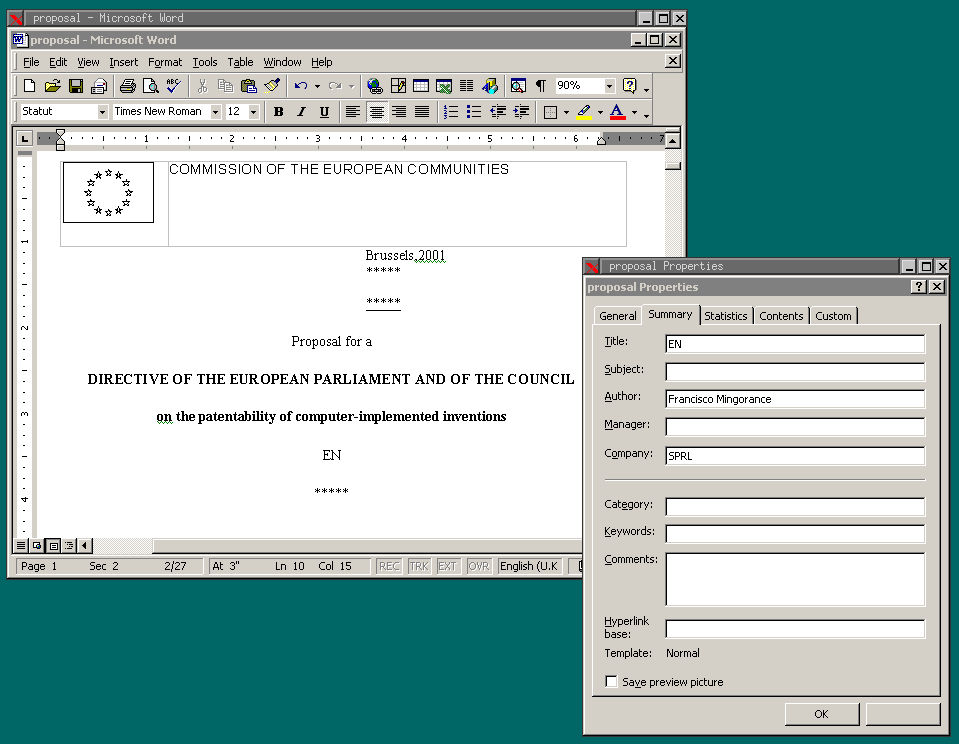
Nice screenshot of our so-called democratic union.
This nice shot in compination with the bottom of this page.
-
Atom Bomb Links
There is a link here of history of the atomic bomb. Oh, and it includes directions on how one is built as well.
On August 2nd 1939, just before the beginning of World War II, Albert Einstein wrote to then President Franklin D. Roosevelt. Einstein and several other scientists told Roosevelt of efforts in Nazi Germany to purify U-235 with which might in turn be used to build an atomic bomb. It was shortly thereafter that the United States Government began the serious undertaking known only then as the Manhattan Project. Simply put, the Manhattan Project was committed to expedient research and production that would produce a viable atomic bomb.
This and this link describe the Japanese atomic bomb program. Germany sent a submarine to Japan carrying uranium oxide, a needed element in building an a-bomb, but it surrendered after Hitler's defeat and was confiscated by the U.S. This uranium could have been used in the atom bombs dropped on Hiroshima and Nagasaki.
Another good link is here.
There was reason to fear that Germany might win the race to produce the bomb. Fission had been discovered in Germany, and German scientists were at least as able as anyone else to assess its significance. Moreover, it seemed ominous that Germany had stopped the sale of uranium ore from the rich mines in Czechoslovakia. Up until mid-1941, concern over a German bomb had been stronger in Britain than in the United States. About that time, however, the sense of urgency began to pervade U.S. nuclear scientists. -
Re:Bill gets a new hat!
That photo is from the ceremony where Bill was awarded an honorary Doctorate by KTH, the Royal Institute of Technology in Stockholm.
Why they decided to do that, I do not know. -
Kerberos for authentication, KISS the rest.
Use Kerberos for authentication. There are PAM modules out there, and it is also supported in Windows 2000 (sort of).
You also need to distribute a passwd file. We store ours in AFS and distribute it using scripts run by cron. Since doesn't contain any password, users do not really need to touch it, but we generate the global passwd file from data in a database anyway. You might want to put stuff like e-mail forwarding information in that database as well, propagate it to the mail server using some simple scripts, and let your users access the database somehow. (Perhaps through a Kerberos authenticating gateway.)
KISS -
Re:Samba is cool,
-
AFS is good. Not buggy kernel code.If you use the Arla AFS client, you won't have to put a lot of buggy code into your kernel, because most of the code is in a user-space daemon. The kernel module is really small.
AFS is good. The volume management is great, and you get real access control lists with groups. How about moving a users home directory to a different server, while the user is logged in? It's completly transparent. Or how about letting people create their own groups? That is useful. And there's proper authentication.
Random advice:
- Use Heimdal Kerberos 5 KDCs (plural for redundancy). Do not use the kaserver that comes with AFS.
- Put Heimdal and KTH-KRB (kerb 4) on all clients.
- Use OpenAFS servers.
- Use OpenAFS clients for Solaris, and Arla AFS clients for Linux 2.2.x. For Linux 2.4.x, OpenAFS clients might work better. I don't know, and probably it depends.
-
AFS is good. Not buggy kernel code.If you use the Arla AFS client, you won't have to put a lot of buggy code into your kernel, because most of the code is in a user-space daemon. The kernel module is really small.
AFS is good. The volume management is great, and you get real access control lists with groups. How about moving a users home directory to a different server, while the user is logged in? It's completly transparent. Or how about letting people create their own groups? That is useful. And there's proper authentication.
Random advice:
- Use Heimdal Kerberos 5 KDCs (plural for redundancy). Do not use the kaserver that comes with AFS.
- Put Heimdal and KTH-KRB (kerb 4) on all clients.
- Use OpenAFS servers.
- Use OpenAFS clients for Solaris, and Arla AFS clients for Linux 2.2.x. For Linux 2.4.x, OpenAFS clients might work better. I don't know, and probably it depends.
-
AFS is good. Not buggy kernel code.If you use the Arla AFS client, you won't have to put a lot of buggy code into your kernel, because most of the code is in a user-space daemon. The kernel module is really small.
AFS is good. The volume management is great, and you get real access control lists with groups. How about moving a users home directory to a different server, while the user is logged in? It's completly transparent. Or how about letting people create their own groups? That is useful. And there's proper authentication.
Random advice:
- Use Heimdal Kerberos 5 KDCs (plural for redundancy). Do not use the kaserver that comes with AFS.
- Put Heimdal and KTH-KRB (kerb 4) on all clients.
- Use OpenAFS servers.
- Use OpenAFS clients for Solaris, and Arla AFS clients for Linux 2.2.x. For Linux 2.4.x, OpenAFS clients might work better. I don't know, and probably it depends.
-
Re:Help... Please?
we have never converted one element into another before (at least not this way).
"Nuclear transmutation was first demonstrated by Rutherford in 1919 , who transmuted 14N to 17O using energetic alpha-particles." source -
Been there, done that..Cool. We actualy have the first installed TAN cube in the world here at KTH (Royal Institute of Technology) Stockholm, Sweden. Ours are feeded by two SGI Onyx 2000's which each have 3 pipelines each feeding all 6 projectors.
You can see the pictures of it here:
http://www.pdc.kth.se/projects/vr-cube/photo-galle ry.html -
Re:No such thing as a free lunch
once the plant is decomissioned, as I recall it gets buried in concrete and/or glass for some long time>
Yeah, Destroying the ecology in a small area around a power plant is way worse than spewing fossil fuel exhaust directly into the air, huh?
the East Coast's continental shelf could support a gigantic wind farm with minimal environmental impact.
I bet that's what they used to think about burning coal and oil.
From what I've read, some wind farms are already price-competitive with coal, etc.
All sarcasm aside, where did you hear this? Is that taking into account the government subsidies and tax breaks? I would be absolutely shocked (and excited) if the cost of equipment, maintenance, and implementation of wind (or solar) power generation could equal fossil-fuel power generation over time.
The way I see it, the simple fact is that you can not extract energy from a system without altering the system. If you're (not directed to anyone in particular) not willing to destroy anything, well... I would say you'd better just kill yourself now, but then you'd be destroying the habitat of countless microbes currently residing in your body. However, you certainly can't go on living, because your home is taking up space where millions of other beings could be living. Your immune system is killing off hordes of innocent virii, bacteria, and fungi every day, just trying to eke out a living in your body. If you don't care about the plants even the most die-hard vegan kills directly, what about their effects higher up the foodchain? How many widdle bunnies starve to death when they could've been fed on the aforementioned vegans' breakfast of lettuce?
You simply can not live (or die) without altering your environment. This applies to all aspects of life, including energy conversaion/usage. The best we can hope for is to improve our efficiency and reduce our impact on the systems we know about. After all, if we start pulling all our energy from the wind, what will that do to weather patterns? How many plants would die off if we started sucking up all the sunlight? I imagine Greenpeace and the ELF will be happy to tell you about the impacts of hydroelectric plants. Okay, so maybe we shouldn't try to pull enery out of the earth's systems. Maybe we should go extraterrestrial, and build a Dyson Sphere or something. Great, until we discover what the rest of the universe was doing with that energy we just nabbed. The alernative? I don't see one. Simply do the best we can. -
Sounds like MPKGMPKG (old release here) is a ports tree that installs all applications in separate directories. That also means that you can have several versions of the same program installed concurrently. It generates config files for the modules package which will manage the PATH and other environment variables for the user.
It works pretty well, but still all programs that should show up in the Gnome or KDE menus etc. are still installed along with those packages. It is also often a lot of work to get programs to not install in
-
Re:Sounds GoodAh, the joys of analog. I regularly look though my log files for interesing stuff. Stuff people have been looking for and finding my web site (not as perverted as indicated) include:
- "Long fingernail and long toenail fetish"
- "mime nude photos"
- "16 year old boys whith arm pit hair"
- "easy and fast directions to make crack cocaine in the microwave"
- "but she was my student why did i have impure thoughs"
- "nude cartoons inspector gadget"
- "secrets on how to suntan through your computer"
-
Re:God damned MP3 anti-pirate busybodies...
If your home computer is online 24/7 (which is presumably is if you're on broadband) t's cooler to use SAMBA, AFS (or here), Coda, InterMezzo, NFS, or the unfinished Lustre. If you're not big on effort, set up an http or ftp (or gopher!) server. That way, you have an automatically up-to-date menu of your mp3s, where you can access all your music any time you can connect to the 'Net.
This box is just itching to be a Coda server. -
Re:12$ Solution, Simple, but what if...I remember seeing a television commercial that ran in Texas during the late 70s. It advertised an oil drilling services company, the type of outfit you'd hire to keep parts and pipe supplied to a drilling site. The commercial claimed decades of experience and pleased customers, and ended with the exhortation "You say you don't have an oil well ? Well GET ONE!!!"
I believe that applies in this case.
But should you not wish to get linux installed on a machine, look at these links (obtained by the google search on "Reading an HFS disk on Windows")
Good luck and have fun.
-
AFS is good
We use (commercial) AFS extensively at Boston University. We've historically had some trouble with getting updated client software for new operating system versions in a timely matter, so OpenAFS is pretty exciting to us. We have been using arla as our Linux client, but unfortunately have some serious reliability issues, so we've been testing OpenAFS and will probably ship that in the upcoming BU Linux 2.0.
-
Global File System (GFS) Rewritten in SPLPosted by Hemos on Fri August 31, 17:01 from the speak-thy-mind dept.
thk writes "Sistina, the main developer of the Global File System, has changed its language from C to SPL (Shakespeare Programming Language). SPL is basically a language to make the source code for programs written with it, resemble a Shakespeare play. Interestingly, the change came just after beta testing, leaving some users a bit miffed. The GFS is an important component of some GPL clustering projects, such as Compaq's SSIC project. The Sistina press release is here."
-
Re:Natural lang processing isn't real work?
I'm sorry that a lot of people seem to misunderstand my attempts at "so called" humor. Of course I think the two SPL creators (who are friends of mine) have done real work.
Maybe not useful work (as in creating peace, ending world hunger etc etc) for our society at large, but interesting, funny and cool work.
The language grew out of a lab assignment in a syntax analysis course at our school. If viewed as a lab assignment, SPL is probably a little more work than the course coordinator demands
/Erik
-
Re:Natural lang processing isn't real work?
I'm sorry that a lot of people seem to misunderstand my attempts at "so called" humor. Of course I think the two SPL creators (who are friends of mine) have done real work.
Maybe not useful work (as in creating peace, ending world hunger etc etc) for our society at large, but interesting, funny and cool work.
The language grew out of a lab assignment in a syntax analysis course at our school. If viewed as a lab assignment, SPL is probably a little more work than the course coordinator demands
/Erik
-
Re:real work
Yes. Of course I was only trying (and failing) to be funny. I'm also a CompSci-student here in Stockholm and the SPL creators are friends of mine at The Royal Institute of Technology.
Mr. Torvalds and Linux is another pretty good example of what university students can create when they probably should use their time to "real school work".
As I said. Only trying to be amusing. Next time I'll just submit a URL.
/Erik Tjernlund -
Temporary mirror
We didn't expect the slashdot effect (well, not so soon anyway
http://cgi.student.nada.kth.se/~d98-jas/shakespea
--r e/
Jon Åslund (one of the authors) -
Re:and the answer is?
Slightly OT:
There is also arla, a free AFS client/server that existed before OpenAFS came about. The client works quite well in Linux. I used it on my PC alot last year. But, yes, IBM already has their very own AFS client for linux (and server too, I assume). -
mpkg: Yet Another Ports Tree
If you like ports, check out mpkg. It is another ports tree for multiple platforms. It's a bit different from the rest of them, so it's worth a look.
-
No sub-atomic computing anytime soonThe problem I have with this discussion is that it involves computing at the sub-atomic level. We are getting better at this kind of thing -- for example measuring the spin state of a single atom (Nanodot discussion is here). But because we have lots of examples of what can be done using atomic-scale engineering (Nature provides many examples of this), and we have no examples of sub-atomic scale engineering, I deeply doubt we will have robust computers operating at sub-atomic size scales anytime soon.
It is worth noting that Lloyd's thought experiments in these areas were preceded by similar speculations over 4 years ago in Anders Sandberg's paper The Physics of Information Processing Superobjects: Daily Life Among the Jupiter Brains. Lloyd has extended them a bit by bringing Black Holes into the picture.
Now, what we will be able to engineer in this century, using diamondoid molecular nanotechnology, is solar system sized nested layer Dyson shell supercomputers. This is a unique architecture that I have named a Matrioshka Brain. It will allow us to most efficiently use the entire power output of the sun and compute somewhere in the range of 10^42 to 10^52 ops per second.
Interestingly enough, Michael Franks has a paper "Reversibility in optimally scalable computer architectures" which postulates a solar system sized reversible architecture that would out-compute any non-reversible architecture. This too would be using atomic-scale engineering. Unfortunately it requires the power output of an A or B class star (~50,000 suns) and requires an amount of silicon equal to the mass of Saturn (our solar system doesn't even come close to having that unless we mine the sun for it). After we have developed machines of these architectures, our development comes to a slow halt unless our ability to do sub-atomic engineering can be developed. I'll be quite happy with what we can get out of atomic-scale engineering -- it supplies enough computronium for roughly a trillion-trillion human minds for those who choose to upload.
-
Not much, I know...Have you had a look at
http://sunsite.kth.se/sun/sunflash/www/march.1995
/ sunflash/75.04.sparc-xterm.htmlGood luck.
-
Maybe try a UNIX KDC?You can always try setting up a UNIX-based KDC, running Heimdal krb5 implementation. (Don't use that one from MIT...
Now, having UNIX clients authenticate to that server is really straight-forward. Just install Heimdal and kth-krb and set it up. The passwd file is distributed using a cron job. It works fine, don't worry.
The Windows clients, at least W2k clients, should be able to authenticate to the KDC, and I think you can solve the rest of the centralized account management through AD.
See, all you clients will use KRB5 or at least KRB4 authentication so you should have a potentially secure system. If you need more PAM modules then you can use the ones from MIT kerberos as well, or Naomaru's.
-
Maybe try a UNIX KDC?You can always try setting up a UNIX-based KDC, running Heimdal krb5 implementation. (Don't use that one from MIT...
Now, having UNIX clients authenticate to that server is really straight-forward. Just install Heimdal and kth-krb and set it up. The passwd file is distributed using a cron job. It works fine, don't worry.
The Windows clients, at least W2k clients, should be able to authenticate to the KDC, and I think you can solve the rest of the centralized account management through AD.
See, all you clients will use KRB5 or at least KRB4 authentication so you should have a potentially secure system. If you need more PAM modules then you can use the ones from MIT kerberos as well, or Naomaru's.
-
PerspectiveReading about nuclear weapons in 1940 would have seemed outrageous too.
Apparently, Michael slept through his history classes because research on the Atom bomb (as it was called then) started before 1940.
On August 2nd 1939, just before the beginning of World War II, Albert Einstein wrote to then President Franklin D. Roosevelt. Einstein and several other scientists told Roosevelt of efforts in Nazi Germany to purify U-235 with which might in turn be used to build an atomic bomb. It was shortly thereafter that the United States Government began the serious undertaking known only then as the Manhattan Project. Simply put, the Manhattan Project was committed to expedient research and production that would produce a viable atomic bomb.
--
"In the land of the brave and the free, we defend our freedom with the GNU GPL." -
Acronyms
I know what RSS is! It is short for "resident set size" and if you use for example top to show it, you can get an idea of how much memory a program is using.
Seriously, it is kind of a problem that there are only a little more than 17 thousand three-letter acronyms. I am starting to see lots of duplicates, even just within the small (but acronym-filled) field of computing.
(Incidentally, and far more off-topic, the best graphical top like program that I know is qps which I urge people to try out. For some reason it does not seem to appear in distributions!?)
-- -
Re:Specs on the C6:
Um, actually, a C6 system probably has, um, er, thinking... Six projectors. At least the similar system here in Sweden (the world's first six-walled Cube) does.
-
Why nobody speaks about ICQ ?
Why nobody speaks about ICQ ?
- It was the pioneer of IM
- It has a very big user base. More than 100 million registered users.
- It has many features. File transfer. Chat. Conference. Url transfer. Voice messages. A good user search interface.
- Many OpenSource clients. Licq, KXicq, gnomeicu (see The Linux ICQ Page)
- The Protocol has not been published, but it is well understood (see The ICQ Protocol Site)
- As far as I know, has never blocked OpenSource clients.
Why so much talk about AIM, MSM and YM ?
-
Does XMLRPC make sense?I worked on a project years ago, while SGML was still a new standard. To sum things up, the goal of the project was to convert tons of technical documention to a standard format. Once the documentation was in this format, it could be presented using numerous rendering devices. Since all documenation was in a standard format, these devices could make sense of what they were reading and present the documentation in a way that made sense for the particular device. Life was good. However, what was a great idea snowballed into disaster as people tried to extend these SGML applications into things that made less and less sense. Hytime came along, it was going to fix everything. Ha!
Then CORBA came along, it was to be the answer to all the worlds problems. I admit I'm ignorant of CORBA, but it seems to me that is hasn't lived up to the hype.
Now we have XML. Again, XML seems great for what it is designed for, a standardized markup language (without some of the more silly features in SGML), but does XMLRPC make sense? Do we really need another standard? What does XMLRPC give us, other than buzzwords for managers to throw about?
I can hear my boss now, "Do your next project in XMLRPC, and mail me
Someone please enlighten me.
-
some considerationsYou know Slashdot wouldn't suck if
- People read the articles before posting.
- Slashdot editors turned 30 seconds of their time toward making sure people can read the articles.
I don't know much of the specifics, but this doesn't seem to be an incredibly interesting development. Since "three-dimensional microfluidic networks" are not quantum-mechanical in nature, at best whatever they can do is to more
What does this mean for you? That this evolution is not interesting and does not shed new light on anything in the physical or mathematical world: nowhere does the article say that this system will solve in polynomial time the maximum clique problem. NP doesn't mean a problem is unsolvable: just that it becomes increasingly and increasingly difficult to solve as the size of it increases. Here is an introduction to the idea of NP. The clay institute is offering $1m for anyone that can solve NP, so I doubt this article claims to do anything of the sort, although, as we've all by now noticed, I can't actually see the article itself. Not worth $5 if you ask me.
Here is an article that already proposes DNA computing. (.gz, and probably not worth a d/l)
And here are some other NP problems -
API has been available for a long time.
Huh? What?!? The ICQ API has been available for quite a while on Windows, I am sure of this because a friend of mine who writes encryption based ICQ plugins told me about using it almost a year ago.
As for the protocol being XML based. It isn't if not we'd already know about it because all the ICQ clones would be using an XML based protocol instead of the ICQ protocol (yes, it's available on the web).
-
Re:Music Apps? [Snack]
Snack: http://www.speech.kth.se/snack/
Here's a blurb:
"""
The Snack Sound Toolkit is designed to be used with a scripting language such as Tcl/Tk or Python. With Snack you can create create powerful multi-platform audio applications. Snack adds commands for basic sound handling, e.g. sound card and disk I/O. Snack also has primitives for sound visualization, e.g. waveforms and spectrograms. It was developed mainly to handle digital recordings of speech, but is just as useful for general audio. Snack has also successfully been applied to other one-dimensional signals.
The combination of Snack and a scripting language makes it possible to create sound tools and applications with a minimum of effort. This is due to the rapid development nature of scripting languages. As a bonus you get an application that is cross-platform from start. It is also easy to integrate Snack based applications with existing sound analysis software.
""" -
He's being "nice", but...
..but the reality is that he's selectivly enforcing his invalid trademark (check the trademark db if you don't believe me). And he's doing this enforcement against the product that's **gasp** putting him out of business. If he really wanted to protect the (tm), he would need to go after:
O SSH
TTSSH
NiftySSH
MacSSH
Java-SSH
TGssh
sshCE
An OpenVSM project called just SSH
SSH-OS2
...
and, well, you get the point. He's just going after OpenSSH because they're beating him in the market. And not only does he have no legal leg to stand on, but he's being a real slime by only going after the successfull one. Theo would be right to tell hime where to stick his lawyers. -
Re:A SSH by any other name...
There is already a version of SSH that is called ossh it's availible from ftp://ftp.pdc.kth.se/pub/krypto/ossh/.
The out cource one could wounder about other SSH versions as ttssh, java-ssh, NiftyTelnet SSH.
/ Balp -
Re:AFSAFS isn't trivial to set up and maintain. It's very cool, though. For those interested, check out OpenAFS, based on an open source fork of the IBM/Transarc codebase, and Arla, a completely from scratch open source implementation.
The Arla client works very well, but I don't think the server is considered stable. I'm not sure about the server side of OpenAFS either.
--
-
Dyson sphere?
Okay.... I know a solid Dyson sphere has been proven in theory to be unstable, but we don't know if this 17x-Jupiter massive object is actually solid yet, do we? So who's to say that someone didn't actually try to build one?
-
Re:Unlimited Power = Unlimited HeatThe idea of a Dyson ring or sphere, or a Criswell (sp?) structure, is to capture power from a star.
No such thing as a "Dyson" ring (and a ring is unstable even in literary daydreams), and a Dyson sphere is not a solid structure, but rather a myriad of habitats and other artifically constructed objects in orbit around a sun so as to capture most of the radiated energy.
If they were a blackbody, they would be invisible, but we're looking for them (do a search for "Dyson").
Obviously they would encounter the issue of radiating waste heat[...]
Actually, that's not a huge issue. Especially when you consider that you can choose the distance (and thus energy per square unit of surface), and deal with radiating that amount out the back for each section of the sphere you build.
--
Evan -
Re:It's usually about competition
This has happened before with other mods. Some of my favorite mods/conversions, such as the Aliens Doom TC (Which did some amazing things with the doom engine) or Aliens Quake were both cease-and-desisted by fox. While they can often still be found floating around the net, the quake mod was never finished, despite the potential it had. These were made back in '97 or earlier, but fox had plans for their own games: Alien VS Predator and Alien Resurection which are both fairly recent arrivals on the scene. Would these sales have actually been hurt by the fan created patches? Possibly, although I would have gotten Aliens vs Predator had I not downloaded the demo and realized how much it sucked. So while it was in their rights to shut the projects down, they'd probably have done better (and had a product sooner) hiring those dedicated fans instead of disgruntling them.
-
Web Life Board
Here's a link to a pretty cool applet that shows exactly how CA works in real time.
This applet will even let you choose the size of the matrix you want to play with, set your own start pattern, and count generations as it goes. (It also shows the famous r-pentonimo we've all come to know and love)
-
Uses of 3D window managers
If you have one of these then you need a 3Dwm. Dont you agree?
-
Arla
It's nice that IBM has released OpenAFS two or so months after they said that it would be released, but a Free (libre) clone
called ARLA has existed for sometime, and in my experience hasn't caused me any problems on several platforms, and is GPL'd
Also, arla supports many platforms, including (Free|Net|Open)BSD, and non x86 Linuxen, which Transarc (the IBM owned
company which actually develops AFS) hasn't bothered porting AFS to.
Arun -
Re:GGI dead?from http://www.ggi-project.com/
2000-10-15
XGGI 1.6.2 has been released. Summary of changes:
- Now uses XFree 3.3.6 as it's base.
- Don't try to open a new VT by default when running on a console-based target. This used to cause problems when running XGGI without any root privileges.
- Italian, Polish and Norwegian keymaps added.
- Save and restore all screens in a multihead configuration upon VT switching.
Yeah, it's not the most current, but i wouldn't say stagnating...
--