Slashdot Mirror
Domain: kvraudio.com
Stories and comments across the archive that link to kvraudio.com.
Comments · 16
-
Re:Shit Editors
There's definitly something to be said about aesthetics too.
For example, imagine a synthesizer. You could reduce it to a list of checkboxes, radio buttons, sliders, and text boxes. However, working with that would be a chore.
-
Re:Who else remembers the horror?
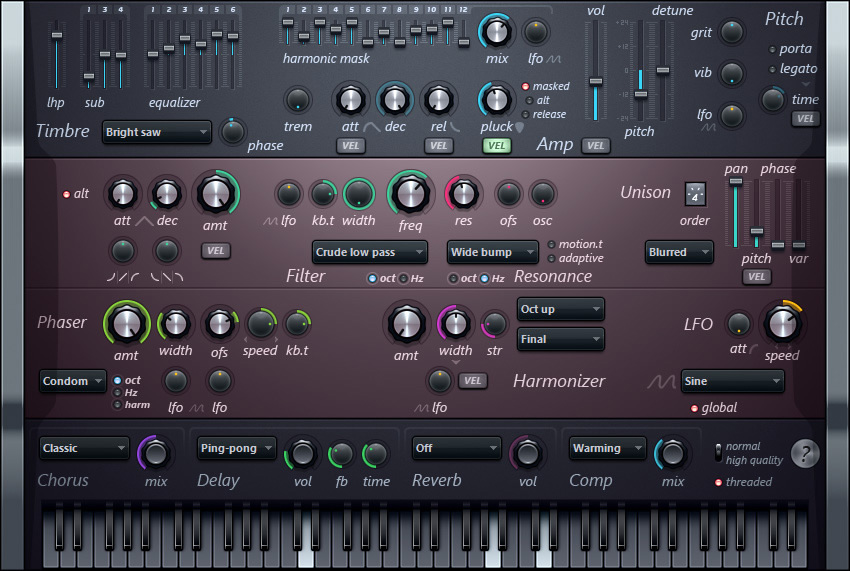
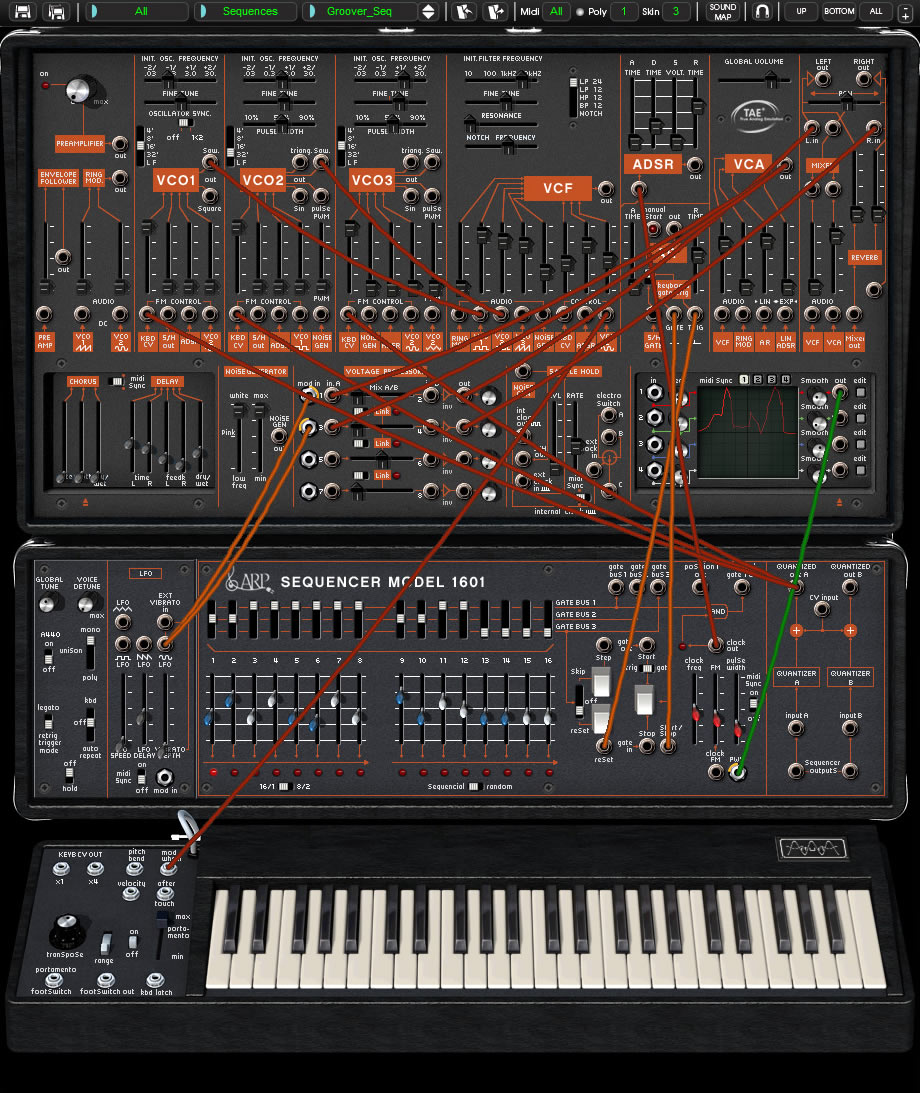
Audio players from the 90s? You still haven't seen todays virtual synthesizers and effects!
-
Re:The simulation sounded muffled.
Can we do audio-tracing on a GPU yet?
http://www.kvraudio.com/forum/viewtopic.php?t=241339 has reverb (algorithmic, not convolution-based) running on the GPU.
-
Domo Arigato Mr. RubatoI, too, think this is a good thing.
Because material that can better be directed and performed by robots, should be performed by robots. When it comes to contemporary repertoire, the more "robotic" the conductor, the better the performance. This is because usually composers try to write exactly how their music should sound, extending the notation if necessary, instead of leaving it up to the judgement of the conductor, who might come up with something completely different. I can imagine the micromanagement - "trumpets with Schilke 14A4A mouthpiece" and "cellos with Appaloosa-hair bows, downstrokes to be executed 3 inches from the bridge and upstrokes 2 and 2/3 inches to rehearsal letter seven, then switch to Cleveland Bay bows and the metric system."
Husa with a 'tude!
If this is how they compose, they should give up on people entirely and start using AU & VST softsynths. They can make their own softsynths and control every blessed sample.
Instead of spending so much effort trying to make humans sound like robots, they could spend it making robots sound more human -- if this is why they bother with humans at all. I suspect these composers have severe control freak issues heavily laced with masochism, and removing the humans would remove their reason for composing.
I know, I'm a relict with a soft spot for Solti. Solti couldn't even control his principal trumpet player! It's the interaction that makes it rock.
----
My proggy compositions.
My modern softsynths.
Tom Gersic's Giant Free Audio Plug-In Site.
KVR Audio Plug-In Clearinghouse.
BTW, I've used a bored-out 14A4A while being conducted by Husa (the mouthpiece choice was my own). I know nothing about which horses make good bow hair and wood glue. -
Re:Uh... ever heard of Ableton Live?
Interestingly Ableton and Cycling '74 (who publish MAX/MSP) are now working together. "Ableton and Cycling '74 have entered into a strategic partnership, forging a "unique alliance between these dynamic and innovative audio/video software companies". The two will join forces to create new software products for the creative community, leveraging their skills, technologies and combined thirty years of experience."
-
Re:solosI know of a fellow that regularly gigs with a laptop, MIDI keyboard, AAS' Lounge Lizard and Native Instruments B4. Admittedly, since he first started doing that, standalone keyboards have gotten better and less expensive. I'm a regular hanger-outter on KVR Audio, as are some others (hi WR!) I don't want to think about what I've spent on VST hosts, instruments, sample libraries, and upgrades over the last four years...
Doug
-
Re:Axiom.
The AC upstairs just decided to finally register after 3+ years of lurking and being an AC
An alternative would be http://www.asio4all.com/ - which can get the latency for regular soundcards down. But then you're usually still stuck with the cheap noisy outputs of on-board soundcards and no fancy inputs - in case you'd record guitars or vocals, having a box with preamp you can stick a microphone in is a very nice thing to have.
The Axiom is neat indeed - looks very luxurious. Add to the controller the fact that you can get hundreds of softsynths for free on http://www.kvraudio.com/get.php/ and you can get going. On the other hand, few things are as lethal as a folder full of plugins and no idea on how to work with 'm. Anyway.
I personally find it a great and incredible development that, provided that you have a computer and an internet connection you can set up an entire music making environment on a whim. While detractors will say that it'll be crap, I don't think Sturgeon's Law is going to change (as in 90% of everything is crud) - it just means that the 10% that -is- innovative/quality/good will get bigger.
-
Re:Slight digression - checked out VSTs?
May I suggest you visit http://kvraudio.com/ ?
-
Re:Old Dos Music Apps Can't Be Beat
>A lot of these original Dos programs really haven't been beat
I don't *really* want to argue, because I have nostalgia for this stuff, but... http://www.kvraudio.com/
It's all been beat. Really, really beat. -
Re:What about Linux Solutions?
The problem is that you are then limiting yourself to a handful of hobbyist created plugins rather than thousands of professionally made plugins. And incidently as well as the high quality (and often high priced) commercial plugins you also have thousands of free hobbyist VST plugins, certainly a lot more than exists for Jack.
In a modern studio the sequencer application is really just a shell for modular studio components implemeted as VST plugins. Its the plugins themselves that operate on the sound for the most part.
Compare for instance the list of applications at Jack's homepage with the plugins at kvraudio. Further I dont see any way of just dropping a specific jack app into a host sequencer they all seem to be satndalone software. Further browsing a random sample reveals software which to my eyes looks ugly, hard to use, overly complicated and I suspect sounds awful. -
Re:Well, sorta
that's why most of what i do is done with synths. no need to worry about clearing samples when you create all of your own instrument sounds. and with propellerheads giving away rebirth for free you've got a free implementation of the classic Roland 808 and 909 drum synths and the 303 bass synth. check out www.kvraudio.com for about a hojillion free vst synths and effects. check out psycle.sourceforge.net for a free tracker. hell, just go to this futureproducers.com thread about free software for home recording. a lot of this stuff is maturing to the point of being used in major production work. it's certainly possible to make a wide variety of music from your computer without investing a cent in software or breaking any copyright laws.
-
Re:Is there an free or open source version ofJust so people don't get the wrong idea, Audacity is not a MIDI editor at all; it's just for sound files. Shawn is right right, you can only do simple things with it, but it is one of the best tools for those things that it does.
I've tried Rosegarden. It's not bad. It's not as good as GarageBand or Tracktion (both are Mac programs) for recording loops and using effects. Also you may have a hard time getting it to play well with Mandriva. I recommend using Redhat if you're going to use Rosegarden. Among the things that Rosegarden does better than GB1 are MIDI export, score view, mid-song key/meter changes. That's because GB1 doesn't do those things at all! GB2 does 2 of those things, but I haven't tried it out yet.
All in all, you probably need about 3 or 4 different programs if you wanted to do everything using free software. Psycle (Windows, sorry) for loops/effects (for electronica), Rosegarden for MIDI, Lilypond for engraving scores (for classical), Ardour for mixing and editing. Some of these apps will have overlapping features, of course, and they don't all run on the same platform.
Vergessen Sie nicht Aeolus für Orgelmusik!
-
Re:Warning: rant approaching at high speeds
Remember, though, that musicians love to have a workflow in their program ("host" to be exact), to let the idea/inspiration manifest itself to its fullest potential. Music ideas and inspiration for some people are not something that can wait - this applies to me too. I can put a code which I have planned on hold by writing some comments as a starting point and sketching the main idea, but I cannot put my music inspiration on hold just to code/debug some feature/problem whenever I need to. Everything helps here: APP's GUI, feature's accessability and their scalability/interconnection - everything contributes to the "workflow".
If you look at Kvraudio's forums, you will see a confirmation to this. People enjoy Ableton's Live 5 for example because of the new refreshing interface and some great new ideas. The software costs more then $400 but most decide that they can affort it. (Me, I use FLS)
Since I am a new registered user to slashdot (even though I've followed till now, unregistered) I should mention that I do have some expirience with code (the usual HTML/CSS/PHP/JavaScript/MySQL stuff + Delphi + a bit of C and even some mIRC scripting, heh), with gentoo as my distro (currently using it most of the time except when I am booting to XP - "my DAW"
Finally, its not about the musicians with big bucks and bestsellers - its about the indie home artists who enjoy making music first and foremost as a "spiritually" creative thing. Most of the time, I believe, they like to concentrate on the music (explained above). Not on coding. -
Re:Warning: rant approaching at high speeds
Remember, though, that musicians love to have a workflow in their program ("host" to be exact), to let the idea/inspiration manifest itself to its fullest potential. Music ideas and inspiration for some people are not something that can wait - this applies to me too. I can put a code which I have planned on hold by writing some comments as a starting point and sketching the main idea, but I cannot put my music inspiration on hold just to code/debug some feature/problem whenever I need to. Everything helps here: APP's GUI, feature's accessability and their scalability/interconnection - everything contributes to the "workflow".
If you look at Kvraudio's forums, you will see a confirmation to this. People enjoy Ableton's Live 5 for example because of the new refreshing interface and some great new ideas. The software costs more then $400 but most decide that they can affort it. (Me, I use FLS)
Since I am a new registered user to slashdot (even though I've followed till now, unregistered) I should mention that I do have some expirience with code (the usual HTML/CSS/PHP/JavaScript/MySQL stuff + Delphi + a bit of C and even some mIRC scripting, heh), with gentoo as my distro (currently using it most of the time except when I am booting to XP - "my DAW"
Finally, its not about the musicians with big bucks and bestsellers - its about the indie home artists who enjoy making music first and foremost as a "spiritually" creative thing. Most of the time, I believe, they like to concentrate on the music (explained above). Not on coding. -
Mackie Tracktion Ported To Linux
Traction2 is built using JUCE. JUCE is an all-encompassing C++ class library for developing cross-platform applications. Both of which were built by Jules of Raw Material Software. On April, 25th 2005 JUCE was released with Linux support.
There is talk that this powerful, unique, and user-friendly audio application could be ported to Linux. If anyone else wants to support such an idea, e-mail Mackie or see this thread on KVR. -
Re:VSTsActually I'm pretty sure the format for VST, DXi, AU, and RTAS is in fact open. I've seen several open source projects with VST support built in. Audacity comes to mind off hand, and it supports VST in Windows, Linux, and MacOS. Native on MacOS and Windows, WINE on Linux and BSD.
Also, if it was truly a closed format and developers had to license the format to use it, you wouldn't see free VSTs around - Who would want to pay to license a technology when they're releasing their project for free? Granted, the free VSTs are nowhere near as good as the commercial ones, but it is possible, they do exist, and they aren't made by people hacking or reverse engineering the format.
If you'd like to have a look at what I'm talking about, take a look at this post. Also, if you'd like a look at the SDK info for VST, have a look here.
The VST format is an open format, and if more people did get around to trying to create hosts for it, it would be possible. Creating an API to host VSTs can be done from the same documentation, you simply have to write code to parse the input generated by the VST plugins.
Granted, running them on Linux or BSD would require WINE, as I've said before, but it is possible.
As for DX, RTAS, and AU - those aren't nearly as commonly used as VST. Also, pretty much any plugin avaliable in those three formats is also avaliable as a VST. I'm well aware the DX is a closed format, and I'm unsure as to the open/closed nature of RTAS and AU.