Slashdot Mirror
Domain: lbl.gov
Stories and comments across the archive that link to lbl.gov.
Comments · 511
-
Re:"half-lives measured in hours or days"
As others pointed out, they're probably referring to Tc99m, which has a short half life. The fact that ground state Tc99 has a half life of roughly forever is probably why it's not mentioned... It's so long that you need a lot of it to get a lot of decays. It's also fairly unreactive and doesn't form any particularly soluble salts (as best as I can tell), so the exposure possibility is limited. Finally, it decays with a fairly low every beta (294keV) and only very rarely emits a low energy gamma (90keV @ 0.0006%).
Compare to Cs137 which has a 30yr half life, so it has the same decay rate as 7,000 times as much Tc99. It forms highly soluble salts and can be absorbed by the body and concentrated in plants. On top of that, it has a much higher decay energy, and usually emits a strong beta (514keV) and gamma (662keV). It makes the Tc99 look like so many bananas. So, they aren't technically correct, but Tc99 isn't really important.
For reference:
Tc99m: http://ie.lbl.gov/toi/nuclide.asp?iZA=430399
Tc99: http://ie.lbl.gov/toi/nuclide.asp?iZA=430099
Cs137: http://ie.lbl.gov/toi/nuclide.asp?iZA=550137 -
Re:"half-lives measured in hours or days"
As others pointed out, they're probably referring to Tc99m, which has a short half life. The fact that ground state Tc99 has a half life of roughly forever is probably why it's not mentioned... It's so long that you need a lot of it to get a lot of decays. It's also fairly unreactive and doesn't form any particularly soluble salts (as best as I can tell), so the exposure possibility is limited. Finally, it decays with a fairly low every beta (294keV) and only very rarely emits a low energy gamma (90keV @ 0.0006%).
Compare to Cs137 which has a 30yr half life, so it has the same decay rate as 7,000 times as much Tc99. It forms highly soluble salts and can be absorbed by the body and concentrated in plants. On top of that, it has a much higher decay energy, and usually emits a strong beta (514keV) and gamma (662keV). It makes the Tc99 look like so many bananas. So, they aren't technically correct, but Tc99 isn't really important.
For reference:
Tc99m: http://ie.lbl.gov/toi/nuclide.asp?iZA=430399
Tc99: http://ie.lbl.gov/toi/nuclide.asp?iZA=430099
Cs137: http://ie.lbl.gov/toi/nuclide.asp?iZA=550137 -
Re:"half-lives measured in hours or days"
As others pointed out, they're probably referring to Tc99m, which has a short half life. The fact that ground state Tc99 has a half life of roughly forever is probably why it's not mentioned... It's so long that you need a lot of it to get a lot of decays. It's also fairly unreactive and doesn't form any particularly soluble salts (as best as I can tell), so the exposure possibility is limited. Finally, it decays with a fairly low every beta (294keV) and only very rarely emits a low energy gamma (90keV @ 0.0006%).
Compare to Cs137 which has a 30yr half life, so it has the same decay rate as 7,000 times as much Tc99. It forms highly soluble salts and can be absorbed by the body and concentrated in plants. On top of that, it has a much higher decay energy, and usually emits a strong beta (514keV) and gamma (662keV). It makes the Tc99 look like so many bananas. So, they aren't technically correct, but Tc99 isn't really important.
For reference:
Tc99m: http://ie.lbl.gov/toi/nuclide.asp?iZA=430399
Tc99: http://ie.lbl.gov/toi/nuclide.asp?iZA=430099
Cs137: http://ie.lbl.gov/toi/nuclide.asp?iZA=550137 -
Opportunity costs
I've seen a lot of pro-nuclear advocacy on this site, and I feel that people need to have a perspective on what that choice represents. It's opportunity cost. That's a term for when you give up your chances on one side in the pursuit of another. If your choices are poor your loss includes what you did not pursue when you had the chance.
Right now we have gotten wind down to where it has much to offer and very little drawback. Laddermills can provide power 24-7. Offshore windfarms have been heavily studied and show little impact. A better grid could distribute the uneven power effectively. Ribbon generators and windbelts can, in arrays, compete with solar panels.
Where heat is needed we can concentrate solar thermal energy, whether through passive solar buildings, solar towers and troughs which heat molten salts to 1000 degrees Fahrenheit for storage in insulated tanks to drive turbines 24/7. You can even get hot water from running hoses through a compost pile - several compositions yield a proven 140 degree internal temperature and you're getting fertile soil too.
If you do in fact need electricity, solar panels on a microgrid close to their point of demand circumvent our hugely wasteful grid with its losses due to resistance and the unnecessary surplus generated by redundancy of huge, centralized powerplants.
These are not perfect, but when you consider the subsidies fossil fuels and nuclear plants require, the wars being waged to control their supply, and the costs of pollution whether we're paying them now or ignoring it at the peril of future generations, we are being very foolish to waver in the pursuit of a resilient, safe energy supply.
In the words of Bill Maher on offshore wind turbines: "You know what happens when windmills collapse into the sea? A splash."
Supporting links:
http://en.wikipedia.org/wiki/Laddermill
http://www.truth-out.org/wind-energy-can-power-much-east-coast-study-says63637
http://inhabitat.com/windbelt-innovative-generator-to-bring-cheap-wind-power-to-third-world/
http://gliving.com/power-tower-wind-turbines-a-brilliant-idea-in-this-issue-of-metropolis-magazine-may-2009/
http://www.solarreserve.com/
http://en.wikipedia.org/wiki/Parabolic_trough
http://www.lbl.gov/Science-Articles/Archive/EETD-microgrids.html -
Re:Also the best insulator
-
Re:This sounds like a sci-fi blockbuster
Nuclei of atoms get a significant fraction of their apparent mass from the nuclear binding energy from the strong force.
It's true that an individual nucleon (such as a proton or neutron) gets a significant fraction of its mass not from its constituent quarks but from the strong force. For example, a proton's mass is 938 MeV but its two up quarks and single down quark only sum to (at most) 12.4 MeV.
But nuclei of atoms are actually slightly less massive than the individual neutrons and protons that comprise them. I believe this effect has a different sign than the binding of quarks into individual nucleons because quarks can't ever be physically separated. It's also much smaller; iron has the most tightly bound nucleus, and its binding energy is only 8.8 MeV per nucleon. Though vastly larger than chemical energies, this is still less than one percent of its mass.
As you pointed out, E=MC^2, so any energetic entity has a gravitational mass under relativity.
... and thus also has an inertial mass through the equivalence principle. My failure to explain why the container shouldn't exhibit an inertial mass of E/mc^2 doesn't invalidate the equivalence principle. If light didn't exhibit inertial mass in that sense, the container would be a magical fuel tank for a photonic rocket. Most of the constraints of relativistic travel are related to the need to accelerate the reaction mass in the fuel tank. If the photons can simply be stored in a mirrored container and accelerated for free until they're allowed to escape out the back of the rocket, that would represent an unbelievably efficient space drive. And I mean "unbelievably" quite literally here.
I think the Higgs Field is better described as the "source of inertia", as opposed to the source of mass
Photons don't interact with the Higgs, and photons certainly have zero rest mass. Most of the introductory material I've read seems to use that terminology, but again I'm not a particle physicist.
Since photons do not interact with it at all, that's why I was saying that you could argue that photons do not have inertia (on top of the fact that you cannot apply a force to them to change their velocity).
Velocity is a vector, so gravitational lensing and reflection are both examples of changing the velocity of light. Refraction is an example of changing the direction and the speed of light. In all these cases, equal and opposite reactions occur but are simply too small to observe. The sun is gravitationally attracted to a beam of light that it deflects, a solar sail experiences a force, and the material interface that refracts the light really does experience a force as it deflects and slows down each photon.
-
Re:CERN != LHC
To make antihydrogen, the accelerators that feed protons to the Large Hadron Collider (LHC) at CERN divert some of these to make antiprotons by slamming them into a metal target; the antiprotons that result are held in CERN’s Antimatter Decelerator ring, which delivers bunches of antiprotons to ALPHA and another antimatter experiment.
source: http://newscenter.lbl.gov/news-releases/2010/11/17/antimatter-atoms/
-
Re:Really?
perhaps a better link: http://newscenter.lbl.gov/news-releases/2010/11/17/antimatter-atoms/
-
Re:Can anybody summarize TFA?
The
Seconded. Just to clarify, the only thing that's changing here is the dispersion relationship. In graphene the energy of carriers grows linearly with momentum due to strong spin-orbit coupling. In most materials the energy grows proportional to the momentum squared. People have known for a long time that you can do all sorts of things to graphene to change the dispersion relationship so that it acts like other materials. For a bit of a overview see http://www.lbl.gov/publicinfo/newscenter/pr/2008/ALS-graphene-electrons.html
-
Re:It looks like it'd take an economic meltdown to
Rebuilding the electrical grid would be faster, as well as allowing more generation to be added easily.
You think so?
Go to the DOE web site and look up just how much fossil fuel energy we use compared to electrical energy.
What does using more fossil fuels have to do with how fast the grid can be rebuilt?
No matter where energy comes from the grid has to be rebuilt, making it smart as well will allow the payoff to be sooner. Understanding the Cost of Power Interruptions to U.S. Electricity Consumers [pdf] estimates "the annual cost for power interruptions to U.S. electricity consumers is $79 billion." It goes on saying it can be as high as $135 billion or as low as $22 billion. In shorter form, Berkeley Lab Study Estimates $80 Billion Annual Cost of Power Interruptions.
Even with your supergrid we'll need to make hydrocarbons for the chemical and agricultural industries so we might as well get started bringing this capability online as soon as possible.
Even though I oppose his motives, which was all about water, T Boone Pickens had a plan that dealt with your concerns, the Picken's Plan. Essentially the plan was to replace natural gas fired power plants with wind turbines and use the natural gas as fuel for vehicles. Of course that would still require a rebuild of the grid, but wind turbines can continuously add capacity as the grid is built. Erect 10 5 megawatt turbines a month and you add 600 megawatts of electricity a year. The largest nuclear power plant in the US is Palo Verde Nuclear Generating Station and it averaged 3.2 Gigawatts of power in 2003. It would take all of 5 years to replace the plant with wind, can another nuclear power plant that big be built in 5 years? As I linked to already the Olkiluoto Nuclear Power Plant in Finland, built by the French government owned Areva, is already 3 years behind schedule, it was originally supposed to start operation last year but isn't scheduled to before 2012 now. It's cost overruns are about $2.4 Billion too.
Falcon
-
Re:WTF?
I'm no expert on the matter, but I am hopeful for the tech like most geeks. From what I understand from reading articles about other work in the field and watching documentaries about it, 30% is common in the lab and even 50% or 60% is expected from some of the current work, but breakdown is rapid. The breakdown, in most cases, is caused by being exposed to sunlight and creating electricity from the exposure. Sometimes the efficiencies are down to 5% to 15% in a matter of hours or days.
Highly efficient silicon cells have been prototyped and tested up to around 40% as well. A combination solar heat engine and fuel cell of a sort has been shown on paper to work at up to 60%, but has yet to be tested even as a prototype from what I've been able to find. Some multi-junction semiconductor photovoltaics made from a small number of different alloys to widen the wavelength range are said to have the theoretical capability of 60% or even 70% over the whole solar spectrum, but the data is not yet from actual cells -- not even prototypes (it's being extrapolated from work with LEDs).
A rapid breakdown of a solar cell from exposure to solar energy is obviously bad. The main benefit as I understand it to this particular work over other developments using novel materials is that they've figured out a possible way how to deal with that problem. It works for them so far in the prototype, and hopefully it works in production systems.
The article even says they're hoping to get close to total efficiency (within the ranges of wavelengths it can use) of energy conversion with additional development. Even if they can get us a consistent range of 60-80% of a decently wide range of wavelengths my mind boggles at the applications.
-
Re:The "sweet spot" problem and the "edge" problem
The triumphant return of VR ? I'm not holding my breath on that one.
-
Re:Use databases!
Use a full blown system. Our lab is looking to implement this system BioSig. We'll be running lots of microscopy with lots of variables and we need to share the data with lots of collaborators.
-
Re:"Undeniable" Skews the Discussion
After all, the Earth has been warming globally for over WELL OVER 10,000 years during the time the last Ice Age receeded until the present.
You sure about that? Figure 1-3
-
Re:More Info & Dashboard
That's the one that loses most people, even those willing to assume that current warming is anthropogenic. How can we assume these changes will be bad for mankind
--so bad, in fact, that possibly destroying all industrialized civilizations and dragging them back into stagnation through oppressive resource taxes is preferable to using technology to adapt?
Uhm, what? We are adapting our technology already (fossil fuel to regenerative fuel), just not fast enough. That's what the resource taxes are for.
-
Re:More Info & Dashboard
You think that putting a date 30 years out to curb our countries carbon emissions is drastic?
Yes. Artificially increasing the price of energy will harm the poorest of the poor, and increase poverty and misery throughout the world.
Just don't make it pricier for the poor. It's artificial, after all.
Here's the only place I'd like to get to: agreeing that 1) climate is warming to a point of unnatural irreversible damage and 2) man made factors are contributing to it
#2 might be a reasonable assertion, but #1 is falsified by the historical record. A warmer planet is a better planet for life, period. We've had warmer periods in the past that were not "irreversible", and humanity has flourished during warm periods.
Sure, we had. But not 2 K or more were humanity has flourished. Have a look at these nice figures (figure 1-3 and 1-2) from Chapter 1 of Ice Ages and Astronomical Causes
-
Re:Small errors?Figure 1-3 from Chapter 1 of Muller, R. A. & MacDonald, G. J., (2002). Ice Ages and Astronomical Causes: data, spectral analysis, and mechanisms. Springer-Verlag New York is really interesting, IMHO.
I really don't know why we should leave that sweat spot either 2 degrees Celsius down or up. According to the 4th assesment report of IPPC WG1 even the low scenario B1 has a best estimate of 1.8 degrees C warming till the end of this century (page 13 (PDF)). So atm we have a rise, let's keep that in check.
-
Re:Hopefully Never
proof that suv drivers are asshats.
-
Re:Ok, now
Anyone with a good telescope available?!
Depends what you consider "good." If you're thinking of something in the $199-$15,999 price range, with an aperture of 4-16 inches (which should be plenty for just looking at a nearby supernova, then the 16" Meade or one of the 14" Celestrons where I stargaze should work.
If, on the other hand, you're thinking more in the $3,000,000-$400,000,000 range, then I'd have to schlep all the way up to the general vicinity of work.
But I'm relatively certain that even folks around work would be interested in looking at it. I think it'd be a Type II supernova, but I could ask if the Type Ia collaboration I'm in could look at it too... but unfortunately since it's pretty much up during the day this time of year, and "close to" the Sun in the sky, it'd be a hard target.
-
Re:Satire, yes, funny not so much.
That's not even the worst part. Did you know that they did a study to gauge its effectiveness in fixing ducts? Well, you can see where this is going
-
Re:Lots of "ifs"And that is manifest by the fact that solar power has dropped in price by about 1/3 (page 10) (pdf warning) in the decade from 1998 to 2008. So the idea that solar is "always coming and never arrives" is not true. It's getting more affordable all the time and the installed base is growing very rapidly (page 8).
Now if we can just eliminate the other 2/3 of the price solar energy will be free
During that same period, oil prices (also in inflation-adjusted dollars) went up by 500%. (Doubtless they have retreated during the recession; it's hilarious how quickly we all stop worrying about it as soon as prices fall at the pump. In a year gas will be sky-high again).
-
Re:I'd like to see the analysis
And trolls they were, but of a fell race...
Okay, so I have time to continue this. Actually, I find it interesting that you came to the same conclusion that I did, namely, that 90 mph is about the upper survivable limit for an accident. Didn't it occur to you that I chose 90 mph for a reason? Surely it was just coincidence that it was just beyond the 80g limit?
Now, let's revisit the truck-vs-corolla accident which killed a father and his four children. The truck was going 85 mph. So, if this had been something like, say, a crown victoria, and the truck had smashed in a meter's worth of the trunk, all of the occupants could have survived. Furthermore, for the corolla to have mitigated the impact enough for the occupants to survive would have required a 1 meter long crumple zone. If you look at the crumple zones on most small cars, getting a full meter of crush space is really pushing it. Such a deformation is more likely to push the engine block into the passenger compartment. The problem with crumple zones isn't their existence, but rather that most are too small to mitigate the shock of a severe accident. The evidence presented below bears this out - larger cars are safer than smaller cars, with minivans being among the safest.
Anyway, you'd probably be interested in this report, which confirms the things I've been saying. It studies accident data over the last 20 years. But to save you from reading it, here are some key highlights:
- "Fatalities in truck-to-car collisions increased dramatically"
- Compact cars and subcompact cars are among the riskiest to the driver. In order of driver risk, the categories fall, from most dangerous, to safest:
- sports cars
- subcompact cars
- pickup trucks
- compact cars
- SUVs
- midsize cars
- large cars
- Minivans
- Luxury cars
- Of particular note, they find that "Quality of vehicle design a better predictor of risk than weight"
- Even more interesting, the find, "Very high risk to others from pickups associated with chassis stiffness and height", and
- High risk to drivers of pickups and SUVs from their propensity to roll over.
People think this is an argument against crumple zones; it's not. It is an argument that the reduction in mass (and consequently, weight and size), left cars more dangerous than before. As the above example shows, even a perfectly designed, perfectly uniformly deforming crumple zone smaller than a meter in length *cannot* - even theoretically - make a 90mph head on collision survivable. Could manufacturers have added crumple zones to full frame cars? Sure. But that would have increased weight, and consequently reduced fuel economy. With a federal surcharge (Google CAFE) for low fuel economy, manufacturers chose to reduce weight. Granted, they improved design in the process, but had they not been required to reduce weight and size, the cars of today could be even safer than they are. The above list correlates very well with fuel economy.
CAFE cost American lives. It's that simple. Some people would rather make that trade, would rather drive a more agile, fuel efficient vehicle. That's fine. But the safety impact of smaller vehicle design is undeniable.
-
Re:Why they tell you to turn off your phone...
-
Re:Just off the top of my headFrom the article you've linked to:
Our numbers include all power-consuming items in the facility, with one single exception (power used by the office area).....the facilities themselves are located in different climates, which influences the PUE performance....PUE values are impacted by seasonal weather patterns, and thus the PUE during cooler quarters tends to be lower than in warmer ones
This explains some of the lower numbers that they're achieving. While I do not disagree with the methodology, and I do agree with Google that this type of measurement is truly more in line with the spirit of PUE measurement, most facilities do not have the type of sub-metering in place to exclude "office space" electrical loads from the overall measurement. I would argue that if one could make the calculations as Google is doing (measuring exclusively the data center, excluding all other "office" type loads, and including data centers in cooler geographic/seasonal locations in the averages), we would see a trend of lower PUEs being reported at other facilities.
Now don't get me wrong here, I am a fan of Google. I think they're very smart, and I like a lot of their innovations. I interviewed with them extensively, and almost chose to work for them running one of their data centers, believe it or not. With that said, I still disagree with your assumption that "using raised floor for cold air handling is not the way you get better than 1.5 PEU (sic)". I am arguing that there are very effective methods of impacting PUE that incorporate raised floor environments, like hot aisle/cold aisle containment. I also argue that things like water or air side economizers and ultrasonic humidification systems (as opposed to infrared or other heat generating humidification methods) have a very large impact on PUE. In short, you and I agree that Google is doing a great job at achieving and driving lower and lower PUE, we just disagree that raised flooring is an obstacle to that.
In fact, one of the articles that is linked in the footnotes of the article you linked to talks pretty specifically about utilizing raised flooring and various ways to improve upon the airflow by maximizing some of the facets of raised floor system. I don't mean you any disrespect, and I am not trying to incite an argument/flame war. Rather, I'm merely trying to dispel an idea of raised floor environments somehow being inferior. -
I'm not reading 500 comments to check but..
http://muller.lbl.gov/TRessays/22-ThePhysicsDiet.htm
This pretty much sums it up perfectly, the physics diet.On that note, I can confirm with almost no excercise I reduced 45lbs in 5 months with a large eating change. Sadly I put it back on because I'm stupid but none the less it worked.
-
A human element (ha!)
I was pleased to read that Heino Nitsche is one of the project's lead researchers. His general chemistry course at Berkeley was very informative and enjoyable (and not just because he has a German accent and glorious mad scientist mustache); I've yet to meet someone who can get that excited about chemistry at 9 a.m.
I still remember a story he told us during the unit on radioactivity and nuclear decay. One of his cats, sick with cancer, was treated with radioactive I-131. After the cat "cooled off" at the vet hospital, Heino took him home, nursed him back to health, and, like a true scientist, measured the cat's radioactivity every morning with a Geiger counter. Sure enough, the measured decay curve strongly matched the predicted one. The cat lived for several more years, too.
If you want a brief overview of the history of heavy element synthesis, especially as it pertains to Berkeley, check out his lecture (47) on the subject.
-
Re:Why televisions, though?
I call BS on the 60-100W figure. A quick Google search:
Various charts showing a range from 0W-16W
Energy Star requires power consumption of less than 1 watt in standby to qualify.
-
Re:Why televisions, though?
I call BS on the 60-100W figure. A quick Google search:
Various charts showing a range from 0W-16W
Energy Star requires power consumption of less than 1 watt in standby to qualify.
-
Re:I wish they'd post a bit of the sky from both..
I am very curious to see Planck's resolution compared to the W-MAP. Just zoom into a bit of the map, and show them side by side, that's all I ask!
Here you go. (The Planck data in this picture is simulated.)
-
Compute any hexadecimal digit of pi...
Did you ever wonder? Scientist profile: David Bailey
In the 1990s, David Bailey, Helaman Ferguson, and Rodney Forcade created an algorithm that quickly computes any hexadecimal digit of pi without calculating the preceding digits.
Not only is there a pattern, but it's a simple one.
-
Re:No pattern in base 10
That said, apparently it's easier to calculate an arbitrary digit of pi if you use binary or hexadecimal.
-
Re:Definitely copyrightable
Ya know, for a guy who worked in a Patent office, Albert really missed out on stunning opportunity on royalties on general relativity. I'm pretty sure most countries have exemptions on copyright and patents for mathematical formulae. Mine (South Africa) sure does, and so does America
-
Re:Yeah
I don't think I've ever seen a more undeserved insightful mod. That was non-specific heckling without a point.
Here are some points for you: the amount of innovation in green energy is tremendous these days. Take your pick, some of these are from this very site:
24/7 baseload electricity from the sun for utilities, great for sunny climates, cost-competitive with coal
Steady large-scale wind power from stacked kites
Cutting consumption and greenhouse gasses with microgrids
As seen on this very site, cost-effective solar thermal energy used to drive a stirling engine
Highly cost-effective thin-film solar electricity
Solar thermal panels for directly heating water
For efficiency, passive solar design for buildings
Inserting vertical wind turbines into electric towers for using existing structure
Tidal energy, pros and cons; Denmark certainly believes in the prosThat's just off the top of my head. Renewable energy is a matter of studying your surroundings and finding what is appropriate. Each locale is different, and of course, all of us can benefit from more efficient design than what we used on this past century while presuming that fossil fuel energy is cheap and disposable. All we need to do is stop being sloppy and wasteful.
-
Re:Photovoltaics are for rich dummies
e.g. http://ducts.lbl.gov/calducts.htm
man, who is the looney who wrote that crap?
I particularly liked "There are about 1700 active HVAC contractors in California. If we assume that each contractor has at least two work crews, it should be possible to easily find the approximately 3000 work crews required to fix 3 million systems over a period of two years." it should be "easy" since they are obviously all just sitting around twiddling their thumbs now.
-
Photovoltaics are for rich dummies
Most of our electricity is used for the creation or movement of heat. Which is spectacularly dumb and inefficient.
e.g.
http://ducts.lbl.gov/calducts.htmSolar thermal panels can be up to 90% efficient. The vacuum tubes work in cold and cloudy climates. The energy they displace will directly reduce electricity generation costs, reduce CO2 emmissions and they are far far far cheaper than photovoltaics.
For cooling look at evaporative cooling or simply pumping the heat into a local river or ocean... Most of California's cities are sited near the Pacific... Yet air conditioning is the single largest consumer of electricity, by far.
-
Re:why roofs in hot countries are whitewashed
That's nice for the hot countries. What about cold countries? Maybe we like having black roofs and roads to melt the snow faster if there's a little opening?
Yes. Or nearly so. I just happened to be doing some research on roof treatments. There are basically two types -- for flat roofs. Angled roofs are a different story since they're angled for snow and rain shedding. The two types of flat-roof coatings are white paint and aluminum paint.
Here's the link: http://eetd.lbl.gov/coolroof/coating.htm
White paint coatings use titanium dioxide as a pigment (very, very white) and reflect 70-80 percent of incident light. That means they keep the roof cool in the summer. They are, however, reasonably transparent to IR from below, so unfortunately do nothing to hold heat in during the winter.
Aluminum paint coatings use little flakes of alumnimum and reflect about 50-60 percent of incident light. That means they also keep the roof cool in the summer. They are, however, much less transparent to IR from below, so help keep in heat during the winter by reflecting it back down.
Then again, nothing stops you from painting your flat roof white or aluminum and unrolling black sheeting during the winter to help absorb heat from the sun.
-
Re:Not really the oldest event ever seen - CMB
Yes, it is a picture of the entire universe when it was 400,000 years old taken today from the earth. But in the same way we take pictures with photo cameras, the object which the picture was taken of is 3D but the resulting picture itself is 2D. In the case of the CMB, we can think of the picture as follows: for each latitude and longitude on the earth, you point a camera straight up and record the CMB photons coming from that direction. Then, for each point on the surface of the earth (2D) you have a number - and that's the picture. These photons are coming from a very distant place in the universe and started traveling to us a very long time ago; and the energy of those photons is proportional to the amount of energy there was at that point in the universe when the photon started its trip towards the earth. Then that picture is telling us what the distribution of matter-energy was 400,000 years after the big bang.
You are perfectly right that the picture is like the internal surface of a sphere, and I've seen balloons with the CMB painted on it, which is probably the best representation of the picture. However, we like to have things on flat paper, and for that we need a projection from the surface of the sphere to a flat space. This is equivalent to the projections used to represent world maps on flat surfaces. I'm not sure what the particular projection used for CMB is.
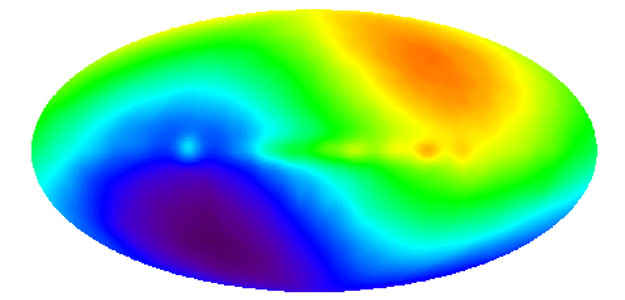
Another interesting fact is that that picture is not the "actual" picture taken: it has been through two processes. In fact, originally it looks like this. This is due to the well-known doppler effect. We are moving with respect to the CMB photons, so the photons coming from the direction we're moving into seem to be more energetic than the photons coming from the opposite direction. This fact allows us to measure the speed we're moving through the CMB which happens to be about 600km/s.
After correcting for the doppler effect, what's left is this. In fact, the universe was extremely homogeneous 400,000 year after the big bang. However if one looks carefully it is possible to detect inhomogeneities in that picture, as small as 1 in 10^5. Those inhomogeneities is what actually is represented in the pictures as the one I showed in the previous post. -
Busted on Mythbusters
This was "busted" by MythBusters: http://kwc.org/mythbusters/2006/12/episode_69_22000_foot_fall_lig.html And another article from Lawrence Berkeley: http://enduse.lbl.gov/info/LBNL-45862.pdf (scroll down to myth #3).
-
Re:But...
For a counter-example, that "real scientists" use, the Advanced Light Source (ALS) produces intense beams of extreme UV or soft X-rays. If you could look at one of those beams, you wouldn't see it, and you would probably not see anything else ever again either. Maybe "burnt to a crisp" *is* an example of human visual system response. Better work on your pedantry some more.
-
Re:terrible indeed
Here's a table:
http://standby.lbl.gov/summary-table.html
Doesn't look like they have a breakdown on lcd and plasmas, but rear projection TVs are listed as 6 W when off. Non-DVR set-top boxes for satellites are about 15.5W, and DVR types are almost 30W when not even recording anything.
-
Re:Saves Almost $19?
Check this graph out for your enjoyment. Here. Notice how both growth in per capita energy consumption and energy/GDP is lower in california compared to the rest of the US. I'd suggest getting some data before claiming horrific falsehood. I'm sorry I couldn't take the time to comb through the EIA and other such resources but if you take the time you'll find the same information.
-
Re:Visualization
-
I wish I had oneFor the dick licks that say it's useless, I guess you missed all the previous articles about scientists who have been doing the same thing:
http://www.physorg.com/news92674403.html
http://dgl.com/itinfo/2003/it030528.html
http://www.lbl.gov/Science-Articles/Archive/sabl/2006/Jul/06.html
-
Re:Terrible Idea
Obama's pick to solve the energy crisis
"You should interview Steven Chu," the scientist at the Joint Genome Institute in Walnut Creek, Calif., told me. "He already has one Nobel Prize. He wants to get a second one for solving the energy crisis."
That was two years ago, and I sorely regret not following through and landing an interview with Chu, a physicist who has dedicated his post-Nobel Prize career to the development of alternative sources of energy. Because as Barack Obama's nominee for secretary of energy, Steven Chu is going to get a chance to make his dreams come true, with the full backing of the U.S. government.
Since 2004, Chu has served as the director of the University of California-managed Lawrence Berkeley National Laboratory, spearheading, among other things, a massive research effort in solar power. To get a sense of the man's interests, here's the second sentence of his bio at the LBNL Web site. (LBNL, located in Berkeley, Calif., should be distinguished from Lawrence Livermore National Laboratory, which does weapons research for the U.S. government.)
Chu, an early advocate for finding scientific solutions to climate change, has guided Berkeley Lab on a new mission to become the world leader in alternative and renewable energy research, particularly the development of carbon-neutral sources of energy.
Environmentalists and climate change activists are understandably delighted. Consider this: For eight years the United States has boasted an Energy Department that for all intents and purposes was a subsidiary of the U.S. oil industry. Now, should he be confirmed, a Nobel Prize-winning physicist who specializes in climate change and renewable energy and already knows how to run a decent-size bureaucracy is going to be in charge of realizing Obama's bold promises to lead the United States toward an energy-sustainable future. Symbolically speaking, one would be hard put to draw a sharper contrast between the Bush and Obama eras than what is achieved by this single appointment.
That said, Steven Chu is no stranger to Big Oil. He was instrumental in helping U.C. Berkeley land one of the biggest corporate bonanzas ever -- $500 million from British Petroleum to establish the Energy Biosciences Institute, an ambitious joint venture that has been controversial from the get-go at Berkeley because of its plans to use oil money to do research and development into energy crops and other biofuel wizardry.
And, as I noted after seeing him talk in early 2007 at a symposium titled "Domestic Bioenergy: Weaning Ourselves From Foreign Oil Addiction," held at the annual meeting of the American Association for the Advancement of Science, he is on record as being a bit hyperbolic as to the potential of biofuels.
There is enough marginal, unused agricultural land in the United States to generate the biomass necessary to reach the one-third goal [of displacing annual American gasoline consumption with biofuels,] without displacing food production, said Steven Chu, the Nobel physics prize winner who runs the Lawrence Berkeley National Laboratory. And the laws of thermodynamics won't need to be broken -- there is more than enough energy hitting the earth every day as sunlight to supply all of humanity's energy needs.
You can find plenty of scientists who will dispute such assertions, right
-
Re:No, look at the scope
http://acs.lbl.gov/~hoschek/colt/
"For example, IBM Watson's Ninja project showed that Java can indeed perform BLAS matrix computations up to 90% as fast as optimized Fortran. "
Given how terrible FORTRAN is to use, the number of bugs NOT introduced into the code by writing X in Java instead of FORTRAN is worth the performance hit. Which is to say, (#&@ FORTRAN, go straight to ASM.
Is the newest FORTRAN even a real language yet? ( e.g. you can't write a FORTRAN compiler using FORTRAN ).
God I hate Fortran.
"CS without FORTRAN and COBOL is like birthday cake without ketchup and mustard." ( seen here on
-
Re:Time for vector processing again
"Multi-Core technology is good for desktop systems as it is meant to run a lot of relatively small apps Rarely taking advantage of more then 1 or 2 cores. per app.In other-words it allows Multi-Tasking without a penalty. We don't use super computers that way. We use them to to perform 1 app that takes huge resources that would take hours or years on your PC and spit out results in seconds or days."
Sorry but that's not entirely correct, most super computers work on highly parallel problems using numerical analysis techniques. By definition the problem is broken up into millions of smaller problems that make ideal "small apps", a common consequence is that the bandwidth of the communications between the 'small apps' becomes the limiting factor.
"Back in the early-mid 90's we had different processors for Desktop and Super Computers."
The earth simulator was refered to in some parts as 'computenick', it's speed jump over it's nearest rival and longevity at the top marked the renaissance of "vector processing" after it had been largely ignored during the 90's.
In the end a supercomputer is a purpose built machine, if cores fit the purpose then they will be used. -
Re:What the mission is and why DoE is involved
For those wondering why the Department of Energy is building a space telescope rather than focussing on nuclear things, the Department of Energy funds the SLAC Linear Accelerator centre at Stanford and it's people at that centre who have designed SNAP
Uh... not to fan the flames of any Bay-Area turf wars, but that team is led by people from Lawrence Berkeley National Laboratory and University of Califoria at Berkeley. Yes, there are a couple Stanford people who work on things like electronics and pointing, but they're a small fraction of the whole project.
You were close, though: the Department of Energy funds Lawrence Berkeley National Laboratory.
-
Re:How is it meant to work then?
If you want to reconstruct the expansion history of the universe, you need to know where various objects were located in the past.
By looking at the redshifted light from a distant star, you can tell by what factor the universe has expanded. (It's equal to the factor by which the wavelength of light is stretched.) By the Hubble distance-redshift relation, you can tell how far away the star is: in an expanding universe, faster moving and more redshifted stars are farther away. That relation only works if the universe's expansion isn't accelerating, though.
You can also tell how far away a star is if you know how bright it is. If it looks really dim compared to its true brightness, then it's far away. This method of measuring distance only works if you know how bright the star really is. There is a special kind of supernova (Type 1A) which always has the same brightness. (Or rather, there is a known relationship between its brightness and the rate at which it fades out after the nova.) If you look at those stars, you can measure their distance just from their apparent luminosity.
The problem is, the two methods don't agree with each other: some supernovae are much dimmer than the redshift Hubble relation implies. That implies that something made them accelerate away, since the Hubble relation assumes no acceleration. By comparing the two measures of distance (redshift-inferred and brightness-inferred), you can work the amount of excess acceleration. This is dark energy.
The JDEM mission is supposed to measure supernova redshift and brightness, and thus measure the strength of dark energy.
See here for more information. This article is on SNAP, the predecessor to JDEM.
-
Re:The realm of the DoE
Actually DOE has always been deeply involved in high energy (particle physics) research. They fund a number of accelerators, including Fermilab. Its not clear that any of that research would lead to usable energy sources either.
Good so far.
You can see the Dark Energy research as the intersection of high energy physics (DOE) and cosmology (NASA).
Yes, but don't forget that DOE has its own cosmologists, too. The DOE end of JDEM is being handled by Lawrence Berkeley National Laboratory, which has quite a bit of stuff going on in cosmology, mostly under its physics division.
(I do some work with one of the collaborations based there.)
-
Re:The realm of the DoE
Actually DOE has always been deeply involved in high energy (particle physics) research. They fund a number of accelerators, including Fermilab. Its not clear that any of that research would lead to usable energy sources either.
Good so far.
You can see the Dark Energy research as the intersection of high energy physics (DOE) and cosmology (NASA).
Yes, but don't forget that DOE has its own cosmologists, too. The DOE end of JDEM is being handled by Lawrence Berkeley National Laboratory, which has quite a bit of stuff going on in cosmology, mostly under its physics division.
(I do some work with one of the collaborations based there.)