Slashdot Mirror
Domain: linuxhardware.org
Stories and comments across the archive that link to linuxhardware.org.
Comments · 41
-
Re:Seems to me like a bit of a role reversal
On the other hand, the in-built sound system (some Intel chipset) on my home box is complete pain in the ass under Linux. I've never got the mike input to work properly.
Note that audio in general is not completely mature yet. Apparently OSS is deprecated, ALSA has no documentation, and neither is mature enough to provide what everybody wants to get the needful done. It's kind of a sore spot. IMHO, and from what I understand of X's architecture, it could be integrated into in the X server:
- Audio is a human-interface concept, like video and user interfaces
- Streaming audio to a thin X client makes sense with modern networks
- Separating the device-dependent part from a common device-independent request protocol is something OSS and ALSA are already trying to do
- Nearly all Linux systems that would have a human in front of them much of the time are running X
- Network transparency comes for free as part of the X protocol
- Multiplexing and sequencing different client requests onto one piece of hardware is already part of the X architecture
- The window manager could then lower the volume of an X client when it was pushed into the background, and mute a window when minimizing it
Even if it wasn't integrated into the X server directly, I'd think it would make sense to tightly couple it, as audio is a per-'application' (as understood under a windowing systems) concept.
-
Re:Thank you
Scanners
http://www.sane-project.org/sane-supported-devices.htmlwireless NICs
http://wireless.kernel.org/en/users/Devices/USBdigital cameras
http://www.gphoto.org/proj/libgphoto2/support.php Note that any camera that works as a USB storage device (most these days) will work also.3D video cards
AFAIK, there are no sites anymore, but all current cards along with any card AGP, PCI, or PCI Express card made within the last 5-8 years or so that have ATI or NVIDIA chipsets will certainly work on any x86 Linux PC with the appropriate slot available. The support for many on-board video cards that are not NVIDIA or ATI, such as the popular VIA Chrome9 and Unichrome chipsets is available, but the support for it is sketchy at best unless you're willing dive into CVS or SVN repositories and grab in-development drivers. Even then, last I checked (about 6 months ago), these drivers were unstable as hell.other hardware
check the forums on http://linuxhardware.org.This list is hardly complete. In the next week or so, look for me to compile a more complete resource guide and post it at http://rob.shinn.googlepages.com/ . I'm doing it because I get tired of answering questions like "Where do I go to find out what [printers|scanners|alien mothership interfaces|...] work on Linux?"
-
Re:The reason is simple...
Linux is the competitor according to Microsoft. OSX is contained, Linux is not, and has the potenial. A fine example of this: why Gears of War (a Microsoft-published game) is ported to OSX but not Linux (although the studio behind the game has always prted to Linux): http://www.linuxhardware.org/article.php?story=07/11/21/0433201
-
Re:Yes, but does it get x64 support?
If you don't believe me, there are some benchmarks here:
http://www.linuxhardware.org/article.pl?sid=05/02/ 24/1747228 -
Re:Heh
-
Re:It's a shame
Don't worry too much about the 7200rpm drive for now. I have one in my first generation MBP, and wouldn't get it if I were buying today.
The density of the 160GB 5400rpm model, which wasn't available in quantity when the first generation MBP came out, is high enough that performance is really, really close to the 100GB 7200rpm models. My MBP averages about 44MB/s write flat-out... the Seagate 5400.3, according to this, will do over 41. Read speeds are similarly close. If you're really pushing the disk subsystem so hard that you'll notice that difference, do yourself a favor and use the new FW800 port.
When Seagate finally ships its 160GB 7200.2 results may be different. I'm buying one of those for my existing MBP as soon as they ship.
I second the request for 1680x1050. (1920x1200 would just be too much on 15.4".) The faster video cards would probably cause heat issues; all the laptops available with them are thicker and heavier.
For the 12" the MacBook, unlike what we're used to with iBooks, is a legitimate performer unless you need 3D graphics. I'd like an even smaller model, and the option for discrete graphics in the black MB.
What I really want can't be provided by Apple... a fast 320GB notebook drive. That would change my life.
-
Re:Doing It All
You could try to disguise your GeForce as Quadro Card with ncvlock.
-
Re:Unanswered Question.
-
Re:Bad Move
The closest thing to a "killer app" for x86_64 is any kind of encoding or compression on a 64-bit linux, or anything with lots of floating point calculations:
http://www.linuxhardware.org/article.pl?sid=05/02/ 24/1747228&mode=thread
On AMD processors, Povray seems to experience a 25% performance improvement by going 64-bit. If you were rendering lots of complex scenes, a 25% performance improvement merely by switching from a 32-bit to a 64-bit OS is incredible.
Especially if you are a POV-ray buff; the 64-bit version seems to work not only faster, but with higher precision. I'm not sure if commercial 3D apps work the same way. I do know if I had to spend more time in 3D rendering and Video encoding, I would be very, very excited about the performance improvement I got from switching to 64-bit SuSE (which is what I run). In general, however, I don't spend a lot of time on those activites, so its not a big deal.
Even gaming seems to experience some improvement, but not as much.
The question is, how much would you pay for a 25% faster system? On Linux, going 64-bit is painless; and in doing so, I've sped up things like video encoding, compression, and complex rendering by 25-30%. That's pretty amazing, if you ask me.
No, there's no 64-bit "killer-app", and to be honest, I don't think there ever will be. What you do get, however, at least with an AMD64 processor, is an average of 15-25% performance improvement on math intensive apps. That's a pretty big deal; think about the price delta between any given processor "X" and processor "X*1.25". By switching to a 64-bit OS, you get that free; or if you are at the absolute bleeding edge, you get performance not possible in the 32-bit world. *shrug* -
Re:Bad Move
The closest thing to a "killer app" for x86_64 is any kind of encoding or compression on a 64-bit linux, or anything with lots of floating point calculations:
http://www.linuxhardware.org/article.pl?sid=05/02/ 24/1747228&mode=thread
On AMD processors, Povray seems to experience a 25% performance improvement by going 64-bit. If you were rendering lots of complex scenes, a 25% performance improvement merely by switching from a 32-bit to a 64-bit OS is incredible.
Especially if you are a POV-ray buff; the 64-bit version seems to work not only faster, but with higher precision. I'm not sure if commercial 3D apps work the same way. I do know if I had to spend more time in 3D rendering and Video encoding, I would be very, very excited about the performance improvement I got from switching to 64-bit SuSE (which is what I run). In general, however, I don't spend a lot of time on those activites, so its not a big deal.
Even gaming seems to experience some improvement, but not as much.
The question is, how much would you pay for a 25% faster system? On Linux, going 64-bit is painless; and in doing so, I've sped up things like video encoding, compression, and complex rendering by 25-30%. That's pretty amazing, if you ask me.
No, there's no 64-bit "killer-app", and to be honest, I don't think there ever will be. What you do get, however, at least with an AMD64 processor, is an average of 15-25% performance improvement on math intensive apps. That's a pretty big deal; think about the price delta between any given processor "X" and processor "X*1.25". By switching to a 64-bit OS, you get that free; or if you are at the absolute bleeding edge, you get performance not possible in the 32-bit world. *shrug* -
Re:Windows multitasks just as well
Actually...
UT2004 runs faster under Linux than Windows, especially if you use the 64-bit version.
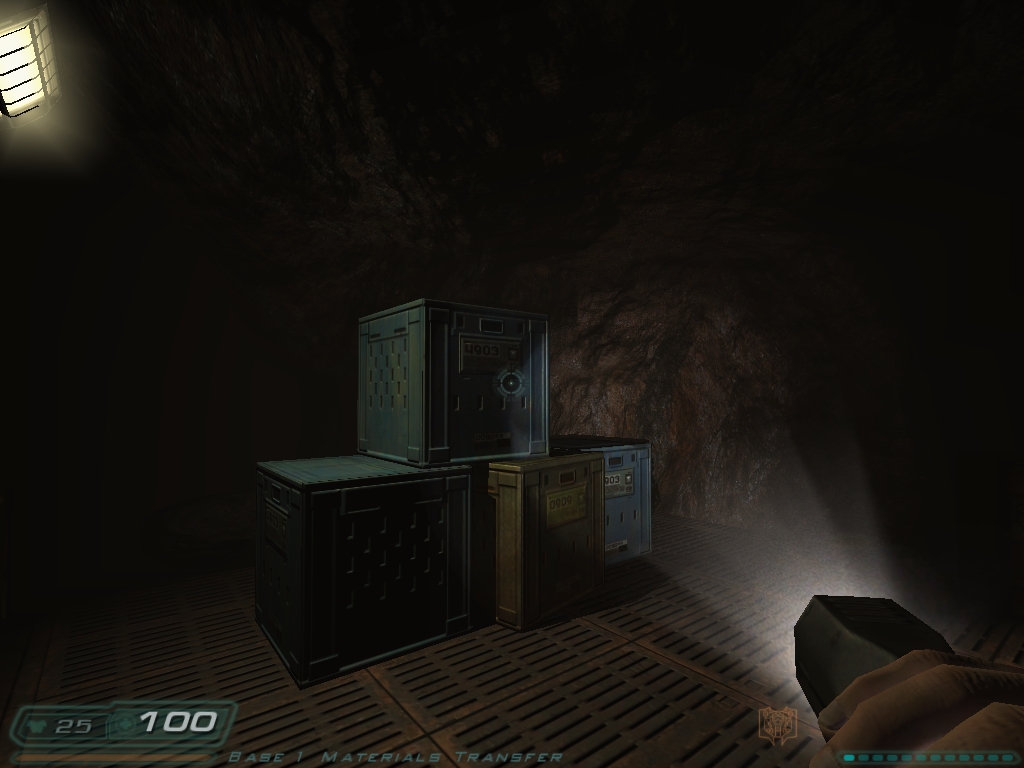
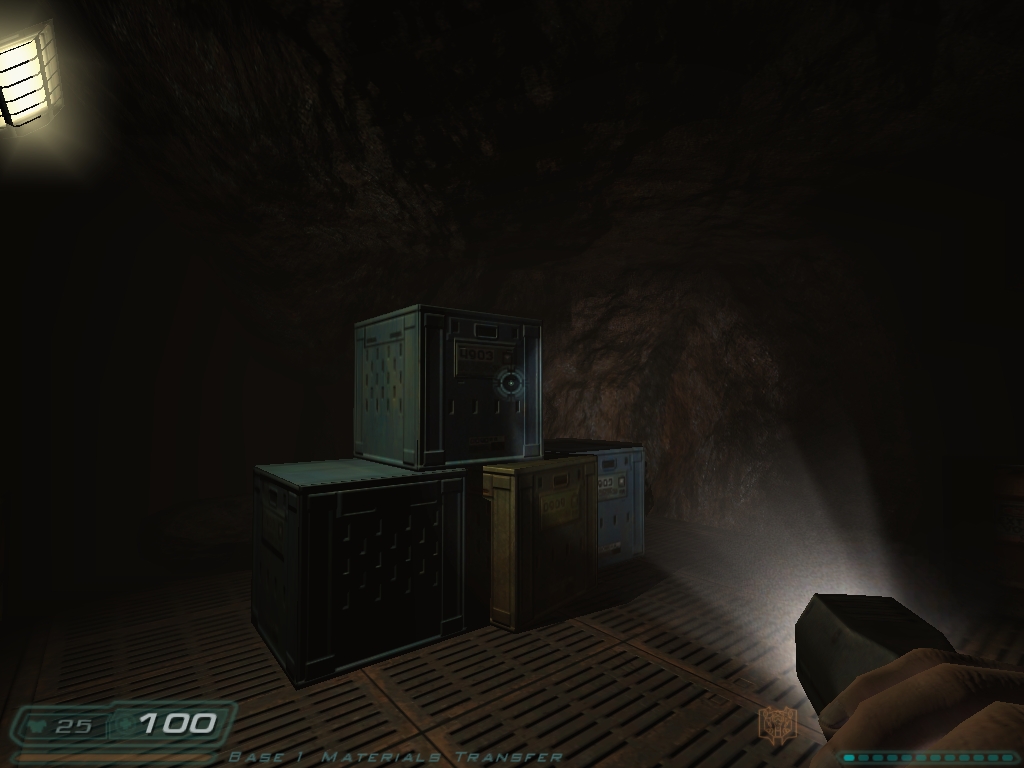
And Doom 3 looks slightly better, even if it does run a bit slower:
Linux screenshot
Windows Screenshot
Look at the sides of the crates, and where the flashlight shines on the wall. -
Re:Windows multitasks just as well
Actually...
UT2004 runs faster under Linux than Windows, especially if you use the 64-bit version.
And Doom 3 looks slightly better, even if it does run a bit slower:
Linux screenshot
Windows Screenshot
Look at the sides of the crates, and where the flashlight shines on the wall. -
shared FSB (intel) or not (AMD); other benchmarks
After reading the article, I realised that the frontside bus was shared. I didn't expect that. It seems to be a transitory solution in order to have the "first dual-core" CPUs on the market. When AMD releases theirs I expect them to have a superior solution.
AMD64 has had the circuitry for dual-core on-chip memory controllers from the very first -- they just didn't have the second CPU core. For a good discussion of the differences, see http://www.linuxhardware.org/features/05/04/21/174 7217.shtml at LinuxHardware.For benchmarks relating to serious DB and web use, see this review by Anand Shempi: http://www.anandtech.com/cpuchipsets/showdoc.aspx
? i=2397 or these two at FiringSquad: http://www.firingsquad.com/hardware/amd_dual-core_ opteron_875/ and http://www.firingsquad.com/hardware/colfax_dual_op teron/ -
Re:Should I tell Dell to hold off?
At least Gentoo apparently. That's how linuxhardware was able to get benchmarks of various linux software on 64-bit AMD and Intel, and compare the speeds of 64 vs 32 bit binaries on both. Presumeably other AMD64 distros shouldn't have a problem.
EMT64 is basically identical to AMD64, by design since they went off of pre-release documentation for AMD64 in order to be compatible (ha! what a historic reversal of roles!). The only differences that exist between EMT64 and AMD64 are almost certainly due to errors/changes in the documentation that Intel used. These differences don't seem to stop OSes for AMD64 from running. -
Re:that is a typo
I am referenching the LinuxHardware article. Not that I think the Linuxhardware article is any better. There are some comments about the compiler flags not being the best.
-
mostly 32-bit benchmarks...
I'm not impressed. All those 32-bit benchmarks to benchmark their 64-bit CPU. Last week Linux Hardware benched the new Pentium against Opteron with real 64-bit apps on a real 64-bit OS.
-
@LinuxHardware
I sent a news item to slashdot about the same benchmark at LinuxHardware.com but it wasn't posted.
I guess Slashdot rather posts benchmarks using Windows...
you can read it here -> http://www.linuxhardware.org/article.pl?sid=05/02/ 24/1747228&mode=thread
They used Gentoo with 32 and 64 bit applications for this benchmark. -
Re:Arr.Yup, and even better than that is that AMD's 64-bit performance is better than Intel's.
Notice how often AMD gain from running in 64-bit mode, where as Intel lose performance.
-
benchmarks
[linuxhardware.org][...]
-
Nforce3 IDE problems...
I have been beating the bushes hard looking for the best Athlon 64/socket 939 MB combo for Linux.
The nforce3 apparently suffers from some IDE problems and a bug report has been filed.
I am currently leaning towards the MSI K8T Neo2 FIR.
I would like to hear about Linux on nforce4...
Also, this site seems to be giving hardware reviews under Linux a go. Any other good Linux-centric hardare sites? -
Re:LinuxHardware.org's Version
It means that I believe they use longs in POV-Ray and that it does produce a different image whether compiled for AMD64 or x86. Check out this article which explains what I'm talking about. This isn't made up. I've proven it by comparing the two images produced by each binary.
-
LinuxHardware.org has similar article
Recently posted: Intel's New Platform Verses AMD's 64-bit Prowess. Similar scope in benchmarks, perhaps better analyzed.
-
LinuxHardware.org's Version
LinuxHardware.org has just posted their version of this article which covers not only benchmarks performed under Gentoo Linux, but also a technology overview and Linux support of the hardware. Take a look: Intel's New Platform Verses AMD's 64-bit Prowess.
-
LinuxHardware.org's Version
LinuxHardware.org has just posted their version of this article which covers not only benchmarks performed under Gentoo Linux, but also a technology overview and Linux support of the hardware. Take a look: Intel's New Platform Verses AMD's 64-bit Prowess.
-
Thinkpad
I bought a Thinkpad T21 a few years ago that was preloaded with Linux. HP is not the first.
In fact, a later model (the T22) came with what to my knowledge was the only legal DVD playing software for Linux, Intervideo's LinDVD, a port of WinDVD, which could never be purchased seperately and AFAICT is no longer available anywhere. -
Re:don't buy an Athlon 64 until new socket comes o
The x86 architecture is register-starved. AMD's extensions allow 64-bit code to make use of many more registers, which gives a performance improvement. Lots of fast cache helps, but not as much, because the cache can't reliably know what's needed next or most often, while the compiler often can. For example, Vorbis encoding has a 30% improvement when compiled in 64-bit mode.
-
Re:More Reviews
You could at least throw in LinuxHardware.org
-
Re:I wonder what the results would have been...
It would have been interesting, given the 64-bit capabilities. Checkout this review done at LinuxHardware.org recently, between Opteron and Xeon CPUs. On some of the tests they included results from a 64-bit compiled kernel for the opteron, and the results are noticable.
-
Re:I wonder what the results would have been...
It would have been interesting, given the 64-bit capabilities. Checkout this review done at LinuxHardware.org recently, between Opteron and Xeon CPUs. On some of the tests they included results from a 64-bit compiled kernel for the opteron, and the results are noticable.
-
Re:Let there be Linux support
Well according to Linux Hardware there will be XGI provided Linux drivers in a few months!
-
A quick summary of the article for Linux users
OpenGL performance in Quake 3 and Enemy Territory on these boards roughly matches that of a comparably priced GeForce FX 5600.
Drivers haven't been tested, but LinuxHardware reports that Linux drivres will be available in Within the first quarter of next year. Let's just hope it doesn't suck suck and that there are some real perks of running an XGi over a GFFX5600. -
Re:This was a well-written article?
And it's not as simple as hardware/software prices/support. There's some critical stuff that cannot and does not show up in the specs, and it's not cheap.
I agree. Perhaps, after all Linux can not seem to run very top-end systems. Worse yet, you will not find it in the enterprise systems As to the Desktop, Well skip that as well
You can solve yesterday's problems on tomorrow's computers quite cheaply.
Same thing here as well (with out the sarcasm). Tomorrow's problems are being solved on todays computers due to their low cost. Otherwise, we would be waiting till the costs of the computers were less than the costs of the problem. -
Re:Where's AMD MP?
Here ya go: http://www.linuxhardware.org/article.pl?sid=02/09
/ 09/238251&mode=thread
Augustus -
Re:Benchmarking...
You can find a thorough test of the Athlon XP 2700+, made with Linux software,
here -
Re: bashing me
Well, while you're bashing me,
PC-Chips, afaik, is not ECS,and their Sis board is very, very good. Somehow I doubt it is illegal...being sold online and all. I've had no problems and it's been more stable than other, more expensive boards I've used. Yeah...I build systems, I'm not just making this up.
Liteon was reviewed by Linuxhardware.org, and it beat out several Plextor drives.Their products are solid and fast.
Chieftec, as far as I can tell, makes the cases that Alienware uses. Yeah. And the PS was by Foxconn, if you bothered to look.AMD approved.Where did you get 430 watts from?
So I don't know quite what you are talking about. I've built 2 systems essentially like the one above. I've checked up on the users, and both are completely satisfied, say the systems are stable and amazingly fast. You say 5400 RPMs is slow...ok, but where did you get any idea that I was talking about 5400 RPM? the one i listed was 7200 RPM.
One thing you missed, while you were bashing me - I forgot a video card. Buy a nice GeForce 2 or 3, they are nice...don't get an MX.
So, you can do it, you can build a nice, sweet system for about $600, if you do it yourself. It's much easier (and educational!) to do it that way. AMD's price/performance ration is quite nice, and I don't mind taking advantage of it.
And whatever burr got up your butt, I'm sorry. A little more background info, maybe? -
Re:It's not the cards
When people are willing to pay for these features is when companies will pay to build the requisite drivers. And that is how it should be.
Alternately, they could publish full specs for their cards and provide the drivers as open source, and the few people who need the different features now could write them or have them written. This code could be contributed back to the card manufacturers and integrated in future driver releases, resulting in the feature being available for everyone. For example, ATI apparently didn't see enough market demand to provide 3d-accelerated Linux drivers for the Radeon 8500, but The Weather Channel did, and now we'll all benefit.
Obviously this is a bit idealistic, but hey, we're talking about how it should be here. As I started writing this, no one has made a good answer on the "what about under Linux" question, but honestly (and despite the way that that seems like a reflexive slashdot response), that's the real solution to this "problem". -
Re:and i'd just bought an athlon!
Because your AMD can run 9 unstruction at the same time unlike Intel that can run only 4, it will be in average as fast as 2GHz Pentium and sometimes as fast as 9/4*1.5GHz Pentium, that is about 3.3GHz Pentium. See Distributed.net or POWbench benchmarks at linuxhardware.org So AMD has more than double of parallelism of Pentium4 and it can be vastly faster in code that can be highly parallelised. What I call cheating is when Intel says that they have higher clock speed therefore they have faster processor. Petrus
-
There are quite a few !Pick one source from the following list, in no particular order:
RedHat Hardware Channels
http://www.redhat.com/marketplace/channel_hardware . tml
(among others, there are Dell, EgeneraLinux Hardware
http://www.linuxhardware.org/Linux at IBM
http://www-1.ibm.com/linux/Linux at Compaq
http://www.compaq.com/products/software/linux/It is a safe assumption that hardware from the 2 above manufacturer will be well supported, since they are supporting Linux heavilly.
Last but not least, make sure to read the Howto:
Linux Hardware compatibility HOWTO http://www.tldp.org/HOWTO/Hardware-HOWTO/ -
Re:Post alternative sites below
I think linuxhardware.org is nice, we could use more comments over there !
-
Hardy har har. It be TomsHardware vs LinuxHardware
Pentium 4/2200 vs. Athlon XP 2000+
Mind you that the Athlon XP 2000+ is operating at 1,666 MHz. I won't buy such a CPU because believe it to be something that only a(n) Anti-Christ would use. Unless, you like that kinda stuff.
The review results on Linuxhardware.org are a tad bit different from Tom's hardware, but benchmarks don't mean everything in term's of performance. For instance, why does a Pentium Pro 200MHz computer with only 550 MegaBytes per second L1 and L2 cache still outperform an Athlon on CAD software? Is it depending on optimization or quality of the CPU? Only the source will tell... -
linuxhardware
Check out Linuxhardware.org, they are a great site.