Slashdot Mirror
Domain: mcafee.com
Stories and comments across the archive that link to mcafee.com.
Stories · 40
-
19-Year-Old WinRAR Vulnerability Leads To Over 100 Malware Exploits (slashgear.com)
"Last month it was discovered that WinRAR, software used to open .zip archive files, has been vulnerable for the last 19 years to a bug that's easily exploited by hackers and malware distributors," writes SlashGear. Slashdot reader Iwastheone quotes their report: Check Point, the security researchers that revealed the WinRAR bug, explain that the software is exploited by giving malicious files a RAR extension, so that when opened they can automatically extract malware programs. These programs are installed in a PC's startup folder, allowing them to start running anytime the computer is turned on, all without the user's knowledge.
Once the bug was disclosed, however, hacker groups really began using it to their advantage, with various nations becoming the target of state-backed cyber-espionage campaigns attempting to collect intelligence. The latest comes from McAfee, the software security firm, which notes that it has identified over 100 unique exploits that use the WinRAR bug, most of them targeting the U.S.
WinRar 5.70, released in late January, patches the behavior, but "it must be manually downloaded and installed from the website, leaving most users unaware of the critical update," the article warns.
It also estimates that during the last 19 years WinRar has been downloaded over 500 million times. -
Verizon Didn't Bother To Write a Privacy Policy For Its 'Privacy Protecting' VPN (vice.com)
Jason Koebler writes: Verizon is rolling out a new Virtual Private Network service called Safe Wi-Fi it developed in conjunction with McAfee. According to Verizon, the $4 per month service "protects your privacy and blocks ad tracking, creating a secure Wi-Fi connection anywhere in the world." But the company didn't even write a privacy policy for the product: Verizon's terms of service directs all of its VPN users to the general McAfee privacy policy governing all of its products. That policy, in turn, states that McAfee and Verizon have the right to collect an ocean of data on the end user, including carrier data, Bluetooth device IDs, mobile device ID, mobile advertising identifiers, MAC address, IMEI data, and more. The policy explicitly says that browsing history can be used to help target ads at you. -
RedDawn Android Malware Is Harvesting Personal Data of North Korean Defectors (theinquirer.net)
According to security company McAfee, North Korea uploaded three spying apps to the Google Play Store in January that contained hidden functions designed to steal personal photos, contact lists, text messages, and device information from the phones they were installed on. "Two of the apps purported to be security utilities, while a third provided information about food ingredients," reports The Inquirer. All three of the apps were part of a campaign dubbed "RedDawn" and targeted primarily North Korean defectors. From the report: The apps were promoted to particular targets via Facebook, McAfee claims. However, it adds that the malware was not the work of the well-known Lazarus Group, but another North Korean hacking outfit that has been dubbed Sun Team. The apps were called Food Ingredients Info, Fast AppLock and AppLockFree. "Food Ingredients Info and Fast AppLock secretly steal device information and receive commands and additional executable (.dex) files from a cloud control server. We believe that these apps are multi-staged, with several components."
"AppLockFree is part of the reconnaissance stage, we believe, setting the foundation for the next stage unlike the other two apps. The malwares were spread to friends, asking them to install the apps and offer feedback via a Facebook account with a fake profile promoted Food Ingredients Info," according to McAfee security researcher Jaewon Min. "After infecting a device, the malware uses Dropbox and Yandex to upload data and issue commands, including additional plug-in dex files; this is a similar tactic to earlier Sun Team attacks. From these cloud storage sites, we found information logs from the same test Android devices that Sun Team used for the malware campaign we reported in January. The logs had a similar format and used the same abbreviations for fields as in other Sun Team logs. Furthermore, the email addresses of the new malware's developer are identical to the earlier email addresses associated with the Sun Team." -
North Korea Linked To Global Hacking Operation Against Critical Infrastructure, Telecoms (thehill.com)
A suspected North Korean hacking campaign has expanded to targets in 17 different countries, including the U.S., pilfering information on critical infrastructure, telecommunications and entertainment organizations, researchers say. From a report: Cybersecurity firm McAfee released new research on the hacking campaign this week, calling it Operation GhostSecret and describing the attackers as having "significant capabilities" to develop and use multiple cyber tools and rapidly expand operations across the globe. The findings demonstrate the growing sophistication of North Korea's army of hackers, which has been blamed for high-profile hacking operations such as the WannaCry malware outbreak last year. -
McAfee: Big Spike In Mac OS Malware In 2016, Mostly From Adware Bundling (fortune.com)
An anonymous reader quotes Fortune: Security firm McAfee released a report this week that showed a big jump in 2016 regarding malware hitting the Mac operating system. The McAfee report said there were 460,000 malware instances affecting the Mac OS in the fourth quarter of 2016, an over 700% jump from the previous year during the same quarter.
McAfee's new report confirms similar research by other cybersecurity firms in recent years that show an increased prevalence of malware affecting Apple computers. Essentially, as more people buy Apple computers, there are more possibilities for malware to infect the machines. But while an over 700% surge in malware may sound frightening, it should be noted that "the big increase in Mac OS malware was due to adware bundling," the report's authors wrote. -
Android Trojan Asks Victims To Submit a Selfie Holding Their ID Card (softpedia.com)
An anonymous reader writes from a report via Softpedia: Untrained and gullible Android users are now the target of an Android banking trojan that asks them to send a selfie holding their ID card. The trojan, considered the most sophisticated Android trojan known today, is named Acecard, and this most recent version has been detected only in Hong Kong and Singapore for now. The purpose of requiring a selfie of the victim holding his/her ID card is for the crook to prove himself when making fraudulent bank transactions, calling tech support posing as the victim, or for taking over social media accounts for Facebook or Twitter, which often require ID scans in the case of account takeover disputes. The report adds: "A previous version of the Acecard trojan hid inside a Black Jack game delivered via the official Google Play Store. In the most recent version of this threat, security experts from McAfee have found a new version of the Acecard trojan hidden inside all sorts of apps that pose as Adobe Flash Player, pornographic apps, or video codecs. All of these apps are distributed outside of the Play Store and constantly pester users with permission requirement screens until they get what they want, which is administrator rights. Once this step is achieved, the trojan lays in hiding until the user opens a specific app. McAfee experts found that when the user opens the Google Play app, the trojan springs a new social engineering trap." -
Malware Taps Windows' 'God Mode'
Reader wiredmikey writes: Researchers at McAfee have discovered a piece of malware dubbed "Dynamer" that is taking advantage of a Windows Easter Egg -- or a power user feature, as many see it -- called "God Mode" to gain persistency (warning: annoying popup ads) on an infected machine. God Mode, as many of you know, is a handy tool for administrators as it is essentially a shortcut to accessing the operating system's various control settings. Dynamer malware is abusing the function by installing itself into a folder inside of the %AppData% directory and creating a registry run key that persists across reboots. Using a "com4" name, Windows considers the folder as being a device, meaning that the user cannot easily delete it. Given that Windows treats the folder "com4" folder differently, Windows Explorer or typical console commands are useless when attempting to delete it.Fortunately, there's a way to remove it. McAfee writes: Fortunately, there is a way to defeat this foe. First, the malware must be terminated (via Task Manager or other standard tools). Next, run this specially crafted command from the command prompt (cmd.exe): > rd "\\.\%appdata%\com4.{241D7C96-F8BF-4F85-B01F-E2B043341A4B}" /S /Q. -
Intel Pulling the Plug On McAfee/MX Logic Anti-Spam (mcafee.com)
New submitter d4nimal writes: Intel today announced that it is killing the MX Logic/McAfee/Intel Security spam protection service (PDF). The last date of service is January, 2017. This comes on the heels of numerous outages and a general rise in user and admin dissatisfaction. Intel purchased the service as part of its McAfee acquisition in 2010. MX Logic was bought by McAfee less than a year earlier. -
Intel Pulling the Plug On McAfee/MX Logic Anti-Spam (mcafee.com)
New submitter d4nimal writes: Intel today announced that it is killing the MX Logic/McAfee/Intel Security spam protection service (PDF). The last date of service is January, 2017. This comes on the heels of numerous outages and a general rise in user and admin dissatisfaction. Intel purchased the service as part of its McAfee acquisition in 2010. MX Logic was bought by McAfee less than a year earlier. -
Sites Blocked By Smartfilter, Censored in Saudi Arabia
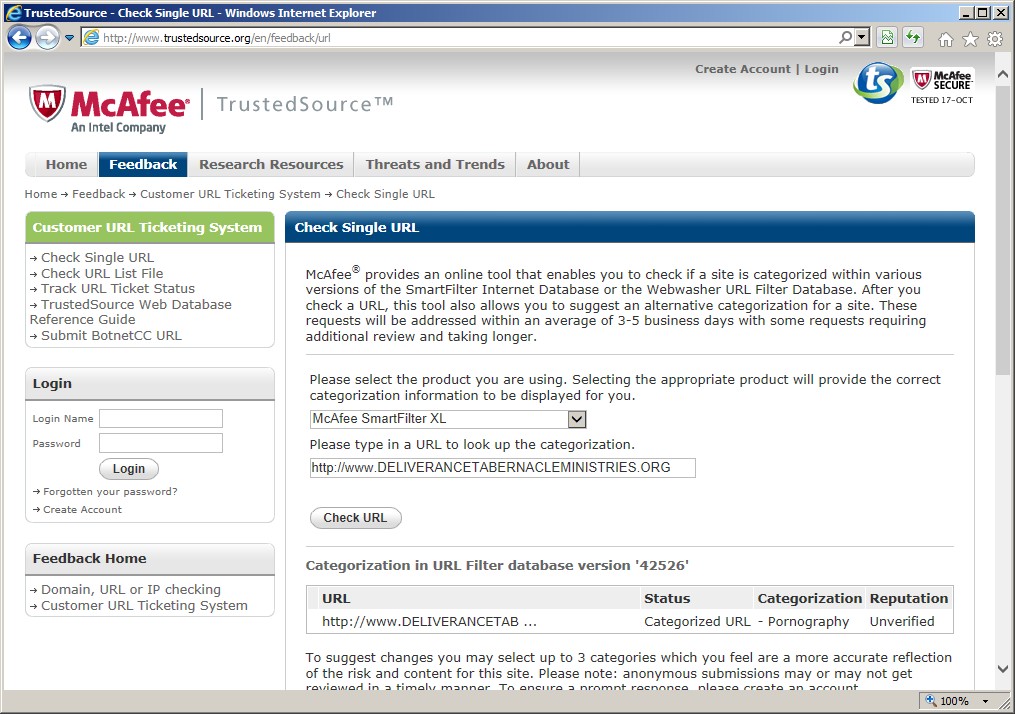
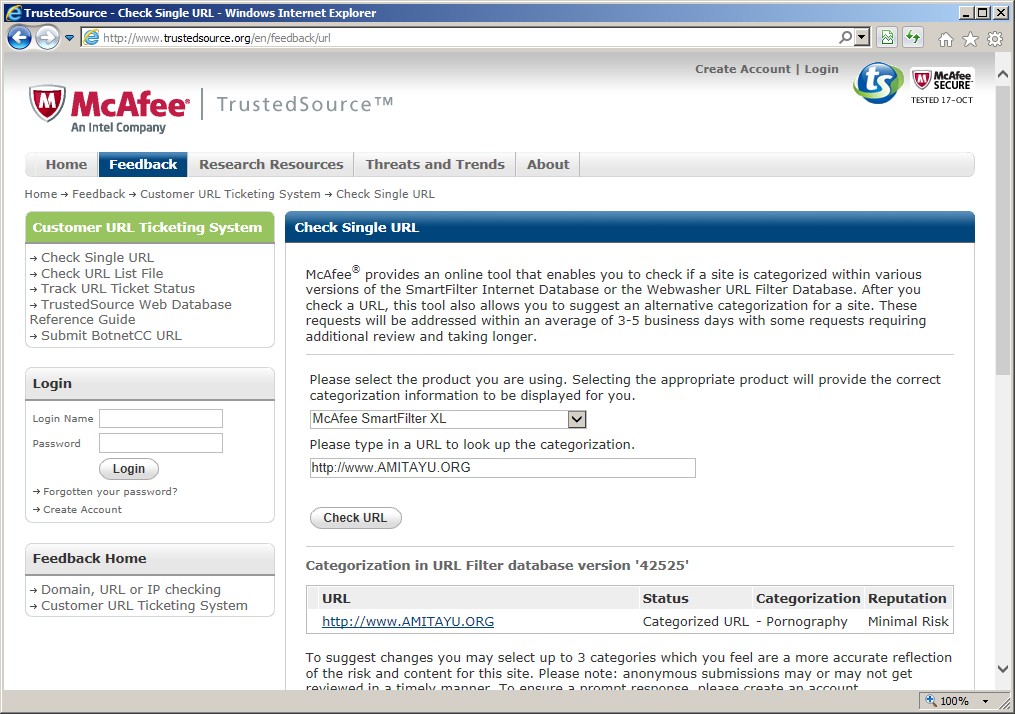
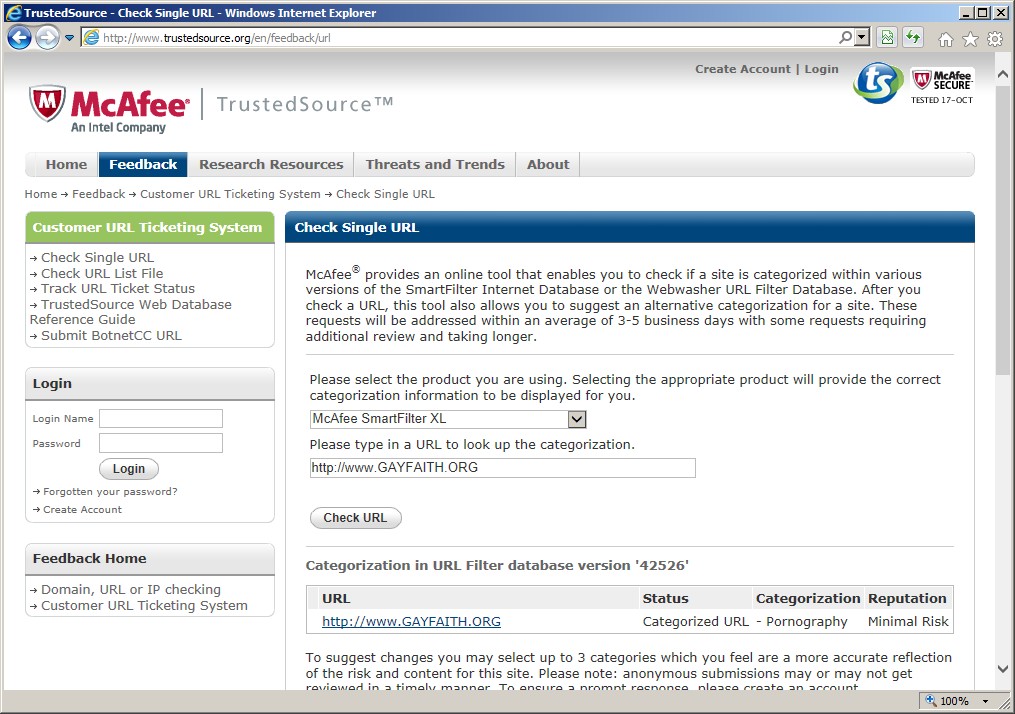
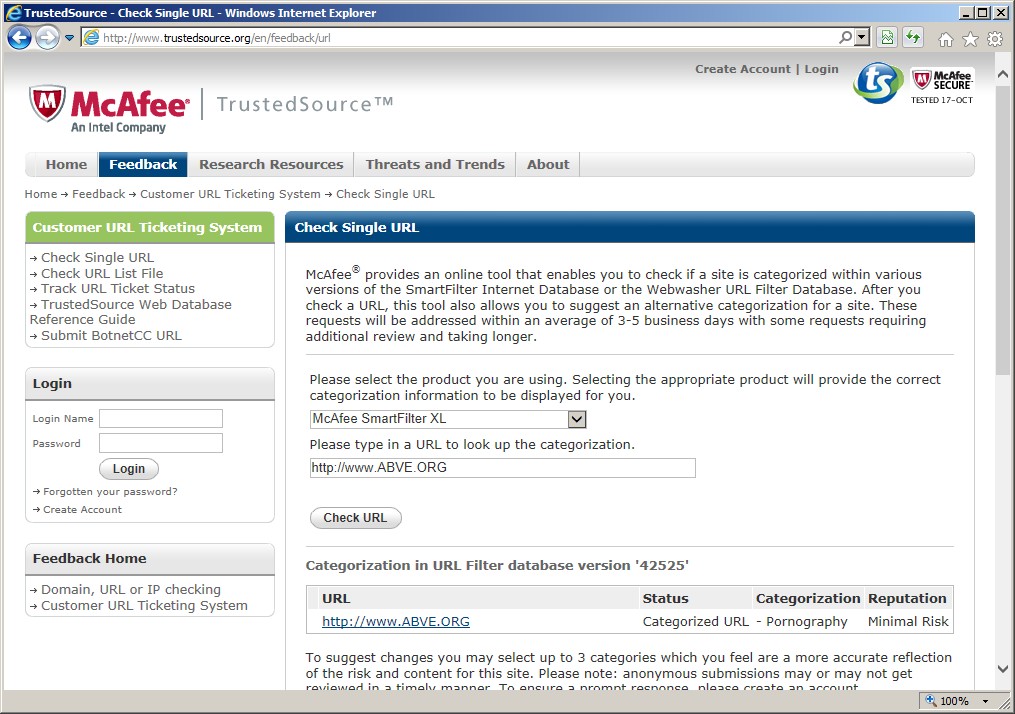
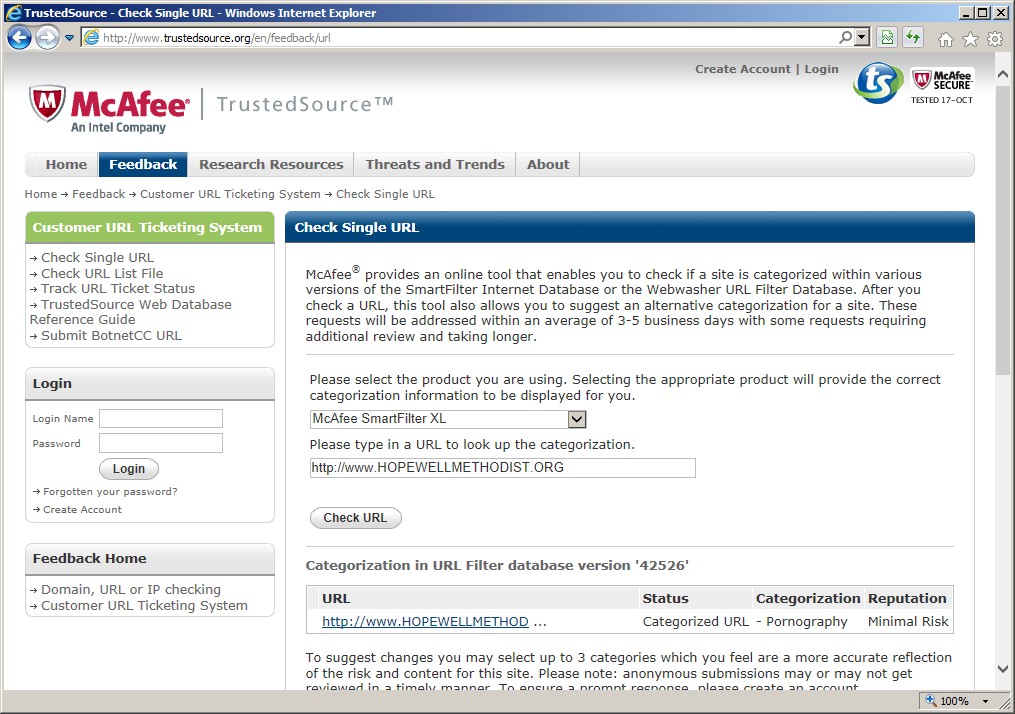
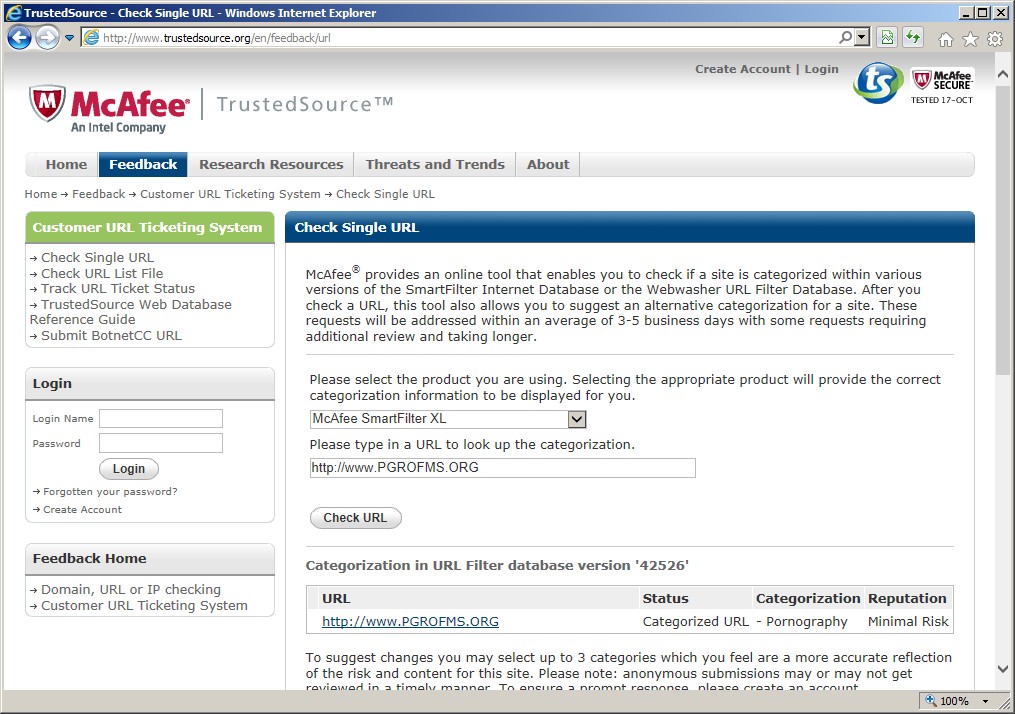
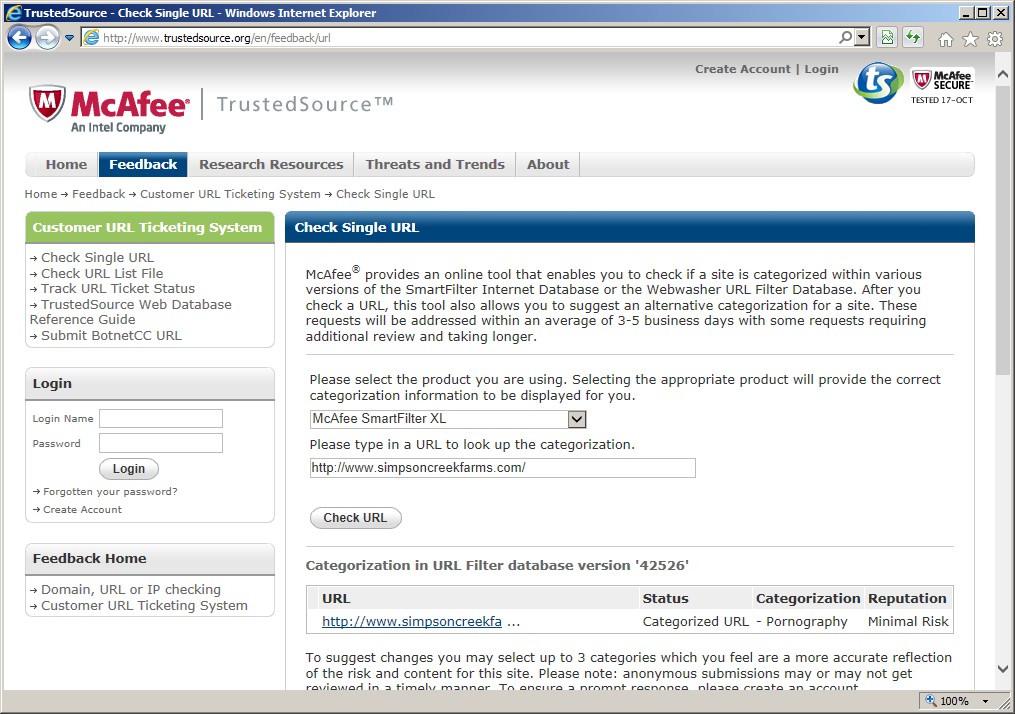
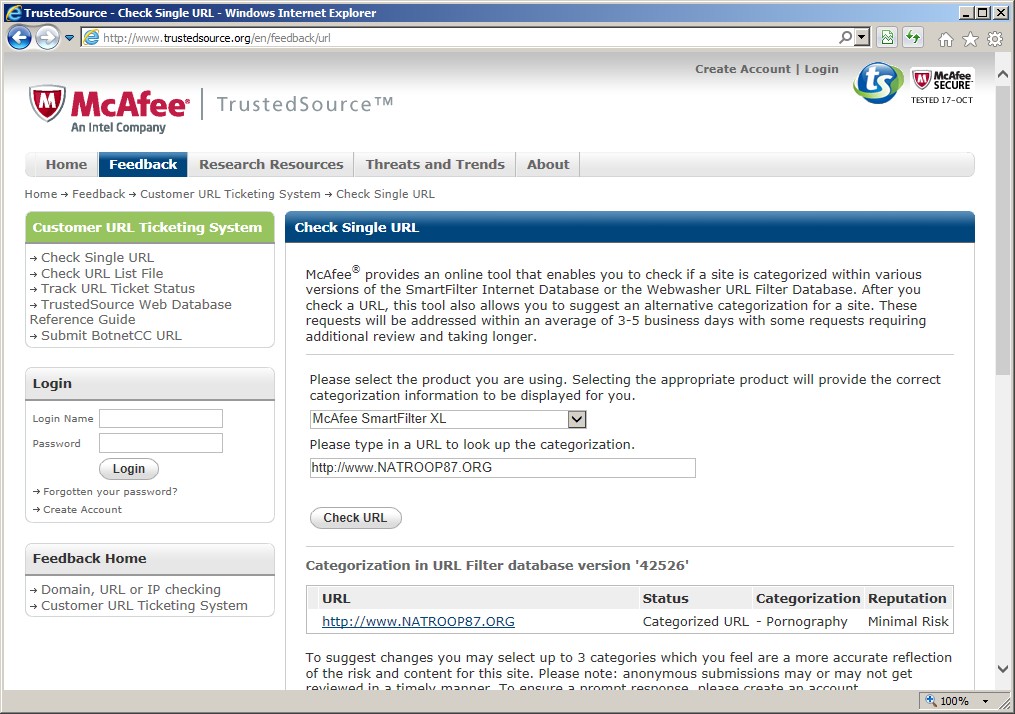
Slashdot contributor Bennett Haselton writes: "Internet users in Saudi Arabia, along with most users in the United Arab Emirates, are blocked by their respective government censors from accessing the websites of the Trinity Davison Lutheran Church, Deliverance Tabernacle Ministries in Pittsburgh, the Amitayu Buddhist Society of Taiwan, and GayFaith.org. An attempt to access any of those websites yields an error page like this one. However, the sites are not blocked because they conflict with the religions beliefs of those countries' governments. Rather, they are blocked because Smartfilter -- the American-made blocking program sold by McAfee, and used for state-mandated Internet censorship in those countries -- classifies those sites as "pornography". You can see the screen shots here, here, here and here." Read on for the rest of Bennett's thoughts.I found these blocked sites by starting with a combination of URL lists and ad hoc spidering, and running as many sites as possible through the Saudi filters to catch the ones that were blocked. Some of the sites were blocked for reasons that were easy to guess -- for example, http://www.bighornbasinsfw.org/, the home page of the Big Horn Basin, Wyoming chapter of Sportsmen for Fish & Wildlife, was almost certainly blocked because of the slang term "nsfw" in their URL. http://www.AgainstPornography.org and http://www.SearchingForMySpermDonorFather.org were presumably blocked because of the presence of the words "porn" and "sperm".
On the other hand, there appears to be no rational reason why the Filipino American Women's Network, the Tuscon Jazz Institute, or the Sacramento Police Activities League would have been blocked by Smartfilter, even by accident. A partial list of the blocked sites that I found is in the blog post I wrote for Citizen Lab, an Internet censorship research center at the University of Toronto.
Articles about sites that are erroneously blocked by Internet censorship software, have a storied history. The first widely read piece was the article "Keys to the Kingdom" written by Brock Meeks and Declan McCullagh in 1996, calling out Cyber Patrol for blocking EnviroLink.org and the University of Newcastle Computer Science Department, and CYBERsitter for blocking the National Organization for Women. I made a minor name for myself and the Peacefire.org site in the late 1990's by writing more pages about sites blocked by other products, including some (like X-Stop and SurfWatch) which no longer exist, and others that are still around, including Smartfilter. I was also one of six people comprising the Censorware Project, a loosely organized group of volunteers that published a few more reports.
By the early 2000's, however, it became clear that anyone whose mind was likely to be changed by information about what kinds of sites were blocked by blocking software, would have changed their mind already (or would, if they came across the research that had already been done up to that point). So the further reports on Internet blocking software errors, by me and other people, slowed to a trickle. I wrote a report in January 2002 on the latest list of sites blocked by Cyber Patrol, a product that most people today have forgotten. In 2006 I worked with the ACLU of Washington to publish a report on sites erroneously blocked by FortiGuard, a program used on computers in some libraries in central Washington, as part of the ACLU's suit to challenge the constitutionality of the program's use on public library terminals. (The Washington State Supreme Court rejected the lawsuit on the grounds that, regardless of what sites were blocked on the computers, it didn't matter because an adult library patron could request for the filter to be turned off.) In 2007 I wrote an article for Slashdot titled "From Bess to Worse" listing some sites that were blocked by an Internet filtering program called Bess (which was later bought out by Smartfilter and discontinued).
Most people's awareness of this debate, if they had heard about it at all, was limited to the perception that "breast cancer sites" and sites about "chicken breast recipes" were sometimes filtered by Internet blocking programs. Or they heard that "Beaver College" actually had to change its name to avoid being censored by web filters. As I tried to explain in a FAQ (written, according to the Wayback Machine, in 1999, but which still broadly holds true today), these examples are true, but they miss the point. These examples make it sound as if blocking software companies are doing the best job they can under the circumstances, and that the errors are unavoidable due to limitations on machine intelligence. In reality, any software algorithm that blocks the American Board of Vocational Experts, the Hopewell United Methodist Church, and the Patriot Guard Riders of Mississippi, as "pornography" (as Smartfilter currently does), is probably not the best algorithm the company could have come up with -- but there's no incentive for them to try harder, because few people will ever look that deep.
And yet, people continue to remember the "breast cancer site" examples. This sounds to me like an example of the narrative fallacy -- people remember that breast cancer sites were blocked, because there's a tidy explanation. There is no tidy explanation for most other examples of blocked sites, so the meme never spreads very far. Conveniently for the blocking companies, the blocked-site errors which make the company look most sloppy (the Kennels at Simpson Creek Farms, the St. Francis Institute of Milwaukee, etc.) are precisely the ones that, due to the narrative fallacy, most people won't remember or hear about.
One company, CYBERsitter, did manage to make a few blocking decisions in the 1990s that were egregious enough that their antics did make the news, and did finally raise some people's awareness that the controversy over private Internet filtering extended beyond "breast cancer sites". After TIME Magazine's website published an article (no longer online) that criticized CYBERsitter's blocking policies, CYBERsitter responded by blocking TIME Magazine's pathfinder.com domain. A few months earlier, CYBERsitter had blacklisted the monthly e-Zine "The Ethical Spectacle, after the Spectacle's founder, Jonathan Wallace, published an article criticizing CYBERsitter for blocking my own Peacefire.org website. And Peacefire.org had been blocked, in turn, because of a page I wrote (now very much out of date) listing some of the sites that CYBERsitter blocked, including the International Gay and Lesbian Human Rights Commission and Mother Jones. (Nowadays, of course, nobody would be surprised that filtering companies block Peacefire.org, since the site publishes ample instructions on how to get around Internet blockers. But at the time, the site's first and only article was the list of sites blocked by CYBERsitter, which is why CYBERsitter received so much criticism for blocking the domain in retaliation.) CYBERsitter also threatened to have Meeks and McCullagh criminally prosecuted for writing "Keys to the Kingdom" and threatened to sue me over the page that I had made.)
The moral, it seems, is that if you want an example of a censored web site to stick in people's minds, it either has to be a forgivable error, or an insane vindictive dick move -- because in either of those cases, people will understand why it happened. The vast swaths of censored websites on the spectrum in between, the ones for which there is no rational explanation for the blocking, go ignored.
These days, though, American and Canadian "censorware" makers have also come under fire for selling censoring software to foreign governments which use them for country-wide censorship. Most of the criticism focuses, naturally, not on the kinds of sites that are accidentally blocked by the blocking software, but on the immorality of these companies enabling statewide foreign censorship in the first place. Netsweeper, Blue Coat, and McAfee have all made the claim that "Once we sell their product to them, we have no control over what they do with it" -- which, as I wrote previously in Slashdot, is nonsense, because for the product to be effective, it has to rely on updates to the blocked-site list, which are provided at regular intervals by the manufacturer. Cut off the updates, and the product will not work, at least not as well.
So the fact that McAfee has classified the Boy Scout Troop 87 of North Andover, the Pan-Iranist Party of Iran, and Reptile Conservation International as "Pornography" is (rightly) overshadowed by the fact that McAfee is selling to government censors in Saudi Arabia and the UAE in the first place. However, as long as the filters are installed, these blocked sites are at least part of the problem for users in those countries, just as much as they are for students or cubicle workers in the U.S. whose network administrators happen to use Smartfilter. And, of course, I sampled only a miniscule fraction of the Web to find these examples of blocked sites, so the true number of stupid blocks affecting Saudi and UAE users is likely to be much larger. For each individual example, you might reasonably ask, "Is it really a big deal if Saudis are blocked from accessing Boy Scout Troop 87 of North Andover?" But it adds up.
-
McAfee Exaggerated Cost of Hacking, Perhaps For Profit
coolnumbr12 writes "A 2009 study (PDF) by the McAfee estimated that hacking costs the global economy $1 trillion. It turns out that number was a massive exaggeration by McAfee, a software security branch of Intel that works closely with the U.S. government at the local, state and federal level. A new estimate by the Center for Strategic and International Studies (and underwritten by McAfee) suggests the number is closer to closer to $300 billion (PDF), but even that much is uncertain. One of McAfee's clients, the Department of Defense, has used the $1 trillion estimate to argue for an expansion of cybersecurity, including 13 new teams dedicated to cyberwarfare. Despite the new data, Reuters said McAfee is still trying to exaggerate the numbers." The $1 trillion study has seen other criticism as well, so the new data is a step in the right direction. -
McAfee Labs Predicts Decline of Anonymous
Every years, McAfee Labs produces a list of predictions relating to computer security for the next 12 months. Last year (PDF) they said Anonymous would have to reinvent itself, and that there would be an overall increase in online hacktivism. This year's report (PDF) is not as optimistic for the hacking collective. "Too many uncoordinated and unclear operations have been detrimental to its reputation. Added to this, the disinformation, false claims, and pure hacking actions will lead to the movement’s being less politically visible than in the past. Because Anonymous’ level of technical sophistication has stagnated and its tactics are better understood by its potential victims, the group’s level of success will decline." That's not to say they think hacktivism itself is on the decline, though: "Meanwhile, patriot groups self-organized into cyberarmies and spreading their extremist views will flourish. Up to now their efforts have had little impact (generally defacement of websites or DDoS for a very short period), but their actions will improve in sophistication and aggressiveness." The report also predicts that malware kits will lead to an "explosion in malware" for OS X and mobile, but that Windows 8 will be the next big target. -
McAfee Labs Predicts Decline of Anonymous
Every years, McAfee Labs produces a list of predictions relating to computer security for the next 12 months. Last year (PDF) they said Anonymous would have to reinvent itself, and that there would be an overall increase in online hacktivism. This year's report (PDF) is not as optimistic for the hacking collective. "Too many uncoordinated and unclear operations have been detrimental to its reputation. Added to this, the disinformation, false claims, and pure hacking actions will lead to the movement’s being less politically visible than in the past. Because Anonymous’ level of technical sophistication has stagnated and its tactics are better understood by its potential victims, the group’s level of success will decline." That's not to say they think hacktivism itself is on the decline, though: "Meanwhile, patriot groups self-organized into cyberarmies and spreading their extremist views will flourish. Up to now their efforts have had little impact (generally defacement of websites or DDoS for a very short period), but their actions will improve in sophistication and aggressiveness." The report also predicts that malware kits will lead to an "explosion in malware" for OS X and mobile, but that Windows 8 will be the next big target. -
Over 60% of Android Malware Hides In Fake Versions of Popular Apps
An anonymous reader writes "Like any popular platform, Android has malware. Google's mobile operating system is relatively new, however, so the problem is still taking form. In fact, it turns out that the larger majority of threats on Android come from a single malware family: Android.FakeInstaller, also known as OpFake, which generates revenue by silently sending expensive text messages in the background. McAfee says that the malware family makes up more than 60 percent of Android samples the company processes." -
The Leap Second Is Here! Are Your Systems Ready?
Tmack writes "The last time we had a leap second, sysadmins were taken a bit by surprise when a random smattering of systems locked up (including Slashdot itself) due to a kernel bug causing a race condition specific to the way leap seconds are handled/notified by ntp. The vulnerable kernel versions (prior to 2.6.29) are still common amongst older versions of popular distributions (Debian Lenny, RHEL/CentOS 5) and embedded/black-box style appliances (Switches, load balancers, spam filters/email gateways, NAS devices, etc). Several vendors have released patches and bulletins about the possibility of a repeat of last time. Are you/your team/company ready? Are you upgraded, or are you going to bypass this by simply turning off NTP for the weekend?" Update: 07/01 03:14 GMT by S : ZeroPaid reports that this issue took down the Pirate Bay for a few hours. -
More Malicious Apps Found On Google Play
suraj.sun writes "We've seen quite a few Android malware discoveries in the recent past, mostly on unofficial Android markets. There was a premium-rate SMS Trojan that not only sent costly SMS messages automatically, but also prevented users' carriers from notifying them of the new charges, a massive Android malware campaign that may be responsible for duping as many as 5 million users, and an malware controlled via SMS. Ars Technica is now reporting another Android malware discovery made by McAfee researcher Carlos Castillo, this time on Google's official app market, Google Play, even after Google announced back in early February that it has started scanning Android apps for malware. Two weeks ago, a separate set of researchers found malicious extensions in the Google Chrome Web Store that could gain complete control of users' Facebook profiles. Quoting the article: 'The repeated discoveries of malware hosted on Google servers underscore the darker side of a market that allows anyone to submit apps with few questions asked. Whatever critics may say about Apple's App Store, which is significantly more selective about the titles it hosts, complaints about malware aren't one of them.'" -
McAfee Retracts Lowball Bug Damage Estimate
bennyboy64 writes "McAfee has changed its official response [warning: interstitial] on how many enterprise customers were affected by a bug that caused havoc on computers globally. It originally stated the bug affected 'less than half of 1 per cent' of enterprise customers. Now McAfee's blog states it was a 'small percentage' of enterprise customers. ZDNet is running a poll and opinion piece on whether McAfee should compensate customers. ZDNet notes a supermarket giant in Australia that had to close down its stores as they were affected by the bug, causing a loss of thousands of dollars." -
IE 0-Day Flaw Used In Chinese Attack
bheer writes "A zero-day attack on IE was used to carry out the cyber attack on Google and others that's been getting so much ink recently, reports The Register, quoting McAfee's CTO. While the web (and security) community has pointed out the problems with IE's many security flaws (and its sluggish update cycle) in the past, IE shows no sign of vanishing from the corporate landscape." -
Adobe Flash To Be Top Hacker Target In 2010
An anonymous reader writes "Adobe Systems' Flash and Acrobat Reader products will become the preferred targets for criminal hackers (PDF) in 2010, surpassing Microsoft Office applications, a security vendor predicted this week. 'Cybercriminals have long picked on Microsoft products due to their popularity. In 2010, we anticipate Adobe software, especially Acrobat Reader and Flash, will take the top spot,' security vendor McAfee said in its '2010 Threat Predictions' report. 'We have absolutely seen an increase in the number of attacks, around Reader in particular and also Flash Player to some extent,' CTO Kevin Lynch told reporters at the Adobe Max conference in October. 'We're working to decrease the amount of time between when we know about a problem and when we release a fix. That used to be a couple of months; now it's within two weeks for critical issues.'" -
Yemenis Should Be Incensed At Websense
Slashdot regular Bennett Haselton writes "Websense, a US-based Internet-censoring software maker, claims not to sell to foreign governments that are censoring Internet access for all of their citizens. But the OpenNet Initiative reports that national ISPs in Yemen have been using Websense to filter Internet access for at least the past four years. Will Websense revoke their license? And what would happen then?" Update: 08/10 21:01 GMT by KD : Bennett adds, "After the story ran, Websense sent me this update." "Since we were informed about the potential use of our products by Yemeni ISPs based on government-imposed Internet restrictions in Yemen, we have investigated this potential non-compliance with our anti-censorship policy. Because our product operates based on a database system, we are able to block updated database downloads to locations and to end users where the use of our product would violate law or our corporate policies. We believe that we have identified the specific product subscriptions that are being used for Web filtering by ISPs in Yemen, and in accordance with our policy against government-imposed censorship, we have taken action to discontinue the database downloads to the Yemeni ISPs."The Internet censoring software maker Websense has a published policy on their website against allowing their software to be used for government-mandated censorship:
Websense does not sell to governments or Internet Service Providers (ISPs) that are engaged in any sort of government-imposed censorship. Any government-mandated censorship projects will not be engaged by Websense. If Websense does win a business and later discovers that the government is requiring all of its national ISPs to engage in censorship of the Web and Web content, we will remove our technology and capabilities from the project.
This supposedly differentiates the company from competitors such as Smartfilter (now owned by McAfee), which according to OpenNet Initiative reports, is used to censor the Internet in several African and Middle Eastern countries including Tunisia, Saudi Arabia, UAE, and Sudan. Websense once enthusiastically competed for the contract to censor Internet access in Saudi Arabia, but has now apparently ceded such markets to Smartfilter.
However, according to the ONI, the two national ISPs in the country of Yemen are using Websense to censor Internet access for all users. The researchers found that some sites are blocked in Yemen that are probably not on Websense's original filtering list, such as the Yemeni Socialist Party, as well as sites that are blocked under standard Websense categories, such as pornography, sex education materials, and "anonymizing and privacy tools" (presumably, proxy sites).
Websense declined to tell me whether they have ever revoked an ISP's license to use Websense after discovering that the ISP was using it in violation of their anti-government-censorship policy. They also declined to say whether they had any ISP customers in Middle Eastern countries, apart from Yemen. (For any Middle Eastern ISP using Websense, there's a high probability that they would be doing it as a result of a government mandated filtering policy, and hence in violation of Websense's stated rules.) But regarding the use of Websense in Yemen, Websense did reply to say simply, "We will look into the matter. If our software is being used in violation of our policy, we will take appropriate action." I think that if they were serious about preventing their software from being used for government censorship, they should have red-flagged any purchase from a national ISP in a country with one of the worst press-freedom ratings in the world, but better late than never.
There are only about 200,000 Internet users in Yemen, compared to over six million in Saudi Arabia, millions more in other censored Middle Eastern countries, and 300 million in Internet-censored China. (And even the Yemenis' Internet access is not filtered all the time, since the ONI report says that the number of concurrent licenses for Websense purchased by the Yemeni ISPs is less than the number of Yemeni Internet users, and when the number of concurrent users exceeds the number of licenses, all requests go through unfiltered!) So it would be a small step towards global liberation of the Internet, but still equivalent to de-censoring Internet access for every resident of Boise if the city had 100% broadband penetration, which is enough to justify putting the squeeze on Websense.
What exactly would happen if Websense did revoke their license for the Yemeni ISPs? They couldn't force the ISPs to uninstall the software, but they could stop allowing them to download further updates to the Websense blocked-site list. Most installations of Websense are configured to download updates to the list every day, to block the latest adult websites as well as to try and stay ahead of newly released proxy sites. Once the list updates stopped, all existing blocked websites would remain blocked, but newly created adult sites and proxy sites would be accessible, and the filtering would gradually become less and less effective. So it would be a concrete victory for Yemeni Internet users, and not just a symbolic gesture.
How would we know if Websense went through with it, anyway, if they refuse to confirm or deny that they have revoked the licenses for Yemen? The ONI declined to tell me how exactly they determined that Yemeni ISPs were using Websense. (Not that I mind; they could have obtained this information with the help of people whose jobs and freedom would be at stake if they were found out, in which case ONI would not be able to share their confidential sources.) Presumably the ONI could repeat their research in the future to determine if Websense were still being used. However, even if they can see that Websense software is still being used to censor the Internet, it may not be easy to tell whether the Yemeni ISPs are still downloading updates to the blocked-site list. My suggestion: Create a new proxy site and don't publicize it anywhere, but report it to Websense for blocking. Test a few days later to verify that it's blocked by Websense, but not by Smartfilter or other popular blocking programs. Then see if it's blocked in Yemen as well. If not, then hopefully that means that Websense cut them off.
And then what? Maybe the Yemeni ISPs will just continue using Websense with a frozen copy of the blocked site list, reasoning that most of the well-known adult sites that users are going to try to visit, are probably already on that list. Maybe they'll set up a shell company in another country, posing as an ISP requesting a legitimate copy of Websense, and buy a new list subscription that way. But it will still be worth it to press Websense into revoking their license, even if it only breaks Internet censorship in Yemen for a few months or a year. At that point, perhaps they'll just take their business to Smartfilter like almost every other Middle Eastern country that censors the Internet.
After all, we shouldn't pick on Websense too much, when Smartfilter is censoring national Internet access for about 100 times that many users in total. If Websense says they don't provide software to government censors, then we should hold them to that. But the real scandal isn't that American censorware companies provide filters to censoring governments while claiming not to, it's that American companies are doing it at all.
-
Taming Conficker, the Easy Way
Dan Kaminsky writes "We may not know what the Conficker authors have in store for us on April 1st, but I doubt many network administrators want to find out. Maybe they don't have to: I've been working with the Honeynet Project'sTillmann Werner and Felix Leder, who have been digging into Conficker's profile on the network. What we've found is pretty cool: Conficker actually changes what Windows looks like on the network, and this change can be detected remotely, anonymously, and very, very quickly. You can literally ask a server if it's infected with Conficker, and it will give you an honest answer. Tillmann and Felix have their own proof of concept scanner, and with the help of Securosis' Rich Mogull and the multivendor Conficker Working Group, enterprise-class scanners should already be out from Tenable (Nessus), McAfee/Foundstone, nmap, ncircle, and Qualys. We figured this out on Friday, and got code put together for Monday. It's been one heck of a weekend." -
Most Users Think They Have AntiVirus Protection, While Only Half Do
SkiifGeek writes "A survey carried out by McAfee and the NCSA found that while more than 90% of users believed that they were protected by antivirus or antimalware products that were updated at least once a week, only 51% actually were. 'Even with significantly growing awareness by everyday users of the need for efficient and effective antivirus / antimalware software, and the increasing market penetration achieved by the security industry, the nature of rapidly evolving Information Security threats means that the baseline of protection is outstripping the ability of users to keep up (without some form of extra help).' The study is available online in PDF format. What sort of an effect does this sort of thinking, and practice, have on the overall security of your systems, networks, and efforts to educate?" -
Latest Version of MyDoom Exploits New IE Flaw
techentin writes " CNN Money is reporting a new and improved MyDoom variant which is spread by a hyperlink in email. Clicking the link connects the user to an infected machine, which exploits a recently discovered buffer overflow in Internet Explorer. McAfee has a more detailed description. Is this yet another good reason for running Firefox?" CNET also has a story. -
Symantec Acquires @Stake
-
McAfee lists Adware in Top 10 Viruses
joelethan writes "In the new sensitive, caring world of Windows security McAfee Virusscan detects adware/malware, just like its competitors. A surprising consequence is that the McAfee's Regional Virus Info now regularly shows adware in its infection top ten. It feels so good to see old favorites like 180Search and DFC listed. "Now for your listening pleasure it's Adware.Gator at number 7 with a bullet..." " -
Windows Accelerators - Do They Really Work?
danila asks: "Today I came across an intriguing review of Windows tweakers on a Russian technology news site. Among the plethora of traditional registry tweakers, the review mentioned Hare 1.5.1. The developers promised nothing less than up to 300% speed increase, 10% FPS increase in 3D games, automatic RAM preservation and even a wizard that automatically cleans and optimizes Windows. It also had AntiCrash 3.6.1 a program to prevent up to 95.8% of Windows crashes. Understandably, I was both intrigued and suspicious since it sounded too good to be true." Has anyone tried this piece of software with any degree of success? How successful are other "windows accelerators" at improving Windows performance? "After a little research I found that download.com didn't have it and there are precious few reviews of this revolutionary software online, but that it was endorsed by McAfee and that developers touted conformance with Microsoft's interface guidelines as an important feature.
Still suspicious, I gathered all my courage and installed both programs (silently preparing for something like Bonsi Buddy or XXX Toolbar) on my Win2k Pro machine (P4 1.6/512Mb). Truth be told, after several minutes I was blown away. Obviously I can't tell how well every promised features works, but disk caching (and pre-fetching) that Hare does is outstanding and display performance improved enough to scare me - windows were opening, minimizing and redrawing without the delay I was accustomed to.
The question is -- is it real or was I fooled by some clever placebo tricks? And if it is real, why isn't the Web full of success stories involving Hare and AntiCrash? Why isn't everyone installing them on every Windows machine in the world? And a rhetorical question -- why doesn't Microsoft incorporate some of the features into its operating systems." -
Bagle/Beagle Variant Includes Source Code
NASAdude writes "Sunday brought a lot of fireworks... and the release of two new Bagle/Beagle variants. One of the variants includes a copy of its source code as an attachment as it spreads via email. It is expected the inclusion of the source will result in numerous variants. It's been dubbed Beagle.Y and Beagle.Z by Symantec and Bagle.ad and Bagle.ae by McAfee. ZDNet ran a story that covers these new variants." -
Bagle/Beagle Variant Includes Source Code
NASAdude writes "Sunday brought a lot of fireworks... and the release of two new Bagle/Beagle variants. One of the variants includes a copy of its source code as an attachment as it spreads via email. It is expected the inclusion of the source will result in numerous variants. It's been dubbed Beagle.Y and Beagle.Z by Symantec and Bagle.ad and Bagle.ae by McAfee. ZDNet ran a story that covers these new variants." -
Settlement Reached in McAfee Class Action Suit
An anonymous reader writes "Network Associates has reached a settlement in a class action suit alleging it broke its own license agreements by not providing users of VirusScan 3 & 4 with free lifetime upgrades. Although not admitting guilt, the settlement entitles all U.S. (sorry to the rest of the globe) owners of the older versions free upgrades to VirusScan v8 (or, optionally, QuickClean/AntiSpyware). If eligible, you have until July 16th to fill out this form. The settlement page also contains links to the Class Notice and Settlement Agreement (in PDF format)." -
Sasser Worm Disruption Growing
thebra writes "Yet another virus is causing problems with Internet Explorer. "Sasser, unlike a virus which travels through e-mails and attachments, spreads directly from the internet."A removal tool can be found here." -
New Windows Worm on the Loose
Dynamoo writes "The Internet Storm Center has issued a Yellow Alert due to the spread of the Sasser worm exploiting Windows 2000 and XP machines through a documented flaw in the Local Security Authority Subsystem Service (LSASS) as described in Microsoft Bulletin MS04-011. Initial analysis seems to indicate classic Blaster-style worm behaviour. Right now I'm just getting a probe every 10 minutes or so on my firewall, but this is bound to escalate sharply as the pool of infected machines grows. Of course all good Windows-using Slashdotters visit Windows Update regularly and have a firewall, don't you? More information at Computer Associates, F-Secure, Symantec and McAfee." -
Slashback: Flashmob, Currency, Verification
The first Slashback in a while, with updates and reactions to previous Slashdot stories, including a Flash-mod supercomputing reminder, the upside of microwave-tested currency, CUPS' user-interface foibles, an alternative to MD5 sums, and more. Read on for the details.Reminder of your scheduled spontaneous appointment. Zero_K writes "As previously posted on Slashdot and the NY Times, the University of San Francisco's, Computer Science department is building a 'flash mob' supercomputer on April 3rd. On their newly updated official web-site (Main Site, ISO's) the team has now posted the ISO image of their custom morphix that will be used to boot all the computers into the cluster, documentation is on the website (under 'downloads') and on the CD (index.html). I personally plan on downloading and testing this ISO tonight. And after the cluster is taken off line, there will be a massive LAN PARTY (Possibly one of the biggest in San Francisco...) On a 10-Gigabit LAN...Oh sweetness ... So if you are in or around the SF Bay Area on April 3rd, be sure to sign up and bring your laptop or desktop to campus and help make history."
Whaddya mean, "no pun intended"? Rudiger writes "After the dust (no pun intended) has settled around the whole Operation Dust Bunny thing, McAfee updates their signature database classifying Dust Bunny as an application. To be more specific: 'This program is detected as a "potentially unwanted application."' They also say 'This is not a virus or trojan.' Should we leave it to the experts this time?"
Would you read Atlas Shrugged on this screen? An anonymous reader writes "The so-called 'electronic paper,' being a high-clarity monochrome display to become a foundation for comfortable and inexpensive 'electronic papers,' has finally shown its face. The new electronic paper, which looks a bit like an iPod, has 10MB memory, keyboard, Memory Stick PRO slot, voice recorder, speaker, and headphones output, and USB2.0 interface."
(We mentioned the device yesterday, but this link provides better images of it.)
Now they're Pragmatic Publishers as well -- much success! AndyHunt writes "As you may have heard, the Pragmatic Programmers have started their own publishing company (see Slashdot reviews here and here). We've just signed our first outside author: Mike Clark, editor of the JUnit FAQ and developer of JUnitPerf and JDepend. He'll be writing the eagerly-anticipated Pragmatic Project Automation book, the third volume in our Jolt Productivity award-winning series."
Exactly how many bits, Ma'am? And in what order, did you say? jlcooke writes "Two months (almost to the day) after getting slashdotted for an innocent post to sci.crypt - the MD5CRK project has launched. The aim is to get the thousands of applications and websites to drop MD5 for SHA-1 or SHA-256 by finding a counter-example of a security requirement in MD5. Press Release is here."
How to take criticism, by example. slashdot_commentator writes "Eric S. Raymond has recently written a wonderful piece explaining to the Linux zealot why it may not be the operating system of choice of all users. (Or what user aspects open source developers need to focus on to further Linux World Domination.) The op-ed specifically focuses on the CUPS printing system. (But it would be a mistake to dismiss it as a screed against CUPS.) The CUPS authors surprisingly acknowledged ESR's points, and he wrote a followup to the article."
Hitting them where it figuratively hurts. Ian Wilson writes with a followup to the Slashdot post earlier this month on "website thieves stealing content and designs from others, taken from silicon.com. Well, now silicon.com is reporting that it has contacted the offending site's advertisers and forced them to stop paying ad revenues - thus effectively crippling the illegal site - after all, no revenue, no reason to the run the site."
Express your appreciation with PizzaPal. Chuck writes "After you guys published the article on $20 bills exploding when microwaved, a co-worker of mine went to put his soup in the microwave and found a $20 bill in it. Too bad it was an older one, but someone around the office must have left it in there after reading your article. The co-worker then took me out to lunch. Thanks, Slashdot!"
-
Why Do Email Admins Make Viruses Worse?
gripdamage asks: "Why are email administrators still sending virus bounce messages, when everyone knows viruses forge the sender? This effectively doubles the amount of email traffic due to the virus (triples in the case that the recipient is also notified). As one of the links says 'any AV software or admins that have it mis-configured [so] that it is continuing to send out notices...to forged senders, deserve to be ridiculed.' I have received 4 times as many erroneous bounce notifications, because of MyDoom , than the actual virus, so the bounce messages are much more of a problem! This is a problem deserving publicity, so that email admins will be shamed into doing the right thing." The problem is that most bounces are automated responses, the simple thing would be to turn them off. Of course, the rational of the automated response is to hopefully notify the infected user of the problem -- what a catch-22! What kind of policy would you recommend when it comes to spam, e-mail and automated responders? -
Hormel Sues Over SpamArrest Name
slammin'j writes "According to this article from the Star Tribune, Hormel has filed a lawsuit against Spam Arrest LLC. for endangering "substantial goodwill and good reputation" of their meat product, Spam. If Hormel wins, it could be bad news for umpteen companies that make use of the word spam in their name." -
Slashback: OpenSSH, Bio, Timeliness
Welcome to Slashback, with updates (below) on a handful of recent Slashdot posts. Most importantly, a message regarding OpenSSH 3.3 could save your system from attack -- read it; you might need to pass the word on to your vendor, too.Things that make you want to bring back thumbscrews. A few days ago, we mentioned the release of OpenSSH 3.3; compared to previous versions, the biggest change in 3.3 is increased emphasis on privilege separation. Today, Theo de Raadt sent word of an OpenSSH vulnerability being worked on by ISS and the OpenBSD team, details of which are expected to be published early next week.
In an announcement sent to bugtraq, he wrote: "However, I can say that when OpenSSH's sshd(8) is running with priv separation, the bug cannot be exploited.
OpenSSH 3.3p was released a few days ago, with various improvements but in particular, it significantly improves the Linux and Solaris support for priv sep. However, it is not yet perfect. Compression is disabled on some systems, and the many varieties of PAM are causing major headaches.
However, everyone should update to OpenSSH 3.3 immediately, and enable priv separation in their ssh daemons, by setting this in your /etc/ssh/sshd_config file:
UsePrivilegeSeparation yes
Depending on what your system is, privsep may break some ssh functionality. However, with privsep turned on, you are immune from at least one remote hole. Understand?
3.3 does not contain a fix for this upcoming bug.
If priv separation does not work on your operating system, you need to work with your vendor so that we get patches to make it work on your system. Our developers are swamped enough without trying to support the myriad of PAM and other issues which exist in various systems. You must call on your vendors to help us."
Theo emphasizes the role of vendor cooperation in making privilege separation work on the full range of systems on which OpenSSH runs. "If the vendors don't start pulling their part," he says in an email, "by the time the bug is posted their customers will be left unprotected. These vendors who do not do the right job and instead just 'sell sell sell' are starting to become annoying. On a lot of systems today, privsep does NOT work well at all. The vendors have not been helping!"
A patched version of OpenSSH could be released as soon as Friday, incorporating vendor patches received by this Thursday.
Read More on Stallman. Vamphyri writes: "Sam Williams, author of 'Free as in Freedom', biography of GNU/Linux founder Richard M. Stallman has gone live with the online free version 1.0 of FAIFzilla.org. The paper pulp version publishers O'Reilly & Associates agreed under the terms of the GNU Free Document License and have their own version up at their site. Williams' site allows for content and corrections to be submitted by readers. He hopes for contributions to be included in later editions of the O'Reilly bio. Also: CGI coders wanted for site enhancement, paragraph and line numbering, searches etc. Maybe a CVS Tree is in order? :)"
"Urpmi Norton" doesn't work for some reason. MrResistor writes "Upon logging in to my computer at work this morning, I was greeted by a virus update notice from McAfee SecurityCenter. The update for today includes W97M/Melissa@MM, and of course McAfees newly manuf^H^H^H^H^Hdiscovered threat, the W32/Perrun JPEG virus (which was also highlighted in yesterdays update). All of the updates in the last week or so have been rated Low or No Threat (except for Perrun, which is "Low On Watch". It seems that in addition to manufacturing new threats, they're also rehashing old threats to keep subscription renewals up. Perhaps it's time for Slashdot to add an Ethics topic?"
-
Slashback: OpenSSH, Bio, Timeliness
Welcome to Slashback, with updates (below) on a handful of recent Slashdot posts. Most importantly, a message regarding OpenSSH 3.3 could save your system from attack -- read it; you might need to pass the word on to your vendor, too.Things that make you want to bring back thumbscrews. A few days ago, we mentioned the release of OpenSSH 3.3; compared to previous versions, the biggest change in 3.3 is increased emphasis on privilege separation. Today, Theo de Raadt sent word of an OpenSSH vulnerability being worked on by ISS and the OpenBSD team, details of which are expected to be published early next week.
In an announcement sent to bugtraq, he wrote: "However, I can say that when OpenSSH's sshd(8) is running with priv separation, the bug cannot be exploited.
OpenSSH 3.3p was released a few days ago, with various improvements but in particular, it significantly improves the Linux and Solaris support for priv sep. However, it is not yet perfect. Compression is disabled on some systems, and the many varieties of PAM are causing major headaches.
However, everyone should update to OpenSSH 3.3 immediately, and enable priv separation in their ssh daemons, by setting this in your /etc/ssh/sshd_config file:
UsePrivilegeSeparation yes
Depending on what your system is, privsep may break some ssh functionality. However, with privsep turned on, you are immune from at least one remote hole. Understand?
3.3 does not contain a fix for this upcoming bug.
If priv separation does not work on your operating system, you need to work with your vendor so that we get patches to make it work on your system. Our developers are swamped enough without trying to support the myriad of PAM and other issues which exist in various systems. You must call on your vendors to help us."
Theo emphasizes the role of vendor cooperation in making privilege separation work on the full range of systems on which OpenSSH runs. "If the vendors don't start pulling their part," he says in an email, "by the time the bug is posted their customers will be left unprotected. These vendors who do not do the right job and instead just 'sell sell sell' are starting to become annoying. On a lot of systems today, privsep does NOT work well at all. The vendors have not been helping!"
A patched version of OpenSSH could be released as soon as Friday, incorporating vendor patches received by this Thursday.
Read More on Stallman. Vamphyri writes: "Sam Williams, author of 'Free as in Freedom', biography of GNU/Linux founder Richard M. Stallman has gone live with the online free version 1.0 of FAIFzilla.org. The paper pulp version publishers O'Reilly & Associates agreed under the terms of the GNU Free Document License and have their own version up at their site. Williams' site allows for content and corrections to be submitted by readers. He hopes for contributions to be included in later editions of the O'Reilly bio. Also: CGI coders wanted for site enhancement, paragraph and line numbering, searches etc. Maybe a CVS Tree is in order? :)"
"Urpmi Norton" doesn't work for some reason. MrResistor writes "Upon logging in to my computer at work this morning, I was greeted by a virus update notice from McAfee SecurityCenter. The update for today includes W97M/Melissa@MM, and of course McAfees newly manuf^H^H^H^H^Hdiscovered threat, the W32/Perrun JPEG virus (which was also highlighted in yesterdays update). All of the updates in the last week or so have been rated Low or No Threat (except for Perrun, which is "Low On Watch". It seems that in addition to manufacturing new threats, they're also rehashing old threats to keep subscription renewals up. Perhaps it's time for Slashdot to add an Ethics topic?"
-
Latest WinWorm Spreads Via ICQ And Outlook
mgooderum was among the many to write in about yet another snippet of malice making the Windows desktop rounds: "The latest email virus -- 'Goner' -- is apparently running around this morning (AP news story on Iwon here - no login needed). The virus is a typical worm that spreads via attachments and user's address books. It appears as a message with an attachment that starts: 'How are you ? When I saw this screen saver I immediately thought about you...' Goner is apparently non-destructive other than the normal DoS issues with the load from it forwarding itself everywhere. What's moderately unique are two features. One is its ability to replicate via ICQ as well as the usual Outlook and Outlook Express. Two is its small size -- it has a packed form that is only 159 bytes. Symantec has details here; McAfee has details here." Update: 12/04 21:57 GMT by T : That should read 159 kilobytes. And as many posters have pointed out, "destructive" is in the eye of the beholder. -
McAfee Patents ASP Business Model
Rob Kischuk writes: "According to an article at InfoWorld, McAfee.com has been granted a patent on its variety of "software as a service". No specifics on the patent, but the CEO's statement, "You either work with us, or you work around this patent", seems to indicate that more than a couple of ASPs could be affected." kerubi gets a cookie for sending in a link to the patent in question, or read McAfee's press release. -
McAfee Patents ASP Business Model
Rob Kischuk writes: "According to an article at InfoWorld, McAfee.com has been granted a patent on its variety of "software as a service". No specifics on the patent, but the CEO's statement, "You either work with us, or you work around this patent", seems to indicate that more than a couple of ASPs could be affected." kerubi gets a cookie for sending in a link to the patent in question, or read McAfee's press release. -
New Virus Can Strike Via HTML E-Mail
cmeans and lots and lots of others have pointed us to this MSNBC article article about yet another e-mail virus. Quote from the story: "The virus can only run if Internet Explorer 5.0 with Windows Scripting Host is installed (standard in Windows 98 and Windows 2000 installations). If security settings for Internet Zone in IE5 are set to High, the worm will not be executed. It does not run on Windows NT." ZDNet also has a story about this "Bubbleboy" virus. Update: McAfee weighs in too. (Thanks, Jade.) Consider yourself warned.