 Slashdot Mirror
Domain: microsoft.com
Stories and comments across the archive that link to microsoft.com.
Comments · 34,132
-
Jim Gray gone missing
On a related note, Jim Gray, the researcher behind the WorldWide Telescope, recently went missing on a sailing expedition. The search has already been suspended.
LS -
Jim Gray gone missing
On a related note, Jim Gray, the researcher behind the WorldWide Telescope, recently went missing on a sailing expedition. The search has already been suspended.
LS -
Re:Maybe 2008 is the year...That means while Open Office will open up your Word 6 document, latest MS Office won't.
Actually, it will. It is Word 2 format (and earlier) that is blocked by default. The DOC file format changed dramatically between version 2 and version 6, so it makes sense for to draw the line at that version. The link above shows that you can still open old formats if you want to. I doubt many people still be able to find any documents from that long ago anyway. The Word docs that I still have from back then are from the Unix version of Word, which I presume used the same format at Word for DOS.
As for VBA, reports that they were dropping it from Office were wrong. They did remove VBA from the Mac version, which I think was a mistake. Sure they should support Applescript, but they should have kept VBA for backwards compatibility.
-
I don't fear the moderation !
I'm possibly gonna be moderated "Funny", but the Vista guidelines are well done IMO.
-
Re:Don't re-invent the wheel
I can only amplify what the parent poster has said.
Follow the design style guide of the hosting desktop environment.
If you are developing for Windows, use Microsoft's own guidelines.
If you are developing for Mac OS X, use Apple's (link already given by someone else).
If you are developing for Gnome, use the Gnome guidelines.
You get the general idea. Also, don't invent your own controls/widgets unless you Really Have To.
If you are writing a cross-platform application, it's a bit more difficult. Find an application framework that adopts the user interface guidelines of the hosting environment, so that you don't have to do the work yourself. (This is left as an exercise for the reader...) -
Re:The whole idea of upgrading PCs???
I'd appreciate it if you'd follow your own advice and not take the conversation out of context and put words in my mouth. My point about things changing under the hood in that none of these changes were apparent to me when I used it.
Fair enough, but I'd like to point out that I don't see how you could notice any changes if you're only running "two or three windows applications."
The side-grade to XP from 2000 was entirely due to gaming, and the fact that lots of games will refuse to install and/or run on 2000 for no adequately explored reason other than "it's not XP".
Well the reason was 2000 was targeted at businesses, so they didn't put alot of effort in the DX for 2000. Conversely, XP was aimed at both home and business users, and because they wanted a single code base, its easy enough to to provide DX to both versions.
What I like about Kubuntu is that it doesn't get in my way.
Well, my experience was different (Mandriva with KDE). It got in my way so much I bought Windows.
The GUI is simpler and more customisable.
Hmm... the GUI is mostly the same, except there's lots more control panel items. So much so that I never knew quite which one would provide the customization I wanted. I could never get the K menu editing to work. Personally I have better things to do than customize my desktop, especially when Windows defaults work great for me.
Hibernate and suspend are more reliable.
I have never had problems with either on XP or Vista.
It keeps itself up to date without requiring reboots all the time (which, incidentally, are faster than Vista).
Hmm, I guess I'm not installing updates twice a day, so I don't care. I haven't had to wait for an update because it was required for me to do something I wanted. The updates have been security or reliablity, and I reboot when I'm done with my computer anyway. I find this argument pretty weak.
The battery lasts longer than Vista.
Can't comment; the only Vista laptop I have only ever had Vista on it, but it lasts as long as my other laptop with XP on it.
Cloning and backing up my partitions and/or home drive is easier than in Vista.
I guess you haven't tried Vista's Backup.
No activation.
Activation which takes three seconds? Honestly I can't see why anyone cares.
Native support for SSH.
I'd rather a graphic remote desktop over command line. I realize that's just my preference though.
A brilliant shell in the form of bash.
Did you try Powershell?
I gave up my "I use Linux cos only 733t HaXx0rz like me can use it" years ago... If not liking Vista makes me an MS-hater
Sometimes people change the rationalization they use. Not saying you're lying though, just saying you might want to think about that possiblity. Not liking Vista doesn't make you an MS hater, but not keeping an open mind when you evaluate it, which it doesn't sound like you really did, makes me wonder though. Honestly I used to have some of those same reasons for not wanting to use MS, but then I realized they were pretty silly.
now I just want something I can do my work in without any hassle. I just want to get my work done.
Heh... pretty funny, considering that's exactly why I moved from using Linux on my server, which I had done for 10 years, and linux on my desktop, which I had for three years, to Windows on both. Seriously, I'm not mocking you at all, I just find it really ironic. -
Re:The whole idea of upgrading PCs???
I think that Apple actually sells a lot of upgrades.
Can you back that up with some numbers, such as % of apple users that buy OS upgrades?
I have not upgraded to Vista because of the cost to benefit ratio. For me it would be a lot of cost and probably a negative benefit.
Probably a negative benefit? Maybe you should try it. Personally I like the new features of Vista, and wouldn't want to go back to XP. I only have one computer that's not running Vista, and that's a laptop from 01 or 02 and I haven't checked specs. -
Re:Hopefully notI want to patent my idea first: It's a method of crippling a system's CPU using only a few lines of code. I'm not going to write it here obviously though, because otherwise someone will beat me to the chase. Prior art.
-
Re:Vista on minimal HW
And as a counterpoint, I'm on a new HP Compaq 8710w, 2.4GHz C2D, 4GB ram, 120GB 7200rpm HDD (laptop).
Running Vista Business x64 off a vanilla HP oem build. No crapware on this class of machine, other than google toolbar garbage which is removed.
This thing is very fast (much faster than my old xp boxes under heavy I/O load), and rock solid stable. UAC is such a HUGE improvement over having to pre-emptively use RunAs all the time in XP. The desktop presenting is fast, smooth, doesnt hang, and doesnt tear.
If I turn off on-access scanning on Sophos, the desktop comes up very fast after reboot or standby. I usually do leave this off anyway, as I havent tripped over anything that Sophos caught in like 5 years.
It survives longer than XP ever did with my usage (5-10 standys, change of networks, and vpns up/down each day), before needing a reboot.
Given other's anecdotal stories, I'm not sure how much of it is the x64 part, or how much of it is that this is just a very high end HP box targeted at engineers, so the drivers and hardware are top-notch. But this machine is fast, stable, and quite impressive.
I got it with Vista so that I could be the guinea pig on our software for Vista and x64, and learn all the little foibles. It's been pretty good to me so far, once I figured out two big problems (many old routers dont like adaptive MTU and tcp/ip management, these just needed their firmwares updated; and the issue about file shareing not working correctly over a VPN: KB 933468). -
Re:The point being....
The problem is sometimes that we, the users, are not listened.
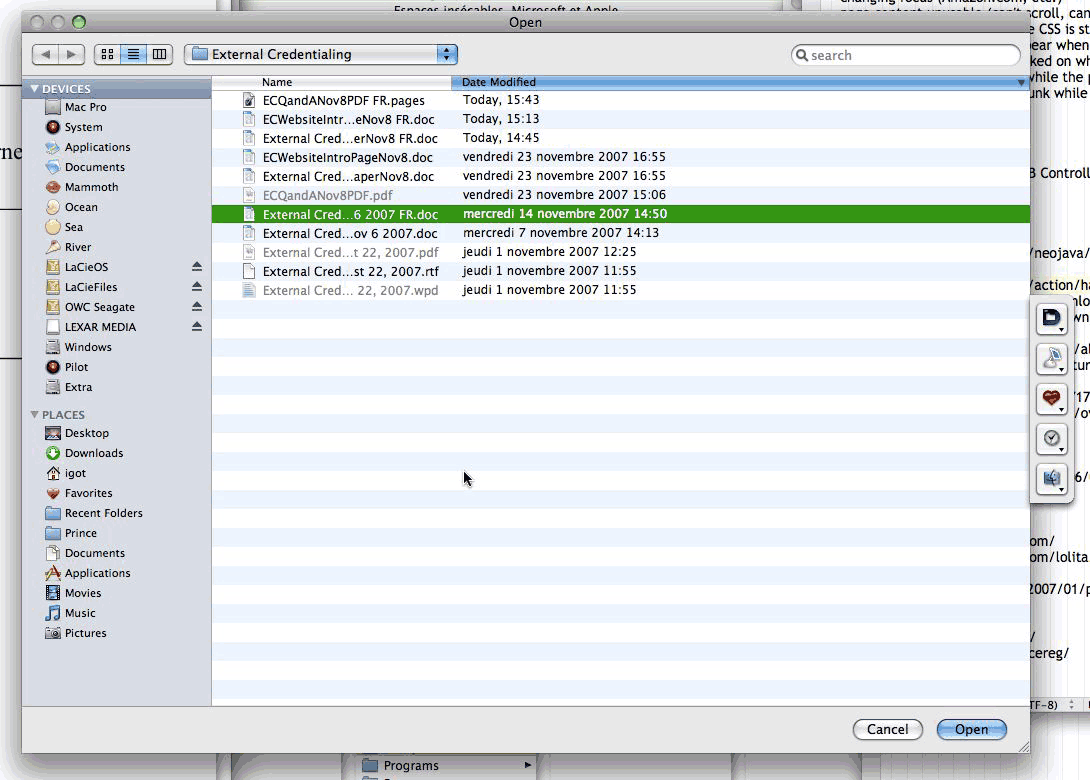
My proposal: Fix the fucking GTK-file-selection box! http://www.gnome.org/~seth/designs/filechooser-spec/
Why on earth is "Browse other folders" taking huge amount of screen estate (in save dialog)???
Do hidden files work (when I type ".bashrc" will gedit open it)?
Vista: http://www.tmssoftware.com/atbdev6.htm (?)
XP: http://www.microsoft.com/library/media/1033/windowsxp/images/using/setup/tips/68222-click-save.gif
Leopard: http://www.betalogue.com/images/uploads/finder/OpenDialogBox-ListView.gif
Java: http://java.sun.com/docs/books/tutorial/figures/uiswing/components/FileChooserOpenMetal.png
Other: http://www.guidebookgallery.org/screenshots/openfile
More: http://www.raizlabs.com/interface/hall-of-shame/default.asp
There is even a theme to change it to KDE style!!!
KGtk: http://www.kde-apps.org/content/preview.php?preview=1&id=36077&file1=36077-1.png&file2=36077-2.png&file3=36077-3.png&name=KGtk+(Use+KDE+Dialogs+in+Gtk+Apps)&PHPSESSID=83fa01cf68ec222d01626c20f3ebe9af -
Re:For more information
A lot of high end MMO games are notorious for memory leaks and when you are playing for several hours plus running voice communications, internet browsing etc I have seen my pagefile hit 1.5 GB before. Microsoft actually recommends 4GB. Best practices for partitioning a hard disk http://www.microsoft.com/windowsxp/using/setup/expert/tulloch_partition.mspx I also do a lot of multi-tasking and photoshop work so the pagefile does get up there. Anyhow for those still sticking with XP the above link and this one are good starters for increasing performance. http://www.pcstats.com/articleview.cfm?articleid=1590&page=1
-
Windows Update Catalog
Windows update has literally thousands of 3rd party drivers. You can search for them directly without having to use the Windows Update application: http://catalog.update.microsoft.com/v7/site/Home.aspx
Note that IE6+ is required to search the driver catalog. Try searching for ATI, Nvidia, or simply just "video"! -
Steve Ballmer doing tech support!
There is something right in a world where Steve Ballmer is reduced to doing tech support for Vista...
have you checked windows update, I assume you found no drivers there either??
Now if only everybody could CC their support requests to mailto:steve.ballmer@microsoft.com, I'm sure they will all be attended to quickly -
Re:Vista on minimal HW"From my point of view, the reason to upgrade to Vista is its significantly higher security than XP, let alone the earlier OS's" Ok, first i was actually about to reply to the GP and defend you.
However, I assumed you meant what you said quoted up there, the main reason to upgrade from XP to Vista was security. Or at least by 'earlier OS's' you meant earlier versions of Windows.
And sure, valid point that would be!
But OS X is definitely not more secure than Vista. Standard Linux consumer distros are not either. LOL
First off, so mods wont get 'facts' confused with 'troll', i need to post this url at the top:
http://www.microsoft.com/technet/security/bulletin/MS08-001.mspx
This will be explained nearly towards the bottom of this post alot better, however is proof your statement is false in a black&white binary world. If you are interested in real world facts where it isnt so clear cut, read on...
An OS that ships with zero services facing the internet (or LAN for that matter, since there is little difference outside of Windows World) is about 100% secure. No version of windows since 3.11 (IE any one with a tcp stack built in) has passed here, and still does.
'But then you add services' you say. Sure, ok. Failure again!
First, we should make the distinction between vender apps and 3rd party apps acting as services. We do this cuz it wouldnt be fair to blame MS for Joe Blows 'super secure internet cursors package' that connects to a remote server plaintext with no auth and executes a list of commands in a file.
Technically all linux services are 3rd party. However, lets bend the rule in windows favor here, and count the 'main' services included in almost all linux distros as not-3rd party (despite the fact they are), such as openssh, apache, bind, etc.
More linux services out of the box have been secure than windows ones, and for the linux ones that have had problems, they have been announced and patched/fixed generally in the time span one sleeps or goes to work in. Windows security bugs are usually swept under the rug and hidden from public view for at least a week, more commonly a month, and in a few rare extreams for years. (See below for proof)
So thats 16-24 HOURS to a fix for opensource apps, and whenever next tuesday rolls around for Windows (IE up to 7 days if the hole is major sever and reported minutes or an hour after patch tuesday just hit.)
Now lets hit the OSX part. You are more correct there, but still not really.
OSX out of the box is by defiinition FAR more secure than vista. Open OSX services: 0, Open vista services: >1
What that means is vista has potential holes that are out there, and wont be reported to us for months (standard MS track record) and wont be fixed till next tuesday (1-7 days), and there is a non 0% chance that disabling that windows services is not possible (no matter how small), which is not the case in OSX.
So, that leaves OSX local exploits compared to vista, and 3rd party introduced ones. In that area I dont know. So i'll give you that just cuz I also dont care to know. easy points, and perfectly plausible to be true.
Apple has had its cases of delaying fixes and trying to hide security issues that don't fall in their opensource components.
Hell, up till very recently (~1-2 months ago) there was a flaw in ALL windows TCP stacks that lets an attacker simply execute code (Ok, in fairness, except for windows 2k, which it just crashed instead of ran code) which included vista.
This bug has existed for many many years and just recently reported and fixed.
you think the 0day hacking groups havent known about this for many years? no, they do, and use it.
Vista was out of the box vulnerable to having remote code executed simply by being on a network.
BTW, here it is from MS's own knowledge base
http://www.microsoft.com/technet/security/bulletin/MS08-001.mspx -
Re:Vista on minimal HW"From my point of view, the reason to upgrade to Vista is its significantly higher security than XP, let alone the earlier OS's" Ok, first i was actually about to reply to the GP and defend you.
However, I assumed you meant what you said quoted up there, the main reason to upgrade from XP to Vista was security. Or at least by 'earlier OS's' you meant earlier versions of Windows.
And sure, valid point that would be!
But OS X is definitely not more secure than Vista. Standard Linux consumer distros are not either. LOL
First off, so mods wont get 'facts' confused with 'troll', i need to post this url at the top:
http://www.microsoft.com/technet/security/bulletin/MS08-001.mspx
This will be explained nearly towards the bottom of this post alot better, however is proof your statement is false in a black&white binary world. If you are interested in real world facts where it isnt so clear cut, read on...
An OS that ships with zero services facing the internet (or LAN for that matter, since there is little difference outside of Windows World) is about 100% secure. No version of windows since 3.11 (IE any one with a tcp stack built in) has passed here, and still does.
'But then you add services' you say. Sure, ok. Failure again!
First, we should make the distinction between vender apps and 3rd party apps acting as services. We do this cuz it wouldnt be fair to blame MS for Joe Blows 'super secure internet cursors package' that connects to a remote server plaintext with no auth and executes a list of commands in a file.
Technically all linux services are 3rd party. However, lets bend the rule in windows favor here, and count the 'main' services included in almost all linux distros as not-3rd party (despite the fact they are), such as openssh, apache, bind, etc.
More linux services out of the box have been secure than windows ones, and for the linux ones that have had problems, they have been announced and patched/fixed generally in the time span one sleeps or goes to work in. Windows security bugs are usually swept under the rug and hidden from public view for at least a week, more commonly a month, and in a few rare extreams for years. (See below for proof)
So thats 16-24 HOURS to a fix for opensource apps, and whenever next tuesday rolls around for Windows (IE up to 7 days if the hole is major sever and reported minutes or an hour after patch tuesday just hit.)
Now lets hit the OSX part. You are more correct there, but still not really.
OSX out of the box is by defiinition FAR more secure than vista. Open OSX services: 0, Open vista services: >1
What that means is vista has potential holes that are out there, and wont be reported to us for months (standard MS track record) and wont be fixed till next tuesday (1-7 days), and there is a non 0% chance that disabling that windows services is not possible (no matter how small), which is not the case in OSX.
So, that leaves OSX local exploits compared to vista, and 3rd party introduced ones. In that area I dont know. So i'll give you that just cuz I also dont care to know. easy points, and perfectly plausible to be true.
Apple has had its cases of delaying fixes and trying to hide security issues that don't fall in their opensource components.
Hell, up till very recently (~1-2 months ago) there was a flaw in ALL windows TCP stacks that lets an attacker simply execute code (Ok, in fairness, except for windows 2k, which it just crashed instead of ran code) which included vista.
This bug has existed for many many years and just recently reported and fixed.
you think the 0day hacking groups havent known about this for many years? no, they do, and use it.
Vista was out of the box vulnerable to having remote code executed simply by being on a network.
BTW, here it is from MS's own knowledge base
http://www.microsoft.com/technet/security/bulletin/MS08-001.mspx -
Mike Nash
LOL @ Mike Nash's complaint that his $2100 Sony was an email-only machine because it had the Intel 915 chipset that can't run glass or movie maker. Mike Nash is the Corporate Vice President, Windows Product Management.
-
Going out on a limb...
Just from a quick perusal of The Google, I'm getting a distinct feeling AIR is something of a glorified web browser. So you can run offline and on your desktop? Hmmmm... Does anyone remember Push technology? Or Active Channels? It seems a little like that, but heavy on the Web 2.0 sauce. But like I said, this was just from a quick perusal of Google results. If anyone would care to point out what makes AIR, more than a glorfied Browser+AJAX, I'm all ears...
-
Re:Still hard to install?
That's why I use Microsoft. It just works. I find, in the end, FOSS is more expensive. To much productivity is lost because I have to spend so much time figuring out how to get something so stupid as a fucking keyboard to work on my computer. Then you have to set up your network hardware, configure programs (hopefully you can get 85% functionality out of them), and so on, and so on, and so on . . .
Calgon^H^H^H^H^H^H Microsoft . . . take me away!!
Beside the fact that when everything is working properly, and I'm not constantly trying to jury-rig some crippled functionality out of a program, it builds my employers confidence in me.
There are two ways you can look like a hero to your employer
1) Saving them a little bit of money
2) Keeping your system up and running smoothly, which has the added benefit of also keeping your customers happy.
Don't get me wrong, I love the idea of open source, but instead of FreeBSD/Linux/Unix/Solaris and all of the variants within, why don't we pool our resources and get one (1) fucking open source system that can actually compete with Microsoft? Only then will the Chinese be forced to recognize "The Year of Linux" on their calendar.
Oh yeah, this is Slashdot. I'm forgetting about that whole anit-Micros^H$oft sentiment thingy. In other words, I guess you can mod me a troll now. -
Re:Wow
Windows NT did have a POSIX environment that sat above the NT kernel.
You can't even do networking without WIN32.
This hasn't been true for a while... You can get an implementation of SSH for instance. It also provides an NFS server and client (IIRC).
In short, it was just enough POSIX for Microsoft to claim it was POSIX.1 compliant...
It's now just enough for MS to claim it is POSIX.2 compliant.
It's not great -- you can still not do GUIs and stuff from a program running in SUA, the compatibility isn't great, and I think that one way or the other (running SUA programs from cmd.exe or Win32 programs from SUA Bash) requires that you invoke the program through another command, but it is still rather better than it used to be.
My impression is that the POSIX subsystem was neglected for a few years and then MS brought it back and updated it to POSIX.2. Between that and the release of PowerShell, I'm not terribly surprised to see something like this story. Could it be a hoax? Maybe. And concerns about "embrace, extend, extinguish" are probably worth having. But for my take, don't be surprised to see increased interoperability attempts at least in the short term, whatever MS's longer term goals are. -
Excessive? It's about one week's income...
http://www.microsoft.com/msft/earnings/FY07/earn_rel_q4_07.mspx
$1 billion is a slap on the wrist for Microsoft. It's probably more profitable for them to pay the fines than to comply with the directive. -
Re:Wow
MS has kept it up to date too. (I think there was some time when it was neglected, but it was then restored a bit ago.)
They've got several programs (though not that many) including Bash, SSH, and GCC.
The integration with the rest of Windows isn't great. -
SFU
MS has had services for unix for years. It is evil & rude, but one way to get the Unix tools on win32:
http://technet.microsoft.com/en-us/interopmigration/bb380242.aspx -
Re:MS is a businessWindows NT has had a POSIX layer since the beginning. At any point Microsoft could have extended this and ported over GNU tools if they had wanted. The whole thing smells of bullshit, and Powershell is not bash. It may have its advantages, but you sure can't bring over a library of thousands of shell scripts.
Cygwin is a solution, but of course, that has nothing to do with Microsoft. They did - it's called Service for Unix and it mostly utilizes GNU tools. It's otherwise primarily based on Interix. At one point you could get the SFU Source code - I thought it was for 3.5 but might have been for an earlier version, which was all GNU tools. Some quick searches aren't finding it. Possible it's with the installer. (Downloading now to find out.)
The POSIX sub-system works quite well, and is quite functional. However, they didn't give it the performance they gave Win32 - the plan being, tell them it can run on Windows under the POSIX sub-system, then get them to port to Win32 when they realize that they can't get the performance under POSIX they can under Win32.
Someone could probably figure out how to write a sub-system for the NT Kernel that could provide better performance to replace the POSIX one. But good luck figuring out the detailed interaction to deal directly with the NT Kernel as an API sub-system. -
Re:Interoperability of Office?
You can't get a perfect drop-in replacement for MS Office precisely because Microsoft are withholding details of file formats and protocols.
Not anymore.
Therefore, Microsoft customers are forced to keep paying licence fees to Microsoft just to keep the ability to access their old saved documents.
I don't understand how not releasing a format somehow forces customers to continually pay license fees. The Office license terms specify a perpetual license, ie, you can run it forever without paying a cent more. Why not just keep using the version of Office you ostensibly used to create the documents in the first place?
Barring that, the viewers are always available to download without cost. -
Microsoft already has UNG
They just spell it Windows Services for UNIX. It includes GCC and many other GNU utilities, no reason to reverse engineer them when you can already redistribute them for free.
The UNG name is way to cure at too many levels for Microsoft, but congratulation to the author of the fake leak for making it -
Re:Wow
Like Microsoft JVM.
-
Re:Wow
If only Microsoft would release a cute little action figure related to this, I would be interested. Until then, I'm not.
-
The real Microsoft UNGMicrosoft UNG Microsoft C#UNG (pronounced "chung" and short for C# Universal Network/Graph System) is a desktop application that displays graphs, which are collections of vertices connected by edges. C#UNG can read graphs in several file formats, lay them out using one of several layout algorithms, and display them with a variety of display options. An Excel add-in enables graph data entered in an Excel worksheet to be displayed easily in C#UNG. The components used to develop the application are available as an API for developers who want to create and display graphs in their own applications.
-
Is this the conference call
they are referring to? I don't see anything in there about GNU or UGN or UNIX. All it is, is a tele-press-conference about interoperability.
-
Windows Services for Unix
And what is the difference between this and Windows Services for Unix? Sounds like rebranding to me.
-
MSR Asirra
Microsoft Research solved this problem with a growing database by using images from petfinder.com. Since there are always new cats and dogs that need to be adopted, there are an infinite number of changing images. http://research.microsoft.com/asirra/
-
Re:Actually he's half right
Jobs is a better example of vendor lockin - he wants everything as a disposable appliance.
It's almost impossible to find a large software company with multiple products that doesn't have some open source offerings, however, even if their main products are primarily closed source. Some examples are Apple, Microsoft [also see Codeplex], Adobe and Oracle.
Probably the best example I can think of for closed source is game companies like EA, Vivendi (Blizzard), etc. Carmack and Id are the exception, not the rule in that industry. -
Re:Russian to English Translation:
I think the rights to Tetris was to the Soviet State of the USSR that doesn't exist anymore. He was a good Communist and signed over the rights to Tetris to the Academy he worked at, which gave the IP to the USSR. Then he decided to turn Capitalist and charge royalties for his game, which the Soviet State still owned legally. So in 1996 he joined Microsoft and gave the rights to Tetris to them for their games division. So now as a born again capitalist, he has to publicly discredit open source software to hide the fact that he has communist roots and gave away ownership of his creation to the USSR, Atari, Nintendo, and even Microsoft, but now after 20 years he claims that open source software took away his income, not the legal papers he signed that gave away his rights to ownership of Tetris to many organizations. Instead he blames Open Source Software, because that is what Microsoft told him to do.
-
Re:One possible reason for releasing the specs nowI do believe one of Microsoft's goals here are to assist the process of those binary formats becoming obsolete, to drive Office 2007/2008 adoption. Whilst I agree with your reasoning, your conclusion (that they did it to drive Office 2007/8 adoption) is flawed, since you don't need to upgrade to Office 2007/8 to use the new formats; you just need to install the compatibility pack.
-
Re:Reminds me of that time when...Didn't satan take over microsoft.com in a similar fashion some years back? Yeah, but thankfully he's stepping down now.
-
Re:where's the disadvantage?
-
Quick and cheap adviceHere's a couple of quick and cheap tricks for turning your existing computer greener:
- Get one of these Intelli Panel or similar (there are other brands). Basically it's an "intelligent" panel where you plug your computer to a master socket and all the peripherals to the other sockets. When the computer is on, all the other sockets get power, when the computer is off, all the other sockets have no power. If you add up the trickle power consumed in standby mode by the power sources of all the peripherals (usually at least 3 - monitor, printer and loudspeakers) you will see that this thing pays itself after a while (for the typical techie setup this thing pays itself in no time)
- Under-clock your CPU. Really! Just do the exact opposite of all those over-clocking articles: reduce the frequency (say, 10%), reduce the Voltage if possible, remove the enormous fan from the top of your CPU cooler. The power vs frequency behaviour of a CPU is non-linear - especially at the top of it's frequency range - so a small reduction in speed = a large reduction in power consumed. See http://download.microsoft.com/download/9/8/f/98f3fe47-dfc3-4e74-92a3-088782200fe7/TWDT05003_WinHEC05.ppt (page 13) for an example. Ditching the fan and getting a quieter machine in the process is just a pleasant side effect of this.
- Under-clock the GPU and memory of your graphics card. (i bet that at this point most hard-core gamers out there are doubting my geek credentials). Ditch the fan if you can. Same rationale as for the CPUs.
- If you still have a CRT monitor, get an LCD one instead. No explanation needed here IMHO
This should be enough to save you quite some $$$ in your energy bill and polish up your green credentials.
For a more radical approach, consider getting a notebook instead of a desktop for your next upgrade: notebooks will, by design, consume less power than desktops. -
Re:Don't think so.
Some kind of Microsoft-themed manga?
Interesting idea, considering their new superheroes... But who would buy a book full of blue pages? -
Re:Crazy with command lines
Dammit, fixed the link.
I'm not sure why you think this is anything new. There have alsways been stacks of things that can only be done on windows with command line only.
Wait you are an exchange admin, you should be right at home with this. Ever tried moving the inetpub/mailroot? -
Re:It has to either be 40% faster or exploit HWIt has to run virtualization out of the box. Pretty close. Hyper-V will be part of the OOBE by the end of the year, and in the meantime there are a number of free and simple to download and install options from MS and others. It has to allow for per process and per CPU throttling Yeah, done with WSRM. Had that for years. It has to run real time back up Yeah, done with VSS. For years. support dedicated inline encryption and security subsystems I have no idea what this means, can you be more specific? It has to support 16x more RAM 16x more than what? Windows supports up to 128GB of RAM in x86 versions and 2TB of memory in x64 versions. Do you really require 32TB of memory to be functional? and an order of magnitude larger AD spaces Order of magnitude larger than what? A single forest can reliably hold over 1B objects. If you need more than that, you use more than one forest. It has to support virtualized patches If you mean binary differential patches, they've been using this for the best part of a decade. a journalled file system Yeah, thats been there since day 1 of NTFS. So old in the windows world its archaic. a file system that spans physical volumes. Yeah, dynamic volumes has been able to do that for like 6+ years.
-
Re:It has to either be 40% faster or exploit HWIt has to run virtualization out of the box. Pretty close. Hyper-V will be part of the OOBE by the end of the year, and in the meantime there are a number of free and simple to download and install options from MS and others. It has to allow for per process and per CPU throttling Yeah, done with WSRM. Had that for years. It has to run real time back up Yeah, done with VSS. For years. support dedicated inline encryption and security subsystems I have no idea what this means, can you be more specific? It has to support 16x more RAM 16x more than what? Windows supports up to 128GB of RAM in x86 versions and 2TB of memory in x64 versions. Do you really require 32TB of memory to be functional? and an order of magnitude larger AD spaces Order of magnitude larger than what? A single forest can reliably hold over 1B objects. If you need more than that, you use more than one forest. It has to support virtualized patches If you mean binary differential patches, they've been using this for the best part of a decade. a journalled file system Yeah, thats been there since day 1 of NTFS. So old in the windows world its archaic. a file system that spans physical volumes. Yeah, dynamic volumes has been able to do that for like 6+ years.
-
Re:It has to either be 40% faster or exploit HW
>> per process and per CPU throttling
> you have a point there, it would be nice...
this became available in Windows Server 2003: Windows System Resource Manager -
You can try it yourself for free
http://www.microsoft.com/canada/heroeshappenhere/register/default.mspx a free copy of the server is available at Microsoft introductory events across the country.
-
Another Windows Server 2008 feature not mentioned
I'm surprised that no one has mentioned the lack of Services for Macintosh on Server 2008. http://forums.microsoft.com/TechNet/ShowPost.aspx?PostID=1886904&SiteID=17 Might as well run Linux or OSX Server if Windows Server is no longer going to "attempt" to offer cross platform support for clients. I'm aware the SFM client used a ancient version of AFP. There used to be the misguided hope Microsoft would update it. Surprisingly they haven't killed Services for NFS. http://technet2.microsoft.com/windowsserver2008/en/library/173273b1-8734-470b-b20c-9496419412501033.mspx?mfr=true Could killing SFM be construed as anticompetitive behavior in the face of increasing Mac marketshare? I think so.
-
Another Windows Server 2008 feature not mentioned
I'm surprised that no one has mentioned the lack of Services for Macintosh on Server 2008. http://forums.microsoft.com/TechNet/ShowPost.aspx?PostID=1886904&SiteID=17 Might as well run Linux or OSX Server if Windows Server is no longer going to "attempt" to offer cross platform support for clients. I'm aware the SFM client used a ancient version of AFP. There used to be the misguided hope Microsoft would update it. Surprisingly they haven't killed Services for NFS. http://technet2.microsoft.com/windowsserver2008/en/library/173273b1-8734-470b-b20c-9496419412501033.mspx?mfr=true Could killing SFM be construed as anticompetitive behavior in the face of increasing Mac marketshare? I think so.
-
Re:AntiTrust concerns?
Where have I seen this before?
How is this news? MS hard/soft blocked incompatible/badly behaved apps in Vista too. The criteria are explicitly spelled out, this guidance is posted publicly. -
Crazy with command lines
They're really pushing the command-line thing for all their products. We got a demo of Exchange 2007 and not everything is configurable from within the GUI. Where it is, it gives you the PowerShell command at the bottom.
The worst part for me is that they're reducing support for a lot of their "old" API and everything has to be rewritten using command line tools. Essentially what I'm doing is making pretty web interfaces for something that should be part of their own product. Madness! -
Re:um yeah
Btw, the "registry as a file system" (similar to the architecture Linux uses for all sorts of abstract "devices") is a documented API one can write own "providers" for.
-
Okay, I have a question
A little off on a tangent, here. But I've never seen this addressed in any of these "Web 2.0" books. Has PHP ever introduced anything that is the equivalent of ASP.NET's "Master Pages"? That's one of the few innovations that I really liked about asp, and the last time I checked, php still didn't have anything quite like it (it was a godsend for me as a developer/designer).
-
Prior Art: Sensors and EnvironmentThe use of communicating sensors has been broadly discussed for "commercial" agricultural applications, including:
- Irrigation management "WiFi Cloud Covers Rural Oregon" in Wired, 2005.
- Wireless water and temperature sensors in a survey of a city park "Baltimore Ecosystem Study in 2005 Jim Gray's paper "Life Under Your Feet: An End-to-End Soil Ecology Sensor Network, Database, Web Server, and Analysis Service", provides implementation detail.
Netting it out: wireless sensors have been important and become more important with communications clouds. Applications for agriculture generally, including vineyards (where microclimate sensing sorts out good from great) and organic production (where pest management and nitrogen fixing have play).
Other "stuff" includes aquatic studies, or smart environments where Acme Farm Roombas navigate fields automatically with, say, groundhog zapping water jets. An early test relied upon GPS and gyroscopes for locational awareness of "automated tractors which could not "detect all obstacles". Wireless sensors could improve efficacy. Calling Cyberdyne!
And those whiny Ficus can go back to state government lobbies where they belong.


&PHPSESSID=83fa01cf68ec222d01626c20f3ebe9af)