Slashdot Mirror
Domain: mit.edu
Stories and comments across the archive that link to mit.edu.
Stories · 1,000
-
MIT Celebrates 10 Years of SCIgen Bogus CompSci Paper Generator With New Tool
alphadogg writes Three MIT grads this week are celebrating the 10th anniversary of their clever SCIgen program, which randomly generates computer science papers realistic enough to get accepted by sketchy technical conferences and publishers, with a brand new tool designed to poke even more fun at such outfits. Just a bit late for April Fool's Day, the new SCIpher program from the MIT Computer Science and Artificial Intelligence Lab alums enables users to hide messages inside randomly-generated calls for papers from phony conferences whose names are so ridiculous that they sound legit. An MIT spokesman says the new tool is really just a way for geeky friends to mess with each other, whereas SCIgen pointed out major flaws in the worlds of scientific journals and conferences. -
MIT Celebrates 10 Years of SCIgen Bogus CompSci Paper Generator With New Tool
alphadogg writes Three MIT grads this week are celebrating the 10th anniversary of their clever SCIgen program, which randomly generates computer science papers realistic enough to get accepted by sketchy technical conferences and publishers, with a brand new tool designed to poke even more fun at such outfits. Just a bit late for April Fool's Day, the new SCIpher program from the MIT Computer Science and Artificial Intelligence Lab alums enables users to hide messages inside randomly-generated calls for papers from phony conferences whose names are so ridiculous that they sound legit. An MIT spokesman says the new tool is really just a way for geeky friends to mess with each other, whereas SCIgen pointed out major flaws in the worlds of scientific journals and conferences. -
MIT's Picture Language Lets Computers Recognize Faces Through Inference
itwbennett writes: MIT researchers are working on a new programming language called Picture, which could radically reduce the amount of coding needed to help computers recognize objects in images and video. It is a prototype of how a relatively novel form of programming, called probabilistic programming, could reduce the amount of code needed for such complex tasks. In one test of the new language, the researchers were able to cut thousands of lines of code in one image recognition program down to fewer than 50. -
'Smart Sewer' Project Will Reveal a City's Microbiome
the_newsbeagle writes: Public health officials want to turn streams of sewage into streams of data. A new project in Cambridge, Mass. will equip sewer tunnels with robotic samplers that can routinely collect sewage from 10 different locations. MIT scientists will then analyze the sewage content for early signs of a viral outbreak or a food-borne bacterial illness, and may be able to draw conclusions about specific health trends throughout the city. This Cambridge effort is a proof of concept; the MIT researchers plan to deploy a larger system in Kuwait, where officials are particularly interested in studying obesity and the effectiveness of public health interventions. -
Hoax-Detecting Software Spots Fake Papers
sciencehabit writes: In 2005, three computer science Ph.D. students at the Massachusetts Institute of Technology created a program to generate nonsensical computer science research papers. The goal was "to expose the lack of peer review at low-quality conferences that essentially scam researchers with publication and conference fees." The program — dubbed SCIgen — soon found users across the globe, and before long its automatically generated creations were being accepted by scientific conferences and published in purportedly peer-reviewed journals. But SCIgen may have finally met its match. Academic publisher Springer this week is releasing SciDetect, an open-source program to automatically detect automatically generated papers. SCIgen uses a "context-free grammar" to create word salad that looks like reasonable text from a distance but is easily spotted as nonsense by a human reader. -
Michael Stonebraker Wins Turing Award
An anonymous reader writes: Michael Stonebraker, an MIT researcher who has revolutionized the field of database management systems and founded multiple successful database companies, has won the Association for Computing Machinery's $1 million A.M. Turing Award, often referred to as "the Nobel Prize of computing." In his previous work at the University of California at Berkeley, Stonebraker developed two of his most influential systems, Ingres and Postgres (PDF), which provide the foundational ideas — and, in many cases, specific source code — that spawned several contemporary database products, including IBM's Informix and EMC's Greenplum. Ingres was one of the first relational databases, which provide a more organized way to store multiple kinds of entities – and which now serve as the industry standard for business storage. Postgres, meanwhile, integrated Ingres' ideas with object-oriented programming, enabling users to natively map objects and their attributes into databases. This new notion of "object-relational" databases could be used to represent and manipulate complex data, like computer-aided design, geospatial data, and time series. -
Global Learning XPRIZE Senior Director Matt Keller Answers Your Questions
A couple of weeks ago you had a chance to ask former Vice President of One Laptop per Child, and current Senior Director of the Global Learning XPRIZE Matt Keller about education and the competition. The XPRIZE challenges teams from around the world to develop open source software that will allow children in developing countries to teach themselves basic reading, writing and arithmetic with a Grand Prize of $10 million. Below you will find his answers to your questions. Teachers?
by itzly
Why can't the kids learn basic reading, writing and arithmetic from regular teachers?
Keller: About 60 million children worldwide – primarily in developing countries – have no access to school of any kind. Another 200 million children attend school for several years and leave without ever having learned to read or write a word. This represents an epic market failure in the realm of education. We believe that while more teachers must be trained, and more schools need to be built, technology offers a way to reach those children who are being failed by the current system.
Has this ever worked before?
by nbauman
Has this ever worked before? Has anyone ever shown that it's possible for children in developing countries to teach themselves basic reading, writing and arithmetic? And have they published their results in peer-reviewed journals? I thought that most of the research found that computers weren't too useful in teaching basic reading, writing and arithmetic, even when students had assistance.
Keller: There has been minimal research on the impact of technology on learning, especially within impoverished and illiterate communities. The few studies that have been done tend to be on teacher-led programs. We want to address the millions of children who do not have access to teachers or schools and engage the best minds to find out if software can help solve this crisis in learning. Reports on literacy software, such as the recent report on an ABRA literacy software program in Kenya, show significant learning improvement.Similarly, a recent report by the University of Nottingham demonstrates the incredible progress children can achieve through learning software. These are exciting and encouraging studies, yet they were conducted in the classroom. We are seeking an answer to a question on a much larger scale, and the research has simply not yet been done.
We want to find out how to reach and empower millions of children who do not have access to a classroom.How can children in Ebola-stricken areas avoid an interruption in their schooling? How can children in illiterate communities without teachers learn basic arithmetic? How can girls learn to read when they cannot safely get to a classroom? What we are setting out to prove has not been tested before, especially not at this scale. We hope that the collective brainpower called upon to develop open source learning software for the Global Learning XPRIZE will create a new field of study. The success of this competition will just be the beginning of unlocking how technology can be leveraged to reach all children, no matter their circumstance.
Breaking the Cycle of Hype
by Anonymous Coward
There is a cycle with technology in education. Next technologies or approaches are develop. We are promised they will revolutionize education. The hype builds. Everyone shells out cash. Research kicks in. Research shows only small gains were made in small populations. Look the next great thing is here to save education. This cycle has been going at least since the invention of the radio and likely before. What have you seen as Senior Director that gives you hope that we will eventually break free from this cycle and actually see significant gains in education?
Keller: I agree, the hype can be very different from the actual results in the education and technology space. I attended an international education technology conference this year and saw first hand the level of hype around the promise of technology and education. There are a lot of promises, yet not the same level of longitudinal studies to back it up. What works? What doesn’t? Educators and administrators are constantly being bombarded by marketing and public relations campaigns designed to sell products, and the overwhelming majority of these products/systems/technologies are aimed at students and classrooms in the developed world. But, it’s very difficult to know what measures up against current/accurate research. A good resource to help fact check is the U.S. Department of Education’s website.
In terms of this promise, there has been interesting work done by MIT, One Laptop per Child and Tufts University on basic reading in remote Ethiopia showing that children – on their own and with each other – can teach themselves the basics of reading and writing. Tufts, MIT and Georgia State University are doing similar studies in rural Georgia with children of migrant farmworkers who have no or limited access to schools. The early results are encouraging, and much of the work I just mentioned has been foundational for the development of the Global Learning XPRIZE.
We also believe that open source is a key component in this case. A principal reason why we wanted this competition to be open source, is that we believe the community will help the best ideas bubble up to the surface.
This prize should provide a unique opportunity for rapid prototyping in which multiple teams and external participants can all be involved. This will not only result in an educational solution that teaches kids basic literacy, but also create a set of open source components and developer communities that will go on to benefit other projects after the competition concludes.
Re: Computer Cost and Support?
by Anonymous Coward
I'm assuming these people don't have the money for computers either. Assuming that someone comes up with a great software solution, how are these people going to get computers to use it, a network, or even electricity?
Keller: Excellent point. The hardware is not here yet. For this competition, we are providing the hardware (tablets and solar charging stations). The price of technology has plummeted in recent years, and by the time this competition concludes in 2019 it will be far more affordable, much in the way cell phones are. If we can prove that the software/content enables children to teach themselves basic reading, writing and arithmetic on their own and with each other, it will expedite the hardware needed to reach the poorest children in the world. In the coming years, advances in technology and the reduction of hardware costs will make tablet-based learning more available, and it’s my great hope that a tablet will be created specifically with this demographic in mind. Incredibly low power requirements, self-charging, self-healing and rugged—all the specifications one would like to see in a tablet designed for children living in remote areas.
Working with governments
by Anonymous Coward
Lots of these developing countries aren't known for being very stable or have issues with educating portions of their population (girls for example). Do you work directly with the governments in these developing areas? Do they seem enthusiastic to your goal?
Keller: Choosing a host country to partner with is an important decision and one that required a great deal of research. I can tell you that country ultimately chosen will be stable, supportive and eager to work with us throughout the implementation/testing phase of the Global Learning XPRIZE. One of our criteria for country selection was that there was equal access to both education and technology for girls and boys. This is a priority for us, and one that is non-negotiable.
We will also be working very closely with the host country’s government on all aspects of the implementation phase, specifically the Ministry of Education and the Ministry of Communications, Science and Technology.
Working with governments
by Anonymous Coward
If the goal is to come up with a free software solution for people who can't afford an education why charge $500 to register? Wouldn't this preclude people in these areas from competing? It seems to me that these people might have the best ideas of what might work since they live there.
We absolutely agree that education should be affordable and accessible to all. While the $500 registration fee may be a challenge for some, it demonstrates a serious commitment to the competition. The winning solutions, however, will be free to everyone, everywhere. This is the primary reason we made this an open source competition.
Judges
by Anonymous Coward
Who is on the judging panel? Is it just educators or do you have people with other areas of expertise like economists, programmers, or people with specific knowledge of these developing areas?
Keller: The judging panel will include experts from a broad range of industries and disciplines, from teachers and neuroscientists to designers and programmers.
Although, as a reminder, there are other ways to participate in the competition, even without being part of a team. We have a wonderful community that is forming around this prize, a community of developers, designers, scientists and more, who are discussing ideas for solutions, collaborating around common pieces of code and more. Come and join us here.
Re: Why not just wait for a solution to emerge?
by Anonymous Coward
Since this seems to be a program trying to reach the same goal as OLPC, just from a software angle, what experience with OLPC is the most helpful for you? Is there a plan to partner up?
Keller: One Laptop per Child distributed laptops through existing educational infrastructures in various countries. During the last two years of its existence, OLPC, in conjunction with MIT and Tufts, began to test the supposition that children could teach themselves and each other how to read. The initial findings proved interesting and promising enough that this supposition is now being tested on a broader scale. OLPC was a pioneering program that leveraged the unique characteristics of computers to help children learn how to learn, and we believe that this initial step will help the Global Learning XPRIZE take this discovery to new heights. -
The Programmers Who Want To Get Rid of Software Estimates
An anonymous reader writes: This article has a look inside the #NoEstimates movement, which wants to rid the software world of time estimates for projects. Programmers argue that estimates are wrong too often and a waste of time. Other stakeholders believe they need those estimates to plan and to keep programmers accountable. Is there a middle ground? Quoting: "Software project estimates are too often wrong, and the more time we throw at making them, the more we steal from the real work of building software. Also: Managers have a habit of treating developers' back-of-the-envelope estimates as contractual deadlines, then freaking out when they're missed. And wait, there's more: Developers, terrified by that prospect, put more and more energy into obsessive trips down estimation rabbit-holes. Estimation becomes a form of "yak-shaving" — a ritual enacted to put off actual work." -
MIT Randomizes Tasks To Speed Massive Multicore Processors
itwbennett writes Researchers at the Massachusetts Institute of Technology have created a data structure that they claim can help large multicore processors churn through their workloads more effectively. Their trick? Do away with the traditional first-come, first-served work queue and assign tasks more randomly. The SprayList algorithm allows processors with many cores to spread out their work so they don't stumble over one another, creating bottlenecks that hamper performance. -
Behind the MOOC Harassment Charges That Stunned MIT
An anonymous reader writes: The complainant in a sexual harassment case has come forward and told her story about what happened when she was a student in a MOOC led by a rockstar professor. "It would take almost a year before Harbi, with the help of MIT’s investigators, said she came to understand that Lewin’s interest in her was not motivated by empathy, and that their first conversations included inappropriate language. Shortly after contacting her, Harbi said, Lewin quickly moved their friendship into uncomfortable territory, and she was pushed to participate in online sexual role-playing and send naked pictures and videos of herself." -
A New Law For Superconductors
TaleSlinger sends word of a newly-discovered "mathematical relationship — between material thickness, temperature, and electrical resistance — that appears to hold in all superconductors." The work (abstract), led by Yachin Irvy, comes out of MIT's Research Laboratory of Electronics. Researchers found that a particular superconductor (niobium nitride) didn't fit earlier models estimating the temperature at which it changes from normal conductivity to superconductivity. So the researchers conducted a series of experiments in which they held constant either thickness or “sheet resistance,” the material’s resistance per unit area, while varying the other parameter; they then measured the ensuing changes in critical temperature. A clear pattern emerged: Thickness times critical temperature equaled a constant — call it A — divided by sheet resistance raised to a particular power — call it B. ... The other niobium nitride papers Ivry consulted bore out his predictions, so he began to expand to other superconductors. Each new material he investigated required him to adjust the formula’s constants — A and B. But the general form of the equation held across results reported for roughly three dozen different superconductors. -
MIT Removes Online Physics Lectures and Courses By Walter Lewin
jIyajbe writes MIT is indefinitely removing retired physics faculty member Walter Lewin's online lectures from MIT OpenCourseWare and online MITx courses from edX, the online learning platform co-founded by MIT, following a determination that Dr. Lewin engaged in online sexual harassment in violation of MIT policies. For an example of Lewin's colorful style, see this YouTube video. MIT has also revoked Lewin's title as professor emeritus, after the school determined that he "had sexually harassed at least one student online." -
MIT Removes Online Physics Lectures and Courses By Walter Lewin
jIyajbe writes MIT is indefinitely removing retired physics faculty member Walter Lewin's online lectures from MIT OpenCourseWare and online MITx courses from edX, the online learning platform co-founded by MIT, following a determination that Dr. Lewin engaged in online sexual harassment in violation of MIT policies. For an example of Lewin's colorful style, see this YouTube video. MIT has also revoked Lewin's title as professor emeritus, after the school determined that he "had sexually harassed at least one student online." -
Be True To Your CS School: LinkedIn Ranks US Schools For Job-Seeking Programmers
theodp writes "The Motley Fool reports that the Data Scientists at LinkedIn have been playing with their Big Data, ranking schools based on how successful recent grads have been at landing desirable software development jobs. Here's their Top 25: CMU, Caltech, Cornell, MIT, Princeton, Berkeley, Univ. of Washington, Duke, Michigan, Stanford, UCLA, Illinois, UT Austin, Brown, UCSD, Harvard, Rice, Penn, Univ. of Arizona, Harvey Mudd, UT Dallas, San Jose State, USC, Washington University, RIT. There's also a shorter list for the best schools for software developers at startups, which draws a dozen schools from the previously mentioned schools, and adds Columbia, Univ. of Virginia, and Univ. of Maryland College Park. If you're in a position to actually hire new graduates, how much do you care about applicants' alma maters? -
MIT Study Finds Fault With Mars One Colony Concept
MarkWhittington writes The Mars One project created a great deal of fanfare when it was first announced in 2012. The project, based in Holland, aspires to build a colony on Mars with the first uncrewed flight taking place in 2018 and the first colonists setting forth around 2024. The idea is that the colonists would go to Mars to stay, slowly building up the colony in four-person increments every 26-month launch window. However, Space Policy Online on Tuesday reported that an independent study conducted by MIT has poured cold water on the Mars colony idea. The MIT team consisting of engineering students had to make a number of assumptions based on public sources since the Mars One concept lacks a great many technical details. The study made the bottom line conclusion that the Mars One project is overly optimistic at best and unworkable at worst. The concept is "unsustainable" given the current state of technology and the aggressive schedule that the Mars One project has presented. -
MIT's Cheetah Robot Runs Untethered
An anonymous reader writes: It's easy to make a robot walk, but hard to keep it from falling over. We've seen a number of crazy robot prototypes, but they're usually tethered and/or stuck on a treadmill. Now, researchers from MIT have developed an algorithm that allows their giant robot cheetah to run around outdoors at up to 10mph. They expect the robot to eventually hit speeds of 30mph. "The key to the bounding algorithm is in programming each of the robot's legs to exert a certain amount of force in the split second during which it hits the ground, in order to maintain a given speed: In general, the faster the desired speed, the more force must be applied to propel the robot forward. ... Kim says that by adapting a force-based approach, the cheetah-bot is able to handle rougher terrain, such as bounding across a grassy field." The MIT cheetah-bot also runs on a custom electric motor, which makes it significantly quieter than gas-powered robots. "Our robot can be silent and as efficient as animals. The only things you hear are the feet hitting the ground." -
Google's Megan Smith Would Be First US CTO Worthy of the Title
theodp writes: Bloomberg is reporting that Google X's Megan Smith is the top candidate for U.S. Chief Technology Officer. With a BS/MS in Mechanical Engineering from MIT, and experience ranging from General Magic to Google, Smith would arguably be the first U.S. CTO worthy of the title (the outgoing U.S. CTO has a bachelor's in Econ; his predecessor has a master's in Public Policy). "Smith joined Google in 2003. As vice president of business development, she oversaw many of its most important acquisitions, like Keyhole, the service that underlies Google Earth. She has led the company’s philanthropic division, Google.org, and served as a co-host for Google’s Solve for X forum, where distinguished thinkers and scientists brainstorm radical technology ideas with Google executives." -
Euro Bank Santander Commissions Study On Bitcoin's Impact On Banking
First time accepted submitter Nikkos (544004) writes Digital currency news website HashReport broke the news Monday that European megabank Santander has commissioned a study to "Analyze the impact of bitcoin and other cryptocurrencies on banks and devise a strategic course of action." The study is being facilitated as a challenge through Yegii, an 'Insight Network' founded by Trond Undheim. Undheim is also a Senior Lecturer at MIT Sloan School of Management, as well as Managing Director at Tautec Consulting. The challenge was initiated by Julio Faura — Head of Corporate development for Banco Santander. According to Dr. Undheim, Faura was "looking for additional outside perspective onto the topic of Bitcoin. While acquiring consulting services from top tier consulting firms can be exciting, he thought that an outsider, multidisciplinary perspective, would be particularly helpful." -
Euro Bank Santander Commissions Study On Bitcoin's Impact On Banking
First time accepted submitter Nikkos (544004) writes Digital currency news website HashReport broke the news Monday that European megabank Santander has commissioned a study to "Analyze the impact of bitcoin and other cryptocurrencies on banks and devise a strategic course of action." The study is being facilitated as a challenge through Yegii, an 'Insight Network' founded by Trond Undheim. Undheim is also a Senior Lecturer at MIT Sloan School of Management, as well as Managing Director at Tautec Consulting. The challenge was initiated by Julio Faura — Head of Corporate development for Banco Santander. According to Dr. Undheim, Faura was "looking for additional outside perspective onto the topic of Bitcoin. While acquiring consulting services from top tier consulting firms can be exciting, he thought that an outsider, multidisciplinary perspective, would be particularly helpful." -
Inside the Facebook Algorithm Most Users Don't Even Know Exists
First time accepted submitter catparty (3600549) writes An examination of what we can know about Facebook's new machine learning News Feed algorithm. From the article: "Facebook's current News Feed algorithm might be smarter, but some of its core considerations don't stray too far from the groundwork laid by EdgeRank, though thanks to machine learning, Facebook's current algorithm has a better ear for 'signals from you.' Facebook confirmed to us that the new News Feed ranking algorithm does indeed take 100,000 weighted variables into account to determine what we see. These factors help Facebook display an average 300 posts culled from roughly 1,500 possible posts per day, per user." -
Extracting Audio From Visual Information
rtoz writes Researchers at MIT, Microsoft, and Adobe have developed an algorithm that can reconstruct an audio signal by analyzing minute vibrations of objects depicted in video. In one set of experiments, they were able to recover intelligible speech from the vibrations of a potato-chip bag (video) photographed from 15 feet away through soundproof glass. -
New Display Technology Corrects For Vision Defects
rtoz (2530056) writes Researchers at the MIT Media Lab have developed a new display technology that automatically corrects for vision defects without requiring glasses or contact lenses. This technique could lead to dashboard-mounted GPS displays that farsighted drivers can consult without putting their glasses on, or electronic readers that eliminate the need for reading glasses. The display is a variation on a glasses-free 3-D technology: a 3-D display projects slightly different images to the viewer's left and right eyes. Similarly, this vision-correcting display projects slightly different images to different parts of the viewer's pupil. -
MIT Combines Carbon Foam and Graphite Flakes For Efficient Solar Steam Generati
rtoz (2530056) writes Researchers at MIT have developed a new spongelike material structure which can use 85% of incoming solar energy for converting water into steam. This spongelike structure has a layer of graphite flakes and an underlying carbon foam. This structure has many small pores. It can float on the water, and it will act as an insulator for preventing heat from escaping to the underlying liquid. As sunlight hits the structure, it creates a hotspot in the graphite layer, generating a pressure gradient that draws water up through the carbon foam. As water seeps into the graphite layer, the heat concentrated in the graphite turns the water into steam. This structure works much like a sponge. It is a significant improvement over recent approaches to solar-powered steam generation. And, this setup loses very little heat in the process, and can produce steam at relatively low solar intensity. If scaled up, this setup will not require complex, costly systems to highly concentrate sunlight. -
Mimicking Vesicle Fusion To Make Gold Nanoparticles Easily Penetrate Cells
rtoz (2530056) writes A special class of tiny gold particles can easily slip through cell membranes, making them good candidates to deliver drugs directly to target cells. A new study from MIT materials scientists reveals that these nanoparticles enter cells by taking advantage of a route normally used in vesicle-vesicle fusion, a crucial process that allows signal transmission between neurons. MIT engineers created simulations of how a gold nanoparticle coated with special molecules can penetrate a membrane. Paper (abstract; full text paywalled). -
Wearable Robot Adds Two Fingers To Your Hand
rtoz writes: Researchers at MIT have developed a robot that enhances the grasping motion of the human hand. This wrist-wearable robot adds two extra fingers that respond to movements in the wearer's hand. The robotic fingers are on either side of the hand — one outside the thumb, and the other outside the little finger. A control algorithm enables it to move in sync with the wearer's fingers to grasp objects of various shapes and sizes. With the assistance of these extra fingers, the user can grasp objects that are usually too difficult to pick up and manipulate with a single hand. -
MIT May Have Just Solved All Your Data Center Network Lag Issues
alphadogg (971356) writes A group of MIT researchers say they've invented a new technology that should all but eliminate queue length in data center networking. The technology will be fully described in a paper presented at the annual conference of the ACM Special Interest Group on Data Communication. According to MIT, the paper will detail a system — dubbed Fastpass — that uses a centralized arbiter to analyze network traffic holistically and make routing decisions based on that analysis, in contrast to the more decentralized protocols common today. Experimentation done in Facebook data centers shows that a Fastpass arbiter with just eight cores can be used to manage a network transmitting 2.2 terabits of data per second, according to the researchers. -
Harvesting Energy From Humidity
rtoz writes: Last year, MIT researchers discovered that when water droplets spontaneously jump away from superhydrophobic surfaces during condensation, they can gain electric charge in the process. Now, the same team has demonstrated that this process can generate small amounts of electricity that might be used to power electronic devices. This approach could lead to devices that can charge cellphones or other electronics using just the humidity in the air. As a side benefit, the system could also produce clean water. The device itself could be simple, consisting of a series of interleaved flat metal plates. A cube measuring about 50 centimeters on a side — about the size of a typical camping cooler — could be sufficient to fully charge a cellphone in about 12 hours. While that may seem slow, people in remote areas may have few alternatives. -
Phase-Changing Material Created For Robots
rtoz writes In the movie Terminator 2, the shape-shifting T-1000 robot morphs into a liquid state to squeeze through tight spaces or to repair itself when harmed. Now a phase-changing material built from wax and foam, and capable of switching between hard and soft states, could allow even low-cost robots to perform the same feat. The material developed by MIT researchers could be used to build deformable surgical robots. The robots could move through the body to reach a particular point without damaging any of the organs or vessels along the way. The Robots built from this material could also be used in search-and-rescue operations to squeeze through rubble looking for survivors. -
Facebook Fallout, Facts and Frenzy
redletterdave (2493036) writes Facebook chief operating officer Sheryl Sandberg said the company's experiment designed to purposefully manipulate the emotions of its users was communicated "poorly". Sandberg's public comments, which were the first from any Facebook executive following the discovery of the one-week psychological study, were made while attending a meeting with small businesses in India that advertise on Facebook. "This was part of ongoing research companies do to test different products, and that was what it was," Sandberg said. "It was poorly communicated. And for that communication we apologize. We never meant to upset you." anavictoriasaavedra points out this article that questions how much of this outrage over an old press release is justified and what's lead to the media frenzy. Sometimes editors at media outlets get a little panicked when there's a big story swirling around and they haven't done anything with it. It all started as a largely ignored paper about the number of positive and negative words people use in Facebook posts. Now it's a major scandal. The New York Times connected the Facebook experiment to suicides. The story was headlined, Should Facebook Manipulate Users, and it rests on the questionable assumption that such manipulation has happened. Stories that ran over the weekend raised serious questions about the lack of informed consent used in the experiment, which was done by researchers at Cornell and Facebook and published in the Proceedings of the National Academy of Sciences. But to say Facebook’s slight alteration of news feeds caused people to suffer depression seems to be unsupported by any kind of data or logic. -
Hierarchical Membrane For Cleaning Up Oil Spills
rtoz (2530056) writes Whenever there is a major spill of oil into water, the two tend to mix into a suspension of tiny droplets, called an "emulsion." It is extremely hard to separate them, and they can cause severe damage to ecosystems. Now, MIT researchers have discovered a new, inexpensive way of getting the two fluids apart again. This new approach uses membranes with hierarchical pore structures. The membranes combine a very thin layer of nanopores with a thicker layer of micropores to limit the passage of unwanted material while providing strength sufficient to withstand high pressure and throughput. -
Is Time Moving Forward Or Backward? Computers Learn To Spot the Difference
sciencehabit (1205606) writes For the first time, scientists have taught computers to figure out the direction of time in videos, a result that could help researchers better understand our own perception of time. Regardless of any possible applications, "we just thought it was a great problem," says one of the study's authors. Teaching computers to see the arrow of time combines computer science, physics, and human perception to get at the heart of the question, "How do we understand the visual world?" The researchers "broke down 180 YouTube videos into square patches of a few hundred pixels, which they further divided into four-by-four grids. Combining standard techniques for discovering objects in still photographs with motion detection algorithms, the researchers identified 4000 typical patterns of motion, or 'flow words,' across a grid’s 16 cells. ... When they tested their program on the remaining 60 videos, the trained computers could correctly determine whether a video ran forward or backward 80% of the time." -
Researchers Unveil Experimental 36-Core Chip
rtoz writes The more cores — or processing units — a computer chip has, the bigger the problem of communication between cores becomes. For years, Li-Shiuan Peh, the Singapore Research Professor of Electrical Engineering and Computer Science at MIT, has argued that the massively multicore chips of the future will need to resemble little Internets, where each core has an associated router, and data travels between cores in packets of fixed size. This week, at the International Symposium on Computer Architecture, Peh's group unveiled a 36-core chip that features just such a "network-on-chip." In addition to implementing many of the group's earlier ideas, it also solves one of the problems that has bedeviled previous attempts to design networks-on-chip: maintaining cache coherence, or ensuring that cores' locally stored copies of globally accessible data remain up to date. -
3D-Printed Material Can Carry 160,000 Times Its Own Weight
rtoz writes: Researchers have found a new material design based on the use of microlattices with nanoscale features, combining great stiffness and strength with ultralow density. The actual production of such materials is made possible by a high-precision 3-D printing process called projection microstereolithography. Normally, stiffness and strength declines with the density of any material; that's why when bone density decreases, fractures become more likely. But using the right mathematically determined structures to distribute and direct the loads, the lighter structure can maintain its strength. This newly invented material is among the lightest in the world. It can easily withstand a load of more than 160,000 times its own weight. -
Overeager Compilers Can Open Security Holes In Your Code
jfruh writes: "Creators of compilers are in an arms race to improve performance. But according to a presentation at this week's annual USENIX conference, those performance boosts can undermine your code's security. For instance, a compiler might find a subroutine that checks a huge bound of memory beyond what's allocated to the program, decide it's an error, and eliminate it from the compiled machine code — even though it's a necessary defense against buffer overflow attacks." -
Continuous System For Converting Waste Plastics Into Crude Oil
rtoz writes: A MIT spinout company aims to end the landfilling of plastic with a cost-effective system that breaks down nonrecycled plastics into oil, while reusing some of the gas it produces to operate. To convert the plastics into oil, this new system first shreds them. The shreds are then entered into a reactor — which runs at about 400 degrees Celsius — where a catalyst helps degrade the plastics' long carbon chains. This produces a vapor that runs through a condenser, where it's made into oil. Much of the system's innovation is in its continuous operation (video). This company aims to produce more refined fuel that recyclers can immediately pump back into their recycling trucks, without the need for oil refineries. Currently, 2 trillion tons of plastic waste is sitting in U.S. landfills, so there is a huge demand for this technology. -
MIT Researchers Can Take Your Pulse, Right Through the Walls
An anonymous reader writes MIT researchers develop technology that can monitor people's breathing and heart rate through walls. 'Their latest report demonstrates that they can now detect gestures as subtle as the rise and fall of a person's chest. From that, they can determine a person's heart rate with 99 percent accuracy. The research could be used for health-tracking apps, baby monitors, and for the military and law enforcement.' The report describes how they extended their through-wall technology to up to five users and how they track vital signs. -
After the Belfast Project Fiasco, Time For Another Look At Time Capsule Crypto?
JonZittrain (628028) writes "I'm curious whether there are good prospects for 'time capsule encryption,' one of several ways of storing information that renders it inaccessible to anyone until certain conditions — such as the passage of time — are met? Libraries and archives could offer such technology as part of accepting papers and manuscripts, especially in the wake of the 'Belfast Project' situation, where a library promised confidentiality for accounts of the Troubles in North Ireland, and then found itself amidst subpoenas from law enforcement looking to solve long-cold cases. But the principle could apply to any person or company thinking that there's a choice between leaving information exposed to leakage, or destroying it entirely. Some suggested solutions are very much out of the box." -
MIT Researcher Works Toward Robots That Assemble Themselves In an Oven
TechCrunch is among the many outlets which carry news (based on a release from MIT professor Daniela Rus) of robots that take advantage of materials engineered to change shape with the application of heat. With carefully planned creases and slits "printed" into flat sheets of plastic, heat-induced deformation can be channeled to create complex three-dimentional shapes, something between origami and Shrinky-Dinks. The creases can also be used to create moving parts in the finished product, and -- as with papercraft -- folding, overlapping and other techniques can increase the stiffness or otherwise give useful properties to the robot bodies formed. From the article: "This project could also produce a variable resistor by opening or closing an electric component and even create metallic muscles that contract when heated or current is applied. It’s obviously still in very early stages right now but Rus and her team will exhibit the technology at the IEEE International Conference on Robotics and Automation this year and maybe, one day, our cake-like robotic servants will rise up and bake us." -
Can Cyborg Tech End Human Disability By 2064?
the_newsbeagle (2532562) writes "As part of a 50th anniversary celebration, IEEE Spectrum magazine tries to peer into the technological future 50 years out. Its biomedical article foresees the integration of electronic parts into our human bodies, making up for physical, emotional, and intellectual disabilities. The article spotlights the visionaries Hugh Herr, an MIT professor (and double amputee) who wants to build prosthetic limbs that are wired directly into the nervous system; Helen Mayberg, who has developed brain pacemakers to cure depression; and Ted Berger, who's working on neural implants that can restore memory function." -
MIT Bitcoin Project To Create Cryptocurrency Ecosystem, Give $100 Per Student
rjmarvin (3001897) writes "Two MIT students have raised $500,000 to turn the campus into a cryptocurrency ecoystem, giving each MIT undergrad $100 in Bitcoin (or about 0.22 Bitcoins) starting next Fall. The MIT Bitcoin Project will make MIT the first physical location worldwide with widespread access to the digital currency. As of yet, there are no regulations governing how the students can use it." -
MIT Designs Tsunami Proof Floating Nuclear Reactor
First time accepted submitter Amtrak (2430376) writes "MIT has created designs for a nuclear plant that would avoid the downfall of the Fukushima Daiichi plant. The new design calls for the nuclear plant to be placed on a floating platform modeled after the platforms used for offshore oil drilling. A floating platform several miles offshore, moored in about 100 meters of water, would be unaffected by the motions of a tsunami; earthquakes would have no direct effect at all. Meanwhile, the biggest issue that faces most nuclear plants under emergency conditions — overheating and potential meltdown, as happened at Fukushima, Chernobyl, and Three Mile Island — would be virtually impossible at sea." -
MIT Researchers Create Platform To Build Secure Web Apps That Never Leak Data
rjmarvin writes: "Researchers in the MIT Computer Science and Artificial Intelligence Laboratory have developed a platform for building secure web applications and services that never decrypt or leak data. MIT researcher Raluca Ada Popa, who previously worked on the Google and SAP-adopted CryptoDB, and her team, have put a longstanding philosophy into practice: to never store unencrypted data on servers. They've redesigned the entire approach to securing online data by creating Mylar, which builds and updates applications to keep data secure from server breaches with constant encryption during storage, only decrypting the data in the user's browser. Integrated with the open-source Meteor framework, a Mylar prototype has already secured six applications by changing only 35 lines of code." -
White House "Privacy Tour" a Flop On Its First Leg At MIT
v3rgEz writes "After the Snowden revelations, President Obama promised greater transparency on how the federal government collects and uses data on its citizens, including a three-leg 'privacy tour' to discuss the balance between security and privacy. Well, the first leg of the tour is up and — surprise, surprise — it's not much of a conversation, with official dodging questions or, in one case, simply walking out of the conference." There's a video of the workshop at MIT, and the article says not all of it was spent watching politicians be politicians: "The review, led by White House counselor John Podesta ... is not confined to intelligence gathering but is meant also to examine how private entities collect and use mass quantities of personal information, such as health records and Internet browsing habits. On the latter subject, the conversation was robust. Experts from places like MIT, Harvard, Nielsen, and Koa Labs traded pros and cons, and proposed high-tech compromises that could allow people to contribute personal information to big data pools anonymously. "
An Anonymous reader also wrote in that "Outgoing National Security Agency boss General Keith Alexander says reporters lack the ability to properly analyze the NSA's broad surveillance powers and that forthcoming responses to the spying revelations may include 'media leaks legislation.' 'I think we are going to make headway over the next few weeks on media leaks. I am an optimist. I think if we make the right steps on the media leaks legislation, then cyber legislation will be a lot easier,' Alexander said." -
Water Filtration With a Tree Branch
Taco Cowboy writes "Dirty water is a major cause of mortality in the developing world. 'The most common water-borne pathogens are bacteria (e.g. Escherichia coli, Salmonella typhi, Vibrio cholerae), viruses (e.g. adenoviruses, enteroviruses, hepatitis, rotavirus), and protozoa (e.g. giardia). These pathogens cause child mortality and also contribute to malnutrition and stunted growth of children.' People have been working on engineering cheaper and cheaper filtration systems for years, but now a group of researchers has found a promising and simple solution: a tree branch. 'Approximately 3 cm^3 of sapwood can filter water at the rate of several liters per day, sufficient to meet the clean drinking water needs of one person.' 'Before experimenting with contaminated water, the group used water mixed with red ink particles ranging from 70 to 500 nanometers in size. After all the liquid passed through, the researchers sliced the sapwood in half lengthwise, and observed that much of the red dye was contained within the very top layers of the wood, while the filtrate, or filtered water, was clear. This experiment showed that sapwood is naturally able to filter out particles bigger than about 70 nanometers.' The team tested E. coli-contaminated water, and the branch was able to filter out 99 percent of the bacterial cells." -
Publishers Withdraw More Than 120 Fake Papers
bmahersciwriter writes "Over the past two years, computer scientist Cyril Labbé of Joseph Fourier University in Grenoble, France, has cataloged computer-generated papers that made it into more than 30 published conference proceedings between 2008 and 2013. Sixteen appeared in publications by Springer, which is headquartered in Heidelberg, Germany, and more than 100 were published by the Institute of Electrical and Electronic Engineers (IEEE), based in New York. Both publishers, which were privately informed by Labbé, say that they are now removing the papers." Looks like journal trolling is really easy. -
MIT Develops Inexpensive Transparent Display Using Nanoparticles
rtoz writes "Researchers at MIT have come up with an innovative approach to creating transparent displays inexpensively, while providing wide viewing angles and scalability to large sizes. To create the transparent display, silver nanoparticles are embedded in plastic, tuned to scatter only certain wavelengths of light and to allow all other wavelengths through. In this example (video), it is tuned to scatter only blue color using 60nm silver particles. The researchers believe that it can be easily enhanced to a multicolor display by creating nanoparticles that can scatter other primary colors. The ability to display graphics and texts on an inexpensive transparent screen could enable many useful applications. For example, they could bring navigation data to windshields of cars and aircraft, and advertisements to the sides of skyscrapers. Cheap 'stick-on screens' could be developed using this technology. The messages broadcast on nanoparticle screens are accessible from virtually every angle. Transparent screens themselves are not new; for example, Google is working on Google glass. But they are expensive. This MIT invention will help to produce transparent displays easily and inexpensively." -
Sites Blocked By Smartfilter, Censored in Saudi Arabia
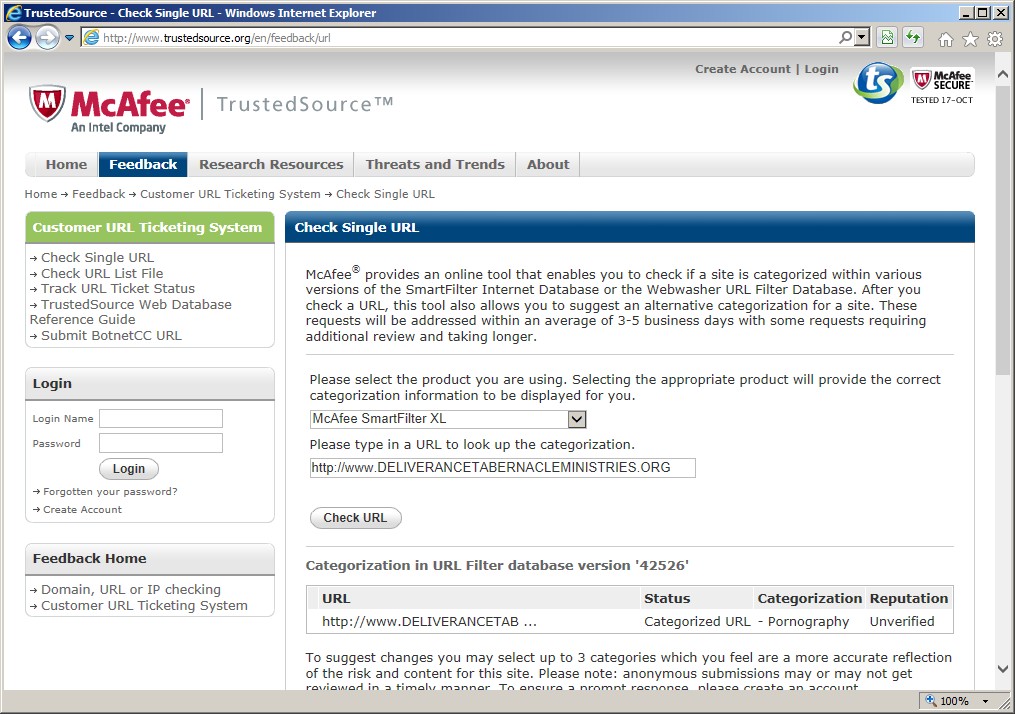
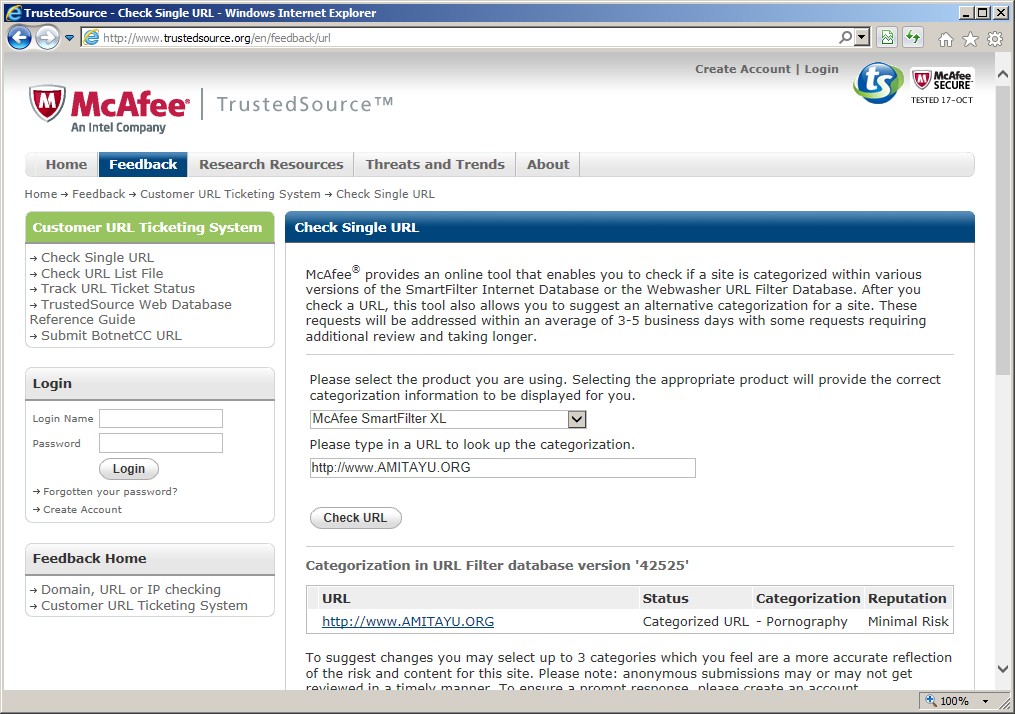
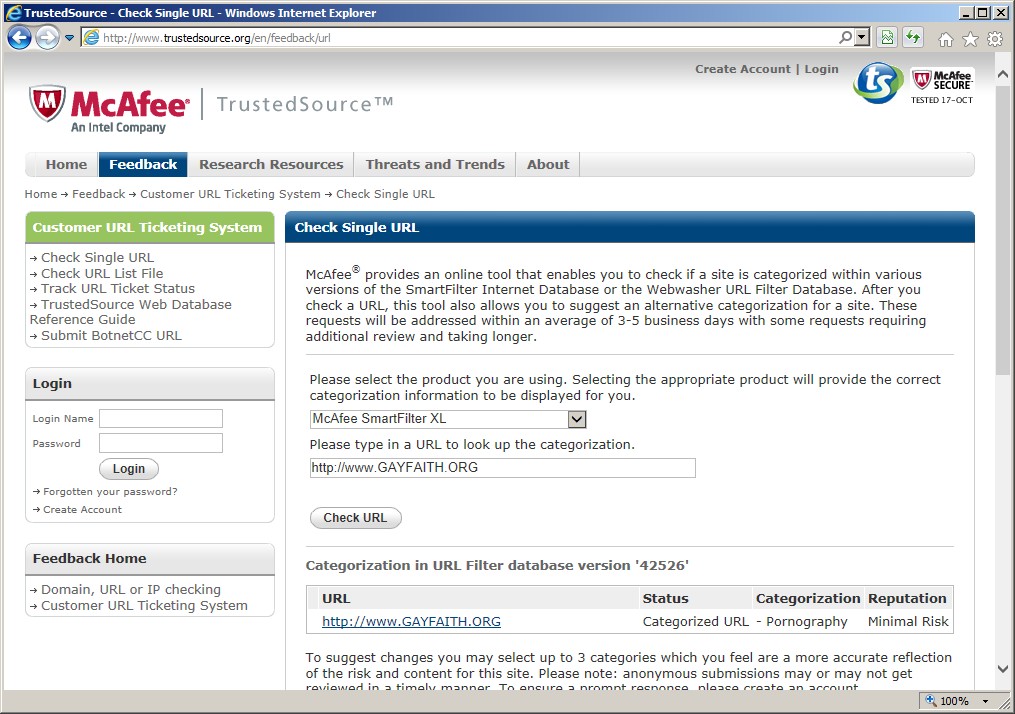
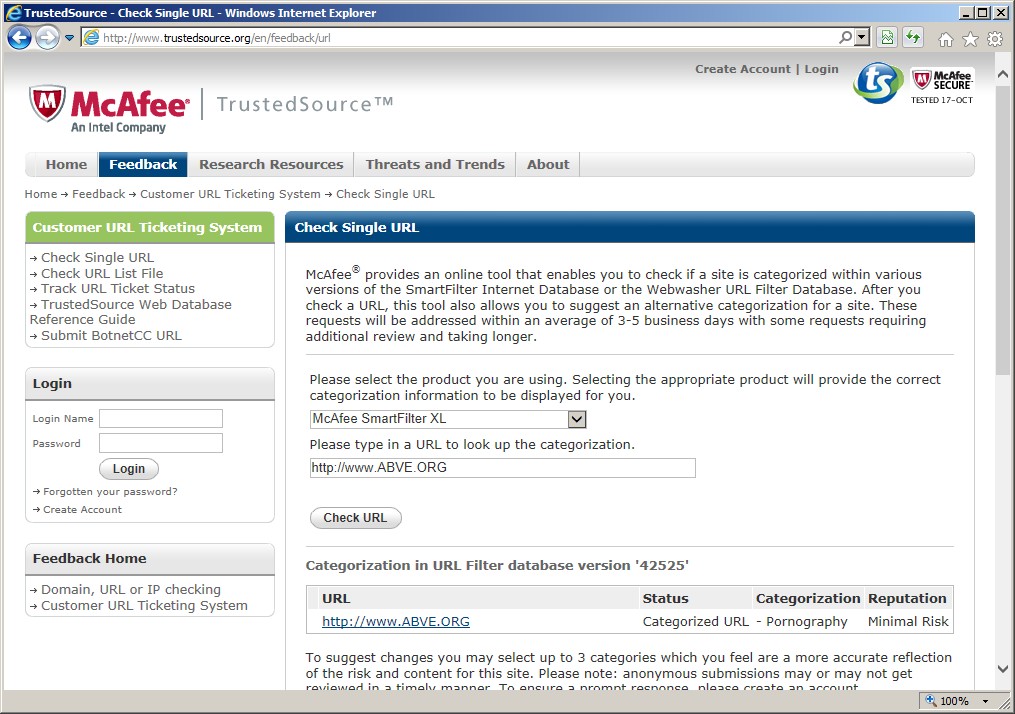
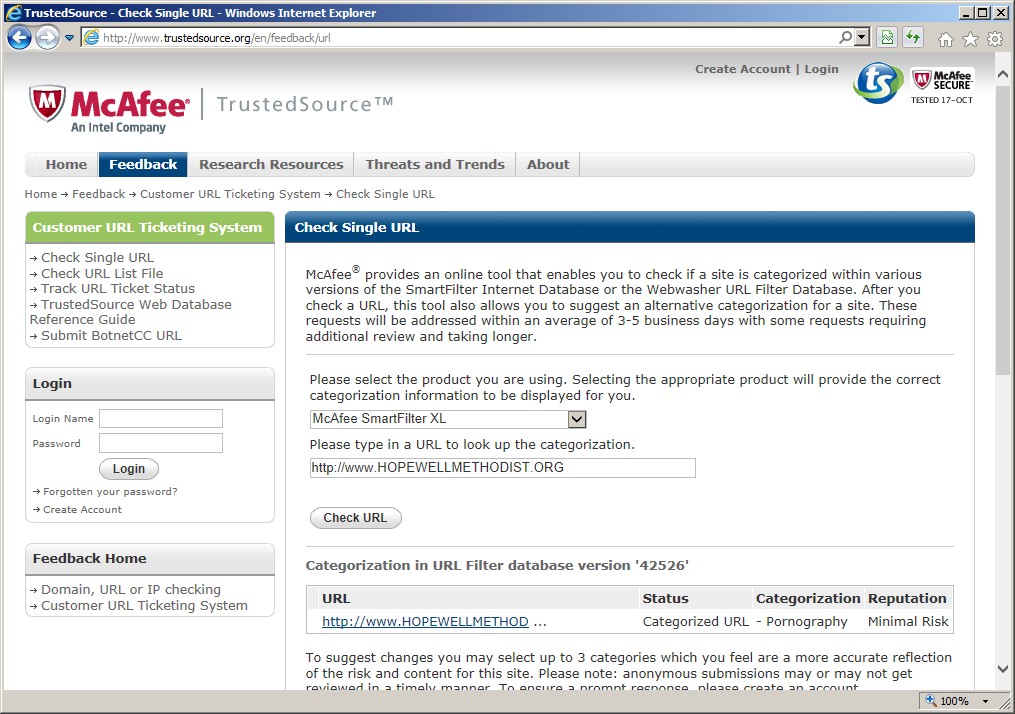
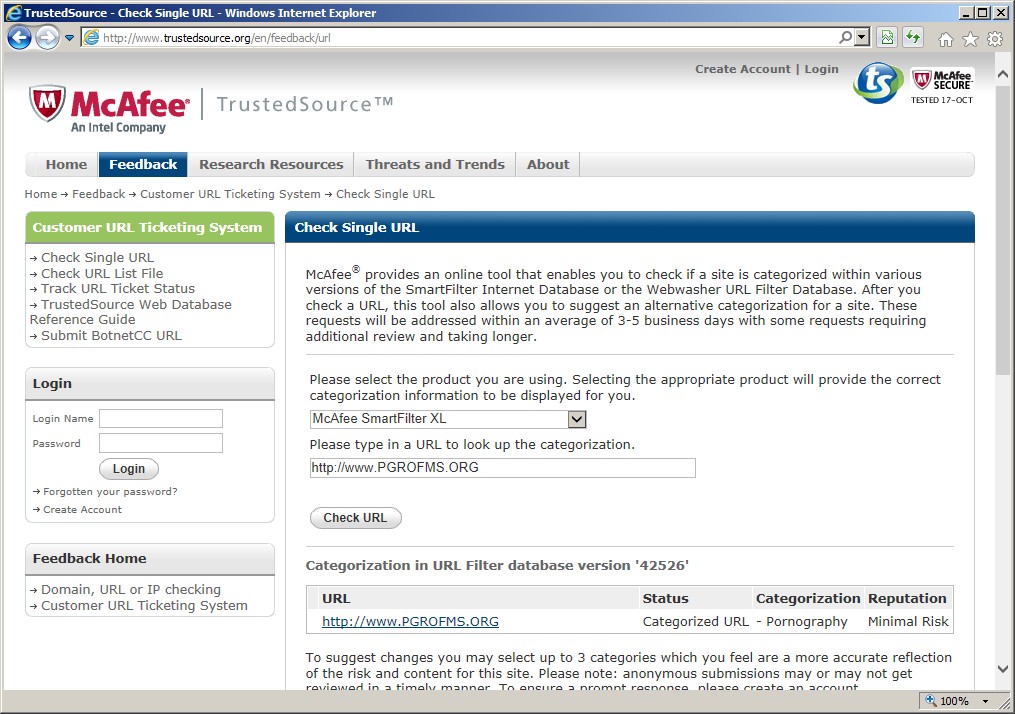
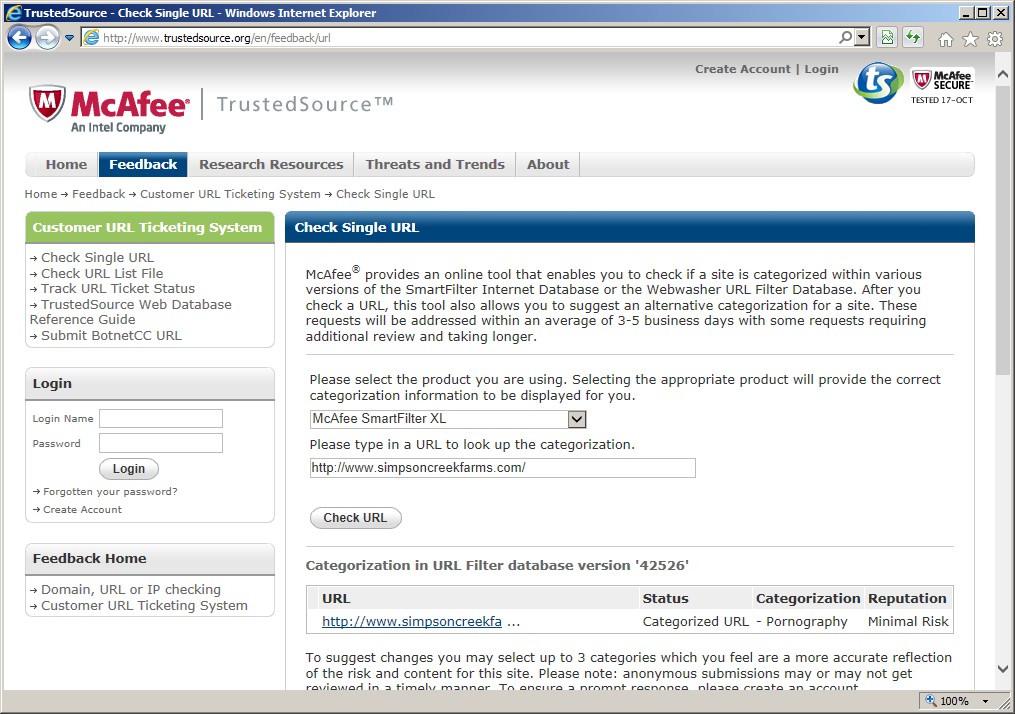
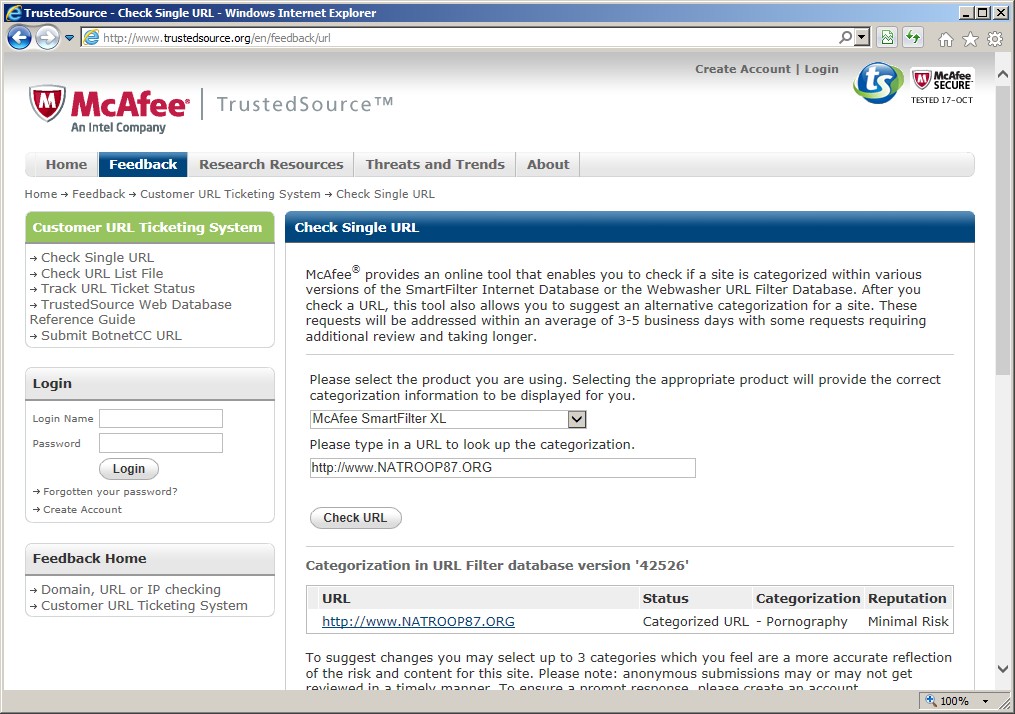
Slashdot contributor Bennett Haselton writes: "Internet users in Saudi Arabia, along with most users in the United Arab Emirates, are blocked by their respective government censors from accessing the websites of the Trinity Davison Lutheran Church, Deliverance Tabernacle Ministries in Pittsburgh, the Amitayu Buddhist Society of Taiwan, and GayFaith.org. An attempt to access any of those websites yields an error page like this one. However, the sites are not blocked because they conflict with the religions beliefs of those countries' governments. Rather, they are blocked because Smartfilter -- the American-made blocking program sold by McAfee, and used for state-mandated Internet censorship in those countries -- classifies those sites as "pornography". You can see the screen shots here, here, here and here." Read on for the rest of Bennett's thoughts.I found these blocked sites by starting with a combination of URL lists and ad hoc spidering, and running as many sites as possible through the Saudi filters to catch the ones that were blocked. Some of the sites were blocked for reasons that were easy to guess -- for example, http://www.bighornbasinsfw.org/, the home page of the Big Horn Basin, Wyoming chapter of Sportsmen for Fish & Wildlife, was almost certainly blocked because of the slang term "nsfw" in their URL. http://www.AgainstPornography.org and http://www.SearchingForMySpermDonorFather.org were presumably blocked because of the presence of the words "porn" and "sperm".
On the other hand, there appears to be no rational reason why the Filipino American Women's Network, the Tuscon Jazz Institute, or the Sacramento Police Activities League would have been blocked by Smartfilter, even by accident. A partial list of the blocked sites that I found is in the blog post I wrote for Citizen Lab, an Internet censorship research center at the University of Toronto.
Articles about sites that are erroneously blocked by Internet censorship software, have a storied history. The first widely read piece was the article "Keys to the Kingdom" written by Brock Meeks and Declan McCullagh in 1996, calling out Cyber Patrol for blocking EnviroLink.org and the University of Newcastle Computer Science Department, and CYBERsitter for blocking the National Organization for Women. I made a minor name for myself and the Peacefire.org site in the late 1990's by writing more pages about sites blocked by other products, including some (like X-Stop and SurfWatch) which no longer exist, and others that are still around, including Smartfilter. I was also one of six people comprising the Censorware Project, a loosely organized group of volunteers that published a few more reports.
By the early 2000's, however, it became clear that anyone whose mind was likely to be changed by information about what kinds of sites were blocked by blocking software, would have changed their mind already (or would, if they came across the research that had already been done up to that point). So the further reports on Internet blocking software errors, by me and other people, slowed to a trickle. I wrote a report in January 2002 on the latest list of sites blocked by Cyber Patrol, a product that most people today have forgotten. In 2006 I worked with the ACLU of Washington to publish a report on sites erroneously blocked by FortiGuard, a program used on computers in some libraries in central Washington, as part of the ACLU's suit to challenge the constitutionality of the program's use on public library terminals. (The Washington State Supreme Court rejected the lawsuit on the grounds that, regardless of what sites were blocked on the computers, it didn't matter because an adult library patron could request for the filter to be turned off.) In 2007 I wrote an article for Slashdot titled "From Bess to Worse" listing some sites that were blocked by an Internet filtering program called Bess (which was later bought out by Smartfilter and discontinued).
Most people's awareness of this debate, if they had heard about it at all, was limited to the perception that "breast cancer sites" and sites about "chicken breast recipes" were sometimes filtered by Internet blocking programs. Or they heard that "Beaver College" actually had to change its name to avoid being censored by web filters. As I tried to explain in a FAQ (written, according to the Wayback Machine, in 1999, but which still broadly holds true today), these examples are true, but they miss the point. These examples make it sound as if blocking software companies are doing the best job they can under the circumstances, and that the errors are unavoidable due to limitations on machine intelligence. In reality, any software algorithm that blocks the American Board of Vocational Experts, the Hopewell United Methodist Church, and the Patriot Guard Riders of Mississippi, as "pornography" (as Smartfilter currently does), is probably not the best algorithm the company could have come up with -- but there's no incentive for them to try harder, because few people will ever look that deep.
And yet, people continue to remember the "breast cancer site" examples. This sounds to me like an example of the narrative fallacy -- people remember that breast cancer sites were blocked, because there's a tidy explanation. There is no tidy explanation for most other examples of blocked sites, so the meme never spreads very far. Conveniently for the blocking companies, the blocked-site errors which make the company look most sloppy (the Kennels at Simpson Creek Farms, the St. Francis Institute of Milwaukee, etc.) are precisely the ones that, due to the narrative fallacy, most people won't remember or hear about.
One company, CYBERsitter, did manage to make a few blocking decisions in the 1990s that were egregious enough that their antics did make the news, and did finally raise some people's awareness that the controversy over private Internet filtering extended beyond "breast cancer sites". After TIME Magazine's website published an article (no longer online) that criticized CYBERsitter's blocking policies, CYBERsitter responded by blocking TIME Magazine's pathfinder.com domain. A few months earlier, CYBERsitter had blacklisted the monthly e-Zine "The Ethical Spectacle, after the Spectacle's founder, Jonathan Wallace, published an article criticizing CYBERsitter for blocking my own Peacefire.org website. And Peacefire.org had been blocked, in turn, because of a page I wrote (now very much out of date) listing some of the sites that CYBERsitter blocked, including the International Gay and Lesbian Human Rights Commission and Mother Jones. (Nowadays, of course, nobody would be surprised that filtering companies block Peacefire.org, since the site publishes ample instructions on how to get around Internet blockers. But at the time, the site's first and only article was the list of sites blocked by CYBERsitter, which is why CYBERsitter received so much criticism for blocking the domain in retaliation.) CYBERsitter also threatened to have Meeks and McCullagh criminally prosecuted for writing "Keys to the Kingdom" and threatened to sue me over the page that I had made.)
The moral, it seems, is that if you want an example of a censored web site to stick in people's minds, it either has to be a forgivable error, or an insane vindictive dick move -- because in either of those cases, people will understand why it happened. The vast swaths of censored websites on the spectrum in between, the ones for which there is no rational explanation for the blocking, go ignored.
These days, though, American and Canadian "censorware" makers have also come under fire for selling censoring software to foreign governments which use them for country-wide censorship. Most of the criticism focuses, naturally, not on the kinds of sites that are accidentally blocked by the blocking software, but on the immorality of these companies enabling statewide foreign censorship in the first place. Netsweeper, Blue Coat, and McAfee have all made the claim that "Once we sell their product to them, we have no control over what they do with it" -- which, as I wrote previously in Slashdot, is nonsense, because for the product to be effective, it has to rely on updates to the blocked-site list, which are provided at regular intervals by the manufacturer. Cut off the updates, and the product will not work, at least not as well.
So the fact that McAfee has classified the Boy Scout Troop 87 of North Andover, the Pan-Iranist Party of Iran, and Reptile Conservation International as "Pornography" is (rightly) overshadowed by the fact that McAfee is selling to government censors in Saudi Arabia and the UAE in the first place. However, as long as the filters are installed, these blocked sites are at least part of the problem for users in those countries, just as much as they are for students or cubicle workers in the U.S. whose network administrators happen to use Smartfilter. And, of course, I sampled only a miniscule fraction of the Web to find these examples of blocked sites, so the true number of stupid blocks affecting Saudi and UAE users is likely to be much larger. For each individual example, you might reasonably ask, "Is it really a big deal if Saudis are blocked from accessing Boy Scout Troop 87 of North Andover?" But it adds up.
-
MIT Begins Offering For-Pay MOOC In Big Data
An anonymous reader writes "MIT announced today that it will begin offering for-profit courses on the edX platform, beginning with a course in Big Data. This is the first for-pay course offered on any of the major MOOC platforms. It is run through MIT Professional Education, the arm of MIT that provides professional education and training for science, engineering and technology professionals worldwide. MIT announced that it will be the first of a new line of professional programs called Online X Programs, to be delivered globally using the MIT and Harvard founded open-sourced online education platform, edX." -
MIT Begins Offering For-Pay MOOC In Big Data
An anonymous reader writes "MIT announced today that it will begin offering for-profit courses on the edX platform, beginning with a course in Big Data. This is the first for-pay course offered on any of the major MOOC platforms. It is run through MIT Professional Education, the arm of MIT that provides professional education and training for science, engineering and technology professionals worldwide. MIT announced that it will be the first of a new line of professional programs called Online X Programs, to be delivered globally using the MIT and Harvard founded open-sourced online education platform, edX." -
Viruses Boost Performance of Lithium-Air Battery Used In Electric Cars
rtoz writes "MIT researchers have found that adding genetically modified viruses to the production of nanowires will boost the performance of lithium-air battery used in electric cars. The key to their work was to increase the surface area of the wire, thus increasing the area where electrochemical activity takes place during charging or discharging of the battery (abstract). The increase in surface area produced by their method can provide a big advantage in lithium-air batteries' rate of charging and discharging. Unlike conventional fabrication methods, which involve energy-intensive high temperatures and hazardous chemicals, this process can be carried out at room temperature using a water-based process."