Slashdot Mirror
Domain: mit.edu
Stories and comments across the archive that link to mit.edu.
Comments · 7,673
-
SprayList paper
SprayList explained here.
-
Re:As Usual
Even if an infinite number of universes exist, that does not imply that any of them are remotely similar to ours. For that implication to hold you must also assume that our universe is finite, or at least a drastically lower order of infinite such that the total number of possible states that our universe could be in is substantially less than the total number of universes that exist with the same geometry and physical laws.
Of course meaningfully comparing different orders of infinity isn't something you can do with high-school arithmetic, but it's a pretty common thing to do in advanced mathematics.
Tegmark is pretty much the most cited guy about this stuff and explains it better than anyone else:
-
Re:Parallel
Strange, I always thought parallel universe meant it is another universe that is parallel to our own on a three dimensional plane. Or in other words, if our universe could be represented by a piece of paper, then another piece of paper laying on top of it is a parallel piece of paper, and where they physically converge with one another manifests as a sphere (like a black hole) similar to how if you were to poke a hole in a piece of paper, then a two dimensional being living in that paper would see a big empty circle.
Read Tegmark''s papers on the multiverse concept(s).
There's many different varieties, 4 within his specific theory:
-
arithmetic. Learn it. Use it.
The cost of living is 28% higher in California:
http://livingwage.mit.edu/stat...
http://livingwage.mit.edu/stat...The average dollar salary of a programmer is 10% higher:
http://www.indeed.com/salary/q...
http://www.indeed.com/salary/q...Texas programmers therefore have average effective salaries 18% than in California. I AM having good luck.
-
arithmetic. Learn it. Use it.
The cost of living is 28% higher in California:
http://livingwage.mit.edu/stat...
http://livingwage.mit.edu/stat...The average dollar salary of a programmer is 10% higher:
http://www.indeed.com/salary/q...
http://www.indeed.com/salary/q...Texas programmers therefore have average effective salaries 18% than in California. I AM having good luck.
-
Re:Ppl who don't know C++ slamming C++
There's probably a number of reasons, but the one explanation I like the most is Sussman's explanation in SICP regarding how object type systems relate to ontologies in knowledge systems: since we still have problems with the latter, it is logical we hit inadequacies and corner cases in the former, too.
-
Re: COBOL
The Tao gave birth to machine language. Machine language gave birth to the assembler.
The assembler gave birth to the compiler. Now there are ten thousand languages.
Each language has its purpose, however humble. Each language expresses the Yin and Yang of software. Each language has its place within the Tao.
But do not program in COBOL if you can avoid it.
-
Sounds a lot like Justify.
This project seems to have similar ambitions to the Justify project. Justify's creator has a good overview of Justify and has published some thoughts about why softwear like this is important.
-
Sounds a lot like Justify.
This project seems to have similar ambitions to the Justify project. Justify's creator has a good overview of Justify and has published some thoughts about why softwear like this is important.
-
TaoFrom the Tao of Programming:
There was once a programmer who wrote software for personal computers. "Look at how well off I am here," he said to a mainframe programmer who came to visit. "I have my own operating system and file storage device. I do not have to share my resources with anyone. The software is self-consistent and easy-to-use. Why do you not quit your present job and join me here?"
The mainframe programmer then began to describe his system to his friend, saying, "The mainframe sits like an ancient Sage meditating in the midst of the Data Center. Its disk drives lie end-to- end like a great ocean of machinery. The software is as multifaceted as a diamond, and as convoluted as a primeval jungle. The programs, each unique, move through the system like a swift-flowing river. That is why I am happy where I am."
The personal computer programmer, upon hearing this, fell silent. But the two programmers remained friends until the end of their days. -
Methane compared to CO2
Methane doesn't last long in the atmosphere
>that '25 times as powerful as CO2' statistic is its equivalent over a 100-year period
Not according to the references I can find.
from http://newsoffice.mit.edu/2014..."...methane is a potent greenhouse gas, as well as a significant byproduct of using natural gas — advocated by many as a “bridge” to a lower-emissions future. But a direct comparison between methane and carbon dioxide, the most abundant greenhouse gas emitted by human activities, is complicated: While the standard figure used for emissions trading and technology evaluation says that, gram for gram, methane is about 30 times as potent a greenhouse gas as CO2, scientists say that’s an oversimplification.
''As reported in a paper published today in the journal Nature Climate Change, authored by MIT assistant professor of engineering systems Jessika Trancik and doctoral student Morgan Edwards, this conversion factor (called the global warming potential, or GWP) may significantly misvalue methane. Getting this conversion factor right is challenging because methane’s initial impact is much greater than that of CO2 — by about 100 times. But methane only stays in the atmosphere for a matter of decades, while CO2 sticks around for centuries. The result: After six or seven decades, the impact of the two gases is about equal, and from then on methane’s relative role continues to decline."
Or, if you prefer Wikipedia as a source: https://en.wikipedia.org/wiki/...
-
We can make the world a different place
Consider using the relational framework in slib.
-
everything old is new again.
Aside from the part where you make money from your extra space, it sure sounds a lot like D.I.B.S.
-
Think of the Women!
Since a majority of biological scientists are women, we just need to spin up the feminist machine and the grant money will flow.
See, with more women in the roles of running labs, women will become the majority of biological scientists.
http://www.sciencedaily.com/re...
-
How long does lithium-polymer battery last?
I've heard about for or five years. While this sounds like a good concept to save money and danger from kerosene lamps, what do people do then? Still, even with planned obsolescence, such systems may still be very cost-effective. But it seems to me there might be better battery technologies one could pick? If not, I hope some sort of battery replacement and recycling program is thought about.
More on a related larger movement of design
"Design for the Other 90 Percent: Innovating for the World's Poor"
http://miter.mit.edu/articlede...Of course, EF Schumacher and the "Appropriate Technology" movement was doing this in various ways in the 1970s.
http://en.wikipedia.org/wiki/A...
"Appropriate technology is an ideological movement (and its manifestations) originally articulated as intermediate technology by the economist Dr. Ernst Friedrich "Fritz" Schumacher in his influential work, Small is Beautiful. Though the nuances of appropriate technology vary between fields and applications, it is generally recognized as encompassing technological choice and application that is small-scale, decentralized, labor-intensive, energy-efficient, environmentally sound, and locally controlled.[1] Both Schumacher and many modern-day proponents of appropriate technology also emphasize the technology as people-centered.[2]"A website in this area: http://www.appropedia.org/
Another organization (of many):
https://www.ncat.org/about-us/Another cheap way of getting some light indoors (but only during the day):
http://www.nydailynews.com/new...
"Brazilian mechanic creates light bulb using water, bleach and a bottle
Alfredo Moser's cheap and environmentally friendly invention is picking up steam in developing nations around the world. The 'Moser lamp' was picked up by the Liter of Light campaign and is now brightening 140,000 homes in the Philippines."BTW, extending the day using artificial light (which I'm not eager myself to give up) is still problematical in a few ways including for health reasons.
On "Spread the wealth, but don't do it for free", it's important to remember that much of the wealth we enjoy in the West is due to cultural ideas that originated in Africa and the East (even things like the concept of "zero"). A lot of key minerals come from poor countries as well, where any wealth from their extraction got concentrated in a few hands. And there is a brutal history of slavery and genocide and colonialism underlying much of the unfolding and spread of Western "civilization". Look at the history of any, say, any currently materially poor African country and you will likely find a land that probably had (for their time) wealthy kingdoms hundreds of years ago that were taken over by European powers with most of people then driven into poverty and/or slavery and then eventually carved up into countries not respecting tribal and cultural boundaries which contributed to later warfare. Entrepreneurs may need to charge for things to make sustainable businesses in today's economy, but there are complex economic and political issues underlying great wealth disparities.
The "Social Credit" idea is worth considering when accepting how so many things are essentially the common capital of all of human kind, and thus all humans in that sense have some claim on the fruits of anyone using that capital:
http://en.wikipedia.org/wiki/S...
"Douglas disagreed with classical economists who recognised only three factors of production: land, labour and capital. While Douglas did not deny the role of these factors in production, he saw the "cultural inheri -
Re:Encrypted computing is possible, if limited
You can do some computational things on encrypted data, like create a database, which obviously adds some overhead. For example cryptdb:
http://css.csail.mit.edu/crypt...And built an application which then decrypts the data on the client when the user needs access to it, for example there is Mylar from the same research group as the database above:
https://css.csail.mit.edu/myla...I don't think you've ever used Cloud software. The entire point of it is to move development and maintenance outside your organization. Yes, I could upload encrypted data to "The cloud" and then write my own database and front end for it. But would defeat the entire point of putting it in the cloud in the first place. What you're describing is basically just an online data backup. No-one really needs that.
Lets say you're a small non-profit and you want to create a ticketing system to track donations. Buying anything at all... that you'd host locally would cost a fortune. You could get a free/open source app, but that doesn't come with any support or guartee that the product will even still be developed a year from now and you don't have the resources to continue development should you need to.
You can go get a Cloud based Saas ticketing system relatively cheap. They maintain everything for you. And if you need a special customization they have developers on staff year round ready to jump on your request. But is your data secure? You have no idea. You can write it into the contract, you can do audits, but you never really know. In fact, it's not possible to know. And being a small non-profit you don't have the clout to force a better contract on them or anyone else. All the contracts come with NDA's embedded so you can't even rely on other companies to report problems with the vendor. It's literally a black box that your data goes in an out of, and what happens inside that box is mostly a mystery to you.
-
Re:Encrypted computing is possible, if limited
You can do some computational things on encrypted data, like create a database, which obviously adds some overhead. For example cryptdb:
http://css.csail.mit.edu/crypt...And built an application which then decrypts the data on the client when the user needs access to it, for example there is Mylar from the same research group as the database above:
https://css.csail.mit.edu/myla...I don't think you've ever used Cloud software. The entire point of it is to move development and maintenance outside your organization. Yes, I could upload encrypted data to "The cloud" and then write my own database and front end for it. But would defeat the entire point of putting it in the cloud in the first place. What you're describing is basically just an online data backup. No-one really needs that.
Lets say you're a small non-profit and you want to create a ticketing system to track donations. Buying anything at all... that you'd host locally would cost a fortune. You could get a free/open source app, but that doesn't come with any support or guartee that the product will even still be developed a year from now and you don't have the resources to continue development should you need to.
You can go get a Cloud based Saas ticketing system relatively cheap. They maintain everything for you. And if you need a special customization they have developers on staff year round ready to jump on your request. But is your data secure? You have no idea. You can write it into the contract, you can do audits, but you never really know. In fact, it's not possible to know. And being a small non-profit you don't have the clout to force a better contract on them or anyone else. All the contracts come with NDA's embedded so you can't even rely on other companies to report problems with the vendor. It's literally a black box that your data goes in an out of, and what happens inside that box is mostly a mystery to you.
-
Encrypted computing is possible, if limited
You can do some computational things on encrypted data, like create a database, which obviously adds some overhead. For example cryptdb:
http://css.csail.mit.edu/crypt...And built an application which then decrypts the data on the client when the user needs access to it, for example there is Mylar from the same research group as the database above:
https://css.csail.mit.edu/myla... -
Encrypted computing is possible, if limited
You can do some computational things on encrypted data, like create a database, which obviously adds some overhead. For example cryptdb:
http://css.csail.mit.edu/crypt...And built an application which then decrypts the data on the client when the user needs access to it, for example there is Mylar from the same research group as the database above:
https://css.csail.mit.edu/myla... -
Irrelevant [Re:As much as could be expected]
MIT, the organization whose access was used to download the documents, declined to press civil charge
Whether civil charges are pressed is completely irrelevant to indictment for criminal charges. If you break into my house but don't succeed in stealing anything of value, you can face criminal charges regardless of whether I sue you in civil court.
and according to the report on MIT's involvement "MIT never requested that a criminal prosecution be brought against Aaron Swartz." (page 13) and "MIT did inform the prosecution that it was not seeking punishment for Swartz,
And whether an organization decides to "press charges" may be a factor, but is not the only factor in whether somebody is indicted for a crime.
and it did inform the defense that it was not seeking any civil remedy from him." (page 14). JSTOR, the organization whose documents were copied, declined to press civil charges.
Again, whether the parties involved seek civil remedies has nothing whatsoever to do with whether there was a crime that a person can be indicted for.
A quote in the MIT report attributed to JSTOR said "The criminal investigation and today’s indictment of Mr. Swartz has been directed by the United States Attorney’s Office. It was the government’s decision whether to prosecute, not JSTOR’s.
Now you got it. It's not MIT's decision, nor is it JSTOR's, whether the person is indicted for a crime.
...When the two parties who were affected choose not to proceed with civil charges and don't press for criminal charges, is calling for criminal charges that carried a possible 50 years of imprisonment and a $1 million dollar fine,
...or a plea bargain of 6 months in prison. But Swartz decided he would rather die than admit he'd done anything wrong.
-
Re:As much as could be expected
MIT, the organization whose access was used to download the documents, declined to press civil charge and according to the report on MIT's involvement "MIT never requested that a criminal prosecution be brought against Aaron
Swartz." (page 13) and "MIT did inform the prosecution that it was not seeking punishment for Swartz, and it did inform the defense that it was not seeking any civil remedy from him." (page 14)JSTOR, the organization whose documents were copied, declined to press civil charges. A quote in the MIT report attributed to JSTOR said "The criminal investigation and today’s indictment of Mr. Swartz has been directed by the United States Attorney’s Office. It was the government’s decision whether to prosecute, not JSTOR’s. As noted previously, our interest was in securing the content. Once this was achieved, we had no interest in this becoming an ongoing legal matter." (page 84)
When the two parties who were affected choose not to proceed with civil charges and don't press for criminal charges, is calling for criminal charges that carried a possible 50 years of imprisonment and a $1 million dollar fine, and which a former White House counsel called "overcharging" and "overzealous" really necessary? Consider that several Senators, including both Republicans and Democrats, questioned or criticized the prosecution using words or phrases like scapegoat, outrageous, and way out of line. How often does THAT happen anymore?
-
Re:That's will be one dead astronugh
The GP post is clearly bullshit, it's in no way in spacex's interests to deliberately kill an astronaut, especially given that the government has multiple contractors working independently on commercial crew transport. However I have a feeling you are being overoptimistic.
overall chance of casualties from launch and landing activities of its Dragon capsule at 30-in-1 million
NASA management came out with similar figures for the space shuttle. http://sunnyday.mit.edu/accide...
Yet the actual crew loss rate for manned space vehicles has been in the single digit percentages. The space shuttle has had two crew loss failures and according to wikipedia has had 135 launches putting the credw loss rate at about 1.5%. Apollo had one crew loss incident during launch preperations and had about 17 manned missions (including skylab, appollo-soyuz and the aforementioned failure on the pad) putting the crew loss rate at about 5.9%. Soyuz has had 124 manned launches and has had two crew loss failures putting it's crew loss failure rate at about 1.6%.
Hopefully both failure analysis and our understanding of spaceship components have improved, but i'd still consider a figire two orders of manitude better than previous vehicles hard to belive without substantial data from actual flights.
-
Re:Missing the pointSaying something several times doesn't make it true. There is nothing in the behaviour of message passing that would prevent it from being compiled into a vtable call behind the scenes.
Of course, in highly dynamic systems you need to recompile method calls on the fly, but that is true for languages like Java as well, which also needs to do this.
Finally, CLOS has the most flexible method calling in existence. You can write your own methods that chooses the appropriate method to call (look up define-method-combination for the gritty details). Amazingly enough, it still manages to compile the method invocations into direct calls.
That said, the actual underlying implementation of the compiler is completely irrelevant in this case. The actual provided functionality available to the programmer, is. And from the point of view of the programmer, the difference between message passing and nay other calling style is minimal, at best.
-
Re:Wayland / serious question
The Unix Haters Handbook is online: http://web.mit.edu/~simsong/ww...
-
Jane/Lonny Eachus goes Sky Dragon Slayer
Jane, before you try to lecture people about orbital mechanics, you should first make sure you understand more fundamental concepts like "conservation of energy".
But net radiative power out of a boundary around the source = "radiative power out" minus "radiative power in", so the equation Jane just described also says:
NO!!!!! As I have explained to you innumerable times now, you can also consider your heat source, by itself, that "sphere". The only NET radiative power out comes from the electrical power in. Further, the cooler walls do not contribute any of that NET power out. That's what net means. [Jane Q. Public, 2014-12-16]
I've already pointed out that Jane's hopelessly confused about the word "net", but that's just one of the mistakes Jane packed into these few sentences.
Jane's also wrong to imply that energy conservation across one choice of boundary could somehow contradict energy conservation across another boundary choice. That's impossible. Many boundary choices are inconvenient but they all have to be consistent. Otherwise, how could we possibly tell which boundary choice was correct?
So Jane can't object to the simple energy conservation equation I derived by claiming that some other boundary choice would somehow contradict my equation. That's completely impossible, and if Jane doesn't understand that point then he should learn about conservation of energy: example (backup), example (backup), example (backup).
As you can tell after reading those introductions, here's how to apply conservation of energy. Draw a boundary around the heat source:
power in = electrical heating power + radiative power in from the chamber walls
power out = radiative power out from the heat sourceSince power in = power out through any boundary where nothing inside is changing:
electrical heating power + radiative power in from the chamber walls = radiative power out from the heat source
I put the boundary around the heat source so the boundary is in vacuum. That's because radiation can't travel through opaque solids like the heat source. So the only way to obtain an energy conservation equation with radiative terms is to place the boundary around the heat source.
For example, I calculated the enclosing shell's inner temperature by drawing the boundary within the enclosing shell. This boundary was inside aluminum, so heat transfer through it was by thermal conduction, not radiation. Notice that even this boundary choice leads to a conduction equation where electrical heating power depends on the cooler chamber wall temperature. That's because all boundary choices have to be consistent. The resulting equations can't contradict each other unless one of them is wrong.
After I asked Jane to explain exactly where his boundary would be drawn, Jane replied:
... You can draw the boundary right around the heat source. Electric power comes in, radiative power goes out.
-
Jane/Lonny Eachus goes Sky Dragon Slayer
Jane's "interest" in that NAS report evaporated after I showed that Jane had been fooled by "Steven Goddard" once again. So let's return to Jane's confusion about basic thermodynamics.
But net radiative power out of a boundary around the source = "radiative power out" minus "radiative power in", so the equation Jane just described also says:
NO!!!!! As I have explained to you innumerable times now, you can also consider your heat source, by itself, that "sphere". The only NET radiative power out comes from the electrical power in. Further, the cooler walls do not contribute any of that NET power out. That's what net means. [Jane Q. Public, 2014-12-16]
I've already pointed out that Jane's hopelessly confused about the word "net", but that's just one of the mistakes Jane packed into these few sentences.
Jane's also wrong to imply that energy conservation across one choice of boundary could somehow contradict energy conservation across another boundary choice. That's impossible. Many boundary choices are inconvenient but they all have to be consistent. Otherwise, how could we possibly tell which boundary choice was correct?
So Jane can't object to the simple energy conservation equation I derived by claiming that some other boundary choice would somehow contradict my equation. That's completely impossible, and if Jane doesn't understand that point then he should learn about conservation of energy: example (backup), example (backup), example (backup).
As you can tell after reading those introductions, here's how to apply conservation of energy. Draw a boundary around the heat source:
power in = electrical heating power + radiative power in from the chamber walls
power out = radiative power out from the heat sourceSince power in = power out through any boundary where nothing inside is changing:
electrical heating power + radiative power in from the chamber walls = radiative power out from the heat source
I put the boundary around the heat source so the boundary is in vacuum. That's because radiation can't travel through opaque solids like the heat source. So the only way to obtain an energy conservation equation with radiative terms is to place the boundary around the heat source.
For example, I calculated the enclosing shell's inner temperature by drawing the boundary within the enclosing shell. This boundary was inside aluminum, so heat transfer through it was by thermal conduction, not radiation. Notice that even this boundary choice leads to a conduction equation where electrical heating power depends on the cooler chamber wall temperature. That's because all boundary choices have to be consistent. They can't contradict each other unless one of them is wrong.
After I asked Jane to explain exactly where his boundary would be drawn, Jane replied:
-
Jane/Lonny Eachus goes Sky Dragon Slayer
Jane's "interest" in that NAS report evaporated after I showed that Jane had been fooled by "Steven Goddard" once again. So let's return to Jane's confusion about basic thermodynamics.
But net radiative power out of a boundary around the source = "radiative power out" minus "radiative power in", so the equation Jane just described also says:
NO!!!!! As I have explained to you innumerable times now, you can also consider your heat source, by itself, that "sphere". The only NET radiative power out comes from the electrical power in. Further, the cooler walls do not contribute any of that NET power out. That's what net means. [Jane Q. Public, 2014-12-16]
I've already pointed out that Jane's hopelessly confused about the word "net", but that's just one of the mistakes Jane packed into these few sentences.
Jane's also wrong to imply that energy conservation across one choice of boundary could somehow contradict energy conservation across another boundary choice. That's impossible. Many boundary choices are inconvenient but they all have to be consistent. Otherwise, how could we possibly tell which boundary choice was correct?
So Jane can't object to the simple energy conservation equation I derived by claiming that some other boundary choice would somehow contradict my equation. That's completely impossible, and if Jane doesn't understand that point then he should learn about conservation of energy: example (backup), example (backup), example (backup).
As you can tell after reading those introductions, here's how to apply conservation of energy. Draw a boundary around the heat source:
power in = electrical heating power + radiative power in from the chamber walls
power out = radiative power out from the heat sourceSince power in = power out through any boundary where nothing inside is changing:
electrical heating power + radiative power in from the chamber walls = radiative power out from the heat source
I put the boundary around the heat source so the boundary is in vacuum. That's because radiation can't travel through opaque solids like the heat source. So the only way to obtain an energy conservation equation with radiative terms is to place the boundary around the heat source.
For example, I calculated the enclosing shell's inner temperature by drawing the boundary within the enclosing shell. This boundary was inside aluminum, so heat transfer through it was by thermal conduction, not radiation. Notice that even this boundary choice leads to a conduction equation where electrical heating power depends on the cooler chamber wall temperature. That's because all boundary choices have to be consistent. They can't contradict each other unless one of them is wrong.
After I asked Jane to expl
-
Re:What are the implications for the textbook mark
Depressing view. Not saying you're wrong, of course, just that it would be a social good to solve these problems somehow.
This is a good start toward solving the problem: http://ocw.mit.edu/courses/onl...
-
CoderDojo
Look and seeif there's a CoderDojo near you, they do free weekly sessions for teaching kids technology, often involving game making: https://coderdojo.com/ For quickly getting kids making games, they tend to use the program Scratch: http://scratch.mit.edu/
-
Re:Scratch
As a volunteer on a UK scheme teaching coding to 11 year olds, I heartily recommend Scratch also.
Nice demo of the sort of things possible : Ms Pacman http://scratch.mit.edu/project...
-
Re:Scratch
Upvote. My kids (10 and 14) have managed to make amazing things in what to me looks like a complete toy. Plenty of books and articles, but best of all is the community around it - kids sharing and expanding each other ideas. Teaches the basics (variables, loops, etc) - but best of all lets them find success early.
-
Code.org
We just did the Hour of Code at my workplace for the kids. Lots of tutorials for beginners on there. MichaelSmith above me also mentioned Scratch, and that's an excellent visual approach to learning procedural programming.
-
Scratch
-
Re:Not really missing vinyl
If you really want to get into the nuts and bolts, there is plenty of free information online. A good start is here:
http://www.dspguru.com/Also check out MIT's Open Courseware lectures on DSP:
http://ocw.mit.edu/resources/res-6-008-digital-signal-processing-spring-2011/video-lectures/
-
Re:As with all space missions:
So are they .
-
Re:No one gets the oil!
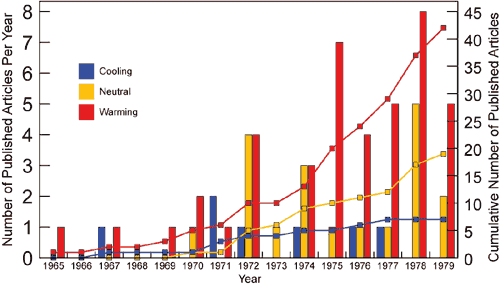
You're regurgitating complete nonsense. Once again, here’s figure 1 from Peterson et al. 2008. Notice that papers predicting warming vastly outnumbered those predicting cooling, even in the 1970s. Ironically:
- The term “global warming” was first used in a 1975 Science article by Wally Broecker called “Are we on the brink of a pronounced global warming?”.
- Sawyer 1972 estimated climate sensitivity as 2.4C, and Schneider 1975 gave a preliminary range of 1.5C to 3.0C.
- Manabe and Wetherald, 1975: “The Effects of Doubling the CO2 Concentration on the climate of a General Circulation Model.”
- In 1977, Freeman Dyson wrote that the “prevailing opinion is that the dangers [of the rise in CO2] greatly outweigh the benefits.”
- In 1977, Robert M. White, the head of the National Oceanic and Atmospheric Administration, wrote a report for the National Academy of Sciences that said “We now understand that industrial wastes, such as the carbon dioxide released in the burning of fossil fuels, can have consequences for climate that pose a considerable risk to future society.” [White, Robert, 1978, Oceans and Climate Introduction, Oceanus, 21:2-3]
- The 1979 JASON report “The long-term impact of atmospheric carbon dioxide on climate” estimated climate sensitivity as 2.4C to 2.8C.
- The National Academy of Science’s 1979 Charney report estimated climate sensitivity as 1.5C to 4.5C and said “If carbon dioxide continues to increase, [we] find no reason to doubt that climate changes will result, and no reason to believe that these changes will be negligible.”
While Jane is reading those papers, he should also consider addressing this issue with his basic thermodynamics:
Your own insistence that power in = power out (assuming perfect conversion and no entropic losses) belies this argument. You are arguing against yourself and you refuse to see that. If power in = power out (your own stipulation)
I'm not the only one insisting that power in = power out through any boundary where nothing inside is changing. Once again, that's a fundamental principle called "conservation of energy". Here are some introductions: example (backup), example (backup), example
-
Re:Let me be the first to say...
Well, I can read every word on it, so...I dunno, get new glasses?
don't be a dumbass, that visualization is crap. so
http://language.media.mit.edu/... -
Website of the study
With interactive graphs, rankings, etc.
-
Re:Hi-Res Image?
-
Jane/Lonny Eachus goes Sky Dragon Slayer
If you have actual, direct evidence, why did you not link to THAT, rather than somebody else's claim? [Jane Q. Public, 2014-12-14]
I linked to reviews of actual, direct evidence by the U.S. National Academy of Sciences and The Royal Society (U.K.) in their joint publication (PDF), and another review of evidence by the American Association for the Advancement of Science, which publishes the journal Science.
While Jane is reading those reviews, he should also consider addressing this issue with his basic thermodynamics:
Your own insistence that power in = power out (assuming perfect conversion and no entropic losses) belies this argument. You are arguing against yourself and you refuse to see that. If power in = power out (your own stipulation)
I'm not the only one insisting that power in = power out through any boundary where nothing inside is changing. Once again, that's a fundamental principle called "conservation of energy". Here are some introductions: example (backup), example (backup), example (backup).
As you can tell, conservation of energy is a fundamental physics principle. Assumptions of "perfect conversion and no entropic losses" aren't applicable, and anyone who mistakenly thinks they are should read through those examples to learn about conservation of energy.
If power in = power out (your own stipulation), and the only NET power INTO a defined spherical region is electrical, and the only NET power OUT of that region is radiative, then net radiative power out at steady-state must therefore be equal to the net electrical power consumed. [Jane Q. Public, 2014-12-14]
Jane seems to be saying that at steady-state:
net electrical power consumed = net radiative power out
But net radiative power out of a boundary around the source = "radiative power out" minus "radiative power in", so the equation Jane just described also says:
net electrical power consumed = "radiative power out" minus "radiative power in"
However, this new equation doesn't match Jane's earlier equation:
My energy conservation equation is this: electrical power in = (epsilon * sigma) * T^4 * area = radiant power out [Jane Q. Public, 2014-10-08]
Notice that Jane's earlier equation doesn't describe net radiative power out, which is why it violates conservation of energy. Is Jane retracting his earlier incorrect equation, or does Jane dispute the definition of the word "net"?
-
Jane/Lonny Eachus goes Sky Dragon Slayer
Your own insistence that power in = power out (assuming perfect conversion and no entropic losses) belies this argument. You are arguing against yourself and you refuse to see that. If power in = power out (your own stipulation)
I'm not the only one insisting that power in = power out through any boundary where nothing inside is changing. Once again, that's a fundamental principle called "conservation of energy". Here are some introductions: example (backup), example (backup), example (backup).
As you can tell, conservation of energy is a fundamental physics principle. Assumptions of "perfect conversion and no entropic losses" aren't applicable, and anyone who mistakenly thinks they are should read through those examples to learn about conservation of energy.
If power in = power out (your own stipulation), and the only NET power INTO a defined spherical region is electrical, and the only NET power OUT of that region is radiative, then net radiative power out at steady-state must therefore be equal to the net electrical power consumed. [Jane Q. Public, 2014-12-14]
Jane seems to be saying that at steady-state:
net electrical power consumed = net radiative power out
But net radiative power out of a boundary around the source = "radiative power out" minus "radiative power in", so the equation Jane just described also says:
net electrical power consumed = "radiative power out" minus "radiative power in"
However, this new equation doesn't match Jane's earlier equation:
My energy conservation equation is this: electrical power in = (epsilon * sigma) * T^4 * area = radiant power out [Jane Q. Public, 2014-10-08]
Notice that Jane's earlier equation doesn't describe net radiative power out, which is why it violates conservation of energy. Is Jane retracting his earlier incorrect equation, or does Jane dispute the definition of the word "net"?
-
Re:Bullshit
Devil's advocate here-- Not true personal opinion, just devil's advocate:
If the MIT policy is anything like federal sexual harassment law, (which I strongly suspect that it will be), then the burden of proof presented by the claimant is that they "Felt" that they were harassed sexually, even if no overt intent by the offender is demonstrable.
I just looked up MIT's policy in fact.
The relevant section, with some added emphasis (mine):
Harassment of any kind is not acceptable behavior at MIT; it is inconsistent with the commitment to excellence that characterizes MIT's activities. MIT is committed to creating an environment in which every individual can work, study, and live without being harassed. Harassment may therefore lead to sanctions up to and including termination of employment or student status.
Harassment is any conduct, verbal or physical, on or off campus, that has the intent or effect of unreasonably interfering with an individual or group's educational or work performance at MIT or that creates an intimidating, hostile, or offensive educational, work, or living environment. Some kinds of harassment are prohibited by civil laws or by MIT policies on conflict of interest and nondiscrimination.
Harassment on the basis of race, color, sex, disability, religion, national origin, sexual orientation, gender identity, veteran's status, or age includes harassment of an individual in terms of a stereotyped group characteristic, or because of that person's identification with a particular group.
Sexual harassment may take many forms. Sexual assault and requests for sexual favors that affect educational or employment decisions constitute sexual harassment. However, sexual harassment may also consist of unwanted physical contact, requests for sexual favors, visual displays of degrading sexual images, sexually suggestive conduct, or offensive remarks of a sexual nature.
In other words, the following scenario would be considered sexual harassment according to MIT's policy:
Two male students are discussing a recent BBQ, in which wives or girlfriends attended. There were bratwursts served. One of the male students remarks to the other that the girlfriend of another male student (not in the conversation) came over while he was cooking the bratwurst, and "Took one look at the size of the sausage, and was like "no way!"."
A female student overhears this, and PRESUMES it is a euphemism for him showing that other woman his penis. She finds this disturbing, unsettling, and repulsive. She reports it.
The male student has no defense against this.
-
Re:Bullshit
http://newsoffice.mit.edu/2014...
"The investigation followed MIT protocol for complaints of sexual harassment. The head of the physics department, Professor Peter Fisher, ensured an objective and timely review, which included a review of detailed materials provided by the complainant and interviews of her and Lewin.
Based on its investigation, MIT has determined that Lewinâ(TM)s behavior toward the complainant violated the Instituteâ(TM)s policy on sexual harassment."
There was an investigation, there was evidence, and they came to a conclusion. I suppose you could suggest that the investigation was flawed somehow, but you are not in a position to review or challenge it and the only man who is hasn't attempted to.
-
The Geek As Drama Queen.
The only thing removing these lectures does is make it harder for others to learn physics without attending school in person.
MIT employs over a thousand faculty members of all ranks.
Over and above that, MIT has about 600 active senior lecturers, lecturers, and professors emeriti. MIT Facts
Lewin is not irreplaceable.
Which is a damn good thing because he is. after all, 78 years old,
MIT makes it easy to study physics outside the classroom, if learning matters more than academic credits.
-
The Geek As Drama Queen.
The only thing removing these lectures does is make it harder for others to learn physics without attending school in person.
MIT employs over a thousand faculty members of all ranks.
Over and above that, MIT has about 600 active senior lecturers, lecturers, and professors emeriti. MIT Facts
Lewin is not irreplaceable.
Which is a damn good thing because he is. after all, 78 years old,
MIT makes it easy to study physics outside the classroom, if learning matters more than academic credits.
-
Heidegger
Maybe they should stop publishing works about Martin Heidegger while they're at, I understand he was a Nazi sympathizer which seems like a pretty terrible thing to be. http://mitpress.mit.edu/books/... http://mitpress.mit.edu/books/... http://mitpress.mit.edu/search...
-
Heidegger
Maybe they should stop publishing works about Martin Heidegger while they're at, I understand he was a Nazi sympathizer which seems like a pretty terrible thing to be. http://mitpress.mit.edu/books/... http://mitpress.mit.edu/books/... http://mitpress.mit.edu/search...
-
Heidegger
Maybe they should stop publishing works about Martin Heidegger while they're at, I understand he was a Nazi sympathizer which seems like a pretty terrible thing to be. http://mitpress.mit.edu/books/... http://mitpress.mit.edu/books/... http://mitpress.mit.edu/search...
-
Re:vs WebP
Take a look at light field cameras, the future of photography is clearly much more interesting than just higher resolution & channel depth:
http://www.dpreview.com/articles/5867769785/light-field-cameras-focusing-on-the-future
Also, this technology seems kind of Blade-Runnerish:
http://newsoffice.mit.edu/2012/camera-sees-around-corners-0321
-
Business Insider?
What use is a link to a science article on Business Insider? Here is the EHT project home page It seems the goals of the project are a lot more interesting than simply proving black holes exist.