Slashdot Mirror
Domain: museum.vic.gov.au
Stories and comments across the archive that link to museum.vic.gov.au.
Comments · 17
-
Re:Any info for Australians?
Hah what a trip, the exact same thing happened to me... I've had a fever and thought it was a hallucination until I read this hahahah
I found this info, hope it helps:
http://www.museum.vic.gov.au/planetarium/skynotes/ sn.html
Meteors
The Lyrids are the main meteor shower in April. The shower is centred near the star Vega in Lyra, the lyre, which appears low to the northern horizon around 3am - the best time to view meteors. The Lyrids are active between the 16th and the 25th, with a peak around the 22nd. The maximum hourly rate typically reaches 10, but occasionally outbursts occur when the meteor rate climbs to 100.
The Pi-Puppids is better placed for us but it is not a persistent shower. It is associated with Comet Grigg-Skjellerup and being a relatively new shower, has periods of inactivity when the comet is far from the Sun. The comet's next pass of the Sun will occur in March 2008, so next year will probably be the one to watch. The peak of the shower is due on the 24th and its centre lies low in the south west to the right of the bright star Canopus in Carina, the keel.
The delta Pavonids which began in late March, peaks on the 6th and will be hindered by the gibbous Moon. This shower is centred on the little known constellation of Pavo, the peacock, which lies near the South Celestial Pole.
There should also be some meteor activity centred on Scorpius and Sagittarius (the archer) that is best seen after midnight. Meteor activity in this region of sky runs from the 15th through until July, with several peaks within this time. -
Re:Actually... I don't think it is pointless...
I don't think I'll reply in detail to everything. I'll just point out that fossils. regardless how you interpret them are very widespread. There are in fact few places of this planet that do NOT have fossils.
Not generally fossils but, areas where specific fossils are not found. If you are in a layer of rock formed in the Precambrian you aren't going to find any bones. Due to certain issues with the oceans we don't find many fossils in the water.
Even if they made some petrified wood, is that the way it really formed? Time is the biggest enemy of fossil making. The is NO known mechanism for making fossils over long periods of time - period. Using fossils, any fossils, as evidence for evolution is a wishful fairy tale.
No petrified wood forms in a very specific way, we simply made the fossilized wood by forcing the process to happen in a few days rather than a large number of years. Having extra time at your disposal wouldn't cause an inability to make fossils. That's just stupid. Secondly, there are many well understood chemical and physical properties which lead to fossil formation.
http://www.safossils.com/fossil.html
http://www.scsc.k12.ar.us/TuttS/fossil_formation.h tm
http://www.museum.vic.gov.au/prehistoric/what/howf ormed.html
http://www.fossils-facts-and-finds.com/how_are_fos sils_formed.html
http://www.nhm.ac.uk/nature-online/earth/fossils/f ossil-folklore/how_are_fossils.htm
http://www.fossil.energy.gov/education/energylesso ns/coal/gen_howformed.html
Really, it isn't hard to figure out.
(....from multiple radiological clocks...)
To use any clock, you have to assume (believe = have faith) that your clock has always ticked at the same or a known rate over the total time measured.
No. That's why one uses multiple clocks. Firstly, sometimes there are slight (1% or so) fluctuation in the initial content of the radiological clock material. One need only believe that all of these radiological decay rates from the half a dozen methods you use remain constant, as would be expected if the laws of physics hold roughly true. Though, to be fair, they have only held true each and every time we checked, perhaps they magically stop working when we aren't looking.
There is evidence that clocks based on atomic properties have drifted as much as by a factor of 300 million times since the "big bang". This drift is related to very fundamental properties of space itself changing as the universe expanded.
Respectfully, no there is not. It took a long while before heavier radioactive particles even formed and from that time, the half lives have remained constant. It is extremely silly to suggest other wise with "there is evidence", as if that is some forgiving phrase with which to preface lies.
The equations for atomic behavior include Planks constant. Evidence that evolutionists like to keep silent shows that the some of the so called "constants" are anything but constant over long time periods. There are few things in nature that are really constant other than change itself. So your clocks are based on faith.
There may have been some slight change in such things as Planks and the speed of light, these are really really small and only true for the first split second of time. Radiological decay and half-lives are extremely consistent. The idea that some error exists and thus the universe is 6,000 years old is downri -
Re:Previous henges
Actually, a quick google search reveals this.
So when they built Stonehenge, there were still wolves in Britain.
But I think it'd be quite difficult to find a strawhenge if a wolf had already blown it down, wouldn't you?
Of course, my theory is that the pigs got chased out of stonehenge too, and so they decided to build off the coast (actually, it was a marsh of some sort at the time, but it wasn't on land) where the wolves would be out of breath by the time they get close enough to blow it down... That, or they were partaking in some early form of copyright infringement and needed to run their operations off shore. -
Re:My Own Research
Google search for "bugs" returns 163,000,000
windows AND bugs: 41,000,000
linux AND bugs: 39,100,000
Then we subtract:
windows AND linux AND bugs: 3,570,000
TOTAL: 76,530,000
Windows and Linux together account for about 47% of the bugs in the world. The number of individual insects estimated to be alive in the world at any one time is 10 quintillion, or 10,000,000,000,000,000,000. That's 4,700,000,000,000,000,000 of the Windows or Linux variety.
Get to work, programmers. -
Re:Granite is radioactive.
No volcanoes? My parent's farm in the Western district of Victoria has them dotted along the horizon. Some are extinct, but some are dormant... which means they could blow at any time! In the next 20,000 years that is. I recall as a child wishing for the excitement of a volcano erupting.
Volcanoes in Victoria (random Google) -
Re:UK and Australia
Nah, they neglected to sign the articles of confederation on 1st January 1901.
-
No 5 is (almost) alive ~ CSIRAC
CSIRAC - (1949 - 1961) - digital computer, entire machine housed at melbourne museum (victoria, australia) after service with CSIRO ( formerly called CSIR), Radio physics lab Sydney University finally residing at Melbourne University.
- approx 5th digital computer created
one of last original computers intact
CSIR Mk1 or CSIRAC designed by team lead by Maston Beard and Trevor Pearcey for CSIR (CSIRO)
primary store of 768 20-bit words
magnetic drum 4,096 word capacity
10ms access time
clock speed 1000Hz
serial bus
paper tape input
30 KW power requirement
crt output of registers
high level programming via language INTERPROGRAM
audio output for errors
first computer programmed for music
emululator available
references:
http://en.wikipedia.org/wiki/CSIRAC
http://www.cs.mu.oz.au/csirac/csirac.html
story on recreations of some of the original music tracks CSIRAC
50th Anniversary of the CSIRAC -
Earth's twin, 300e6 years ago
What do we know about that star and its surroundings? Is it likely to have inhabitable planets...
As cool as it is to find a star that's a twin to ours, it's incredibly unlikely that we'll find a planet even remotely similar to Earth.
For one thing, the article notes that 18 Sco is 4.2 billion years old, while Sol is 4.5 billion years old. If everything else were exactly equal, it would be like stepping back 300 million years back in time. A quick Google finds that one of the more complex forms of life found 300e6 years ago on this planet was the Velvet Worm -- not a species known for its technology.
But even that is unlikely, given the Earth's unusual formation. This planet has an unusual mix of minerals on its crust, plus plate tectonics to keep them mixed, and an iron core that's magnetic enough to keep out the sun's ionizing radiation. Plus, a moon big enough to stir up the oceans, and a tilt to generate asymmetrical solar heating... and all that apparently due to a one-in-a-million collision between a proto-Earth and a Mars-sized planet not long after Sol formed.
I can't find the quote, but someone calculated the odds of finding another sentient species as tiny. It's not that it doesn't develop elsewhere in the galaxy... there are billions of chances, so surely more than one came up all 7s. It's just that the distances are so vast, and the chances of favorable development so small, that entire civilizations (or species) could rise and fall by the time their transmissions reach another civilization's satellite dishes.
But still, at less than 50 light years, it would only take a few hundred years to get there and back. Are the generation ships ready yet? -
Re:Pharlap?
You philistine!
-
Look at home first.I just returned from 2 years backpacking around Australia and one thing I realized from travelling is how much you take your own country for granted. In that light here are some geeky things I saw in Australia that you may not be aware of:
- CSIRAC - In the Melbourne Museum "the only remaining intact first generation stored memory computer in the world"
- Parks Observatory - From the film The Dish. Yes it exists and is near Parkes only 6 hours west of Sydney. Free Visitors Center
- Powerhouse Museum - In Sydney. Displays from the industrial revolution to the digital age. Also does a cool Aibo demonstration if you've never seen one before.
As for stuff in North America, I've taken living here for granted and hardly done much local traveling so all I can think of in my neck of the woods is Science World in Vancouver. It's aimed more towards the kids though but the domed IMAX theater is impressive.
No matter what you see or do you're going to have a fantastic time. Just don't try to plan too far ahead or expect to stick to a schedule or budget or you'll spend all your time worrying and won't have any fun.
-
Re:What the.. ?
1) What the US calls a shrimp, Australians call a prawn.
Um, no. Shrimp and prawns are two totally different things in the US, and throughout the world actually. However, in the US we do use both terms because some of us know the difference - talk to someone in New Orleans.
Or just check out Merriam-Webster. They say a prawn is "any of numerous widely distributed edible decapod crustaceans (as of the genera Pandalus and Peneus) that resemble shrimps and have large compressed abdomens" but a shrimp is "any of numerous mostly small and marine decapod crustaceans (suborders Dendrobranchiata and Pleocyemata) having a slender elongated body, a compressed abdomen, and a long spiny rostrum." They are in the same family, but prawns are much larger than shrimp.
If you are an Aussie, you could always go here, which is the InfoZone at Museum Victoria. Apparently someone down under knows the difference! Here's an excerpt:
"Shrimp or Prawn?
There is often confusion regarding the difference between a shrimp and a prawn. Physically they look very similar but there is one sure way to tell them apart. In shrimps or carideans the side plate of the second segment of the abdomen overlaps the segments in front and behind. Prawns, most of which belong to the family Penaeidae of the group Dendrobranchiata, have all the abdominal side plates overlapping tile-like from the front. A more fundamental difference but one impossible to appreciate in a single specimen is that female prawns do not brood eggs but shed them into the currents where they develop independently. It would therefore make sense to call all member s of the Penaeidae "prawns" and members of the Caridean "shrimps" and this is what most Australians do. King prawns and banana prawns are names understood in this continent for penaeids sold frozen at the markets. The tiny shrimps bought in cans or froz en are imported carideans. Confusion arises when we hear Americans refer to prawns as "shrimp"."
So, unfortunately, it would seem that even though Museum Victoria knows the difference, most Aussies don't, and incorrectly believe that Americans don't know what they are talking about. Even the last sentence from the InfoZone expresses this belief. This is most distressful for Americans to hear, because we are under the constant barrage of comments from Old Europe, and apparently also Australia, about how sophisticated they are, and how ignorant Americans are. I won't go on record to say that it's really the other way around, but comments like this, from a goverment source even, makes one wonder. -
Re:I love this experimentOkay I'll bite. First up you claim "Evolution is not scientific." As I have said before it's a theory. it's a theory that makes predictions that can be tested. Those tests are designed to falsify that theory. Thus it is scientific.
Next: I don't recall bringing up the age of the earth, but since you ask, there are many ways of measuring the age of geological structures, and thus the earth.
- radiometric dating. This method relies on the radioactive decay of an unstable type of atom (parent isotope) within the rock into another type of stable atom (daughter isotope). In a certain period of time, called the half-life, half of the parent isotopes will have decayed into daughter isotopes; in an additional, equivalent period of time, half of the remaining parent isotopes will have decayed, and so on. The length of the half-life, which can be measured, varies for different isotopes. By measuring the ratio of parent to daughter isotopes, the time that has elapsed since decay began can be calculated; this is equivalent to the age of the rock.
- fission track dating. Certain minerals in rocks contain small amounts of uranium which decay radioactively by the splitting apart of the atomic nucleus (nuclear fission). The two fission fragments produced are highly energetic and highly charged, and they produce a linear trail of radiation damage in the surrounding crystals of the rock. This trail is known as a fission track. Fission tracks can be enlarged by chemical etching until they can be observed and measured under a microscope. The number of tracks is proportional to the time since they started to accumulate, and to the amount of uranium in the rock. The amount of uranium present can be determined by irradiating the rock with neutrons to produce a second set of fission tracks. The ratio of the original tracks to the new ones gives a measure of geological age.
- amino-acid racemisation. The method relies on the fact that molecules of amino-acids, the building blocks of proteins, occur in two different forms that are mirror images of each other. These two forms are referred to as left-handed and right-handed. In living organisms, only left-handed amino acid molecules are present, but once the organism dies they slowly convert to their right handed form. Simultaneously, the right handed forms produced slowly convert back to left handed forms, until an equilibrium is reached (half left handed and half right handed), at which point the ratio remains constant. The time taken to reach equilibrium is known, so by determining the ratio of right handed to left handed forms it is possible to estimate the time elapsed since the organism died.
-
Re:Makes sense...
Unfortunately it's not that simple, inorganic systems can have as much visual complexity as organic things. For example.. um.. (looks out of window here in Toronto).. a snowflake! Fractal complexity, such as that seen in the branches of a tree, is frequently mirrored in the inorganic world - the snowflake is one example, another less well known example are manganese dendrites, they look just like fossil plants, but are totally inorganic such as these [Victoria Museum]. The patterns of frost on a frozen windscreen are another example. I can't see how a computer program can distinguish whether such complex patterns are signs of life or not. Still, if it helps NASA get more funding, then who am I to argue! Jolyon
-
More CSIRAC Photos
I took some photos of CSIRAC while visiting the Melbourne Museum where it's now on display. They have a 2KB Casio electronic diary placed in the exhibit an example of a recent computer of the same power.
-
For more information see these links
-
Re:If you can't get down to Melbourne..
Powerhouse has a trs-80 model one display thats running an apple program. I wonder how that happned.
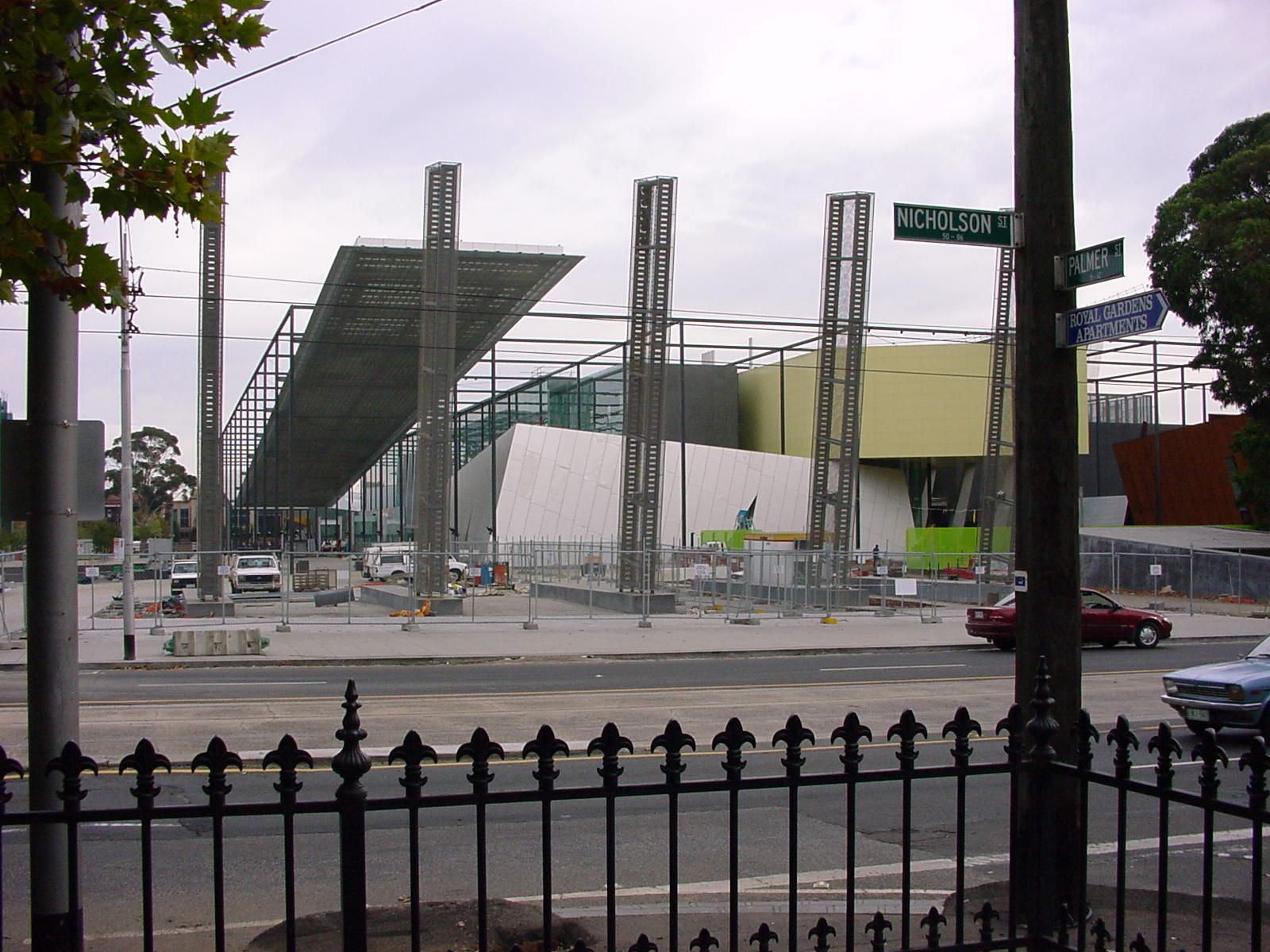
The new butt ugly Melbourne Museum isn't fully open yet. Their sci/tech section is still closed but admission is 1/2 price for the 1/3 that is open.
If you have a need to be close to the oldest surving computer, I've got a room for rent across the street from the butt ugly building. -
Re:Define Vintage
I suspect there are several things that would help classify a computer as vintage.
I'm guessing the most importaint factor is that it has been abaondoned by its maker. Things like a Sun 3 are vintage while a sparcstation 1 isn't (yet). A PDP-11 and most vaxen are but the Microvax isn't yet at least till the end of the month.
I also expect that a minium of 5 years (or should it be 10) is needed. My web server is running on a Sparcstation 1 that is now over 11 years old and its not vintage yet so maybe 10 years should be the cut-off.
I do know the the first computer to do music that they are installing accross the street from my house counts as vintage since its now 50 years old.