Slashdot Mirror
Domain: nanomedicine.com
Stories and comments across the archive that link to nanomedicine.com.
Comments · 29
-
Re:Design failure
You assume RTG technology - I don't and I don't think the linked article does, either.
They discuss Energy Organs here, stating that (emphasis mine):
a sphere of Gd148 emitting ~100 watts with a 75-year half-life and measuring 3.41 cm in diameter with a 5-micron Pt shield glows at 1326 K (e-sub-r for Pt at 1326 K is 0.156; Gd melting point ~1585 K, Pt melting point ~2042 K); this is approximately the decomposition temperature of diamond (into graphite) and well above the combustion point for diamond in air (Section 6.5.3), so Pt-coated sapphire (sapphire melting point ~2310 K) may provide a more stable first wall for the radionuclide energy organ. Carnot thermal efficiency for a heat engine using this source could reach, at most, ~76%.
I'd say that's pretty good efficiency, and given the power levels and temperatures, I think non-RTG technologies should be used. If the system never drops below 0C, why not use a more conventional system?
Plus, you could just use the Gd148 to keep the craft warm and use other means to generate electrical power.
-
Re:Design failure
Gd148 is sexy as hell, but isn't exactly available in the corner drugstore. I quote:
A ~0.2 kg block of pure Gd148 (~1 inch^3) initially yields ~120 watts, sufficient in theory to meet the complete basal power needs of an entire human body for ~1 century...
-
Re:the dire equations
I know everyone hates armchair rocket scientists, but I'd like to leave this here:
A ~0.2 kg block of pure Gd148 (~1 inch^3) initially yields ~120 watts, sufficient in theory to meet the complete basal power needs of an entire human body for ~1 century
They could've had 120W of heat free for the asking with 200g of Gd148 (a pure alpha emitter). Use 50W of that to keep the wee beastie warm, and the other 50-ish Watts might've been enough to power the lander.
-
Re:RTG? Please!
Generating electricity with existing RTG technology is about 5% efficient. This paper mentions phosphored white LEDs efficiencies at 55 Lm/W. This paper says "The efficiency of the color phosphors was experimentally compared within the range up to 90 Lm/W for green, up to 30 Lm/Watt for blue, and up to 35 Lm/Wt for red color at 14 kV." [In this case kV are keV since they were shooting electrons]. This site says the decay energy of a Gd-148 alpha particle is about 3.271 MeV.
Doing the math, 1 Gd-148 alpha decay is about 5.24E-13 Joules, so 1.9E+12 decays/sec would deliver 1 Watt.
Given an alpha particle power output of 1 Watt , converting it to electricity at 5% efficiency then running LEDs at 55Lm/W would result in 2.75 Lm of light. The same alpha flux directed on the phosphors would result in a minimum of 30 Lm in the blue part of the spectrum, 90 Lm in green, and 35 Lm in red.
This paper is one of my favorites - it states, "A ~0.2 kg block of pure Gd148 (~1 inch3) initially yields ~120 watts, sufficient in theory to meet the complete basal power needs of an entire human body for ~1 century...". That's an awful lot of power packed into a tiny 1 in^3 package!
Fascinating stuff.
-
Re:Electric vehicles
"do you know the [size] of the smallest possible nuclear reactor plus adequate shielding?"
Yes, I do. About 11 microns in diameter and very, very light. Fascinating reading material, BTW.
-
Re:I feel the need...
Diamond is not a good idea in this application. Carbon burns in the presence of Oxygen with an ignition temperature of (IIRC) about 500C (ah, here's a ref: 870-1170K - I guess that's 600C+). If kept away from anything to combine with it, diamond can handle much higher temperatures, but that doesn't apply here.
-
Re:An amazing achievement
If we had the collective courage [read - no enviro-wackos] to use RTGs on our Mars probes, we wouldn't have lost Spirit to freezing temperatures brought on by low power from the solar cells.
We used 'em on quite a few spacecraft - why they aren't used more often for solar power-limited missions escapes me.
Even if you don't go the whole RTG route, including a small chunk of Gd148 would've kept Spirit from freezing. From http://www.nanomedicine.com/NMI/6.3.7.1.htm:
"A ~0.2 kg block of pure Gd148 (~1 inch^3) initially yields ~120 watts, sufficient in theory to meet the complete basal power needs of an entire human body for ~1 century..."
-
Re:Nuke Engines
Gadolinium 148. Alpha only emitter, very energetic, half live of 75+ years. Daughter product stable and safe. Use it to power a Stirling engine.
Fascinating Article on Gd148 in medicine to power nano-bots.
-
Re:Heh
One of the key issues is having power enough to heat them in the winter.
If the supposedly 'enlightened' greenies wouldn't raise a huge ruckus, the answer is to either alloy Gadolinium 148 into the frame or just have a block of it hanging around. It gives off a huge amount of heat, and essentially no radiation that would harm the rover (it's one of the few strong pure alpha-emitting isotopes).
A fascinating paper on powering medical implants with radionuclides states:
A ~0.2 kg block of pure Gd148 (~1 in^3) initially yields ~120 watts, sufficient in theory to meet the complete basal power needs of an entire human body for ~1 century (given suitable nucleochemical energy conversion and load buffering mechanisms, and a sufficiently well-divided structure).
Also from that paper, an amazingly small sphere of Gd 148 can power small implants:
Among all gamma-free alpha-only emitters with t1/2 > 10^6 sec, the highest volumetric power density is available using Gd148 (gadolinium) which a-decays directly to Sm144 (samarium), a stable rare-earth isotope. A solid sphere of pure Gd148 (~7900 kg/m3) of radius r = 95 microns surrounded by a 5-micron thick platinum shield (total device radius R = 100 microns) and a thin polished silver coating of emissivity er = 0.02 suspended in vacuo would initially maintain a constant temperature T2 (far from a surface held at T1 = 310 K) of [ 600 K ] with a 75-year half-life, initially generating 17 microwatts of thermal power which can be converted to 8 microwatts of mechanical power by a Stirling engine operating at ~50% efficiency.
-
Re:Huygens
Not for a a couple kg of Gadolinium 148. Pop a chunk of that on the surface and down, down it'll go. According to this fascinating article on alpha particle energy in medicine, a 0.2 kg cube of Gd148 can produce approximately 120W. A 2 kg block would produce 1200W of power and be scorching hot for most of it's almost 75 year half life. What makes it even sexier is that its a pure alpha emitter - safe as can be to humans unless ingested/inhaled. Its only decay product is a stable isotope of Samarium.
-
Re:Easier, more 'scientific' way to do it
There aren't that many glaciers in their territory. 8-)
Radioactive heating (particularly alpha-induced heating) is very effective. This fascinating article states:
"Among all gamma-free alpha-only emitters with t1/2 > 106 sec, the highest volumetric power density is available using Gd148 (gadolinium) which a-decays directly to Sm144 (samarium), a stable rare-earth isotope. A solid sphere of pure Gd148 (~7900 kg/m3) of radius r = 95 microns surrounded by a 5-micron thick platinum shield (total device radius R = 100 microns) and a thin polished silver coating of emissivity er = 0.02 suspended in vacuo would initially maintain a constant temperature T2 (far from a surface held at T1 = 310 K) of 600 K."
That's pretty darned hot for such a tiny bead. Note that it only generates 17 uW of thermal power.
I've long thought that alloys containing Gd148 would make excellent additions to cold-weather emergency gear. A small ceramic puck containing a small amount of Gd148 (which is a pure alpha emitter, is itself not toxic, and decays into a stable isotope of Samarium) would generate enough heat to keep a lost hiker alive, or keep someone alive in a life raft in frigid waters.
-
Richard Hull is IMBY
Richard Hull, the guy behind fusors.net lives 8 miles from me. At least now I know which way to look to see the nuclear flash/smoke from the hole where is house was when it all goes wrong! 8-)
Seriously, I think his work is extremely interesting, and I applaud him. I love to tinker, too. My 'nuclear dream' is to commercialize alpha-only sources for survival gear. If you don't think a tiny amount of an alpha source can generate large amounts of heat, read this fascinating article. I'd love to have a chunk of Gd148 to experiment with.
-
Re:So exactly who...Very interesting book excerpt on that very subject: http://www.nanomedicine.com/NMI/6.3.7.1.htm
This paper outlines using a Gd148 source to power medical implants. Fascinating.
A solid sphere of pure Gd148 (~7900 kg/m3) of radius r = 95 microns surrounded by a 5-micron thick platinum shield (total device radius R = 100 microns) and a thin polished silver coating of emissivity er = 0.02 suspended in vacuo would initially maintain a constant temperature -
Re: Had to exist?
Noone has ever "seen" an atom either, or a bunch of molecules.
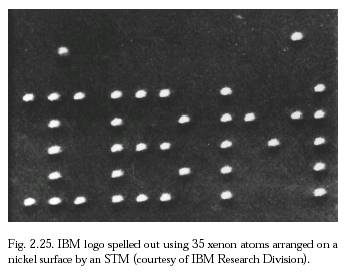
I've seen 38 atoms.... IBM made a logo out of a few and took a picture...
http://www.nanomedicine.com/NMI/Figures/2.25.jpg -
Three orders of magnitude...
nano-scale artworks. It includes a 15 micron wide badger, a ten micron long guitar (which was actually played) and a 120 micron long New Scientist logo.
This features are all multi-micron in size. That isn't nano-scale, that's micro-scale, a three orders of magnitude difference. Just because it's small doesn't make it "nano". (Perhaps "nano" is the new "turbo" or "extreme"? Oh no wait, that's "HD".)
Come back when the features are nanometer size, like this one, or these. -
Re:this is very old news...
Yes indeed
from http://www.nanomedicine.com/NMI/9.2.7.6.htm
* In the 1950s, Marvin Minsky and Rollo Silver^289 built a "hydroflip computer" using hydraulic logic elements consisting of millimeter-wide grooves and holes in multiple layers of plastic sheets with small rods and balls inserted in some of the grooves. When the assembly was pressed together and connected to a water supply, it became a hydraulic computer powered by a 3-inch high column of water, operating at ~30 Hz.
289. Marvin Minsky, "Virtual Molecular Reality," in Markus Krummenacker, James Lewis, eds., Prospects in Nanotechnology: Toward Molecular Manufacturing, John Wiley & Sons, New York, 1995, pp. 187-195.
CC. -
Re:Today's waste tomorrow's power sourceSure. And if you look at the ORNL decay paths for the various isotopes of plutonium [1] you will notice that the primary radiation is alpha particle, not gamma rays. So it is relatively easy to shield the nanorobots from the alpha particle effects. This is why Robert Freitas choose Gd-148 (also an alpha particle emitter) as a power source for nuclear powered nanorobots [2].
You have to keep in mind that it doesn't matter whether ionizing radiation is destroying the atomic bonds within nanorobots (and therefore gradually disrupting the normal function of the nanorobots) so long as there is either (a) sufficient redundancy in the nanorobot to tolerate gradual loss of functional components (as is the case in many biological systems); or (b) the nanorobot can remanufacture damaged parts faster than the radiation can destroy them. That is something which should be possible for relatively sophisticated nanorobots (though not the most simple variants). Even simple "bionanorobots" such as E. coli, if supplied with sufficient materials and energy, could replicate to the mass of the Earth in less than 2 days. So having nanorobots (or microscale nanofactories) recycling radiation damaged nanorobots and replacing them with functional nanorobots doesn't seem to present a significant problem.
1. http://www.ornl.gov/sci/isotopes/
2. http://www.nanomedicine.com/NMI/6.3.7.1.htm -
Re: How Do You Job-Hunt If You Work Overtime?have thoughts of law school, but I don't want to go through all of that if I end up disliking it as much.
My friends who have been to law school have become, ah, lawyers, judges, investigators, and venture capitalists. Law school sharpens the mind and teaches analysis and discipline and ethics (yeah, I know - lawyer jokes).
One man I've never met except virtually via email exchanges is Glenn Harlan Reynolds. He is on the University of Tenn Law Faculty, and writes (very well and) prolifically about technology. Send him a note - maybe you'll get an encouragement.
Another guy with a law degree who writes about a field completely tangental is Robert Freitas.
But do whatever you do, do it at your own pace.
-
Re:Was: Hot Water
You're asking about the Hypsithermal Limit - the point where the amount of energy we dump into the atmosphere starts to seriously affect earth's climate. The link is about what it means to the number of nanomachines there can be on earth, but it's still answers your question. Super-short summary: Earth gets ~2X10^17 watts from the sun; The upper safe limit for human power is ~2X10^15 watts; Current human power use is ~1.5X10^13 watts.
-
Strange-(er)-than fiction.
" Strange. I thought Mechanical Computing was in the past"
The mechanical meets the electrical, and is practical , possibly using fluids among other things. -
Re:Can someone tell me
One plus for fusion over fission is that, as it currently stands you cannot create a pure fusion bomb, so heavy water is not as dangerous as letting the world play around with Uranium and isotopes that can be generated from it.
I am looking for something that will be able to replace depleting Oil and Gas reserves for power generation, in the developing as well as the developed world. And while pebble bed reactors look good from the non-proliferation and safety side of things, they are not so good on the re-processing side of things.
So any positive fusion news is good news, well it means all we would have to worry about is the hypsithermal limit. Good luck with the reactor. I wonder how plausible it would be to build a sonoluminescent fusion device at home, something to look into....
-
Gray Goo is a real threatThe gray goo concept goes back at least as far as Drexler's 1986 book, Engines of Creation. The best paper on gray goo is by Robert Freitas, author of Nanomedicine.
Although Freitas' paper is oriented towards showing ways to detect and fight gray goo, a careful reading shows that it answers most of the superficial objections to the concept. There is plenty of energy to create diamondoid (rock-like) nanobots starting with energy-rich organic matter. Specialized gray goos could eat things like auto tires or road asphalt and bring commerce to a halt. It might even be possible to create a solar powered replicator that could work in air, extracting carbon, nitrogen, oxygen and hydrogen from common gasses. A single microscopic seed could turn the atmosphere opaque within days.
In short, there are enormous dangers from gray goo, and the only thing that can save us is that it will probably be quite difficult to design, so safer forms of nanotech can be well established before goo becomes a real threat. At that point Drexler and Freitas hope that we will have a nanotech immune system for the biosphere, "blue goo" (named for the color of police uniforms) which will be omnipresent and constantly monitoring for the signature of gray goo outbreaks, ready to attack with overwhelming force.
Sure, it's all sci-fi now, but it's going to be a reality eventually. If the Drexlerian vision of nanotech comes to fruition, it brings great dangers along with great rewards. We'll look back on the world of today as a sleepy, safe, comfortable time when nothing much happened.
-
Subject is misleadingWhile it is beginning to be quite feasible to begin to connect neurons in the brain or motor cortex to neurons or muscles whose normal connections to the brain have been disrupted this is a far cry from a Matrix-like interface.
Current estimates by Robert Freitas suggest that it is going to require at least a trillion nanorobots in place within the brain and most probably the installation of an extensive fiber optic network to handle the required bandwidth to provide a matrix-like interface (either for real time full bandwidth human-computer interfaces or for brain/mind uploading into a computer). This may be documented to a limited extent in Ray Kurzweil's forthcoming book The Singularity is Near (est. publication early 2005) and perhaps to a greater extent in several years when Nanomedicine Volume III is published.
-
Nanites, Biobots and NanobotsI don't believe there is a technical definition for nanites. If someone has a source for its first use, please post it.
Nanobots, have been fairly well defined and well described. See for example, the respirocytes paper from the Nanomedicine page at the Foresight Institute. The operating parameters for diamondoid nanobots are described in depth in Nanomedicine, Volume I . A dozen or more types of nanobots are described in the current and future volumes of Nanomedicine.
Biobots, is a term that I personally have used at several conferences to describe what chainsaw1 refers to as "nanites". However they do not have many of the qualities he attributes to them. They might make you somewhat stronger, but your ultimate strength is limited by your bone strength . People who abuse steroids can become so strong they snap their bones. It will be difficult to construct biobots/nanites that create stronger bones because you need a stronger structural material. The only possible material that currently exists, for which we have manufacturing systems in nature, would be very strong sea shells (e.g. abalone shells). But your body would probably have an immune reaction if you loaded them up with biobots that augmented your natural bone with the proteins that are used to strengthen the shells. Biobots, could perhaps do things like influence whether your muscle fibers are fast twitch or slow twitch, which would change you from a sprinter into a marathoner and back. Biobots could also produce erythropoetin, causing you to make more red blood cells, increasing your oxygen capacity, and perhaps at the same time your risk for forming blood clots or overloading your heart due to increased blood viscosity. Biobots could also give you the skin of a cameleon or octopus (color changing). Biobots will not have significant communications capabilities because it would have to be encoded chemically and there is no system in nature for "writing" new information into DNA (all it does is erroneously copy old information) or writing a variety of chemical molecules that would be required for communicating any volume of information.
Biobots do have uses however. I came to the conclusion in watching the movie X-men, that about 1/3 of the capabilities in the movie, you could do with biobots, 1/3 the capabilities would require diamondoid nanobots and the final 1/3 would probably require changing the laws of physics or "tricks" using microelectronics.
It is worth noting, that the term biobots is overloaded, because it is used in some contexts to describe small insect-like robots that have neural-net control systems.
-
Nanomedicine and nanotechnology can be safeI was a reviewer for Nanomedicine and I speak with Robert Freitas frequently. He is very serious about designing nanobot medical devices so they are non-replicating, have numerous failsafes, and do not create the possible problems most people envision. One reason writing all three volumes will take 6 years is the depth of analysis that has to be done to meet this standard. While it is doubtful that a single individual can think of everything, Nanomedicine clearly will lay the foundation for safe and very useful nanobots such as Respirocytes.
The problems mentioned by Bill Joy in his interview point out how poorly informed he is. Anyone who has been in the computer industry as long as he has, should know enough to "read the manual(s)" before offering uninformed opinions. The problems regarding nanotechnology run amok have been discussed for many years in the sci.nanotech newsgroups as well as at conferences for the Foresight Institute's Senior Associates. The basic solutions involve making "safe" (e.g. reviewed, open source) designs available while at the same time developing defenses against nanotech run amok. The Extropy Institute's Mailing List Archives, for example, contains recent discussions about encouraging the availability of "almost anything" manufacturing boxes (similar to Star Trek "replicators"), while discouraging the availability of "everything" boxes.
Diamondoid or saphire based molecularly assembled nanobots used in medical applications will greatly exceed the capabilities in of "biobots" built on existing genetic machines (DNA, enzymes, bacteria, cells, etc.) because they are stronger, can pack the "code" more densely, and can have more complex programs than the rather "ad hoc" designs that nature has provided us with. Most of the first volume of Nanomedicine is devoted to determining exactly what the physical limits will be on power, communication, mobility, etc. Most of the applications will be discussed in Volumes II and III.
Joy may be right that the technology poses a threat to the "human species", but that begs the question of "Why would you want to run on obsolete hardware?". Anyone who understands even a little astronomy knows that galactic hazards doom biological human forms to death at some point. Only those humans who choose to upload have any hope of living the trillion or so years that seems quite feasible. So while the hopes for biochemical humans are rather dismal even with Nanomedicine, the long term prospects for humanity, based on what nanotechnology allows are quite good indeed.
As far as nanotechnology background material goes, the best (nontechnical) source is Engines of Creation. Other references can be found in Eric Drexler's CV.
-
Nanomedicine and nanotechnology can be safeI was a reviewer for Nanomedicine and I speak with Robert Freitas frequently. He is very serious about designing nanobot medical devices so they are non-replicating, have numerous failsafes, and do not create the possible problems most people envision. One reason writing all three volumes will take 6 years is the depth of analysis that has to be done to meet this standard. While it is doubtful that a single individual can think of everything, Nanomedicine clearly will lay the foundation for safe and very useful nanobots such as Respirocytes.
The problems mentioned by Bill Joy in his interview point out how poorly informed he is. Anyone who has been in the computer industry as long as he has, should know enough to "read the manual(s)" before offering uninformed opinions. The problems regarding nanotechnology run amok have been discussed for many years in the sci.nanotech newsgroups as well as at conferences for the Foresight Institute's Senior Associates. The basic solutions involve making "safe" (e.g. reviewed, open source) designs available while at the same time developing defenses against nanotech run amok. The Extropy Institute's Mailing List Archives, for example, contains recent discussions about encouraging the availability of "almost anything" manufacturing boxes (similar to Star Trek "replicators"), while discouraging the availability of "everything" boxes.
Diamondoid or saphire based molecularly assembled nanobots used in medical applications will greatly exceed the capabilities in of "biobots" built on existing genetic machines (DNA, enzymes, bacteria, cells, etc.) because they are stronger, can pack the "code" more densely, and can have more complex programs than the rather "ad hoc" designs that nature has provided us with. Most of the first volume of Nanomedicine is devoted to determining exactly what the physical limits will be on power, communication, mobility, etc. Most of the applications will be discussed in Volumes II and III.
Joy may be right that the technology poses a threat to the "human species", but that begs the question of "Why would you want to run on obsolete hardware?". Anyone who understands even a little astronomy knows that galactic hazards doom biological human forms to death at some point. Only those humans who choose to upload have any hope of living the trillion or so years that seems quite feasible. So while the hopes for biochemical humans are rather dismal even with Nanomedicine, the long term prospects for humanity, based on what nanotechnology allows are quite good indeed.
As far as nanotechnology background material goes, the best (nontechnical) source is Engines of Creation. Other references can be found in Eric Drexler's CV.
-
Nanomedicine and nanotechnology can be safeI was a reviewer for Nanomedicine and I speak with Robert Freitas frequently. He is very serious about designing nanobot medical devices so they are non-replicating, have numerous failsafes, and do not create the possible problems most people envision. One reason writing all three volumes will take 6 years is the depth of analysis that has to be done to meet this standard. While it is doubtful that a single individual can think of everything, Nanomedicine clearly will lay the foundation for safe and very useful nanobots such as Respirocytes.
The problems mentioned by Bill Joy in his interview point out how poorly informed he is. Anyone who has been in the computer industry as long as he has, should know enough to "read the manual(s)" before offering uninformed opinions. The problems regarding nanotechnology run amok have been discussed for many years in the sci.nanotech newsgroups as well as at conferences for the Foresight Institute's Senior Associates. The basic solutions involve making "safe" (e.g. reviewed, open source) designs available while at the same time developing defenses against nanotech run amok. The Extropy Institute's Mailing List Archives, for example, contains recent discussions about encouraging the availability of "almost anything" manufacturing boxes (similar to Star Trek "replicators"), while discouraging the availability of "everything" boxes.
Diamondoid or saphire based molecularly assembled nanobots used in medical applications will greatly exceed the capabilities in of "biobots" built on existing genetic machines (DNA, enzymes, bacteria, cells, etc.) because they are stronger, can pack the "code" more densely, and can have more complex programs than the rather "ad hoc" designs that nature has provided us with. Most of the first volume of Nanomedicine is devoted to determining exactly what the physical limits will be on power, communication, mobility, etc. Most of the applications will be discussed in Volumes II and III.
Joy may be right that the technology poses a threat to the "human species", but that begs the question of "Why would you want to run on obsolete hardware?". Anyone who understands even a little astronomy knows that galactic hazards doom biological human forms to death at some point. Only those humans who choose to upload have any hope of living the trillion or so years that seems quite feasible. So while the hopes for biochemical humans are rather dismal even with Nanomedicine, the long term prospects for humanity, based on what nanotechnology allows are quite good indeed.
As far as nanotechnology background material goes, the best (nontechnical) source is Engines of Creation. Other references can be found in Eric Drexler's CV.
-
Nanomedicine and nanotechnology can be safeI was a reviewer for Nanomedicine and I speak with Robert Freitas frequently. He is very serious about designing nanobot medical devices so they are non-replicating, have numerous failsafes, and do not create the possible problems most people envision. One reason writing all three volumes will take 6 years is the depth of analysis that has to be done to meet this standard. While it is doubtful that a single individual can think of everything, Nanomedicine clearly will lay the foundation for safe and very useful nanobots such as Respirocytes.
The problems mentioned by Bill Joy in his interview point out how poorly informed he is. Anyone who has been in the computer industry as long as he has, should know enough to "read the manual(s)" before offering uninformed opinions. The problems regarding nanotechnology run amok have been discussed for many years in the sci.nanotech newsgroups as well as at conferences for the Foresight Institute's Senior Associates. The basic solutions involve making "safe" (e.g. reviewed, open source) designs available while at the same time developing defenses against nanotech run amok. The Extropy Institute's Mailing List Archives, for example, contains recent discussions about encouraging the availability of "almost anything" manufacturing boxes (similar to Star Trek "replicators"), while discouraging the availability of "everything" boxes.
Diamondoid or saphire based molecularly assembled nanobots used in medical applications will greatly exceed the capabilities in of "biobots" built on existing genetic machines (DNA, enzymes, bacteria, cells, etc.) because they are stronger, can pack the "code" more densely, and can have more complex programs than the rather "ad hoc" designs that nature has provided us with. Most of the first volume of Nanomedicine is devoted to determining exactly what the physical limits will be on power, communication, mobility, etc. Most of the applications will be discussed in Volumes II and III.
Joy may be right that the technology poses a threat to the "human species", but that begs the question of "Why would you want to run on obsolete hardware?". Anyone who understands even a little astronomy knows that galactic hazards doom biological human forms to death at some point. Only those humans who choose to upload have any hope of living the trillion or so years that seems quite feasible. So while the hopes for biochemical humans are rather dismal even with Nanomedicine, the long term prospects for humanity, based on what nanotechnology allows are quite good indeed.
As far as nanotechnology background material goes, the best (nontechnical) source is Engines of Creation. Other references can be found in Eric Drexler's CV.
-
some cool linksRobert Freitas has written the (afaik) world's first technical book on Nanomedicine, described here and purchasable at Amazon or the publisher. This book is a big advance in the art, comparable to Drexler's Nanosystems. Freitas is an extremely diligent author, treating every imaginable detail of the designs he proposes.
A gentler intro to nanomedicine is available here, in an earlier book.
One of the interesting ideas from Freitas's book is the respirocyte, an artificial red blood cell with a much higher oxygen-carrying capacity than the biological version. A person with respirocytes in his bloodstream could sit on the bottom of a swimming pool for nearly four hours.