Slashdot Mirror
Domain: nasa.gov
Stories and comments across the archive that link to nasa.gov.
Comments · 16,365
-
Ha.
2010 is the next solar maximum! Who wants to place bets that the nav circuits on this thing get scrambled on its way back!?
-
License
The program license
-
Ofiicial site
http://worldwind.arc.nasa.gov/
(as apposed to the submitters Wiki - not that I'm ungrateful for his contributions and bringing this news to my attention) -
Re:What's that thing for?
-
Re:anythingAmazing - someone must have broken into your ISP and blocked: http://data.giss.nasa.gov/gistemp/ [nasa.gov], because it shows exactly the opposite effect (strong increases in surface air temps, offset by cooling in the stratosphere). Of course those silly NASA scientists are morons compared with some cold-fusion type cranks in a Danish basement producing unpublicable results. And as has been explained here countless times (though sadly without use of Occam's Crazy Straw), the word "global" next to "warming" means "averaging all over the globe", and therefore local cooling is not only permitted, it's often expected.
I am not positive but I am pretty sure that we didn't have weather satellites in 1880. The GP's claim was that the best source of temp data (US Weather Sats) show the temp to be fluctuting about a constant mean. Your rebuttal links to NASA networks of land wx survey sites. A staple claim by the anti-GW crowd is that the measured temp increases are an artifact of wx data being taken in urban areas which are warming due to "heat island" effects independent of a constant temp outside of the urban area.
-
Re:anything
You know, I've been thinking along the same lines lately. I've always been a big believer in the greenhouse theory and have made changes in my lifestyle to reflect it (i.e., I ride a bicycle to local fruit stands instead of driving to the grocery store, etc). But the more I watch and learn about the theories concerning our planet, the more I wonder if we could be mistaken. One of the things I keep wondering about is that the earth's magnetic poles are in continous movement. This movement seems to cause a fluctuation in the earth's electromagnetic field, decreasing it as much as %10 since the 19th century. Since this protects us from global winds, could this not be a part of the problem or is this already considered in teh current calculations for global warming?
Another point that I have been pondering is that even if global warming is caused by man, it is pretty arrogant of us to believe that we will kill the earth (or all of the life found on it). It seems very likely that we could kill ourselves and most of the organisms that are adapted to the world as we know it, but life will still live on. This has already occurred during the Great Dying. So in a sense, we are really trying to save ourselves from ourselves
-
Re:anything
Twenty years ago, climate research became politicised in favour of one particular hypothesis, which redefined the subject as the study of the effect of greenhouse gases. As a result, the rebellious spirits essential for innovative and trustworthy science are greeted with impediments to their research careers.
Evidently the scientist in Mr. Caldwell and yourself feels no need to produce repeatable evidence for this claim. Show us the data, or quit repeating hearsay.And while the media usually find mavericks at least entertaining, in this case they often imagine that anyone who doubts the hypothesis of man-made global warming must be in the pay of the oil companies. As a result, some key discoveries in climate research go almost unreported.
Is that why a guy who assumed the title of State Climatologist so he could sow doubt about global warming appears on CNN at least an order of magnitude more often than one of NASA's most senior and respected scientists? That definitely sounds like a media cover-up to me. C'mon, man, if you're going to use the tobacco lobby's disinformation techniques, at least use them with some finesse so they aren't just flopping around in the open all exposed and gooey.He saw from compilations of weather satellite data that cloudiness varies according to how many atomic particles are coming in from exploded stars. More cosmic rays, more clouds. The sun's magnetic field bats away many of the cosmic rays, and its intensification during the 20th century meant fewer cosmic rays, fewer clouds, and a warmer world. On the other hand the Little Ice Age was chilly because the lazy sun let in more cosmic rays, leaving the world cloudier and gloomier.
Clearly such mundane and well-researched explanations for warming as carbon-driven greenhouse effect must not be right, if far-fetched ideas like cosmic rays could be invoked to magically produce clouds that give us the explanation we hope is true. Who needs Occam's Razor when we've got Occam's Crazy Straw?!? As it happens, my father has spent years studying cosmic ray showers. His group, which works out of a ragtag lab called Los Alamos, is obvious unfamiliar with the power of Occam's Crazy Straw, so they have made no predictions of global temperature change whatsoever.So one awkward question you can ask, when you're forking out those extra taxes for climate change, is "Why is east Antarctica getting colder?" It makes no sense at all if carbon dioxide is driving global warming. While you're at it, you might inquire whether Gordon Brown will give you a refund if it's confirmed that global warming has stopped. The best measurements of global air temperatures come from American weather satellites, and they show wobbles but no overall change since 1999.
Amazing - someone must have broken into your ISP and blocked: http://data.giss.nasa.gov/gistemp/, because it shows exactly the opposite effect (strong increases in surface air temps, offset by cooling in the stratosphere). Of course those silly NASA scientists are morons compared with some cold-fusion type cranks in a Danish basement producing unpublicable results. And as has been explained here countless times (though sadly without use of Occam's Crazy Straw), the word "global" next to "warming" means "averaging all over the globe", and therefore local cooling is not only permitted, it's often expected.
You have done an amazing job researching and writing a book that incorporates absolutely no verifiable scientific fact, but relies exclusively on crackpots, unlikely theories, and misinterpretation of existing science, and you are to be roundly commended for your Herculean efforts. Move over Intelligent Design, there's a new pseudoscience in town. -
Space tomato seeds - NASA
NASA has been sending seeds to space for a long time. In 1989 I, and all my classmates, received packages of tomato seeds as part of LDEF Experiment P0004-01. A little bit of Googleing turned up Park Seed SEEDS project which nicely describes the project. Most of my classmates killed their plants. I planted mine in the family garden and bore fruit. That was quite tasty. As I recall there was some legalese that said don't eat the fruit that the plants bear lest you turn into a tomato based superhero.
The Long Duration Exposure Facility project main page. -
Space tomato seeds - NASA
NASA has been sending seeds to space for a long time. In 1989 I, and all my classmates, received packages of tomato seeds as part of LDEF Experiment P0004-01. A little bit of Googleing turned up Park Seed SEEDS project which nicely describes the project. Most of my classmates killed their plants. I planted mine in the family garden and bore fruit. That was quite tasty. As I recall there was some legalese that said don't eat the fruit that the plants bear lest you turn into a tomato based superhero.
The Long Duration Exposure Facility project main page. -
Re:What's that thing for?
Why yes, I am glad you asked. http://www.nasa.gov/mission_pages/station/science
/ index.html will get you to the weekly science overview and the current expedition science overview. You get all this while the place is still under construction. Just think when a crew of six is available with full laboratory environments in the next few years. By the way, http://www.nasa.gov/mission_pages/station/structur e/iss_manifest.html gives a summary run down on when to expect new capabilities to be in place. -
Re:What's that thing for?
Why yes, I am glad you asked. http://www.nasa.gov/mission_pages/station/science
/ index.html will get you to the weekly science overview and the current expedition science overview. You get all this while the place is still under construction. Just think when a crew of six is available with full laboratory environments in the next few years. By the way, http://www.nasa.gov/mission_pages/station/structur e/iss_manifest.html gives a summary run down on when to expect new capabilities to be in place. -
Re:How Hirise works
The HiRise camera uses 14 2048x128 pixel CCDs. The 2048 pixels are in the across-track direction (perpendicular to the direction of flight), and the 128 pixels are in the along-track direction. The charge in each pixel is read out (along the 128 pixel direction) at the same speed that the image moves across the sensor, a technique known as Time Delay Integration (TDI). The pixels aren't averaged, since all the signal from one point is kept together in one packet.
If the first four pixels in a column die, no biggie, you lose 3% of your dynamic range. However, if the last four pixels die (the ones where the charge from all the other pixels must transfer through), you could very well lose 100% of your dynamic range since you may not be able to read out the image anymore. Imagine taking a very long road trip from LA to Long Island (the readout pixel), and finding out that the bridges got washed out.
The "ghosting" effect you speak of wouldn't occur in this configuration. In a standard CCD, surface traps caused by radiation damage or manufacturing defects trap charge and randomly release it over time. If it's really bad, you could take an image and read it out, then read it out again without exposing the CCD to any additional light and still get a recognizable image. Since the charge in this CCD is continuously transferred, it'd end up looking like long streaks (limited to single columns as you suggest), reducing the contrast and the SNR of the image, but not causing double images.
If anyone wants to read up on this, this PDF from NASA is a great resource: http://marsoweb.nas.nasa.gov/HiRISE/papers/6th_int _mars_conf/Delamere_HiRISE_InstDev.pdf -
Cult of CO2
One must also ask, and this is something I rarely see in the general debate : "What about all the nitrogen?"
Even back in 1994 the global warming potential of fertilizers were known :
"In wet soils, denitrifying bacteria convert nitrate to nitrous oxide and gaseous nitrogen. The former is a greenhouse gas that has an energy reflectivity per mole 180-fold higher than that of carbon dioxide."
I came across the notion in an MIT courseware video lecture (16 or 17 I think)
On a slightly different tack nitrogen's role in reducing carbon fixing was documented in 1996
and thus warning against adding nitrogen to the ecosystem because it reduces the ability to fix the dreaded carbon, ignoring N's own contribution.
Yet here we have Nasa saying that carbon fixing is nitrogen limited and we should add more nitrogen to the system.
Not that all modern thinking is pro-nitrogen.
Add into the mix the world's estimated 1,300,000,000 cattle belching out 400 litres of methane each per day : 520,000,000,000 litres
Here's more on methane
Methane is responsible for nearly as much global warming as all other non-CO2 greenhouse gases put together. Methane is 21 times more powerful a greenhouse gas than CO2. While atmospheric concentrations of CO2 have risen by about 31% since pre-industrial times, methane concentrations have more than doubled. Whereas human sources of CO2 amount to just 3% of natural emissions, human sources produce one and a half times as much methane as all natural sources. In fact, the effect of our methane emissions may be compounded as methane-induced warming in turn stimulates microbial decay of organic matter in wetlands--the primary natural source of methane.
and more
What conclusions?
My conclusion is that reducing one's carbon footprint will not suffice. The way to fix more nitrogen is to grow more pulses and legumes which is good because you're going to need something to replace the cows you're eating now. Stop pouring nitrogen on to the fields and start eating more organic produce.
As we've been saying for a while : "think globally, act locally" -
Re:No picturesHeating it up in this case is just slang for turning it on before actually using it; there's not really a heater per se. I did find this from a NASA white paper:
Low-noise CCD performance was attained at a rate of 16 Mpix/s. 128 levels of time delay and integration (TDI) is used to achieve a signal-to-noise ratio of >150:1, but requires precision timing in the electronics and a quiet spacecraft.
The fact that the problem is semi-harmonic certainly seems to indicate some sort of short (like a ground-hum in a poorly installed car radio). The bad news is that the project leaders do not seem optimistic about correcting this problem (or even finding the cause). The first part to fail was one of the IR sensors, and IIRC it failed after orbit insertion (ie, after aerobraking), while the other problems are more recent.Earlier in this same paper they also mention that a temperature of 20 Celsius is kept throughout the spacecraft, so there should be no fogging problems at all. Cassini had to run around Venus twice to get to Saturn, and hence had to worry with both heating and cooling; it was far more complex beastie.
-
I suspect I know where it is coming from
What do you expect when you read this description in one of their astronauts' bios:
http://www.jsc.nasa.gov/Bios/htmlbios/nowak.html
[emph added]
PERSONAL DATA: Born May 10, 1963, in Washington, D.C. Married, with three children. Lisa enjoys bicycling, running, skeet, sailing, gourmet cooking, rubber stamps, crossword puzzles, piano, and African violets. As an undergraduate she competed on the track team. Her parents, Alfredo and Jane Caputo, reside in Rockville, Maryland. -
A Damn ShameAlthough the rovers are certainly the superstars of Mars research, the MRO has provided more usable data than any other Mars mission so far. I certainly hope they can fix this problem, or at least work around it; the MRO should have many years of good science left in its system. I believe that the primary mission is scheduled to run through 2008 and then extended missions will be tacked on after that.
Incidentally, this is the camera that could pick out the rovers from orbit. Losing definition on this camera would certainly impact one of the missions objectives, which is to look for good landing spots for future missions (robotic and human).
-
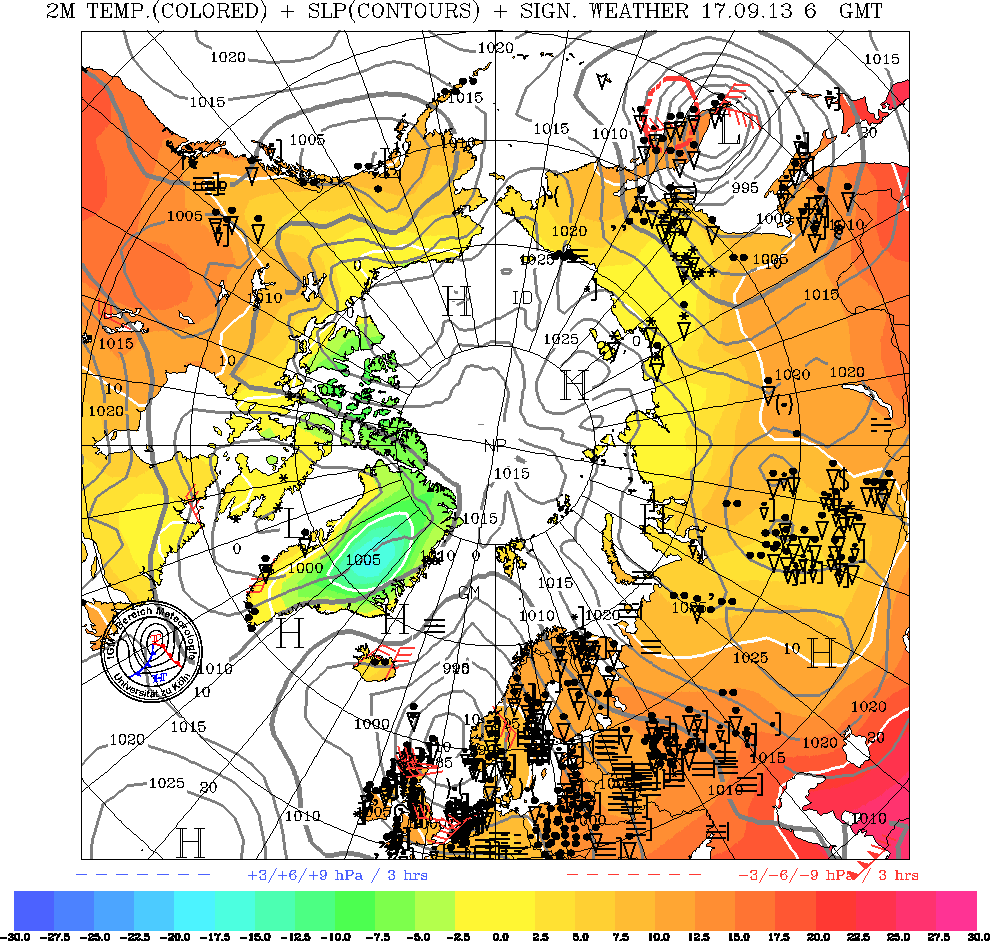
Re:What is your source?I have used the Environment Canada site for my local forecast for years - it's world-class and hey, I pay for it through my taxes. Plus, the weather office is right across town so I know the measurements are locally-accurate. For a time I even screen-scraped the pre-CSS version of the page for my city every 15 minutes to add a META REFRESH tag and a set of the other links I use. I'm a weather nerd, yes. I have a set of pages loaded into tabs in Konqueror and set the ones I can to refresh every half-hour. It occupies a permanent spot on my main virtual desktop and I have a couple old monitors burned with the image of that page from when I had a separate machine for my "weather console".
The forecast for my city:
http://weatheroffice.ec.gc.ca/forecast/city_e.html ?ab-50&unit=m&b_templatePrint=trueAnd radar:
http://gfx.weatheroffice.ec.gc.ca/radar/index_e.ht ml?id=wrnThen continental satellite imagery in the Infrared band:
http://gfx.weatheroffice.ec.gc.ca/data/satellite/g oes_nam_1070_100.jpgAnd the big (polar) picture, a meteorological map:
http://www.uni-koeln.de/math-nat-fak/geomet/meteo/ winfos/arcisoTTPPWW.gifFinally, for the super-big picture (I have this for fun):
http://sohowww.nascom.nasa.gov/data/realtime/realt ime-update.htmlFunny that this item came along - I was just thinking today of resurrecting a page I used to have for weather links that friends used to use to get their weather. There's a weekend project...
-
Mars is a pipe dream
because of the radiation issues. http://www.astrobio.net/news/article2122.html http://science.nasa.gov/headlines/y2004/17feb_rad
i ation.htm -
Re:200 mile high club?
Unless you take a couple of rubber/elastic bands with you, I guess. But try to explain THAT to your superiors...
Bungee ties. Or, more formally, a Payload Equipment Restraint System. Astronauts are used to the idea of retasking mission equipment. Now, explaining the unusual recreational reading material in your personal effects for that mission... that might be hard to explain.
-
Re:Good Science/Art websites?
Seconded... I have the Astronomy Picture of the Day set to my homepage for all of my machines. Great great pictures every day. In fact, one of the most breathtaking pictures I've seen there was just put up the other day:
http://antwrp.gsfc.nasa.gov/apod/ap070205.html
Awesome. -
Re:Good Science/Art websites?
-
a couple of stats
At 850km, the "lighter" objects (high area-to-mass ratio, e.g. insulation, thin plates) will decay within 30 to 60 years. A 1cm steel sphere at that altitude, for example, will only drop about 80km over the next 100 years.
NASA's Orbital Debris Quarterly News has general articles, and always ends with a launch table and "box score". We'll have to wait for the next issue, but China has more than tripled its cataloged debris. With this one event, it's now got about a quarter of what the US and Russia each have, pulling well ahead of France and locking in its position in 3rd place.
I'm really curious about what's going on behind the Chinese wall. I know that NASA in no way controls what the US DoD does in space, and can only nag the administration to keep its promises. NASA scrambles the same way no matter who does the test. Does the Chinese Minsistry of Science (or whatever) butt heads with the Ministry of Defense? I look forward to reading the history, many years from now. -
a couple of stats
At 850km, the "lighter" objects (high area-to-mass ratio, e.g. insulation, thin plates) will decay within 30 to 60 years. A 1cm steel sphere at that altitude, for example, will only drop about 80km over the next 100 years.
NASA's Orbital Debris Quarterly News has general articles, and always ends with a launch table and "box score". We'll have to wait for the next issue, but China has more than tripled its cataloged debris. With this one event, it's now got about a quarter of what the US and Russia each have, pulling well ahead of France and locking in its position in 3rd place.
I'm really curious about what's going on behind the Chinese wall. I know that NASA in no way controls what the US DoD does in space, and can only nag the administration to keep its promises. NASA scrambles the same way no matter who does the test. Does the Chinese Minsistry of Science (or whatever) butt heads with the Ministry of Defense? I look forward to reading the history, many years from now. -
Re:Sorry, but I had to
First of all, if you're going to bother perpetuating this discussion with an anonymous coward, you should take the time to point out that NASA research and development is required to be disseminated back to the public by its charter.
Second, this is exactly why we have communications, navigation, geological, and weather satellites and Google Earth. It's part of why the airline industry has been steadily progressing in safety, capability, and efficiency. It's part of why people are spending so much time debating climate change.
Third, the operations of the government are ideally, although to varying degrees in practice, the consensus of the people, who knowing that the votes they make affect the taxes they pay, choose to support various candidates or measures. In this way, the operations of NASA are a mandate of the people, just as the operations of the Departments of Defense, State, Energy, Transportation, and Agriculture are. -
Re:Unlikely.
-
SpaceX, Rocketplane, and COTS OptionNASA can fulfill its mission by expanding its existing COTS contract with SpaceX and expanding it to include manned launches using the dragon crew module.
The American people will still have a vibrant space agency, that can focus on exploration, rather than on space launch, which is rapidly becoming a normal, commercial business.
NASA's COTS contract also includes Rocketplane, which also includes demonstrations for ISS support.
The COTS contract was a polite way for Congress to buy some insurance in case Lockheed's Space Shuttle Replacement spins out of cost control in terms of either dollars or time.
Which I think is a great move as a taxpayer, having watched ISS cost much more than planned and delivering much less than expected.
We just need the safest, soonest, and cheapest way to get people and stuff into space. I don't care who does it, so Lockheed and those people at NASA in bed with Lockheed, watch out, you've got competition.
-
Re:Short question (with two parts)
As I said, before. I am NOT GOING TO GET INTO A PAPER PISSING CONTEST.
This isn't a debate about research DOGMA in the current scientific community. I think it is clear for a variety of reasons many have already made up their mind we are the primary reason for CO2 based climate change. I just don't think the problem is that simple, and I think current conclusions are based on greed and bad science.
Its one of the reasons why, we refuse to put better instrumentation into orbit and pretty much build a better view of our Earths Biosphere in general, IMHO.
After all, if you already know everything about everything, why put better instrumentation in orbit. Sorry if I sound pedantic, but Bob Meyer, my prof when I was an undergrad at UW Madison told me once never to make this mistake: "The greatest barrier to science is revelation because singular understanding of nature leads to ignorance."
I think that puts the current science of global warming in an excellent frame of mind.
Google and spend your own time researching alternative viewpoints, I am not doing it for you. Its a FREE INTERNET.
Besides, I already proposed a SIMPLE EXPERIMENT for all concerned here:
Watch the solar neighborhood over the next decade. Here is a page at NASA to get you started:
http://eos.nasa.gov/imswelcome (Seems to be down right now....but don't worry, it comes and goes....depending on funding. I think they take it down because they already know everything about that science and consider it a waste of money to do anything else with it. When they forget something, they put it back up.
http://www2.jpl.nasa.gov/basics/Ktable.html (Place your bets! Up or down 10 years from now? I say they are all up along with the Earth if our current solar cycles continue to strengthen.)
Like I said, if I am full of crap, in the next 10 years the mean temps of all the bodies in the solar system should have NO correlation to earths own warming.
If I am right, then there should be precipitous increases in average temperature/radiation in the infra red band for all bodies in our solar system with a postive net increase.
Very simple hypothesis, very simple experiment.
Good Luck.
-Hack -
Re:Short question (with two parts)
As I said, before. I am NOT GOING TO GET INTO A PAPER PISSING CONTEST.
This isn't a debate about research DOGMA in the current scientific community. I think it is clear for a variety of reasons many have already made up their mind we are the primary reason for CO2 based climate change. I just don't think the problem is that simple, and I think current conclusions are based on greed and bad science.
Its one of the reasons why, we refuse to put better instrumentation into orbit and pretty much build a better view of our Earths Biosphere in general, IMHO.
After all, if you already know everything about everything, why put better instrumentation in orbit. Sorry if I sound pedantic, but Bob Meyer, my prof when I was an undergrad at UW Madison told me once never to make this mistake: "The greatest barrier to science is revelation because singular understanding of nature leads to ignorance."
I think that puts the current science of global warming in an excellent frame of mind.
Google and spend your own time researching alternative viewpoints, I am not doing it for you. Its a FREE INTERNET.
Besides, I already proposed a SIMPLE EXPERIMENT for all concerned here:
Watch the solar neighborhood over the next decade. Here is a page at NASA to get you started:
http://eos.nasa.gov/imswelcome (Seems to be down right now....but don't worry, it comes and goes....depending on funding. I think they take it down because they already know everything about that science and consider it a waste of money to do anything else with it. When they forget something, they put it back up.
http://www2.jpl.nasa.gov/basics/Ktable.html (Place your bets! Up or down 10 years from now? I say they are all up along with the Earth if our current solar cycles continue to strengthen.)
Like I said, if I am full of crap, in the next 10 years the mean temps of all the bodies in the solar system should have NO correlation to earths own warming.
If I am right, then there should be precipitous increases in average temperature/radiation in the infra red band for all bodies in our solar system with a postive net increase.
Very simple hypothesis, very simple experiment.
Good Luck.
-Hack -
Brand power
The only reason to keep Netscape alive is brand recognition. Look at how many websites are still "best viewed"/"tested" or have bookmark or printing directions for only Netscape and IE, or just haven't been updated to say anything different: NOAA, part of NASA, NIH sites, govts of Utah and Minnesota, the IOC, a Consumer Reports site and college after college after college. If people keep seeing these notices, especially on government sites, there's no way they'll switch to some "other" browser, and keeping Netscape as a brand will be worthwhile. I mean, do I really have to mention AOL?
-
Offsite storage!From the original article (from NASA, not msnbc.com) "The moon could also provide some creative commercial opportunities: lunar power from solar cells, protected data archives, mining of lunar metals, and research under conditions of low gravity and high vacuum, to name a few."
So, if your data is REALLY vital, you can store your backups in the ULTIMATE offsite data center!
-
Re:Already there
-
Re:HyperboleWe stick ourselves with burdens to benefit our children's children all the time. New Yorkers have spent decades paying for an aqueduct system that wont benefit anyone for decades yet. We also stick ourselves with burdens that will never benefit anyone but our parents. Retirement for the baby boomers is a particularly severe example of this, since my generation will pay far, far more into the world's retirement savings plans than we will ever have any hope of getting out.
So you're saying you DIDN'T have a negative reaction to 9/11? There are certain presumptions that one can reasonably make -- I can presume that you breath a mixture of mostly oxygen and nitrogen, for example. I can presume that you possess a liver and an instinctive desire to own a residence of some kind. And I can presume -- particularly since you are an American -- that you freaked-the-fuck-out on 9/11, and continue to live in a state of deep and profound fear. It's a presumption that has a high likelihood of being correct, so there is no reason not to make out. Thanks for trying to piss on the basic concept of approaching life empirically though...
Do some research -- most projections suggest that Manhattan will be experiencing serious flooding on a regular basis.
The Goddard Institute's page on the subject.
They're quite confident that flooding on the scale of what occurred in New Orleans during hurricane Katrina would be a frequent occurrence; much of Manhattan would be underwater multiple times a year.
I know you think that scientists just make these things up because they hate you and want to take away everyone's SUVs, but it's just not the case. And I'm sure you believe that people who are concerned about this are actually just jealous of you and want to take away your money, but that too is not the case. You're confusing scientists and environmentalists with politicians and other sorts of busybodies.
Do I have the right to put your life in danger? Can I store pipe bombs in your house? Can I leave a baggy of Acetone Peroxide on the hood of your car, just because I need to set it down somewhere and it's convenient? Of course not -- the very idea is retarded. And it goes both ways. You don't have the right to put me or my descendants in danger. It doesn't matter one little bit that you're too fucking cheap to accept the true costs of transportation, of electricity, of heating and air-conditioning, etc. If you have to endanger me and my descendants to get those things, you should expect to pay a premium. My lung-tissue isn't free -- do you think that you should be allowed to pump mercury and sulfur dioxide into the atmosphere, just because you want cheap power? Fuck you. You think you can play russian roullette with the world's climate, just because you're too cheap to buy an electric car and pay for renewable electricity? Nope, sorry. My right to life and security, and my descendants right to life and security, trump your greed and selfishness. Even if it is just a risk, and not a certainty, you don't have the right to put ME at risk.
You can put yourself at risk of course -- get your own little coal-generator, run it in your basement, and plug your chimney so that the emissions stay inside your house. I bet you'll suddenly feel VERY strongly about how dangerous those emissions are.
-
Don't forget
The major problem with solar forcing enthusiasts is that they ignore the fact that the variations in solar output simply aren't large enough in magnitude to account for the observed recent warming trend.
That and the fact that we just came out of a sunspot minimum and yet are still experiencing record temperatures. -
An Email Received by all NASA employees today..Subject: A Message From the Office of Inspector General
Point of Contact: NASA Office of Inspector General, 1-800-424-9183
A Message From the Office of Inspector General
Pursuant to a request from 14 United States senators, the NASA Office of Inspector General (OIG) is conducting investigative and audit activities regarding alleged "repeated instances of scientists
Through this notice the OIG is seeking your help in conducting a thorough review into this issue.
NASA policy on the dissemination of scientific and technical information derives from The National Aeronautics and Space Act of 1958, as amended, and is primarily implemented by NASA Policy Directive 2200.1 and NASA Procedural Requirements 2200.2B. The policy directive states, in pertinent part, the following:
NASA shall provide for the widest practicable and appropriate dissemination of the STI [Scientific and Technical Information] resulting from NASA's research effort, while precluding the inappropriate dissemination of sensitive information. NASA shall disseminate STI in a manner consistent with U.S. laws and regulations, Federal information policy, intellectual property rights, technology transfer protection requirements, and budgetary and technological limitations.
Accordingly, the OIG asks that if you have personal knowledge of NASA research (pertaining to climate change) having been wrongfully, unlawfully, or without good cause changed, suppressed, or censored, that you contact the OIG either:
- By e-mail: http://www.hq.nasa.gov/office/oig/hq/hotline.html - By phone: - By mail:
The identity of anyone who provides the OIG with information will be protected, consistent with the Inspector General Act of 1978 and the Privacy Act. Also, the Whistleblower Protection Act protects any civil servant who provides information to the OIG from any form of reprisal, retribution or adverse action by their employer if those actions are taken solely because of the information being shared with the Office of Inspector General.
While the OIG will accept information at any time on this or any other matter, we request a response to this notice, if any, no later than February 16, 2007.
Thank you for your consideration and cooperation.
-
Re:Hubble gone is no real loss
Also notice how the anony-coward did not address the encryption downlink. All he did was stress that all the data is stored at some website.
From what I could gather doing a simple web search, the Hubble downlink comes down to Goddard Space Flight Center via the Tracking and Data Relay Satellite System (TDRSS). It looks as if they have a web site...
http://msp.gsfc.nasa.gov/tdrss/oview.html
http://en.wikipedia.org/wiki/TDRSS
So, unless one can hack into the TDRSS system, I guess you're out of luck in getting the raw telemetry stream from the Observatory. As for the encryption, I would imagine it would come from a requirement that all commands to and all information received from Hubble would have a single point of origin, namely Goddard, and that encryption is to prove the link is valid. After all, you wouldn't want someone else commanding the satellite to do something that could damage it (like point it toward the Sun, for example).
What ARE they doing on Hubble?
As for what is being observed with HST, another simple web search provided the two following links:
http://www-int.stsci.edu/~inr/thisweek1/previous15 .html (abstracts and general info)
http://www.stsci.edu/observing/weekly_timeline.htm l (for detail down to the second)
It's not that difficult, people. -
Re:Mandatory GW
-
Re:No time in the upcoming servicing mission
The upcoming Hubble Servicing Mission already has two new science instruments on the manifest: the Wide Field Camera 3 (WFC3, a replacement for the venerable Wide Field Planetary Camera 2 - WFPC2) and the Cosmic Origins Spectrograph (COS). WFC3 wasn't intended to be a replacement for the Advanced Camera for Surveys (ACS), but the new instrument should be able to do much of the imaging science that is now lost with the ACS visible-wavelength detectors down.
Information on the Hubble Servicing Mission can be found from NASA's Hubble site:
http://www.nasa.gov/mission_pages/hubble/servicing /index.html -
Hubble pictures are nice 'n' all...
...but the excitement of seeing some of those pictures can't compare with what I felt when I first saw this pair of galaxies and the Orion Nebula with my own eyes in my shiny new low cost ($300) 8" reflector (even if they didn't look as spectacular as in those pictures I linked to).
-
Hubble pictures are nice 'n' all...
...but the excitement of seeing some of those pictures can't compare with what I felt when I first saw this pair of galaxies and the Orion Nebula with my own eyes in my shiny new low cost ($300) 8" reflector (even if they didn't look as spectacular as in those pictures I linked to).
-
Misleading. You will still have great wallpapers
Actually, although the Advanced Camera for Surveys produces some of the deepest and highest resolution images, especially of distant objects, it is the wide-field planetary camera that produces a lot of the most memorable images, such as the "Pillars of Creation" in the Eagle Nebula.
Hubblesite.org has a good layman's description of the instruments on the Hubble.
Also, we're still getting many fine images of the planets, stars, galaxies, and nebulae around us from the Spitzer and the multitude of ground-based scopes that make great backgrounds. And don't forget the fantastic Mars rovers or Cassini. -
Misleading. You will still have great wallpapers
Actually, although the Advanced Camera for Surveys produces some of the deepest and highest resolution images, especially of distant objects, it is the wide-field planetary camera that produces a lot of the most memorable images, such as the "Pillars of Creation" in the Eagle Nebula.
Hubblesite.org has a good layman's description of the instruments on the Hubble.
Also, we're still getting many fine images of the planets, stars, galaxies, and nebulae around us from the Spitzer and the multitude of ground-based scopes that make great backgrounds. And don't forget the fantastic Mars rovers or Cassini. -
Misleading. You will still have great wallpapers
Actually, although the Advanced Camera for Surveys produces some of the deepest and highest resolution images, especially of distant objects, it is the wide-field planetary camera that produces a lot of the most memorable images, such as the "Pillars of Creation" in the Eagle Nebula.
Hubblesite.org has a good layman's description of the instruments on the Hubble.
Also, we're still getting many fine images of the planets, stars, galaxies, and nebulae around us from the Spitzer and the multitude of ground-based scopes that make great backgrounds. And don't forget the fantastic Mars rovers or Cassini. -
Misleading. You will still have great wallpapers
Actually, although the Advanced Camera for Surveys produces some of the deepest and highest resolution images, especially of distant objects, it is the wide-field planetary camera that produces a lot of the most memorable images, such as the "Pillars of Creation" in the Eagle Nebula.
Hubblesite.org has a good layman's description of the instruments on the Hubble.
Also, we're still getting many fine images of the planets, stars, galaxies, and nebulae around us from the Spitzer and the multitude of ground-based scopes that make great backgrounds. And don't forget the fantastic Mars rovers or Cassini. -
Re:The Beeb Disagrees...
Hubble is scheduled to get a new camera (WFC3="Wide Field Camera 3") in the 2008 Servicing Mission 4 (SM4, http://hubble.nasa.gov/missions/sm4.php). The camera that just (mostly) failed (ACS="Advanced Camera for Surveys") would have operated in parallel with the new WFC3 camera. Hubble has yet another camera (WFPC2=Wide Field Planetary Camera 2) that is still operating normally. NASA loves acronyms. Long live Hubble!
-
Re:obligatory conspiracy post....I thought they already had a service launch scheduled for sometime soon...
From http://hubble.nasa.gov/index.php: "Hubble to be Serviced Again Administrator Michael Griffin's decision on October 31, 2006 to fly servicing mission SM4 in mid- to late-2008 will bring unique capabilities to Hubble in the form of two new science instruments, Cosmic Origins Spectrograph and Wide Field Camera 3. In addition, new gyros and batteries will extend Hubble's life through 2013."
Of course by then it may be too late... -
Re:Aren't the optics the valuable part?A little budget math:
Total HST cost: $6 billion
Yearly HST operations budget: $337 million
Single servicing mission in 2008: $900 million
I like Hubble a lot, but other missions which don't require (or allow) Shuttle service and cost on the order of $0.3-0.8 billion seem to me far more cost effective. The mirror is a tiny fraction of the cumulative operations costs.
-
Re:Commemorate by ceasing to send humans
This is a common theme that permeates almost all discussions that talk about sending humans into space. Why don't we just send robots? They're more capable, able to do more work, less costly, etc, etc, etc.
I'm sure everyone is familiar with, or at least the work of, Dr Steven Squyre, Mars Exploration Rover PI (Spirit and Opportunity robots). He gave the following message at a NASA Administrator's Symposium back in 2004 and repeated the same message at ISDC in LA last year. It's a long read but well worth it. I've emphasized the central points:
I'd like to finish this on a slightly lighter note by telling you a story. We had a lot of discussion yesterday about humans versus robots. And as the robot guy here, I want to tell a story about the experience that I had that really taught me a lot about that particular topic. We were at first trying to figure out how to use a set of rovers on Mars to really do scientific exploration. The technology folks at JPL [Jet Propulsion Laboratory] built a wonderful little vehicle called FIDO. And FIDO was a great test rover - you could take it out in the field and you didn't worry about getting a few scratches in the paint.
We took it out to a place called Silver Lake in the Mojave Desert about 1997. And we went out there and it was the first time I had ever been out in the field. So I went out there with my team - a bunch of really high-priced geologic talent - some serious field geologists. And we got the rover out there and, of course, the rover breaks down. First time I've ever been out in the field, it's dusty, it's dirty, you know, the rover's not working. So okay, what am I going to do with all these bored geologists I've got on my hands? So I said, "Look, let's go on a geology walk. Let's go on a little field trip." So everybody got their boots and their rock hammers and their hand lenses and everything. And I picked up a notebook and a stopwatch. And we walked out to a nearby ridge where I knew there was some interesting geology exposed and we sat down - or rather I sat down - and they went off and they started geologizing.
And I started timing them. You know, how long does it take for Andy Knoll to walk over to that rock? How long does it take Ray Arvidson to pick that thing up and break it open with his rock hammer and look at it with a hand lens? And they were doing a lot of things that our rovers couldn't do, but I focused on the things they were doing that our rovers could do. And, you know, I did it as quantitatively as I could - this was hardly a controlled experiment. And when I looked at the numbers afterwards, what I found was that what our magnificent robotic vehicles can do in an entire day on Mars, these guys could do in about 30-45 seconds.
We are very far away from being able to build robots - I'm not going to see it in my lifetime - that have anything like the capabilities that humans will have to explore, let alone to inspire. And when I hear people point to Spirit and Opportunity and say that these are examples of why we don't need to send humans to Mars, I get very upset. Because that's not even the right discussion to be having. We must send humans to Mars. We can't do it soon enough for me. You know, I'm a robot guy. I mean, I love Spirit and Opportunity - and I use a word like "love" very advisedly when talking about a hunk of metal.
But I love those machines. I miss them. I do. But they will never, ever have the capabilities that humans will have and I sure hope you send people soon. -
Re:Antiques
The only real disadvantage is our inability to return things from orbit, and as far as I know we've never used that capability.
We used it on a few occations, the most noteable being STS-32, when Columbia brought back the absolutely massive LDEF satellite. http://setas-www.larc.nasa.gov/LDEF/index.html
-
Re:The jokes...
http://news.nationalgeographic.com/news/2005/11/1
1 10_051110_warming.html
http://www.geocraft.com/WVFossils/greenhouse_data. html
http://www.giss.nasa.gov/edu/gwdebate/
http://www.koshland-science-museum.org/exhibitgcc/ causes12.jsp
These are only some of the links you get when you google water vapor and global warming. You might want to read them. -
Re:Apollo 12Apollo 12 even brought back pieces of Surveyor III. ((The referenced page (astronomy picture of the day) shows surveyor 3 from a distance of
Yep... The moon's seen it's first example of the very human activity known as looting.