Slashdot Mirror
Domain: nasa.gov
Stories and comments across the archive that link to nasa.gov.
Comments · 16,365
-
Re:on what grounds?
This might help to give you a better understanding of where all that energy goes. Hope it helps.
-
Re:on what grounds?
But since you ask, and for most people solar variability simply makes sense. And because I highly doubt you will look for, or if you do look since you will not find anything that shows steady state solar output. I will counter you ludicrous unsubstantiated claim.
http://makeashorterlink.com/?K5FA257AB Space.com
http://vathena.arc.nasa.gov/curric/space/solterr/o utput.html
http://en.wikipedia.org/wiki/Image:Sunspots_11000_ years.jpg Seems to show multiple cyclical changes
http://en.wikipedia.org/wiki/Image:Milankovitch_Va riations.png
http://en.wikipedia.org/wiki/Image:Carbon-14-10kyr .png "Carbon-14 production showing 10,000 years of solar variation and generally increasing solar activity."
http://en.wikipedia.org/wiki/Image:Carbon-14-10kyr -Hallstadtzeit_Cycles.png "2,300 year Hallstatt solar variation cycles."
http://en.wikipedia.org/wiki/Image:Carbon-14_with_ sunspots_since_1700.png "Sunspot record (red) with 14C (inverted). There is a 20-60 year delay between sunspot levels and radiocarbon changes."
http://en.wikipedia.org/wiki/Image:Carbon-14_with_ activity_labels.png "Solar activity events recorded in radiocarbon."
http://en.wikipedia.org/wiki/Image:Solar_Forcing_G ISS_model.gif Hey look at those cycles That seem to line up presactly with observed surface temperature on earth. That is quite a coincidence. You will of course note the upward trend that last from the beginning of the century until present day, that is above the apparent decade cycle.
I have to assume that the Ruskies laid their bet on that last graph which shows a fairly steady cycle that shows us entering into a downward trend. Who would have that a massive fusion reaction throwing off massive amounts of energy, thermal and otherwise, could have any effect on temperature here.
Gee, who'd have thunk it. Any questions? -
Re:on what grounds?
The problem is that clouds are not static, and many of the clouds are smaller than the resolution of the models. It' s a well known issue. The numbers you have seen are only fuge factors.
"Climate models rely heavily on satellite data, but because clouds change rapidly, their structure is difficult to simulate in computer models. Yet, understanding global climate change depends heavily on the ability to accurately model cloud structure and behavior. "The only vehicles we currently have to predict future climatic change are general circulation models, which run on computers," said Cess. "As far as we know, no model has predicted the change in cloud vertical structure we observed in 1998 -- that tells us there's a problem with the models. If we're going to have robust climate models, they must predict what we observe."
http://earthobservatory.nasa.gov/Study/CloudsInBal ance/
"Current computer climate models can't accurately predict cloud formation, which, in turn, hinders their ability to forecast climate change from human activities. " http://gtresearchnews.gatech.edu/newsrelease/cloud cover.htm -
Shuttle prep
I'm sure that it takes a while for the machine to move from the staging area to the physical pad, then you need to load the fuel, which takes a while to say the least.
http://science.ksc.nasa.gov/facilities/tour.html
And
http://science.ksc.nasa.gov/facilities/crawler.htm l -
Shuttle prep
I'm sure that it takes a while for the machine to move from the staging area to the physical pad, then you need to load the fuel, which takes a while to say the least.
http://science.ksc.nasa.gov/facilities/tour.html
And
http://science.ksc.nasa.gov/facilities/crawler.htm l -
Re:The World Catches Up
"Has anti-americanism gotten so bad that now people feel obliged to close their eyes to the facts and celebrate our fall even though it hasn't happened yet?"
In a word, yes.
I don't think anyone is celebrating the fall of civil freedoms, or the drastic decline in engineers and scientists - rather it's a feeling of regret on the part of most of us.
GWB did manage to pee in the world's collective cornflakes right after 911 though. That declaration that if we weren't with the US then we were on the side of the terrorists pretty well guaranteed some dislike. Canada has been on the end of what can only be described as economic warfare for the last few years as well. More and more you see people avoiding "Made in the USA" or "Product of US" or "Grown in USA".
I'm pretty sure some idiot will flame me about this - so go ahead, But it doesn't change the fact that when the US most needed friends, GWB managed to piss everyone off.
What I see as terribly regrettable in the US space program and in the comments here, is lack of a goal. Go to Mars. Go to the moon. Go to Venus (practical by the way if the colonists live in floating cities, as breathable air provides all the lifting capacity needed in Venus' atmosphere.) PDF Document here.
Does the shuttle help do that? Don't think so. -
Re:warming to war to hotter then to cooling off
I tend to think at best, just for a SWAG, we have to go on past planetary history. We usually wind up with major wars fought by major powers with whatever the major weapons of that time period were. It has eventually always happened. I see nothing that convinces me todays humans are any better than yesterdays humans in that regard. So the combination of lame hoomannz and natural cyclical warming trends should indicate for the next generation or more we will have _more warming_.
I agree, and therefore conclude that even though we might have some clever people, humans are pretty dumb on overall actions (just look at corporate software development). The global warming gasses seem to be altering Albedo and placing the majority of the heat into the oceans, quotingThe ocean was the logical place to look for any extra heat the Earth is collecting. "It's the biggest bucket to hold heat," says Willis. "It has the largest heat capacity of any single component of the climate system." A high heat capacity means that it takes a lot of energy to raise the temperature. "You know it takes a lot of energy to boil a pot of water, so imagine how much you'd need to increase the ocean's temperature," adds Willis. "It takes at least a 1000 times more energy to raise the temperature of the ocean than it does the atmosphere." "We know that if the ocean temperature is rising," says Willis, "there is a lot of energy that is causing it. The only way we have to explain that much heating is by greenhouse gases."
Backed up here as well with the additional information that even if we stopped putting out greenhouse gasses, so much extra heat is now stored up in the oceans that the world will continue heating for 100 years before stabilising. Hotter oceans would cause rainfall changes, fishing changes, cloud cover changes, tropical storm changes, world conveyor belt changes and possibly Hadley cell changes that could melt the whole Antarctic ice sheet which seems less unlikely due to the high sensitivity of ice sheets to small surface temperature changes. Thing is if I lived in India or China I'd definitely want air conditioning in 45 Celsius temperatures, it's hotter than Texas over there! Well, at least my children will have something interesting to watch on their TVs apart from terrorists, and I might make lots of money by buying stock in desalination plant construction companies. -
Re:warming to war to hotter then to cooling off
I tend to think at best, just for a SWAG, we have to go on past planetary history. We usually wind up with major wars fought by major powers with whatever the major weapons of that time period were. It has eventually always happened. I see nothing that convinces me todays humans are any better than yesterdays humans in that regard. So the combination of lame hoomannz and natural cyclical warming trends should indicate for the next generation or more we will have _more warming_.
I agree, and therefore conclude that even though we might have some clever people, humans are pretty dumb on overall actions (just look at corporate software development). The global warming gasses seem to be altering Albedo and placing the majority of the heat into the oceans, quotingThe ocean was the logical place to look for any extra heat the Earth is collecting. "It's the biggest bucket to hold heat," says Willis. "It has the largest heat capacity of any single component of the climate system." A high heat capacity means that it takes a lot of energy to raise the temperature. "You know it takes a lot of energy to boil a pot of water, so imagine how much you'd need to increase the ocean's temperature," adds Willis. "It takes at least a 1000 times more energy to raise the temperature of the ocean than it does the atmosphere." "We know that if the ocean temperature is rising," says Willis, "there is a lot of energy that is causing it. The only way we have to explain that much heating is by greenhouse gases."
Backed up here as well with the additional information that even if we stopped putting out greenhouse gasses, so much extra heat is now stored up in the oceans that the world will continue heating for 100 years before stabilising. Hotter oceans would cause rainfall changes, fishing changes, cloud cover changes, tropical storm changes, world conveyor belt changes and possibly Hadley cell changes that could melt the whole Antarctic ice sheet which seems less unlikely due to the high sensitivity of ice sheets to small surface temperature changes. Thing is if I lived in India or China I'd definitely want air conditioning in 45 Celsius temperatures, it's hotter than Texas over there! Well, at least my children will have something interesting to watch on their TVs apart from terrorists, and I might make lots of money by buying stock in desalination plant construction companies. -
Re:Global warming could cause an Ice Age
Water freezes at the poles, leaving a much heavier "brine" that sinks and causes a heavy churn. For a better understanding read this ->
http://seawifs.gsfc.nasa.gov/OCEAN_PLANET/HTML/oce anography_currents_1.html
Sorry, it isn't all fluid mechanics and the earth's rotation. Don't be so ignorant. -
Two words: Quantum EntanglementInformation flow (see: Steven Hawking's theories) cannot propogate at faster than the speed of light, or causality is violated and we have (dead virgins/future grandfathers) all over the place.
Tell that to NASA.
But two entangled particles can appear to influence one another instantaneously, whether they're in the same room or at opposite ends of the Universe.
Sounds like empirical evidence of faster than light information flow to me. So that explains why Captain Picard doesn't have any lag when he's talking with a subordinate halfway across the galaxy. Yet it doesn't explain why everyone likes to conveniently overlook it just because it doesn't fit a theory. Get back to me when your theory explains quantum entanglement. In the meantime, I'll be looking for those dead virgins. They're probably in the same place as those Iraqi WMDs.
-
Re:It's a glorified capsule
It'll re-enter like a lifting body or a glider (like the Space Shuttle). Capsules drop.
Russia had several plans for lifting body or glider manned orbital space craft, such as the Spiral.
So did NASA, which recently had Scaled Composites (of SpaceShipOne fame) develop the X-38 (notice the similarity to the Russian Bor), only to see it cancelled because of the cost. That cost, incidentally, was slightly higher than the projected cost for the Kliper, and still half that of a successful Space Shuttle flight.
That is the one thing of the US space program I still don't get. Why have a hugely expensive and dangerous shuttle program, then claim at the same time that astronauts' lives and money are so important, when you have a half-developed, modern, cheap and presumably safe system sitting on the shelves? -
Re:Shuttle type transport not economically effecti
The Russians already had a clone of the Shuttle - the "Buran" - which successfully took off, orbited the earth, and landed without losing a single heat tile.. all unmanned. The project was then scrapped due to lack of further funding.
If they are copying anything here it's not the shuttle, but the next-gen NASA design which is back to a "lauched on the tip of a rocket" type design... but the timing, if anything, more suggests NASA copying Russia rather than vice versa.
http://www.aeronautics.ru/archive/space/russia/rsc e/energia-buran/page_01.htm
http://www.aerospaceweb.org/question/spacecraft/q0 153.shtml
http://liftoff.msfc.nasa.gov/rsa/pics.html -
Re:Great to see something new.
"Because you don't build something as complex as a shuttle, and have a new model every other year."
You still run a 386?
The space shuttle may be complex, but we went to the moon in under 10 years on computers of the equivalent power of a Commodore (so I hear). The shuttle is overly complex. It should either be put in a museum, or given enough fuel to fly it unmanned over the Atlantic and sunk right next to the Titanic.
People are booking personal space flights, and now you can book a flight for 2 around the moon for $200,000,000, FAR less than the shuttle program costs. NASA has a mainframe mentality. The small agile start ups with complex yet highly manageable and cost effective are the cluster computing mentality.
If today's NASA were in charge of the military during WWII, the sword wielding Mongolians would have developed the atomic bomb before the US. IMO, the future of space is in private ventures. Even if they weren't technologically backwards (most NASA "inventions", like Tang, Teflon, and Velcro, are just urban legends), NASA will only put some Johnny D. Rightly on the Moon or Mars. I'm planning on my Mars retirement vacation though the combined company/state funded Le Soviet Virgin Galactic 50 years from now. NASA is the equivilant of a state run automotive company competing with private ventures. It worked long for VW, it did not work for Yugo, and it isn't working for NASA.
I read recently about anti-information from quantum. How, if you learn this information, you actually know less. I'll bet NASA helped fund that research. -
Yeah, look at competition...
"Yeah, it was cooperation and not competition that put a man on the moon!"
Y'know, I'm gonna burn some karma here. But there are times I really hate this attitude.
When I was a kid, say, early 1970s, I picked up an old book on the planets and the "future" of space flight. This book was written probably around 1959 or 1960. It talked about Sputnik and Explorer I. And it talked about how man would get into space. The book started with the "space plane" (what I learned in later years would be considered the X-20). It sat at the top of a rocket, was launched into orbit, and landed again like a normal airplane. The book then talked about the next big step--a space station constructed in orbit. This looked remarkably like the space station shown in 2001. The book ended with what would be the next big step--probably sometime in the late 1980s or early 1990s--of an expedition to explore the moon.
Well, of course, we beat that by 20 years! We landed on the moon in 1969! But what did we get out of it? Are we on the moon now? Could we do more with the moon now, if we were to land on it again, than plant some flags and play some golf?
Your vaunted "competition" to get us to the moon gained us very little in the long run. Yeah, we made it and we developed some pretty impressive technology to do it, which had all sorts of commercial benefits. But we didn't go to the moon to explore. We didn't go to the moon to expand humanity. We went to the moon to beat the Commies. And once that was accomplished, we were done.
I liken it to a 240,000 mile race. We're all excited at the approach of the race. We discuss, debate, and argue about who we think will win. When the race starts, we are glued to our seats. Whoever wins, we cheer, we applaud, slap them on the back and say what a great job they did. But a week after the race, it's business as usual. The winner's name is written in the history books and that's it.
The American Public wasn't behind the Apollo program in order to broaden mankind's knowledge of the universe. We were behind it to whoop some Commie butt and show the world how great the U.S. of A was. And so, when the race was won, the banners were taken down, the streets swept clear of the ticker tape from the parades, and people went back to their own business secure in the knowledge that their country was #1.
That, to me, is what our "competition" to get to the moon got us. Getting to the moon was sold to the people as a race which we had to win. The money spent on Apollo was taken from programs like the X-20. It short-circuited plans for a permanent space station. It put all our resources behind one big "show"--get to the moon. We're only now starting catch up to where we might have been in the late 1970s, if only we had hadn't gotten distracted by beating the commies to the moon.
Consider the concept of "competition": You have an objective--a thing you have to accomplish. If you reach the objective before the others, you win. If you don't, you lose. I'm not interested in that. I'd like to see colonies on the moon. I'd like to see manned exploration of Mars. But these are long-term things--there is no "competition." And if we waste the money on "flags and footprints" kinds of missions so we can thrust our collective index fingers in the air and yell "We're #1!", the long term goal of having my children or my children's children live and work on the moon will never be realized.
Don't get me wrong. I'm not saying Apollo wasn't an amazing achievement. But everyone complains about the fact that we didn't follow-up Apollo with more and better trips to the moon. But as I said, this wasn't how Apollo was sold to the people. It was sold as a competition. And competitions are over when somebody wins. I want the follow-up. And the only way we'll get it is to stop thinking about "beating" other countries and start thinking about how we can do this "for all mankind."
Isn't that what the plaque says it's all about? -
Re:Space elevators
Why do they say they're going to enter the material into some space elevator competition at the end of the article then?
For this year's space elevator tether competition (a collaboration between the Spaceward Foundation and NASA's Centennial Challenges), I think the tether doesn't have to actually be space elevator strength, it just needs to be stronger than everyone else's. As for following years, it needs to be the previous year's winner by 50%. -
Re:Space elevators will never work
Paragraph two is mostly right anyway.
First one is wrong regarding total payload mass. I'd do math to refute the statement, but it has already been done. http://trs.nis.nasa.gov/archive/00000535/
And yeah, the travel time will likely be few days. So what? You can get to LEO in a matter of hours once everything has been built out and systems put in place to deal with any whiplash effects that jumping off before the steady-state altitude.
And it isn't 50K miles to Geo -- it is about 24K miles. I point this out simply because it seems like you are kind of 'creating data' to put it politely. http://liftoff.msfc.nasa.gov/academy/rocket_sci/sa tellites/geo-high.html
Finally, advantage of capturing energy: again, completely off base with respect to the current design considerations. It would be a LOT cheaper ( I estimate at least by a factor of ten, but that is just a guess) to take high energy fuel up to the anchor mass (at the end of the tethor), than to design the system to actually allow both up and down capabilities.
And even if you HAVE a down capability, that by no means implies that you can capture the potential energy of a decending object. Recall that it is a 'rope', not a bar. And the rope is already in tension. I can see no solution which would allow you to gather any worthwhile amount of energy. You can't run a current through the elevator, as you would then have a stupendeous amount of magnetic drag thanks to Earths magnetic field. So no electromagnetic regen. Which doesn't matter, as *any* form of draggy braking against the cable just looks like more mass to be lifted from the perspective of the anchor mass.
If it were a solid bar than the shift of mass would do the job on its own, thanks to the whole inertia game. If we used a 'dangling rope' and litterally tied the 'Low end' to a mass, lifted it into space and then dropped it back down, you could also get the energy back, minus drag.
In summary, your entire post strikes me as pure opinion, with no basis in fact. If I am mistaken, I urge you to issue some form of defense. While I commend you for caring, I believe that you do a disservice by attacking something you don't understand, while pretending, or worse assuming, that you do. -
Re:Space elevators will never work
Paragraph two is mostly right anyway.
First one is wrong regarding total payload mass. I'd do math to refute the statement, but it has already been done. http://trs.nis.nasa.gov/archive/00000535/
And yeah, the travel time will likely be few days. So what? You can get to LEO in a matter of hours once everything has been built out and systems put in place to deal with any whiplash effects that jumping off before the steady-state altitude.
And it isn't 50K miles to Geo -- it is about 24K miles. I point this out simply because it seems like you are kind of 'creating data' to put it politely. http://liftoff.msfc.nasa.gov/academy/rocket_sci/sa tellites/geo-high.html
Finally, advantage of capturing energy: again, completely off base with respect to the current design considerations. It would be a LOT cheaper ( I estimate at least by a factor of ten, but that is just a guess) to take high energy fuel up to the anchor mass (at the end of the tethor), than to design the system to actually allow both up and down capabilities.
And even if you HAVE a down capability, that by no means implies that you can capture the potential energy of a decending object. Recall that it is a 'rope', not a bar. And the rope is already in tension. I can see no solution which would allow you to gather any worthwhile amount of energy. You can't run a current through the elevator, as you would then have a stupendeous amount of magnetic drag thanks to Earths magnetic field. So no electromagnetic regen. Which doesn't matter, as *any* form of draggy braking against the cable just looks like more mass to be lifted from the perspective of the anchor mass.
If it were a solid bar than the shift of mass would do the job on its own, thanks to the whole inertia game. If we used a 'dangling rope' and litterally tied the 'Low end' to a mass, lifted it into space and then dropped it back down, you could also get the energy back, minus drag.
In summary, your entire post strikes me as pure opinion, with no basis in fact. If I am mistaken, I urge you to issue some form of defense. While I commend you for caring, I believe that you do a disservice by attacking something you don't understand, while pretending, or worse assuming, that you do. -
Re:This Just In!
Yup, there'd be consolidating across the sat map market with this move.
-
Re:This Just In!
Looking at http://www.nasa.gov/about/budget/
-
Re:HeyI also doubt a single beam actually cost 600 million.
http://www.spacedaily.com/news/shuttle-02d.html
I doubt you are a engineer, let alone an aerospace engineer.
I'm not an aerospace engineer, but I am an engineer. I'm an engineer who believes in redundant systems and simple solutions over "space hardened" systems. There are lots of examples of guys building working systems on shoestring budgets that last well beyond their engineered lifetimes. Check out http://www.hypocrites.com/article2897.html for just one example. I also cite a story from the Apollo days when Joe Shea vetoed a crazy design for measuring the remaining fuel in the fuel tanks of Apollo spacecraft. Instead of using a nuclear detector to measure fuel in a weightless environment (page 8), he chose a design based on one found in his Karman Ghia. They installed reserve fuel tanks capable of getting the crew home, and always made sure that they were within their limits.
I find it interesting that NASA always talks about how they fly the most complex systems in the world, yet somehow its the Russians with their 40 year old designs that have the most reliable systems.
-
Re:Just Go Back to the Pre-1999 foam formula
It was the switch to foam that isn't manufactured with freon in 1999 that led to the Columbia tragedy. NASA knew that the new foam shed more than the old foam but ignored the problem
Please, do a little research.
Learn the difference between BX-250 and BX-265. Discover for yourself what foam compound was used for ET-93.
Here. Maybe this will help... -
Re:Hey
radiation shielding research on the ISS. Being fried by radiation from the Sun is even worse than being fried by radiation in the Van-Allen belts. Going back to the Moon to put more flags and footprints down is pointless. Going back to utilize the Moon's resources is a lot harder to do without a good radiation shield.
-
Actually, that's more like 3 months...
-
Re:This Just In!
Better than that, hopefully we'll get mars.google.com in 7 months. (0.3m is better resolution than even google maps)
-
Re:Why don't
Oh come now. You go on in this "we're demolishing our beautiful forests" vein - here's a MODIS image of your region of the country from 2002 - the deep green is forest. Get a sense of perspective, man.
I've heard this type of rant before, and I'm suprised that you're claiming that people are "fleeing from the cities". I mean, people who are enviros are usually in the same boat as the social-justice libs who rail against how all of the yuppies are moving back into the cities and gentrifying them. Can you guys on the left get your facts straight?
Would you rather that the (probably overblown) concern of gentrification and people moving back into the cities in droves be the actual case, or that people move out of the cities into exurbs, "destroying the environment"?
I mean, there's a solution to the dual problems "fleeing from the cities" and "moving back into the cities", and I suppose that's why VHEMT exists, but y'all should at least be up front about it. -
Re:A Little Late
I'm not certain we in the U.S. have much right to complain about human overpopulation and overcrowding. Considering we have one of the largest (landwise) nations in the world, and the average population density of the nation is so ridiculously low compared to nations in Europe or in western, southern, and eastern Asia.
Though taking into account our current fertility rate and the rate of immigration, we should probably start thinking about the issue in a preventative sense.
(Check it out: http://antwrp.gsfc.nasa.gov/apod/image/0303/people earth94_usda_big.gif)
Those are both examples of animals people traditionally eat.
How many people in the U.S. actually eat hunted deer or rabbit on a regular basis? Game should be a much bigger part of our diet, IMHO. It could reduce the agricultural stress of cattle farming in the midwest and California, in addition to helping control the population of the game concerned. With close monitors on game populations, the state DNRs could make rules that nudge hunters toward the types of game that are overpopulated in a given year, or away from hunting if the herds are thinning.
Finally, while I agree to a point with the idea of humans being part of nature and letting nature take its course, there is reason to worry about the end of such laissez-faire attitudes. The process of evolution is related in a way to chaos theory and thermodynamics. Given a closed system, which the earth pretty much is, and which the ecologies on separate continents can approximate, the system will tend to settle into a "stable" state over time. Humans, however, have the ability to change ourselves and our environment faster than it can settle. We are spurring along global entropy faster than it would otherwise happen. So if we continue the way we do, we're soon going to end up with the most stable configuration of all: a dead, lifeless planet. But I'm afraid that efforts to change the environment back to what we think "it should be", without first reducing our own effects, will only introduce more disorder, more entropy, and worsen things. It's like overdampening shock absorbers. A little dampening eases the ride, right? But a lot of dampening is no better than having none at all.
The best thing to do, as the parent noted, is to use our intelligence and ability to reduce our effect on the environment as much as possible, and let the world recover a stable state that includes us, rather than just going on as we always have, making the mess and cleaning it up after the fact, and then trying to force the environment back to the way it used to be. By doing so, we're causing damage, and then counteracting the evolutionary nature of the environment to attempt to cope with what we're doing. When I talk about letting things be, I'm not saying we shouldn't clean up pollution we've already made. But I am saying we shouldn't be messing with the animals and where they live. Haven't we humans had enough bad experiences with species transplantation? We've illustrated time after time after time that we simply cannot predict the end effect of doing this. The world's ecology is simply too complex to think we can experiment with this stuff. We know from past experience what has bad effects, so let's first concentrate on avoiding that in the future. So far, we can't even do that much right! What makes us think we know how to actively improve what nature has already done???
We first need to quit damaging, and then stand back and let the ecology adjust by itself. Losing species is always saddening to those who appreciate nature's beauty. And I don't think it's harmful to perpetuate them in zoos if they can't survive in the wild. But nature will continue to be beautiful in new ways if we can just lessen our effects, and step out of the way to let it do its thing. Right now, we are outside "the cycle" because we have a huge aff -
Re:The S. Koreans
"in a farming/logging town of less than 1,000 people can get broadband access, and how all these centres in the US cannot?"
Because it's easier to deal with your brother when he's an outlier instead of the norm. When the vast, vast majority of Canadians live close together, there is enough leftover resources to run that single trunk out to serve those outliers. It's cheaper to run a single trunk to a single community of 1000 people than, say, run ten trunks out in different directions to serve ten neighborhoods of 100 people.
Being able to point to the situation of 1 or even 10,000 specific, carefully chosen Canadians doesn't change the situation for the whole of the 3E7 north of the 49th. If you really want, I can point out a similar number of connected rural users in the US, but that doesn't change the fact that people in Canada cluster together far more tightly than people in the US.
Go here and check out how the distribution in Canada compares to the US. In the east, civilization all but ends at the St. Lawrence. In the west, the distribution is a little smoother (at least within a particular spur), but it's still easier to pick out Winnipeg and Calgary than, say, Minneapolis/St. Paul or even Houston. Heck, some of the Plains States look like a Cartesian grid. -
Re:The Milky Way
Yea, next thing you'll be telling me is that NASA found water on mars.
-
Re:What's the problem?
A system that is to last a month
All of these systems, even in the simplest version, are expensive, complex, heavy, and need to be maintained.
they just pivot in place
That doesn't matter - they still pivot, which makes the seals very complicated and higher maintenance. You cannot connect a stationary object with a rotating object without some sort of rotating joint. You want connected pipes. Thus, the pipes must have a rotating joint - end of story.
docking a supertanker to a harbour
I already told you that the joint isn't to withstand stress. They approach at low cm/s speeds, often going down to high mm/s speeds near contact. There's no huge force to absorb. 1 cm/s with 100 tonnes is only 1000 newtons. Assuming that, given the docking speed, it takes 10 seconds to stop, that's 100N/s, or slightly more than the force of a gallon of water sitting on the ground. It's nothing.
The mass of the docking hatch is in the mating equipment, pressure tight hatch doors. If you want to handle the transfer of air, power, fluids, etc to and from the habitation modules, you're looking at something as complex as the Pirs module: about 3 tonnes.
depressurizing it would just switch the chamber to internal life support
Oh, so now we have *two* life support methods - one internal and one external - *and* one of them is powerful enough to keep a vacuum-emptied comparment filled! Now this is rich!
could just enter the airlock instead of docking into it
Oh, so you want a 15 tonne airlock instead of a 3 tonne airlock! Got it. It doesn't solve the risks of entering and exitting an airlock (the airlocks don't even have a computer hooked up to the pressure release openings and hatch, out of caution), nor the length of time to do the checks, but if it makes you happy...
My bet is the process could be vastly simplified
My bet is that people have been killed before on Soyuz craft due to the dangers of valve failures, and we don't want this to happen again. Guess who's right on their bet?
No, only "material" transfer gets cut off
Exactly: material transfer gets cut off. Oxygen is material. Return air gets cut off. Human waste gets cut off. In short, you either need to have 8-hour supplies and all of the pumps, heaters, valves, tanks, electronics, etc to control them, *and* a hatch complex enough to handle fluid transfers (which means multiple pipe dockings), or you have to not have them get cut off.
The joints remain mated all the time
*Then You're Talking About Pipes That Rotate*, which as we've both agreed, is very difficult, high maintenance, and failure prone. -
Interplanetary navigation and trajectory planning
Your source at NASA Johnson Space Center may use "simple" Newtonian physics, but please remember, NASA JSC has not executed a trajectory to Mars or any other planet. The NASA focus of expertise in interplanetary navigation is NASA Jet Propulsion Lab (JPL), affiliated with Caltech. Here is a useful link: A chapter on spacecraft navigation from JPL's "Basics of Spaceflight" http://www.jpl.nasa.gov/basics/bsf13-1.html A search on JPL's home page will yield numerous references to navigation and trajectory information: http://www.jpl.nasa.gov/ Navigation generally involves several course corrections along the way. There are early burns to correct the trajectory after launch, another possibly at the midpoint, and one or more final burns for orbital insertion or landing ellipse targeting.
-
Interplanetary navigation and trajectory planning
Your source at NASA Johnson Space Center may use "simple" Newtonian physics, but please remember, NASA JSC has not executed a trajectory to Mars or any other planet. The NASA focus of expertise in interplanetary navigation is NASA Jet Propulsion Lab (JPL), affiliated with Caltech. Here is a useful link: A chapter on spacecraft navigation from JPL's "Basics of Spaceflight" http://www.jpl.nasa.gov/basics/bsf13-1.html A search on JPL's home page will yield numerous references to navigation and trajectory information: http://www.jpl.nasa.gov/ Navigation generally involves several course corrections along the way. There are early burns to correct the trajectory after launch, another possibly at the midpoint, and one or more final burns for orbital insertion or landing ellipse targeting.
-
NASA interplanetary navigation
Your source at NASA Johnson Space Center may use "simple" Newtonian physics, but please remember, NASA JSC has not ever planned and executed a trajectory to Mars or any other planet. The NASA focus of expertise in interplanetary navigation is NASA Jet Propulsion Lab (JPL), affiliated with Caltech. Here is a useful link: A chapter on spacecraft navigation from JPL's "Basics of Spaceflight" http://www.jpl.nasa.gov/basics/bsf13-1.html A search on JPL's home page will yield numerous references to navigation and trajectory information: http://www.jpl.nasa.gov/ Also, remember that navigation generally involves several course corrections along the way. There are early burns to correct the trajectory after launch, another possibly at the midpoint, and one or more final burns for orbital insertion or landing ellipse targeting.
-
NASA interplanetary navigation
Your source at NASA Johnson Space Center may use "simple" Newtonian physics, but please remember, NASA JSC has not ever planned and executed a trajectory to Mars or any other planet. The NASA focus of expertise in interplanetary navigation is NASA Jet Propulsion Lab (JPL), affiliated with Caltech. Here is a useful link: A chapter on spacecraft navigation from JPL's "Basics of Spaceflight" http://www.jpl.nasa.gov/basics/bsf13-1.html A search on JPL's home page will yield numerous references to navigation and trajectory information: http://www.jpl.nasa.gov/ Also, remember that navigation generally involves several course corrections along the way. There are early burns to correct the trajectory after launch, another possibly at the midpoint, and one or more final burns for orbital insertion or landing ellipse targeting.
-
Trajectory Computation methodology and tools
IAATA (I am a trajectory analyst)
I typically don't do navigation-level detail work, but I do performance level work used to size spacecraft, determine mass/power/thrust/specific impulse levels, etc.
Generally there are two types of missions, high thrust (chemical) and low-thrust (ion engine, solar sail, etc).
For a chemical mission you need to know where and when you leave (your initial state vector), where and when you are going (your final state vector). One can solve Lambert's problem to determine the performance and trajectory. There are also software programs such as MIDAS but unfortunately I don't believe they are publicly available.
For chemical missions, you can take the delta-V result, and since the chemical system applies the delta-V nearly instantaneously, you can simply use the rocket equation to calculate your mass fraction:
delta-V = g * Isp * ln(m0/mf)
Where g is sea-level gravity, Isp is the specific impulse, m0 is your initial mass, and mf is your final mass.
What else is there to consider? Well, you want to launch at the date when the trajectory will require the least propellant, but you want a wide enough window such that if you launch a week, or two, late due to mechanical problems, your spacecraft will still have enough propellant to do the job.
Aside from programs, you can also find useful data in a 'pork chop plot,' such as this: http://marsprogram.jpl.nasa.gov/spotlight/porkchop -image01.html The pork chop plot shows contours of delta-V (in blue) vs. launch and arrival date. The red lines are lines of constant flight time. These type of plots are typicaly constructed using a tool like MIDAS or Lambert's problem, and are publically available. Here's one example http://trs.nis.nasa.gov/archive/00000438/
As someone who is interested in performance, rather than navigation, I can generally assume that the planets are massless (unless I'm doing a gravity assist). The amount that Jupiter perturbs your when youre going to Mars CAN make the difference between capturing into the correct orbit and slamming into the ground, but it has a very small affect on the amount of propellant needed.
We also often assume that the spacecraft leaves from the center of mass of Earth, and goes to the center of mass of the target body. Again, this doesnt affect performance much but the additional complexity for the optimizers usually isnt worth it.
For low-thrust missions, things are generally much more complicated mathematically. With chemical missions, you can assume instantaneous changes in velocity. But for low-thrust missions, the thrust is being applied continuously for long time durations. The number of degrees of freedom in the optimization grows substantially.
For Earth-orbiting low-thrust vehicles, simple-control laws can perform the desired maneuver (orbit raising, station keeping, etc) while minimizing propellant mass. I recommend searching NASA's techinical databases for "control laws" if youre interested.
For interplanetary low-thrust spacecraft, there are several codes used to solve the problem ranging from "performance level" accuracy to "navigation level" accuracy. One that is publically available to US citizens is OTIS. http://otis.grc.nasa.gov/ OTIS can be used to compute high-fidelity interplanetary high-thrust, low-thrust, lauhch vehicle, aircraft, and many other types of trajectories. Its very general, very powerful, but has a very steep learning curve. The developers are always looking to widen the user base, so feel free to try it out. -
Trajectory Computation methodology and tools
IAATA (I am a trajectory analyst)
I typically don't do navigation-level detail work, but I do performance level work used to size spacecraft, determine mass/power/thrust/specific impulse levels, etc.
Generally there are two types of missions, high thrust (chemical) and low-thrust (ion engine, solar sail, etc).
For a chemical mission you need to know where and when you leave (your initial state vector), where and when you are going (your final state vector). One can solve Lambert's problem to determine the performance and trajectory. There are also software programs such as MIDAS but unfortunately I don't believe they are publicly available.
For chemical missions, you can take the delta-V result, and since the chemical system applies the delta-V nearly instantaneously, you can simply use the rocket equation to calculate your mass fraction:
delta-V = g * Isp * ln(m0/mf)
Where g is sea-level gravity, Isp is the specific impulse, m0 is your initial mass, and mf is your final mass.
What else is there to consider? Well, you want to launch at the date when the trajectory will require the least propellant, but you want a wide enough window such that if you launch a week, or two, late due to mechanical problems, your spacecraft will still have enough propellant to do the job.
Aside from programs, you can also find useful data in a 'pork chop plot,' such as this: http://marsprogram.jpl.nasa.gov/spotlight/porkchop -image01.html The pork chop plot shows contours of delta-V (in blue) vs. launch and arrival date. The red lines are lines of constant flight time. These type of plots are typicaly constructed using a tool like MIDAS or Lambert's problem, and are publically available. Here's one example http://trs.nis.nasa.gov/archive/00000438/
As someone who is interested in performance, rather than navigation, I can generally assume that the planets are massless (unless I'm doing a gravity assist). The amount that Jupiter perturbs your when youre going to Mars CAN make the difference between capturing into the correct orbit and slamming into the ground, but it has a very small affect on the amount of propellant needed.
We also often assume that the spacecraft leaves from the center of mass of Earth, and goes to the center of mass of the target body. Again, this doesnt affect performance much but the additional complexity for the optimizers usually isnt worth it.
For low-thrust missions, things are generally much more complicated mathematically. With chemical missions, you can assume instantaneous changes in velocity. But for low-thrust missions, the thrust is being applied continuously for long time durations. The number of degrees of freedom in the optimization grows substantially.
For Earth-orbiting low-thrust vehicles, simple-control laws can perform the desired maneuver (orbit raising, station keeping, etc) while minimizing propellant mass. I recommend searching NASA's techinical databases for "control laws" if youre interested.
For interplanetary low-thrust spacecraft, there are several codes used to solve the problem ranging from "performance level" accuracy to "navigation level" accuracy. One that is publically available to US citizens is OTIS. http://otis.grc.nasa.gov/ OTIS can be used to compute high-fidelity interplanetary high-thrust, low-thrust, lauhch vehicle, aircraft, and many other types of trajectories. Its very general, very powerful, but has a very steep learning curve. The developers are always looking to widen the user base, so feel free to try it out. -
Trajectory Computation methodology and tools
IAATA (I am a trajectory analyst)
I typically don't do navigation-level detail work, but I do performance level work used to size spacecraft, determine mass/power/thrust/specific impulse levels, etc.
Generally there are two types of missions, high thrust (chemical) and low-thrust (ion engine, solar sail, etc).
For a chemical mission you need to know where and when you leave (your initial state vector), where and when you are going (your final state vector). One can solve Lambert's problem to determine the performance and trajectory. There are also software programs such as MIDAS but unfortunately I don't believe they are publicly available.
For chemical missions, you can take the delta-V result, and since the chemical system applies the delta-V nearly instantaneously, you can simply use the rocket equation to calculate your mass fraction:
delta-V = g * Isp * ln(m0/mf)
Where g is sea-level gravity, Isp is the specific impulse, m0 is your initial mass, and mf is your final mass.
What else is there to consider? Well, you want to launch at the date when the trajectory will require the least propellant, but you want a wide enough window such that if you launch a week, or two, late due to mechanical problems, your spacecraft will still have enough propellant to do the job.
Aside from programs, you can also find useful data in a 'pork chop plot,' such as this: http://marsprogram.jpl.nasa.gov/spotlight/porkchop -image01.html The pork chop plot shows contours of delta-V (in blue) vs. launch and arrival date. The red lines are lines of constant flight time. These type of plots are typicaly constructed using a tool like MIDAS or Lambert's problem, and are publically available. Here's one example http://trs.nis.nasa.gov/archive/00000438/
As someone who is interested in performance, rather than navigation, I can generally assume that the planets are massless (unless I'm doing a gravity assist). The amount that Jupiter perturbs your when youre going to Mars CAN make the difference between capturing into the correct orbit and slamming into the ground, but it has a very small affect on the amount of propellant needed.
We also often assume that the spacecraft leaves from the center of mass of Earth, and goes to the center of mass of the target body. Again, this doesnt affect performance much but the additional complexity for the optimizers usually isnt worth it.
For low-thrust missions, things are generally much more complicated mathematically. With chemical missions, you can assume instantaneous changes in velocity. But for low-thrust missions, the thrust is being applied continuously for long time durations. The number of degrees of freedom in the optimization grows substantially.
For Earth-orbiting low-thrust vehicles, simple-control laws can perform the desired maneuver (orbit raising, station keeping, etc) while minimizing propellant mass. I recommend searching NASA's techinical databases for "control laws" if youre interested.
For interplanetary low-thrust spacecraft, there are several codes used to solve the problem ranging from "performance level" accuracy to "navigation level" accuracy. One that is publically available to US citizens is OTIS. http://otis.grc.nasa.gov/ OTIS can be used to compute high-fidelity interplanetary high-thrust, low-thrust, lauhch vehicle, aircraft, and many other types of trajectories. Its very general, very powerful, but has a very steep learning curve. The developers are always looking to widen the user base, so feel free to try it out. -
Safe Workplace
I wonder if the astronauts on Apollo 1 demanded a safe workplace?
In all seriousness, they probably get some kind of health cover comparable to the military - their service with this civillian space agency will probably give them serious long term health problems while procedures for safe exploration of space are being worked out. -
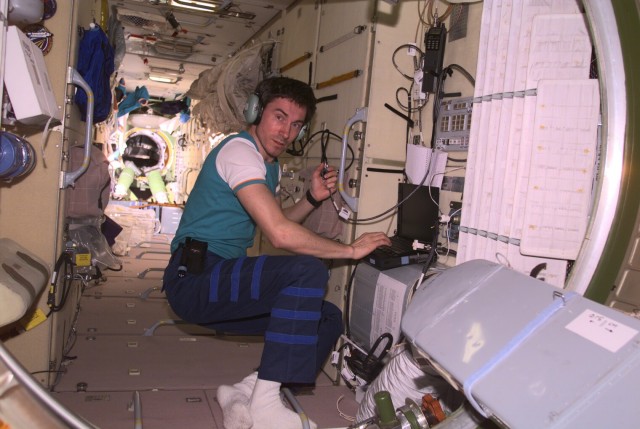
U5MIRHere is a picture of Sergei Krikalev talking to an earth-based school group using his amateur radio equipment onboard ISS. Sergey is an active amateur radio operator while aboard ISS, since Expedition One, The first ISS crew launched October 31, 2000.
According to Nasa:
"Dozens of astronauts have used the Space Shuttle Amateur Radio Experiment, or SAREX, to talk to thousands of kids in school and to their families on Earth while they were in orbit. They have pioneered space radio experimentation, including television and text messaging as well as voice communication. The Russians have had a similar program for the cosmonauts aboard the Russian Space Station Mir. When U.S. astronauts were aboard Mir in preparation for the long duration missions of the International Space Station, they used amateur radio for communication, including emergency messaging while Mir was in distress." -
U5MIRHere is a picture of Sergei Krikalev talking to an earth-based school group using his amateur radio equipment onboard ISS. Sergey is an active amateur radio operator while aboard ISS, since Expedition One, The first ISS crew launched October 31, 2000.
According to Nasa:
"Dozens of astronauts have used the Space Shuttle Amateur Radio Experiment, or SAREX, to talk to thousands of kids in school and to their families on Earth while they were in orbit. They have pioneered space radio experimentation, including television and text messaging as well as voice communication. The Russians have had a similar program for the cosmonauts aboard the Russian Space Station Mir. When U.S. astronauts were aboard Mir in preparation for the long duration missions of the International Space Station, they used amateur radio for communication, including emergency messaging while Mir was in distress." -
U5MIRHere is a picture of Sergei Krikalev talking to an earth-based school group using his amateur radio equipment onboard ISS. Sergey is an active amateur radio operator while aboard ISS, since Expedition One, The first ISS crew launched October 31, 2000.
According to Nasa:
"Dozens of astronauts have used the Space Shuttle Amateur Radio Experiment, or SAREX, to talk to thousands of kids in school and to their families on Earth while they were in orbit. They have pioneered space radio experimentation, including television and text messaging as well as voice communication. The Russians have had a similar program for the cosmonauts aboard the Russian Space Station Mir. When U.S. astronauts were aboard Mir in preparation for the long duration missions of the International Space Station, they used amateur radio for communication, including emergency messaging while Mir was in distress." -
Irrelevant - we'll shake the bone density back
Exercise generally does squat to retain or build bone mass. NASA research has been indicating that it's the vibrations which occur while you're exercising that actually stimulate the bone growth.
http://www.nasa.gov/lb/vision/earth/everydaylife/w eak_knees.html
http://my.webmd.com/content/article/34/1728_85890
http://www.galileo2000.nl/home/Eng-galileo.htm
Astronauts will still have to do exercise to keep from losing excessive muscles but in the future we'll just vibrate them a bit while they're in orbit to keep them from losing bone density. -
The solar-system map they use is public at JPL
They don't use two-body approximations for the NASA missions to Mars!
They use high-precision numerical integration for the trajectory of the spacecraft, using one of the standard high-precision general ephemerides as background data. (Textbooks mentioned by posters elsewhere in this thread decribe in general terms the astronav. techniques used for mission planning, but as soon as they get down to mapping the trajectory as precisely as possible, they need the background ephemeris as well.)
For the recent Mars missions, the background ephemeris is a very highly refined ephemeris "DE410" produced by the JPL, this appears to be a local improvement intended especially to reduce errors in the neighborhood of Mars and Saturn, relative to the DE405 ephemeris which remains the world standard for official ephemeris publications. It seems they got an accuracy in the region of Mars as close as only "a few meters"!!!
See details of DE410 on the public JPL site here, and especially you might want to look at the background report on DE410.
-wb- -
The solar-system map they use is public at JPL
They don't use two-body approximations for the NASA missions to Mars!
They use high-precision numerical integration for the trajectory of the spacecraft, using one of the standard high-precision general ephemerides as background data. (Textbooks mentioned by posters elsewhere in this thread decribe in general terms the astronav. techniques used for mission planning, but as soon as they get down to mapping the trajectory as precisely as possible, they need the background ephemeris as well.)
For the recent Mars missions, the background ephemeris is a very highly refined ephemeris "DE410" produced by the JPL, this appears to be a local improvement intended especially to reduce errors in the neighborhood of Mars and Saturn, relative to the DE405 ephemeris which remains the world standard for official ephemeris publications. It seems they got an accuracy in the region of Mars as close as only "a few meters"!!!
See details of DE410 on the public JPL site here, and especially you might want to look at the background report on DE410.
-wb- -
Re:Trip to mars dont seem that "simple"
Here's a primer.
-
Re:Security and Open and Available Software
On the contrary, I bet dollars to donuts that a well worded Freedom of Information Act request would divuldge any calculations you wanted to know.
It's your tax dollars, you have a right to know whether their scientists are playing pong or actually trying to keep foam from flying off things at the wrong times.
NASA has a page dedicated to this:
http://www.hq.nasa.gov/office/pao/FOIA/ -
Re:Security and Open and Available Software
Orbital Dynamics codes / tools are still developed by NASA, and available to the public (including the source) at no cost (although some components are export controlled). If you don't have a problem with somewhat dated Fortran code, the Optimal Trajectories by Implicit Simulation (OTIS) tool is what you need to calculate a viable Earth-Mars trajectory (and optimize it). It accounts for the influence of other bodies along the way (Earth Moon, Phobos, Deimos), relative planetary position as a function of launch date, etc. It's not user friendly, and the learning curve is more like a wall, but it will allow you to produce fully optimized, real world trajectories as good as any NASA actually flies.
-
The Basics of Spaceflight
This page is a good start for learning about all the fun stuff that you have to do. Not quite the math you're looking for, but it covers stuff other than just orbits.
-
Re:Much more than a 2-body problem ...
-
Re:Much more than a 2-body problem ...
-
"Fundamentals of Astrodynamics"is the book you want. It's by Bate, Mueller, and White, and it works from first principles up to "how we designed the Apollo lunar trajectories".
The easiest way to conceive of interplanetary orbits is to first pretend that they lie in a single plane (the plane of the ecliptic) and then pretend that the planets themselves are insignificant for most of the trip -- so you consider only the gravitational field of the Sun. Then your orbit is an ellipse. It's pretty easy to show that, if you're going at Earth's orbital velocity, the ellipse that gets you from Earth's orbit to any other nearly circular orbit with the least change in velocity (ie rocket fuel) is an ellipse that is tangent to both orbits.
Once you've figured that out, you have to figure out when to launch to get to Mars's orbit in the same place that Mars happens to be. Those times happen at a particular phase of Mars's and Earth's orbit.
You can do pretty well by pretending that you can neglect the Sun entirely until you get far enough from the Earth, then you can neglect Earth and Mars entirely until you get close enough to Mars. That is the technique that was used for Apollo trajectories -- the "method of spliced conics". You can hear some evidence of it in the Apollo 13 movie, when they talk about "entering the Moon's gravitational field" or something like that -- the Moon's gravitational field extends throughout the Universe, of course, but to simplify the calculations they neglected everything but the mass with the strongest gravitational force on the capsule.
Nowadays you can get really, really good orbital elements for each of the planets online, which lets you calculate exactly where each planet is at any given time. You can just code up an insanely cheesy inverse-square-law integrator in PDL or one of the other free languages -- or even a spreadsheet -- and find a good orbit by trial and error using the gravitational fields of all the large bodies in the solar system.