Slashdot Mirror
Domain: nasa.gov
Stories and comments across the archive that link to nasa.gov.
Comments · 16,365
-
BTW, some interesting graphs
In 1996 with 1996 dollars, NASA was spending 15 Billion / year. But Apollo was more than 25 Billion / year in 1996 dollars Now, GWB is spending 15 Billion but with 2005 Dollars.
So, GWB is spending less than Clinton, and Clinton certainly spent less than Kennedy/Johnson. -
Re:Professionally?
Well, it's not a web application, but NASA World Wind was out before Google Maps. http://worldwind.arc.nasa.gov/
I don't remember all the features, but when I last looked at it, it had a good zoom, which I like better than Google Maps. It also provides data from LandSat and USGS.
Unfortunately, it's Windows only, and now that I switched to Linux, I have to use Google Maps. -
NASA World Wind
You can already get the whole map of the world from NASA's World Wind, including the Urban satellite data, plus it's 3D...
http://worldwind.arc.nasa.gov/ -
Shameless Plug (Google hacks?)
I've been working on a full-earth terrain renderer for the last year, similar in style to Keyhole or Worldwind. The addition of worldwide outlines on google is wonderful, because yesterday afternoon I finally started to add a google maps data source to my application. Until now, it limited to WMS servers such as http://onearth.jpl.nasa.gov./
It's not nearly complete yet, because I still haven't properly handled the projection google uses (so the image is off near the poles), and it breaks at high detail levels, but these should be easily fixed within the next couple days. It should easily scale to the best data Google offers in the future.
There is one screenshot at the bottom of the page. The quality is fairly low, but that's because it's being rendered on a 5 year old laptop (I'm currently away from home).
http://cs.ucsb.edu/~richards/terrain/
I have no idea if I'll ship this with google maps support (since it is against their TOS), but it was fun to do. -
ARG
should be
http://worldwind.arc.nasa.gov/ -
Re:Making progress, but it's not Earth yet
Take a look at worldwind.
Its free, offers better (satellite) data than google maps and even has 3d hight information.
http://worldwind.nasa.gov/ -
Re:Making progress, but it's not Earth yetNASA WorldWind is a good start. Make sure to use that right mouse button
-
Re:This is just priceless
you might want to try World Wind (but bring lots of time and a fat pipe!). Far better than google maps, more complete and with lots of different data sources to chose from. give it a try, it's free.
-
Re:Asteroids/Comets - Terraforming
The atmosphere would do a good job shielding you from radiation, the climate would be more moderate, and if you had to protect crops from the atmosphere still, the greenhouses would be much lighter if you didn't have to have them pressurized.
This may sound easy to you [cough], but it's not so easy as you think! Unlike Earth, Mars has no organized magnetic field. The magnetic field on Earth prevents much of the solar wind from destroying the ozone layer in our atmosphere, which as I'm sure you know, is the layer of our atmosphere that is the most important in blocking ultraviolet radiation.
Clearly, it's not as easy as just increasing the atmospheric density on Mars, but that would certainly be a start. -
Eros-ward Ho!
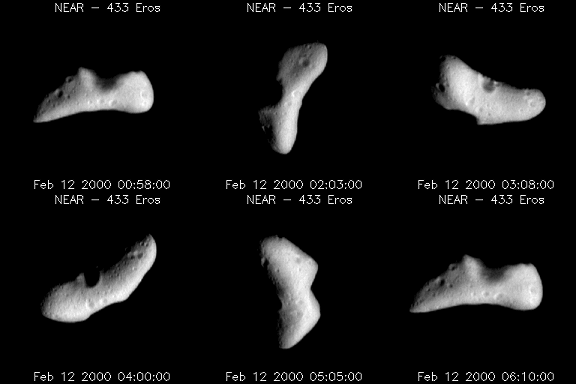
I've always been a fan of boring out a station in the asteroid Eros, and spinning it up like the picture shows to create 1g artificial gravity at the ends of the asteroid.
Seems like the only way to get a large colony in space is to use materials already there.
Eros is attractive because we have already landed a craft on it. -
Well hell
I'm trademarking "irrational" and "imaginary" because...well, you know..."real" is already taken.
-
Re:Baby & bathwater...I remember watching the coverage of Shepard's first flight...
OK, well, you've got me beat there! I'm jealous, I was just a baby when man last landed on the moon. The Shuttle was all I had.
Yes, I remember it being advertised as reusable, which could translate into savings over things like Apollo. If there was a big marketing campaign, it sure didn't make much of an impression on me, or perhaps I was sold already.
Well, it's pretty clear from that NASA bibliography that this is exactly how it was being sold. Not just in the press, but to Congress. You can find this in any standard history of the space program, eg in McDougall's
For someone claiming to be so well-versed in the program's history, you suffer remarkable tunnel vision. I guess you must have missed all the accusations that the Columbia's crew died because NASA put budget concerns and cost-savings over the safety of the astronauts. This is why it's not a good idea to put the words NASA and cheap in the same sentence.
I'm not sure what we are arguing about here. You seem to equate cheap with unsafe. Maybe that's so - but in that case, it seems rather foolish to use a manned spacecraft as a heavy lifter. Use a manned spacecraft to put people into space and nothing else. Use an unmanned spacecraft for payloads so you can get them up there cheaply. Cheap is good if you want get real space development going. But - I wasn't even saying Shuttle should be cheap (it shouldn't, if it's then going to be unsafe). I'm saying Shuttle was supposed to be cheap. It's not. That's all.
Anyway, the very fact that such accusations were made suggests that there was a period when NASA and cheap did go together - and that period was the 1970s, which is what I am talking about here. I'm not saying safety was not a concern back then, but you know, there's a reason why both the Rogers commission and the CAIB were able to make safety recommendations - because safety was not the primary concern when the Shuttle was originally designed and built. In fact, the Rogers commission report noted: "Costs were the primary concern of NASA's selection board [for Shuttle contractors], particularly those incurred early in the program." (vol 1 chapter 6 p 120).
I'd suggest you check the survival rate of the early test pilots (and planes) for military aircraft. Your comparison is invalid. The shuttle was the first American spacecraft that was not only reusable but also made controlled landings (not to mention the other features). It was the first of its kind, not a slightly larger or slightly faster improvement of an existing aircraft. (Compare the two - the shuttle doesn't bear any resemblance to an Apollo capsule.) Two failures in 113 missions is far better than Apollo's record of one disaster and one near-disaster scrubbed mission. The fatality ratio for the shuttle is also less.
This is all irrelevent - to my point, anyway. All I am trying to get across is that Shuttle has not performed as initially advertised - nowhere near it. In science, when you perform an experiment, you make your predictions in advance. You don't perform the experiment first and then decide if it was successful or not. In those terms, the Shuttle was a failure, because it did not perform as it was supposed to. This does not mean it's a useless spacecraft. It still has a fine record. But as an experiment in cheap, reliable, regular access to orbit, it's a failure.
Perhaps there was some hype it didn't live up to. My car doesn't really get 36 MPG either, despite the government figures. 113 missions in about 20 years is pretty regular. The missions were so regular that I was one of the very fe
-
Down with combustion!
If we could just get rid of combustion and the need for incredibly expensive fuels... we'd be set.
Elecromagnetism? Superheated water / water reclamation?
===
http://www.nasa.gov/centers/marshall/news/backgrou nd/facts/vcd.html -
Re:interesting
Um.. you test engines in wind tunnels. Hypersonic wind tunnels are really hard to come by. There's one at Glenn Research Center near Cleveland, Ohio. They have a "moveable wall" to dial up different mach numbers for various projects made of inch and a half thick steel. It is one of the largest tunnels of its kind (very few are actually walk-in tunnels) but the usefull stream is probably very close to the size of the engine to be tested. I am unsure of what it's maximum mach number is, but it's definately single digit.
You start out by testing the engine at low speeds, and keep increasing speed until you notice some vibration mode that you didn't find before or you reach the limits of the materials you chose for initial testing. (like maybe you didn't wait for the blades to crystalize, but you're not using maximum engine stress so it cut fab time for the prototype) or any of a number of pre-defined stop points at which you evaluate the condition of the engine and either proceed with more testing or scrap and redesign. It seems they haven't tested it at its design speed yet. -
Biosphere 2
Biosphere 2 demonstrated convincingly that even with a massive infrastructure, hundreds of millions of dollars, and access to convenient and widespread inputs and manicured, primed soil, that creating and maintaining an artificial, productive, self-sustaining biosphere is a herculean task with no easy solution. And they propose to erect something similar on Mars, a terrifically hostile environment with no escape route? Good luck! NASA's Biomass Production Chamber has not fared especially well, and the USSR's BIOS experimental results are acceptable only as long as you are willing to eat algal slime.
-
Re:Just add water
Mars's pressure is little higher than a vacuum. NASA has been doing experiments to get plants to grow in the sparsest atmosphere possible. Currently, if the pressure gets too low, plants think that there's a drought even if they're given plenty of water and kept at 100% humidity.
As for light, Mars gets half the sunlight we do on Earth; plenty of plants on Earth grow in partial shade. -
Nothing new here - old news
So what? Griffin restates the VSE goals at an Air Show in Paris.
Some examples of real news:NASA downselect for CEV was indeed announced Monday, as the article says could happen.
Photos of t-space testing a new Air Launch method for rockets.
BTW, if you want interesting human spaceflight news check HobbySpace RLV News periodically. -
More Info on Typial Wave Heights
Check out some data from the TOPEX mission with maps of the earth showing typical signifigant wave height here.
-
Re:Significance of the statement
Doesn't exactly inspire and encourage like the Kennedy declaration did, does it?
I'd say the Kennedy speech at Rice is just about the most romanticized, misremembered speech I can think of. Much more about godless communists, only sort of about the moon, in the sense of 'hmm, space exploration... now _there's_ a plausible new reason for spouting more cold war rhetoric'.
"Hostile misuse of space"? "A hostile flag of conquest"? "Weapons of mass destruction"? "New terrifying theater of war"? That's inspiring and encouraging?
I'm no fan of Bush or his various bureaucrats, but whatever anyone's said about this, it's definitely more inspiring than 'we've got to go to the moon to beat the terrorists!' -
Re:Why?
The goal is probably to put all of NASA's funding towards a big popular initiative, starve other programs, then cancel the initiative or allow it to be cancelled. It's a politically safe way of reducing funding.
Personally, I don't like to hear about people cutting funding for organizations like NASA, but on the other hand, I've always suspected that they were hemoraging money with an inadequate return on the investment. Maybe some of that 16.5 billion dollar budget could be spent on improving education for the approximately 80 million school aged kids in the country. Even better, fork over some of that $420+ billion dollar defense budget. Smarter kids = better science, better weapons, hopefully less need for war, and countless other benefits. -
Re:Why?Have a look at
http://gltrs.grc.nasa.gov/reports/2005/TM-2005-213 610.pdf
One of the surprises of the Apollo experience was how troublesome the lunar dust turned out to be. It obscured their vision on landing, clogged mechanisms, abraded the Extravehicular Mobility Suits (EMS), scratched the instrument covers, degraded the performance of radiators, compromised seals, irritated their eyes and lungs, and generally coated everything with surprising tenacity. Some of the EMS components were approaching failure at the end of these missions, which ranged from 21 to 75 hr on the lunar surface.
Also, the dust is far from a constant size, and is far more abrasive than you'll find here on earth, due to a lack of erosion mechanisms on the moon.
-
Re:Back to the moon?
NASA has a rebuttal page dedicated to the "The Great Moon Hoax"
http://science.nasa.gov/headlines/y2001/ast23feb_2 -
Re:Baby & bathwater...It's not hindsight - I'm actually (well, as of next month) a history PhD student who will be studying contemporary perceptions of precisely those early airplanes and LTA craft you mention. So I'm not into projecting current views backwards. Instead I'm talking about what Shuttle was supposedly going to be when it was proposed. I dunno how old you are, but I'm old enough to remember Columbia's first flight, and I still have all the newspaper articles about it I cut out about it at the time, as a major little space geek. Cheap, reliable and regular is what we were promised.
Cheap? Yes, it was supposed to be cheap. Have a look through this annotated bibliography and search for "cost" - you'll see that in the 1970s it was often claimed that Shuttle would provide cheaper access to space (a "quantum leap" according to one article). I don't know what you are talking about with regard to cutting corners and so forth - in the 1970s this was not a public issue. After the massively costly Apollo and in such an economically uncertain period, space travel had to be done cheaply or not at all. At least it had be sold as cheap.
Reliable? Not sure what early aircraft you are thinking of. Sure, it's much more reliable than the first generation or two of aircraft - Wright, Bleriot, Farman, Zeppelin. But those are the equivalent of Mercury, Gemini, Apollo. The proper comparison should be with the 1920s and 1930s, when you had breakthrough aircraft like the DC3, say, or the Empire class flying boats. These were far more reliable than the Shuttle in any terms you can think of. That's what we were promised. Something you could depend upon to get you up into space when you needed to go, not getting endlessly delayed because of maintenance or weather issues. (Safety is another reliability issue too - the DC3 sure didn't have a 3% flight failure rate.)
Regular? I don't mean the grounding after the accidents, I mean the fact it was supposed to fly on the order of weekly, with a turnaround time of a month or so. Never happened. In fact originally it was claimed that the cost-effectiveness depended upon launching at the optimal (high) rate, but the Shuttle clearly requires far too much maintenance than was originally planned for this to work. (And who mentioned anything about the astronauts? I'm not having a go at them.)
These factors were all part of the original justification for the Space Shuttle. You are the one who is employing hindsight to redefine its purpose - it wasn't meant to be an experimental vehicle at all, but a rugged, practical, cost-effective workhorse. If you are saying the original goals have been superseded, well, that's another argument.
-
light curve method
An alternative method is to look for eclipses of the planet passing in from its stars. About 5% of the planets have been discovered this way. One estimate is about one in two hundred stars have suitable orientations and plantary systems for this method, if one could observe them long enough. A @hundred megapixel space probe called Kepler might be launched around 2008 to observe light curves of several hundred thousand stars for several years. This might find dozens of eclipsing planets plus understand the abundance of planets.
-
light curve method
An alternative method is to look for eclipses of the planet passing in from its stars. About 5% of the planets have been discovered this way. One estimate is about one in two hundred stars have suitable orientations and plantary systems for this method, if one could observe them long enough. A @hundred megapixel space probe called Kepler might be launched around 2008 to observe light curves of several hundred thousand stars for several years. This might find dozens of eclipsing planets plus understand the abundance of planets.
-
Re:Once every two days?
Mercury orbits in 88 days. There are planetary
fact sheets at http://nssdc.gsfc.nasa.gov/planetary/planetfact.ht ml
that are useful for finding solar system data quickly. For extrasolar planets, go to http://exoplanets.org/
-
ATV
You can do ATV legally in the US with NTSC, with a ham license.
You can see this the video for yourself, with stuff you have at home right now. There are cable channels that are on ham bands, but it's OK because their signals stay on the cable.
If you live in the SF ba area, hook a UHF antenna (vertically polarized) to your cable-ready TV or VCR with TV out, and tune to cable channel 57 (421.25 MHz), and aim it at Mt. Hamilton (east of San Jose).
Here are some tests on 1.2GHz, which is also a ham band. -
ATV
You can do ATV legally in the US with NTSC, with a ham license.
You can see this the video for yourself, with stuff you have at home right now. There are cable channels that are on ham bands, but it's OK because their signals stay on the cable.
If you live in the SF ba area, hook a UHF antenna (vertically polarized) to your cable-ready TV or VCR with TV out, and tune to cable channel 57 (421.25 MHz), and aim it at Mt. Hamilton (east of San Jose).
Here are some tests on 1.2GHz, which is also a ham band. -
Re:Definition of a non-story:
I gave you a link. How many more do you want? I'll get you as many as you need. There are no people in the literature who "think radiation is a more or less negligable effect" - the tiles were designed *specifically* to be radiative - that is why they have such a large surface area.
Look, is it really worth my time to baby-step you through Space Shuttle 101? If references aren't good enough for you, ask a NASA scientist (but first search for "tiles" to see where they already discuss it). I'll quote some of the answers that they've given:
"Jessie from Jacksonville, Ill., age: 14 asked the following question of Mission Specialist Andrew Thomas
Question: Why doesn't the space shuttle burn up on its way through the Earth's atmosphere?
Answer: The space shuttle, Jessie, is encased in some very fine silicon ceramic tiles, which are able to take a very large amount of heat. And they absorb the heat and radiate it back out into space so that the space shuttle does not burn up due to the friction of the atmosphere. "
Congratulations, a fourteen year old now knows more about the shuttle tiles than you. Bet that makes you feel great?
Here's another:
"Rachiel fengstad, of Lethbridge Alberta asked the following question of Linda Ham, lead flight director
Question: What properties of ceramics are the most useful in space shuttle technology?
Answer: The light weight and quick heat dissipation rate of the shuttle's ceramic tiles are pretty useful qualities. Also, quite a few electronic components make use of ceramic packaging which is a good insulator. Original Response"
One of the answers refers to the TPS information page . From the overview:
"The HRSI tiles protect areas where temperatures are below 2,300 F. These tiles have a black surface coating necessary for entry emittance (second definition)."
you can't damage it with your fingernail at all
Mechanical properties of FRCI-12 tiles (why do I have to do all the work for you?). Tensile strength - 107 psi (737 kpa). For comparison, a study of bridge concrete failures when testing a repair method found the average failure tensile strength to be just over 500 kpa (concrete starts out higher, but decreases with age). In short, it has the tensile strength of old concrete (but is far, far lighter). Yes, what we really want is hardness, but I don't have time to hunt that down.
extremely cheap
June 27, 2000 QuestChat with George Raiche, Research Scientist, NASA Ames Research Center, Moffett Field, CA
"RE: [Bertus] Sorry I send the same question twice...How much does one of this plates cost about in dollars??
To tell you the truth, I don't know how much one tile costs. The material costs are very small--the real expense was in the research costs to invent the tiles. Also, the labor costs to inspect and replace the tiles are far greater than the material cost. It's like repairing a car--the labor charge is usually much more than the parts."
If you have any more questions, ask NASA (I gave you the link) or actually do a web search yourself - I'm not your babysitter. -
Re:Definition of a non-story:
I gave you a link. How many more do you want? I'll get you as many as you need. There are no people in the literature who "think radiation is a more or less negligable effect" - the tiles were designed *specifically* to be radiative - that is why they have such a large surface area.
Look, is it really worth my time to baby-step you through Space Shuttle 101? If references aren't good enough for you, ask a NASA scientist (but first search for "tiles" to see where they already discuss it). I'll quote some of the answers that they've given:
"Jessie from Jacksonville, Ill., age: 14 asked the following question of Mission Specialist Andrew Thomas
Question: Why doesn't the space shuttle burn up on its way through the Earth's atmosphere?
Answer: The space shuttle, Jessie, is encased in some very fine silicon ceramic tiles, which are able to take a very large amount of heat. And they absorb the heat and radiate it back out into space so that the space shuttle does not burn up due to the friction of the atmosphere. "
Congratulations, a fourteen year old now knows more about the shuttle tiles than you. Bet that makes you feel great?
Here's another:
"Rachiel fengstad, of Lethbridge Alberta asked the following question of Linda Ham, lead flight director
Question: What properties of ceramics are the most useful in space shuttle technology?
Answer: The light weight and quick heat dissipation rate of the shuttle's ceramic tiles are pretty useful qualities. Also, quite a few electronic components make use of ceramic packaging which is a good insulator. Original Response"
One of the answers refers to the TPS information page . From the overview:
"The HRSI tiles protect areas where temperatures are below 2,300 F. These tiles have a black surface coating necessary for entry emittance (second definition)."
you can't damage it with your fingernail at all
Mechanical properties of FRCI-12 tiles (why do I have to do all the work for you?). Tensile strength - 107 psi (737 kpa). For comparison, a study of bridge concrete failures when testing a repair method found the average failure tensile strength to be just over 500 kpa (concrete starts out higher, but decreases with age). In short, it has the tensile strength of old concrete (but is far, far lighter). Yes, what we really want is hardness, but I don't have time to hunt that down.
extremely cheap
June 27, 2000 QuestChat with George Raiche, Research Scientist, NASA Ames Research Center, Moffett Field, CA
"RE: [Bertus] Sorry I send the same question twice...How much does one of this plates cost about in dollars??
To tell you the truth, I don't know how much one tile costs. The material costs are very small--the real expense was in the research costs to invent the tiles. Also, the labor costs to inspect and replace the tiles are far greater than the material cost. It's like repairing a car--the labor charge is usually much more than the parts."
If you have any more questions, ask NASA (I gave you the link) or actually do a web search yourself - I'm not your babysitter. -
Re:Definition of a non-story:
I gave you a link. How many more do you want? I'll get you as many as you need. There are no people in the literature who "think radiation is a more or less negligable effect" - the tiles were designed *specifically* to be radiative - that is why they have such a large surface area.
Look, is it really worth my time to baby-step you through Space Shuttle 101? If references aren't good enough for you, ask a NASA scientist (but first search for "tiles" to see where they already discuss it). I'll quote some of the answers that they've given:
"Jessie from Jacksonville, Ill., age: 14 asked the following question of Mission Specialist Andrew Thomas
Question: Why doesn't the space shuttle burn up on its way through the Earth's atmosphere?
Answer: The space shuttle, Jessie, is encased in some very fine silicon ceramic tiles, which are able to take a very large amount of heat. And they absorb the heat and radiate it back out into space so that the space shuttle does not burn up due to the friction of the atmosphere. "
Congratulations, a fourteen year old now knows more about the shuttle tiles than you. Bet that makes you feel great?
Here's another:
"Rachiel fengstad, of Lethbridge Alberta asked the following question of Linda Ham, lead flight director
Question: What properties of ceramics are the most useful in space shuttle technology?
Answer: The light weight and quick heat dissipation rate of the shuttle's ceramic tiles are pretty useful qualities. Also, quite a few electronic components make use of ceramic packaging which is a good insulator. Original Response"
One of the answers refers to the TPS information page . From the overview:
"The HRSI tiles protect areas where temperatures are below 2,300 F. These tiles have a black surface coating necessary for entry emittance (second definition)."
you can't damage it with your fingernail at all
Mechanical properties of FRCI-12 tiles (why do I have to do all the work for you?). Tensile strength - 107 psi (737 kpa). For comparison, a study of bridge concrete failures when testing a repair method found the average failure tensile strength to be just over 500 kpa (concrete starts out higher, but decreases with age). In short, it has the tensile strength of old concrete (but is far, far lighter). Yes, what we really want is hardness, but I don't have time to hunt that down.
extremely cheap
June 27, 2000 QuestChat with George Raiche, Research Scientist, NASA Ames Research Center, Moffett Field, CA
"RE: [Bertus] Sorry I send the same question twice...How much does one of this plates cost about in dollars??
To tell you the truth, I don't know how much one tile costs. The material costs are very small--the real expense was in the research costs to invent the tiles. Also, the labor costs to inspect and replace the tiles are far greater than the material cost. It's like repairing a car--the labor charge is usually much more than the parts."
If you have any more questions, ask NASA (I gave you the link) or actually do a web search yourself - I'm not your babysitter. -
Re:Definition of a non-story:
I gave you a link. How many more do you want? I'll get you as many as you need. There are no people in the literature who "think radiation is a more or less negligable effect" - the tiles were designed *specifically* to be radiative - that is why they have such a large surface area.
Look, is it really worth my time to baby-step you through Space Shuttle 101? If references aren't good enough for you, ask a NASA scientist (but first search for "tiles" to see where they already discuss it). I'll quote some of the answers that they've given:
"Jessie from Jacksonville, Ill., age: 14 asked the following question of Mission Specialist Andrew Thomas
Question: Why doesn't the space shuttle burn up on its way through the Earth's atmosphere?
Answer: The space shuttle, Jessie, is encased in some very fine silicon ceramic tiles, which are able to take a very large amount of heat. And they absorb the heat and radiate it back out into space so that the space shuttle does not burn up due to the friction of the atmosphere. "
Congratulations, a fourteen year old now knows more about the shuttle tiles than you. Bet that makes you feel great?
Here's another:
"Rachiel fengstad, of Lethbridge Alberta asked the following question of Linda Ham, lead flight director
Question: What properties of ceramics are the most useful in space shuttle technology?
Answer: The light weight and quick heat dissipation rate of the shuttle's ceramic tiles are pretty useful qualities. Also, quite a few electronic components make use of ceramic packaging which is a good insulator. Original Response"
One of the answers refers to the TPS information page . From the overview:
"The HRSI tiles protect areas where temperatures are below 2,300 F. These tiles have a black surface coating necessary for entry emittance (second definition)."
you can't damage it with your fingernail at all
Mechanical properties of FRCI-12 tiles (why do I have to do all the work for you?). Tensile strength - 107 psi (737 kpa). For comparison, a study of bridge concrete failures when testing a repair method found the average failure tensile strength to be just over 500 kpa (concrete starts out higher, but decreases with age). In short, it has the tensile strength of old concrete (but is far, far lighter). Yes, what we really want is hardness, but I don't have time to hunt that down.
extremely cheap
June 27, 2000 QuestChat with George Raiche, Research Scientist, NASA Ames Research Center, Moffett Field, CA
"RE: [Bertus] Sorry I send the same question twice...How much does one of this plates cost about in dollars??
To tell you the truth, I don't know how much one tile costs. The material costs are very small--the real expense was in the research costs to invent the tiles. Also, the labor costs to inspect and replace the tiles are far greater than the material cost. It's like repairing a car--the labor charge is usually much more than the parts."
If you have any more questions, ask NASA (I gave you the link) or actually do a web search yourself - I'm not your babysitter. -
ISS has a history of supporting Amateur RadioNot only have there been quite a few astro/cosmonauts that are licensed amateurs, but they maintain a functional Amateur Radio station on the ISS.
Official NASA ISS Amateur Radio Page
It's incredibly easy to talk to the ISS from the earth... you don't need a particularily high-powered radio to do it. In fact, the radio on the ISS is a plain jane, Kenwood dual-band radio.
-
Combustion sucks!
Likewise, taking forever to reach other planets isn't too swell either.
Long live warp and wormhole theory, we should slow down poking around space (as people, not slow down in probing, mind you)
NASA's breakthrough physics project
http://www.grc.nasa.gov/WWW/bpp/ -
You win, but not by much.
Quick and Easy calculation:
Foale returned to Earth after spending 145 days in space, 134 of them aboard Mir. His estimated mileage logged was 58 million miles (93 million kilometers), can be used for an estimate of miles / days, which is in one day the shuttle does 400K miles (or
Checking the data down below here, you will find that cars have one half the rate of the shuttle. IOW, the shuttle is more dangerous, but not by that much. And that does not consider the speed or the usefullness of the shuttle.
I would trust NASA and the shuttle. -
Re:Definition of a non-story:
Issues related to. The bipod foam, which caused the Columbia accident, has been eliminated. You're never going to be able to eliminate all tank debris. The OBSS is a done deal, but I think they're having some problems with work stabilization, that is, having an astronaut actually work on tiles and not send himself flying all over the place. They've installed sensors in the wing leading edges that will be able to sense an impact. So it's not like they've just been sitting on their thumbs this whole time.
-
Re:N.A.S.A.
Oh, I'd say they have plenty:
http://www.jsc.nasa.gov/Bios/astrobio_activemgmt.h tml -
Re:But what are they doing?
A slightly ignorant question:
What is NASA doing?
I can't speak for the rest of NASA, but I know what we're doing, and it's a lot:
http://www.jpl.nasa.gov/missions/
(So, how many of you -
Solar Energetic ParticlesAll that I know I get from the others. (I do IT in a department full of solar physicists, but I don't fully undertand the data that I deal with)
NOAA maintains a list of 'Solar Proton Events'. My boss maintains a copy of the data, which has an extra footnote:The >10 MeV proton event began on January 16 at 0210 UTC following the X2.6 flare late on the 15th. The peak flux following this flare was 365 pfu at 16/1840 UTC. The >10 MeV protons decayed to 117 pfu by midday on January 17 when a stronger injection of protons occurred following the X3.8 flare and CME. This new infusion began at 17/1240 UTC and peaked with 5040 pfu at 17/1750 UTC. The event decayed to about 19 pfu early on January 20 when yet another proton flare occurred. The X7 flare and CME that occurred on January 20 produced the hardest and most energetic proton event of Cycle 23. The >10 MeV protons peaked at 1860 pfu at 20/0810 UTC. The >100 MeV protons peaked at 652 pfu at 20/0710 UTC, which was the highest >100 MeV proton flux level observed since 1989 October (680 pfu). The >10 MeV proton event finally ended at 22/1755 UTC.
So, the CME (believed to be) associated with it occured about 3 hrs before GOES got hit by it.
Images and movies of the event, as seen by LASCO, are at:ftp://ares.nrl.navy.mil/pub/lasco/halo/20050115b
-
Re:How the protons got to earth so quickSomething accelerated the protons to near the speed of light. They arrived so soon after the electromagnetic radiation from the flare.
According to Francis Cucinotta, NASA's radiation health officer at the Johnson Space Center (source), an astronaut on the Moon would have received a dose of 50 rem, enough to cause radiation sickness.
-
SOHO, STEREO, SDO, etc.
The problem is, that although you can place satellites there, getting data from some of these places is a big problem, because you have to schedule antenna time through the deep space network.
Currently, there's the ESA-NASA project SOHO, the Solar and Heliospheric Observatory, which sits near L1. You can't actually place it directly in the sun-earth line, because then you can't communicate with the satellite, because of too much noise from the sun.
Currently in testing are the two observatories called STEREO, the Solar TErrestrial RElations Observatory, which will launch two satellites flung ahead and behind the earth (but because of the physics involved, they have no way of stopping them, because they won't have enough fuel to stop.
(and there's also the Japanese Solar-B project, which is the successor to Yohkoh, set for launch next year)
But in my opinion, the most significant solar observing satellite in planning is SDO, the Solar Dynamics Observatory. (and I say this purely from an IT standpoint) SDO will be at an inclined geosyncronous orbit -- so it will be able to talk to a single antenna the whole time -- rather than storing up its data, and then sending it down to earth once a day, it will be sending a constant stream of full resolution data.
And we're not talking about the 1megapixel images from SOHO/EIT or SOHO/TRACE instruments -- or even the 4megapixel from STEREO/SECCHI. We're talking about 16 megapixel images, every 10 seconds from one of the instruments, with a planned terrabyte of uncompressed data per day.
Oh -- and I work for NASA contractor, and am assigned to work on STEREO and VSO (the Virtual Solar Observatory, a search engine for solar physics data). -
SOHO, STEREO, SDO, etc.
The problem is, that although you can place satellites there, getting data from some of these places is a big problem, because you have to schedule antenna time through the deep space network.
Currently, there's the ESA-NASA project SOHO, the Solar and Heliospheric Observatory, which sits near L1. You can't actually place it directly in the sun-earth line, because then you can't communicate with the satellite, because of too much noise from the sun.
Currently in testing are the two observatories called STEREO, the Solar TErrestrial RElations Observatory, which will launch two satellites flung ahead and behind the earth (but because of the physics involved, they have no way of stopping them, because they won't have enough fuel to stop.
(and there's also the Japanese Solar-B project, which is the successor to Yohkoh, set for launch next year)
But in my opinion, the most significant solar observing satellite in planning is SDO, the Solar Dynamics Observatory. (and I say this purely from an IT standpoint) SDO will be at an inclined geosyncronous orbit -- so it will be able to talk to a single antenna the whole time -- rather than storing up its data, and then sending it down to earth once a day, it will be sending a constant stream of full resolution data.
And we're not talking about the 1megapixel images from SOHO/EIT or SOHO/TRACE instruments -- or even the 4megapixel from STEREO/SECCHI. We're talking about 16 megapixel images, every 10 seconds from one of the instruments, with a planned terrabyte of uncompressed data per day.
Oh -- and I work for NASA contractor, and am assigned to work on STEREO and VSO (the Virtual Solar Observatory, a search engine for solar physics data). -
SOHO, STEREO, SDO, etc.
The problem is, that although you can place satellites there, getting data from some of these places is a big problem, because you have to schedule antenna time through the deep space network.
Currently, there's the ESA-NASA project SOHO, the Solar and Heliospheric Observatory, which sits near L1. You can't actually place it directly in the sun-earth line, because then you can't communicate with the satellite, because of too much noise from the sun.
Currently in testing are the two observatories called STEREO, the Solar TErrestrial RElations Observatory, which will launch two satellites flung ahead and behind the earth (but because of the physics involved, they have no way of stopping them, because they won't have enough fuel to stop.
(and there's also the Japanese Solar-B project, which is the successor to Yohkoh, set for launch next year)
But in my opinion, the most significant solar observing satellite in planning is SDO, the Solar Dynamics Observatory. (and I say this purely from an IT standpoint) SDO will be at an inclined geosyncronous orbit -- so it will be able to talk to a single antenna the whole time -- rather than storing up its data, and then sending it down to earth once a day, it will be sending a constant stream of full resolution data.
And we're not talking about the 1megapixel images from SOHO/EIT or SOHO/TRACE instruments -- or even the 4megapixel from STEREO/SECCHI. We're talking about 16 megapixel images, every 10 seconds from one of the instruments, with a planned terrabyte of uncompressed data per day.
Oh -- and I work for NASA contractor, and am assigned to work on STEREO and VSO (the Virtual Solar Observatory, a search engine for solar physics data). -
SOHO, STEREO, SDO, etc.
The problem is, that although you can place satellites there, getting data from some of these places is a big problem, because you have to schedule antenna time through the deep space network.
Currently, there's the ESA-NASA project SOHO, the Solar and Heliospheric Observatory, which sits near L1. You can't actually place it directly in the sun-earth line, because then you can't communicate with the satellite, because of too much noise from the sun.
Currently in testing are the two observatories called STEREO, the Solar TErrestrial RElations Observatory, which will launch two satellites flung ahead and behind the earth (but because of the physics involved, they have no way of stopping them, because they won't have enough fuel to stop.
(and there's also the Japanese Solar-B project, which is the successor to Yohkoh, set for launch next year)
But in my opinion, the most significant solar observing satellite in planning is SDO, the Solar Dynamics Observatory. (and I say this purely from an IT standpoint) SDO will be at an inclined geosyncronous orbit -- so it will be able to talk to a single antenna the whole time -- rather than storing up its data, and then sending it down to earth once a day, it will be sending a constant stream of full resolution data.
And we're not talking about the 1megapixel images from SOHO/EIT or SOHO/TRACE instruments -- or even the 4megapixel from STEREO/SECCHI. We're talking about 16 megapixel images, every 10 seconds from one of the instruments, with a planned terrabyte of uncompressed data per day.
Oh -- and I work for NASA contractor, and am assigned to work on STEREO and VSO (the Virtual Solar Observatory, a search engine for solar physics data). -
Re:It's too bad that we don't have a constellation
You do know that SOHO is already happily orbiting L1? Obviously, from L1 it has an unobstructed view of the sun all the time. Additionally, this gives us almost 180 degrees of coverage - not quite as good at the rim, but coverage none the less.
-
Looking up on the SOHO gallery
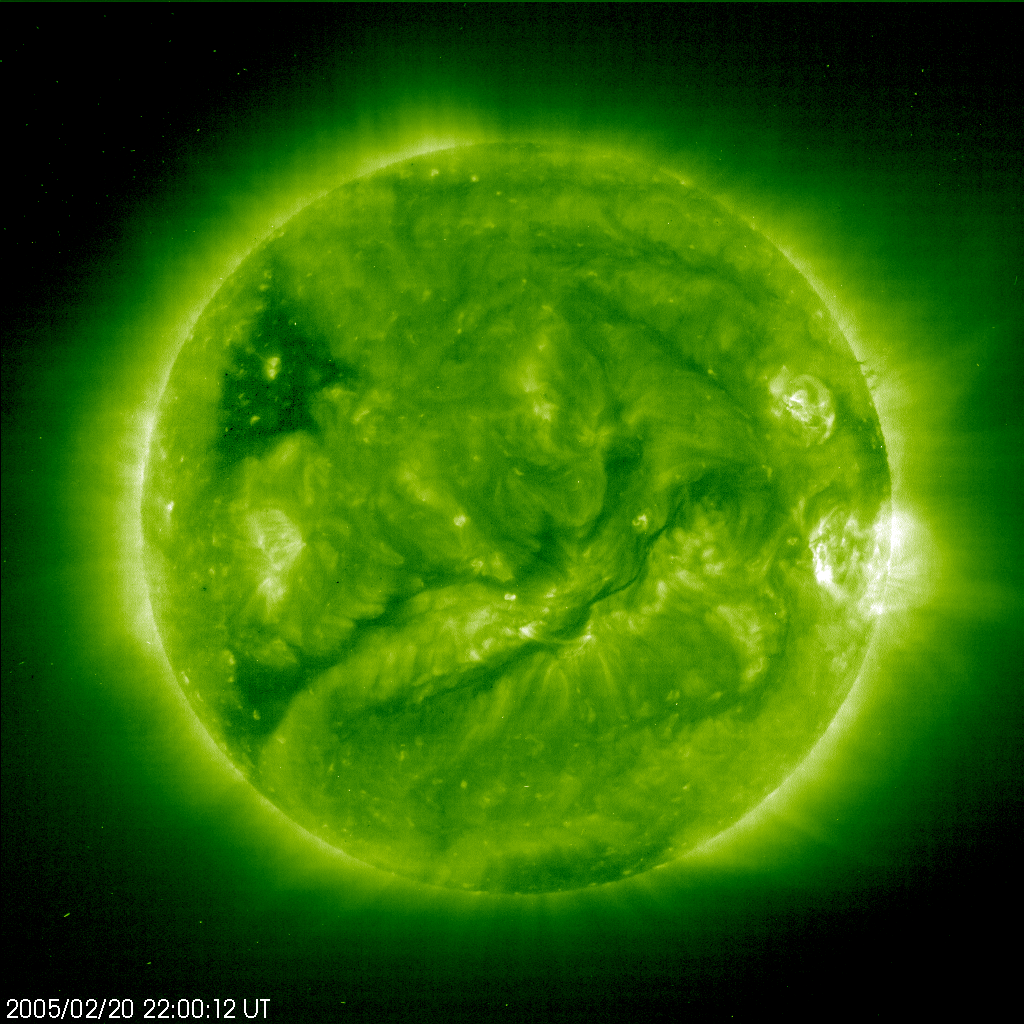
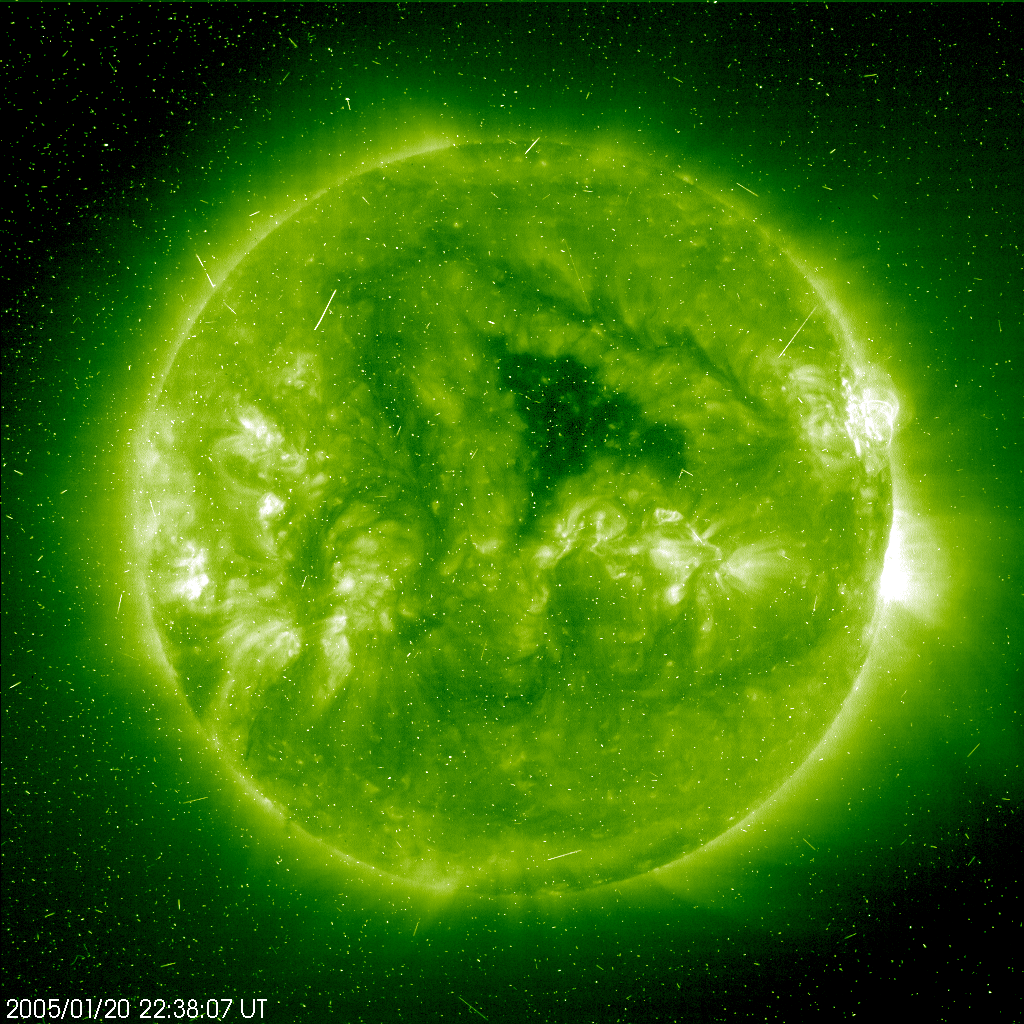
I thought this was pretty interesting, here's a picture on January 20th, then another picture from February 20th.
-
Looking up on the SOHO gallery
I thought this was pretty interesting, here's a picture on January 20th, then another picture from February 20th.
-
Hurray! Maybe NASA Quota based hires will end too!
I am so glad they newly appointed Mike Griffin is gutting the old regime, and I was expecting this for weeks. Not only is he a scientist, he has an MBA and common sense.
Common sense is something missing from NASA and NASA's hiring practices, contracting rules, and even grant administration.
I hope my own bosses get the axe too.
Failure plagues NASA ever since NASA embarked on an astounding gender and race based hiring and advancement program a few years ago. Many of the female led programs have had resounding failures, and the waste and delays from SBIR (ethnic third party procurement rules) and other racist programs have destroyed NASA in many ways.
There reason the MAJORITY of recent mars missions failed is gender and race bias in hiring and promotion against whites and asians.
Vital FACT! Nasa switched to forced female hiring in most of the recent Mars failures.
For the first time ever ONLY WOMEN called the shots on the largest mars mission that failed. read
http://www.nytimes.com/library/national/science/04 1899nasa-women.html
(remove spaces if needed, Slashcode ads them)
for the first time ever all three KEY positions of the failed mars missions were female
Sarah A. Gavit = the mars project manager
Suzanne E. Smrekar, 37, the lead mars scientist
Kari A. Lewis= the mars project's chief engineer
Current hiring rules from the new top level NASA female administration dictate this new female forced hiring policy.
NASA has hiring policies that try to hire women DESPITE IQ or experience. In fact they now PREVENT job related award honors and bonuses based on how many females you hire and how many females and black contractors you hire!!! This is a fact!
NASA publicly has stated this from the woman in charge. I can't tell you about my own memos.
NASA is proud to boast 2% female active engineers minimum and that is WAY out of wack with societies norms.
The mars missions are even more than 2% female.
The average IQ of a Caucasian US Male holding a medical degree is IQ 124, but as the front page of the San Jose Mercury proclaimed in huge block letter headlines, and millions of IQ scores show (see the Bell Curve book data), the chance of a FEMALE obtaining a test score of 124 is EIGHT TIMES LESS LIKELY than an equivalent male. EIGHT TIMES LESS LIKELY. Conversely very low IQ people are almost always males. The average IQ is the same for both genders 100, but the IQ distribution bell curves are dramatically different shapes.
NASA boasts a female-minority web site documenting how not only are contractors hired by whether or not they are female or black but what state their small companies reside in! NASA apparently requires all 50 states to have minority participation in parts design and supply for the mars missions! REGARDLESS of competence! Sex and race are the prime criteria in current years. Check out NASA own detailed list of female and minority small contractors at : http://sbir.nasa.gov./ SBIR is a euphemistic acronym for small business innovation research, but as you can easily see it is actually a gender and race quota based system spearheaded by the new women helping to run NASA now.
from the female mars leader
"Women have really added to the workplace because we do come at things from a different angle," she said.
"For the same reason that cultural diversity works, gender diversity is wonderful, too, especially when you're trying to do something creative."
Also from the female mars leader Gavit:
"The fact that we're women hasn't made a difference," she said. "It's not an issue here. But it's good that young girls see that engineering and technical fields are wide open to women. That's the good thing about saying it's a woman-led team."
The -
Cryoclastic eruptions?
Titan is the only moon in the solar system to have a substantial atmosphere
Triton, Neptune's large moon also has a substantial Nitrogen atmosphere, enough to entrain geyser plumes that move downwind. Ganymede has a thin atmosphere as well.
the hypothesis is that this feature is probably formed by plumes of frozen methane, forced from underground, which then slowly evaporate into methane gas.
It will be interesting to see what style of volcanism dominates on Titan - "cryoclastic" eruptions of methane gas and ammonia-hydrate ice crystals, or gooey water/hydrocarbon flows. The light colored lobate features surrounding the caldera in the TIMS image suggests the later. The apparent ring faults surrounding the caldera also suggest that this is a shield profile volcano built by effusive eruptions. It will be interesting to measure its profile with Cassini's radar to find out for sure.
-
Take a look for yourself
Today's Astronomy Picture of the Day show a nice picture of this.
If you're interested in this stuff, bookmark http://antwrp.gsfc.nasa.gov/apod/astropix.html, which just points to the current picture of the day.