Slashdot Mirror
Domain: nasa.gov
Stories and comments across the archive that link to nasa.gov.
Comments · 16,365
-
Re:Sun Ray
20 years ago or so, 14.4Kbps modems were cutting edge, slightly before that 2400bps, a few more years back 1200, 300 or 110 bps. 3Mbps is fairly standard now, why wouldn't we have 500Mbps or more standard in 10-20 years?
However, the idea of using a (communal) computer to do things on, giving it access to your entire digital existance, is absurd, and the reason is one of trust. You have to trust the owner of the machine to have not bugged it, and to have kept it secure so no one else can have bugged it. Much more likely is a ubiquitous wireless network, wired ports for even higher speed available as telephones are now (complimentary or for a small fee, depending on context), and small wearable inconspicuous computers with highly portable I/O - either voice response (e.g. using sub-vocal nerve impulse detection), virtual or projected keyboards, unobtrusive data gloves, 3D overlay displays beamed into your eyes (using eyeball and head tracking; put on a pair of sunglasses if you want to be able to block out the rest of the world and see only your virtual display). You never have to configure your computer becauuse it is always with you. Plug into a network or a local system, but trust your data integrity by using secure protocols between you and your home data store when you want to access data you're not carrying in the 1-terabyte chunk you carry around with you.
Of course, computers in the home will be completely different as well. The "home server" will be always-on, taking messages, monitoring security, controlling environment, providing wireless and wired network connections, and providing data storage. There probably would be screens and control stations throughout the house (so you don't necessarily have to wear your wearable portable system at home).
-
Re:If they had a wisk broom...The Apollo 12 mission retrieved Surveyor III parts including the camera. Here is the link to the description of it
Here is a link describing the bacteria etc(FYI, it is a
As far as a vulture mission, I see your point about the cost. My thought was more along the lines of general hardware and reuse. For example, would the Mars Rover landing sites be reusable in the near future by other rovers?
Both the rovers are in great spots for science, sending another rover to those locations seems to be logical. My thought was that "While we're here, we might as well dust off those solar panels and put these old rovers to work". I agree however that the effort of figuring out how to dust off those panels and restart the rovers is more than just sending a new rover each time.
-
mars solar storm movie
Were you disappointed by the movie not working? Two errors were in the link.
This is the working link,
And here's a link to the movie itself. -
mars solar storm movie
Were you disappointed by the movie not working? Two errors were in the link.
This is the working link,
And here's a link to the movie itself. -
Re:Magnetic FieldYes, the magnetic field does deflect a lot of solar radiation.
Warning: blatant oversimplification!Much of the solar flux comes in the form of charged particles, such as Hydrogen ions and electrons. Electrically charged particles are deflected by magnetic fields. Thus, a major portion of the solar wind does not reach the surface of Earth. To find out more, here is a helpful link.
-
Wrong link in article
go here for cool animations.
-
Re:Simple Process
You're right that space junk is becoming a quite big problem and I'm not sure what can be done about it - larger particles can probably be vaporised by laser within the next few years. NASA tracks particles down to about 1cm in size with radar and experiments looking at particles below 1mm involve putting up satellites that are essentially large orbital dartboards. Of course, when you're doing mach 25, hitting objects smaller than 1cm is still a really bad thing to do.
The trick, now that we know how much of a problem orbital debris can cause, is to stop dumping more up there.
For larger objects such as disposable rocket stages and low satellites this shouldn't be too big a problem - fit them with reaction control thrusters and enough propellent to deorbit them. You also need to take this into account when designing the satellites so they will burn up on reentry instead of crashing into possibly populated areas - I wouldn't have thought this would be a big problem - if you're designing a satellite and isn't going to burn up, why not put a small charge inside it to fragment the satellite after it's entered the atmosphere?
The use of completely reusable vehicles like Space Ship One will help here too.
The real problem is when things go wrong and something unexpectedly fragments while in orbit (your space craft explodes while in orbit or a satellite is hit by some large debris and disintegrates) - then you're left with a lot of junk floating around with no way for it to deorbit itself.
Another problem seems to be that geostationary satellites are too high to deorbit - geostationary orbit is at about 36,000 Km high and they just don't have enough fuel to deorbit from that altitude. At the moment, these satellites are pushed into a "graveyard orbit" that's 200 - 300Km above geostationary. Eventually it's going to get pretty crowded in the graveyard orbit, with the added problem that in a few hundred years those satellites orbits will decay back to geosynchronous altitude. -
Re:Simple Process
You're right that space junk is becoming a quite big problem and I'm not sure what can be done about it - larger particles can probably be vaporised by laser within the next few years. NASA tracks particles down to about 1cm in size with radar and experiments looking at particles below 1mm involve putting up satellites that are essentially large orbital dartboards. Of course, when you're doing mach 25, hitting objects smaller than 1cm is still a really bad thing to do.
The trick, now that we know how much of a problem orbital debris can cause, is to stop dumping more up there.
For larger objects such as disposable rocket stages and low satellites this shouldn't be too big a problem - fit them with reaction control thrusters and enough propellent to deorbit them. You also need to take this into account when designing the satellites so they will burn up on reentry instead of crashing into possibly populated areas - I wouldn't have thought this would be a big problem - if you're designing a satellite and isn't going to burn up, why not put a small charge inside it to fragment the satellite after it's entered the atmosphere?
The use of completely reusable vehicles like Space Ship One will help here too.
The real problem is when things go wrong and something unexpectedly fragments while in orbit (your space craft explodes while in orbit or a satellite is hit by some large debris and disintegrates) - then you're left with a lot of junk floating around with no way for it to deorbit itself.
Another problem seems to be that geostationary satellites are too high to deorbit - geostationary orbit is at about 36,000 Km high and they just don't have enough fuel to deorbit from that altitude. At the moment, these satellites are pushed into a "graveyard orbit" that's 200 - 300Km above geostationary. Eventually it's going to get pretty crowded in the graveyard orbit, with the added problem that in a few hundred years those satellites orbits will decay back to geosynchronous altitude. -
NASA report on dust accumulation (link)
This has been debated a few times here at slashdot. I learned everything I needed to know from the following NASA report:
PDF file here -
Re:What happens....
Sure, if you can fit one of these in your back yard.
-
Re:Naming Convention
The names aren't official, they're just for the project team to have a common language for targeting, etc. See their article.
-
Re:6 month life cycle...good or bad?
I like the way you've taken the opposite side to a lot of other people but even among your valid arguments I'd still rather just buy a product and have it last a long time. If it did what I bought it to do the day I bought it why shoulden't it do it in 1, 5 or even 10 years time. I know that in 1994 you could get a 486 machine for word processing and if you could still easily get printer cartriges for printers made in 1994 I'm sure it would still be quite a usefull machine, but do you still see people using equipment that old? I find it a sad fact that you don't and an environmental hazard to boot with all the wasted recources going into products that will be landfill in 2 or 3 years.
I know that I will always be one to laugh when I see a 4 year old fridge thrown out and a 40 year old fridge continue to cool like it was brand new. Even if it is only used to cool beer at some summer beachhouse I admire the fact that it was built to last. Imagine how satisfying it would be knowing that the camera you bought today was powered off a plutonium heat cell and would last as well as the Voyager probe. -
Re:Satellites in Orbit
Remember that satellites in LEO make 16 revolutions per day (once every 89 minutes) and cross the equator twice on each (ascending and descending). Multiply that by nearly 10,000 objects big enough to track (~5cm) and many more they can't see. NASA has a good description of the problem that explains the physics and gives examples of high velocity impacts.
This is not a trivial problem. -
Where is the Holographic Memory When You Need It!
Hopefully we wont have to wait long for Holographic Memory to become commercially available. It looks like the space program is one of the few to actually use Holographic Memory for anything now.
-
Re:Interesting...
You're forgetting the cluster of Alien cities imaged from outer space already by Cassini:
Here
-
Re:False-color picture
Too bad this is only a false-color image and has no relation to the colors visible to the human eye.
There are pictures corresponding to approximately what the human eye would see - kind of boring, and similar to the pictures taken by Voyager 2. The improvement in Cassini's false-colour pictures is due to the use an infra-red camera and some carefully tuned filters, letting the spacecraft peer straight through Titan's distinctly murky atmosphere. This is the breakthrough - it's finally possible to figure out what's under that atmosphere, and at high resolution too!
The preliminary maps of Titan from Cassini's imagery are already beating the best images taken from Earth - including the astounding images taken from ground-based telescopes by the European Southern Observatory. Interestingly, features on the different maps do match up - which definitely shows that they're real feature, and not random camera artefacts. -
Re:False-color picture
Too bad this is only a false-color image and has no relation to the colors visible to the human eye.
There are pictures corresponding to approximately what the human eye would see - kind of boring, and similar to the pictures taken by Voyager 2. The improvement in Cassini's false-colour pictures is due to the use an infra-red camera and some carefully tuned filters, letting the spacecraft peer straight through Titan's distinctly murky atmosphere. This is the breakthrough - it's finally possible to figure out what's under that atmosphere, and at high resolution too!
The preliminary maps of Titan from Cassini's imagery are already beating the best images taken from Earth - including the astounding images taken from ground-based telescopes by the European Southern Observatory. Interestingly, features on the different maps do match up - which definitely shows that they're real feature, and not random camera artefacts. -
Re:NASA Funding
Yeah, and they have already found the first alien city - its huge! - picture here
-
Tilted face? How about a tilted valley?
Compare this picture of Titan with this picture of Mars. You might need to spin Titan 120 degrees counterclockwise and then mirror it vertically if you're not spatially adept.
If you still can't see a match, wait until the high-res Titan images arrive with the feature dead-centered instead of offset, and I'll do a side-by-side in The GIMP. -
Tilted face? How about a tilted valley?
Compare this picture of Titan with this picture of Mars. You might need to spin Titan 120 degrees counterclockwise and then mirror it vertically if you're not spatially adept.
If you still can't see a match, wait until the high-res Titan images arrive with the feature dead-centered instead of offset, and I'll do a side-by-side in The GIMP. -
Re:Temperature to Support Life?You said:
Damn, we need "warp drives."
Got news for ya. They're already working on it.
-
Re:Interesting
Funny. Look at this picture.
It looks a hell of a lot like a gaussian blurred image of Mars with some photoshop effects. -
Re:a quibble and some other comments
Just a quibble, but that "first of Titan" image is NOT an infrared image. It's an actual map of the surface of Titan using special filters on its lenses that can peer through the opaque haze around the moon. What you're seeing in that image is surface brightness.
From previous observations of this surface brightness it was believed that the highly reflective bright patches were ice. However, and hence the headline of this article, the first infrared images of the surface showed the ice to be in the darker regions -- completely the opposite of what was previously believed.
And no, the landing site will probably not be changed based on this new information. The real science of the Huygens probe is its descent through the atmosphere and not data retrieved from the surface (although that would be considered a bonus). -
Re:NASA FundingBecause the un-manned exploration of space is run through JPL not directly through NASA.
JPL is part of NASA, it's just run by the folks from UC
Actually, JPL is run by Caltech for NASA. Funding for JPL comes from NASA.
-
Re:NASA FundingBecause the un-manned exploration of space is run through JPL not directly through NASA.
JPL is part of NASA, it's just run by the folks from UC (yes, that's an anomaly and in this case it seems to work very well). They get their funding from the same places the rest of us do, ie the overall NASA budget which has slightly increased this year if I recall correctly.
-
Re:NASA Funding
Why are we not giving them more funding?
Its always hard to justify givng money to pure science. Its a noble endeavour, but how can you calculate the ROI of knowing the composition of rocks on Mars? Would most people care? If Cassini didn't go to Saturn until, 30 years from now, would it make any difference.
We should always have a well funded space agency, but don't get outraged when there are cuts to the program.
NASA still gets $15.5 billion this year ($91M less than last year). And where is that money going? Well NOAA is getting a $190M increase in funding. Different scientists, but still science research, with more likely more immediate impact. -
Clouds vs Surface
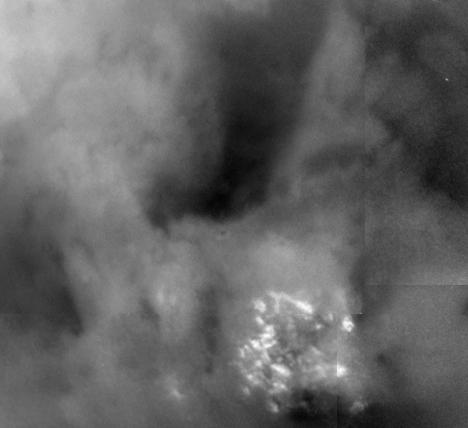
The image linked to in the main story as "bright patches" does show the bright surface features (bright, diffuse background), but the sharply defined bright feature at the bottom of the image is a cloud. There is a 4 frame image of the cloud, as it moved across the surface over the duration of the flyby.
This 3 frame image prepared by the Cassini team, for their press conference yesterday, shows the surface definition through visual and infrared spectra, defining the areas of surface features, ices, and possible hydrocarbons. -
Clouds vs Surface
The image linked to in the main story as "bright patches" does show the bright surface features (bright, diffuse background), but the sharply defined bright feature at the bottom of the image is a cloud. There is a 4 frame image of the cloud, as it moved across the surface over the duration of the flyby.
This 3 frame image prepared by the Cassini team, for their press conference yesterday, shows the surface definition through visual and infrared spectra, defining the areas of surface features, ices, and possible hydrocarbons. -
a quibble and some other commentsBut the first infrared images taken by Cassini revealed water ice as dark patches because it is mixed with material that may be organic, raining on to the surface.
These certainly are not the first infrared images taken by Cassini, not even the first of Titan, which were taken in mid April.
It was the earlier images, earth-based images, and the errant idea that the dark areas were ethane oceans which convinced the Cassini-huygens team to choose this landing ellipse. Now that they know different, one wonders whether they'll modify the plan.
-
a quibble and some other commentsBut the first infrared images taken by Cassini revealed water ice as dark patches because it is mixed with material that may be organic, raining on to the surface.
These certainly are not the first infrared images taken by Cassini, not even the first of Titan, which were taken in mid April.
It was the earlier images, earth-based images, and the errant idea that the dark areas were ethane oceans which convinced the Cassini-huygens team to choose this landing ellipse. Now that they know different, one wonders whether they'll modify the plan.
-
a quibble and some other commentsBut the first infrared images taken by Cassini revealed water ice as dark patches because it is mixed with material that may be organic, raining on to the surface.
These certainly are not the first infrared images taken by Cassini, not even the first of Titan, which were taken in mid April.
It was the earlier images, earth-based images, and the errant idea that the dark areas were ethane oceans which convinced the Cassini-huygens team to choose this landing ellipse. Now that they know different, one wonders whether they'll modify the plan.
-
Re:NASA Funding
Because the un-manned exploration of space is run through JPL not directly through NASA. If you want more neat stuff like this, give the money directly to JPL rather than pouring it down the NASA rat-hole.
-
Re:building blocks of life.... again...
I suggest that you read more about the Cassini-Huygens mission. The mission objective is to study Saturn as a whole. Searching for life is not the mission's purpose.
-
Re:Nonconductive spray - Grew through the epoxy?
I though growing crystals were slow to enlarge and fragile.
Don't underestimate the physical forces possible at the pointy end of a metal stick measured in um or #100s of atoms wide! (Compare the puncturing to your foot when you step on a tack vs stepping on a pebble.)
If I understand http://nepp.nasa.gov/whisker/experiment/exp2/index
The experiment shows (among other things) that the whiskers can form as a result of atomic migration of Zn from within the electrical surface, and not necessarily from deposition from the outside. Whatever is forcing the metal atoms (or quasi-ions) to move through the sea of other metal atoms to get to their nucleation point (the needles) probably doesn't care that there is a layer of flexible covalently-bonded (and mostly non-reactive with respect to metal ions) carbon, hydrogen and oxygen near it. And because this appears to be a slow process, a small force applied over time requires little energy, the loss of which is difficult to detect.
Also, hard epoxy would have fracutring issues when applied too generously to anything that experiences temperature change, like electronics. -
Comments from the posterA few comments/followup from the poster, Mr. Christmas Lights:
1. I first like to thank simoniker for adding the "small metallic fibers which grow on surfces that have been electroplated with zinc" to the article - made it more understandable/readable.
2. The NASA URL is one-level deep (a mistake on my part) - here is the top-level.
3. Related to #2, I would STRONGLY recommend
4. Some Anonymous Coward seems to have a problem with my nickname. Did you actually click on the "Mr. Christmas Lights" and see what is there - tell me that isn't appropriate (it's been used before BTW).
5. The same AC made a smart-ass comment about the Nigritude Ultramarine SEO contest - while I'm aware of that contest (#4 above is a hint for 'ya!), I'm currently ranking #199 for the keyphrase with less than a week to do, so I'm not a contendor
6. I haven't seen anyone comment on a business (verus technical) aspect of the Denver Post article (but this is
7. There have been several Denver Post articles about the failure of these computer systems. I didn't mention that fact in my submission because I thought it would be too lengthy, but apparently the inability to electronically check/file business/elections stuff has been a real big deal - good example of our dependancy on computers.
'Nuff random late night rambling!
-
Comments from the posterA few comments/followup from the poster, Mr. Christmas Lights:
1. I first like to thank simoniker for adding the "small metallic fibers which grow on surfces that have been electroplated with zinc" to the article - made it more understandable/readable.
2. The NASA URL is one-level deep (a mistake on my part) - here is the top-level.
3. Related to #2, I would STRONGLY recommend
4. Some Anonymous Coward seems to have a problem with my nickname. Did you actually click on the "Mr. Christmas Lights" and see what is there - tell me that isn't appropriate (it's been used before BTW).
5. The same AC made a smart-ass comment about the Nigritude Ultramarine SEO contest - while I'm aware of that contest (#4 above is a hint for 'ya!), I'm currently ranking #199 for the keyphrase with less than a week to do, so I'm not a contendor
6. I haven't seen anyone comment on a business (verus technical) aspect of the Denver Post article (but this is
7. There have been several Denver Post articles about the failure of these computer systems. I didn't mention that fact in my submission because I thought it would be too lengthy, but apparently the inability to electronically check/file business/elections stuff has been a real big deal - good example of our dependancy on computers.
'Nuff random late night rambling!
-
Re:Too bad...Point taken, though most of the interest in the Hubble comes from the pretty pictures it gives us using the visible portion of the spectrum. No one cares about the other stuff, hence why the proposed Webb scope isn't that popular with the public.
The recent Hubble Ultra Deep Field images--which were very popular with the public--were generated using the ACS (Advanced Camera for Surveys) and NICMOS (Near Infrared Camera and Multi-object Spectrometer). As the name implies, NICMOS is an infrared camera. ACS is sensitive from deep in the UV through visible wavelengths up into the near infrared.
In other words, the Hubble Deep (and Ultra Deep) Field images are false-colour images. Indeed, most of the most impressive Hubble images are false-colour. The famous 'Pillars of Creation' would actually appear pinkish and relatively unremarkable in a photograph.
SOHO images of the Sun are almost exclusively false-colour. Once again, some of them are quite eye-catching. COBE's measurements of the microwave background are also (obviously) false-colour--but they still made headlines.
As long as you can take a picture of something at some wavelength, it can be represented in the visible. With a little bit of talent, that representation can be made 'pretty'. There are many arguments for and against the JWST and its specific instrumentation choices--but an inability to produce newsworthy pictures is not one of them.
-
Re:Too bad...Point taken, though most of the interest in the Hubble comes from the pretty pictures it gives us using the visible portion of the spectrum. No one cares about the other stuff, hence why the proposed Webb scope isn't that popular with the public.
The recent Hubble Ultra Deep Field images--which were very popular with the public--were generated using the ACS (Advanced Camera for Surveys) and NICMOS (Near Infrared Camera and Multi-object Spectrometer). As the name implies, NICMOS is an infrared camera. ACS is sensitive from deep in the UV through visible wavelengths up into the near infrared.
In other words, the Hubble Deep (and Ultra Deep) Field images are false-colour images. Indeed, most of the most impressive Hubble images are false-colour. The famous 'Pillars of Creation' would actually appear pinkish and relatively unremarkable in a photograph.
SOHO images of the Sun are almost exclusively false-colour. Once again, some of them are quite eye-catching. COBE's measurements of the microwave background are also (obviously) false-colour--but they still made headlines.
As long as you can take a picture of something at some wavelength, it can be represented in the visible. With a little bit of talent, that representation can be made 'pretty'. There are many arguments for and against the JWST and its specific instrumentation choices--but an inability to produce newsworthy pictures is not one of them.
-
Re:That's no exoplanet!
Kinda like this one?
-
Re:Okay then...
"Reflections on a Mote of Dust
Image of Earth captured by Voyager 1
We succeeded in taking that picture [from deep space], and, if you look at it, you see a dot. That's here. That's home. That's us. On it, everyone you ever heard of, every human being who ever lived, lived out their lives. The aggregate of all our joys and sufferings, thousands of confident religions, ideologies and economic doctrines, every hunter and forager, every hero and coward, every creator and destroyer of civilizations, every king and peasant, every young couple in love, every hopeful child, every mother and father, every inventor and explorer, every teacher of morals, every corrupt politician, every superstar, every supreme leader, every saint and sinner in the history of our species, lived there on a mote of dust, suspended in a sunbeam.
The earth is a very small stage in a vast cosmic arena. Think of the rivers of blood spilled by all those generals and emperors so that in glory and in triumph they could become the momentary masters of a fraction of a dot. Think of the endless cruelties visited by the inhabitants of one corner of the dot on scarcely distinguishable inhabitants of some other corner of the dot. How frequent their misunderstandings, how eager they are to kill one another, how fervent their hatreds. Our posturings, our imagined self-importance, the delusion that we have some privileged position in the universe, are challenged by this point of pale light.
Our planet is a lonely speck in the great enveloping cosmic dark. In our obscurity -- in all this vastness -- there is no hint that help will come from elsewhere to save us from ourselves. It is up to us. It's been said that astronomy is a humbling, and I might add, a character-building experience. To my mind, there is perhaps no better demonstration of the folly of human conceits than this distant image of our tiny world. To me, it underscores our responsibility to deal more kindly and compassionately with one another and to preserve and cherish that pale blue dot, the only home we've ever known." - Carl Sagan -
Re:MUST SHUT DOWN HUBBLE!RTFA. At the bottom of the article, it clearly states:
The US space agency Nasa is studying options to refurbish the Hubble telescope using unmanned spacecraft following a decision earlier this year that, in the wake of the Columbia disaster, it was too dangerous to send astronauts to it on the space Shuttle.
Hopefully the upgrades will be good enough to complement the James Webb Space Telescope scheduled to launch in 2011. I can't wait to see if they redo "deep field" picture with this, it would be truely stunning. -
Re:They must have been nervous
Not true. Galileo flew through Jupiter's ring and Voyager 2 and Pioneer 11 flew through a gap in Saturn's ring. (Which is what Cassini just did, albeit a different gap and with full knowledge of what they were doing this time.)
-
Re:Gravitational Assists Get you what speed?
You can (theoretically) add the planet's speed relative to the Sun to your own on each flyby. A "long series of these things" could add as much as you wanted.
In a practical sense, though, you can't just keep zooming by Jupiter again and again at just the right angle and get up to c for free. You'd have to keep adjusting your orbit to encounter Jupiter over and over, and at some point the energy required to do that would be more than you'd gain from the effort. The gravity assist is only worth doing when the planet is "just going your way", more or less. The trick with something like Cassini is to figure out a path (however convoluted) that results in those planets "just happening" to be going your way at the time you get there.
The technique is useful when you only have slow, pathetic chemical rockets to shove yourself around the universe.
Explanation of gravity assist -
Umm....Cosmic rays create randomly oriented streaks. Noise induced specks have a random "snow-like" appearance. The bands appear to be some sort of malfunction in the imaging circuitry.
This image shows all three imaging problems. There appears to be a short cosmic ray streak in the lower left quadrant veering about 30 degrees downward and to the right, there may be some speckle in the black band or it may be a real signal (the white dots in the black band) and there's banding throughout the entire image that spreads from the white regions to the black and back to the white.
-
Re:Hey..?
The nuclear power is only for electrical power generation, not spacecraft propulsion. Cassini has two main engines and 16 thrusters for attitude control.
-
Re:Pictures.
Does anyone who knows a thing or two about CCD's know why these preliminary unprocessed images are so badly banded (horizontally)?
-
Re:nice image showing gravitonal waves in the ring
nice image showing gravitonal waves in the rings (link)
Not sure what you mean by gravitational waves let alone gravitonal waves, but there does seem to be some interesting structure in the outer ring in that picture. It reminds me of the famous braided ring spotted by the Pioneer 11 fly-by. I don't remember if Voyager saw this kind of thing. -
My thought exactly
Although somebody has pointed out that they did qualify it as the closest approach during the 4-year planned mission, note that Galileo survived 6 years beyond its 2-year planned orbital mission, and sent back data even as they intentionally crashed it into Jupiter to keep if from possibly contaminating one of Jupiter's moons in the future. I wouldn't be surprised if a similar fate is in store for Cassini-Huygens: both a significantly extended mission, followed by a controlled "disposal" when its usefulness has been wrung dry.
-
Re:Amazing.
I find myself curious what compression algorithms they are using... is it lossless?
I was reading an interesting page on how the cameras process the data and on some of the technical aspects regarding the images - the FAQ on the raw images available for downloading.
Apparently, there are both lossless and lossy compression schemes, and it sounds like the compression is done within the cameras themselves - it's not like, say, the Mars Rovers which have a fairly big processor in the middle doing all the work. I don't think it mentions the specific compression algorithms themselves; I wouldn't be surprised if the lossy one is a form of JPEG. I know that was used on Mars Pathfinder, also launched in 1997...
The raw images I have seen are pretty messy, and for trulyspectacular views of Saturn, its rings and its moons it's probably best to wait for them to be processed properly. The FAQ details some of the ways in which they're processed on the ground, too - anyone want a go themselves? -
Re:Hey..?
They basically used a "slingshot" manuever to rocket this thing around the sun twice and use the sun's gravitational pull to fling Cassini toward Saturn. Very dangerous thing to do with a rocket full of plutonium. Thank god it didn't blow up like the Columbia or Challenger shuttles.