Slashdot Mirror
Domain: nasa.gov
Stories and comments across the archive that link to nasa.gov.
Comments · 16,365
-
Re:Shiny!
Shamelessy reposted with some edits from Metafilter...
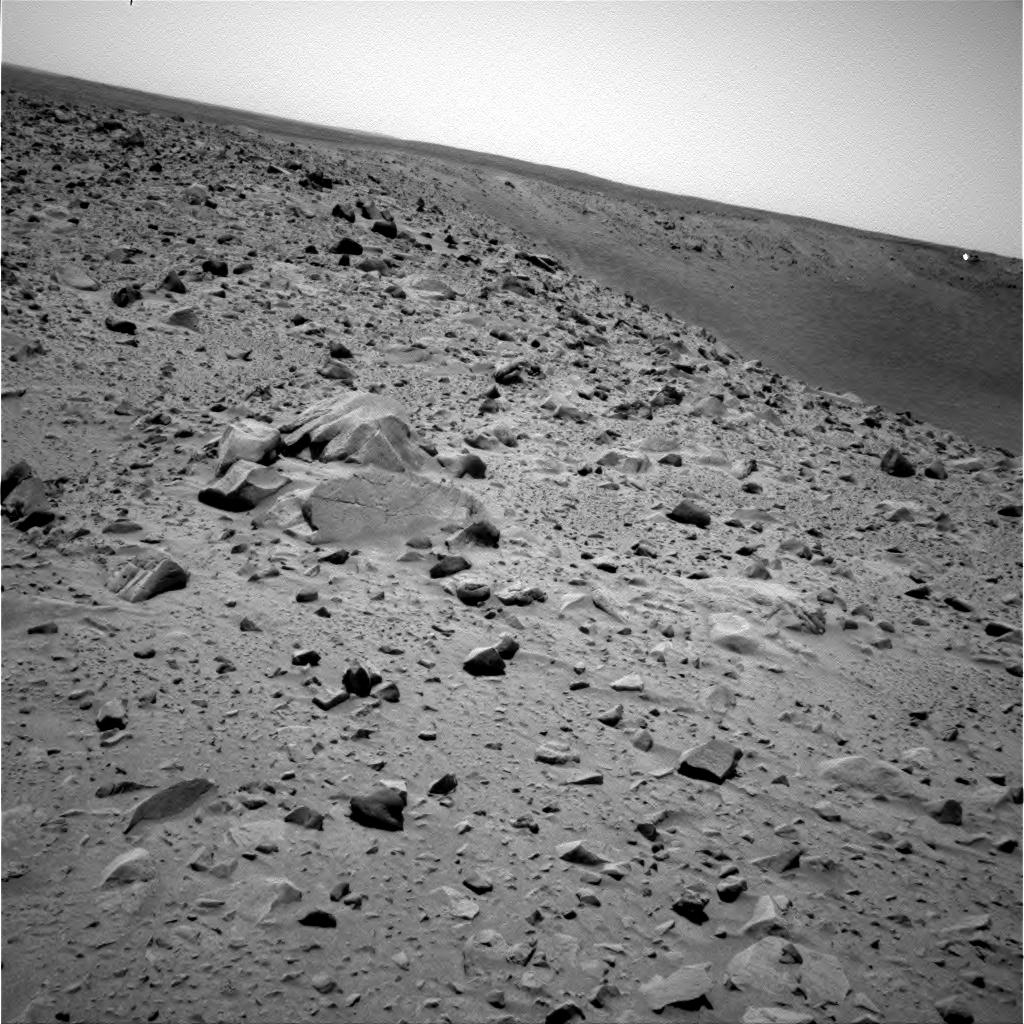
I thought at first it was just a digital photo artifact, but seeing as how the flash of white appears in several photos from Spirit's navcam on Sol66, my next thought was ALIEN BUILDINGS!!!
Okay, not really. My next thought was that it might be the lander's backshell or heatshield. So I looked up a map of the rover's intended route, and orbital images of the landing site with labels. Take a look at the photos, the maps, and the scales. Apparently the lander's heatshield had impacted a nearby crater; that's Bonneville. -
It's a Bird, It's a Plane, It's a... Spacecraft?Scroll down on todays Press Release Images-page, and check this picture (400kb).
I think that's even more interesting, and might draw people's interest as well.
-
It's a Bird, It's a Plane, It's a... Spacecraft?Scroll down on todays Press Release Images-page, and check this picture (400kb).
I think that's even more interesting, and might draw people's interest as well.
-
Re:They're not fooling anyone...
And if you take a close look at the background of the Bonneville crater, you can actually see an empty can of Coke blinking in the sunlight.
-
Heatshield
I don't know why JPL isn't playing up the coolness factor of this a bit more, but in this panoramic navcam montage of Bonneville, you can clearly see the lander's heatshield to the left, glinting in the sun.
(Later on preview) Okay, now MSNBC is mentioning it. -
Seriously...
Sorry about the silly offtopic 1st post but I just couldn't resist.
More seriously, I have been following the twin rover missions with great interest and I think it's absolutely amazing what they (And the JPL team of course) have achieved. I looked with great interest at the pic of our "pale blue (Even though the pic is monochrome) dot"
Even on the relatively tiny (In relation to astronomical standards) scale of a view from our nearest neighbour, it is truly humbling to realise just how insignificant our rock, in the greater scheme of things, really is.
Some of you might be interested in visiting a site that I visit on a daily basis to get and update on the latest images from Mars - photojournal.jpl.nasa.gov
-
How about those rabbit ears pics?
bunny
Some reports said this thing was actually moving -
Shiny!
I've noticed in some of the images of Spirit there is what seems to be a very shiny object at the opposite end of the crater:
Here (top right), here (top left) and here (middle).
Could it be a piece of Spirits entry/descent stage? In that last image it looks like an oddly shaped rock. If it is a rock, what could have made it so reflective? -
Shiny!
I've noticed in some of the images of Spirit there is what seems to be a very shiny object at the opposite end of the crater:
Here (top right), here (top left) and here (middle).
Could it be a piece of Spirits entry/descent stage? In that last image it looks like an oddly shaped rock. If it is a rock, what could have made it so reflective? -
Shiny!
I've noticed in some of the images of Spirit there is what seems to be a very shiny object at the opposite end of the crater:
Here (top right), here (top left) and here (middle).
Could it be a piece of Spirits entry/descent stage? In that last image it looks like an oddly shaped rock. If it is a rock, what could have made it so reflective? -
Re:Off the top of my head..
One of those universe/solar system simulations - I forget the name.
Possibly because there's more than one name to forget... (=
Let's see, for general touring around the Solar system and neighborhood, there's nothing quite like Celestia. Hours of fun, and very pretty to look at.
Noctis is also similar, but set in a fictional universe.
For more pretty pictures, but less interactivity, see The Solar Journey homepage or the Solar System Simulator. Also The Nine Planets for Kids.
Naturally, kids aren't that interested in just flying around. Well, Orbit lets them blow each other up in space, but with realistic physics and visuals. Once that gets boring, you can let them fly a space shuttle to the ISS with Orbiter. Beware, though. Orbiter is no simple game - you actually need to know how space flight works. There's also the Microsoft Space Simulator, which Orbiter has more or less superseded.
If you're not looking to get that far off the ground, FlightGear's an excellent flight simulator in which you can fly everything from the original Wright Brothers' craft right up to concept superplanes.
More links, mainly astronomy related, here, here, here, here, and here.
Finally, you might wish to try browsing the Tucows Games site and Freshmeat's game section (you'll need to login to make full use of Freshmeat).
Good luck, have fun searching. -
Re:Off the top of my head..
One of those universe/solar system simulations - I forget the name.
Possibly because there's more than one name to forget... (=
Let's see, for general touring around the Solar system and neighborhood, there's nothing quite like Celestia. Hours of fun, and very pretty to look at.
Noctis is also similar, but set in a fictional universe.
For more pretty pictures, but less interactivity, see The Solar Journey homepage or the Solar System Simulator. Also The Nine Planets for Kids.
Naturally, kids aren't that interested in just flying around. Well, Orbit lets them blow each other up in space, but with realistic physics and visuals. Once that gets boring, you can let them fly a space shuttle to the ISS with Orbiter. Beware, though. Orbiter is no simple game - you actually need to know how space flight works. There's also the Microsoft Space Simulator, which Orbiter has more or less superseded.
If you're not looking to get that far off the ground, FlightGear's an excellent flight simulator in which you can fly everything from the original Wright Brothers' craft right up to concept superplanes.
More links, mainly astronomy related, here, here, here, here, and here.
Finally, you might wish to try browsing the Tucows Games site and Freshmeat's game section (you'll need to login to make full use of Freshmeat).
Good luck, have fun searching. -
Re:Where have I heard this before?
NO ONE has made a realistic case as to how to have a sustainable program in a cost-effective fashion.
Yes
they
certainly
have.
Not just pie in the sky stuff either but detailed plans by experts with proven technology. Read up on it and you'll realize the only thing keeping humans off of Mars is politics. -
Re:All the intelligent analysis is arth-bound anywHow many prominent scientists do you know are also qualified as astronauts?
Harrison H. Schmitt. Although he might be pushing the age limit a bit for a Mars mission
-
One trick??? No way.
You are correct. For several years now there has been a diminishing of Hubble science. No knock against Hubble. The instrument has been used to its full capability. There is not much more to be got out of it.
Wow. Now that's talking out of your butt.
Hubble doesn't only take pictures. Those are what most of the public are familiar with, but an impressive number of other instruments have been used on Hubble at one time or another. Take a look here for a full rundown.
Spectroscopy is a close second to imaging for Hubble. Instead of just showing us what something looks like, we get a chance to see what that something is made of, what kind of environment it's sitting in, how it's moving, and what the physical conditions are of that thing (density, temperature, pressure, etc.). Pretty pictures are a good first step for astronomy, but to know what (astro)physics is going on out there, most of the time we have to turn to spectroscopy. The canceled servicing mission was going to install the third major spectroscopy instrument on Hubble. It has never been without one.
Yes, we can do some spectroscopy from the ground. Molecular spectroscopy is mostly done with radio telescopes. But, most atomic spectroscopy is done in the very blue optical to UV. That's where atoms in energetic environments resonate. You can not do any UV spectroscopy from the ground. Period. JWST will not fill this gap.
Ending Hubble's life early will seriously restrict the amount of physics that we can learn from all the pretty pictures that have come out. Such an action nullifies the large investment we've already made. For each public release photo by STSCI, there's a myriad of hard-core followup scientific studies done, many times with Hubble's other instruments. Many of these never hit the NY Times, but they are sometimes more invaluable to the field than the original pictures themselves.
Worse, the release of UDF data was clearly staged to garner political support.
Really? The data started being taken last September. The planning started way before then. Are you suggesting that particular working team knew all along that Bush was going to announce his plan and that O'Keefe was going to can Hubble a week later? Wow.
The real shame for the astronomical community is the delay and poor planning for the Hubble successor. That can hardly be blamed on O'Keefe or President Bush.
Right.
When someone effectively cancels the last 20-25% of the lifetime of your current mission, you're supposed to be planning for that years in advance. All the planning and all the money was pre-designated with the last servicing mission and the instruments that were to be installed on HST during that trip in mind. Frankly, ending HST early wasn't even though about seriously until the shuttle accident. If memory serves, that was only a year ago.
And you should probably be aware that the "astronomical community" that's working on the JWST bits right now is for the most part (a) contained within a NASA division; (b) has funding from NASA; and/or (c) being done by a contractor. There are certainly a few astronomers involved and invested, but that cross-section certainly does not represent the "community" as a whole.
So, sorry, I certainly will blame NASA's top dog and the fellow that choose him to be head of NASA for not seeming to try very hard to maintain the planned life of the best, most versatile space telescope the world has built. -
Re:O'Keefe - not just a bean counter
O'Keefe is a former Secretary of the Navy and has taught at Oxford, Cambridge. He's also be a member of high level policy teams at the Naval Post-Grad school. You can find out more about him here.
Why does NASA have to do manned flight at all? They are at their best doing robotic science missions. I say that more private dollars (or rupes or whatever) should be used for manned flight programs. -
Re:Post pictures
Ok, then - what the hell is THIS? Think it's a noseprint? Check out the closeup.
-
Re:Post pictures
Ok, then - what the hell is THIS? Think it's a noseprint? Check out the closeup.
-
Also at NASA's photojournal
A comprehensive list can also be found here.
-
Re:Prior art: NASA
Actually those missions did not use CCD devices, but a technology called a vidicon (vacuum tube) that was used in television cameras.
Needles to say Nasa has always been on the forefront of imaging technology, and the ones used in space imaging are quite different than the ones you find in your every day digital camera.
When you send a billion dollar probe somewhere, you can't afford not to have the very best in imaging technology.
Some amateur astromers have adapted the CCD technology found in digital cameras for their telescopes, but they pale in comparison to ones specifically made for this purpose. Decent ones are still quite expensive, and you can check the latest astronomy magazines for mor information on them.
-
Re:Sounds like an over broad claimJust did some more probing and found a description of voyager's cameras at NASA.
Under the Instrument Description section, it says the cameras are 'vidcons' (also user by mariner). That is, they use television cameras, as you said, but the cameras collect photons directly, without an intermediate film stage.
It sounds like an "electronic camera" to me! Also, the space craft have on board digital storage (presumably magnetic core?) and used compression for the Uranus flyby in 1986. An electronic camera and digital storage were paired well before the craft's launch in 1977. Compression, was used for the 1986 fly by of Uranus, so a combination of 'electronic camera, digital storage and compression' had no doubt been designed and tested well before 1986.
I'll bet similar systems were also in place on earth bound telescopes.
-
Re:Sounds like an over broad claimJust did some more probing and found a description of voyager's cameras at NASA.
Under the Instrument Description section, it says the cameras are 'vidcons' (also user by mariner). That is, they use television cameras, as you said, but the cameras collect photons directly, without an intermediate film stage.
It sounds like an "electronic camera" to me! Also, the space craft have on board digital storage (presumably magnetic core?) and used compression for the Uranus flyby in 1986. An electronic camera and digital storage were paired well before the craft's launch in 1977. Compression, was used for the 1986 fly by of Uranus, so a combination of 'electronic camera, digital storage and compression' had no doubt been designed and tested well before 1986.
I'll bet similar systems were also in place on earth bound telescopes.
-
Re:Sounds like an over broad claimJust did some more probing and found a description of voyager's cameras at NASA.
Under the Instrument Description section, it says the cameras are 'vidcons' (also user by mariner). That is, they use television cameras, as you said, but the cameras collect photons directly, without an intermediate film stage.
It sounds like an "electronic camera" to me! Also, the space craft have on board digital storage (presumably magnetic core?) and used compression for the Uranus flyby in 1986. An electronic camera and digital storage were paired well before the craft's launch in 1977. Compression, was used for the 1986 fly by of Uranus, so a combination of 'electronic camera, digital storage and compression' had no doubt been designed and tested well before 1986.
I'll bet similar systems were also in place on earth bound telescopes.
-
Kodak started killing itself in the early 1990s...That's when they got rid of C. Al Dewan.
Who's he? One of the unsung geniuses of the photographic era, he designed many of their scientific film processes -- including the film that was used on Skylab.
He also made some custom extreme-ultraviolet 70mm film for our sounding rocket flight in the early 1990s. The film was called "649 experimental", and it was fabulous. Very sensitive to extreme-ultraviolet, but practically dead in visible light -- I think its effective ASA rating was about 0.05. Yes, that's 2,000 times less sensitive than normal film. And the resolution was fabulous -- about 2,000 line pairs per millimeter -- that's like 0.25 micron pixels. For our application (a telescope platform that was like a prototype of the solar coronal imager on SOHO), it was the bee's knees. Much higher resolution than any electronic detector, and sensitive and reproducible as all get-out.
Thing was -- Kodak told Al not to make us the film. So he (I'm paraphrasing here) gave them the finger, made our film, and retired.
I figured that was the beginning of the end for them -- it was a symptom that they were beginning to restrict and ultimately ditch the very people who were continuing to make them great. A company that big has a lot of momentum -- but, sure enough, they're spiraling down. Not enough innovation.
-
Whorekarming
Slashdot had a discussion about Programming Gone Wrong in the past.
It mentioned, among others, the Ariane 5 Failure, the infamous Therac-25 accidents, loss of Mars Orbiter, Hi-tech toilet swallowing woman, AT&T Switch failure, a bunch of things literally crashing, etc. And here is yet another article on miserable Patriot failure.
For professional assessment of risks, there is a Usenet group for RISKS Digest (Google groups) that describes all kinds of situations where technology has gone wrong. -
UFO on Mars
It's funny... for all the silly crap the nutzo's are claiming to see in Mars images, hardly anything has been made of the unidentified flying object in this image (large streak near the bottom). That's a 15-second exposure of part of the early morning Martian sky, a segment of a panorama series designed to also grab the Earth... the streak is likely one of the 30-some or so defunct and/or lost spacecraft that may be orbiting Mars right now.
-
Re:The EDGEAn expanding universe in which the expansion is accelerating has always bothered me because it is based solely on the observed red shifts of distant galaxies. Might it not be possible that something other than accelerating cosmological expansion accounts for the red shift?
For example, perhaps the red shift is caused by scattering due to intergalactic dust (ie; the same principle that makes sunsets appear reddish here on Earth). The further light travels through the intergalactic dust, the more the scattering would shift the light towards the red end of the spectrum.
Another possibility might be that light loses energy as it travels, and since light energy equates to frequency (red=low energy, violet=high energy), the further light travels the more red shifted it would appear. Perhaps the energy loss (and consequent frequency shift) is too small for us to measure in laboratories here on Earth?
Ok, my asbestos suit is in place - fire away!
-
Re:Make way for the new generation.So yeah, between 2008 and 2011 there'll be a gap.
You are on the money, but there really isn't a gap. Look at SIM - launch in 2009 - BEFORE JWST and perhaps TPF, perhaps 2014. Both of these guys will make Hubble look like an out-of-date toy.
Many people are acting like HST is the only astro mission up there. Here some others:
Spitzer, Chandra, GALEX, FUSE, INTEGRAL, RXTE, WMAP and XMM-Newton - all flying now.
The idea that NASA astro budget has been axed is bunk.. it's higher then ever.
-
Re:Make way for the new generation.So yeah, between 2008 and 2011 there'll be a gap.
You are on the money, but there really isn't a gap. Look at SIM - launch in 2009 - BEFORE JWST and perhaps TPF, perhaps 2014. Both of these guys will make Hubble look like an out-of-date toy.
Many people are acting like HST is the only astro mission up there. Here some others:
Spitzer, Chandra, GALEX, FUSE, INTEGRAL, RXTE, WMAP and XMM-Newton - all flying now.
The idea that NASA astro budget has been axed is bunk.. it's higher then ever.
-
Goof in diagram showing position of field in sky
If you download the illustration showing the location of the HUDF in the sky, you get a graphic with the southern sky, the Earth, Hubble rotating around it and rays projecting out from the telescope to the location of the field, at about 28 degrees of south declination from the look of it.
But the picture looks like Hubble is over the pacific, shooting over the North Pole of the earth, not down into the southern celestial hemisphere at all.
These are supposed to be the Nasa Rocket Scientists. -
Re:Ok Astronomy guysIt's just interesting that each time they release pictures from really really deep space, they have to revise the estimate for the time of the big bang.
This is BS. The latest and best estimate of the age of the universe is from the WMAP data, which gave a result of 13.7 billion years. This was actually close to the lower (more recent) end of generally accepted estimates. Neither the original Hubble Deep Field nor this image has had any significant effect on estimates of the time of the Big Bang.
-
Definitely not that...Eeeks, you've all slid down the same slippery slope
Granted, it's probably just a tire track, or something
If you notice the raw image names given, they begin with:
1M131201699EFF
1M131212854EFF 1------------- Opportunity
-M------------ Microscopic Imager
--iiiiiiiii--- Time taken, unsigned integer seconds since ?MEpoch?...
-----------EFF Full-Frame 'EDR' (not linearized)
#man meredrSo those two images are both 'microscopic.'
Tire tracks? Did Opportunity goof off and play with some MicroMachines(tm) for 3 hours?There are lots of unusual objects, particularly in micro images. Being genious enough to know I'm an idiot; I go 'hmm can't wait until someone explains the process that makes that biological looking shape.'
-
Indeed! (/.ing update)Hubble's Deepest View Ever of the Universe Unveils Earliest Galaxies
For the story and images, choose a mirror site below:
- Kennedy Space Center (Florida, USA)
- Ames Research Center (California, USA)
- Goddard Space Flight Center (Maryland, USA)
Due to high demand, this story is being temporarily mirrored by other Web sites for easy access. For a permanent link to this story, bookmark this page. This page will be replaced by the actual story and images when the mirroring ends.
Although we will do our best, HubbleSite is not responsible for the availability of this story on external mirror sites.
If you have trouble reaching the mirror sites, you can bookmark this page and try again later.
---
What can I say Slashdot, I'm so proud of you
What was it? Oh yeah, wget -b -r http://www10.ksc... O:-)
And Apparently there're too many "junk characters" here. Heh.
-
Indeed! (/.ing update)Hubble's Deepest View Ever of the Universe Unveils Earliest Galaxies
For the story and images, choose a mirror site below:
- Kennedy Space Center (Florida, USA)
- Ames Research Center (California, USA)
- Goddard Space Flight Center (Maryland, USA)
Due to high demand, this story is being temporarily mirrored by other Web sites for easy access. For a permanent link to this story, bookmark this page. This page will be replaced by the actual story and images when the mirroring ends.
Although we will do our best, HubbleSite is not responsible for the availability of this story on external mirror sites.
If you have trouble reaching the mirror sites, you can bookmark this page and try again later.
---
What can I say Slashdot, I'm so proud of you
What was it? Oh yeah, wget -b -r http://www10.ksc... O:-)
And Apparently there're too many "junk characters" here. Heh.
-
Indeed! (/.ing update)Hubble's Deepest View Ever of the Universe Unveils Earliest Galaxies
For the story and images, choose a mirror site below:
- Kennedy Space Center (Florida, USA)
- Ames Research Center (California, USA)
- Goddard Space Flight Center (Maryland, USA)
Due to high demand, this story is being temporarily mirrored by other Web sites for easy access. For a permanent link to this story, bookmark this page. This page will be replaced by the actual story and images when the mirroring ends.
Although we will do our best, HubbleSite is not responsible for the availability of this story on external mirror sites.
If you have trouble reaching the mirror sites, you can bookmark this page and try again later.
---
What can I say Slashdot, I'm so proud of you
What was it? Oh yeah, wget -b -r http://www10.ksc... O:-)
And Apparently there're too many "junk characters" here. Heh.
-
Re:Ok Astronomy guys
Ok, you can actually view a pretty interesting image detailing how 'close to the edge' these ultra deeps actuall go!
http://hubble.gsfc.nasa.gov/survey/hubbledev/db/20 04/07/images/j/formats/web_print.jpg
This is amazing and wonderful stuff.
Regards,
-pararox- -
Make way for the new generation.
I can't get all that emotional about Hubble. Yes, it sucks that we won't have a space telescope, but it sucks worse that we -- as in the US -- won't have manned access to space rather shortly unless we get our asses in gear on the next-gen STS.
The thing is, there's a much better replacement coming up. It's called the James Webb Space Telescope. It'll be put in an L2 orbit, and from what I can gather, will put Hubble to shame.
So yeah, between 2008 and 2011 there'll be a gap. But as far as saving Hubble, what can I say: satellites have an expected end of life. Hubble's been up there since 1990. Eighteen years is a damn good run. -
Funny Warning...So, I was looking for the highest resolution version, and I finally found it here. They have a very amusing warning page:
"You are attempting to access an image with an extremely high resolution. While the file size may be small, the number of pixels these images contains requires at least 113 MB of free RAM that is not being used by any other application, including your operating system.
Many computers and Web browsers will have difficulty viewing this image, which is intended mainly for high-resolution printed and digital material. The image may not appear, it may cause your Web browser to lock up, or it may crash your computer. Some Web browsers will display a "broken image" icon in response to your attempt to view the picture.
If you simply want to view this picture on screen, we recommend choosing one of the other image formats offered. If you still want to use this image, we suggest right-clicking (option-click on a Macintosh) on the following link, then choosing "Save Target As" to directly download this file to your computer. You can then try opening the file using dedicated image-viewing software. But note that few computers will be able to handle even the downloaded version of this image."
Thanks hubblesite, you guys made my day. Now when I look at my five year old system that can barely run WarCraft III, I'll remember that it's one of the few computers in the world able to handle this image.
-
why NASA wants to scrap Hubble?
because they are *morons*... my wife is an astronomer and i have a lot of friends in the field. everyone seems outraged by this... it seems as if there are simple "marketing" reasons for scrapping the hubble telescope:
1. talking about a deep field image is not as entertaining for the common american as talking about a man on mars.
2. the shuttle is the weak link here. two have exploded so far. you need to service the telescope once in a while. currently nobody wants to hear the word shuttle, so why should we then service it?
not to mention that the telescope is modular and you can always install new instruments, i.e. it can live long and prosper...
what pisses me off most is that ther are several types of observation which you can *only* do from space. if hubble is scrapped, then several astronomers will be rather unhappy and unable to do their job. not to mention that hubble has provided amazing insights into space. the argument from NASA that it is too expensive to service it is BS. it's just that they are having a hard time to sell their budget in general and so they need to focus on more popular topics. now you might say: well, who cares about hubble. the new generation space telescope, james webb, is around the corner! well, it is not. first, it will sit in a lagrange point in space (cool idea!!!) which is rather far away and so impossible to service if something breaks. and at this point i would like to remind you the faith of beagle 2 as well as the problems hubble had at the beginning (mistake in mirror). how shall we fix such problems on JW? in addition, JW telescope will be launched in 2011... and we all know that realistically it wont happen till 2015. so if hubble gets trashed in 2007, what will we do? why put all cards on JW if hubble is still perfectly functioning and generating the most amazing data? makes you wonder...
as for the ultra deep image: amazing! i wonder how much it costs to use the hubble for ~ 11 days... -
Re:ComparingAPOD is Astronomy Picture Of the Day. So if it was there this morning it is still there (and it is). Here's the address: http://antwrp.gsfc.nasa.gov/apod/astropix.html
Not quite true. This morning UK time APOD was showing the old Deep Field photo, with a note that it would update around about 9am EST with the new photo - presumably it was being held for the press release. The old picture is still linked on the APOD entry where it orignally appeared -
Original Image
Here's a link to the original Deep Field Image: Original Deep Field Image
-
Re:Ok Astronomy guys
As I understand it, the last time the Hubble tried something like this was the Hubble Deep Field, which looked out to approximately 10% of the guesstimated age of the Universe. The full press release for the new UDF is here.
and they indicate that what we're looking at is about 400-800M years after the Big Bang.
Generally, the galaxies appear way more active than what we see locally, which is to be expected. But I--total amateur that I am--think it's a bit odd that the galaxies got slapped together so quickly. Whether it draws any of our assumptions about the Big Bang itself into question remains to be seen. -
Comparing
APOD had an old Hubble picture of the same space location earlier today. Unfortunately I didn't save it back then. Can someone please upload it so we can compare to the old depth of field?
-
But isn't most dust on mars magnetic?
You could use a magnet to wipe off the dust, since most dust on mars is magnetic. Here is the article, look at the last 3 paragraphs.
-
spirit/opportunity
I know this sounds like a troll but I was having a look on the website and these rovers don't move very much do they? if it moves 4 meters this is considered of import.
also whats with waking up to all these songs every morning? whats that do? do the rovers have advanced music perception algorithms? didn't think so. -
Hey! mars dust is largely magnetic....
why not stick a magnet to the bottom of the solar panels?
Both rovers carry magnets supplied by Denmark for experiments to analyze martian dust. Dust covers much of Mars' surface and hangs in the atmosphere, occasionally rising into giant dust storms. One of the magnets is designed to exclude any magnetic dust particles from landing in the center of a target area. During Spirit's time on Mars, dust has accumulated on other parts of the target while the center has remained "probably the cleanest area anywhere on the surface of the rover," said Dr. Morten Madsen, science team member from the Center for Planetary Science, Copenhagen, Denmark.
"Most, if not all of the dust particles in the martian atmosphere are magnetic," Madsen said. Another of the magnets is within reach of the rover's robotic arm. Examination of dust on the target by instruments on the end of the arm will soon yield further information about the composition of the dust, he said. -
Re:Has the atmosphere DRASTICALLY changed in 20 yrWell let's see, the link I gave says (from viking)
Surface pressure: 6.36 mb at mean radius (variable from 4.0 to 8.7 mb depending on season)
[6.9 mb to 9 mb (Viking 1 Lander site)]
Surface density: ~0.020 kg/m3
Scale height: 11.1 km
Total mass of atmosphere: ~2.5 x 10¹⁶ kg
Average temperature: ~210 K (-63 C)
Diurnal temperature range: 184 K to 242 K (-89 to -31 C) (Viking 1 Lander site)
Wind speeds: 2-7 m/s (summer), 5-10 m/s (fall), 17-30 m/s (dust storm) (Viking Lander sites)
Mean molecular weight: 43.34 g/mole
Atmospheric composition (by volume):
Major : Carbon Dioxide (CO2) - 95.32% ; Nitrogen (N2) - 2.7%
Argon (Ar) - 1.6%; Oxygen (O2) - 0.13%; Carbon Monoxide (CO) - 0.08%
Minor (ppm): Water (H2O) - 210; Nitrogen Oxide (NO) - 100; Neon (Ne) - 2.5;
Hydrogen-Deuterium-Oxygen (HDO) - 0.85; Krypton (Kr) - 0.3;
Xenon (Xe) - 0.08now- from pathfinder Meteorology
It was mid-summer in the northern hemisphere of Mars when Pathfinder landed. The Pathfinder Lander is at 19.33 N, 33.55 W. The Viking 1 Lander touched down at 22 N, 50 W, 2 km below datum elevation on 20 July 1976, and is used for many of the comparisons below.
The pressures measured over the first three days average about 6.75 mb, 10% to 20% smaller than those recorded by the Viking 1 Lander during the same season 21 years ago (note that this result is consistent with the elevation difference of about 100 meters between the Mars Pathfinder and Viking 1 landing sites). The pressure showed a slight decline over the first few weeks but is now starting to rise slowly. This rise should continue through December, 1997. The pressure rise is concurrent with the slow shrinking of the southern polar cap, now at its maximum extent, as the southern winter ends.
Temperatures measured from the top of the 1 meter mast on Mars Pathfinder varied from daily highs of about 260 K (+8 F) to lows of 196 K (-107 F). This is about 10 K degrees (18 F degrees) warmer than Viking 1 Lander measurements made at 1.6 meters. The sol-to-sol temperatures have been very repeatable over the first 30 sols, and should continue until about 60 sols after landing, after which they will start to show more variation.
Preliminary wind speed estimates give late evening and early morning prevailing winds from the SSE, which shifted in the early afternoon to be from the N to NE. This is very similar to what Viking 1 found at this time of year. During the day, winds were light at only a few km or miles per hour. At night the wind speed increased to about 10 to 20 mph (16 - 32 kph) from the south.
The repeatable weather patterns of northern summer found by Viking 1 have been verified by Pathfinder so far. These include diurnal (day-night) pressure changes and semi-diurnal changes by as much as 4.5% due to atmospheric thermal tides.
Interruptions in the normal pattern of temperature drops observed on a few nights may indicate water in the atmosphere is condensing as fog. Humidity measurements are planned later in the mission.
On sol 25, temperature sampling was done at 4-second intervals for the whole day. Temperature fluctuations by 15 to 20 K (30 to 40 degrees F) were observed over minutes or seconds at some periods, suggesting turbulent boundary-layer mixing between the warmer near-surface region and cooler layers above that. A "dust devil" was also detected passing by the lander on sol 25, and later high resolution sampling has detected more dust devil signatures.
More detailed information and historical weather reports are available at the Mars Pathfinder project weather page. Raw and reduced data are available online at http://atmos.nmsu.edu/PDS/data/mpam_0001/aareadme. htmPathfinder used a parachute... didn't anyon notice how hard it hit? the fact that pressure and temperatures change so mu
-
Has the atmosphere DRASTICALLY changed in 20 yrs?from nasa's own website
NASA's Viking Mission to Mars was composed of two spacecraft, Viking 1 and Viking 2, each consisting of an orbiter and a lander. The primary mission objectives were to obtain high resolution images of the Martian surface, characterize the structure and composition of the atmosphere and surface, and search for evidence of life.
how does that mean they had no idea the air was so thin? -
Re:Conversions...A factor of +/- 10 could be completely possible, however what about other more simple errors? I don't know much about what numbers go into blasting some metal from Earth, but logically what would happen if any of the assortment of numbers was even 1% off? Even with recalculations, who hasn't incorrectly answered an "easy" math problem on a test to realize they made a stupid mistake even after going through the problem a second time before turning in the test?
Lets say (using the parents example) the radius of Mars was incorrectly entered (from our less accurate 1988 data vs. our more exact 2001 data) with an error of 1%, so instead of 3375km for polar radius, we have 3341km. This error is furthered in say Newtons Law of Gravity, because the radius is squared, giving a 2% error in just the denomenator of the equation. Obviously there are some margins to counter this, but Distance to Mars, Radius of Mars, Mass of Mars, all equal to many sig figs.
If you're interested in more Mars/Earth info I found this NASA data in my googling.
-
It's not just the dust
It appears that dust covering the solar panels is only one of a number of factors which will end up rendering the mars rover a paperweight.
The dust on the solar panels appears to be complicated by the fact that the batteries "lose capactity" and (probably most importantly) the sun moves past the latitude where the rover is located. Just like days get shorter in the winter...
I guess it doesn't matter if your solar panels are clean if they aren't being exposed to the sun for an appreciable length of time.
All of this was grossly overinterpreted from an article lean on details... http://marsrovers.jpl.nasa.gov/mission/tl_surface. html