Slashdot Mirror
Domain: nasa.gov
Stories and comments across the archive that link to nasa.gov.
Comments · 16,365
-
Re:namersFor the younger among us:
For background on current names:
How names for features are selected:
And the best explanation you're likely to get of how planets get their names:
-
Re:Anybody else want to see a night time picture?
-
Re:Anybody else want to see a night time picture?
-
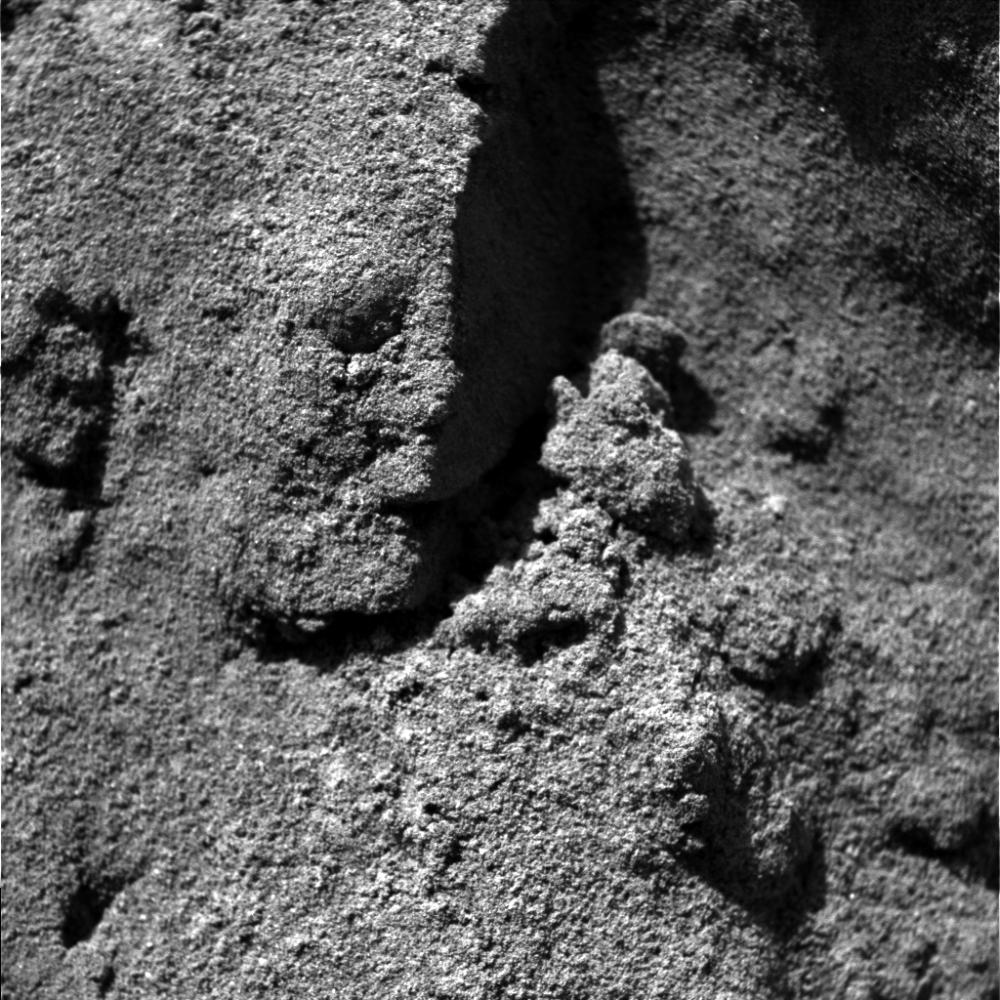
More evidence of Life on Mars
Did anyone else notice the face in this picture?? Bears a strong resmblance to the original 'face on mars'
Coincidence? I think not. -
Re:on the moon? think again --
Now it is clear that you have no idea on the concept of interferometry either.
No, of course I do. I never said it would be easy, but it's not impossible. I'm a bit confused about the necessity of a completely stable site (the 30 meter number came from the Thirty Meter Telescope, which has planned sites for places like Hawaii - not exactly what one would consider a "perfectly stable site") - I don't think that the lunar surface would be a tremendously bad placement for it. The control you're immediately throwing out as "ridiculous" is definitely within reach nowadays. Technology's amazing.
Your argument is basically: assuming no launch costs, no personnel costs, a cost-free fully-outfitted manufacturing facility (that needs to make mirror substrates out of the lunar soil!
Yes, that would be exactly what I'm assuming. What would need to be launched that wouldn't be used for something else? Not a tremendous amount, for one. The personnel are used for other things, the manufacturing facility is used for other things, etc.
If you're trying to say "if we go to the Moon to build a telescope, it'd be insanely expensive!" I agree with you. Very much so. But that's not what I've been saying. What I've been saying is "if we go to the moon, and establish a permanent presence, building a telescope is a good idea."
I'm not sure how far in the not-to-distant future you are dreaming
I'd say 50 years is a reasonable estimate. If Bush is serious about the return-to-the-Moon thing.
Your comment about steel mills is way off too. These mills live and die on the margins.
Um. Yeah. Duh. That's because there's no money in small-scale extremely expensive totally cost-inefficient steel production, which is what I said.
They are large and power hungry because of thermodynamics.
No, they're power hungry because of thermodynamics. They're large because of scale. They would lose money trying to make steel smaller-scale than they do now - it's not that it's impossible. Not unless you're trying to say that iron and/or steel has never been made in anything except gigantic foundries. Besides, that's again assuming there's no other material on the Moon that could make a strong support besides steel. I wouldn't even think of steel, as the materials aren't easily available.
I mean, c'mon. Do you think no one's thought about "how do we manufacture things on the Moon?" Of course they have, and there's an absolute flood of information about it. Here's just a start.
Anyone can simply say "oh, we can't do it, it's too complicated, requires too much work, etc." Not really. There's certainly no reason why we can't build a telescope out of materials on the Moon. It's just hard. And requires people to think, and be creative, and come up with new solutions to things, which is usually harder to convince people to do in a culture where people are constantly happy with the status quo. -
Ok,it's not a game anymore...
I want whoever had hidden my shiny roundmarbles on Mars to come and tell me the truth.
I lost these things since the first grade, sniff, how am I supposed to get them back from there? -
Re:Resolving Power?http://astrogeology.usgs.gov/Projects/MER-AthenaM
I There is also information about the rover, and science instruments on NASA's site, but these are extremely topical, but also good to look at first. So there you go.
-
Re:Resolving Power?http://astrogeology.usgs.gov/Projects/MER-AthenaM
I There is also information about the rover, and science instruments on NASA's site, but these are extremely topical, but also good to look at first. So there you go.
-
Sprit has dug a trench,,,
The sprit rover has now also dug a trench in "Laguna Hollow"
-
Oh no, not again!
Hasn't anyone else noticed this?
The mars face has returned!
Dan East -
Re:hurrah, we found dirt!
Hey if the martian face looks like a face then this piece of dirt does too. Wow! There MUST have been a civilisation...
-
Don't Panic
Oh, please stop it. I am so sick and tired of this global warming whining and hyperbole. As if the forces of nature were were in any way under mankind's control, and as if it would even be possible to significantly reduce carbon emissions without reducing the Earth's population accordingly. What about this thing that's ready to wipe out civilization as we know it (a bit overdue)? Or the old favorite, the big rock from the sky? Oh, and here's my new personal favorite: EVERYTHING goes boom... the whole of Creation jumps to another energy state, just like an electron orbiting an atom... just as it's probably done before. Why, there are countless ways in which this meaningless speck of dust that we inhabit might just shake itself out of its current human infestation. Why focus on just one that's out of our control?
-
Re:From the astronomy angle...spanklin:
What does that comment and the rest of your post have to do with what I said, which is that JWST is not a replacement for the HST? In fact, I don't see that I ever said anything about GWB in my post, or in fact in any post I've ever written!
Nothing. And no, you never did. I was explaining my response to DirtyJ's original post.
spanklin:The relevant point is that Hubble can observe in the ultraviolet, optical, and infrared regions of the electromagnetic spectrum. JWST will be an infrared-optimized telescope. It will not have UV capabilities, and its optical performance will be mediocre.
You are absolutely correct. I wasn't looking at it from the user perspective. NASA is transitioning from HST to JWST, therefore that-which-is-transitioned-to replaces that-which-is-transitioned-from. That's a contractor's perspective. Won't be last time somebody says "That's great, but I liked the old one better." -
Re:From the astronomy angle...DirtyJ:
We also see the imminent demise of HST.
Relax, it's being replaced by the James Webb Space Telescope. -
Re:Marburger says...aws4y:
...then Bush announces his Mars push and Hubble is gone and all the astronomy probes that were planed for the next ten years are in jepordy [sic].
Oh no! You mean the James Webb Space Telescope they're replacing Hubble with is being cancelled? That's news to me. -
Re:There are alternatives
As a taxpayer who doesn't fund the space program (different country) I think that the public/private argument is a hard one to make from any perspective.
There is potential for huge amounts of money to be wasted and, let's face it, we have huge problems on earth that need solving a whole lot sooner than GUT. But at the same time the space program has provided a huge number of benefits to humanity.
Historically we have seen that markets tend to be poor innovators but good at creating markets for new technology. More importantly it would be impossible to convince many small companies to collaborate on a risky venture (with little opportunity for return), and those companies with enough capital tend not to be interested.
One solution may be for the government to fund a large project, but to "outsource" a lot of the development of component parts to private corporations.
-
Re:Great Quote from the ArticleThe best proof that there's intelligent life in the universe is that it hasn't come here.
They don't come here because the Milky Way is zoned industrial.
Better hope there're no accidents. Just look at what happened in M87.
-
Text-only version
The site is becoming a little slow already, so here is a text-only version. The http://chandra.harvard.edu site seems to be slashdoted already.
-
image from marsAs others above have posted, he did not contradict himself at all. In fact he also did not assert that what he had seen was, indeed, vegetation. He said that they seem to me to be unmistakably vegetation. That is, he finds the image quite intriguing.
see for yourself (*WARNING* LARGE FILE! ~8Mb i think). It is interesting. Of course, it could be debris from the lander. It'd be nice to get a comment from someone at JPL. I know that one of the rover handlers (among others at JPL) was posting here last week. Any comments?
-
Re:Cool, but where's the money?Exactly. The USSR had a quality space shuttle that seemed to be WAY better than the US one, plus was cheaper to develop.
They made 12 of them to test all the avionics and one of them made it into space as a test flight and on AUTOPILOT landed only 5 feet off it's target (well impressive).
Alas that was it's last flight as it was cancelled cos of lack of cash.
They could use it as a starting point for a new one and hope it doesn't end up as another flight sim ride in Gorky Park
-
Russian shuttle
-
Super Soyuz has been proposed before
Russians have been designing larger and possibly reuseable Soyuz-type spacecrafts for long time. The original mission was ferrying military cosmonauts to Almaz and Polya military space stations. A later design was Zarya resusable space craft to be launched with Zenit booster. Project was cancelled on financial grounds back in 1989, but the technology has been further developed in connection with ISS and Sea Launch projects.
-
Re:Wow. Amazing. Not.No one wants to hear [...]"Spirit Finds Another Rock".
While I agree with you, I think it's starting to get old how Spirit woke up today and made it's best drive yet.
On another note, I'm starting to wonder if NASA hasn't already found what it set out to do, and that is to determine whether there was water or not.
In an early press release, they mentionned how finding oliving would indicate that water was not the cause of hematite.
"What are the other materials found with the hematite? Clays and carbonates would indicate there had been water in the area. If the area had been volcanic, you would expect to see other types of minerals like olivine and pyroxene."
Later, it was quickly mentionned, but not at all expanded on that we did end up finding olivine.
One unexpected finding was the Mossbauer spectrometer's detection of a mineral called olivine, which does not survive weathering well. [...]
So I'm starting to wonder, is it actually finished? Do they have nothing left to do?
In any case though, as pointed out even by yourself, Nasa needs to put out some more interesting information... I don't know, raw graphs of surface temperature or _something_ other than friggin "today we performed the first ever U-turn on an alien planet".
-
Re:Wow. Amazing. Not.No one wants to hear [...]"Spirit Finds Another Rock".
While I agree with you, I think it's starting to get old how Spirit woke up today and made it's best drive yet.
On another note, I'm starting to wonder if NASA hasn't already found what it set out to do, and that is to determine whether there was water or not.
In an early press release, they mentionned how finding oliving would indicate that water was not the cause of hematite.
"What are the other materials found with the hematite? Clays and carbonates would indicate there had been water in the area. If the area had been volcanic, you would expect to see other types of minerals like olivine and pyroxene."
Later, it was quickly mentionned, but not at all expanded on that we did end up finding olivine.
One unexpected finding was the Mossbauer spectrometer's detection of a mineral called olivine, which does not survive weathering well. [...]
So I'm starting to wonder, is it actually finished? Do they have nothing left to do?
In any case though, as pointed out even by yourself, Nasa needs to put out some more interesting information... I don't know, raw graphs of surface temperature or _something_ other than friggin "today we performed the first ever U-turn on an alien planet".
-
Re:Wow. Amazing. Not.No one wants to hear [...]"Spirit Finds Another Rock".
While I agree with you, I think it's starting to get old how Spirit woke up today and made it's best drive yet.
On another note, I'm starting to wonder if NASA hasn't already found what it set out to do, and that is to determine whether there was water or not.
In an early press release, they mentionned how finding oliving would indicate that water was not the cause of hematite.
"What are the other materials found with the hematite? Clays and carbonates would indicate there had been water in the area. If the area had been volcanic, you would expect to see other types of minerals like olivine and pyroxene."
Later, it was quickly mentionned, but not at all expanded on that we did end up finding olivine.
One unexpected finding was the Mossbauer spectrometer's detection of a mineral called olivine, which does not survive weathering well. [...]
So I'm starting to wonder, is it actually finished? Do they have nothing left to do?
In any case though, as pointed out even by yourself, Nasa needs to put out some more interesting information... I don't know, raw graphs of surface temperature or _something_ other than friggin "today we performed the first ever U-turn on an alien planet".
-
space duct tape erodes!
Kapton tape, which is essentially used as space duct tape, erodes in the presence of atomic oxygen. Atomic oxygen (just a single O, not the usual stable O2) is quite reactive, and will eat away many materials on the leading edge of spacecraft. Atomic oxygen is found more in the lower orbits (i.e. ISS and space shuttle) rather than the higer orbits (geosynchronous). Here are some pictures from the experiment.
(yep, I'm a former rocket scientist) -
Weather
We've had plenty of evidence of current, as well as past weather on Mars before we even launched the Spirit Rover.
-
Re:Innocent
I'll have to flee Europa as well.
You live here? Yeah, I'd probably flee too, before the RIAJ caught me... -
How the MER Navigates
You might want to see this mildly humorous QuickTime movie on the official MER site detailing how the rovers get around without engineers having to shimmy the things around every other obstacle. The thing does it by itself--something the Russian lunar rovers didn't do.
Two words about the movie's beginning: Bullet time. -
Re:Reasoning
Mars has no atmosphere
Oh yes it does. It is kind of thin by our standards, but it IS an atmosphere. -
Meanwhile, on the other side of Mars...
... Opportunity was digging a trench in the Martian soil. I built this animation from recent raw images, and I wouldn't be surprised if NASA/JPL unveil their own version at this afternoon's press conference (6pm GMT, IIRC, and it'll probably broadcast on NASA TV.
Mirror this image if you like; my ISP probably won't be too pleased if all their bandwidth gets eaten by greedy Slashdotters. -
Meanwhile, on the other side of Mars...
... Opportunity was digging a trench in the Martian soil. I built this animation from recent raw images, and I wouldn't be surprised if NASA/JPL unveil their own version at this afternoon's press conference (6pm GMT, IIRC, and it'll probably broadcast on NASA TV.
Mirror this image if you like; my ISP probably won't be too pleased if all their bandwidth gets eaten by greedy Slashdotters. -
Re:One short trip for Artificial IntelligenceI'll not quibble over what formally counts as AI, but it seems pretty intelligent to me -- the rover dynamically builds a 3D map, identifies danger spots, and avoids them in order to get to a goal.
Also check out the QT animation on the NASA site titled "Rover Navigation 101: Autonomous Rover Navigation"
AI or not, it's pretty darn cool.
-
latest information can be found here..
The latest information on Spirit's and Opportunity's adventures can be found here!
-
Re:And what, end up like Beagle 2?
There is a reason American Space Technology works better, performs better, and is the envy of all the other countries on this speck of dust.
Hmm, are you talking about the grounded space shuttles or the only working US space laboratory called SpaceLab that was, according to this article developed by europe's ESA? -
Volcanoes on Io responsible
Sulfuric acid found on Europa was reported as far back as 1999 when this article was published on Science@NASA based on this NASA Press release. According to the article, sulfur from volcanoes on Io, another one of Jupiter's satellites, may be responsible for the environment on Europa.
-
Volcanoes on Io responsible
Sulfuric acid found on Europa was reported as far back as 1999 when this article was published on Science@NASA based on this NASA Press release. According to the article, sulfur from volcanoes on Io, another one of Jupiter's satellites, may be responsible for the environment on Europa.
-
Re:134 years to find
I believe mars is a smaller planet. It's the 4th one from the left not counting the big firey object.
-
Solution: Multi-OS Boxes
One solution to the monoculture problem is multi-OS architectures in which a single process is executed on multiple independent codebases within each box.
On high-reliability systems (Space Shuttle & X-29 flight controls), multiple redundant subprocessors attempt to compute the same answer. If the subprocessors get different answers, the majority-rules and the system logs the exception. If each processor ran independent code, then exploits of any one codebase would be detected and disinfected. A multi-system with one exploited/infected codebase would continue running while ignoring the output of the infected subprocessor.
The system would still have some vulnerabilties. Simultaneous attack on a majority of the codebases might succeed in redefinig the majority to suit the malware. Also, codebase independence is very hard. More than likely several codebases might share the same fault (e.g. a buffer overrun bug). Attacks on the overseer/majority-rules system might also succeed. Finally, if the standard has an exploit (e.g., decrypting WiFi WEP), then all codebases implementing the standard are vulnerable.
The biggest downside is bloat and cost. But at least it would give people a reason to buy the latest greatest chips from Intel, AMD, IBM, etc. -
Re:Someone tell me again...
Guess we better junk it because it seems we aren't getting any good science out of it. Whats that? oldest known galaxy huh? Cool!
No, that's the job of the James Webb Telescope
http://www.ngst.nasa.gov/FastFacts.htm -
Re:How do you decompose in space?
bzzzt, actually, you would live for quite some time (well, you would be consious for around 15 - 20 sec, IIRC. more info here). and you wouldn't freeze that quickly since the only way to get rid of your heat is via radiation, which isn't very effective, cause as cold as it is in space there are not many (cold) atoms around to cool you down, think if a thermos, it has a layer of vacuum in it's bottle as an insulator, space itself is hence a pretty good insulator as well
-
Re:Someone tell me again...
RTFA's
NASA said NOTHING about the costs... They said it is TOO risky to fix it. Also, they never said there wasn't good science coming from it.
And what are you talking about other crafts? The space shuttles are the main crafts that go to speace.
nasa shuttles
wired article that tells about hubble and reasons its not being fixed. -
Re:ppfffttt
How long will it take to cool down far enough that it's no longer emitting enough radiation (of whatever sort) for us to even see it?
About 100 billion years, typically 10-20X as long as the star's pre-dwarf lifetime. The surface temperature is 20X the sun's, so in theory they're 160000 times as radiant per square centimeter than the sun is. But they're about as big as the earth, so an incredible amount of thermal energy has to radiate through a relatively small surface area. In the standard APOD photo you can see what they look like- they have the color of hot blue giant stars but they're very dim for being so small.
Is anyone proposing such a mechanism as an explanation of the dark matter issue?
A white-dwarf-matter theory runs into trouble pretty fast. It predicts things that we don't see, like many more supernovas each year than observed. There are a whole bunch of dark matter theories that try to explain the weird gravitational stuff using ordinary baryonic matter like rocks, dwarfs, or comets. In general they are only seriously brought up when someone is dismissing them.
-
Re:If Sun is on the ropes...
Ok - the ground control software for the NASA Mars Rovers. Or how about Satellite tracking visualization software. There's ShowSky , and I'd venture a guess that there's a whole host of other places it's being used in in-house and scientific apps that don't get the same press as the next release of the Sims.
-
Re:Not even that good.
They do have one thing that helps (as it turns out, quite a bit): no in-band background noise to interfere with the communication.
Anyway, yes their data rates are lower than diect broadcast TV satellite. It's all about the relative S/N owing to inverse square law and the greater distance to the deep space vehicle. The rover and orbiter link rates are on par with Magellan's - 128~256 kb/s, compared with about 30mb/s for a DTV satellite transponder channel.
Read this chapter in JPL's Space Flight Primer for more information about how their space vehicle comms work. A tidbit I found in there: they use coherent (phase-locked) transmission and Doppler to very accurately measure the remote vehicle's position. That's a neat hack.
Both things are amazing when you look at them, for different reasons. Deep space communication is amazing because it's possible. Direct broadcast satellite is amazing because it's so cheap!
A nitpick: the 'milestone' stated in the article, which was apparently overlooked by many of the posters here is the fact that, for the first time, a non-NASA spacecraft (in this case the ESA's Mars Express Orbiter) got into the act as a data relay for the rovers. This is more a statement about cooperation than it is about outright technical achievement. It is a political milestone, much the same as our (America's) cooperation with Russia in the ISS and in developing new rocket booster technology. Yet while it is political, it is a good thing in that it's another step toward recognizing that for space exploration to be fully realized it needs to be global endeavor, not a national one.
This is very much at odds with Bush's election-year 'man to the moon' pipe dream that serves no real scientific end and is more about beating the collective American wiener on the table with China. -
Re:Not even that good.
They do have one thing that helps (as it turns out, quite a bit): no in-band background noise to interfere with the communication.
Anyway, yes their data rates are lower than diect broadcast TV satellite. It's all about the relative S/N owing to inverse square law and the greater distance to the deep space vehicle. The rover and orbiter link rates are on par with Magellan's - 128~256 kb/s, compared with about 30mb/s for a DTV satellite transponder channel.
Read this chapter in JPL's Space Flight Primer for more information about how their space vehicle comms work. A tidbit I found in there: they use coherent (phase-locked) transmission and Doppler to very accurately measure the remote vehicle's position. That's a neat hack.
Both things are amazing when you look at them, for different reasons. Deep space communication is amazing because it's possible. Direct broadcast satellite is amazing because it's so cheap!
A nitpick: the 'milestone' stated in the article, which was apparently overlooked by many of the posters here is the fact that, for the first time, a non-NASA spacecraft (in this case the ESA's Mars Express Orbiter) got into the act as a data relay for the rovers. This is more a statement about cooperation than it is about outright technical achievement. It is a political milestone, much the same as our (America's) cooperation with Russia in the ISS and in developing new rocket booster technology. Yet while it is political, it is a good thing in that it's another step toward recognizing that for space exploration to be fully realized it needs to be global endeavor, not a national one.
This is very much at odds with Bush's election-year 'man to the moon' pipe dream that serves no real scientific end and is more about beating the collective American wiener on the table with China. -
Re:I'm kind of surprised...
Not sure about this - you do know geostationary orbits are at around 35000 kms don't you? I know that the shuttle/ space station experience atmospheric drag, but they're only a few hundreds of kms up (see here and scroll down for a graph)
-
Re:closer
Supposedly it's 0.7% methane. While this means that a relatively low proportion of the planet is carbon, Jupiter's sheer enormity means that there's a hell of a lot of carbon there. More than you could fit under your bed at any rate.
-
Not even that good.
The lag time between Earth and Mars is anywhere between 3 and 22 minutes when Earth and Mars are clostest and farthest away from each other in their orbits
And just to make matters worse, you've got to deal with some serious high-gain amplification to "dial them up". Beaming cable over a satellite's easy -- sending it millions of miles away means a lot more power (a scarce commodity on a satellite to begin with) or a much more sensitive antenna on the recieving end. I don't know what the current data transmission rates with the things we sent to Mars, but for reference, the Magellan probe back in the 90's had a transmission rate of 115 - 268.9 kilobits/sec.
It is really amazing to consider that we now have a "spy" satellite orbitting Mars relaying images of the surface back to us on Earth, and that it's sensors are good enough to show us photos of the landing of the rover on the surface. Just incredible. But this technology is still in its infancy -- we've still got decades before we land a man on the planet. This is an amazing page about the Soviet exploration of Venus that may also be of interest. -
Re:Formation
They won't fuse all the way to iron normally... Mostly just to carbon
not necessarily, i supose that you haven't ever heard of the CNO process, in which at 10 solar masses or more, the carbon catalyses a reaction which turns two hydrogens into helium, check here