Slashdot Mirror
Domain: nasa.gov
Stories and comments across the archive that link to nasa.gov.
Comments · 16,365
-
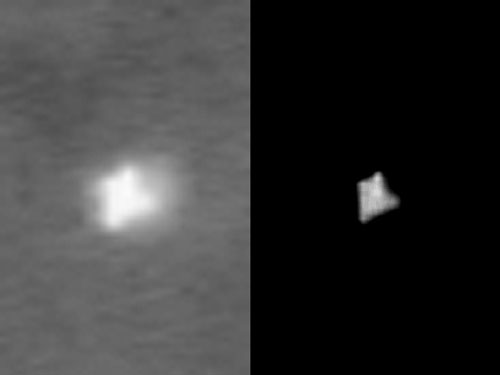
Suspiciously good pics of landing site from orbit
Is it just me, or has anyone else been very puzzled by the pics that NASA released of Sprit's landing site? These were supposedly taken by the Mars Orbiter Camera on the Mars Global Surveyor.
I thought that the best cameras in orbit around Mars were those on the European Mars Express, with a top resolution of 12 metres/pixel, and yet here the Spirit lander, about 2 metres aross, is spread across about 10 pixels.
Something's not right... -
Can low-power corrupt memory?
I watched the press conference on NASA-TV and they talked about how the thing wouldn't go to sleep at night and so it got me to wondering about the low power question. Obviously they have the rover power off when power gets to a certain level, but what if that level is slightly off?
In other words, if the onboard CPU has enough power and continues to run but the memory doesn't have enough power, doesn't that cause all kinds of wackiness?
They keep talking about the data pointing to simultaneous faults... well, as programmers we know these are the very worst kinds of bugs to deal with, but with something as (I'm assuming) well written as their code, so doesn't that point to a memory problem? I mean, the think is working flat-out beautifully one moment, and then the next moment it goes tits up.
The other question I had concerned this motor they had turned on but which didn't complete its sequence. When they command the motor to do something, do they tell it to run for some interval of time, or do they tell it to achieve a specific position? I was thinking that if it's the latter, and then if it gets stuck somehow, this could create the low power situation as the motor just grinds away. -
Rover is coming back online
linky
2004 News Releases
Artist's concept of Mars Exploration Rover
Related Links:
+ NASA's rover page
Mars Exploration Rover Mission Status
January 23, 2004
5 pm PST
NASA's Spirit rover did not go to sleep today even after ground controllers sent commands twice for it to do so.
Shortly before noon, controllers were surprised to receive a relay of data from Spirit via the Mars Odyssey orbiter. Spirit sent 73 megabits at a rate of 128 kilobits per second. The transmission included power subsystem engineering data, no science data, and several frames of "fill data." Fill data are sets of intentionally random numbers that do not provide information.
Spirit had not communicated successfully through Odyssey since the rover's communications difficulties began on Wednesday.
Spirit's twin, Opportunity, will reach Mars at 05:05 Universal Time on Jan. 25 (12:05 a.m. Sunday EST or 9:05 p.m. Saturday PST) at a landing site on the opposite side of the planet from Spirit.
JPL, a division of the California Institute of Technology, Pasadena, manages the Mars Exploration Rover project for NASA's Office of Space Science, Washington, D.C. Additional information about the project is available from JPL at http://marsrovers.jpl.nasa.gov and from Cornell University, Ithaca, N.Y., at http://athena.cornell.edu. -
Re:Landers
Actually
-
Re:Maybe not so
-
Good News for SpiritSpirit's better off right now than yesterday's press release. See:
http://marsrovers.jpl.nasa.gov/newsroom/pressrele
a ses/20040123b.html -
Re:Nice news...
The face was one of the first targets for Mars Global Surveyor. Too bad it just looked like a face.
-
More news
By increasing the digit at then of of this http://www.jpl.nasa.gov/releases/2004/30.cfm, you can get more news.
This one above is somewhat upbeat. The data rate from this last communication went from 10 minutes at 10 bits per second to 20 minutes at 120 bits per second.
Not quite live streaming, but not yet slashdoted either. -
Clickable link and textJPL has an update
Updated Mars Exploration Rover Mission Status January 23, 2004
The flight team for NASA's Spirit received data from the rover in a communication session that began at 13:26 Universal Time (5:26 a.m. PST) and lasted 20 minutes at a data rate of 120 bits per second.
"The spacecraft sent limted data in a proper response to a ground command, and we're planning for commanding further communication sessions later today," said Mars Exploration Rover Project Manager Pete Theisinger at NASA's Jet Propulsion Laboratory, Pasadena, Calif.
The flight team at JPL had sent a command to Spirit at 13:02 Universal Time (5:02 PST) via the NASA Deep Space Network antenna complex near Madrid, Spain, telling Spirit to begin transmitting.
-
Re:750 bytes
according to the latest on NASA's marsrover webpage, an additional communication session of ~20 minutes occurred with transmission at 120 bits/sec... hopefully this information will help determine what happened to the Spirit rover 2 days ago...
-
Re:Scientific point of view
Yeah, I am not a Scientist (I just play one on Tv...jk), but I think this is becomming a "Tag-Team" publicity show between NASA and European Space Agency. I mean them no disrespect, as they both have accomplished a tremendous amount and are trying to garner the interest of space in younger generations, but it seems a little "fake" to me as an adult.
I mean, like the parent poster explained, water was always expected and to some extents already discovered. A good read can be found at:
here -
Contact w/ Spirit
Good News for NASA, Bad news for Brits. NASA had 20 minutes of connection at 120b/s with spirit.
-
better newsThe latest update seems to indicate that they may be on track to getting back working
They just need to stay away from the STOP+A keys -
Re:Lowell said that 120 years ago>When he saw the water channels on Mars
thought it was canals that he thought he saw. Sure, channels would mean the presense of water, but _canals_ would mean the presence of intelligent life.
Unfortunately, Lowell's descriptions were flawed. Slipher's methods were not sensitive enough to detect atmospheric water vapor. Contemporary astronomers Antoniadi and Hale disputed the geometrical patterns that he termed canals, and few believed them to be waterways.
-
More recent "successful" attempt......
-
WaterWell, honestly, I would be more than surprised if there is _NO_ water on Mars than the other way around..
Let's think about it: Water is Hydrogen Oxide -
and Hydrogen is the most common element in the universe.
So if you've got some Oxygen somewhere you're most likely to get some water then (bang!) -
Images prove there are martians.
Even though the martians finally did get Spirit it wasn't until after we got proof that they exist! Look at the Panoramic Camera Sol 014 images. In the last dozen images there are a bunch of blacked out spots where the martians were. Not only does this prove that there are martians, but it also proves that they are camera shy.
-
Money saver...
could they have saved some money by simply reposting the pcitures from this site?
Or maybe, dun da daaaa, they already did but have just run out... -
remember pathfinder in 97?
- But a few days into the mission, not long after Pathfinder started gathering meteorological data, the spacecraft began experiencing total system resets, each resulting in losses of data.
Pathfinder in it's 1997 landing (04JUL1997) suffered a series of unexplained system failures. David Wilner CTO of WindRiver Systems, the creators of WxWorks the realtime embedded system kernel talked to IEEE Real-Time Systems Symposium at a later date explaining how they solved software bugs in the system.
- leaving the "debugging" facilities in the system saved the day
this article explains how they solved the problem - by including the debug code with the os. I remember reading about this on
Windriver systems is supplying the OS for the current mission. Lets see how long it takes them to work this one out
links:
www.kohala.com/start/papers.others/pathfinder.html
research.microsoft.com/~mbj/Mars_Pathfinder/Author itative_Account.html -
Re:No, didn't RTFA
-
"low tech" alternative?
Well, not exactly, but this one has no moving parts: Aerogel Clothing. Can't seem to find any prices for any of this stuff
-
Re:Common sense revolution
It's a nice peice of equipment, but it's not going to last for decades to come.
Parts are wearing out (two of the 6 gyros have already failed - and that's AFTER some of them have been replaced on shuttle missions), and it actually uses consumables (like orientation thruster propellant), so it always HAD a limited lifespan. In fact - it's projected life span is just about up.
There WERE plans to capture it, bring it home, 'refurbish' it, and redeploy, but the shuttle is required for this. It looks like Hubble will limp along for a little, but it's not expected to survive past 2007.
In fact, NASA has been planning on replacing it for decades - that was always the original plan. I don't know how much the James Webb Space Telescope has been affected by the shake up in NASA, but it's been meant to replace the HST for a while now. -
certainly the communications software.
given that NASA uses real player for their briefings, they're probably just stuck waiting for the "buffering..." message to finish.
-
No offence to the original submitter
But I like my writeup better
"ghettoboy22 writes "Multiple news services are reporting the Martian Interplanetary Defence Force (MIDF) has successfully captured an extraterrestial craft codenamed "Spirit" on the outskirts of a small village in Lower Gusev province two days ago, coming on the heals of the successful downing of another invasion craft last month. Speculation has insued from Spirit's handlers on Earth who are suggesting the craft was hit with the much feared Martian "Cosmic Ray" computer viri, causing it to speak nothing but jibberish. No worries though - our buddies will have their work cut out for them when Spirit's sister-ship "Opportunity" makes it's decent from Martian orbit in T minus 58 hours!"" -
Check it out...I found this not too long ago... It's a simulated bird's eye view from MER-B or the Opportunity Rover looking at Mars. It's supposed to land at around 9 PM PST on January 24.
I sure hope this does better than some of the others so far.. Otherwise we might already know it's fate.
-
Spirit Rover vs Arches Nat'l Park (Moab, Utah)The USA Today article Imprint shows Mars craft landed in 'weird stuff' describes "The soil was stripped up and folded in an interesting way," said Jim Bell, who designed the panoramic camera that Spirit used to photograph the "mud-like" patch. "It has quite alien textures."
Might this soil crust on Mars be same/similar to the LIVING biological soil crust found at Arches National Park (Moab, Utah)?
Additional details regarding biological soil crusts maybe are to found here:
Hello NASA JPL
Earth-to-NASA JPL
Hello?
-
This is news?Harrison Schmitt, who happens to be both an Adjunct Professor at Wisconsin as well as a former Apollo astronaut has been harping on this for years (since the mid-70s).
I'm not sure why this warrants an article now, seeing that no real developments on the topic have happened in a long time...
-
Re:Really?
That's not entirely true. Apparently there's been some success in using more exotic materials such as plastics. NASA actually has a website on the subject.
-
Duh - The shovel's been done before
-
CCDs *are* B&WCCDs are inherently black and white. Two main methods for capturing color data are 1) using alternating color filters (as is done on MER Spirit's Pancam) and 2) using a single patterned filter overley on top of the CCD (like most consumer digital cameras).
Here are some good links (from the site mentioned in the sig below) to read about the Pancam, including its various filters:- NASA Info on Pancam
- Athena Pancam Info
- Athena Pancam Technical Briefing
- Planetary Society Pancam Info
For news, status, updates, scientific info, images, video, and more, check out:
(AXCH) 2004 Mars Exploration Rovers - News, Status, Technical Info, History. -
Re:Permanent Fliers
Yeah. This is a very cool technology that looks like a low-cost, low-latency alternative to geosynchronous satellites.
Nasa is apparently working on something similar. -
Re:Permanent Fliers
Yeah. This is a very cool technology that looks like a low-cost, low-latency alternative to geosynchronous satellites.
Nasa is apparently working on something similar. -
screw aerogel, what's up with this @#$(%?
Take a look at the aerogel picture again:
here
What's up with that shit? Is it a man or a woman??? Long fingernails, but hairy like crazy!!! -
Local satellite replacement.
Nasa's project Helios (the unmanned solar-powered "flying wing") has had a similar Idea behind it:
Why clutter geostationary orbit when you can have unmanned planes circling metropolitian areas? Using solar power, these flying relays could operate nearly indefinitely at a fraction of the price.
The biggest problem that remains: What to do at night, when there is no sun powering the Solar Cells? Helios used Fuel Cells for backup power, but the technology is not yet advanced enough to sustain flight for longer than ~1 week. -
trollzzz
Mars confirms! We are lucky on earth with the dust we have, we look on this as a big step in cleaning-industry and never before have people been this happy.
Given the current information we estimate that we will be able to travel to pluto in 3 years time.
In other news, SUSE is doing stuff! -
Re:R-factor?I'm just curious as to what the R-factor would be. The article does not specify this.
Based on the many images I've seen like this one, the R value is high enough not to matter--any pieces thick enough to survive the rigors of construction would provide stunningly effective home insulation.
On a more serious note, the properties of aerogel depend very strongly on the conditions under which it is prepared. There are all manner of tradeoffs that can be made with respect to mass density, insulating properties, and mechanical strength. The other estimates on this thread to the effect of R-200 to R-400 per inch are probably in the right ballpark, however.
For those who are interested, there's some more excellent aerogel photos here.
-
Re:Amazing stuff...
Google for 'aerogel' and you'll find a couple of companies that produce it commercially. The cost according to NASA (here) is about $1 per cubic centimetre for a litre's worth, so $1000 for 1000cm^3 of the stuff.
-
Re:It is subject to shattering, catasrophicallyThis concerned me, too. How is it that a material susceptible to catastrophic failure is used to catch dust moving at insane speeds into it? One would think that in space it would be almost effortless to make it shatter.
This is a picture from an experiment using "a special air gun, particles are shot into aerogel at high velocities. Closeup of particles that have been captured in aerogel are shown here. The particles leave a carrot-shaped trail in the aerogel". (source)
-
Re:It is subject to shattering, catasrophicallyThis concerned me, too. How is it that a material susceptible to catastrophic failure is used to catch dust moving at insane speeds into it? One would think that in space it would be almost effortless to make it shatter.
This is a picture from an experiment using "a special air gun, particles are shot into aerogel at high velocities. Closeup of particles that have been captured in aerogel are shown here. The particles leave a carrot-shaped trail in the aerogel". (source)
-
Re:Where to buy?
According to the NASA/JPL Aerogel FAQ linked further up the page, aerogel costs about $1 per cc in 1 litre quantities. Since 6 cubic inches is 98.322384 cc, $160 seems a little over priced.
-
Re:Amazing stuff...
The pictures are amazing. Wow. http://stardust.jpl.nasa.gov/photo/aerogel.html
-
Re:dude
"Silicon has been produced in the lab from simulated lunar soil (natural terrestrial anorthosite, similar to that found in the lunar highlands) at purities acceptable for solar cell production."
Thus spake NASA.
Looks like someone isn't as smart as he thinks he is. Be a gent and acknowledge you were wrong. -
more on aerogelI have a friend who works on this. Here is a NASA newspaper article on her work; here is her website, showing aerogel in many different configurations. If you want to know more about it, you could always drop her a line.
While I'm sure aerogel has many pracitcal uses (trying not to fall asleep here), the "cool" factor is also very high. I've seen some of her samples, and everything the article says is correct. It's so light it feels like the wind could take it; in fact, if you drop it in water, I think it dissolves. Since the material is so expensive, it's obviously something you don't want to do, since every last piece is precious.
As you might imagine, a material that's ultra-light and 'holographic' has artistic applications, too. The "brain" image made it onto the cover of Nature neuroscience, and wouldn't look out of place in a design magazine. When you see it up close, the image seems to be 'embedded' in the material, even though it's so light you could easily crush it with your hand. The airiness and delicacy of the material makes the image that much more striking.While we're all attuned to the utilitarian value of materials like this, it's always neat to see what people outside of engineering can do with them.
-
What people don't know about aerogel
Here's a nerdy factiod about aerogel that might help your processor speed.
There has been some close research into using substances like aerogel to improve processor speeds. Apparently the substances can be used as very efficient insulators between traces and components. This is because aerogel and substances like it are mostly made of air, which has a very high dielectric constant so aerogel itself is a very good insulator.
It's better described here -
Photos
Some cool shots.
-
It is subject to shattering, catasrophically
The article doesn't touch on it, but the NASA FAQ mentions this unique property...
Q: What happens if I touch it?
A: Silica aerogel is semi-elastic because it returns to its original form if slightly deformed. If further deformed, a dimple will be created. However, if the elastic limit is exceeded, it will shatter catastrophically, like glass. -
Re:balsa wood in the right structure can do as mucHere is brick-on-aerogel picture. Looks quite cool.
-
Re:R-factor?
Not sure if all Aerogels are created equally, but this is from 1999 NASA article on Aerogel:
"A single one-inch thick windowpane of silica aerogel is equivalent to the insulation provided by 20 windowpanes of glass (R-20 insulation factor)."
--
For news, status, updates, scientific info, images, video, and more, check out:
(AXCH) 2004 Mars Exploration Rovers - News, Status, Technical Info, History. -
Aerogel FAQ
Very good Aerogel FAQ.
--
For news, status, updates, scientific info, images, video, and more, check out:
(AXCH) 2004 Mars Exploration Rovers - News, Status, Technical Info, History. -
Aerogel Facts and a PictureSome facts, from JPL Aerogel site:
- It is 99.8% Air
- Provides 39 times more insulating than the best fiberglass insulation
- Is 1,000 times less dense than glass
- Was used on the Mars Pathfinder rover
--
For news, status, updates, scientific info, images, video, and more, check out:
(AXCH) 2004 Mars Exploration Rovers - News, Status, Technical Info, History.