Slashdot Mirror
Domain: nasa.gov
Stories and comments across the archive that link to nasa.gov.
Comments · 16,365
-
Spirit Rover Picture(s) Hint @ Life on Mars???The USA Today article Imprint shows Mars craft landed in 'weird stuff' describes "The soil was stripped up and folded in an interesting way," said Jim Bell, who designed the panoramic camera that Spirit used to photograph the "mud-like" patch. "It has quite alien textures."
Might this soil crust on Mars be same/similar to the biological soil crust found at Arches National Park (Moab, Utah)?
Additional details regarding biological soil crusts maybe are to found here:
-
Re:Scrapping shuttlesA cause for concern is in the last paragraph:
"Sources said Bush will direct NASA to scale back or scrap all existing programs that do not support the new effort"
What about the exploration of the (possible) oceans on Europa? The rest of the solar system? The Terrestrial Planet Finder?
There's more to space than Mars.
-
Re:let's get this out of the way first
There is no ice on the moon?
-
Re:let's get this out of the way first
nasa has a plan for a lander on europa complete with a sub-ice probe that's been sitting on the backburner for years.
I wouldn't even call these plans; at the moment, the only Europa-relevant mission currently under consideration by NASA is the Jupiter Icy Moons Orbiter (JIMO). Unfortunately, as its name implies, JIMO won't have a lander facility. The mission, if it goes ahead, will be launched no sooner than 2011.
-
Yeah, but Mars is warming too...
I've said this before, but I still think we give ourselves too much credit. I think we are seeing the results of much larger cycles in the sun that we do not fully understand.
Why?
Because Mars is experiencing global warming too.
Don't get me wrong, I think we are trashing the environment, and that if we don't do something about it, it will come back and bite us in the ass as a species, but I don't think it is a given fact that global warming is a direct result of our actions. There is simply too much we don't understand. -
Re:let's get this out of the way firstwhy spend money and time going to mars?
nasa has a plan for a lander on europa complete with a sub-ice probe that's been sitting on the backburner for years.
if dubya is going to spend money on the space program that's a worthwhile project!
-
Re:When will we send higher-resolution cameras?
"In 2005, NASA plans to launch a powerful scientific orbiter, the Mars Reconnaissance Orbiter. This mission will focus on analyzing the surface at new scales
-
Re:Yeah sureActually, global warming was first predicted over 100 years ago by Svante Arrhenius, he of the Arrhenius equation. Now, there are a lot of things that we don't know about how our planet's climate works. But we do know that:
- CO2, CH4, etc., do trap longwave radiation (the greenhouse effect)
- Atmospheric concentrations of these gases are increasing due to human activity
It's also not noted very often that, as much of our emitted CO2 ends up in the oceans (by increasing atmospheric concentrations we introduce an imbalance in the carbon cycle), we are lowering the pH of the ocean (CO2 + H20 -> H2CO3 -> HCO3- + H+. Expect it to drop by 0.5pH or so over the next century or so (that figure is from memory, I may be off, but not by a lot). That scares the crap out of me.
-
Re:"We can find it if we know where it is!"
Uh, this is the same resolution as the currenct MSG. From the article:
"Normally it can resolve features only down to about 3 feet (1 meter) per pixel, not good enough to discern a typical landing craft from its surroundings."
They got the additional resolution needed to see the landers by using a funkey trick, something about pitching the spacecraft at a faster speed... not very well explained in the article. But it gives a single-dimension resolution of ~20 inches/pixel.
The MSG actually only has a resolution of 1.5 meters/pixel, if the information here is correct. So The Mars Recon Orbiter camera will be a bit of an improvement, if they use the same resolution-enhancing trick. But it will only make the dot a little bigger... I doubt it will be able to confirm that the dot actually is a lander. Although, the HiRISE will have a 1-2 ft/pixel resolution at near-infrared. This could be be enough to almost make out something... -
Re:"We can find it if we know where it is!"
Uh, this is the same resolution as the currenct MSG. From the article:
"Normally it can resolve features only down to about 3 feet (1 meter) per pixel, not good enough to discern a typical landing craft from its surroundings."
They got the additional resolution needed to see the landers by using a funkey trick, something about pitching the spacecraft at a faster speed... not very well explained in the article. But it gives a single-dimension resolution of ~20 inches/pixel.
The MSG actually only has a resolution of 1.5 meters/pixel, if the information here is correct. So The Mars Recon Orbiter camera will be a bit of an improvement, if they use the same resolution-enhancing trick. But it will only make the dot a little bigger... I doubt it will be able to confirm that the dot actually is a lander. Although, the HiRISE will have a 1-2 ft/pixel resolution at near-infrared. This could be be enough to almost make out something... -
Re:Chalk one up to American quality!
Yeah, I don't think that ever happened. That would require landing on mars which we have all seen is difficult in itself but would also require taking back off from Mars. That would probably be more difficult then landing. It would require making it land with enough fuel to take off and get back to earth making it much more dangerous. It would also require more then twice the amount of fuel then a one way mission would. And if it costs near 100 million to take off from earth just think what it would cost to take off from mars.
I seem to remember reports of fossilized bacteria found in meteorites or something like that. I really doubt that it was from mars.
No, actually the scientists did think the meteorite was from Mars. Here is one story.
And here is NASA's take on it. As I said, I was confused and after thinking about it a bit realized that this had to be the only instance of Mars rocks, for the reasons described. By the way, it would not take twice as much fuel to bring rocks back from Mars because Mars gravity is 0.11G. It's quite a bt tougher than bringing back moon rocks, but it could be done in theory. I had thought that perhaps we could send a probe to mars that was capable of taking off later, but we have not done that yet.
-
Re:"We can find it if we know where it is!"That said, this is pretty damn cool. Hopefully the next mission will have even better resolution cameras, and we can get a better view.
The Mars Reconnaissance Orbiter launching in 2005, arriving in 2006 will have a higher resolution camera called HiRISE. 1-2 meters/pixel.
-
Re:"We can find it if we know where it is!"That said, this is pretty damn cool. Hopefully the next mission will have even better resolution cameras, and we can get a better view.
The Mars Reconnaissance Orbiter launching in 2005, arriving in 2006 will have a higher resolution camera called HiRISE. 1-2 meters/pixel.
-
Re:QuickTime on 20% of the PCs sold in the US
Wow - that IS impressive.
I have always prefered Quicktime over Real or Windows Media, even before I bought a Mac. I would love to see more Quicktime content.
NASA and JPL have some very COOL Quicktime of their rover EDL. -
NASA
Much better luck loading with the story at NASA's site, including an MPEG version of the animation.
-
Re:This is Crippleware!
Do you think that they will have another Robotics Course again? I really enjoyed the Rio Tinto analog study and the whole MARTE project in general.
-
Re:This is Crippleware!
Do you think that they will have another Robotics Course again? I really enjoyed the Rio Tinto analog study and the whole MARTE project in general.
-
Re:Not to flame, but "NO SHIT!"
Because it's very, very hard to identify a planet as small as Jupiter. Jupiter is big for our system, but small compared to some of the behemoths that have been discovered (like HD 168443 c). However, if he looked at the list I just linked to, he'd know that a few rather small planets (probably still Jovians, but smallish ones) have been identified.
-
Re:rovers in museums
That would be the Personal Exploration Rover. Here's the press release. -
Re:What about the US?The Vikings both went for about 4 years if I recall.
The Viking 1 lander touched down on 20 July 1976 and operated until 13 November 1982 when "a faulty command sent by ground control resulted in loss of contact" (doh!).
The Viking 2 lander touched down on 3 September 1976 and operated until 11 April 1980 when its batteries failed.
-
Re:Interseteller ProbesFrom NASA:
Eventually, the Voyagers will pass other stars. In about 40,000 years, Voyager 1 will drift within 1.6 light years (9.3 trillion miles) of AC+79 3888, a star in the constellation of Camelopardalis. In some 296,000 years, Voyager 2 will pass 4.3 light years (25 trillion miles) from Sirius, the brightest star in the sky . The Voyagers are destined--perhaps eternally--to wander the Milky Way.
This answers the question of what advances are needed. Basically, we need either laser-powered solar sails, or we need antimatter propulsion. Even then, the trip would still take a long time and be enormously expensive. -
Re:HOLD THE PHONE
That works on linux, developed in the helix community.
Boy, works on linux is the catch, isn't it?
The helixplayer open source project has a Milestone build, which you can no longer download, as it's pretty old. They have a nightly builds page, though.
I tried the latest Developer Release (DR5). First I tried playing some Real 10 Video. First I tried the Paycheck trailier. The command line client failed with an X error. The GUI client said (here it comes) "Buffering", then hung at different percentages, and crashed for all the other videos on that page. When I say hung, I don't mean stuck waiting for network; the GUI refused to update any further.
helixplay refused to play an mpeg (it didn't crash or anything... it just wouldn't do anything when you click "Play"). splay crashed on an mpeg. Both did play new codeced audio streams and mp3s, though. splay managed to play an older RealVideo stream (in this case NASA TV), but helixplay hung as usual.
Then I tried the latest nightly build (20040107). That one performed exactly the same.
There is another project that provides a plugin to realplayer 8 for playing real 10 content under linux, but finding those files is as hard as finding files on the real.com site. The "binaries" link takes me to a license agreement, but accepting that only led to an error page. Clicking binaries again, and agreeing again takes me to a blank page.
So, can you play Real 10 content in Linux? If you were trying really hard to be optimistic, you could say "not yet", I suppose. -
Picture(s) Hint @ Life on Mars???The USA Today article Imprint shows Mars craft landed in 'weird stuff' describes "The soil was stripped up and folded in an interesting way," said Jim Bell, who designed the panoramic camera that Spirit used to photograph the "mud-like" patch. "It has quite alien textures."
Might this soil crust on Mars be same/similar to the biological soil crust found at Arches National Park (Moab, Utah)?
Additional details regarding biological soil crusts maybe are to found here:
-
Re:Price Vs Performance
Um... You're forgetting Sojourner.
-
Re:next time
NASA's Spirit actually sent telemetry tones back to the Odyssey orbiter as it started decending through the martian atmosphere. They meant things like:
- "I have entered atmosphere and everything seems to be in order"
- "I have started to bounce on the martian surface"
- "I have stopped bouncing on the surface and is still alive"
etc...
It might still not be able to easily pinpoint where it crashed if it had done so, but it would at least work like a primitive "black box" doing the best it can to tell what went wrong. Since this is obviously also good to know to learn from mistakes.
Read more here. -
Re:The best one I've seen
15C on air? You must live at the North Pole, since no amount of air cooling will lower the temperature of the CPU below the room temperature.
Amazing. It is possible to grow up without ever being exposed to the concept of wind chill factor. Admittedly, getting it to work inside a computer case is going to create a significant amount of noise, but if that's a tradeoff you're willing to accept... -
Nut (as in bolt)
Has anyone else noticed there seems to be a shiny nut (as in bolt) in http://photojournal.jpl.nasa.gov/jpeg/PIA04995.jp
g ?
It's in that lower left section that is sticking out at the bottom. You can see it's reflecting light.
Is Spirit falling apart or have we found a clue as to what happened to Beagle2?
-- Rob -
And so it begins...
The destruction of another planet in the name of humankind. Am I the only one that thinks it's sad that we're already destroying off-world natural resources?
-
Pipe sticking up from the ground in one image
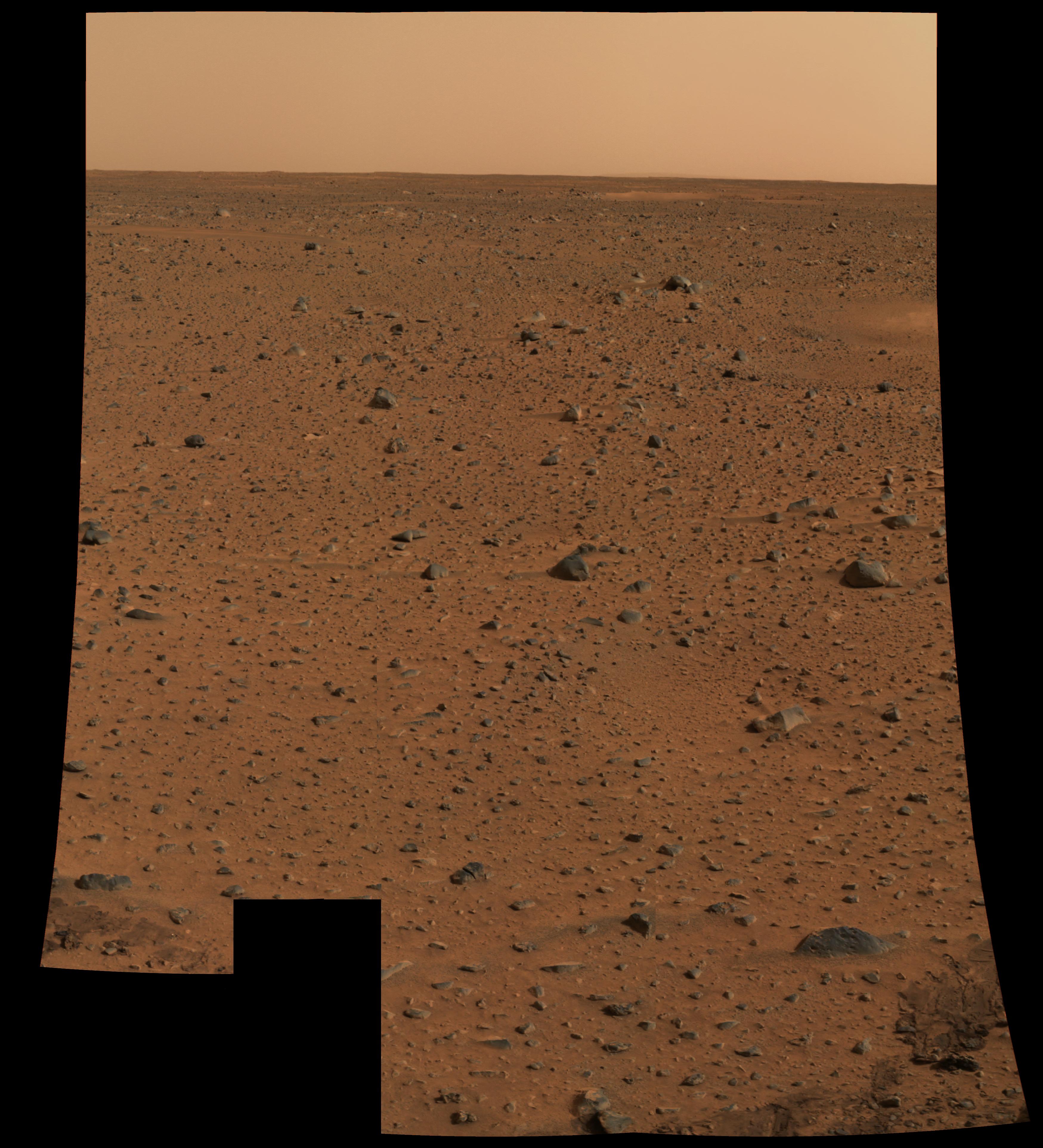
In the high resolution image of the martian horizon in the lower left corner, in the wind trail, there is definately a pipe sticking up from in the ground. The wind trail does not seem damaged so it can't be from the landing.
Something has been here before... -
Re:The real Mars.
Am I missing something?
Nope. -
Re:I want to see an alien sky shot
-
Re:I want to see an alien sky shot
-
Re:other hi res planetary surface images?The MER pancam has a 1024x1024 CCD and a 16(deg)x16(deg) FOV, giving it
-
Re:other hi res planetary surface images?The MER pancam has a 1024x1024 CCD and a 16(deg)x16(deg) FOV, giving it
-
"Airbag marks"
This image shows marks in the martian soil (upper right) made by the Mars Exploration Rover Spirit's airbags during their final deflation and retraction. The picture was taken by the panoramic camera on the rover.
I do not know about anyone else, but that image looks a lot like a deflated airbag to me. The shadows definitely create that impression. The image gives one the impression that the airbag popped and did not retract properly. I guess we have begun to litter on Mars. -
Re:Martian weather
They proably made it out of aluminum because it's light and plastic would probably degrade faster.
Well, that, and the plaque is stamped on the back of the probe's high-gain antenna. Space & weight are at a steep premium on these probes, and there really isn't room to add an extra slab of metal for any non-scientific purpose, even if most people would find the gesture fitting.
By way of comparison, read about the Marsdial project, which does basically the same thing: mount a "frivilous" device onto one of the key components of the rover, done in a way that there's substantially no additional hardware (extra mass to require fuel, additional parts to possibly break down, etc).
Sentimentality is nice, but pragmatism is critical here.
-
Re:What are they censoring?
I don't think that is correct, at least according to NASA's Site
The entire rover only has 128 megs ram and 3 megs on rom.
-
Karma whoring
Full resolution JPG (3498 samples x 3851 lines)
-
high quality version here
for the tif version of this first color photo, head here. warning: 40mb!
i was watching CNN or Headline News and the NASA person they were interviewing said the compression ratio for this picture was 24:1, which is done by the rover before transmission. apparently, the ratio is adjustable and they are gearing up to take even better shots with less compression soon. -
On a related note, a question....
I first noticed these jack-o'-lantern faces on the propellant tanks of the cruise stage while taking a look at the craft with Celestia, and at first I was thinking it was just some humour on the part of the person creating the skin for Celestia. But then I saw the picture linked to above, and obviously it wasn't just the programmer having a lark. I haven't been able to find anything on the Web about who came up with the idea, and why, though. I've developed a pet theory of my own, which would be that they needed a certain amount of dark surface on the gold-foil-wrapped tanks to maintain the proper thermal balance, and decided to do something more catchy than just a big bulls-eye dot on them or something like that.
Anyway, anybody know just what the real story is, and whodunnit?
-
Pathfinder
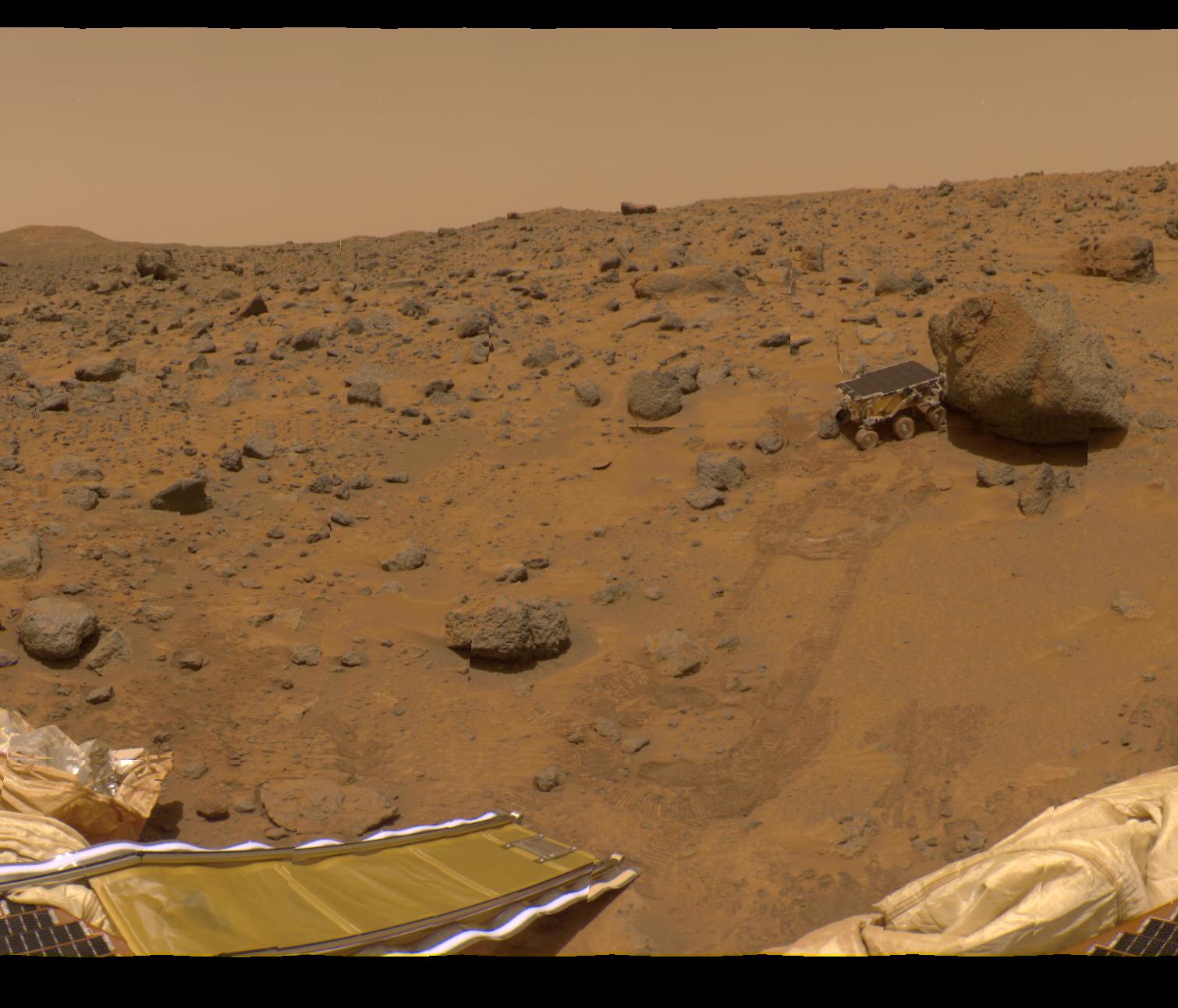
Well this really is a very different view of Mars than to what we are used to. Those rocks are very smooth, tho it could be the dustdevils that cause that over many millions of years rather than water. Apparently this landing spot has quite a lot of them. Wouldn't it be cool if it was caused by water eroson! It would be one of the biggest discoveries of the century.
For comparison, here is the Pathfinders landing site.
(*fingers crossed for Beagle 2 and the next NASA rover*) -
Burnt SkullTake a look at the first color image (~ 1mb jpeg). Scroll down about two-fifths of the way along the left edge of the picture.
Is it just me, or is there a burnt detached skull lying there?! Did the solid rockets broil a Martian on the way down? -
Re:Hmmm....
I remember that exact same reaction to the Viking landers back in 1976 when Dr Carl Sagan (1934-1996) was in charge of the Mars missions.
http://nssdc.gsfc.nasa.gov/planetary/viking.html
The Royal Institution had Dr Sagan run their Christmas Lectures for Children around that time. -
Re:Wrong file dates?...NASA keeps the images in "small", "modest", and "original 300 meg for scientific research" sizes.
Which you can find, respectively, at these locations:Although the description is more accurately stated "modestly sized jpegs, full size jpegs, and original tiffs." -
Re:Wrong file dates?...NASA keeps the images in "small", "modest", and "original 300 meg for scientific research" sizes.
Which you can find, respectively, at these locations:Although the description is more accurately stated "modestly sized jpegs, full size jpegs, and original tiffs." -
Re:Wrong file dates?...NASA keeps the images in "small", "modest", and "original 300 meg for scientific research" sizes.
Which you can find, respectively, at these locations:Although the description is more accurately stated "modestly sized jpegs, full size jpegs, and original tiffs." -
Re:Hmmmm.... Patterns....
Full size image here
-
Re:And you can see... rocks.
From the JPL website:
- Rover Speed
The rover has a top speed on flat hard ground of 5 centimeters (2 inches) per second. However, in order to ensure a safe drive, the rover is equipped with hazard avoidance software that causes the rover to stop and reassess its location every few seconds. So, over time, the vehicle achieves an average speed of 1 centimeter per second. The rover is programmed to drive for roughly 10 seconds, then stop to observe and understand the terrain it has driven into for 20 seconds, before moving safely onward for another 10 seconds.
Just click on the Technology button.
- Rover Speed
-
Re:And you can see... rocks.
From the JPL website:
- Rover Speed
The rover has a top speed on flat hard ground of 5 centimeters (2 inches) per second. However, in order to ensure a safe drive, the rover is equipped with hazard avoidance software that causes the rover to stop and reassess its location every few seconds. So, over time, the vehicle achieves an average speed of 1 centimeter per second. The rover is programmed to drive for roughly 10 seconds, then stop to observe and understand the terrain it has driven into for 20 seconds, before moving safely onward for another 10 seconds.
Just click on the Technology button.
- Rover Speed
-
Re:Where?
This landing was indeed staged!
Look at a picture from my back yard. Now compare to a released image. Sure, nothing similar there, NASA!