Slashdot Mirror
Domain: nasa.gov
Stories and comments across the archive that link to nasa.gov.
Comments · 16,365
-
All the images
-
Re:Better panaroma shot
-
Full Images
You can get the full quality version of these images and more here.
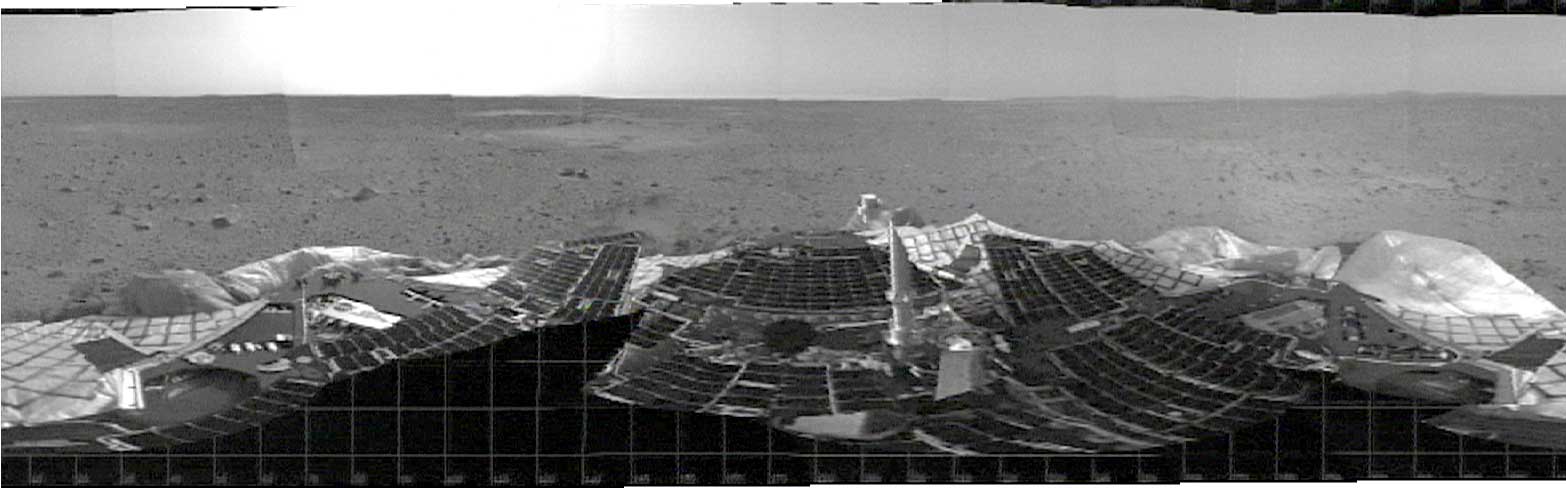
Great stuff so far! The landscape seems a lot flatter than where Pathfinder landed. -
Those aren't the real pictures...
These are the real pictures: First Pictures. It should be noted that these are black and white and not color or false color, as the submitter may lead some to believe, to that magazine's tweaking of the original.
-
Better panaroma shot
-
Re:FIRST ROVER IMAGE FROM SURFACE OF MARS!!!!!There's a whole bunch of them from the horse's mouth here.
Congratulations NASA!
-
Astronomy Picture of Day
APOD as usual as something, though at this time just an artist rendering. APOD should have some good actual pictures posted in coming days.
(Extral NFL Play-off SIG -
Re:First Hi-Res Images on Web
More medium-res images are available at the JPL press site.
-
First Hi-Res Images on Web
Hi-res images (that aren't just screencaps from NASATV stitched together) are starting to appear on the NASA press site. The first is here.
-
Latest Images from Spirit (as of 5AM EST)
Image 1 Screencap
Image 2 NASA Folks looking at image
Image 3 360' shot
Image 4 NASA Folks looking at 360'
Image 5 panorama
Image 5 Large larger panorama
Image 6 first image before contact
and if you havent noticed already just change # on the URL for the latest:
http://spaceflightnow.com/mars/mera/040104image #
Oh yeah, and I second the fact that NASA-TV should have made this a big event but:
a. What cable provider has NASA TV anymore, I think the general american public lost their space spirit (no pun intended) after the first few apollo missions.
b. Ok, so hypathetically, if it were a big event like, say, the first moon mission, and it failed horribly, that really wouldnt help the american general public moral, now would it.
I'm sure the CNN bit tomorrow will suffice for most people and as for those interested, check out this site for tons of images and some beautiful animations and video clips. -
Video
-
Video
-
Re:Not to mention Stardust!
Slashdot is on the Stardust microchip.
-
Re:Mars Rover Spirit Lands, Goes Radio Silent
And not to shoot myself in the foot by bogging down all feed....
Here's a bunch of feeds (mostly RealMedia) for live NasaTV on the web.
-Alex -
Re:NASA TV on DirecTV... Anyone? Anyone?RealAudio stream:
-
Re:Why bounce?
They do. Nasa has a nice description of the landing. They deploy parachutes, fire rockets, bring the thing to a halt about 40 feet up, and then cut the chute and drop it to the floor below. I would guess that this is to reduce the risk of the probe getting caught up in the parachute, but I honestly don't know.
-
Total Mission Bandwidth & Data Constraints
There is an interesting and informative entry on the NASA site regarding how much data can be transmitted back and forth between Earth and the rover:
http://marsrovers.nasa.gov/mission/comm_data.html
If we assume best case scenario for the transmission potential stated there and assume the direct-to-Earth rate averages the midpoint between the stated 12000bps and 3500bps, the total daily data for a single Martian day, direct-to-Earth and orbiter relay potential combined, is on the order of 17MB. The total data for the entire mission is on the order of 1,550MB.
Of course, this has to include protocol overhead, error, and operating instructions, but it provides one quantitative, if not qualitative, answer to how much data can be retrieved by the mission. In this case, a bit more than 2 CDs worth. -
Pick up the live stream on the net ...
http://www.nasa.gov/multimedia/nasatv/index.html is the starting point. At 12:50 AM Eastern they're streaming live in RealVideo.
-
Re:Software Updates for Images?!
What a poor design! They have to update the software in order to get new images? That's got to be the dumbest thing I've heard in a long time. Did they forget that the Internet exists where you can update images and indexes automatically? Sheesh.
Disclaimer: I'm a junior member of the Maestro Development team, however most of my work was on the mission version (SAP), not the public version.
The original specifications for Maestro (originally called WITS) contained an automatic updating client called MECS (Multimission Encrypted Communications System). I worked heavily on this the summer of 2002, and it was really great. It was going to work a bit like CVS in that it used deltas to transfer changes between versions of files, and had intelligent merging of XML content, etc. However due to funding constraints, the plug was pulled on MECS so there are no automatic updates.
There is a scientist version of SAP for use on personal computers that uses something called SAP-SYNC that automatically updates everything by comparing what's on client with server ahnd using LFTP, however it was theorized that the load on JPL's servers would be far to great to do that for all of our fans out there.
It was decided because of the massive budget cuts, little funding, and of course the fact that our staff has dropped down to all of three people to keep things simple. Doing things this way makes it possible to bittorrent things (I actually told them to bittorrent this for slashdotting about a year ago, however things have been so hectic here I"m not surprised they didn't!)
If you're interested in the design of MECS and how it was supposed to function, check out this paper.
As for the people complaining about the design, we don't really like it either! Write your congressman, get NASA outreach more funding, and we'll have things to really engage the population!
Cheers,
Justin Wick
Science Activity Planner Support Staff
Mars Exploration Rovers -
Not to mention Stardust!Did you happen to get your name on the microchip on stardust as well? Stardust Microchip Names
I believe there was also another microchip on another of the mars probes, where your name got on it if you were a member of the Planetary Society but I can't seem to find the link at the moment. I just vaguely remember printing out a certificate a few years ago.
-
Re:Great!I always visit this page and go down the sites they have listed where NASA TV is streamed. I usually have the best luck with either one of the KSC links, although a few times the Houston Cronicle stream has been reliable.
During high profile missions (like tonight), though, they tend to get swamped no matter where you go. I got kicked off a few times but was able to reconnected almost immediatly.
Beagle-2 and MER-A (Spirit) are not close enough together to do a search. MER-2 (Opportunity) also won't be close enough to Beagle-2.
You should consider downloading (for free) Mars24, which is a Java application that shows a map of Mars, and you can configure it to show you where all the successful landers (and Beagle-2) are located in relation to each other, plus where the Sun is shining, and other stuff.
-
Re:Great!I always visit this page and go down the sites they have listed where NASA TV is streamed. I usually have the best luck with either one of the KSC links, although a few times the Houston Cronicle stream has been reliable.
During high profile missions (like tonight), though, they tend to get swamped no matter where you go. I got kicked off a few times but was able to reconnected almost immediatly.
Beagle-2 and MER-A (Spirit) are not close enough together to do a search. MER-2 (Opportunity) also won't be close enough to Beagle-2.
You should consider downloading (for free) Mars24, which is a Java application that shows a map of Mars, and you can configure it to show you where all the successful landers (and Beagle-2) are located in relation to each other, plus where the Sun is shining, and other stuff.
-
Re:Take that Beagle 2!
Technically Beagle 2 did make it first.
Well, technically Viking made firstCrispin
----
Crispin Cowan, Ph.D.
CTO, Immunix Inc. -
Re:cool they finally did it
cool they finally did it they landed on the red planet
Ever hear of sojourner? -
It already has been
It already has been in development for some time at NASA
-
You can email the probe
With your probing requests at spirit@nasa.gov. Please, no spam.
-
NASA TV press conference
Press conference here at 9:30pm PST, so in about 25 min.
-
Re:Pretty cool but...According to the mission factsheet, it's supposed to fly into the comet on July 4th, 2005, making a crater that's potentially "the size of a football field."
What gives me a giggle about the thing, is whether or not it will be successful. I mean, look at the multitude of Mars missions that have attempted a landing and then failed and crashed. So, since we seem to be so good at crashing things, will "Deep Impact" be successful at crashing too? Or will it fail with a spectacular, "Damnit, we missed!" as the probe goes sailing back out into oblivion?
Elonka
-
Re:I was there
-
Re:I was there
-
Re:finaly!!
I personally like this one
it could be perceived as a superhero flying through a cloud, arm up, with a saved person in tow below
Yeah, sure.
-
Cool, reusable tech in Stardust probe
There's a nice PDF link which gives some excellent background on the Stardust mission.
Some points of interest for
1) They use Aerogel to collect the dust for return
2) The Dust Analyzer was based on a design used for the ESA's Giotto probe
3) The navigation camera used was left-over from the Voyager mission of 1977, combined with a left-over sensor head from the Gallileo mission launched in 1989
4) The CPU is a hardened version of the Macintosh PowerPC chip, known as the RAD6000, which runs at between 5 and 20 MHz. It has 128 Mb of RAM, and 3 Mb of PROM.
5) The operating system uses only 20% of its RAM for its own use -- the rest is dedicated to experiments, including 75 Mb for images from the navigation camera
6) The radio transponder is a relict of the Cassini mission to Saturn
Follow the first link for lots more nice tech details. -
Cool, reusable tech in Stardust probe
There's a nice PDF link which gives some excellent background on the Stardust mission.
Some points of interest for
1) They use Aerogel to collect the dust for return
2) The Dust Analyzer was based on a design used for the ESA's Giotto probe
3) The navigation camera used was left-over from the Voyager mission of 1977, combined with a left-over sensor head from the Gallileo mission launched in 1989
4) The CPU is a hardened version of the Macintosh PowerPC chip, known as the RAD6000, which runs at between 5 and 20 MHz. It has 128 Mb of RAM, and 3 Mb of PROM.
5) The operating system uses only 20% of its RAM for its own use -- the rest is dedicated to experiments, including 75 Mb for images from the navigation camera
6) The radio transponder is a relict of the Cassini mission to Saturn
Follow the first link for lots more nice tech details. -
Vietnam Memorial Names AboardA little-known fact is that this probe is also carrying a chip which contains all of the names from the Vietnam War Memorial in DC.
The idea that the names of those fallen soldiers are mixing with stardust today, has been giving me a warm fuzzy feeling.
-
Re:Today a comet, tomorrow Mars
-
Re:Today a comet, tomorrow Mars
-
Re:New Desktop Pictures for Everyone
Best wallpaper I've ever seen is this.
-
Re:Stardust Schmardust...
Beagle burned? This is BIG. There're Oxygen in mars's atmosphere!
Um, yes, there is. About -
Re:finaly!!
NASA's Astronomy Picture of the Day archive.
-
Re:Nerds chase tail, film at eleven
Just take a few extra moments, if you haven't already, to really look at the image, and realize this is one of the objects of wonderment that has been gazed upon by our ancestors, all the way back to the beginning of our history. And now it's right there in a close-up photo.
It really is amazing that we can not only see what that old thing really looks like, but also get to check out the stuff it's made from when the spacecraft gets back here in a couple of years.
Truly awesome. -
Re:This has been done before
I don't think Aerogel has been used to collect comet dust before. Or maybe you know different?
-
Re:This has been done beforeThe mission is important due to the sample return. There is no Solar Electric propulsion according to the mission website, it was performed by a standard monopropellant.
Perhaps you are thinking of the SMART-1 mission?
-
finaly!!
why use video when you can use......
http://stardust.jpl.nasa.gov/news/040102a.gif
ANIMATED GIFS!
seriously thats like the longest one ive ever seen. i could only get as far as the guy in the blue shirt and the old people in congress.
-
Re:Too much interference
It's a shame Hubble is our only orbiting telescope.
There's more to the electromagnetic spectrum than visible light you know. The Hubble Space Telescope is only one of NASA's four orbiting "Grand Observatories". Here are links to info about the other telescopes.
-
Ground vs. Space summary
Several people have commented that the money may be better spent on a space telescope. Here's why that may not be true:
Advantages of space:
* Extremely low light pollution and air absorption. This means you can see very dim things that may not be ever visible from the ground.
Advantages of ground:
* Initial cost is about 100-1000 times cheaper for same-sized primary
* Repairs and routine maintenance are possible without a $250 million shuttle launch
* Newer technology is possible, since it's less risky. Hubble uses a lot of electronics from the early 1980s.
Hubble cost $1.5 billion initially plus $0.25 billion per year (http://hubble.nasa.gov/faq.html) for a 2.5-meter telescope.
Since light-collecting power goes as the square of the diameter, a 100-meter telescope has 1600 times the light collecting ability of Hubble. So, if the celestial objects of interest are not background-limited, you can get the same quality image in 1 minute that would take Hubble a whole day to acquire. -
Re:Novice astronomer question
You mean like this one?
-
original articles
Better articles (no exploding stars) here and here (pdf).
-
original articles
Better articles (no exploding stars) here and here (pdf).
-
Not the first
If all goes well, the probe will return the material to earth for research in 2006-- the first extraterrestrial material captured from outside the moon's orbit.
Now don't forget about Genesis, which will (hopefully) be returning solar wind samples in late 2004.
AC.
-
Re:Just the usual...
The main use for such technology is a high-speed intercontinental bomber or reconnaissance platform. Not space launch. So far no other engine beats rockets for cost/efficiency when doing space launches.
That is odd, because NASA is researching scramjet engines for their Next Generation Launch Technology program. The X-43A is one project that is part of the Next Generation Launch Technology effort along with the X43-C. The X-43C hopes to be able to reach between Mach 7 and 10.