Slashdot Mirror
Domain: nasa.gov
Stories and comments across the archive that link to nasa.gov.
Comments · 16,365
-
Re:I'm confused.From the Near Earth Asteroid Tracking project FAQ:
If we were to discover tomorrow that a comet or asteroid is on an Earth- intersecting path, what could we do about it? What would you recommend doing about it?
Actually, some 100 bodies have already been discovered on orbits which take them so close to the Earth's orbit, that they could hit in the far distant future. This is because the orbits of these bodies change slowly with time. Although their orbits do not intersect Earth's orbit at present, they could hit in a few thousand years or more.
The scenario you have in mind is most likely to unfold as follows. In the course of our search for Earth-crossing asteroids, we could find one that will hit not in the next year, or even in the next ten years, but might hit in the next hundred years. We believe that the chance that we will find such an object is only 1 in 1,000, even after a complete search. If we do find such an object, we will have plenty of time to track it, measure its orbit more precisely, and plan a system for deflecting it from its current orbit (hopefully away from the Earth's). There will be no great hurry, and no great panic. It would be a project for all the world's nations to take part in. It could be a globally unifying event. Because we will have found it long before it actually hits the Earth, it probably would take only a small impulse (chemical rockets, or perhaps mass drivers) to divert it from a threatening path.
There is a much smaller chance that we would find one that could impact in the next 10 years. The chance of that happening is 1 in 10,000. If this were to happen, we would probably still have time to launch a crash program of scientific and technological research, with the goal of characterizing both the structure of the menacing asteroid, and the best means for diverting its orbit.
The least likely scenario is that we would find one that could hit in the next year. The chance is 1 in 100,000. In that case, there is probably little that we could do to divert it.
-
More information
More technical information is found in MAPLD Paper D1 and other reports. NASA Huntsville, NSA, USAF (Eglin), University of South Carolina, George Washington University, George Mason University, San Diego Supercomputer Center, North Carolina A&T and others have StarBridge Hypercomputers they are exploring for diverse applications. The latest StarBridge HC contains Xilinx FPFAs with 6 million gates compared to the earlier HAL-Jr with only 82,000 gates. Costs are nowhere near $26 Million. NASA spent approx 50K for two StarBridge Systems.
-
Crypto cracking applications?According to this this presentation, NSA are involved with two projects.
Going from 4GLOPS in Feb'01 to 470GFLOPS in Aug'02 for ten FPGAs, that's 120 times faster in little over a year. Not bad.
Any thoughts on what this means for crypto cracking capability?
-
Odyssey + Global Surveyor, not ObserverThe new finding is based on analysis of Mars Observer readings [...]
Forgive the nitpick, but the Mars Observer wasn't involved in this. It was a combination of data from Mars Odyssey and Mars Global Surveyor. Observer isn't even mentioned in the article...gotta proof-read those submissions, folks.
Contact was lost with Observer shortly before it was to enter orbit around Mars.
See JPL/NASA for more information on the 2001 Mars Odyssey and Mars Global Surveyor
-
Odyssey + Global Surveyor, not ObserverThe new finding is based on analysis of Mars Observer readings [...]
Forgive the nitpick, but the Mars Observer wasn't involved in this. It was a combination of data from Mars Odyssey and Mars Global Surveyor. Observer isn't even mentioned in the article...gotta proof-read those submissions, folks.
Contact was lost with Observer shortly before it was to enter orbit around Mars.
See JPL/NASA for more information on the 2001 Mars Odyssey and Mars Global Surveyor
-
Odyssey + Global Surveyor, not ObserverThe new finding is based on analysis of Mars Observer readings [...]
Forgive the nitpick, but the Mars Observer wasn't involved in this. It was a combination of data from Mars Odyssey and Mars Global Surveyor. Observer isn't even mentioned in the article...gotta proof-read those submissions, folks.
Contact was lost with Observer shortly before it was to enter orbit around Mars.
See JPL/NASA for more information on the 2001 Mars Odyssey and Mars Global Surveyor
-
Re:first spacecraft on Mars
From this page I'd say it was Mariner 3 or Mariner 4. HTH HAND.
-
Re:first spacecraft on Mars
One of the Mariners, I guess, but the CO2 data seems to date from 1969, not 1966. I don't know.
-
Re:Let me ask this...
I didn't mean to imply that bacteria was now spreading across the moon, just that bacteria was carried within our equipment and could live for years under very extreme conditions. Contamination that doesn't spread can still be a real problem if it invalidates an expensive mission because it can't be proven that the life forms weren't brought along. Here's a better article that gives more detail on the moon bacteria.
Perhaps the Murchison Meteorite was ejected from the Earth billions of years ago, in an asteroid strike, before left-handed amino acids had been eliminated? On the other hand, scientists have already simulated conditions in space to produce various amino acids showing that they can form 'spontaneously' space. So, instead of this meteorite showing that life exists elsewhere, maybe it just validates the latest theories. -
one step ahead of you...
That's an excellent idea... as many others have mentioned, contamination is still an issue; your method substantially reduces it however.
Large rocks are hard to collect; dust particles are much easier. A probe is currently out there collecting them in aerogel. -
Re:More Resolution != Better Telescope
However, better resolution doesn't have to be for imaging. There are a handful of optical interferometer projects (ground and proposed space) that have amazing resolution and are used for very narrow field of view imaging as well as astrometry. In this case, more resolution == better telescope (at least for its intended application). This is why, for instance, NASA has the JWST as well as SIM. Different scopes for different folks.
-
Re:More Resolution != Better Telescope
However, better resolution doesn't have to be for imaging. There are a handful of optical interferometer projects (ground and proposed space) that have amazing resolution and are used for very narrow field of view imaging as well as astrometry. In this case, more resolution == better telescope (at least for its intended application). This is why, for instance, NASA has the JWST as well as SIM. Different scopes for different folks.
-
Re:More Resolution != Better Telescope
However, better resolution doesn't have to be for imaging. There are a handful of optical interferometer projects (ground and proposed space) that have amazing resolution and are used for very narrow field of view imaging as well as astrometry. In this case, more resolution == better telescope (at least for its intended application). This is why, for instance, NASA has the JWST as well as SIM. Different scopes for different folks.
-
One serious question though
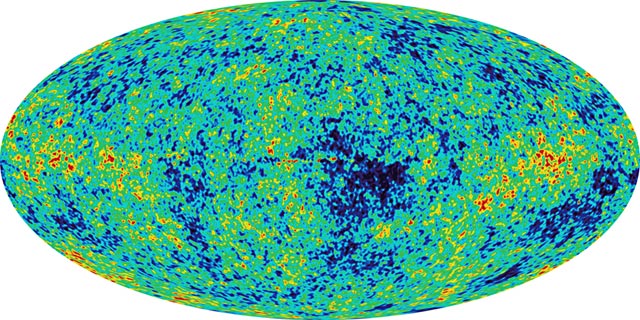
Why does the baby pic of the universe represent the (borders of the) universe in the shape our own planet?
Why this sudden geocentrism again?
There is an animation on the NASA website that starts with the global shape and ends up with sth totally different (namely the borders being that what we can see of it). -
One serious question though
Why does the baby pic of the universe represent the (borders of the) universe in the shape our own planet?
Why this sudden geocentrism again?
There is an animation on the NASA website that starts with the global shape and ends up with sth totally different (namely the borders being that what we can see of it). -
Astronomy Picture of the Day
The map (really big version too) is today's Astronomy Picture of the Day. Along with another good description of the findings with the typical excellent APOD links.
Go Apod!
M@ -
Possible Answer?
The density of the universe also determines its geometry. If the density of the universe exceeds the critical density, then the geometry of space is closed and positively curved like the surface of a sphere. This implies that photon paths diverge slowly and eventually return back to a point. If the density of the universe is less than the critical density, then the geometry of space is open, negatively curved like the surface of a saddle. If the density of the universe exactly equals the critical density, then the geometry of the universe is flat like a sheet of paper. Thus, there is a direct link between the geometry of the universe and its fate.
The simplest version of the inflationary theory, an extension of the Big Bang theory, predicts that the density of the universe is very close to the critical density, and that the geometry of the universe is flat, like a sheet of paper.
From http://map.gsfc.nasa.gov/m_uni/uni_101shape.html -
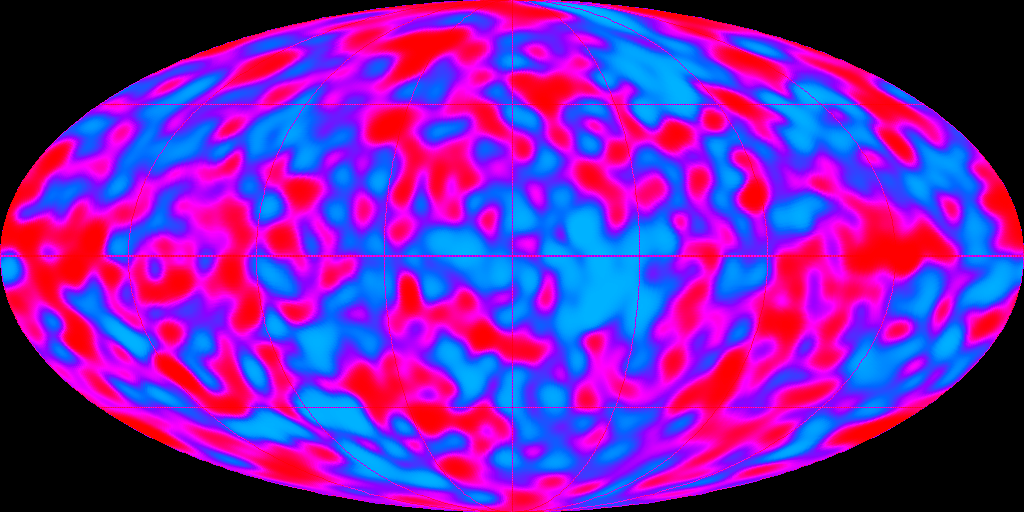
Good agreement with COBE
When I first saw the COBE map awhile back, a little part of me said, "Well, that's nice, but such subtle data from a single platform isn't much to go on." But now, the new image certainly does seem to correlate well with it. The similarities are graphically obvious, and the fact that those data were obtained independently from COBE's is what makes this announcement most significant.
-
Cheap Science vs. Expensive PorkFrom the launch press release
"MAP, an Explorer mission, cost about $145 million."
If I understand correctly...
Measuring the age of universe, calculating initial proportions of baryonic matter vs. energy, and deriving shape of universe: $145M.
Shuttle flight to install ISS module: $500M.
Shuttle flight to watch ants float in zero-G: 7 deaths, $500M for launch, $2.0B for new shuttle.
Your Congressional District's seat at the trough of Shuttle/ISS pork: "Priceless."
Now that I've bashed, some constructive criticism - cut NASA in half.
One half - NAA - I'll call the National Aeronautics Administration. Its job will be pure Aeronautics. Launch vehicles. Rockets. Engines. From pricy Shuttles to half-decent Shuttle-C heavy-lift modifications, to cheap expendables, to funky crewed vehicles like X-33, VentureStar, or DC-X.
The other half - N(whoops!) let's call it the NSSA - National Space Science Administration - will do science. Build probes. Stick 'em on rockets built by the NAA, or LockMart, Boeing, or Armadillo, and do some frickin' science.
Under such a scenario, we could have avoided the Shuttle/ISS debacle completely; NAA might have had concerns about losing funding once the last Shuttle was built, and probably would have had a significant incentive to keep asking Congress for funding to build newer, better, cheaper-per-pound launch vehicles.
Why? Because they'd be under competitive pressure from every other contractor under the sun building launch vehicles to launch NSSA's space probes. Perhaps NSSA would have come to the same mistake NASA did - and decided that we Really Needed a Space Station - but even if that were the case, the design requirements of ISS would have immediately mandated a heavy lift vehicle, wholly unlike the Shuttle.
In such a scenario, NSSA would have had the choice between building ISS with three FooCorp Big Dumb Booster flights, or 30-40 NAA Shuttle flights.
Unlike the current NASA monolith, in which both halves exist to feed each other, a separate NSSA would have been loathe to spend its hard-begged budgetbucks to use another government department's (i.e. "NAA's") Shuttle, particularly in the face of cheaper alternatives. (And likewise, NAA, seeing that it had no Shuttle customers, would have been forced to spend its hard-begged budgetbucks building the Shuttle's successor, or find itself on the Congressional chopping block.)
-
Other links
-
MAP Announcement Tuesday
-
MAP Announcement Tuesday
-
MAP Announcement Tuesday
-
The Real Story
My guess is that they are talking about the results from MAP. This is a satellite that was looking at the CMB. Unfortunately, this won't tell us one bit about dark energy. What it tells us about is the total matter-energy budget of the universe. But we've known that the universe is "flat" since COBE (the last satellite to look at the CMB).
The basic way at looking at cosmological parameters is this: CMB tells us about the geometry of the universe (Omega_total = Omega_matter + Omega_energy), clustering tells us about the matter content (Omega_matter), and supernovae tell us about the acceleration of the universe (Omega_matter - Omega_energy).
Only supernovae have given us direct evidence that the universe is accelerating. -
Re:Russians Can Help, But Can't Sustain ISS Alone
It showed technological superiority over the USSR
There was a Russian space shuttle. From http://liftoff.msfc.nasa.gov/rsa/buran.html:History
The Russian Shuttle Buran ("Snowstorm" in Russian) was authorized in 1976 in response to the United States' Space Shuttle program. Building of the shuttles began in 1980, with the first full-scale Aero-Buran rolling out in 1984. Test Flights
The first suborbital test flight of a scale model of Buran took place in July 1983. There were five additional flights of the scale model in following years. Aerodynamic tests of the full-scale Buran analogue began in 1984. This aero-Buran was worn out after 24 test flights and would not fly again. The last of these aerodynamic test flights was in April 1988. Orbital Launch
The first and only orbital launch of the shuttle Buran was at 3:00 GMT on November 15, 1988. The flight was unmanned, as the life support system had not been checked out and the CRT displays had no software installed. The vehicle was launched on the powerful Energiya booster into an 247 by 256 km orbit at 51.6 degrees inclination. The Buran orbited the Earth twice before firing its thrusters for reentry. The flight ended at 6:25 GMT when the vehicle touched down at Tyuratum. The Buran 1 mission was limited to 2 orbits due to computer memory limitations. Aftermath
Although the first orbital flight of Buran was unmanned, it demonstrated much promise. The autopilot that landed the shuttle was able to overcome a 34 mph crosswind to land within 5 feet of the runway center line. Also, of the 38,000 heat shield tiles that covered Buran, only 5 were missing. Cancellation
After the first flight of Buran, funding for the project was cut. Although the project wasn't officially canceled until 1993, much of the work was halted long before that date. There were two other Buran shuttles under construction. The second orbiter, "Ptichka" ("Little Bird" in Russian) was originally scheduled for completion in 1990. The third Buran was due in 1992. Neither was finished. In November 1995, the partially completed shuttles were dismantled at their production site. The manufacturing plant is scheduled to be converted for production of buses, syringes, and diapers. -
AF photographs were posted FridayIt takes a while to propagate this stuff!
Full size photo, which was linked to the Sensors and timeline There's also a page of general Columbia information.FWIW I've created an intereactive presentation of sensor readings.
-
AF photographs were posted FridayIt takes a while to propagate this stuff!
Full size photo, which was linked to the Sensors and timeline There's also a page of general Columbia information.FWIW I've created an intereactive presentation of sensor readings.
-
AF photographs were posted FridayIt takes a while to propagate this stuff!
Full size photo, which was linked to the Sensors and timeline There's also a page of general Columbia information.FWIW I've created an intereactive presentation of sensor readings.
-
Re:Of course they want it back!
The last thing NASA wants is for a l33t hax0r to deploy the landing gear while still in orbit!
The gear seems to be involved somehow, see http://www.nasa.gov/columbia/COL_sensor_wire_03020 7.pdf and http://www.nasa.gov/columbia/COL_image_030207.html
In short, it shows abnormal temperature increase around left gear, loss of sensors whose wires were placed close to the gear, then loss of sensors just on the gear. The photo shows shuttle outline with something where the deployed gear could be expected. -
Re:Of course they want it back!
The last thing NASA wants is for a l33t hax0r to deploy the landing gear while still in orbit!
The gear seems to be involved somehow, see http://www.nasa.gov/columbia/COL_sensor_wire_03020 7.pdf and http://www.nasa.gov/columbia/COL_image_030207.html
In short, it shows abnormal temperature increase around left gear, loss of sensors whose wires were placed close to the gear, then loss of sensors just on the gear. The photo shows shuttle outline with something where the deployed gear could be expected. -
Re:NASA blew it up!!!
You mean the range safety system? Sorry, well documented.
The NSDs provide the spark to ignite the CDF, which in turn ignites the LSC for shuttle vehicle destruction. The safe and arm device provides mechanical isolation between the NSDs and the CDF before launch and during the SRB separation sequence.
The mechanism is installed in the SRB's and the ET. Once away, there is no destruct capability documented. And why document one, but not another? -
I am Amazed
You might want to due a bit of reading before going into such a rant. The STS-107 page alone indicates the detailed level of monitoring in place. In fact Columbia had more monitoring points than the 'production' shuttles.
-
InsulationSo the ground camera's caught one hit from the external tank insulation, big deal. What is to say that more did not shed off before the tank was released? To put a fine point on this; it is not just the tile at risk. There is a system of gap fillers between the tile that have had problems with coming loose; specificly on Columbia in 1995
In Fact Columbia is different in regard to changes made in these gap fillers.
"A 1995 paper by NASA scientists estimated that 90 percent of all tile damage on the shuttle belly resulted from the foam "debonding" during liftoff and smacking into the craft. " Read for your self at NSTS
-
InsulationSo the ground camera's caught one hit from the external tank insulation, big deal. What is to say that more did not shed off before the tank was released? To put a fine point on this; it is not just the tile at risk. There is a system of gap fillers between the tile that have had problems with coming loose; specificly on Columbia in 1995
In Fact Columbia is different in regard to changes made in these gap fillers.
"A 1995 paper by NASA scientists estimated that 90 percent of all tile damage on the shuttle belly resulted from the foam "debonding" during liftoff and smacking into the craft. " Read for your self at NSTS
-
InsulationSo the ground camera's caught one hit from the external tank insulation, big deal. What is to say that more did not shed off before the tank was released? To put a fine point on this; it is not just the tile at risk. There is a system of gap fillers between the tile that have had problems with coming loose; specificly on Columbia in 1995
In Fact Columbia is different in regard to changes made in these gap fillers.
"A 1995 paper by NASA scientists estimated that 90 percent of all tile damage on the shuttle belly resulted from the foam "debonding" during liftoff and smacking into the craft. " Read for your self at NSTS
-
Three cheaper launch alternativesThe compelling problem that the space program should try to solve is that launching into space is just too damn expensive. Today it costs $5K to $10K to place one kilogram in orbit. At that price, space tourism and colonization are completely out of the question. Using its dying gasp of breath to dramatically lower the cost of launch would be the noblest, most valuable thing NASA could do. From that point on, space development would be picked up by Marriott and 3M, and political Brownian motion would be removed from the equation.
Tethers ( 1, 2, 3 ) attached to counterweights can be used to transfer spacecraft from one orbit to another. The first tether has an orbit that skims the atmosphere, where a craft catches and connects to the end of the tether. The craft is lifted into low earth orbit and subsequent tethers help it to reach escape velocity. Using the tethers takes energy out of the orbits of the counterweights, some of which can be put back by using the tethers for descent as well as launch.
J. Storrs-Hall (once moderator of sci.nanotech) envisioned a space dock, a linear motor suspended 100 km above the ground that accelerates spacecraft to an elliptical orbit. He computes an amortized cost of reaching low earth orbit of 42 cents per kilogram. From the elliptical orbit, it's a relatively small safe step to escape velocity.
A space elevator ( 1, 2 ) is an excellent long-term solution. A cable is hung from a weight in geosynchronous orbit, reaching down to the Earth's surface. The elevator climbs the cable, carrying a craft. When it reaches GEO, the craft detaches and spends only a little fuel getting to escape velocity.
Tethers and the space elevator require novel materials for strong cables, probably using carbon nanotubes. The frame to hold up the space dock is in compression, and something we could build with little or no advance in material science. Any of these alternatives would be vastly cheaper and vastly safer than putting human lives on the noses of fuel tanks subjected to unreasonable speeds and stresses.
-
Three cheaper launch alternativesThe compelling problem that the space program should try to solve is that launching into space is just too damn expensive. Today it costs $5K to $10K to place one kilogram in orbit. At that price, space tourism and colonization are completely out of the question. Using its dying gasp of breath to dramatically lower the cost of launch would be the noblest, most valuable thing NASA could do. From that point on, space development would be picked up by Marriott and 3M, and political Brownian motion would be removed from the equation.
Tethers ( 1, 2, 3 ) attached to counterweights can be used to transfer spacecraft from one orbit to another. The first tether has an orbit that skims the atmosphere, where a craft catches and connects to the end of the tether. The craft is lifted into low earth orbit and subsequent tethers help it to reach escape velocity. Using the tethers takes energy out of the orbits of the counterweights, some of which can be put back by using the tethers for descent as well as launch.
J. Storrs-Hall (once moderator of sci.nanotech) envisioned a space dock, a linear motor suspended 100 km above the ground that accelerates spacecraft to an elliptical orbit. He computes an amortized cost of reaching low earth orbit of 42 cents per kilogram. From the elliptical orbit, it's a relatively small safe step to escape velocity.
A space elevator ( 1, 2 ) is an excellent long-term solution. A cable is hung from a weight in geosynchronous orbit, reaching down to the Earth's surface. The elevator climbs the cable, carrying a craft. When it reaches GEO, the craft detaches and spends only a little fuel getting to escape velocity.
Tethers and the space elevator require novel materials for strong cables, probably using carbon nanotubes. The frame to hold up the space dock is in compression, and something we could build with little or no advance in material science. Any of these alternatives would be vastly cheaper and vastly safer than putting human lives on the noses of fuel tanks subjected to unreasonable speeds and stresses.
-
Re:Curious ignoranceWhat other answers could people give?
The correct answer, for instance. If you check this NASA site, you will learn that "On June 16,1963 Valentina Tereshkova was launched into space aboard Vostok 6" -
Re:Benford doesn't know what he's talking aboutYet another brilliant Anonymous Coward wrote:
Benford apparently isn't aware that centrifuge experiments *have* been conducted on the space shuttle. Or that Columbia was carrying a physiology experiment that would have done a lot for revealing just why exposure to zero-G causes orthostatic intolerance [inability to stand or remain standing].
The radius of the centrifuge obviously matters *a lot* if you're talking about having people live in them for long periods of time. The acceleration gradient of a centrifuge is really weird when you're near the axis: imagine a radical change in "gravity" when you stand-up or sit-down. Imagine "gravity" being stronger at your feet than at your head. The point of using the long tether gimmick is to get a flat acceleration gradient that more closely approximates a planets surface gravity.
Specifically, the 1998 STS-90 mission [Neurolab], among other things, studied how humans perceived centrifugal motion in the absence of an existing 1G gravity vector. This mission was designed to study the vestibular system, but others have looked at cardiovascular effects.
The long and the short is that it helps some, but the inertial problem is still sticky. Worse, it tends to make the astronauts sick. Losing track of your vertical tends to make your body do bad things.Take a look at the "off-axis rotator" they used in these Neurolab experiments. It's really *small*... no wonder if it made them sick: Astronaut Training for The Vestibular Team Experiments
A simple review of Pubmed/Medline would have showed all of this. But then, Benford's strength always was was fiction, wasn't it?
Gregory Benford's technical credentials are somewhat better established than yours, Anonymous: Gregory Benford Professor Plasma Physics and AstrophysicsActually, I've read his work. I don't think fiction's really a strong-point, either.
And, not that it's relevant or anything, but some of his fiction strikes me as being some of the best SF written in the last several decades (I'm a fan of "Across the Sea of Suns" myself). -
Re:TVOntario
If it weren't for curiosity, none of us would have left Africa some 6-7 million years ago.
That's an overreaching generalisation on an evolutionary process that took place, as you mention, 6-7 million years ago. While I'm not an authority on human evolution, I think it's fair to say that curiousity need not necessarily be the primary reason. The quest for food, for instance, could be one possible reason.
But all the same, your point about curiousity being a motivator for exploration raises an interesting point, albeit in a socio-cultural sense. One of the very interesting things about the history of exploration is that most explorers were European; there were very few Oriental explorers. Why didn't any Easterner "discover" Europe, just as Vasco da Gama "discovered" Goa in the late-16th century? As an old National Geographic article (can't remember the issue/year; sorry) once pointed out, European explorers needed the East; by the fifteenth century, the ancient Silk Route was closed by marauding invaders. The West needed to re-open a trade route to the exotic East to continue its import of spices, perfumes and tea. There were pecuniary benefits here; the explorers were, actually, entrepreneurs.
My point is simple:- projects such as the ISS or even the trip to Mars are all fine, inspiring and impressive, but as long as there's no real economic motive, I don't think space exploration can survive.
So, the question is, can space bring in the big bucks? Quite possibly, yes.
-
Re:Benford doesn't know what he's talking about
I think Benford had a much larger centrifuge in mind than either the STS90 or STS107 experiments.
Boeing designed a centrifuge module for the ISS that was a bit larger--2.5 meters or so, but it's not for human use. -
Re:Benford doesn't know what he's talking about
I think Benford had a much larger centrifuge in mind than either the STS90 or STS107 experiments.
Boeing designed a centrifuge module for the ISS that was a bit larger--2.5 meters or so, but it's not for human use. -
Links to Photo & Sensor Schematics
NASA's afternoon press conference today produced the Air Force photo and a helpful series of slides mapping the sensor failures over time.
-
Links to Photo & Sensor Schematics
NASA's afternoon press conference today produced the Air Force photo and a helpful series of slides mapping the sensor failures over time.
-
"Obsolete" computers...
The New York Times has done a great job of bungling the Columbia story completely. First it was their lock-on to the foam theory, which has been all but discounted by NASA over the past couple days. It could still resurface, but if NASA's engineers with all their sophisticated computer modeling don't believe it, I don't believe it either - and I certainly don't believe the Times' journalists are more capable engineers than NASA's are. Now it's all this talk about Columbia's "outdated" computers - the implication being this thing was too old to fly, and that technology has passed it by.
Problem is, Columbia has been overhauled three times in the past twenty years, most recently in 1999, when it had a brand new glass cockpit installed, its heat shielding and many other components upgraded, and every inch of its wiring inspected. This in addition to the upgrades during the two previous overhauls.
In reality, this was probably the newest shuttle in the fleet. Its computers, avionics, and heat shielding were second to no other shuttle - only the Atlantis, which is the only other shuttle to go through this latest overhaul, matched Columbia in technology. I therefore have a hard time believing the computers were responsible for this accident. I have a hard time believing the heat shielding was responsible for this accident too. These were not old tiles, and this was not outdated shielding technology.
My feeling is this will come down to human error, as most of these things do. From what I understand, one of the new parts installed on Columbia in 1999 was upgraded heat shielding on the leading edges of the wing. Who's to say there wasn't a microscopic crack in this new shielding that was not detected and failed after a period of time, similar to what caused the UAL DC-10 crash in Sioux City a while back (a microscopic flaw in an engine part went undetected for more than 10 years before it finally failed in spectacular fashion). Who's to say this shielding wasn't installed or maintained improperly? (I have a difficult time believing this, but then most accidents of this magnitude are the result of difficult-to-believe events.) Who's to say there wasn't a *software* bug in the *new* flight systems, which only a particular set of peculiar events brought out on this particular flight? (Say, a bit of yaw, which the system over-compensated for and led to an oscillation that eventually ripped the ship apart.)
In any case, the NY Times is on the wrong track with this, and the whole idea of the Columbia containing all this obsolete technology needs to be dropped. The Columbia had leading-edge technology where it needed it, reliable and proven technology elsewhere. That's the same combination every new aircraft or spacecraft built today aspires to have. There's nothing anyone could complain about with regard to Columbia's technology. -
Blame USAF - they compromised the shuttle designThe design of the Shuttle was compromised by the USAF requirements for a vehicle that could be launched, orbit once and land. the problem is that the USAF launched from Vandenburg for the polar orbits, which has a lot of water in the vicinity.
The original design that NASA were gunning for was for a vehicle that would come in steeper and then glide over a limited range to its target with two real wings. The advantage being that the vehicle would only be exposed for a short period of time to the heating effect. The shuttle would also land a lot slower with this design.
The USAF needed a longer glide range to operate from Vandenburg, so they could always get back to land, even after a single orbit. They pressed for a delta wing which allowed them to glive for about 2,500 miles. This disadvantge is that the shuttle must fly through reentry (rather than a controlled stall, that NASA wanted). This meant that reentry took a lot longer, with much greater exposure to heat.
-
Re:Carbon-carbon trouble-trouble?joseph schmo asked, "anyone know what carbon-carbon is?" Nasa conveniently answered that question here:
Reinforced Carbon-Carbon (RCC) is a light gray, all-carbon composite. RCC, along with inconel foil (metal) insulators and quartz blankets, protect the orbiter's nose, chin, and wing leading edges from the highest expected temperatures and aerodynamic forces. It also is used in the arrowhead area at the forward section of the orbiter where the external tank is attached. RCC is used there for shock protection during pyrotechnic separation of the external tank from the orbiter.
Fabrication of RCC begins with graphite cloth which is saturated with a special resin. Layers of the cloth are then laminated and cured, after which they are heat-treated to convert the resin into carbon.
After further processing, the material is treated with a mixture of alumina, silicon and silicon carbide to give it a grayish, oxidation-resistant coating, and then heated in a furnace. The orbiter's nose cap is fabricated as one piece while each of the wings has 22 seperate RCC panels and T- seals on the leading edge. Each panel is affixed to the orbiter's skin by mechanical attachments.
-
Re:Because they didn't plan for it
They did plan for it.
From Nasa's Human Space Flight pages:
The nominal maximum crew size is seven. The middeck can be reconfigured by adding three rescue seats in place of the modular stowage and sleeping provisions. The seating capacity will then accommodate the rescue flight crew of three and a maximum rescued crew of seven.
Make sure one other shuttle is always ready to go within a week like Atlantis was
Atlantis wasn't ready to go. It could be pressed into service, but only by eliminating all pre-launch testing. You know, the testing that routinely finds problems in the months prior to launch that have to be fixed and occasionally cause launch delays?
You want a shuttle ready to go everytime? Ok. You just doubled the cost for every launch. Because keeping a shuttle ready is a huge expense. The environment, even inside a building, is not friendly to the components and continual inspection is necessary for some areas... like the tiles.
It seems like a simple thing to rig up some camera or whatever to look around the corners.
It's not a simple thing. They've been trying to design one for ISS and it's problematic. And that's a vehicle that's not designed for reentry.
As long as you have water, and you can recirculate that pretty low tech, if they don't do that already.
Oddly enough, Columbia would have been in good shape here... They were actually testing systems to recycle water from waste. See here.
I expect something like this to be in place before the shuttles are taken in use again
I don't. Doing so at this stage would kill manned space flight. It's akin to eliminating seafaring exploring from Europe in the 1400s - 1600s because too many people died in the process, and so we won't do any more exploration until the infrastructure is in place to keep them safe. Except that until the exploration has been done it's impossible to put the infrastructure in place.
I'm not saying that a rescue couldn't have occurred - in fact I posited ways it could have been done (based off statements from NASA no less), but also stated the issues that would have been encountered. Nor am I saying that a rescue shouldn't be attempted in a future case.
But, realistically, we don't have the infrastructure yet. If we want to be able to prevent this kind of disaster in the future, then we have to do more missions, build more flight systems (hopefully more cost effective to run than the shuttle fleet), and put more permanent installations into space. But all of this is decades down the road... and trying to fix it the other way around is a nearly certain way to kill manned spaceflight all together. -
Re:Because they didn't plan for it
They did plan for it.
From Nasa's Human Space Flight pages:
The nominal maximum crew size is seven. The middeck can be reconfigured by adding three rescue seats in place of the modular stowage and sleeping provisions. The seating capacity will then accommodate the rescue flight crew of three and a maximum rescued crew of seven.
Make sure one other shuttle is always ready to go within a week like Atlantis was
Atlantis wasn't ready to go. It could be pressed into service, but only by eliminating all pre-launch testing. You know, the testing that routinely finds problems in the months prior to launch that have to be fixed and occasionally cause launch delays?
You want a shuttle ready to go everytime? Ok. You just doubled the cost for every launch. Because keeping a shuttle ready is a huge expense. The environment, even inside a building, is not friendly to the components and continual inspection is necessary for some areas... like the tiles.
It seems like a simple thing to rig up some camera or whatever to look around the corners.
It's not a simple thing. They've been trying to design one for ISS and it's problematic. And that's a vehicle that's not designed for reentry.
As long as you have water, and you can recirculate that pretty low tech, if they don't do that already.
Oddly enough, Columbia would have been in good shape here... They were actually testing systems to recycle water from waste. See here.
I expect something like this to be in place before the shuttles are taken in use again
I don't. Doing so at this stage would kill manned space flight. It's akin to eliminating seafaring exploring from Europe in the 1400s - 1600s because too many people died in the process, and so we won't do any more exploration until the infrastructure is in place to keep them safe. Except that until the exploration has been done it's impossible to put the infrastructure in place.
I'm not saying that a rescue couldn't have occurred - in fact I posited ways it could have been done (based off statements from NASA no less), but also stated the issues that would have been encountered. Nor am I saying that a rescue shouldn't be attempted in a future case.
But, realistically, we don't have the infrastructure yet. If we want to be able to prevent this kind of disaster in the future, then we have to do more missions, build more flight systems (hopefully more cost effective to run than the shuttle fleet), and put more permanent installations into space. But all of this is decades down the road... and trying to fix it the other way around is a nearly certain way to kill manned spaceflight all together. -
Re:PDP's don't suck for this application
The GPC's on the shuttle are actually IBM AP-101S systems, not PDP's. See this link.