Slashdot Mirror
Domain: nasa.gov
Stories and comments across the archive that link to nasa.gov.
Comments · 16,365
-
Ham Radio on the Space StationThe last mission brought up the first ham radio payload. They won't activate it on this trip, but they've given out callsigns for a mission later this year. Hams will be able to work the station with as little as a walkie-talkie and a hand-held beam antenna. When astronauts aren't operating voice, the system will be set up for packet radio and will answer and acknowledge a contact automaticaly. More information is here. Between this and the soon-to-be-launched Million-dollar amateur radio satellite, built and financed by hams, we're going to see a lot more space ham activity.
Bruce
-
ISS Visibility
For those around the world who would like to actually see the ISS in the night sky, as it soars past high above:
ISS Naked-Eye Visiblity Data
It isn't very bright yet, but will be in the future. Perhaps the docked shuttle will add to it as well. -
Re:Meteorite
What would have happened if the Tunguska event of 1908 had happened 2 hours later? Boom, in the middle of Moscow... Here's some statistics; whether they comfort you or scare you is all in how you look at things. There are probably about 1000 >1km asteroids that cross earth orbit. One of those hits us, on extreme average, every 300,000 years or so. You might be interested in reading this. Also, this place has a lot of good info and links about meteorites, impacts, and the like.
But you've gotta think... between airbursts and small impacts, we're bombarded pretty heavily already. All precautions allowed by our level of technology are being taken; if a meteorite hit us tomorrow, there's not a single damn thing we can do about it. Worrying about it is as pointless (even less so) than worrying about tripping over a sidewalk crack and breaking your neck. If you spend every spare minute thinking about it, yes, you'll be a paranoid wreck. So don't.
Of course, some people (Arthur C. Clarke among others) think it'll take a major impact in a populated area to unite the planet... The problem is it could happen tomorrow.. or 10,000 years from now. We just don't know. (of course, because I said that, and because today's Friday the 13th, I'll probably get hit by one on the way to work) -
Re:Pressure too low for liquid CO2?
here is some cut'n paste from the Mars Fact Sheet:
Martian Atmosphere
Surface Pressure: ~6.1 mb (variable) [6.9 mb to 9 mb (Viking 1 Lander site)]
Surface Density: ~0.020 kg/m3
Scale height: 11.1 km
Average temperature: ~210 K
Diurnal temperature range: 184 K to 242 K (Viking 1 Lander site)
Wind speeds: 2-7 m/s (summer), 5-10 m/s (fall), 17-30 m/s (dust storm) (Viking Lander sites)
Mean molecular weight: 43.34 g/mole
Atmospheric composition (by volume):
Major : Carbon Dioxide (CO2) - 95.32% ; Nitrogen (N2) - 2.7%
Argon (Ar) - 1.6%; Oxygen (O2) - 0.13%; Carbon Monoxide (CO) - 0.08%
Minor (ppm): Water (H2O) - 210; Nitrogen Oxide (NO) - 100; Neon (Ne) - 2.5;
Hydrogen-Deuterium-Oxygen (HDO) - 0.85; Krypton (Kr) - 0.3;
Xenon (Xe) - 0.08
-
Space habitats first, then Mars!Why all this Mars stuff lately?
Some people at NASA from a generation raised on planetary sci-fi just doesn't get it. Colonizing the surface of the Moon would create a habitable area equal to Africa. Colonizing Mars would produce a habitable area with a surface area equal to Earth's land masses (not including ocean surface). Sure, do it someday for fun, but not first.
NASA should instead invest the bulk of its R&D in creating one self-replicating space habitat that could duplicate itself using only sunlight and asteroidal ore. If duplicating once per year in a hundred years such a habitat and its offspring would produce thousands of times the habitable surface of the Earth, enough to support trillions of humans and large populations of other species.
Remember: a planet is a very wasteful way to use mass. It is much more efficient to use shells to contain atmosphere. If you wan't gravity, just spin it. If you don't want gravity, live in bubbles.
Related links:
http://members.aol.com/oscarcombs
http://members.aol.com/oscarcombs/s ett le.htm
http://www.permanent.com/
http://science.n as. nasa.gov/Services/Education/SpaceSettlement/
http://www.luf.org/ -
Re:Magnetic field?
-
Re:Magnetic field?
-
Re:Magnetic field?This article seems to say what you said - but just about the upper atmosphere, not the whole thing.
Gravity must take care of the rest. Of course with Mars being 1/9th the mass of Earth, there isn't quite as much gravity as there is here. (Assuming here is Earth. I dunno, all I've seen recently is a computer screen. here could be anywhere.)
-
Re:The peak? certainly the furthermost point
The Saturn V design is in the class known as Big Dumb. Were we to launch a moon mission today, we'd probably send up a lander in one rocket, the living module in another, supplies in a third, and crew in a fourth. Get them all to the space station of your choice, launch the mission from there. Granted, Big Dumb is a very good way of engineering things sometimes, but as techniques get better it's not usually needed.
Total costs for the development of the Saturn V were $9.3 billion. Apparently in 1960s dollars, too. The total program cost $25.4 billion (same link), or about $95 billion in today's dollars.
I would be surprised if a smart team, using off-the-shelf components entirely (ok, maybe a lunar lander would have to be made from scratch) would cost more than, huge overestimate here, $5 billion from start to finish. If the Russians can keep a space station manned and supplied year-round for something like $200 million, I'm sure we could do a moon mission for less than $5 billion. Then why don't we? Because we don't want to. Not because we can't. -
Re:What I know is this:
My primary point was that you don't acknowledge that the magnitude of a negative outcome, not just its probability, is a significant factor in calculating risk.
Not all those who raised concerns were mindless, ignorant anti-nuke zealots.
You mention the integirty of the RTG in the Appollo 13 accident, but not the release of plutonium during the failure of SNAP 9-A in 1964. NASA's records indicate that in 22 missions with RTG power sources, there have been three accidents, one of which resulted in the release of radioactive material(NASA. Some might examine this record and draw the conclusion that NASA's methodology in determining accident probabilities is flawed. Before Challenger, the probability of catastrophic failure during shuttle launch was calculated as being very low. After the accident, the probability was recalculated and is now estimated to be much higher...
NASA's 1995 environmental impact study indicated that a potential Cassini failure could result in 2,300 fatalities over a 50 year period. This estimate was later reduced to 120 fatalities, but the studies seemed to be an official confirmation of the negative scenarios that alarmed some people.
I agree that the risk was worth taking, but I disagree that there was no risk.
-
Re:Were are the hi-res eyecandy images?Did I miss a link?
No, the link was easy to miss, and then, once you're there, it's easy to think you missed something. Those images only technically satisfy Rob's first rule of art... if you're running 1280x1024 or bigger, they don't quite look like Rob-qualified art. Crisco pulled out the best links for us, though.
I wager that if you write to the folks who run the TRACE gallery site, they will point you to images that you have to scale down to fit on your desktop. At least, this worked for me for Hubble Space Telescope images.
In the meantime, check out the awesome image I use for my desktop. (Tips: Click on the small one to see the real eyecandy. Crop off the credits, and place on black background. Collect compliments from fiends and cow-orkers. Distribute only the original, please.)
-
NASA pics
NASA's site has some MUCH larger "fountains of fire" pics at http://www.gsfc.nasa
-
Re:Hmm...
So how long before we start hurling robots to land on it? Then how many millions go down the toilet before we actually land something successfully?
Well, it depends on how you define your terms...
First you have to be clear about what you mean by "land on it" -- Jupiter is a huge gas giant and while "we" might "hurl robots at it", the goal would be to sample its atmospheric composition and conditions, not land on it.
Second, you have to define what you mean when you ask "how many millions must go down the toilet".. etc. If you are wondering how much money will be spent on medical care for uninsured cigarette smokers over the next few years, or how much will be spent on cosmetics or disposable, single use plastic containers or glossy porno printed matter, or fuel inefficient SUVs... then the number is probably staggeringly high.
But if you are wondering how much money will be wasted by NASA beofre a probe is sent into Jupiter's atmosphere then the answer is: none at all. The Gallileo mission sent a probe into the Jovian atmosphere on December 7, 1995. The probe transmitted data for almost an hour and deropped about 200km into the Jovian atmosphere before rising temperatures caused it to fail.
-
links for the Cassini & Galileo modelsHere are links for the:
and
I actually built the Cassini one a couple years ago, took about 20 hours or so. Had it (and a mini intel Pentium astronaut) hanging from the giant spiderweb made from network cable over my desk. That is, the SECOND attempt took about that long. I got about halfway through the first attempt before figuring out all the skills needed to do a half-decent job of it, then crumpled it up and started over again.
-
links for the Cassini & Galileo modelsHere are links for the:
and
I actually built the Cassini one a couple years ago, took about 20 hours or so. Had it (and a mini intel Pentium astronaut) hanging from the giant spiderweb made from network cable over my desk. That is, the SECOND attempt took about that long. I got about halfway through the first attempt before figuring out all the skills needed to do a half-decent job of it, then crumpled it up and started over again.
-
Re:White Spots
I thought those might be from the Shoemaker-Levy 9 impact too, but after a little searching on the NASA website, it doesn't look to be the case. The impacts from the comet made dark dots on the surface, which then dissipated in a turbulent fashion. Not to mention, the impact occured "lower" than where the white dots are.
a random Shoemaker-Levy impact image -
Info
I hate to be a karma whore, but here's a link to information on cassini
Cassini info -
The missing NASA link
If you want to find out more about the Cassini-Huygens mission, you should check the NASA web page on the mission. (Was it just me, or was the story as posted need more info?)
P.S. Can anybody figure out why the links on the Challenging 1/37th paper model of Cassini seem to be broken? I want to build one of these puppies!
-
The missing NASA link
If you want to find out more about the Cassini-Huygens mission, you should check the NASA web page on the mission. (Was it just me, or was the story as posted need more info?)
P.S. Can anybody figure out why the links on the Challenging 1/37th paper model of Cassini seem to be broken? I want to build one of these puppies!
-
lots more pictures
Available up a couple of levels here on the jpl site.
------------- -
Re:Looks pretty damn cool!Check out the New Scientist article and NASA's own popularized article on the subject. Evidently, even the inventor hasn't really got how to steer worked out.
Still, he estimates that the specific impulse -- the ratio of fuel to thrust, a measure of efficiency -- is some 1000 times better than chemical rockets. Admittedly, this figure doesn't count the overhead necessary to generate the electrical power.
And don't forget, in addition to getting the thing off the surface, you need to get outside the Earth's own magnetosphere for this sail to work. The magnetosphere is only 10 earth radii on the sun side, but it extends millions of km on the other side, away from the sun. You'd probably kick the spacecraft out perpindicular to the sun line, something that would take about as much fuel as putting a satellite in geosynchronous orbit. Practical, but it takes a lot of overhead to do just that much.
-
Re:Number-crunching *IS* the point!I think the problem is that we hear about these wonderful advances (super computers with real mean stats) but that's the last of it. We never see anything that's done on these. When you finally get your program written and run it on one of these badboy computers do you plan on telling us what you found?
Case in point: Voyager I and II are still operating and NASA is still communicating with them. However, if they didn't have this site I, being John Q. Public, would be a little bored with the subject and say "What the hell is NASA doing these days?"
What I'm trying to say is that after you've run your simulations take a day a create a web page telling us common folk what you found. That way we know someone is using these powerful computers and we might just learn a little something we didn't know yesterday.
In advance, Thanks.
-
Drag at "low" altitudes
There are a few reasons why the Mir is so low in orbit. first it takes less energy to resupply a low orbit station, next the drag that causes the mir to slow down causes the space around it to be relatively junk-free (with earth's atmosphere as the vacuum cleaner for that) Mir orbits earth on a flight path that keeps it alternate between 54N and 54S (IIRC) between 310 and 400 km above ground (sea level). at this altitude Mir travels around earth several times a day. A ground plot looks a bit like a sine curve, and is slightly displaced on each turn. (sorry I am lacking a bit of vocabulary here) you can see for yourself at "Where is Mir?"
-
Re:OK, I'll demonstrate my ignorance...>This creates varying gravitational potentials which change depending on the positions of all the parties involved (Gravity is dependent on 1/r^2)
It really obeys General Relativity or if you want to be really accurate, it probably obeys some sort of quantized GR... But then you could still not quite be satisfied with this and say that it obeys some physical theory we wont see for 100 years(or ever), but effectively GR is probably about as accurate as you want (or need) for this case. Again, the problem is calculating trajectories of all of those things moving around up there and the more accurate the theory, the more time spent computing... If you want to see something NASA has up on their website that calculates trajectories for a number of satellites currently out there, take a look at http://liftoff.msfc.nasa.gov/RealTi me/ JPass/
It's actually pretty cool if you get a chance to look at it... Be sure to take a look at J-Track 3D
I might add that there are lots of smaller objects up there, hurtling around at ridiculous speeds that can add to problems that any satellite could have. Imagine a screw went thru your car going at 20,000 km/s. (Although this last bit I'm not so sure of... I think I've been told this before but I'd be interested to see someone who actually knew anything about this post...)
-
Re:Nations involved in the ISS should fund de-orbi
Perhaps because the US isn't the only one funding the ISS? Reagan wanted to launch Freedom on our own, but with shrinking budgets, it wasn't practical. The ISS is the much smaller politically correct space station.
Unfortunately, as with many things designed and built by committee, it's over-cost, behind schedule, and the parts in orbit are already failing. You can find a list of the ISS participants here.
-
Re:strange...
Hard to believe theres only been 100 launches. Seems like more that that, especially when you think of the timescale.
Actually, only a hundred launches seems about right. We sometimes forget in our post-spacerace society exactly how complex, difficult, and downright dangerous these missions are. That's why every single mission-that's right, every one- has its own mission patch (by the way, you can see STS-92's patch at this location. They call them "missions" for a reason: they are as intricate and dangerous as any military action. The slightest mistake can cost billions of dollars and even irreplaceable human lives, as has already been demonstrated in our history. To see just how complex this stuff is, check the source. Star Trek and other sci-fi makes this stuff look too easy; space travel is the hardest thing humans do. Okay, maybe maintaining world peace is the hardest, but space travel is right up there! Take care,
Mark P.S: If you think missions are hard, look at the history of extra-vehicular activities. Hmmm...bundling myself up like a kid in winter and stepping out into a near-zero pressure environment where the sunlight alone could vaporize me in an instant... sounds like fun! -
Re:strange...
Hard to believe theres only been 100 launches. Seems like more that that, especially when you think of the timescale.
Actually, only a hundred launches seems about right. We sometimes forget in our post-spacerace society exactly how complex, difficult, and downright dangerous these missions are. That's why every single mission-that's right, every one- has its own mission patch (by the way, you can see STS-92's patch at this location. They call them "missions" for a reason: they are as intricate and dangerous as any military action. The slightest mistake can cost billions of dollars and even irreplaceable human lives, as has already been demonstrated in our history. To see just how complex this stuff is, check the source. Star Trek and other sci-fi makes this stuff look too easy; space travel is the hardest thing humans do. Okay, maybe maintaining world peace is the hardest, but space travel is right up there! Take care,
Mark P.S: If you think missions are hard, look at the history of extra-vehicular activities. Hmmm...bundling myself up like a kid in winter and stepping out into a near-zero pressure environment where the sunlight alone could vaporize me in an instant... sounds like fun! -
NASA is already on it.
As you can see, they are skipping PDA's at NASA, and going right for PSA's. Imagine one of these connected to the web. Actually, I have heard they are considering web access from the space station, and that a Universal Wide Web is in the works, but for the life of me, can't find anything about it on the NASA Sites.
Going on means going far -
Re:Golf Ball
The ball is near the javelin, that straight line in a crater. Try the text description of the image. The image is also described in this transcript of Apollo 14 EVA-2, as well as the javelin throw and golfing.
-
Re:Golf Ball
The ball is near the javelin, that straight line in a crater. Try the text description of the image. The image is also described in this transcript of Apollo 14 EVA-2, as well as the javelin throw and golfing.
-
Re:The Moon belongs to the United States.Whoever gets there first can claim the land. And to date, no other nation has been to the moon.
Um, no. The Soviets went to the moon.
-
Golf BallThe artifacts scattered across the lunar surface by U.S. astronauts include a golf ball knocked over the horizon
Well, I don't think it was "over the horizon" when it was visible in a picture from the Lunar Module [picture in direction of Turtle Rock]. Shepard estimated "the first ball went about 200 yards (183 meters) and the second 400 yards (366 meters)".
-
Golf BallThe artifacts scattered across the lunar surface by U.S. astronauts include a golf ball knocked over the horizon
Well, I don't think it was "over the horizon" when it was visible in a picture from the Lunar Module [picture in direction of Turtle Rock]. Shepard estimated "the first ball went about 200 yards (183 meters) and the second 400 yards (366 meters)".
-
Re:You're right.
From the NASA Workstation Management Guide:
Windows NT
Windows NT is where the majority of the INTEL workstations will be in about 2 years. It is expected most, if not all, the Windows 95 workstations will migrate to NT or be replaced by NT workstations. There is a group working to develop the necessary standards for NT. Getting manageable configurations established before NASA migrates to the new operating system, as opposed to playing catch-up as we had to do with Windows 95, should make the NT migrations much easier than the Windows 95 migration.
A baseline configuration for NT 4.0 does not exist. However, this is being addressed through the Hardware/Software Lead Center at this time. The efforts of the Workstation Management Expert Center will be centered on the configuration developed by the NT 4.0 working group.
One of the primary requirements of a managed workstation is to know what is installed on the workstation. This is the basis of any future modifications, and must be documented. The NT 4.0 working group will be identifying the basic components of a Windows NT 4.0 workstation. It is expected that each of the Expert Centers will provide this information as well for their components of the NASA workstation.
In addition to knowing what is installed on a workstation, the service provider need to know where it is installed. By being able to assume a location of important files, the task of updating those files is greatly simplified. The job is hard enough without having to take into account multiple locations for system, application and data files.
MAC
At this time, there are no standards or configurations available for the MAC. As these are developed, by the Workstation Hardware/Software Lead Center and MAC Expert Center, they will be included in this document. It cannot be emphasized enough that until standard configurations are developed (even Center specific ones) workstation managementon MAC platforms should be limited to inventory activities.
Philosophy
Baseline Configuration
Installed Components
Directory Structure
UNIX
At this time, there are no standards or configurations available for UNIX. As these are developed, by the Workstation Hardware/Software Lead Center and UNIX Expert Center, they will be included in this document. It cannot be emphasized enough that until standard configurations are developed (even Center specific ones) workstation management on UNIX platforms should be limited to inventory activities.
Philosophy
Baseline Configuration
Installed Components
Directory Structure
-- -
Re:Progress & ATV
My fault. Just looked at RussianSpace and confirmed that Vladimir Komarov died in 1967 when the first Soyuz spacecraft he was flying hit the ground much too hard. This NASA page confirms that Georgi Timofeyevich Dobrovolskiy, Vladislav Nikolayevich Volkov, and Viktor Ivanovich Patsayev (the crew of Soyuz 11) died of suffocation on rentry after undocking from Salyut 1. However, Apollo 11 (with 3 astronauts) had already landed on the the moon when Soyuz 11 launched in 1971, so it wasn't an attempt to beat the Americans to putting 3 men in space simultaneously.
Even more interesting, however, is a page I just found describing the fates of a number of "unnamed cosmonauts" early in the Soviet Space program. According to the author, James Oberg, the Soviets "lost" cosmonauts routinely, and many rumors circulated in Western circles about these mens' fate. It's a fascinating article, detailing Stalinistic photographic doctoring, and most interestingly a fatality in a Soviet high altitude simulation chamber which bears a grisly resemblance to the 1967 Apollo 1 fire, but which occured in 1961!
-
about the delta clipper experimental program.The delta clipper the dc-x and the dc-xa were one and the same project. I would like to refer anyone who's interested in crash and burn rocketry to NASA . Rockets that tip over and explode are just not a good idea.
I'll stand by my judgement of vertical landers. Though skips and loops can be used for air breaking, you are sill left with the problem of descent. An exercise for the reader is to immagine how much fuel you would need to land safetly from the roof of the empire state building. I'd rather have a parachute.
It sucks to kill any project, but two half project do not make anything useful. NASA made a good call.
Anyone who is interested in the relative merits of different rockets can read. "Spaceflight Dynamics" by William E. Wiesel. Wings in general are a bad idea, but they alow for controled descent. The space shuttle without wings would reach 9 km/s, but it achieves 7.8 instead. I prefer Orion shuttle combination.
We've gotten lost in pleasant details. My overall point was that politics has not hamstrung NASA with such fine disinctions. Politics have failed to give NASA a clear mission and budget to go with it. If someone like Bill Clinton would have emulated the better characteristics of JFK (not all good, mind you, he feared Orion) instead of chasing interns around the white house, we might have such a mission. NASA is doing well with what they have.
-
Re:Its all physics
There is even a NASA project, that will try to produce propellant (in a small scale) on mars: Mars in-situ Propellant Production (MIPP)
-
Re:New Designs
Look at the Kennedy Space Centre sight. They describe the shuttles in minute detail. They also have a very detailed study of the events that led to the Challenger failure. HTH ROSCO
-
The NASP(X-30) and X-33 are two different things
X-33 info: http://x33.msfc.nasa.gov/index.html
X-30 info: er, I can't find any in three minutes of searching. However there are some pretty pictures.
--
"I have also mastered pomposity, even if I do say so myself." -Kryten -
The NASP(X-30) and X-33 are two different things
X-33 info: http://x33.msfc.nasa.gov/index.html
X-30 info: er, I can't find any in three minutes of searching. However there are some pretty pictures.
--
"I have also mastered pomposity, even if I do say so myself." -Kryten -
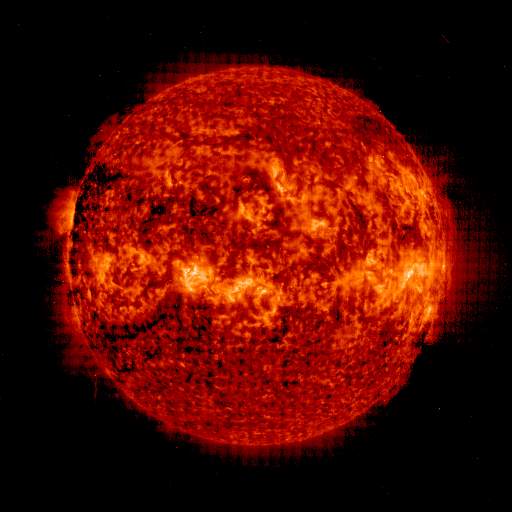
Re:Current SOHO Image
hmmm that latest picture came from the extreme ultraviolet imaging telescope and was of the 30.4 nanometer Helium/Silicon 11 line. In that band the sun's surface is totally obscured by the hot corona above. for a clear view of the surface look at the intensitygram.
-
Re:Current SOHO Image
-
Current SOHO Image
-
Sunspot info site
Although it's geared towards kids in school, NASA has a great site on Sunspots here.
There is also an interesting article on the recent coronal mass ejection here.
Also read about the cold summer of 1816 here. It is theorized that the earth was extra cool because of sunspot activity.
Fun stuff... brings out the amateur scientist in me.
-Todd
-
more infoz.
for more information on the type of sunspot (beta gamma delta) try here: spaceweather.com
also, that article from the BBC was posted on friday, the sunspot is now at the center of the solar disk and pointed more directly at earth. the latest magnetograms and intensitygrams are up at the SOHO site here.
-
Re:Difficult, but definitely a good idea
For anyone wanting to begin using a quality methodology in their programming, I make the following suggestions:
1) Read [Steve McConnell's] three books. It's a good start. What he writes is based on solid research, which he shares with you. His books aren't the complete answer to all problems, but reading them and using a bunch of the tools/methodologies he describes is a great way to begin doing things better.
2) Do a Google search on "Software Capability Maturity Model" and start researching. Eventually you'll come across the Software Engineering Institute, and their [summary of CMM], which is well worth reading.
3) Do a Google search on "Bell Canada Trillium" and start researching. The [Trillium model] is well-respected, and is based on ISO, CMM and other best practices. Where it differs is that it actually tells you what to do; the others tell you what you need.
4) Do as much as you can with the structures that are described, plan on how to do them all, and adapt them to your needs. Identify what works and what doesn't, and fix those things that don't.
-- -
Re:Difficult, but definitely a good idea
For anyone wanting to begin using a quality methodology in their programming, I make the following suggestions:
1) Read [Steve McConnell's] three books. It's a good start. What he writes is based on solid research, which he shares with you. His books aren't the complete answer to all problems, but reading them and using a bunch of the tools/methodologies he describes is a great way to begin doing things better.
2) Do a Google search on "Software Capability Maturity Model" and start researching. Eventually you'll come across the Software Engineering Institute, and their [summary of CMM], which is well worth reading.
3) Do a Google search on "Bell Canada Trillium" and start researching. The [Trillium model] is well-respected, and is based on ISO, CMM and other best practices. Where it differs is that it actually tells you what to do; the others tell you what you need.
4) Do as much as you can with the structures that are described, plan on how to do them all, and adapt them to your needs. Identify what works and what doesn't, and fix those things that don't.
-- -
Re:Black Holes> I remember reading some articles a while back that talked about how the universe was still expanding (from the big bang)
Maybe you were readin this one?
http://www.wsws.org/articl es/1999/mar1999/cosm-m17.shtml
> but how eventually when the expansion halted
Uhm, you DO know that not only is the universe expanding, it is ALSO accelerating !
Edwin Hubble realized that galaxies were rushing away from each other at a rate proportional to their distance, i.e. the farther away, the faster the recession
The rate is called the "Hubble constant" which you can read about it here:
http://www.science.n asa.gov/newhome/headlines/ast25may99_1.htm
Cheers -
Re:Velcro on the padWhere do you get this idea?
The Offical findings include
- No single ignition source of the fire was conclusively identified.
- The Command Module contained many types and classes of combustible material in areas contiguous to possible ignition sources.
- Coolant leakage at solder joints has been a chronic problem.
- The coolant is both corrosive and combustible.
- Deficiencies in design, manufacture, installation, rework and quality control existed in the electrical wiring.
- These deficiencies created an unnecessarily hazardous condition and their continuation would imperil any future Apollo operations.
- The Command Module Environmental Control System design provides a pure oxygen atmosphere.
- This atmosphere presents severe fire hazards if the amount and location of combustibles in the Command Module are not restricted and controlled.
The only mention I can find of velcro in the whole report is when velcro straps burn, but this is some 15 seconds after the start of the fire, so they're obviously not the cause.
-
Shuttle avionics hardware / software interesting..Not exactly on-topic, but there's a lot of awesome information about shuttle engineering available at http://www.ksc.nasa.gov/shu ttle/technology/sts-newsref/.
In particular, I was impressed with the avionics computers and software. They have five computers to handle this. During ascent and descent, four of them are running identical software concurrently, and any two computers can vote another out of the loop, if they sense it's malfunctioning. The fifth computer runs an avionics package with identical specs but from a different vendor, in case a bug is discovered in the primary software. The captain or pilot can drop to the alternate software with a press of a button.
This is all pretty impressive stuff to me