Slashdot Mirror
Domain: nasa.gov
Stories and comments across the archive that link to nasa.gov.
Comments · 16,365
-
Re:They Aren't For Tracking Asteroids
Not as hard as you would think. Radar is actually already in (relatively) wide use for asteroid research, since asteroids tend to have quite low albedos (ie., they're really dark) and aren't lit that well. It's often easier to get a radar image than a decent visible image...of course, that's if you already know where the asteroid is and can use a high-gain antenna (like Goldstone's) to not waste all your power.
-
What is this, exactly?
Can someone advise as to what this is? Is it a report about TIRA ran thru a journalist filter, or something very much like the existing TIRA project?
http://en.wikipedia.org/wiki/TIRA_(System)
Here's NASA's version of the same thing:
-
Re:random thoughts...
But the odds of some *specific* object disturbed by Jupiter hitting the Earth may be vastly *higher*.
The odds of such an object existing are low.
I mean at the end of the day Apophis may have a 100% chance of hitting us, or it might have a 0% chance of hitting us. We can only estimate based on what we know if its orbit. Without knowledge of a specific Jupiter-orbit object, we can only estimate based on the odds of potential disturbed orbits intersecting earth. This is how conditional probability works.
As far as the "maybes" go, NEOs are more likely to be dangerous than objects kicked around by Jupiter.
we've had more than 5 'city-killer' sized objects pass inside the Moon's orbit.
First let's keep in mind that even at that close earth is still a small target. A bulls-eye 1/3700th the size of the dartboard.
I'm not sure what counts as "city-killer", but this NASA chart shows 8 objects at less than 1 Lunar Distance, all of greater than 50km at the low end of estimated size and at greater than 8 km/s relative velocity.
Of course before getting too scared about the term "city killer", we would then have to look at the odds that such an impact hits a city (extremely low) or even land (not that high).
You're unlikely to get hit by a truck on any given crossing, but that doesn't mean it's a good idea to keep doing it.
Yes. The correct reason to worry is because we aren't watching the skies well enough, not because an impact on Jupiter means there might be some other object from the vicinity headed to earth. It doesn't.
We definitely need more asteroid discovery and tracking.
-
Re:Wow.
They found that over a period of almost two decades, the Earth as a whole became more bountiful by a whopping 6.2%. About 25% of the Earth’s vegetated landmass — almost 110 million square kilometres — enjoyed significant increases and only 7% showed significant declines. modis.cn/pubs/PERS_2007_Liang.pdf
Global Rotation of SeaWiFS Biosphere Decadal Average with Land
-
Let's not be alarmist just yet.
Ok, before I get modded Troll, I'd like to appeal to your critical thinking logical side.
First, while I personally find this a bit saddening, lets ask a couple questions and make some observations.
1. Why is the ice cap cited as such a barometer of global warming?
2. Is the warming necessarily anthropogenic? Wouldn't it melt even if the warming was entirely natural?
3. What does an ice cap (which floats on water, which is an order of magnitude better conductor of heat than air)
3a. Where does this water get it's heat from? Hint: 75% of our surface is water. Does air affect ocean temps or something else?
3b. What is the heating role of CO2 in water. (ignore acidification)
4. If I showed you a temperature graph which showed temperatures are average while ice area is down, what would you infer?
( temperature graph )
4a. Could the ice pack be affected by say a storm that broke up the ice which facilitated melting?So while the news is bad, we can't necessarily draw the conclusion that we've been told to draw. Low sea ice has nothing to with CO2. Global warming maybe, but not CO2.
-
Average Arctic Ice increasing since 2007
http://www.webcitation.org/6AKKakUIo
There was almost a million km more ice over last winter than there was in the previous low year of 2007.There was also an exceptionally strong summer storm this year in early August (the time when ice is thinnest) that led to a lot of ice breaking up - hence the relative ice low.
http://earthsky.org/earth/powerful-summer-storm-in-arctic-reduces-sea-ice-even-moreResult is an at least 30 year low, but it is pretty consistent with the 60 year AMO/PDO ocean cycle:
http://earthobservatory.nasa.gov/Features/ArcticIce/Images/arctic_temp_trends_rt.gifSo it doesn't actually look like this is a "death spiral" at least in the short term, more like a bit of seasonal variability in an otherwise 5 year upwards trend.
-
Re:If I recall.....
Faster Than Speed of Light?
Is faster-than-light-speed possible? If so, does it involve the use of the Worm Hole Theory?
Faster than light speed is not possible within the theories that we currently think explain the Universe best. That does not mean that it is impossible, since our understanding of the Universe is limited. Many of us hope that some way will be found to circumvent "The Laws of Physics". A wormhole is not really a means of going faster than light (or backward or forward in time); it's a shortcut so that something that was far away is much closer. You can think of an ant on a piece of paper. If that ant could fold the paper around and poke a hole through it, it could get to the far end much faster than if it just walked. That's what a wormhole does in 3D space.Dr. Eric Christian
http://helios.gsfc.nasa.gov/qa_sp_sl.html
I think NASA disagrees with you, pal.
-
NASA thinks it *may* be possibleCheck out this PDF report: Interstellar Propulsion Research: Realistic Possibilities and Idealistic Dreams by Les Johnson, NASA Marshall Space Flight Center.
The actual name of the program (originally funded by DARPA) was 100 Year Starship Study (100YSS). It is a study of what would be necessary to actually have such a ship. There are LOTS of issues, time and distance being big ones, along with propulsion and power, and a whole lotta cultural ones.
I do wonder about the speakers and some of the format of this symposium. They are charging significant extra fees to see Nichelle Nichols and others talk at the various dinner events. That comes off more as fundraising than science symposium.
I will be attending the symposium, as a representative of a group that made a proposal to DARPA (SpaceGAMBIT) , but will not be at the extra cost events.
-
Re:Isn't this more NOAA's job?
Goto the site and click Overview > Sponsors. You will see that, while NASA is the one carrying out the mission, its sponsored (ie funded) by several divisions of the NOAA and NSF, etc so think of it more as NASA is being contracted to do this research and not a whole lot is coming directly out of their own budget.
-
Re:Isn't this more NOAA's job?
NASA has an interesting historical discussion of that question. The division of labor used to be that NASA flew the observational satellites, while NOAA and NWS did the ground-based work and data analysis. That makes some sense to me, but NASA says that by the 1970s this wasn't working (partly due to budget cuts), so NASA was given authority to run entire programs focused on earth analysis in an in-house manner, including both satellite and ground-based elements. NASA's first major program under that new mission description was the ozone-hole monitoring program, started in 1979.
-
Re:Isn't this more NOAA's job?
NASA has an interesting historical discussion of that question. The division of labor used to be that NASA flew the observational satellites, while NOAA and NWS did the ground-based work and data analysis. That makes some sense to me, but NASA says that by the 1970s this wasn't working (partly due to budget cuts), so NASA was given authority to run entire programs focused on earth analysis in an in-house manner, including both satellite and ground-based elements. NASA's first major program under that new mission description was the ozone-hole monitoring program, started in 1979.
-
Re:Always the frontrunner?
There are a few reasons. Celestial mechanics is a big one: Voyager 2 took advantage of a rare planetary conjunction so it could visit all four of the gas giants. The next chance to do that is in something like 150 years.
Most of the time you'd be spending $$$ on a fly-by of one planet, and that money would be better spent on a mission that can orbit that planet instead. So instead of Voyager-style craft, you get missions like these:
Cassini-Huygens: Saturn and its moons
Dawn: Vesta in 2011-2012, and Ceres in 2014
Galileo: Jupiter and its moons
Juno Spacecraft Mission: Jupiter-bound for polar orbit in 2016
Magellan: Venus orbiter
Mariner program: Venus, Mars, and first to Mercury
Messenger: Mercury
New Horizons: Pluto and its moons in 2015
Curiosity et al: MarsHaving the probes act as relays won't work when you launch them at 10-year intervals. After 10 years, you need a 26-meter antenna or even larger to communicate with the probe. It would also require the probes to be sent out in the same general direction, but 10 years later the planets will be in different places. Again, no planet to visit=expensive space relay.
The Pioneers and Voyagers were hugely important as a first step, but they raised more questions than they answered. At the same time, they provided information that was necessary to design probes for the environment they'd find at each planet. The extreme radiation of Jupiter for example.
NASA is using that information and methodically answering those questions by sending probes to each individual planet for more detailed observations than a Voyager-style flyby could ever make.Once the Voyagers are truly outside the solar system, the data they'll yield then can be used to create a new mission to follow the Voyagers out of the solar system for more detailed observation of that environment.
-
Re:You have to give it to the engineers
Actually there has been some maintenance done
they switched to the backup thruster set
http://www.nasa.gov/mission_pages/voyager/voyager20111114.html -
Re:Always the frontrunner?
For what it is worth: Voyager 1 travels faster than Pioneer 10, and overtook it (in terms of distance from the sun) many years ago. Pioneer 10 is 16.8 billion km from the sun, traveling at 12.0 km/sec. Voyager 1 is 20 billion km away, traveling at 17.0 km/sec. New Horizons, currently en route to Pluto, will also head out from the solar system. It also went on a very fast trajectory (e.g., it achieved sun escape velocity directly from launch, rather than through gravity assists). However, New Horizons has already slowed to a velocity less than Voyager 1 (15.2 km/sec), and won't ever overtake it.
-
Re:Always the frontrunner?
For what it is worth: Voyager 1 travels faster than Pioneer 10, and overtook it (in terms of distance from the sun) many years ago. Pioneer 10 is 16.8 billion km from the sun, traveling at 12.0 km/sec. Voyager 1 is 20 billion km away, traveling at 17.0 km/sec. New Horizons, currently en route to Pluto, will also head out from the solar system. It also went on a very fast trajectory (e.g., it achieved sun escape velocity directly from launch, rather than through gravity assists). However, New Horizons has already slowed to a velocity less than Voyager 1 (15.2 km/sec), and won't ever overtake it.
-
Re:Always the frontrunner?
How could Pioneer 10 have been launched first, been the most distant object in 1997, been passed by Voyager 1, and pass Voyager 1 again? There's no further acceleration, and, for any reasonable human time frame, the solar system is essentially moving in a straight line.
-
Re:2020?
The power of the plutonium RTGs continually declining is one issue, as already noted. Another issue is the finite amount of hydrazine on board for what little maneuvering may need to be done. See the last paragraph of this page and this article.
-
Re:Always the frontrunner?
It would be nice to think that one day we'll reach a technological level that allows us to overtake Voyager 1. I'm not that hopeful though. I think that the head start Voyager 1 has means that it always will be more remote from Earth than anything else constructed here. Excluding Pioneer 10, that is.
Voyager 1 is currently the most distant man-made object, and is more distant than Pioneer 10.
-
Has it made it ?
If you look at this picture, it sure does look like Voyager 1 may have left the solar system (in a plasma sense) in late August. (In other words, it is no longer seeing protons from the solar wind, which means it may be outside of the Sun's bubble of plasma, and into the interstellar medium.
If so, it has impeccable timing.
-
Re:Overlooking a bigger problem?
-
Re:quick question
if I must.
The primary method of determining what's out there is infrared spectroscopy. Each and every element and compound has its own infrared signature; regardless of temperature, luminosity, or the conditions of the surrounding space, the signature of a given compound/element is the same, therefore where you see a given signature you can be pretty certain that the compound to which it refers is present. What makes the science even more fun is that you can determine the signature of each molecule using samples on Earth. If you see the same signature through the telescope, as it were, you'd be looking at a significant mass of that molecule.
Here is a list of molecules found on a regular basis in interstellar clouds.
-
Hasta la Vesta, baby!
WHAT. It is a crime, a *crime*, I tell you, that this article doesn't even mention the NASA team's slogan for this phase of the mission.
-
Asteroid Vesta and dwarf planet Ceres
According to NASA - http://www.nasa.gov/mission_pages/dawn/ceresvesta/index.html - Asteroid Vesta mainly consists of rock while dwarf planet Ceres is mainly ice
What is interesting is the picture of the meteorite that NASA claims is from asteroid Vesta. That rock is made up of almost entirely mineral Pyroxene - http://en.wikipedia.org/wiki/Pyroxene - which is common in lava flow
Hmm
How can an asteroid of only 330 mile wide have volcano that spewed out lava ?
-
Dear Slashdot:
When posting NASA news, it's always best to go to NASA itself. Avoiding ad cluttered sites will help reduce excess traffic on our limited bandwidth.
-
Re:Awesome Launch
It was part of the "etc" in the tour. The real treat was that next year the tour includes the Van Alen Suspenders.
@decsnake: http://www.nasa.gov/connect/social/index.html has information about the Nasa Social program. It'a basically a lottery system, where you sign up and if not picked, you join a wait list. As not everyone who is picked is willing to travel, has conflicts, end-of-year vacation shortages, whatever, you can get chosen off the wait list. You and only you can currently go (no +1s), although, and not to separate myself from
The events are completely free, and they throw in lots of goodies, however transportation, lodging, etc. is your own expense.
-
Re:Situations vacant: Slashdot editor
Yes that was very poor proofreading on my part, and the editor missed it as well. Things happen we all make mistakes however I was not mistaken on the identity of the the two planets Kepler-47a and Kepler-47b. http://www.nasa.gov/mission_pages/kepler/news/kepler-47.html
-
What incredible workmanship
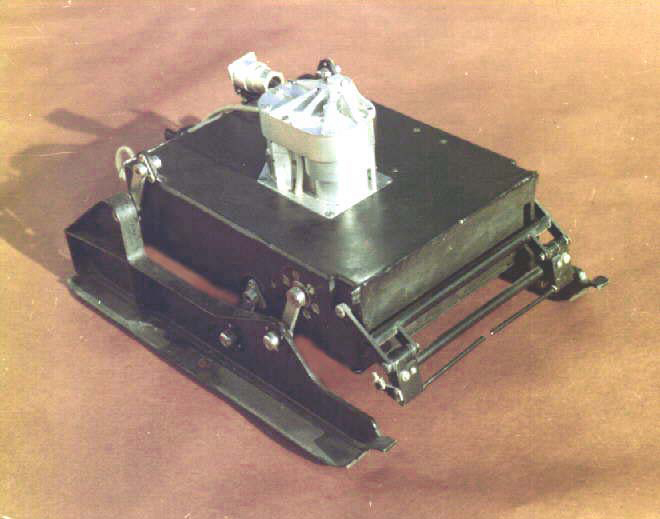
Boy, the Soviet space program really operated on a shoestring and with limited underpaid talent, didn't it? My grandfather could have made that thing in his little machine shop at the back of their quarter-acre property. Actually, he would have produced something that looked and functioned far better than this clunky little thing (the U.S. military got a lot of WWII machined parts from him). Good grief, the cuts in the plates look jagged or uneven and I could swear some welds are visible. It looks like a hobbyist project. So I guess the Soviet space program was just a hobby for the Politburo....
-
Re:Core Samples?
There is a proposal floating (haha) about for an airplane at Mars. It was a finalist in the last Mars Scout (i.e. relatively small/cheap missions) selection but was not selected. http://marsairplane.larc.nasa.gov/
-
Link to a Lunar Cave article
Nobody has linked to earlier articles on Lunar and Martian Caves, so here goes. Nasa Science News Rabbit Holes , Caves in Copernicus Crater , Mars cave entrance .
-
Re:Are these devices that important?
Are we seeing 450 crashes a day? Are we even seeing 1/1000th of that? Nope. [...] Well, looks like you're an idiot, and electronic devices are perfectly fine.
Keep in mind that you do have human beings in charge of airplanes who can usually figure around these things. Airplanes do have a few redundancies for things. You also have Air Traffic Controllers who check these things
Also, NASA has their ASRS database. It's a volunteer thing--pilots, FAs, etc report these things to NASA which keeps track of them. Because of this, this is certainly not an exhaustive list. For entertainment value, do a text search on PED in the narrative, though, and you'll see various cases where passenger electronic devices are believed to have affected the instruments.
Of course, there's no direct connection. These people aren't trying to prove or disprove anything. If there's a problem, they tell passengers to turn off electronic devices. If the problem goes away, it was the device. Also, some of the reported issues are with older planes--737s, MD80s, etc.--which may actually have issues versus a brand new Boeing 767 or Airbus A380. Also, from the equipment involved, your cheap-ass Dell may have a problem that my beautiful MacBook Pro doesn't have--or, if you prefer, your cheap-ass laptop may have more shielding than my super-thin less-is-more MacBook Air. Not to mention that air travel is international and a phone used by a Chinese or Australian person might not have the same requirements as a phone sold here in the states. Add to that overlapping radio problems--the interference only occurs when I'm using my iPhone in seat 23F and you're using your PSP in seat 17A.
There's no way to take all of these factors into account.
-
Re:Almost Meaningless
You're correct that satellites can only provide us with relatively recent data, but scientists have used arctic ice cores and rock samples dating back hundreds of thousands of years to show the rise in atmospheric CO2 levels.
You mean the CO2 level increases that lag behind the temperature rises?
The data shows a drastic spike in atmospheric CO2 during the last century. http://climate.nasa.gov/evidence/
As far as the NASA cite, I don't trust NASA either way regarding AGW/climate change, regardless of which side their data seems to bolster. NASA has become far too politicized and plays far too many political games to be a trusted source re: AGW/climate change, or any politically-sensitive topic.
As for my personal opinion, I think we're toast. We're far too selfish, divided, and concerned with immediate gratification to change our course. I don't dwell on it too much, though. I find my time better spent in front of nice warm tire and plastic bottle fire.
I think using less oil and generally being better stewards of the planet is fine and worthy if done without causing major economic upset and harm to people.
If by "change our course" you mean undertaking attempts to modify global climate trends by causing algae blooms or the other methods suggested to attempt "terraforming" our planet, then I think it's a foolish waste at best, and possibly an extinction-level event, as we posses nowhere near enough data, knowledge, or understanding to safely attempt such a thing. It would be like taking a 10-yo kid that is currently taking a science class covering basic electricity and telling him to go ahead and stick his hands into the guts of your TV set. Better have an ambulance standing by. Except that we have no ambulances to take us off the Earth if we screw the pooch dicking around with our planet's climate.
Strat
-
Re:Almost Meaningless
You're correct that satellites can only provide us with relatively recent data, but scientists have used arctic ice cores and rock samples dating back hundreds of thousands of years to show the rise in atmospheric CO2 levels. The data shows a drastic spike in atmospheric CO2 during the last century. http://climate.nasa.gov/evidence/ As for my personal opinion, I think we're toast. We're far too selfish, divided, and concerned with immediate gratification to change our course. I don't dwell on it too much, though. I find my time better spent in front of nice warm tire and plastic bottle fire.
-
JFK's Moon Speech
I think it is the time for everyone to revisit John F. Kennedy Moon's Speech. I wish I was alive in that era. Everything sounded so exciting and promising.
http://er.jsc.nasa.gov/seh/ricetalk.htm -
Re:Now with Arf IV engines!
Silly answer: It's a Terrier Malemute with an improve Malemute upper stage.
Serious answer: it's a sounding rocket based on the US Navy RIM-2 Terrier surface-to-air missile from the 1950s as the first stage, with a Thiokol Malemute upper stage. The Terrier is used as a first stage for a variety of small rockets.
A recent launch of note that used Terrier-Malemute variants was ATREX.
-
Ask the correct community : science informatics
What you're describing sounds like a fairly typical Sensor Net (or Sensor Web) to me, maybe with a little more data logged than is normal per platform. (I believe they call it a 'mote' in that community).
Some of the newer sensor nets use a forwarding mesh wireless system, so that you relay the data to a highly reduced number of collection points -- which might keep you from having to deal with the collection of the hard drives each night (maybe swap out a multi-TB RAID at each collection point each night instead).
I'm not 100% sure of what the correct forum is for discussion of sensor/platform design. I know they have presentations in the ESSI (Earth and Space Science Informatics) focus group of the AGU (American Geophysical Union). Many of the members of ESIPfed (Federation of Earth Science Information Partners) probably have experience in these issues, but it's more about discussing managing the data after it comes out of the field.
On the off chance that someone's already written software to do 90% of what you're looking for, I'd try contacting the folks from the Software Reuse Working Group of the Earth Science Data System community.
You might also try looking through past projects funded through NASA AISR (Adanced Information Systems Research)
(and if you haven't guessed already
-
Ask the correct community : science informatics
What you're describing sounds like a fairly typical Sensor Net (or Sensor Web) to me, maybe with a little more data logged than is normal per platform. (I believe they call it a 'mote' in that community).
Some of the newer sensor nets use a forwarding mesh wireless system, so that you relay the data to a highly reduced number of collection points -- which might keep you from having to deal with the collection of the hard drives each night (maybe swap out a multi-TB RAID at each collection point each night instead).
I'm not 100% sure of what the correct forum is for discussion of sensor/platform design. I know they have presentations in the ESSI (Earth and Space Science Informatics) focus group of the AGU (American Geophysical Union). Many of the members of ESIPfed (Federation of Earth Science Information Partners) probably have experience in these issues, but it's more about discussing managing the data after it comes out of the field.
On the off chance that someone's already written software to do 90% of what you're looking for, I'd try contacting the folks from the Software Reuse Working Group of the Earth Science Data System community.
You might also try looking through past projects funded through NASA AISR (Adanced Information Systems Research)
(and if you haven't guessed already
-
Ask the correct community : science informatics
What you're describing sounds like a fairly typical Sensor Net (or Sensor Web) to me, maybe with a little more data logged than is normal per platform. (I believe they call it a 'mote' in that community).
Some of the newer sensor nets use a forwarding mesh wireless system, so that you relay the data to a highly reduced number of collection points -- which might keep you from having to deal with the collection of the hard drives each night (maybe swap out a multi-TB RAID at each collection point each night instead).
I'm not 100% sure of what the correct forum is for discussion of sensor/platform design. I know they have presentations in the ESSI (Earth and Space Science Informatics) focus group of the AGU (American Geophysical Union). Many of the members of ESIPfed (Federation of Earth Science Information Partners) probably have experience in these issues, but it's more about discussing managing the data after it comes out of the field.
On the off chance that someone's already written software to do 90% of what you're looking for, I'd try contacting the folks from the Software Reuse Working Group of the Earth Science Data System community.
You might also try looking through past projects funded through NASA AISR (Adanced Information Systems Research)
(and if you haven't guessed already
-
Re:Really?
Please, do correct me if I'm wrong; but I was under the impression that the overwhelming majority of the cost of doing space work was in launching the things,
Android IS Linux. Its just that it has already been trimmed down to the bones and runs on very powerful, but low energy consuming hardware. So it saves them the need of making a linux version to do the same thing.
As for your other points, it seems from TFA that they will not actually be using the phones as we know them, but rather stripped down models sans screen, case, battery, etc. Probably wrapped in something to compensate for lack of radiation hardened componentry. But then again, the types of short duration, low orbit, small payload missions they are planning this for can probably risk the radiation for the duration.
In the case of our intrepid Nexus phones, the issue is being tactfully ignored. As these are test missions, NASA isn’t concerned about the long-term viability of these craft, and only expects them to last a few weeks or months. Due to their low orbits and lack of thrusters to increase their altitude during the mission, the Nexus-powered satellites will be falling back down to Earth within a year anyway. Even if they were built to better withstand the extremes of space, they would still just burn up in the atmosphere before too long.
I doubt they launch these things singly, they probably piggyback on other launches, but being the size of a coffee cup, they might be able to use cheap sounding rockets. There are a number of different models of these relatively cheap rockets that can launch low earth orbit small payloads.
-
Re:Really?
Please, do correct me if I'm wrong; but I was under the impression that the overwhelming majority of the cost of doing space work was in launching the things,
Android IS Linux. Its just that it has already been trimmed down to the bones and runs on very powerful, but low energy consuming hardware. So it saves them the need of making a linux version to do the same thing.
As for your other points, it seems from TFA that they will not actually be using the phones as we know them, but rather stripped down models sans screen, case, battery, etc. Probably wrapped in something to compensate for lack of radiation hardened componentry. But then again, the types of short duration, low orbit, small payload missions they are planning this for can probably risk the radiation for the duration.
In the case of our intrepid Nexus phones, the issue is being tactfully ignored. As these are test missions, NASA isn’t concerned about the long-term viability of these craft, and only expects them to last a few weeks or months. Due to their low orbits and lack of thrusters to increase their altitude during the mission, the Nexus-powered satellites will be falling back down to Earth within a year anyway. Even if they were built to better withstand the extremes of space, they would still just burn up in the atmosphere before too long.
I doubt they launch these things singly, they probably piggyback on other launches, but being the size of a coffee cup, they might be able to use cheap sounding rockets. There are a number of different models of these relatively cheap rockets that can launch low earth orbit small payloads.
-
Are DeVry doing astrophysics degrees now?
Using the Sun as a big-assed gravity slingshot
... will gain nothing.
http://www2.jpl.nasa.gov/basics/grav/primer.php
Though perhaps your confusion is the fault of the person who coined the misleading name in the first place.
-
Re:Sadly, no, we are not advancing
Second, we are proceeding at a glacial pace! And even if we launched a fleet every two years, we are still communicating at a top speed of 8 kilobits a second. We've high def cameras that can transmit 4K, yet we are still looking at 1976 Viking-speed photos slowly uploading from Curiosity. What use is this? We can't see nary a damned thing. We need a high speed relay in orbit around Mars, preferably nuclear powered, to beam back a laser signal, or at least short wavelength radio. This is ridiculous. We were supposed to launch one, but, no money. A trillion for other things tho...
Good news! NASA already has a high-speed relay in orbit around Mars - the Mars Reconnaissance Orbiter. Speeds of up to 6Mbit/s from the orbiter back to Earth (it went past a hundred terabits total a few years ago), and up to 2Mbit/s as a relay for surface probes such as, erm, Curiosity.
NASA's Mars Odyssey and ESA's Mars Express orbiters can also act as data relays. Bandwidth is still a definite problem for Curiosity and the like, but it's already sent back some pretty impressive imagery that's somewhat above Viking-level...
If you want more data, get some geostationary (areostationary?) communications satellites around Mars - currently surface probes are limited to relaying data when a probe is visible in the sky - and invest in the Deep Space Network back on Earth.
-
Scrubbed 'til tomorrow ...
Subject: Correction: Radiation Belt Storm Probes Launch, Rescheduled for August 25
This morning's planned launch of the Radiation Belt Storm Probes (RBSP) has been delayed to Saturday, August 25, 2012 at 4:07 a.m. The launch from Space Launch Complex 41 at Cape Canaveral Air Force Station in Florida can be viewed live at http://www.nasa.gov/ntv .
[local bits trimmed]
The RBSP mission is the second in NASA's Living With a Star program, becoming part of a fleet of spacecraft helping to predict space weather and its effects on orbiting spacecraft and on our technology here on Earth. RBSP has two identical probes to study the Van Allen Radiation Belts which are two concentric, donut-shaped rings of high-energy particles that surround Earth. Data from the probes will help us understand this major feature of the Earth's magnetosphere and the interactions between the sun and Earth.
(4:07am being Eastern, unlike the @!@#$% NASA mail system which sends everything out in central time)
For more information on the mission, visit http://www.nasa.gov/rbsp
-
Scrubbed 'til tomorrow ...
Subject: Correction: Radiation Belt Storm Probes Launch, Rescheduled for August 25
This morning's planned launch of the Radiation Belt Storm Probes (RBSP) has been delayed to Saturday, August 25, 2012 at 4:07 a.m. The launch from Space Launch Complex 41 at Cape Canaveral Air Force Station in Florida can be viewed live at http://www.nasa.gov/ntv .
[local bits trimmed]
The RBSP mission is the second in NASA's Living With a Star program, becoming part of a fleet of spacecraft helping to predict space weather and its effects on orbiting spacecraft and on our technology here on Earth. RBSP has two identical probes to study the Van Allen Radiation Belts which are two concentric, donut-shaped rings of high-energy particles that surround Earth. Data from the probes will help us understand this major feature of the Earth's magnetosphere and the interactions between the sun and Earth.
(4:07am being Eastern, unlike the @!@#$% NASA mail system which sends everything out in central time)
For more information on the mission, visit http://www.nasa.gov/rbsp
-
CPU
If anyone else is wondering what commputer hardware they are using that can "continue working even in the harshest conditions", according to the Launch Press Kit, it's the same kind of RAD-750 PowerPC compatible CPU that's in a number of other "recent" probes, including the Curiosity rover.
Avionics computer: RBSP’s on-board avionics computer is based on a BAE RAD-750 radiation hardened processor with
16 MB of RAM plus a 16 GB SDRAM data recorder. The spacecraft interfaces are controlled by a customized radiation-
tolerant RTAX2000 FPGA (field-programmable gate array) microprocessor. -
Re:Doin' Donuts, hacked?
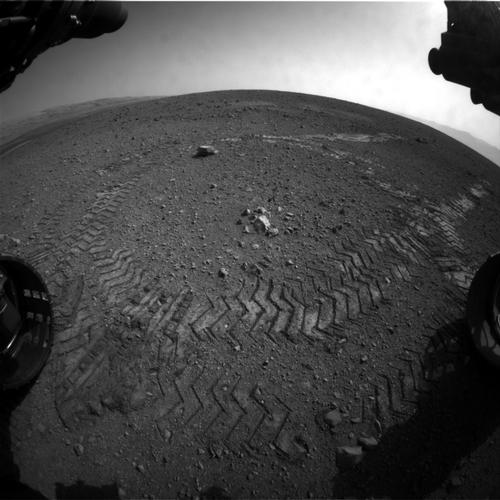
The rover is doing donuts:
http://mars.jpl.nasa.gov/msl/images/PIA16095_Hazcamtracks-br.jpg
Hopefully they do a few powerslides next, and maybe a some number 11's.
-
Doin' Donuts, hacked?
My
http://slashdot.org/comments.pl?sid=3045879&cid=40980565
The rover is doing donuts:
http://mars.jpl.nasa.gov/msl/images/PIA16095_Hazcamtracks-br.jpg
For my next prediction, the rover will find another Mitt Romney tax haven, on Mars.
-
NASA link
Here's a more official news link: http://www.nasa.gov/mission_pages/msl/news/msl20120819b.html. I hope they will announce soon the actual results of the spectroscopy somewhere.
Also a reminder that NASA's official page for this mission is:
http://www.nasa.gov/msl/. This is probably a better source for MSL news than wired.Would it hurt slashdot editors to post the official NASA links as well as the submitted, third-party news links? We pay them to be editors after all.
-
NASA link
Here's a more official news link: http://www.nasa.gov/mission_pages/msl/news/msl20120819b.html. I hope they will announce soon the actual results of the spectroscopy somewhere.
Also a reminder that NASA's official page for this mission is:
http://www.nasa.gov/msl/. This is probably a better source for MSL news than wired.Would it hurt slashdot editors to post the official NASA links as well as the submitted, third-party news links? We pay them to be editors after all.
-
More ad laden slashdot bullshit
Anybody want to tell me why they don't link to the source
And anybody want to tell me why sppammers can post more frequently than I can?
-
Apophis would be next in 2029 then
Or Niburu around Feb. 2013 (again). In fact, look up John Moore on YouTube here http://www.youtube.com/watch?v=crU9sM5QTUk&feature=related to see what I am talking about in the latter, as well as IRAS satellites and 10th planet discovered in 1983 etc. (here's a link on Apophis http://neo.jpl.nasa.gov/apophis/ ). I don't know what to believe on any of it, since I tend to believe what I see first hand usually only (but by then, it'd be too late). It does make for interesting thought and hair-raising discussion at the very least, and something to prepare one's self for. Scares the hell out of me and I hope everyone's wrong on those things as there really would be no stopping them. Perhaps they explain blanks in our history every 2500 years or so, and things like Lemuria, Atlantis, and the sudden disappearance of the Sumerian civilization too. Food for thought.