Slashdot Mirror
Domain: nasa.gov
Stories and comments across the archive that link to nasa.gov.
Comments · 16,365
-
Re:Exploding Minivans
According to this Earth fact sheet, our mean orbital velocity is 29.78km/s (that is 18.50mps—or 66,600mph for non-SI people, or generally people on the other side of The Pond).
Therefore, I wager that the average minivan parked in a stationary[1] orbital lot is speeding somewhat above 33,000mph relative to Earth.
[1] OK, I get the fact that the term stationary gets somewhat ambiguous at some point
-
Re:Depends on the field, and depends on the subjec
Didn't fakegate prove once and for all that there's no real money being paid out by Heartland?
The rest of your post consists mostly of ad hominems and other logical fallacies, but when it comes to consensus it simply has no place in science. No scientist bases their work on consensus, they base it upon hypotheses that has withstood falsifications over time.
http://randi.org/site/index.php/swift-blog/1506-skeptic-history-a-tale-of-two-scientists.html
http://earthobservatory.nasa.gov/Features/Wegener/printall.php
-
"old" news, 1979 report on asteroid retrieval
in 1970s a conference at NASA Ames Research Center on Space Resources and Space Settlements. Attendees included Jacques Cousteau and Gov. Jerry Brown, Gerald O'neill was well known even in public media discussing space settlements (govt like NASA said "settlements" where private groups said "colonies" and reason is colonies was a bad term to use particularly for African nations that were colonized by Europeons). Actually I thought, and still do, think the concept of putting an asteroid in earth orbit, setting up mining ops (imagine one that has lotsa platinum, you will find lowcost HLV will get put into service ***now***). Or an asteroid used as a HEO space station, burrow deep inside and have considerable shielding.
Earlier scenarios for mass-driver retrieval of asteroidal materials were tested and refined after new data were considered on mass-driver performance, favorable delta-V opportunities to earth-approaching asteroids with gravity assists, designs for mining equipment, opportunities for processing volatiles and free metals at the asteroid, mission scenarios, and parametric studies of the most significant variables. It is concluded that the asteroid-retrieval option is competitive with the retrieval of lunar materials for space manufacturing, while a carbonaceous object would provide a distinctive advantage over the earth as a source of consumables and raw materials for biomass in space settlements during the 1990's. Immediate studies on asteroid-retrieval mission opportunities, an increased search and followup program, precursor missions, trade-offs with the moon and earth as sources of materials, and supporting technology are recommended.
PDF of report, http://ntrs.nasa.gov/archive/nasa/casi.ntrs.nasa.gov/19790024063_1979024063.pdf
-
"old" news, 1979 report on asteroid retrieval
in 1970s a conference at NASA Ames Research Center on Space Resources and Space Settlements. Attendees included Jacques Cousteau and Gov. Jerry Brown, Gerald O'neill was well known even in public media discussing space settlements (govt like NASA said "settlements" where private groups said "colonies" and reason is colonies was a bad term to use particularly for African nations that were colonized by Europeons). Actually I thought, and still do, think the concept of putting an asteroid in earth orbit, setting up mining ops (imagine one that has lotsa platinum, you will find lowcost HLV will get put into service ***now***). Or an asteroid used as a HEO space station, burrow deep inside and have considerable shielding.
Earlier scenarios for mass-driver retrieval of asteroidal materials were tested and refined after new data were considered on mass-driver performance, favorable delta-V opportunities to earth-approaching asteroids with gravity assists, designs for mining equipment, opportunities for processing volatiles and free metals at the asteroid, mission scenarios, and parametric studies of the most significant variables. It is concluded that the asteroid-retrieval option is competitive with the retrieval of lunar materials for space manufacturing, while a carbonaceous object would provide a distinctive advantage over the earth as a source of consumables and raw materials for biomass in space settlements during the 1990's. Immediate studies on asteroid-retrieval mission opportunities, an increased search and followup program, precursor missions, trade-offs with the moon and earth as sources of materials, and supporting technology are recommended.
PDF of report, http://ntrs.nasa.gov/archive/nasa/casi.ntrs.nasa.gov/19790024063_1979024063.pdf
-
3D images of Lyrids
I'm surprised that the article doesn't mention that the entire point of the synchronized ISS + ground + balloon pictures is to capture the meteor positions in 3D. http://science.nasa.gov/science-news/science-at-nasa/2012/18apr_lyrids/
-
Re:Public concern
Your chart was deceptive. Look at the error bars, for example.
-
So damned fast
FTA
The HTV-2 could fly anywhere in the world in less than 60 minutes.
What the fucking fuck that's fast.
To compare, the space station orbits Earth about every 90 minutes.
-
Re:Public concern
I take it you're not disputing that 98% of climatologists are convinced that climate change is occurring, and is human-caused.
As for the negative effects of this change, IPCC Working Group II covered that pretty well. There's plenty of similar reports from other bodies too, including individual climatologists.Are you claiming that these do not represent the majority opinion, or just nit-picking about the exact figure?
-
Re:ARES?
Well, if we're pulling tiny projects out of our ass there's this: http://mars.jpl.nasa.gov/programmissions/missions/missiontypes/balloons/
Both ARES and the balloons floating are for the same thing, environmental observation.I think what the big boys here are talking about is something larger.
-
ARES?
Doesn't NASA already have a great idea for a Mars exploration mission? ARES?
-
Re:a better idea
We already do. Here is the mission patch.
-
Re:Greenland history
Keep in mind that these physical models do not model the complex social and economic factors that dictate the time course of atmospheric CO2 increase. As a result, they do not predict the trajectory of global temperature change—they predict the temperature change given a specific trajectory of CO2 increase. For this reason, the term "projection" is commonly used instead of "prediction" to describe the model output. So to evaluate the predictions of a climate model, it is necessary to plug in the actual CO2 values. When this is done, Hansen's 1988 model still looks quite good. Of course, as historically important as Hansen's pioneering work was in demonstrating that rising CO2 implies a problematic rise in global temperatures (a prediction that has been dramatically confirmed since then), there has been considerable scientific progress in quarter century plus since then, and he is no longer the only scientist doing this kind of work. There are multiple competing models from independent research groups, although they agree qualitatively in predicting that rising CO2 will result in climate change sufficient to cause multiple severe problems. For a full discussion of the modern state of the art in climate models, see the IPCC reports.
-
Re:About the movie "The Great Global Warming Swind
My point is that you should read more scientific papers
http://www.mpg.de/495993/pressRelease20041028
http://www.nasa.gov/mission_pages/sunearth/news/solarcycle-primer.html
-
Hansen's Predictions were accurate
'James Hensen has been making predictions about climate change since the 1980s. When people are comparing what is happening now to those predictions, they can see they fail to match up.'"
Hansen's 1981 paper can be read here. Figure 6 contains future projections which estimated that we would experience about half a degree Celsius of warming by 2012. Compare to NASA's temperature record here. We have warmed about half a degree since Hansen's paper. In other words, Hansen couldn't have been more accurate.
So the real question is this: Why do climate 'skeptics' like Dr. Benny Peiser always make shit up? Peiser's objections aren't even legitimate unresolved scientific questions but just blatant falsehoods that anybody using google could disprove in 5 minutes. Answer: Peiser's only goal is to fool people who are too stupid or too lazy to look shit up for themselves.
-
Re:Public concern
That's just not true. http://data.giss.nasa.gov/gistemp/graphs_v3/Fig.A2.gif [nasa.gov]
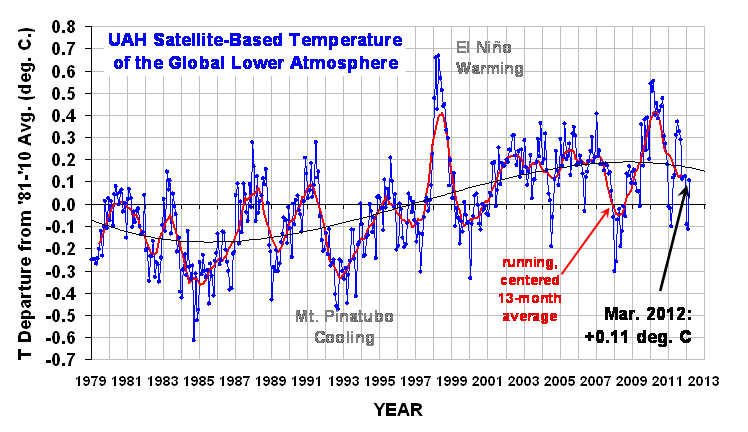
It depends what graph you look at http://www.drroyspencer.com/wp-content/uploads/UAH_LT_1979_thru_March_2012.png
-
Re:Public concern
and the promised "hockey stick" increase in temperatures not been seen in the last 15 years...
That's just not true.
http://data.giss.nasa.gov/gistemp/graphs_v3/Fig.A2.gifAnd note, climate is what happens over periods of at least 30 years. At 15 years you're still in the realm of weather.
But heck, the fact you're not interested in a serious discussion of AGW is underlined by the Muslim outreach comment.
-
Re:Cue good old Carl ...
No it does not have this, and I don't think one will fly until there is firmer evidence for microbial life. However it has a vastly imporved micro imager...in color no less. The test pictures from it are pretty spectacular (compared to Opportunity's): http://www.jpl.nasa.gov/news/news.cfm?release=2010-384#4
-
Re:Hey guys, STFU and build a rocket, would you?
http://www.nasa.gov/externalflash/nasacity/index2.htm is an interactive learning tool listing some of the many non-space contributions of NASA
-
Re-entry may not be that challenging
Just a thought here, but I don't think re-entry would be that challenging for bacteria based life to survive. Most people think that what left of an asteroid is really hot when they land, but that just isn't the case. In fact asteroids have been touched right after landing and described as 'cool' in temperature.
http://impact.arc.nasa.gov/news_detail.cfm?ID=1
If bacteria were in the core part of the asteroid that survived impact it should be reasonable to assume that the part that is cool to the touch never got hot enough to kill any bacteria that were inside it. The other two questions than become what kind of shock (g-forces) can bacteria survive? We know they can survive the shock of being launched into space, and without the squishy bodies that we have they may well survive the shock of re-entry.
If we could determine the answers to those questions than really the only questions remaining are can bacteria adapt to their new home? We already know they live in places on earth that are very inhospitable by our standards. The only other real question is how long can they survive in space? We have documented cases of bacteria surviving in space for years at a time. If there is no real limit to how long they can survive in space than cross solar system colonization is all but inevitable.
-
Martin Lo's low energy trajectories
Actually Martin Lo discovered low energy gravitational paths or "superhighways" that would allow objects like space probes and maybe rocks to travel all around the solar system without power. These calculations were used in the Genesis probe NASA project IIRC.
http://en.wikipedia.org/wiki/Interplanetary_Transport_Network
http://genesismission.jpl.nasa.gov/gm2/team/people/lo/interview1.htm -
Re:Showing off what was possible in times long gon
What was then: http://www.nasa.gov/multimedia/imagegallery/image_feature_1204.html
And, "A Spaceship Landed on Earth" by Rockwell Intl, Aug 1978 16mm film: http://www.youtube.com/watch?v=Hgk4GskErjQ
There's still big arguments on where the orbiters will be placed. Texas still feels they deserve one based in Houston (lotsa diatribes on nasawatch). Geez, now that the Shuttle has stopped flying is when the politicos take interest in this program. Would have been nice if they took interest when it was still flying.
-
Re:How about sharing?
I think that you are talking about Technology Readiness Levels (TRLs), which are by means restricted to DARPA, but are pretty ubiquitous in aerospace.
-
Anyone ever notice...
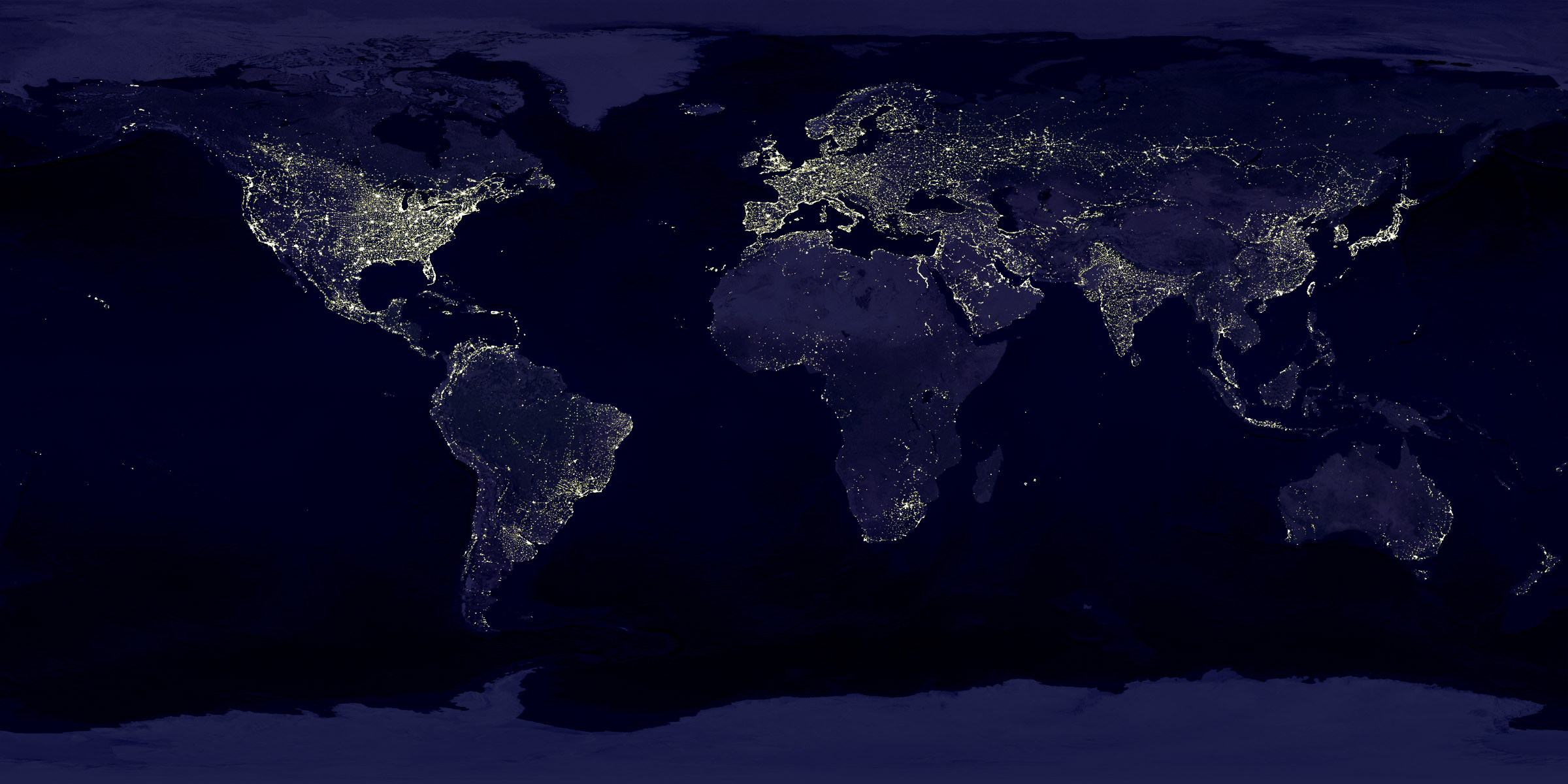
http://eoimages.gsfc.nasa.gov/images/imagerecords/55000/55167/earth_lights_lrg.jpg
Anyone ever notice the really bright spot on the norther coast of Alaska? The big swath north of Anchorage, out by Prudhoe Bay... -
Re:monkeys throwing darts...
Well, you can take for instance the side of the 1300 scientists that made the report that's cited here: http://climate.nasa.gov/causes/. Or the 3146 surveyed here: http://articles.cnn.com/2009-01-19/world/eco.globalwarmingsurvey_1_global-warming-climate-science-human-activity.
But these guys are all funded by some organization that wants people to recycle, right?
-
Re:A Pointless Anecdote
FFS: http://climate.nasa.gov/evidence/
Or don't you trust these guys either?
-
Re:SUNSPOTS
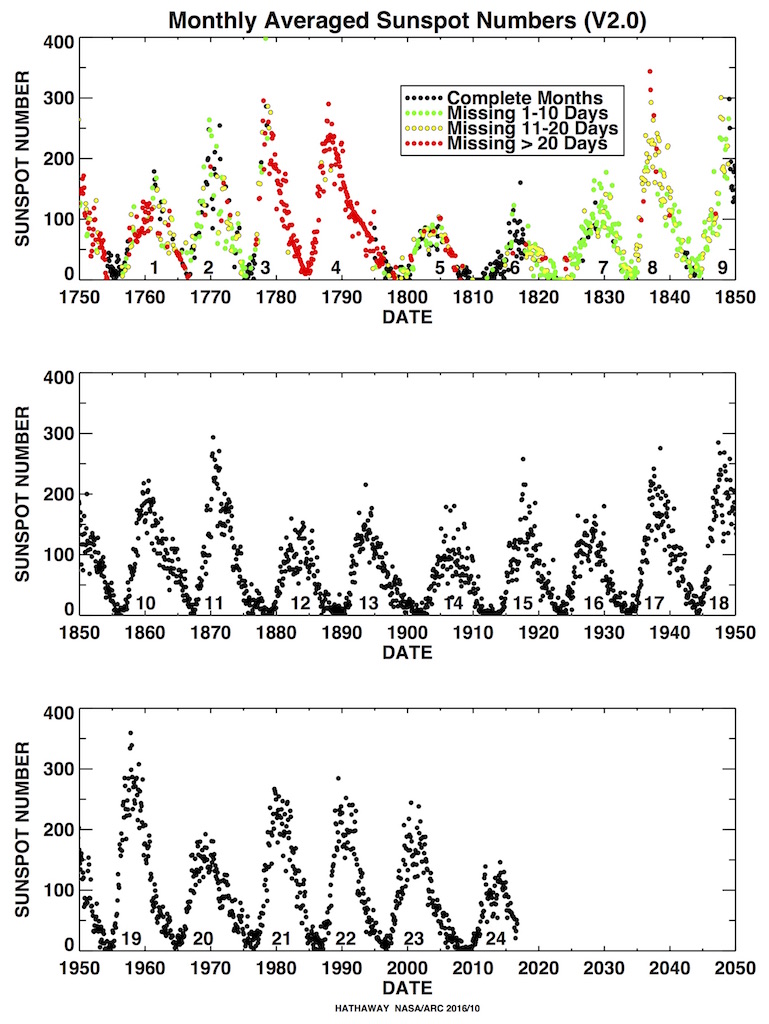
Really? This graph of sunspot activity looks like it correlates well with temperature graphs?
The referenced paper (in TFS, that is) actually talks about variation in solar luminosity and in volcanic aerosols as the primary source of variation about the long-term trend.
-
Re:SUNSPOTS
Really? This graph of sunspot activity looks like it correlates well with temperature graphs?
The referenced paper (in TFS, that is) actually talks about variation in solar luminosity and in volcanic aerosols as the primary source of variation about the long-term trend.
-
Re:I think of astronaut as a formal title
Actually, if I remember my NASA politics correctly, the Space Shuttles had three classes:
- Astronauts: These were the "commanders" and "pilots" who flew the plane and made decisions about the mission.
- Mission Specialist: Someone who had a specific job to do up there.
- Payload Specialist: Someone who knew something about a particular payload being sent aloft--usually, themselves. John Glenn, Jake Garn, Salman Abdulaziz Al-Saud, and Christa McAuliffe were Payload Specialists on various Shuttles.
"Payload Specialists" were absolutely not considered to be "astronauts."
-
Re:I think of astronaut as a formal title
Actually, if I remember my NASA politics correctly, the Space Shuttles had three classes:
- Astronauts: These were the "commanders" and "pilots" who flew the plane and made decisions about the mission.
- Mission Specialist: Someone who had a specific job to do up there.
- Payload Specialist: Someone who knew something about a particular payload being sent aloft--usually, themselves. John Glenn, Jake Garn, Salman Abdulaziz Al-Saud, and Christa McAuliffe were Payload Specialists on various Shuttles.
"Payload Specialists" were absolutely not considered to be "astronauts."
-
Re:I think of astronaut as a formal title
Actually, if I remember my NASA politics correctly, the Space Shuttles had three classes:
- Astronauts: These were the "commanders" and "pilots" who flew the plane and made decisions about the mission.
- Mission Specialist: Someone who had a specific job to do up there.
- Payload Specialist: Someone who knew something about a particular payload being sent aloft--usually, themselves. John Glenn, Jake Garn, Salman Abdulaziz Al-Saud, and Christa McAuliffe were Payload Specialists on various Shuttles.
"Payload Specialists" were absolutely not considered to be "astronauts."
-
Re:I think of astronaut as a formal title
Actually, if I remember my NASA politics correctly, the Space Shuttles had three classes:
- Astronauts: These were the "commanders" and "pilots" who flew the plane and made decisions about the mission.
- Mission Specialist: Someone who had a specific job to do up there.
- Payload Specialist: Someone who knew something about a particular payload being sent aloft--usually, themselves. John Glenn, Jake Garn, Salman Abdulaziz Al-Saud, and Christa McAuliffe were Payload Specialists on various Shuttles.
"Payload Specialists" were absolutely not considered to be "astronauts."
-
Re:I think of astronaut as a formal title
20/100 or better vision but they have to be correctable to 20/20 that is to be a Commander or Pilot and it easier for a Mission Specialist, you need 20/200 or better but again it as to be correctable to 20/20 get into the as a Astronaut program. Here are the requirements from 2004... http://www.nasa.gov/audience/forstudents/postsecondary/features/F_Astronaut_Requirements.html
I couldn't find anything more recent.
Also to get your Astronaut wings, you need to go up 80km (50mi) in the US, if you want Federation Aeronautique Internationale (FAI) to recognize it, you need to go up 100km (62mi).
The only really difference is 6 more X-15 pilots get their wings under the US rules. -
Re:Kepler's produced great stuff
Mine too!
I strongly recommend watching the Kepler conference.
http://keplergo.arc.nasa.gov/ScienceKepSciCon1.shtmlThis is awesome!
You need some science background - if you don't know what a harmonic is, or a power spectra - you'll be pretty lost.
But as it's a new field, I was able to keep up with about 80% of the content, even though I only have a couple of semesters of physics under my belt, and a very limited understanding of the maths.
-
Re:Wonderful
Twenty years ago, we knew of 9 planets. Now we can begin to do statistical analysis on families of solar systems. It's a huge affirmation of long-held suspicions that previously had no real data to support them. It's a huge boost to being able to model solar system formation. It's really useful information EVEN THOUGH you can't fly to those planets yourself and crunch around on the surface in your hiking boots. Ugh.
We can't dictate advances in propulsion technology on a schedule that's convenient for your agenda of galactic conquest. NASA is a (maybe the) major investor in breakthrough energy and propulsion technologies for spaceflight. Take a look here if you want your opinions to be clouded by some actual facts;
http://www.nasa.gov/offices/oct/early_stage_innovation/niac/index.html
-
Re:Where is the data?
There are two main imaging techniques that work in moderate-energy gamma-rays: Coded Aperture which use a shadow mask; and Compton Imaging.
According to this article the camera uses Compton Imaging. In this technique you look at gamma rays that scatter off of one detector and into another. Each detector tells you where the interaction occurred and how much energy was deposited. From this information, you can derive for each gamma ray that it came from somewhere on a hollow cone (with its tip at the first interaction point.) If you detect many gamma rays you can look at where the cones intersect, and that's where the gammas are coming from.
-
Where is the data?
So where is the data on how accurate it actually is? How does it work???
For example, this is informative.
http://imagine.gsfc.nasa.gov/docs/features/exhibit/glast_exhibit.html
TFA about this device is useless.
-
Re:Thoughts From a Conservative Engineer
Second, causes of environmental extremism frequently only present a partial view of science to justify an agenda.
Bullshit. Your trying to conflate wack-jobs like greenpeace with scientists. Scientists have no agenda, and are fiercely independent due to the extremely competitive environment that they're in. And even if they did, science builds on itself. If a false premise was somehow reviewed and let through it wouldn't take long for other scientists to discover the flaw, as it would affect their work. As a scientists, the last thing you want to do is build your research on flawed result, as you will get quickly shown the door in most cases.
Much of the research upon which scientists have based these claims is not public.
Bullshit. You can download data, source code, and papers (unless they're paywalled, in which case visit your local university). And if your having problems using google, grab the IPCC report and turn to the references sections, where there is quite an extensive list. You can get climate models, GB's of climate and reanalysis data, and other materials all with some quick searching and clicking. For example, here http://www.giss.nasa.gov/tools/modele/ , which has a bona fide IPCC AR5 climate model with all the fixins' ready for you to mess around with.
They have taken steps to avoid Freedom of Information Act requests, even to the extent that a frustrated whistleblower dumped a series of emails that blew up into the scandal now known as Climategate.
It was cracker, not a whistleblower. A whistleblower is someone who works within the organization. A cracker is someone who gains illegal access to a system. All this climategate crap has been discussed ad nausem and multiple independent reviews found jack. You can either accept that or not, but it certainly detracts from any argument you're trying to make. Or would you find it acceptable to bring up the compromised Heartland Institute documents?
For instance, proper simulation analysis undergoes a process called Independent Validation and Verification (IV&V). This involves third parties reproducing results against known outcomes, and anyone wishing to challenge the assertions may openly participate.
No shit. What do you think the peer review process is there for? Let me guess, you've never tried to publish a paper in a journal like Nature have you? Do yourself a favor and read up on validation studies in climate science. It is clear that you have no idea what is involved.
However; this is not what's happened. Rather than openly engaging skeptics, even those with scientific backgrounds, the proponents tarnish, ridicule, and exclude such people from the process.
Bullshit. That is what deniers do. Skeptics are just as free to submit their papers to scientific journals for review as anyone else. But you can't just come up with some half-cocked hypothesis, throw together some shoddy graphs, yell and scream about conspiracies, and expect anyone in the scientific community to take your paper seriously.
If your going to present something to refute what over a century of climate science research has been telling us, then you're going to need some rock solid evidence to back that claim up. The common arguments brought forth by deniers don't even pass the basic energy balance and thermodynamic review of a typical high school curriculum, let alone anything resembling a serious peer review.
Given the substantial financial gains some stand to make with the implementation of CO2 emissions policy, conservatives not welcoming such changes will naturally express a high degree of skepticism.
What the hell are you talking about? The fossil fuel industry alone makes hundreds of billions of dollars very single year. Compared to this, the science funding in the US amounts to jack shit. And that's just comparing it to just one segment of the economy who would prefer that climate scientists just go away. If cli
-
Re:Obvious
> Reality has a well known liberal bias. Of course conservatives are going to distrust
> science. This is going to be the case anywhere and everywhere conservativism is popular.Correction. so-called "reality" will be modified to conform to liberal dogma. Have you ever read Orwell's novel "1984"? The main character was Winston Smith, whose job it was to re-write history to suit the whims of The Party. Ask conservatives if we don't believe the data "proving" global warming...
From 1997, *AT THE GISS WEBSITE* http://www.giss.nasa.gov/research/briefs/hansen_07/ James "handcuffs" Hansen says "The U.S. has warmed during the past century, but the warming hardly exceeds year-to-year variability. Indeed, in the U.S. the warmest decade was the 1930s and the warmest year was 1934."We can't have that. The data's got to get with the program. USA 1998 annual temp anomaly *MUST* be made to exceed that of the 1930's. See http://wattsupwiththat.com/2010/12/25/do-we-care-if-2010-is-the-warmist-year-in-history/
====
1) Sato's first report, dated July 1999, shows 1934 with an impressive lead of over half a degree (0.541 C to be exact) above 1998.2) The year 2000 was a bad one for 1934. November 2000 analysis seems to have put it on a downhill ski slope that cooled it by nearly a fifth of a degree (-0.186 C to be precise). On the other hand, it was a very good year for 1998, which, seemingly put on a ski lift, managed to warm up by nearly a quarter of a degree (+0.233 C). That confirms the Theory of Conservation of Mass and Energy. In other words, if someone in your neighborhood goes on a diet and loses weight, someone else is bound to gain it.
3) Further analysis in January 2001 confirmed the downward trend for 1934 (lost an additional 26th of a degree) and the upward movement of 1998 (gained an additional 21th of a degree), tightening the hot race to a 28th of a degree (0.036 C).
4) Satoâ(TM)s analysis and reporting on the great 1934 vs 1998 race seems to have taken a hiatus between 2001 and 2006. When the catâ(TM)s away, the mice will play, and 1998 did exactly that. The January 2006 analysis has 1998 unexpectedly tumbling, losing over a quarter of a degree (-0.269 C), and restoring 1934âs lead to nearly a third of a degree (0.305 C). Sato notes in her email âoeThis is questionable, I may have kept some data which I was checking.â Absolutely, let us question the data! Question, question, question ⦠until we get the right answer.
5) Time for another ski lift! January 2007 analysis boosts 1998 by nearly a third of a degree (+0.312 C) and drops 1934 a tiny bit (-0.008 C), putting 1998 in the lead by a bit (0.015 C). Sato comments âoeThis is only time we had 1998 warmer than 1934, but one [on?] web for 7 months.â
6) and 7) March and August 2007 analysis shows tiny adjustments. However, in what seems to be a photo finish, 1934 sneaks ahead of 1998, being warmer by a tiny amount (0.023 C). So, hooray! 1934 wins and 1998 is second.
OOPS, the hot race continued after the FOIA email! I checked the tabular data at GISS Contiguous 48 U.S. Surface Air Temperature Anomaly (C) today and, guess what? Since the Sato FOIA email discussed above, GISS has continued their taxpayer-funded work on both 1998 and 1934. The Annual Mean for 1998 has increased to 1.32 C, a gain of a bit over an 11th of a degree (+0.094 C), while poor old 1934 has been beaten down to 1.2 C., a loss of about a 20th of a degree (-0.049 C). So, sad to say, 1934 has lost the hot race by about an eighth of a degree (0.12 C). Tough loss for the old-timer.
===
After the original data was posted, it was "re-analyzed" 7 times in 10 years until 1998 beat 1934. And this "re-analyzed" data ends up in global temperature databases, which boosts global warming statistics.
In the real world, acc
-
Space Shuttle Computers
GPC - General-Purpose Computers - "Five identical general-purpose computers aboard the orbiter control space shuttle vehicle systems. Each GPC is composed of two separate units, a central processor unit and an input/output processor. All five GPCs are IBM AP-101 computers. Each CPU and IOP contains a memory area for storing software and data. These memory areas are collectively referred to as the GPC's main memory."
GPC-4 issue awakens crew - July 2011
General-Purpose Computers - NASA -
Space Shuttle Computers
GPC - General-Purpose Computers - "Five identical general-purpose computers aboard the orbiter control space shuttle vehicle systems. Each GPC is composed of two separate units, a central processor unit and an input/output processor. All five GPCs are IBM AP-101 computers. Each CPU and IOP contains a memory area for storing software and data. These memory areas are collectively referred to as the GPC's main memory."
GPC-4 issue awakens crew - July 2011
General-Purpose Computers - NASA -
Re:Is anybody tracking these things?
There are people that video the moon's shadowed portion looking for the signs of meteor impact. Search google for "lunar impact flashes". Here's one:
http://www.nasa.gov/centers/marshall/news/lunar/program_overview.html
-
This is news from January.The papers were published back in January. Just look at the ArXiv links : http://arxiv.org/abs/1201.5424 from the source page http://kepler.nasa.gov/Mission/discoveries/ .
I thought these had been discussed back then.
Back to the god-squaddie baiting!
-
Re:Earth-like planets
54 candidates in habitable zone, at least five roughly earth-sized (but note even gas giant in habitable zone is significant because it might have habitable moon)
http://kepler.nasa.gov/news/nasakeplernews/index.cfm?FuseAction=ShowNews&NewsID=98
-
Re:Ground vs Space
Want an awesome space telescope? One word: Kepler It is discovering planets orbiting other stars! Hundreds of them! Simultaneously!
-
Re:Remember folks weather isn't climate, unless it
My understanding of the science (some of this is recent) goes like this on this point. If you look at "paleoclimate", what you get is that the last time it was as warm as it is projected to get, the sea level was meters higher. http://www.cmar.csiro.au/sealevel/sl_proj_longer.html That is, the temperature may be predicted by models, but the melting is predicted by "history". What history lacks is a record of how fast things melt during rapid change, because past change was not as rapid as what is currently observed and predicted.
At the fast-melt end, there's this: http://www.giss.nasa.gov/research/briefs/hansen_15/ I followed the links and attempted to understand them, but did not to my satisfaction. One paper notes that we seem to be observing accelerating melt rates (but it is too soon to tell for sure). The other paper ( http://www.columbia.edu/~jeh1/mailings/2011/20110118_MilankovicPaper.pdf ) is harder to understand. One issue is the difference in methods of estimating old temperatures; ocean sediment cores give one result, ice cores give another. If you believe ice cores, we have a couple of degrees C before we hit the icecaps-melt temperature; if you believe the ocean cores, we have a few tenths of degree C (i.e., we're essentially there now). Hansen also discusses much faster icecap disintegration, but I have not followed the reference chain all the way back to the papers that reached those conclusions (it appears to be based on more paleoclimate studies, and some inferences from the rate of temperature change then versus now).
And I've been trying to make sense of the Hansen predictions, because at the high end, they suggest rates as fast as 5 centimeters per year, occurring sometime later in this century, which I think counts as alarming.
-
Re:I was surprised for a minute
Hmmmmmmmm...who to trust?
On one hand I see that cpu6502 suspects that our current warming spike is entirely natural.
On the other hand I see that the U.S. National Academies and the science academies of Canada, France, Germany, Italy, Japan, Russian, the UK, Brazil, China, India, Mexico and South Africa, the National Oceanic and Atmospheric Administration, the American Association for the Advancement of Science, NASA, the American Physical Society, the American Geophysical Union, the American Chemical Society, the American Meteorological Society, the Geological Society of America, the European Academy of Sciences and Arts, the Australian Institute of Physics and the International Union of Geodesy and Geophysics think cpu6502 is wrong.
http://www8.nationalacademies.org/onpinews/newsitem.aspx?RecordID=05192010
http://www.nationalacademies.org/includes/G8+5energy-climate09.pdf
http://www.noaanews.noaa.gov/stories2010/20100728_stateoftheclimate.html
http://www.aaas.org/news/press_room/climate_change/mtg_200702/aaas_climate_statement.pdf
http://climate.nasa.gov/evidence/
http://www.ucsusa.org/assets/documents/ssi/american-physical-society.pdf
http://www.agu.org/sci_pol/positions/climate_change2008.shtml
http://portal.acs.org/portal/acs/corg/content?_nfpb=true&_pageLabel=PP_SUPERARTICLE&node_id=1907&use_sec=false&sec_url_var=region1
http://www.ametsoc.org/policy/2007climatechange.pdf
http://www.geosociety.org/positions/position10.htm
http://www.euro-acad.eu/downloads/memorandas/lets_be_honest_-_festplenum_03.03.07_-_final2.pdf
http://www.aip.org.au/scipolicy/Science%20Policy.pdf
http://www.iugg.org/resolutions/perugia07.pdf
http://planet3.org/2012/03/11/a-brief-guide-to-the-scientific-consensus-on-climate-change/ -
Poison?
Hopefully you understand that nobody is claiming that carbon dioxide is poisonous to humans in the concentrations discussed in climate change and you were just trying to be funny. But I think it's useful to be clear about what CO2 does. It and some other gases trap heat in the atmosphere. That phenomenon was discovered in the mid 1800s. Things like the Jet Propulsion Laboratory's Atmospheric Infrared Sounder wouldn't work without that effect.
A good link covering that and more: http://climate.nasa.gov/evidence/
Note that globally, 10 of the warmest years occurred in the last 12.
-
Original link
The original source of this article, which was copied verbatim, is NASA Earth Observatory. Give credit where credit is due.
-
Blood boiling myth
It's a myth that your blood will "boil" in a vacuum, at least while it is still within you.Your blood pressure is higher than the vapor pressure of the water in your blood. See http://imagine.gsfc.nasa.gov/docs/ask_astro/answers/970603.html So Dave can make it across the void and kill Hal. It was science fiction, not science fantasy. tOM
-
Re:Slowing down.Here is what NASA says:
theory predicts -- and animal experiments confirm -- that otherwise, exposure to vacuum causes no immediate injury. You do not explode. Your blood does not boil. You do not freeze. You do not instantly lose consciousness. Various minor problems (sunburn, possibly "the bends", certainly some [mild, reversible, painless] swelling of skin and underlying tissue) start after ten seconds or so. At some point you lose consciousness from lack of oxygen. Injuries accumulate. After perhaps one or two minutes, you're dying. The limits are not really known.
You do not explode and your blood does not boil because of the containing effect of your skin and circulatory system. You do not instantly freeze because, although the space environment is typically very cold, heat does not transfer away from a body quickly. Loss of consciousness occurs only after the body has depleted the supply of oxygen in the blood.


.svg)