Slashdot Mirror
Domain: nasa.gov
Stories and comments across the archive that link to nasa.gov.
Comments · 16,365
-
Re:Our budget deficits are catastrophic, too
Better go look at the budget. Obama's budget *increases* NASA spending while removing its most visible mission. Basically, he plans on creating the next Lockheed or Boeing at taxpayer expense.
Quite the opposite, actually. The current Constellation program favors cost-plus non-competitive contracts, while the new plan uses fixed-price commercial contracts with multiple companies competing and developing in parallel, with companies only getting paid for meeting milestones. For example, a number of companies are currently under "CCDev" contracts for developing commercial crew vehicles and technologies, and only get paid the full amount if they meet all of their milestones by the end of 2010. You can read more about this in the budget documents:
http://www.nasa.gov/news/budget/index.html
http://www.nasa.gov/pdf/428356main_Exploration.pdf
http://www.nasa.gov/pdf/428356main_Exploration.pdf -
Re:Our budget deficits are catastrophic, too
Better go look at the budget. Obama's budget *increases* NASA spending while removing its most visible mission. Basically, he plans on creating the next Lockheed or Boeing at taxpayer expense.
Quite the opposite, actually. The current Constellation program favors cost-plus non-competitive contracts, while the new plan uses fixed-price commercial contracts with multiple companies competing and developing in parallel, with companies only getting paid for meeting milestones. For example, a number of companies are currently under "CCDev" contracts for developing commercial crew vehicles and technologies, and only get paid the full amount if they meet all of their milestones by the end of 2010. You can read more about this in the budget documents:
http://www.nasa.gov/news/budget/index.html
http://www.nasa.gov/pdf/428356main_Exploration.pdf
http://www.nasa.gov/pdf/428356main_Exploration.pdf -
Read the Augustine commision report.
The astronauts, members of Congress, and defense contractors make it sound as though there was a robust manned program in place that Obama arbitrarily decided to cancel. Instead, the manned program was barely making headway and was cannibalizing the rest of the NASA budget. Here is background on the sad shape that NASA was in 2009: http://www.nasa.gov/pdf/396093main_HSF_Cmte_FinalReport.pdf or http://science.slashdot.org/story/09/09/08/1955242/Future-of-NASAs-Manned-Spaceflight-Looks-Bleak Summary: There was not enough money in manned spaceflight to hit anything close to the proposed schedule for shuttle replacement/Moon/Mars. The lack of money was driving the costs up even further (if you spread a program out over more time you wind up with a standing army drawing paychecks). The administration had the choices to give NASA a lot more money to get the manned program back on track, cut the manned program, or watch the unmanned programs be cannibalized to feed the manned program as they have been for the last couple years. I suppose upping the NASA budget would have been as good a stimulus as some, at least for aerospace engineers like me.
-
Re:Our budget deficits are catastrophic, too
Better go look at the budget. Obama's budget *increases* NASA spending while removing its most visible mission. Basically, he plans on creating the next Lockheed or Boeing at taxpayer expense. http://www.nasa.gov/pdf/420990main_FY_201_%20Budget_Overview_1_Feb_2010.pdf
-
Re:Priorities.
Access to health care is still a big problem in the USA. But huge swaths of modern medicine are the result of human space travel. It's hard to find anything today that isn't in some way reliant on space-related research.
Further Research.
I'm not saying that postponing a manned return to the Moon is catastrophic by itself - but we depend on space travel for so much today that scaling back our efforts there amounts to saving pennies today (NASA's budget is a tiny drop in the federal budget!) by throwing away potentially massive results tomorrow. And this is aside from how important exploration is in purely human terms. -
Re:I'm not clear on what their case is...
The question is: can you be extorted? It's a valid question. It needs to be addressed.
No, it's not a valid question. Extorted for what? These guys work for JPL, which works on such projects such as the Mars Rover."Tell me the composition of rock 153 on mars... or I'll tell the world you're a fagot!"
"Tell me the composition of the Jovian moon Titan... or I'll tell the world you're a former alcoholic!"
"Give me pictures of the nursery nebula taken by the wild field camera on Hubble... or I'll tell the world you and your wife are into wife swapping!" -
Re:I'm not clear on what their case is...
These employees had gone through a background check (NAC) when they were first hired. They have no access to classified information, nor do they have access to locations where classified projects may be developed. The requirement extends to the cafeteria workers and the groundskeepers. The plaintiffs are employees of Caltech and are not civil servants.
The investigations (and re-investigations every 5 years) would require the employees do "voluntarily" sign a waiver (http://www.opm.gov/forms/pdf_fill/sf85.pdf) that would authorize any investigator to "obtain any information" from a long list of enumerated and "other" sources, and would authorize any custodians of such information to release it on request, "regardless of any previous agreement to the contrary".
The investigators then send questionnaires (http://edocket.access.gpo.gov/2005/pdf/05-21051.pdf) to neighbors, former employers, and references asking, in an open-ended manner, for any derogatory information.
After the investigators are done, a NASA official "adjudicates" the applicant based on criteria that include "carnal knowledge", "attitude", "sodomy", and, sometimes, "adultery" and "cohabitation". The criteria had been posted on a NASA website, (http://nasapeople.nasa.gov/references/SuitabilitySecurityDeskGuide.pdf ), now replaced with an empty page. The plaintiffs have posted a copy at (http://hspd12jpl.org/files/SuitabilitySecurityDeskGuide.pdf , see page 65 of the pdf). In their latest court filing (http://www.justice.gov/osg/briefs/2009/2pet/7pet/2009-0530.pet.rep.pdf) the Solicitor General denies that NASA uses this.
A lot more on this is at the plaintiff's website, http://hspd12jpl.org/.
-
Astronomy picture of the day of Gliese 710http://antwrp.gsfc.nasa.gov/apod/ap991211.html
Astronomy picture of the day for December 11, 1999.
The star field shown [in the image at the above link] is based on the Palomar Digitized Sky Survey and is 1/4 degree wide (about half the diameter of the full moon).
-
Re:Standards by Domain needed.
You're assuming that the differences are something that someone can keep up with in real time. If someone makes a change in calibration that results in a few month's worth of data changing, it might take weeks or even months to catch up (as you're still trying to deal with the ingest of the new data at the same time). As for bittorrent, p2p is banned in some federal agencies -- and as such, we haven't had a chance to find out how well it scales to dealing with lots (10s of millions) of small files (1 to 16MB).
As for the low-level issues -- it's not even close. The problem is that people build their catalogs to handle the type of science they want to do; they often don't revolve around the same concepts, and they might have one or thousands of tables. See my talk Data Relationships: Towards a Conceptual Model of Scientific Data Catalogs from the 2008 American Geophysical Union.
I've been working for years with people who want to search the data from the systems I maintain, but the way that they want me to describe the data to make it searchable aren't easy to define -- even terms like 'instrument' mean something different between their system and mine. (and I have a paper submitted for the Journal of Library Metadata's special 'eScience' issue, dealing with issues in terminology and other problems that the library field doesn't typically run into, but we have to deal with in science informatics)
Disclaimer : If it's not apparent from the message, I work in this field.
-
Re:Density is what matters, not size
You took the naive analysis and screwed it up. No one lives 100 miles north of the 49th parallel. No one lives in the Rockies. Look at the map. You wire up the cities, and you have most of the population. It's as if you said, "Well Austrialia only has a population density of 7.3/sq miles!" and conveniently neglect to mention that almost everyone lives in either Sydney or Melbourne.
Take a look at Manhattan. AT&T can't even support the iPhone there. Sure AT&T says the problems with the iPhone aren't due to their network, but rather the phone itself, but if that was true, then we'd see the same problems outside the US, and we don't.
The infrastructure of the US sucks, and it's because neither the corporations nor the government is putting money into it. Well let me rephrase that. The government, thanks to the stimulus plan we're starting to see some investment in that. But damnit, I want my smart grid, but I'd settle for US 101 to be paved.
Quite frankly the in a country of more than 300 million losing the half million people that live in isolated mountain shacks surrounded by barbed wire isn't that much of a loss on the national scene.
(And yes, I did grow up in the rural midwest.)
-
Re:Amazing
WindBourne said,
"As such we NEED multiple architecturesI agree with you. Yet it takes a look at history to see how we got here.
"The above will prevent Congress from doing what it is doing AND will prevent an accident in a rocket from shutting down the entire space program."
Your point here escapes me. Congress controls spending; that's in the Constitution. How could we prevent Congress from doing anything? Recently, Bush's space policy (go back to the Moon, etc) was a good one. However, Congress did not fund it. While I see you faulting "neo-cons", the truth is that the bean counters at OMB (Office of Management & Budget) have control. When the Republicans were in office, no funding. Now the Democrats are in office. No funding.
Obama has had a year to express interest in the space program, or even allocate keep-the-workforce-alive funding.
You wrote, "Nixon killed Skylab because he did not fund NASA properly for building the Shuttle after shutting down Apollo in 1970."
I came across a detailed and well written history of the Space Shuttle. It's a detailed history of the winding down of Apollo, the effort to fund a Mars mission, a space station, and many different incarnations of the Shuttle. The OMB constantly shows up in these decisions. I highly recommend this history.
You can find it at:
http://history.nasa.gov/SP-4221/contents.htm
As an example, here is a quote from that history concerning Nixon's decision to approve the Shuttle:
"Why, finally, did Nixon decide to build the Shuttle? One must not underestimate the tendency of the federal government to look after its own; few major Washington programs reach an end, to vanish into the night. Nixon had no wish to shut down piloted space flight; he wanted to keep it alive. He also was concerned over aerospace employment. Yet he could have addressed such issues with nothing more than Big Gemini riding atop a Titan III-M, to fly occasionally and show the flag.
The key to the Shuttle was its well-founded prospect of low cost and routine operation. This promise did not rest on the cost-benefit studies of Mathematica, which the Flax Committee largely refuted and the OMB rejected out of hand. Rather, it rested on technical developments: automated onboard checkout, reusable thermal protection, rocket engines with long life. No OMB internal memo or White House report ever denied this promise; only experience would do that, years later. The Shuttle thus could find its way to approval, within a nation and government that remained willing to embrace the new."
Thanks,
David Small
-
Re:Is the atmosphere dense enough?
Yeah I was thinking about landing only. I reckon you could land on skids at Meridiani Planum
-
Re:Honest question?
And yet the Wikipedia article on Antimatter says,
Almost all matter observable from the Earth seems to be made of matter rather than antimatter.
So clearly we seem to have some way of discerning between matter and antimatter. From some more research, this result seems to come from the fact that we know what matter/antimatter annihilation looks like, and almost nothing we see in the cosmos looks like that (there's apparently a lot of it near the center of the galaxy, due to the intense gravity doing something-or-other). Therefore, almost everything we can see should be of the same type of matter, because it doesn't all explode constantly - and because it doesn't all explode constantly against us, it's probably all the same kind of matter as we are*.
Note that the link I cited is from 1998; here is a blog post that may more accurately reflect the current understanding of how the apparent disparity between matter and antimatter came about (I don't know, I'm not an astrophysicist).
*Seems like a good setup for a science fiction story, though - we finally develop FTL travel, but none of the ships ever come back. Eventually it turns out that oops the rest of the universe is made out of matter and we're the ones made out of antimatter.
-
Re:Forgive the skepticism
Obama cancels the plans to return to the moon and about a month later vast quantities of water are suddenly discovered on the moon.
You seem to have a common misconception: NASA only cancelled Constellation, which was a horribly overbudget and behind schedule program designed to build two new rockets which wouldn't have been able to take people to the Moon until sometime in the late 2030s. The newly announced program boosts NASA's budget, and places an emphasis on lowering the cost of spaceflight to LEO and building the technologies needed for sustainable beyond-Earth exploration.
In situ resource utilization (e.g. lunar ice extraction) is one of the new technologies emphasized in the new plans. The old Constellation plans largely defunded this kind of research, as the funds were needed to help prevent the rocket building from getting further behind schedule. The new plans call for a near-term in-space resource extraction demonstrator:
http://www.nasa.gov/pdf/428356main_Exploration.pdf
Flagship Technology Demonstrations
Projects selected as in-space, flagship demonstrations will be significant in scale, and offer high potential to demonstrate new capability and reduce the cost of future exploration missions. These missions will demonstrate such critical technologies as in-orbit propellant transfer and storage, inflatable modules, automated/autonomous rendezvous and docking, closed-loop life support systems, and other next generation capabilities key to sustainably exploring deep space.
In FY 2011, NASA will initiate several Flagship Technology Demonstrators, each with an expected lifecycle cost in the $400 million to $1 billion range, over a lifetime of five years or less, with the first flying no later than 2014. In pursuit of these goals, international, commercial, and other government agency partners will be actively pursued as integrated team members where appropriate.
In FY 2011, NASA will initiate demonstration projects in the areas of in situ resource utilization (ISRU), autonomous precision landing and hazard avoidance, and advanced in-space propulsion, leading to demonstrations on either robotic precursor or flagship missions.
In Situ Resource Utilization: NASA will fund research in a variety of ISRU activities aimed at using lunar, asteroidal, and Martian materials to produce oxygen and extract water from ice reservoirs. A flight experiment to demonstrate lunar resource prospecting, characterization, and extraction will be considered for testing on a future Flagship Technology Demonstration or robotic precursor exploration mission. Concepts to produce fuel, oxygen, and water from the Martian atmosphere and from subsurface ice will also be explored.
NASA's plans also call for propellant depots in low-Earth orbit, and likely EML-1, a Lagrange point which allows relatively easy access to the Moon, Near-Earth Asteroids, and Mars. Once lunar ice extraction is demonstrated and an EML-1 propellant depot is established, a natural progression is to have automated processing plants on the Moon produce H2 and O2 fuel from lunar ice, which can then get shipped up to the EML-1 depot making access to the inner solar system much easier. The old plan suppressed this sort of research in favor of in-house rocket-building, while the new plan enables sustainable space exploration.
-
Re:Habitable Moon
O2 from electrolysis of water, powered by solar?
-
ISS Residents
I was curious to see if they did any projection on whether the ISS is shielded enough for a storm of that scale. This article from 2005 (http://science.nasa.gov/headlines/y2005/27jan_solarflares.htm) seems to indicate ISS is heavily shielded. There was nothing in the OP's articles that indicated if the modeled storm would be strong enough to cause serious radiation damage to the residents.
-
Climate change is natural and good.
If AGW were so factual, its proponents would not be so adamant about hiding data. A scientist has not so much to hide even when he harbors doubts about his conclusions because his overriding concern is not to be right or to profit, but that the Truth is discovered and by provable steps Knowledge progresses.
Carbon is a precious resource we should preserve because we need it. It's an important part of the photosynthesis process that plants use to store solar energy into a form that's remarkably compact and has incredible utility both for energy dense uses like transportation and accomodation of humans' thermal needs, but in the production of food. We are not well served by giving it to phytoplankton that feed zooplankton that sequester it in calcium deposits on the floor of the oceans.
We live in an interglacial age. By fits and starts the temperature is rising as it is expected to - and we should be glad of that. A habitably warm Earth is not by any measure the norm in geological time, especially for our teeming billions. A glacial age just will not support 6 billion people. The skewed graphs that made the end of the last millenium into a hockey stick that implied a runaway greenhouse effect have been thoroughly debunked. We're still contributing CO2, and the warming stopped. If the spike existed at all, and was not an artifact of the interpretation of the data, the point remains that fifteen years on, the global climate did not increase by 5c. The sky did not fall. We are not being punished by brutal hurricanes. The Himalayan glaciers are still there, receding at the expected rate. If Men have an impact on climate, it is so small as to be unworthy of notice. Even if we used up all of the fraction of carbon fuels left accessible to us as wastefully as possible, we could not impact the climate once again as much as we have already. If anything, the arable zone has moved closer to the landmass and that's not a bad thing.
All of that carbon was once in the air. Let's not forget that. That's how it came to be in the form and location it is in. It was sequestered by plants once before and it will be again. Far more carbon than this was once in the air and is sequestered in limestone deposits which are even now being subducted into the Earth's mantle to be seen again nevermore. If you think a Hummer produces a lot of CO2, you should look at Mayan plaster. You need not go so far as South America though - wander down to the Home Depot and read the ingredients on the box of Beadex texture (pdf) that your contractor textured the walls of your home with (Limestone, >85% by weight). The Earth was once much warmer than it is, even in human history. When that carbon (both the limestone and the fossil fuels) was in the air before, the Earth did not turn into Venus and it won't this time either because we could not with all our technolgy even release all of the carbon that was in the air before. Most of it is now dissolved into the Earth's core - and even when it was in the air Earth still went through glacial cycles and didn't runaway into Venus. It just can't happen. It was life that transformed the Earth into an environment habitable by humans, and it's life that will defend that equilibrium. We're rich, we're smart, and we're active, but we're a fraction of a percent a percent of the planet's biomass. We're just not that important in the grand scheme of things.
Yes, climate change means the oceans rise - as they always have. At mere millimeters per year the message really shouldn't be "Run for your lives" - but more like "It might be wise to encourage your children to build their huts a few meters further from the rising sea". Yes, the Sahel region of Africa and the Chinese Gobi desert and a thin strip of South America will become less habitable over time as part of this natural cycle. If humans
-
Re:Thunk dumb.
What, you expect lack of knowledge on an issue to stop people from commenting on it? You *don't* expect to hear straw men?
Random straw man example: the "glaciers aren't melting" comment. First off, most glaciers are in decline, so they're wrong. But more importantly, AGW does not mean that all glaciers will decline. Glacier melt rates certainly affect rate of flow. But so does snowfall rate, and there are a good number of lesser factors (for example, how strongly pack ice holds back the front of the glacier). Some glaciers almost never experience temperatures above freezing, so melt rate isn't a significant issue for them; it's all about the balance between snowfall and discharge rate (which partly depends on pack ice if it reaches the sea). Snowfall rate and how well pack ice is retained depends on how weather patterns and ocean currents and temperatures change in the area. In most areas, the average precipitation increases in AGW scenarios. Oceans generally warm (although not evenly, thanks in large part to thermohaline cycling). And ocean currents vary. So you can't make any general comment about how all glaciers will react.
A good example of something that's been misused by *Gore*, to be even-handed here, is Kilimanjaro. Gore cited it as an example of climate change. It was probably one of the worst cases he could have picked. The summit of Kilimanjaro almost never goes above freezing. The rate of glacier change is a balance between snowfall and sublimation. Most (although not all) papers on the subject indicate that the balance of these two has indeed shifted due to human activity -- but primarily the raising of food in the region, not warming.
It's really a shame that Gore picked that case, because most glacier declines that have been studied have been determined to be primarily due to warming (esp. inland/temperate/mountain glaciers). But not Kilimanjaro.
-
Re:Brilliant idea!
Errr, the article is about how canceling it is going to cost about as much to finish it.
False. The cost of "finishing" Constellation is estimated to be $100-$160 billion dollars from 2010 through 2020 (on top of the $9B or so already spent), at which point it wouldn't have even accomplished a lunar landing yet -- the Apollo-style landing would be in either early 2020s or late 2030s depending on whether you spent closer to the $100B or $160B. Most of these costs are for developing the Ares I and V rockets, and the Orion capsule.
This article is about how the cancellation costs may be higher than the anticipated $2.5B, but it'll still be quite a bit lower than $100-$160 billion.
-
Re:Of Course
It would be quite bad for NASA to continue the Constellation project, as it miserably fails to achieve any of the goals which were set forth for in the Vision for Space Exploration; the VSE is what Constellation was ostensibly designed to fulfill. From the 2004 VSE:
http://www.nasa.gov/pdf/55583main_vision_space_exploration2.pdf
Goal and Objectives
The fundamental goal of this vision is to advance U.S. scientific, security, and economic interests through a robust space exploration program. In support of this goal, the United States will:
* Implement a sustained and affordable human and robotic program to explore the solar system and
beyond;
* Extend human presence across the solar system, starting with a human return to the Moon by the year 2020, in preparation for human exploration of Mars and other destinations;
* Develop the innovative technologies, knowledge, and infrastructures both to explore and to support decisions about the destinations for human exploration; and
* Promote international and commercial participation in exploration to further U.S. scientific, security, and economic interests.Let's look at these original goals one by one and compare them to Constellation vs. the new plan:
Implement a sustained and affordable human and robotic program to explore the solar system and
beyondConstellation was pretty much the opposite of sustained and affordable, with costs constantly increasing and an ever-slipping deadline. Not only that, but Constellation's going overbudget resulted in the cancellation of many human and robotic projects which would have contributed to making exploration sustainable and affordable.
The new plan for NASA places sustainable and affordable exploration as its primary goals, allowing us to make steady progress towards expanding into the inner solar system, with key near-term development and in-space tests of technologies like propellant depots, cost-effective access to orbit, nuclear propulsion, lightweight manned modules, in situ resource utilization (asteroid/moon mining), and nuclear electric propulsion. All of these things were unfunded under the old plan.
Extend human presence across the solar system, starting with a human return to the Moon by the year 2020, in preparation for human exploration of Mars and other destinations
According to the Augustine Committee's report, Constellation wouldn't have been able to even produce the Ares I (essentially an in-house duplicate of the existing Atlas V, Delta IV, and Falcon 9 rockets) by 2017-2019, which would have only been able to transport astronauts to the ISS several years after the ISS had splashed into the ocean. They wouldn't even be able to develop a lunar lander until "well into the 2030s, if ever," or the mid-2020s if NASA got a massive funding boost.
Under the new plan, IOC for several competing commercial crew vehicles is 2014/2015. The precise plan is still being formulated, but it's likely to involve propellant depots in low-Earth orbit and the EML-1 lagrange point in this decade, which makes the Moon (and near-Earth asteroids, and Phobos, and ultimately Mars) much easier to access for both robots and humans, using already-existing rockets.
Develop the innovative technologies, knowledge, and infrastructures both to explore and to support decisions about the destinations for human exploration;
If you read through the documents which established Constellation, innovative technologies were deliberately excluded, as they didn't want to have to re-adapt the 15/20-year program if any of those technologies worked out differently than expected. Avoiding innovative kind of makes sense for short-term projects, but for a long-term project pretty much guarantees that your end product is going to
-
Re:Of Course
It would be quite bad for NASA to continue the Constellation project, as it miserably fails to achieve any of the goals which were set forth for in the Vision for Space Exploration; the VSE is what Constellation was ostensibly designed to fulfill. From the 2004 VSE:
http://www.nasa.gov/pdf/55583main_vision_space_exploration2.pdf
Goal and Objectives
The fundamental goal of this vision is to advance U.S. scientific, security, and economic interests through a robust space exploration program. In support of this goal, the United States will:
* Implement a sustained and affordable human and robotic program to explore the solar system and
beyond;
* Extend human presence across the solar system, starting with a human return to the Moon by the year 2020, in preparation for human exploration of Mars and other destinations;
* Develop the innovative technologies, knowledge, and infrastructures both to explore and to support decisions about the destinations for human exploration; and
* Promote international and commercial participation in exploration to further U.S. scientific, security, and economic interests.Let's look at these original goals one by one and compare them to Constellation vs. the new plan:
Implement a sustained and affordable human and robotic program to explore the solar system and
beyondConstellation was pretty much the opposite of sustained and affordable, with costs constantly increasing and an ever-slipping deadline. Not only that, but Constellation's going overbudget resulted in the cancellation of many human and robotic projects which would have contributed to making exploration sustainable and affordable.
The new plan for NASA places sustainable and affordable exploration as its primary goals, allowing us to make steady progress towards expanding into the inner solar system, with key near-term development and in-space tests of technologies like propellant depots, cost-effective access to orbit, nuclear propulsion, lightweight manned modules, in situ resource utilization (asteroid/moon mining), and nuclear electric propulsion. All of these things were unfunded under the old plan.
Extend human presence across the solar system, starting with a human return to the Moon by the year 2020, in preparation for human exploration of Mars and other destinations
According to the Augustine Committee's report, Constellation wouldn't have been able to even produce the Ares I (essentially an in-house duplicate of the existing Atlas V, Delta IV, and Falcon 9 rockets) by 2017-2019, which would have only been able to transport astronauts to the ISS several years after the ISS had splashed into the ocean. They wouldn't even be able to develop a lunar lander until "well into the 2030s, if ever," or the mid-2020s if NASA got a massive funding boost.
Under the new plan, IOC for several competing commercial crew vehicles is 2014/2015. The precise plan is still being formulated, but it's likely to involve propellant depots in low-Earth orbit and the EML-1 lagrange point in this decade, which makes the Moon (and near-Earth asteroids, and Phobos, and ultimately Mars) much easier to access for both robots and humans, using already-existing rockets.
Develop the innovative technologies, knowledge, and infrastructures both to explore and to support decisions about the destinations for human exploration;
If you read through the documents which established Constellation, innovative technologies were deliberately excluded, as they didn't want to have to re-adapt the 15/20-year program if any of those technologies worked out differently than expected. Avoiding innovative kind of makes sense for short-term projects, but for a long-term project pretty much guarantees that your end product is going to
-
Re:Of Course
It would be quite bad for NASA to continue the Constellation project, as it miserably fails to achieve any of the goals which were set forth for in the Vision for Space Exploration; the VSE is what Constellation was ostensibly designed to fulfill. From the 2004 VSE:
http://www.nasa.gov/pdf/55583main_vision_space_exploration2.pdf
Goal and Objectives
The fundamental goal of this vision is to advance U.S. scientific, security, and economic interests through a robust space exploration program. In support of this goal, the United States will:
* Implement a sustained and affordable human and robotic program to explore the solar system and
beyond;
* Extend human presence across the solar system, starting with a human return to the Moon by the year 2020, in preparation for human exploration of Mars and other destinations;
* Develop the innovative technologies, knowledge, and infrastructures both to explore and to support decisions about the destinations for human exploration; and
* Promote international and commercial participation in exploration to further U.S. scientific, security, and economic interests.Let's look at these original goals one by one and compare them to Constellation vs. the new plan:
Implement a sustained and affordable human and robotic program to explore the solar system and
beyondConstellation was pretty much the opposite of sustained and affordable, with costs constantly increasing and an ever-slipping deadline. Not only that, but Constellation's going overbudget resulted in the cancellation of many human and robotic projects which would have contributed to making exploration sustainable and affordable.
The new plan for NASA places sustainable and affordable exploration as its primary goals, allowing us to make steady progress towards expanding into the inner solar system, with key near-term development and in-space tests of technologies like propellant depots, cost-effective access to orbit, nuclear propulsion, lightweight manned modules, in situ resource utilization (asteroid/moon mining), and nuclear electric propulsion. All of these things were unfunded under the old plan.
Extend human presence across the solar system, starting with a human return to the Moon by the year 2020, in preparation for human exploration of Mars and other destinations
According to the Augustine Committee's report, Constellation wouldn't have been able to even produce the Ares I (essentially an in-house duplicate of the existing Atlas V, Delta IV, and Falcon 9 rockets) by 2017-2019, which would have only been able to transport astronauts to the ISS several years after the ISS had splashed into the ocean. They wouldn't even be able to develop a lunar lander until "well into the 2030s, if ever," or the mid-2020s if NASA got a massive funding boost.
Under the new plan, IOC for several competing commercial crew vehicles is 2014/2015. The precise plan is still being formulated, but it's likely to involve propellant depots in low-Earth orbit and the EML-1 lagrange point in this decade, which makes the Moon (and near-Earth asteroids, and Phobos, and ultimately Mars) much easier to access for both robots and humans, using already-existing rockets.
Develop the innovative technologies, knowledge, and infrastructures both to explore and to support decisions about the destinations for human exploration;
If you read through the documents which established Constellation, innovative technologies were deliberately excluded, as they didn't want to have to re-adapt the 15/20-year program if any of those technologies worked out differently than expected. Avoiding innovative kind of makes sense for short-term projects, but for a long-term project pretty much guarantees that your end product is going to
-
Re:Why something so complex?
Some sort of electrostatic repulsion?
Perhaps - as long as you can guarantee that all the dust on an alien world is charged to the same polarity. In some cases it is possible.
-
Re:Not impressed
"Think about the scary noises you sometimes hear in frozen lakes - those are the ice heaving as it melts."
I live in Australia you insesitive clod!
Seriously though, if it was pure water then there would be little chance of life. But Cassini has already "tasted" organics in the ice vents, implying there's more to it than just water. -
Thread hijacking, yeah!
NASA article: http://www.nasa.gov/mission_pages/cassini/media/cassini-20090624.html
picture: http://www.nasa.gov/mission_pages/cassini/multimedia/pia06191.html
Video: http://saturn.jpl.nasa.gov/multimedia/flash/Enceladus/enceladus.html <-- no readingIt'd be awesome to live on a saturn, especially if you have a view of Saturn (how large would it be on the sky?)
Btw. it was the Cassini spacecraft that made the flyby.
-
Thread hijacking, yeah!
NASA article: http://www.nasa.gov/mission_pages/cassini/media/cassini-20090624.html
picture: http://www.nasa.gov/mission_pages/cassini/multimedia/pia06191.html
Video: http://saturn.jpl.nasa.gov/multimedia/flash/Enceladus/enceladus.html <-- no readingIt'd be awesome to live on a saturn, especially if you have a view of Saturn (how large would it be on the sky?)
Btw. it was the Cassini spacecraft that made the flyby.
-
Thread hijacking, yeah!
NASA article: http://www.nasa.gov/mission_pages/cassini/media/cassini-20090624.html
picture: http://www.nasa.gov/mission_pages/cassini/multimedia/pia06191.html
Video: http://saturn.jpl.nasa.gov/multimedia/flash/Enceladus/enceladus.html <-- no readingIt'd be awesome to live on a saturn, especially if you have a view of Saturn (how large would it be on the sky?)
Btw. it was the Cassini spacecraft that made the flyby.
-
New stuff
Yeah, it's only showing up again because Cassini made another Enceladus flyby in late 09 and they're just releasing the pictures.
This JPL article gives a better idea of what was new this flyby.
A new map that combines heat data with visible-light images shows a 40-kilometer (25-mile) segment of the longest tiger stripe, known as Baghdad Sulcus. The map illustrates the correlation, at the highest resolution yet seen, between the geologically youthful surface fractures and the anomalously warm temperatures that have been recorded in the south polar region. The broad swaths of heat previously detected by the infrared spectrometer appear to be confined to a narrow, intense region no more than a kilometer (half a mile) wide along the fracture.
So basically, higher resolution images have allowed them to isolate the heat that they detected earlier (from the 2005 flyby) as a "broad swath" to specifically the cracks in the surface from which water is spewing, confirming their previous hypothesis.
-
Re:Cue the teabaggers.
Here's some source code for you:
http://www.giss.nasa.gov/tools/modelE/
If you have any trouble finding methodologies or raw data (right now it seems like you're using the "I DON'T SEE IT LINKED FROM THIS NEWS ARTICLE SO IT MUST BE A DARK SECRET" research method), try contacting the researchers - they'll probably be happy to send it to you.
Cracking this whole global conspiracy wide open could be just a few phone calls and emails away! You could be the one to do it, you'd get your name in the history books, your likeness in statues honoring your groundbreaking work! So what are you waiting for? Get going!
-
Re: Lomborg has a response
"First of all, linking to realclimate.org without providing context is wasting everyone's time."
What the fuck are you talking about? The quote provides the context, the title of the RC article demonstrates it's a strawman.
You like impressive lists? - Here's one...
Gavin Schmidt's publications. ( includes 5 Nature, 2 Science, 7 Geophys. Res. Lett).
All his 50 odd papers are on climate science, M.Mann who founded RC has an even more impresive publication record. You can blather on about what you think is the definition of a climate scientist but Mann and Schmidt are both internationally recognised climate scientists regardless of what you think.
Lomborg's list is a tad less impressive, it consists of a sole publication in a sociology journal. I have no objection to him speculating about "what to do", I have a problem with him distorting science to fit his predefined answer of "do nothing".
While on the subject of "what to do", please point to any RC article that ADVOCATES any particular political solution for reducing emmissions. I've been reading the site for several years and have yet to see one. -
as the 1978 report for the FAA on FBW said...
http://www.nasa.gov/centers/dryden/pdf/87891main_H-1080.pdf
"he development of the procedures and policies for the validation and certification of aircraft with an advanced electronic flight-control system will be one of the most important tasks that must be accomplished before the considerable advantages of these systems can be realized. It will be necessary to develop the validation methods as early as possible so that the designers of these advanced control systems will fully understand the reliability requirements and the means that will be available to demonstrate that reliability. The regulatory authorities will also need to be aware of what is being developed and anticipate the data and testing they will require to demonstrate compliance with the regulations. The authorities will be very reluctant to certify a new system for which there is no precedent without ample assurance that flight safety can be assured. On the other hand, airframe companies and the airline customers will be reluctant to commit to the user of an advanced system, in spite of large potential advantages, unless flight safety can be assured and there are no large risks and unreasonable costs in obtaining certification. In order to give both the users and the regulatory authorities the necessary confidence, it is necessary for the validation methods to be developed along with the development of the systems themselves."
It's a sad, sad thing that cars don't need to be certified by the NHTSA before manufacturers can sell them.
-
Re:False Hopes.
...is a friggin' sensationalist claim that has no place in science reporting, either on a primary site or on a news aggregation site. Should the first Falcon 9 fail, they will learn from it and launch better designs in the future. Orbital still is working on its Taurus rocket. The EELV program (Atlas and Delta) are still pushing strong in the commercial market. If the first Falcon 9 flight fails, it will not be the end all be all of either Obama's current NASA vision, nor America's role in the space program. So please, keep the hyperbole out of the damned summaries guys.
I totally agree. I'm a huge fan of SpaceX and have a lot of hope for them, but even if they suddenly disappeared into the ubiquitous ether the new NASA plan would still be going strong. As you mentioned, there's quite a few other companies getting fixed-price milestone-based funding from NASA to develop launch vehicles and spacecraft for crew. A quick summary:
Launch vehicles:
* SpaceX Falcon 9 (vehicle mentioned in summary): medium development risk, low-cost
* Lockheed/ULA Atlas V: low-risk (development risk, that is), high cost, but still drastically lower cost than Space Shuttle or Constellation (has been operating for a number of years now, with all 20 launches so far successful)
* Boeing/ULA Delta IV Heavy: low-risk, high cost (could potentially lift Orion spacecraft)
* Orbital Taurus II: medium-risk, medium-cost, although probably better suited for cargo than crewSpacecraft (potentially launched on a variety of different launch vehicles):
* SpaceX Dragon: capsule is pretty much ready, with a number of test articles, but the development "long pole" is a to-be-developed launch escape system
* Boeing/Bigelow capsule: sometimes termed the "Orion Lite", Bigelow's also interested in this as a way to get to his private space station modules
* Blue Origin: composite capsule, also designing a novel push-based (instead of the traditional tractor-based) escape system adaptable to other capsules
* Sierra Nevada/SpaceDev Dream Chaser: more novel design, using a lifting-body based on the well-tested HL-20; this sort of design provides a gentler reentry from LEO (and potentially upgrades well to lunar/Lagrangian return); the company has already spent at least $10M of its own funds developing the design and building test articles
* Orbital Cygnus: optimized for cargo deliveries to ISS, but can potentially be extended to crewIt's also worth noting that Blue Origin, ULA, Boeing, and Sierra Nevada are all being funded on CCDev contracts (in addition to a certain amount of private funding, which they're all required to have). With these contracts, they only get the full payment if they meet all of their pre-determined milestones (building test articles, performing tests, etc.) by September of 2010. IMHO, this September is when we'll get a better idea of which companies will be competing for crew/cargo delivery in the future, and
-
Re:Absence of Evidence
Suddenly the meme switched from being about "Global Warming" to being "Climate Change".
The shift was a result of people not understanding that the term "global warming" referred to the mean global termperature. The media, and Joe Sixpack, did not understand that this meant some regions could still cool, and hence the meme that any cooling disproves global warming was born.
The recent cooling is just weather.
By recent cooling, do you mean Climate myths: Global warming stopped in 1998? Or is this another "they can't predict the weather so how can they predict the climate" post? Regardless, these arguments have already been debunked: What's the Difference Between Weather and Climate? and Climate myths: Chaotic systems are not predictable.
-
Re:I usually just point out
Yeah, and some of us have downloaded the numbers and crunched them
Citation needed.
Until then you have no way to compete with NASA GISS, MET and BOM.Now tell us something we didn't know 100 years ago.
Just did, 100+ years of temperature measurements, the measurements do not seem to support your theories which are pretty much unsupported anyway. Your entire post is one giant bare assertion fallacy after another.
-
Re:Absence of Evidence
When you have an algorithm, for instance, that produces the 'hockey stick' even when fed random numbers, that is positive proof that the numbers have been cooked - manipulated in order to produce the predetermined outcome.
Yes but we don't have such algorithms do we? Instead we have models such as GISS-E which you can download and run on your *nix box at home.
-
Re:Scared the piss out of me, too.
Here's the landing track:
http://www.nasa.gov/images/content/428601main_KSC217_mid_nooa.gif
Didn't *scare* me, just caught me unaware..."BOOOM! Hey..thunder? Nowait, shuttle!". I just moved to Florida, so the shuttle experiences are new (I drug my ass out of bed at 0400 2 weeks ago to see the sky light up from the night launch).
-
Sonic boom or not? Math
Some debate here as to whether what we're seeing is a sonic boom, or just loud low-frequency sound waves. Let's do the math...
Basic question: is the rocket going at Mach 1 or greater when the phenomenon happens?
In the video, the launch happens at 0:38, and the ripples are seen at 1:53, 75 seconds later.
Here's a handy document showing the launch profile of an Atlas V. It doesn't show velocity vs time, but on page 19 there's an acceleration vs time graph for the Atlas V 401, the specific vehicle used in this launch. It shows the average thrust during the first 75 seconds is 1.4 +/-
Subtract out 1 g for gravity pulling the rocket down, to get a vehicle acceleration of 0.4 +/- 0.05 g, which over 75 seconds will lead to a final velocity of 294 +/- 36 m/s.
The speed of sound is 330 m/s. So at the time we see the ripples, the rocket is riiiiight about at the speed of sound, maybe a little over, maybe a little under, impossible to tell.
This transition to supersonic flow is often chaotic and irregular, which would explain the intense but complicated ripples seen. If the rocket was going at mach 2 or 3, we'd see a perfectly shaped set of concentric rings; if it was going at far less than mach 1, we'd see nothing at all.
-
Re:I love to be the first to say this...
Solar radiation is remarkably invariant, as Warmers point out every time Denialists mention it. Now suddenly it's an important variable?
A good reference regarding solar variability is section 2.7.1 on pages 188-193 of chapter 2 in the IPCC AR4 WG1 report. "Remarkably invariant" wouldn't be my first choice of words. Solar output varies cyclically, mainly at an 11 year cycle. But the satellite network hasn't detected a long term trend in solar output over the past ~40 years to match the surface temperature trend over that timespan.
Also, isn't it curious that there's no evidence of warming in the past 15 years but we keep on hearing about how Arctic ice is melting at record rates. What do you suppose is driving that? If global temperatures have not increased, yet Arctic melting is not only going on but going on at a rate far faster than anyone predicted (which is what I always see reported) what is driving it? Clearly not anything to do with the Earth's overall heat budget, which you have just admited has been very nearly neutral in the past 15 years.
Again, it's better to think about the heat content of the ocean+troposphere system. That eliminates the spurious ENSO heat redistributions which seem to confuse so many nonscientists. Plus, the internal energy of the Earth certainly includes the heat of fusion of melting glaciers and sea ice, so I don't agree that the Earth's heat budget has been neutral over the past 15 years.
That's because you need more than 15 years to get statistically significant figures.
You do realize you're just making that up?
Wow! In that case, why do climatologists bother to take initial condition ensembles, if climate models have the accuracy you're claiming they do? Is it because they enjoy increasing the run time on expensive supercomputers by an order of magnitude?
GCMs with better skill than those available to modern science will eventually be able to make predictions that require less temporal averaging. But right now I'd say his figure is on the low side; climate is only meaningful when discussing averages over ~20 years.
-
Re:I love to be the first to say this...
"I'm not saying this to be faceious..."
Ditto, a few points...
I do not agree that there has been virtually no warming since 1995, the trend is still 0.11 ~ 0.15DegC/decade. What Phil Jones actually said in his BBC interview (linked in the skeptical science article) was that the confidence level for the trend over that 15yr period does not quite reach the magical 95% level of certainty. The same is true for ANY 15yr period. It comes as no surprise to me that the Daily Fail is the source of the misquotes and confusion.
Arctic melt is mainly driven by the rise in ocean temps (see the graph in the skeptical science link above), ocean currents, and a phenomena called polar amplification that was first predicted by models in the 1980's and was later confirmed by regional analysis of observations.
Both the ocean and the ice have a thermal inertia many orders of magnitude larger than the atmosphere. This means that if the atmosphre were to somehow drop 10DegC off the global average (say a freak run of consecutive volcanic eruptions) the ice would still continue on a melting trend for quite a few years.
There is some weak evidence that the heat going into the recent "dramatic" melting of the Arctic ice may be responsible for the flattening of the curve over the last couple of years but this is far from certain. What is a lot more certain is that, like the long term atmosphereic trend, the long term melting trend is virtually unchanged by the recent dramatic melt.
The PDO (El-Nino/El-Nina) is an internal fluctuation of the Earth's climate system, it is not a root cause for anything. It randomly redistributes existing heat in the ocean/atmosphere. It has nothing to do with the heat budget because it is basically large scale turbulence, I would also be very impressed if anyone could predict turbulance with any degree of accuracy.
Solar flux was counted as a minor positive forcing in the IPCC reports. There is some evidence it has become weaker since the 1990's. But I agree that the forcing effect of the sun can be considered stable in a "spherical cow" analysis.
None of this changes the radiative forcing properties of CO2 that have been understood now for nearly 200yrs. Nor does it change the fact we have pumped half a trillion tons of the stuff into the atmosphere and are on track to double that tonnage in the next 40yrs.
The only thing humans have any control over is our emmissions of GHG's (long term warming) and areosols (short term cooling). According to Fourier (1824 - explained in my link above), a trillion tons of CO2 will result in a rise of ~1.5degC. This 1.5degC will be added to the heat budget regardless of all the other forcings and feedbacks we don't have control over. The same laws of physics will continue to operate after 2050. We could blanket ourselves in smog to balance the heat budget but that seems to me to be a case of the cure being worse than the disease.
Simple risk analysis says we need to drastically cut our emmission, technically and financially I don't believe it's a difficult 40yr goal, I also don't believe anyone has the political solution to the tradgedy of the commons. -
Re:I love the double standards
Yes, CO2 is a greenhouse gas, but its effect is dwarfed by the #1 GHG, water vapor.
Water vapor precipitates out on a short cycle, especially when carried via weather patterns — and, with cloud formation, even has your vaunted negative feedback cycle (in isolation, at least). The cycle for removing CO2 is much longer and much more involved.
The history of not sharing data, models (i.e., statistical) and computer code should at least suggest that we need to review what's already been done to make sure it's correct.
Here, knock yourself out. Plenty more where that came from.
What's the 'correct' temperature, anyways?
Depends on where your house is. Half of America lives within 50 miles of a coastline.
You may have much lower standards for accepting scientific theories as truth, but you should at least recognize it when you do so.
When I decide not to go down a dark alley, it's not because I looked up the local crime statistics. I know enough about science in general to be able to judge the approach, results, limitations, and (yes) politics outside my particular bailiwick (astrophysics, should you be curious. Credentials available upon request).
Truth? If I wanted truth, I'd go to the philosophy department. -
Suspicious resemblance (!)...
-
Re:Here's a better picture (from the source)
-
Re:Here's a better picture (from the source)
-
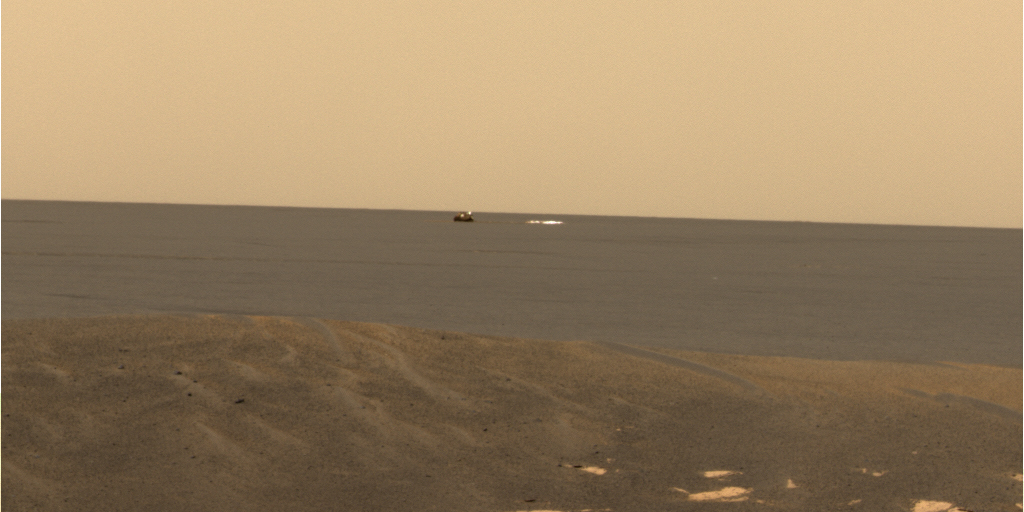
Here's a better picture (from the source)
Here is the NASA full size photo. It's today's NASA Image of the Day.
-
Here's a better picture (from the source)
Here is the NASA full size photo. It's today's NASA Image of the Day.
-
Re:I Don't Think This Was Well Thought Out
I will be convinced global warming is false when charts like these show the global temperature *drop*:
http://data.giss.nasa.gov/gistemp/graphs/Any questions?
-
Yes, you are a critical thinker!
Everyone has a lot to gain, so I will in fact call anything anyone claims without backing up those claims with any evidence bullshit...
Any normal scientist do will research, write a paper and in the conclusion of the paper claim 'more research needs to be done'... they are no evil money-hungry scientists because of that, it's stating a fact because every field can use more research and coincidentally they will have more work. My problem is with 'scientists' who make extraordinary claims without backing them up with sufficient data, or they have 'proof' but only the pretty graphs not the raw data. These people are fear-mongerers that hold the world hostage with these claims and try to silence opposition. When you can no longer oppose a questionable idea, questionable motives and questionable practices without being attacked you can be damn sure there is something wrong.
You questioned the graph without hesitation, as you should... I have certainly not provided any evidence and you should not believe me on my word on anything... But I have found the source of this graph for you: http://www.uoguelph.ca/~rmckitri/research/nvst.html who also reference http://data.giss.nasa.gov/gistemp/station_data/ -
Re:Science or Religion?
2009 was the hottest year on record? Huh. News to me, I have heard otherwise. Not locally or nationally, but globally.
Here you go:
http://www.giss.nasa.gov/research/news/20100121/Your citing Dr. Fake Data Hansen. That's your source? The man is well known for being, at best, sloppy or, at worst, deliberately misleading. According to him, every year is the hottest year on record. Among real scientists, most acknowledge 1998 as being the hottest year on record in recent history.
-
Re:Science or Religion?
Remember when 1998 was supposed to be the hottest ever? Then that was debunked and it was 1934.
1934 is (almost) the hottest year on record in the (contiguous) USA .
The hottest year on record globally is 2005. 2009 is a statistical tie with 1998 (and a couple others in the noughties) as second-warmest. 1934 doesn't come close. The last decade is the warmest on record.
All relevant graphs are conveniently located there.
Well if ol' Phil is right and we haven't seen any statistically significant warming for fifteen years....
Then it has crap all to do with the existence of trends that can only be detected over more than 20-30 years, as Phil himself points out in the bit that you blanked out of your mind, right?
and the proposed solution (seizing most of the world's wealth, eliminating most of the current industrial base, etc.)
Hm. OK. Never mind.
We both know the difference between science and arguments to win points in the mass media and influence the electorate, right?
Apparently not.
-
Re:Science or Religion?
Remember when 1998 was supposed to be the hottest ever? Then that was debunked and it was 1934.
1934 is (almost) the hottest year on record in the (contiguous) USA .
The hottest year on record globally is 2005. 2009 is a statistical tie with 1998 (and a couple others in the noughties) as second-warmest. 1934 doesn't come close. The last decade is the warmest on record.
All relevant graphs are conveniently located there.
Well if ol' Phil is right and we haven't seen any statistically significant warming for fifteen years....
Then it has crap all to do with the existence of trends that can only be detected over more than 20-30 years, as Phil himself points out in the bit that you blanked out of your mind, right?
and the proposed solution (seizing most of the world's wealth, eliminating most of the current industrial base, etc.)
Hm. OK. Never mind.
We both know the difference between science and arguments to win points in the mass media and influence the electorate, right?
Apparently not.