Slashdot Mirror
Domain: noaa.gov
Stories and comments across the archive that link to noaa.gov.
Comments · 2,602
-
Re:Grasping at Straws
Grasping at straws indeed. This is the map for November, and you're telling me that the AGW folks are grasping at straws?
http://www.ncdc.noaa.gov/sotc/service/global/map-percentile-mntp/201311.gif
-
Re:Technolog
Funny thing is, we have Ice Core Samples from all over Greenland, in Multiple Different Databases and they have all missed (or misinterpreted) this data for decades. Some of these were 2000 meters deep. In addition there were dye experiments in some areas.
So it is sort of a surprise that we had no hint of this.
-
Re:Technolog
Funny thing is, we have Ice Core Samples from all over Greenland, in Multiple Different Databases and they have all missed (or misinterpreted) this data for decades. Some of these were 2000 meters deep. In addition there were dye experiments in some areas.
So it is sort of a surprise that we had no hint of this.
-
Re:One picture from the article illustrates why we
The police still kill more than them.. lightning strikes on golf courses also.
Go back to your EDL rally.
Lets take the USA. 2,977 people killed in the 9/11 attacks. Each year 37 people are killed by lightning strikes. In the past it was as high as 70. Even if we assume that all of these occurred on golf courses you are way off. As for police killings - if you mean in all time the answer is "so far". Looking at Wiki lists they kill about 400 each year. The muzzy threat is growing.
In Britain (which does not have tropical storms) only 3 people a year are killed by lightning strikes and 15 people have been killed by police. Compare that with the 56 killed in the 7 July bombings. Again the muzzy threat is growing here too.
-
Re:Why must you have their data?
No but it is amazing what NEW science you can do with OLD data. I've worked with the Transportable Array project for example http://www.usarray.org/researchers/obs/transportable it's over a decade old and scientists are still discovering new ways to take advantage of the data and will likely be doing so for decades to come. On the other hand a lot of data is just junk due to poor quality metadata; when was that instrument calibrated? I dunno. Damn. At leat in geophysics we have the National Geophysical Data Center to curate this stuff http://www.ngdc.noaa.gov/ at least until Congress cuts it's funding.
-
But not in reality.
-
Re:In the USA
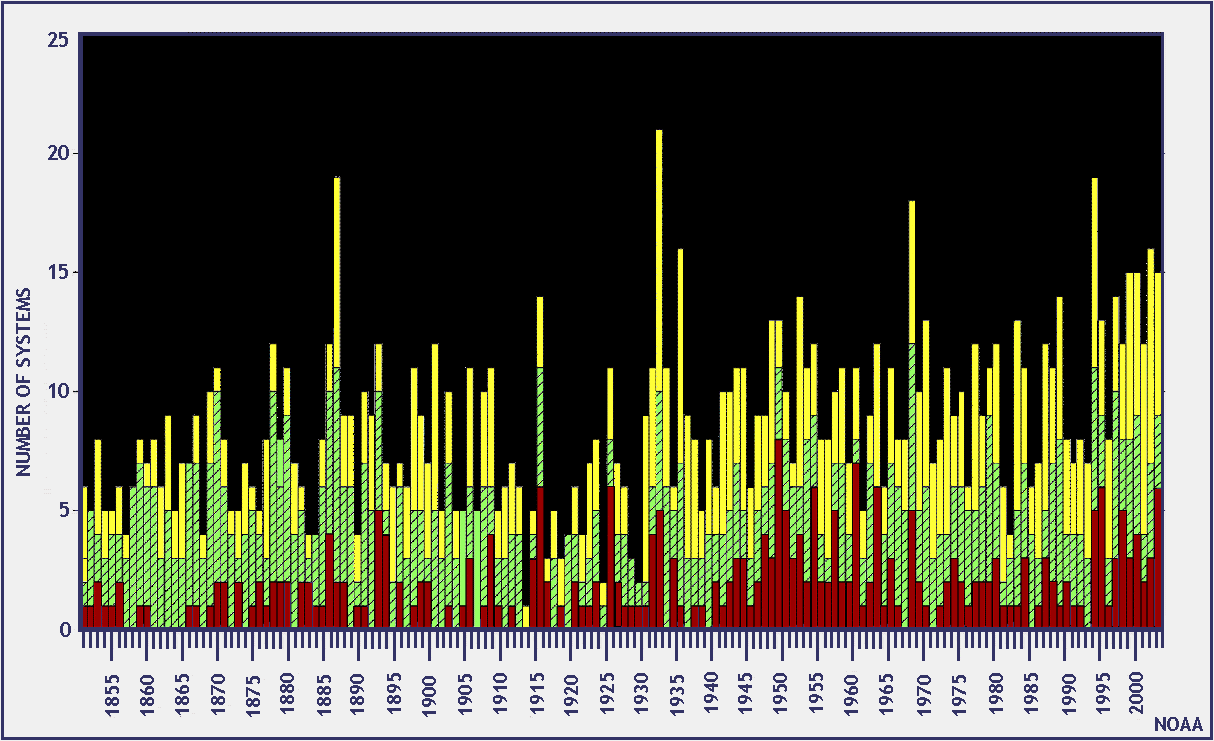
The climate isn't a consistent thing, there will be outliers - the period in the 1880's is one of them. The issue is the average is going up, while the standard deviation is going down, so we're getting a higher number of storms, but we're getting them every year, not just once every 25/50 years. Note the density in recent years compared to historic in the graph of hurricanes per year.
NOAA recently released a report detailing 12 major weather events we've been having (droughts, floods, storms) and their link to climate. There's yet to be a "debunking" of this that uses science instead of conspiracy theories.
The great thing about science is that it corrects itself when it's wrong - hence why the global cooling theories were overturned and replaced with the more accurate global warming. Now, while global warming is happening , it confuses some because it causes more shifts in climate often resulting in colder temperatures (or more snow), so even though the global temperature on average is rising, there are pockets of cold. The models also show this to produce more extreme weather events as shown in the NOAA report above.
The labels may vary, but the proposed action is the same - citizens are urged to change to cleaner energy sources. The libertarians should love this idea, because renewables mean they can be completely independent from utilities or governments and provide their own sources of power with solar or wind. The ones that get hurt are the poor little guy strip-mining a mountain or running a factory.
It's not about control, it's about moving to better energy sources. The first step is education, but there have always been greedy people that don't care what they're doing to everyone else - the same type that output poison into the river killing everything. Then the big government has to come in and tell them that it's not OK to be killing everything. -
Re:In the USA
The climate isn't a consistent thing, there will be outliers - the period in the 1880's is one of them. The issue is the average is going up, while the standard deviation is going down, so we're getting a higher number of storms, but we're getting them every year, not just once every 25/50 years. Note the density in recent years compared to historic in the graph of hurricanes per year.
NOAA recently released a report detailing 12 major weather events we've been having (droughts, floods, storms) and their link to climate. There's yet to be a "debunking" of this that uses science instead of conspiracy theories.
The great thing about science is that it corrects itself when it's wrong - hence why the global cooling theories were overturned and replaced with the more accurate global warming. Now, while global warming is happening , it confuses some because it causes more shifts in climate often resulting in colder temperatures (or more snow), so even though the global temperature on average is rising, there are pockets of cold. The models also show this to produce more extreme weather events as shown in the NOAA report above.
The labels may vary, but the proposed action is the same - citizens are urged to change to cleaner energy sources. The libertarians should love this idea, because renewables mean they can be completely independent from utilities or governments and provide their own sources of power with solar or wind. The ones that get hurt are the poor little guy strip-mining a mountain or running a factory.
It's not about control, it's about moving to better energy sources. The first step is education, but there have always been greedy people that don't care what they're doing to everyone else - the same type that output poison into the river killing everything. Then the big government has to come in and tell them that it's not OK to be killing everything. -
Re:Reference for the 4"
There is no evidence that the rate of sea level rise is increasing
No evidence except for the measurements and data. Here's a graph from NOAA.
Sea level rose rapidly 10,000 years ago at the end of the last glacial period. They have been fairly stable for the last 8000 years until levels began to climb again in the 20th century.
Records and research show that sea level has been steadily rising at a rate of 1 to 2.5 millimeters (0.04 to 0.1 inches) per year since 1900.
Since 1992, new methods of satellite altimetry indicate a rate of rise of 3 millimeters (0.12 inches) per year. - See http://oceanservice.noaa.gov/facts/sealevel.html
-
Re:Reference for the 4"
There is no evidence that the rate of sea level rise is increasing
No evidence except for the measurements and data. Here's a graph from NOAA.
Sea level rose rapidly 10,000 years ago at the end of the last glacial period. They have been fairly stable for the last 8000 years until levels began to climb again in the 20th century.
Records and research show that sea level has been steadily rising at a rate of 1 to 2.5 millimeters (0.04 to 0.1 inches) per year since 1900.
Since 1992, new methods of satellite altimetry indicate a rate of rise of 3 millimeters (0.12 inches) per year. - See http://oceanservice.noaa.gov/facts/sealevel.html
-
Two more on the way
In addition to the one above (USCG Doc. No. 1243693), here's another one on the way: USCG Doc. No.: 1225103.
-
Two more on the way
In addition to the one above (USCG Doc. No. 1243693), here's another one on the way: USCG Doc. No.: 1225103.
-
Re:There's 4 of them
And more on the way (not transferred from the builder?) http://www.st.nmfs.noaa.gov/pls/webpls/cgv_pkg.vessel_id_list?vessel_id_in=1243693
-
Re:There's another one here in Portland, Maine
Check http://www.st.nmfs.noaa.gov/st1/CoastGuard/VesselByName.html - search for BAL0: there's 0001, 0010, 0011 and 0100...
-
There's 4 of them
According to the US ship registration database (go to http://www.st.nmfs.noaa.gov/st1/CoastGuard/VesselByName.html and search for BAL0), there are four similar barges, with the convenient names:
BAL0001
BAL0010
BAL0011
BAL0100Looks like there's a pattern there, and it does scream Google...
-
Re: You're an idiot...
Individual scientists have overturned long-standing consensus for the entire history of science.
This same argument is also used by the countless wrong people too.
Sure, it does happen - but only after a) the method and conclusions are shown to be rock-solid, b) confirming evidence is found by third parties, and c) the existing body of evidence is also explained in the new context. This does not happen commonly - it's far more often that attempts to challenge the status quo fail one or all of the above, and are quickly forgotten.
it has very often turned out that the minority was right
And how often has that minority been wrong?
When I can easily identify errors in a scientific paper, then yes, my judgment is better than theirs. When scientist B points out an error in scientist A's paper, which I can verify for myself is true, then yes, my judgement is better than that of scientists A.
And when Scientists A and C point out errors in Scientist B's critique, who do you believe then? You have no idea even of how much you don't know in the complex field of climatology, yet you're still certain you can "easily" identify errors that the paper's authors, their peer reviewers and the great bulk of climatologists somehow missed completely. Or perhaps you're just selecting the conclusions you want to believe.
who do you think is the one suffering from Dunning-Kruger?
My answer stands
rather than evaluating the actual science in each case.
I'm not capable of evaluating the science at that level. Neither are you, unless you have a PhD and years of work in climate science that you haven't mentioned. We don't have the training or the experience, we haven't been reading all the relevant literature for the last decade, we don't even know what we would need to know to do that. The conclusions sound reasonable to me, but so do the critiques - and so do the counter-critiques. How is a layman supposed to tell who's the most accurate? It's not high-school level stuff.
That's science for you. Actual figures, peer-reviewed paper. If you have a problem with it, refute the science, not my comment about the science.
I assume you're referring to Fyfe et al (2013). And no, I have no problem with it. The models are clearly failing to robustly predict surface temperature variability, and if you read the paper itself, you'll see that it offers a number of possible reasons for this, including the ENSO and AMO oscillations, stratospheric aerosols, model base factors like climate sensitivity, or just unusual natural variability. There's a lot of factors involved, and nobody's claiming that the science is perfect yet, not even close. But we do know, for example, that ocean warming (where 90% of the heat imbalance goes) is continuing unabated, as does ocean acidification. Surface temperatures, while important to humans, are only a small part of the overall rising trend - and they can fluctuate up just as quickly as down.
What I do have a problem with, is the prodigious assumptive leap that a paper like Fyfe's somehow provides evidence that all climate science is therefore junk, that AGW must therefore be insignificant, or even that the 180-year global warming trend has suddenly ceased. This paper does not begin to suggest that, merely that our surface temperature models need more work, nothing more. Meanwhile, other peer reviewed papers like Santer et al (2013) conclude unequivocally that "Our results... underscore the dominant role human activities have played in recent climate change." (I can cite half a dozen others that say the same, if you want).
-
It's global warming, not "my home town warming."
A large portion of North America last March and April were unseasonably cold. Where I live, we had 20 days in April with snowcover on the ground (the first 8 being some of the days without snow). It was unprecedented weather for that time of year (i.e. unseen in my lifetime). The icing out out lakes in the area set records or were close to the records for lateness.
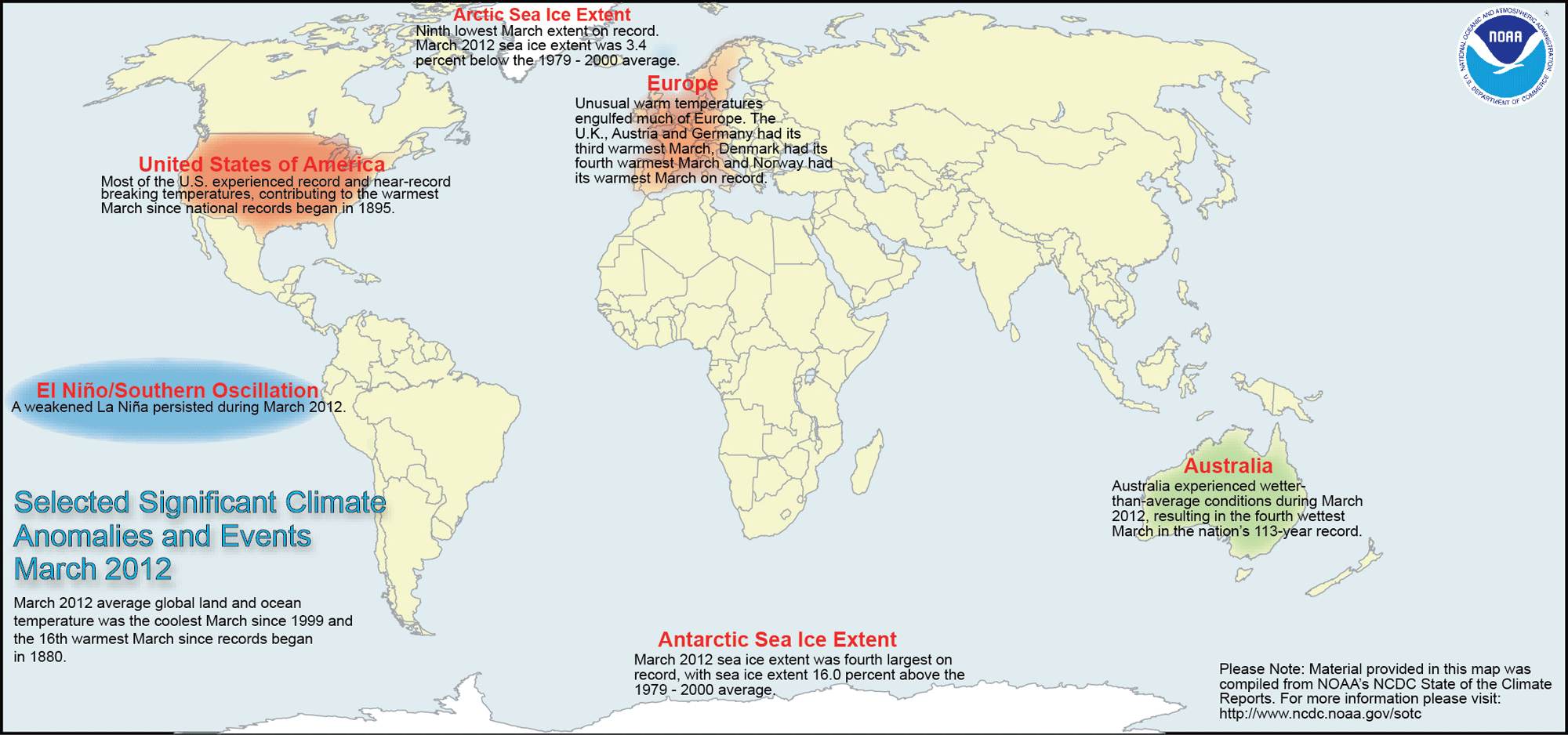
Where in North America do you live? I ask, because according to NOAA, you only saw colder temperatures along the west coast in March, whereas the midwest saw temperatures up to 15 F higher than average, making it the warmest March on record since 1895. We also saw lower than average snow fall west of the Mississippi in April. There was a late-season snowstorm in the Appalachians in April 2012 though, but despite this, it was the third warmest April on record, nationally.
I am not disagreeing with global warming or that it can cause anomalous patters in weather. But all predictions and forecasts were opposite to what actually happened. This can not be waved away by your two points.
Then let's provide more data! After all, North America isn't the whole planet, and in March 2012, Europe also had one of its warmest Marches on record, Australia had record rainfalls, and the Greenland ice sheet had it's ninth lowest sea ice extent on record. (On the other hand, the Antarctic had one of its 4th largest.) Averaging over the globe, it was the 16th warmest March on record.
April, on the other hand, turned remarkably chilly in Europe, making it one of the coldest on record in several countries, and the Greenland sea ice "rebounded" to become one of the greatest since 2001 (still 1.8% lower than the 1979-2001 average). Globally, this was still 0.65 C over the historical average, and ocean temperatures were the 11th warmest on record for April.
Overall, 2012 was about the 8th or 9th warmest year on record. I find it amusing that you cite regional weather for one or two months in one part of the world as evidence that the whole world isn't warming and chide the GP for only providing "two points."
-
It's global warming, not "my home town warming."
A large portion of North America last March and April were unseasonably cold. Where I live, we had 20 days in April with snowcover on the ground (the first 8 being some of the days without snow). It was unprecedented weather for that time of year (i.e. unseen in my lifetime). The icing out out lakes in the area set records or were close to the records for lateness.
Where in North America do you live? I ask, because according to NOAA, you only saw colder temperatures along the west coast in March, whereas the midwest saw temperatures up to 15 F higher than average, making it the warmest March on record since 1895. We also saw lower than average snow fall west of the Mississippi in April. There was a late-season snowstorm in the Appalachians in April 2012 though, but despite this, it was the third warmest April on record, nationally.
I am not disagreeing with global warming or that it can cause anomalous patters in weather. But all predictions and forecasts were opposite to what actually happened. This can not be waved away by your two points.
Then let's provide more data! After all, North America isn't the whole planet, and in March 2012, Europe also had one of its warmest Marches on record, Australia had record rainfalls, and the Greenland ice sheet had it's ninth lowest sea ice extent on record. (On the other hand, the Antarctic had one of its 4th largest.) Averaging over the globe, it was the 16th warmest March on record.
April, on the other hand, turned remarkably chilly in Europe, making it one of the coldest on record in several countries, and the Greenland sea ice "rebounded" to become one of the greatest since 2001 (still 1.8% lower than the 1979-2001 average). Globally, this was still 0.65 C over the historical average, and ocean temperatures were the 11th warmest on record for April.
Overall, 2012 was about the 8th or 9th warmest year on record. I find it amusing that you cite regional weather for one or two months in one part of the world as evidence that the whole world isn't warming and chide the GP for only providing "two points."
-
It's global warming, not "my home town warming."
A large portion of North America last March and April were unseasonably cold. Where I live, we had 20 days in April with snowcover on the ground (the first 8 being some of the days without snow). It was unprecedented weather for that time of year (i.e. unseen in my lifetime). The icing out out lakes in the area set records or were close to the records for lateness.
Where in North America do you live? I ask, because according to NOAA, you only saw colder temperatures along the west coast in March, whereas the midwest saw temperatures up to 15 F higher than average, making it the warmest March on record since 1895. We also saw lower than average snow fall west of the Mississippi in April. There was a late-season snowstorm in the Appalachians in April 2012 though, but despite this, it was the third warmest April on record, nationally.
I am not disagreeing with global warming or that it can cause anomalous patters in weather. But all predictions and forecasts were opposite to what actually happened. This can not be waved away by your two points.
Then let's provide more data! After all, North America isn't the whole planet, and in March 2012, Europe also had one of its warmest Marches on record, Australia had record rainfalls, and the Greenland ice sheet had it's ninth lowest sea ice extent on record. (On the other hand, the Antarctic had one of its 4th largest.) Averaging over the globe, it was the 16th warmest March on record.
April, on the other hand, turned remarkably chilly in Europe, making it one of the coldest on record in several countries, and the Greenland sea ice "rebounded" to become one of the greatest since 2001 (still 1.8% lower than the 1979-2001 average). Globally, this was still 0.65 C over the historical average, and ocean temperatures were the 11th warmest on record for April.
Overall, 2012 was about the 8th or 9th warmest year on record. I find it amusing that you cite regional weather for one or two months in one part of the world as evidence that the whole world isn't warming and chide the GP for only providing "two points."
-
It's global warming, not "my home town warming."
A large portion of North America last March and April were unseasonably cold. Where I live, we had 20 days in April with snowcover on the ground (the first 8 being some of the days without snow). It was unprecedented weather for that time of year (i.e. unseen in my lifetime). The icing out out lakes in the area set records or were close to the records for lateness.
Where in North America do you live? I ask, because according to NOAA, you only saw colder temperatures along the west coast in March, whereas the midwest saw temperatures up to 15 F higher than average, making it the warmest March on record since 1895. We also saw lower than average snow fall west of the Mississippi in April. There was a late-season snowstorm in the Appalachians in April 2012 though, but despite this, it was the third warmest April on record, nationally.
I am not disagreeing with global warming or that it can cause anomalous patters in weather. But all predictions and forecasts were opposite to what actually happened. This can not be waved away by your two points.
Then let's provide more data! After all, North America isn't the whole planet, and in March 2012, Europe also had one of its warmest Marches on record, Australia had record rainfalls, and the Greenland ice sheet had it's ninth lowest sea ice extent on record. (On the other hand, the Antarctic had one of its 4th largest.) Averaging over the globe, it was the 16th warmest March on record.
April, on the other hand, turned remarkably chilly in Europe, making it one of the coldest on record in several countries, and the Greenland sea ice "rebounded" to become one of the greatest since 2001 (still 1.8% lower than the 1979-2001 average). Globally, this was still 0.65 C over the historical average, and ocean temperatures were the 11th warmest on record for April.
Overall, 2012 was about the 8th or 9th warmest year on record. I find it amusing that you cite regional weather for one or two months in one part of the world as evidence that the whole world isn't warming and chide the GP for only providing "two points."
-
NOAA Weather Radio + OTA TV for the win...
NOAA Weather Radio should be receivable anywhere in CONUS and there are decent radios to be had (that will activate automatically during severe weather events) for less than $50. Something worth considering.
As far as the asshats at TWC, have you considered going OTA-only or at least OTA for your local channels? If you're lucky you have a local station with a good weather operation that will go above and beyond the EAS reporting -- one of our local stations preempted NBC for the better part of an hour when we had a tornado earlier this year -- but even if they don't you'd still be assured of getting the EAS alerts.
Check out TV Fool and AntennaWeb as starting resources for determining if OTA reception is feasible from your location and what kind of antenna system you would need to make it happen. As an added bonus, you'll get a far better HD picture than anything Time Warner is sending down their pipe, they compress the hell out of their digital channels.
-
Re:Bad idea
Anchovies and sardines aren't as susceptible to overfishing as larger fish. Their fast reproductive cycle allows them to recover quite fast if conditions are right. Their populations are linked to ocean temperature, which is also something humans have an effect on. You can learn more about it here
-
Re:Cognitive Errors, Courtesy Exxon
The ltibeam you link and the exxon one are considerably different. A 12kHz transducer is on the order of inches in size.
Er, go look at that picture again. The lower the frequency, the longer the wavelength. Which means, it'll be bigger, not smaller. Unless of course you build a transducer that, er, doesn't work. In which case sure, "inches in size" works great.
-
Re:Cognitive Errors, Courtesy Exxon
Look, as somebody who actually works in this industry
... And whose identity is "Anonymous"
, multibeam sounders operate on very high frequencies, way over what whales can perceive.
And yet, I can take away your hearing by emitting ultrasound if it's powerful enough. You won't hear yourself going deaf, you'll just go deaf. Actually, I can even kill you with exposure of 180dB of ultrasound. But, working (anonymously) in the industry, you'd know that frequency is only part of the equation.
What's hilarious here is that the Slashdot circle-jerkers are already screaming EXXON...BAAAAD!
Statements like these definately add to your credibility. By making juvenile sexual jokes, it's immediately obvious to everyone that this is a man who makes six figures in the field of Oceanography.
But do you know what kind of sonar does make whales' ears bleed?
Yes: The very loud kind. Just like any other animal's ears. In fact, whale's ears are more suseptible to damage due to high decibel emissions than humans because in the human ear, air waves hit a membrane behind which there is a liquid-filled area, thus the energy of the wave can be dissipated; Pressure waves travelling through air are much less powerful than underwater, because of the density of the medium. Whales, unfortunately, have inner ears filled with the same liquid is its surrounding environment, and at the same pressure... meaning there is no transitive barrier to protect them.
The big fucking' spherical and cylindrical arrays you find in the tips of the bulbous dicks of ships and submarines.
Well, without knowing which ship was involved in a 6 year old incident, it's impossible to know whether any phallic-shaped devices were mounted to the ship. However, while lacking your literary ability in the many uses of the word 'fuck', an independent science team, perhaps with less impressive credentials than yours, found the ships' activities were the likely cause of the sudden displacement and eventual death of the whales. Oh, and the names of the members of that scientific team were the International Whaling Commission, the US Marine Mammal Commission, the US National Oceanic and Atmospheric Administration, the US Bureau of Ocean Energy Management, ExxonMobil Exploration and Production (Northern Madagascar) Ltd, the International Fund for Animal Welfare, the Wildlife Conservation Society and the Government of Madagascar. They all think you're full of crap, but what would over a hundred scientists know compared to someone who swears like a sailor anonymously on slashdot?
Have you even seen a fucking multibeam? The transducer array is roughly the size of a shoebox.
You must have very big feet then. That's a picture of the NOAA's multibeam echosounder, an ER60. It is a low-power model, and in this case is being used to track the migratory movements of fish, and is of limited range. The kind that several sources have indicated were used by ExxonMobile inject high pressure air into the water; These are considerably larger, and more powerful, than these systems, which modulate a diaphram. It's the difference between your laptop's speakers, and a pneumatically-driven organ like those seen at older churches. Needless to say, the organ is much louder.
Idiots. I'm surrounded by goddamn idiots!
Yeah... I know this feeling well. Look at how often I get downmodded for providing factual and relevant commentary, instead of simp
-
Another cry of wolf
The whole website 350.org was created what now... 6 years ago? Because Bill McKibben said that 350 ppm CO2 was a "safe upper limit" for CO2 in the atmosphere in 2007.
http://en.wikipedia.org/wiki/350.org
http://350.org/Since we are now well past 350ppm CO2 in the atmosphere: http://www.esrl.noaa.gov/gmd/ccgg/trends/
The IP-Cry-Wolf organization has to create a "new" upper limit. It's just more bullshit. They have no idea what any "safe upper limit" for CO2 is, they guess and publicize scary numbers every 5 years in order to secure future funding.
-
Re:Look over here, look over here!
Dealing with your 'blockquote' style is way too hard. I suspect this is a rathole, and nobody else is reading it, and that you know what you said, so I'll omit the quotes.
So, your assertion is that changes in CO2 levels is NOT caused by human activity, or that the contribution by humans is negligible. Sadly, most authorities disagree with you. I have no way of measuring the effect, so I can't weigh in, other than to mention that I trust folks who do this for a living far more than I trust you. Here are a few links:
EPA
IPCC
NOAA
More IPCC
RealClimateAccording to folks that study this, the sea level is rising. Here are some links:
Union of Concerned Scientists
National Geographic
EPA
NASA, scroll down.The ice core mystery has been explained in such a way that the time differences are in the noise. Here is a link that attempts to explain it: arstechnica. However, one obvious reason why CO2 might follow temperature rises is that lots of CO2 is released in the arctic tundra when the permafrost melts. As solar cycles cause warming CO2 is released. However, it could easily be a situation where small changes in temperature cause CO2 spikes, which then contribute to a feedback loop. Since nobody was there, nobody really knows for sure. However, this article describes a paper in Nature 2012 that describes the feedback loop. Note the paper assumes that excess CO2 causes temperature rises. That is pretty much not contested at this point, I believe, due to a strong theoretical understanding of the interactions. Since there were no excess sources of CO2 in the Pleistocene, the temperature rise precedes the CO2 rise. Since we are artificially increasing CO2, we trigger the warming effect without a requirement for excess solar radiation.
I have read 'Good Calories, Bad Calories' by Taubes. The book is very convincing. The view of nutrition as a power game, with no real science behind it is quite interesting. Sadly for your case, there is LOTS of science to back up the assertions of Global Warming caused by human activity. Too many to simply dismiss.
If there is no problem with CO2 causing global warming, and we are going to be ok despite these emissions, well, that would be wonderful. Due to lobbying by Koch and friends, that is probably what we are going to end up with anyway. However, if there is only a 1% possibility that the worst will happen, and hundreds of millions of people will die because of it, I will still support doing whatever we can to prevent it. Can you really be so sure of your facts, many of which are supported by papers paid for by Koch subsidiaries who have a real financial interest in stopping any action on climate change?
-
"A cool year" - really? Part3, Jul & Aug 2013
Here's what NOAA has to say month by month for 2013 (continued)
July Global Highlights - http://www.ncdc.noaa.gov/sotc/global/2013/7
The combined average temperature over global land and ocean surfaces for July 2013 was the sixth highest on record, at 0.61C (1.10F) above the 20th century average of 15.8C (60.4F).
The global land surface temperature was 0.78C (1.40F) above the 20th century average of 14.3C (57.8F), marking the eighth warmest July on record. For the ocean, the July global sea surface temperature was 0.54C (0.97F) above the 20th century average of 16.4C (61.5F), the fifth warmest July on record.
The combined global land and ocean average surface temperature for the January–July period (year-to-date) was 0.59C (1.06F) above the 20th century average of 13.8C (56.9F), tying with 2003 as the sixth warmest such period on record.August Global Highlights - http://www.ncdc.noaa.gov/sotc/global/2013/8
The combined average temperature over global land and ocean surfaces for August 2013 tied with 2005 as the fourth highest in the 1880–2013 record, at 0.62C (1.12F) above the 20th century average of 15.6C (60.1F).
The global land surface temperature was 0.77C (1.39F) above the 20th century average of 13.8C (56.9F), the 11th warmest August on record. For the global oceans, the August average sea surface temperature was 0.57C (1.03F) above the 20th century average of 16.4C (61.4F), tying with 1998, 2003, 2005, and 2009 as the record highest for August.
The combined global land and ocean average surface temperature for the June–August period was 0.62C (1.12F) above the 20th century average of 15.6C (60.1F), tying with 2009 as the fifth warmest such period on record.
The June–August worldwide land surface temperature was 0.85C (1.53F) above the 20th century average, the seventh warmest such period on record. The global ocean surface temperature for the same period was 0.53C (0.95F) above the 20th century average, the fifth warmest June–August on record.
The combined global land and ocean average surface temperature for the year-to-date (January–August) was 0.59C (1.06F) above the 20th century average of 14.0C (57.3F), tying with 2003 as the sixth warmest such period on record. -
"A cool year" - really? Part3, Jul & Aug 2013
Here's what NOAA has to say month by month for 2013 (continued)
July Global Highlights - http://www.ncdc.noaa.gov/sotc/global/2013/7
The combined average temperature over global land and ocean surfaces for July 2013 was the sixth highest on record, at 0.61C (1.10F) above the 20th century average of 15.8C (60.4F).
The global land surface temperature was 0.78C (1.40F) above the 20th century average of 14.3C (57.8F), marking the eighth warmest July on record. For the ocean, the July global sea surface temperature was 0.54C (0.97F) above the 20th century average of 16.4C (61.5F), the fifth warmest July on record.
The combined global land and ocean average surface temperature for the January–July period (year-to-date) was 0.59C (1.06F) above the 20th century average of 13.8C (56.9F), tying with 2003 as the sixth warmest such period on record.August Global Highlights - http://www.ncdc.noaa.gov/sotc/global/2013/8
The combined average temperature over global land and ocean surfaces for August 2013 tied with 2005 as the fourth highest in the 1880–2013 record, at 0.62C (1.12F) above the 20th century average of 15.6C (60.1F).
The global land surface temperature was 0.77C (1.39F) above the 20th century average of 13.8C (56.9F), the 11th warmest August on record. For the global oceans, the August average sea surface temperature was 0.57C (1.03F) above the 20th century average of 16.4C (61.4F), tying with 1998, 2003, 2005, and 2009 as the record highest for August.
The combined global land and ocean average surface temperature for the June–August period was 0.62C (1.12F) above the 20th century average of 15.6C (60.1F), tying with 2009 as the fifth warmest such period on record.
The June–August worldwide land surface temperature was 0.85C (1.53F) above the 20th century average, the seventh warmest such period on record. The global ocean surface temperature for the same period was 0.53C (0.95F) above the 20th century average, the fifth warmest June–August on record.
The combined global land and ocean average surface temperature for the year-to-date (January–August) was 0.59C (1.06F) above the 20th century average of 14.0C (57.3F), tying with 2003 as the sixth warmest such period on record. -
"A cool year" - really? Part 2, Apr-Jun 2013
Here's what NOAA has to say month by month for 2013 (continued)
April Global Highlights - looks like an error has this page pointing to the June update so details can be found instead at
http://www.climate.gov/news-features/featured-images/april-2013-global-climate-updateMay Global Highlights - http://www.ncdc.noaa.gov/sotc/global/2013/5
The combined average temperature over global land and ocean surfaces for May 2013 tied with 1998 and 2005 as the third warmest on record, at 0.66C (1.19F) above the 20th century average of 14.8C (58.6F).
The global land surface temperature was 1.11C (2.00F) above the 20th century average of 11.1C (52.0F), also the third warmest May on record. For the ocean, the May global sea surface temperature was 0.49C (0.88F) above the 20th century average of 16.3C (61.3F), tying with 2003 and 2009 as the fifth warmest May on record.
The combined global land and ocean average surface temperature for the March–May period was 0.59C (1.06F) above the 20th century average of 13.7C (56.7F), tying with 2004 as the eighth warmest such period on record.
The March–May worldwide land surface temperature was 0.97C (1.75F) above the 20th century average, the 11th warmest such period on record. The global ocean surface temperature for the same period was 0.45C (0.81F) above the 20th century average and tied with 2001 as the seventh warmest such period on record.
The combined global land and ocean average surface temperature for the January–May period (year-to-date) was 0.59C (1.06F) above the 20th century average of 13.1C (55.5F), the eighth warmest such period on record.June Global Updates - http://www.ncdc.noaa.gov/sotc/global/2013/6
The combined average temperature over global land and ocean surfaces for June 2013 tied with 2006 as the fifth highest on record, at 0.64C (1.15F) above the 20th century average of 15.5C (59.9F).
The global land surface temperature was 1.05C (1.89F) above the 20th century average of 13.3C (55.9F), marking the third warmest June on record. For the ocean, the June global sea surface temperature was 0.48C (0.86F) above the 20th century average of 16.4C (61.5F), the 10th warmest June on record.
The combined global land and ocean average surface temperature for the January–June period (year-to-date) was 0.59C (1.06F) above the 20th century average of 13.5C (56.3F), tying with 2003 as the seventh warmest such period on record. -
"A cool year" - really? Part 2, Apr-Jun 2013
Here's what NOAA has to say month by month for 2013 (continued)
April Global Highlights - looks like an error has this page pointing to the June update so details can be found instead at
http://www.climate.gov/news-features/featured-images/april-2013-global-climate-updateMay Global Highlights - http://www.ncdc.noaa.gov/sotc/global/2013/5
The combined average temperature over global land and ocean surfaces for May 2013 tied with 1998 and 2005 as the third warmest on record, at 0.66C (1.19F) above the 20th century average of 14.8C (58.6F).
The global land surface temperature was 1.11C (2.00F) above the 20th century average of 11.1C (52.0F), also the third warmest May on record. For the ocean, the May global sea surface temperature was 0.49C (0.88F) above the 20th century average of 16.3C (61.3F), tying with 2003 and 2009 as the fifth warmest May on record.
The combined global land and ocean average surface temperature for the March–May period was 0.59C (1.06F) above the 20th century average of 13.7C (56.7F), tying with 2004 as the eighth warmest such period on record.
The March–May worldwide land surface temperature was 0.97C (1.75F) above the 20th century average, the 11th warmest such period on record. The global ocean surface temperature for the same period was 0.45C (0.81F) above the 20th century average and tied with 2001 as the seventh warmest such period on record.
The combined global land and ocean average surface temperature for the January–May period (year-to-date) was 0.59C (1.06F) above the 20th century average of 13.1C (55.5F), the eighth warmest such period on record.June Global Updates - http://www.ncdc.noaa.gov/sotc/global/2013/6
The combined average temperature over global land and ocean surfaces for June 2013 tied with 2006 as the fifth highest on record, at 0.64C (1.15F) above the 20th century average of 15.5C (59.9F).
The global land surface temperature was 1.05C (1.89F) above the 20th century average of 13.3C (55.9F), marking the third warmest June on record. For the ocean, the June global sea surface temperature was 0.48C (0.86F) above the 20th century average of 16.4C (61.5F), the 10th warmest June on record.
The combined global land and ocean average surface temperature for the January–June period (year-to-date) was 0.59C (1.06F) above the 20th century average of 13.5C (56.3F), tying with 2003 as the seventh warmest such period on record. -
"A cool year" - really? Part 1, Jan-Mar 2013
Here's what NOAA has to say month by month for 2013
January Global Highlights - http://www.ncdc.noaa.gov/sotc/global/2013/1
The average combined global land and ocean surface temperature for January 2013 tied with 1995 as the ninth warmest January since records began in 1880, at 0.54C (0.97F) above the 20th century average of 12.0C (53.6F).
The globally-averaged land surface temperature for January 2013 was the 13th warmest January on record, at 0.90C (1.62F) above average. The average land surface temperature across the Southern Hemisphere was record warm for the month.
The globally-averaged ocean surface temperature was the eighth warmest January on record, at 0.41C (0.74F) above average.
February Global Highlights - http://www.ncdc.noaa.gov/sotc/global/2013/2
The combined average temperature over global land and ocean surfaces for February 2013 tied with 2003 as the ninth warmest on record, at 0.57C (1.03F) above the 20th century average of 12.1C (53.9F).
The global land surface temperature was 1.00C (1.80F) above the 20th century average of 3.2C (37.8F), tying with 2010 as the 11th warmest February on record. For the ocean, the February global sea surface temperature was 0.42C (0.76F) above the 20th century average of 15.9C (60.6F), making it the eighth warmest February on record.
The combined global land and ocean average surface temperature for the December–February period was 0.51C (0.92F) above the 20th century average of 12.1C (53.8F), making it the 12th warmest such period on record.
The December–February worldwide land surface temperature was 0.71C (1.28F) above the 20th century average, tying with 1992 as the 15th warmest such period on record. The global ocean surface temperature for the same period was 0.43C (0.77F) above the 20th century average and was the eighth warmest such period on record.
The combined global land and ocean average surface temperature for the January–February period (year-to-date) was 0.56C (1.01F) above the 20th century average of 12.1C (53.8F), tying with 2005 as the ninth warmest such period on record.March Global Highlights - http://www.ncdc.noaa.gov/sotc/global/2013/3
The combined average temperature over global land and ocean surfaces for March 2013 tied with 2006 as the 10th warmest on record, at 0.58C (1.04F) above the 20th century average of 12.3C (54.1F).
The global land surface temperature was 1.06C (1.91F) above the 20th century average of 5.0C (40.8F), the 11th warmest March on record. For the ocean, the March global sea surface temperature was 0.41C (0.74F) above the 20th century average of 15.9C (60.7F), making it the ninth warmest March on record.
The combined global land and ocean average surface temperature for the January–March period (year-to-date) was 0.58C (1.04F) above the 20th century average of 12.3C (54.1F), the eighth warmest such period on record. -
"A cool year" - really? Part 1, Jan-Mar 2013
Here's what NOAA has to say month by month for 2013
January Global Highlights - http://www.ncdc.noaa.gov/sotc/global/2013/1
The average combined global land and ocean surface temperature for January 2013 tied with 1995 as the ninth warmest January since records began in 1880, at 0.54C (0.97F) above the 20th century average of 12.0C (53.6F).
The globally-averaged land surface temperature for January 2013 was the 13th warmest January on record, at 0.90C (1.62F) above average. The average land surface temperature across the Southern Hemisphere was record warm for the month.
The globally-averaged ocean surface temperature was the eighth warmest January on record, at 0.41C (0.74F) above average.
February Global Highlights - http://www.ncdc.noaa.gov/sotc/global/2013/2
The combined average temperature over global land and ocean surfaces for February 2013 tied with 2003 as the ninth warmest on record, at 0.57C (1.03F) above the 20th century average of 12.1C (53.9F).
The global land surface temperature was 1.00C (1.80F) above the 20th century average of 3.2C (37.8F), tying with 2010 as the 11th warmest February on record. For the ocean, the February global sea surface temperature was 0.42C (0.76F) above the 20th century average of 15.9C (60.6F), making it the eighth warmest February on record.
The combined global land and ocean average surface temperature for the December–February period was 0.51C (0.92F) above the 20th century average of 12.1C (53.8F), making it the 12th warmest such period on record.
The December–February worldwide land surface temperature was 0.71C (1.28F) above the 20th century average, tying with 1992 as the 15th warmest such period on record. The global ocean surface temperature for the same period was 0.43C (0.77F) above the 20th century average and was the eighth warmest such period on record.
The combined global land and ocean average surface temperature for the January–February period (year-to-date) was 0.56C (1.01F) above the 20th century average of 12.1C (53.8F), tying with 2005 as the ninth warmest such period on record.March Global Highlights - http://www.ncdc.noaa.gov/sotc/global/2013/3
The combined average temperature over global land and ocean surfaces for March 2013 tied with 2006 as the 10th warmest on record, at 0.58C (1.04F) above the 20th century average of 12.3C (54.1F).
The global land surface temperature was 1.06C (1.91F) above the 20th century average of 5.0C (40.8F), the 11th warmest March on record. For the ocean, the March global sea surface temperature was 0.41C (0.74F) above the 20th century average of 15.9C (60.7F), making it the ninth warmest March on record.
The combined global land and ocean average surface temperature for the January–March period (year-to-date) was 0.58C (1.04F) above the 20th century average of 12.3C (54.1F), the eighth warmest such period on record. -
"A cool year" - really? Part 1, Jan-Mar 2013
Here's what NOAA has to say month by month for 2013
January Global Highlights - http://www.ncdc.noaa.gov/sotc/global/2013/1
The average combined global land and ocean surface temperature for January 2013 tied with 1995 as the ninth warmest January since records began in 1880, at 0.54C (0.97F) above the 20th century average of 12.0C (53.6F).
The globally-averaged land surface temperature for January 2013 was the 13th warmest January on record, at 0.90C (1.62F) above average. The average land surface temperature across the Southern Hemisphere was record warm for the month.
The globally-averaged ocean surface temperature was the eighth warmest January on record, at 0.41C (0.74F) above average.
February Global Highlights - http://www.ncdc.noaa.gov/sotc/global/2013/2
The combined average temperature over global land and ocean surfaces for February 2013 tied with 2003 as the ninth warmest on record, at 0.57C (1.03F) above the 20th century average of 12.1C (53.9F).
The global land surface temperature was 1.00C (1.80F) above the 20th century average of 3.2C (37.8F), tying with 2010 as the 11th warmest February on record. For the ocean, the February global sea surface temperature was 0.42C (0.76F) above the 20th century average of 15.9C (60.6F), making it the eighth warmest February on record.
The combined global land and ocean average surface temperature for the December–February period was 0.51C (0.92F) above the 20th century average of 12.1C (53.8F), making it the 12th warmest such period on record.
The December–February worldwide land surface temperature was 0.71C (1.28F) above the 20th century average, tying with 1992 as the 15th warmest such period on record. The global ocean surface temperature for the same period was 0.43C (0.77F) above the 20th century average and was the eighth warmest such period on record.
The combined global land and ocean average surface temperature for the January–February period (year-to-date) was 0.56C (1.01F) above the 20th century average of 12.1C (53.8F), tying with 2005 as the ninth warmest such period on record.March Global Highlights - http://www.ncdc.noaa.gov/sotc/global/2013/3
The combined average temperature over global land and ocean surfaces for March 2013 tied with 2006 as the 10th warmest on record, at 0.58C (1.04F) above the 20th century average of 12.3C (54.1F).
The global land surface temperature was 1.06C (1.91F) above the 20th century average of 5.0C (40.8F), the 11th warmest March on record. For the ocean, the March global sea surface temperature was 0.41C (0.74F) above the 20th century average of 15.9C (60.7F), making it the ninth warmest March on record.
The combined global land and ocean average surface temperature for the January–March period (year-to-date) was 0.58C (1.04F) above the 20th century average of 12.3C (54.1F), the eighth warmest such period on record. -
Re:Enough is enough.
An interesting take on the Kosaka and Xie study.
Not very interesting:
Tisdale: Anyone with a little common sense who’s reading the abstract and the hype around the blogosphere and the Meehl et al papers will logically now be asking: if La Niña events can stop global warming, then how much do El Niño events contribute? 50%? The climate science community is actually hurting itself when they fail to answer the obvious questions.
On average (as Xie points out to Curry) La Niña / El Niño contribute nothing to global warming - they can't, they don't make heat, they just move it around.
Also check out what Tamino has to say about Curry's misinterpretation of the results.
And note that, at this time, it's simply a fit of data, it is NOT a model as it is much too new to actually have been used for a prediction. Unlike the other dozens and dozens of studies I linked to further up the chain.
Nope, it's a model.
Kosaka and Xie don’t have a tunable parameter. They used a full-blown coupled ocean-atmosphere climate model (GFDL CM2.1).
http://blog.chron.com/climateabyss/2013/08/learning-from-the-hiatus/
http://nomads.gfdl.noaa.gov/nomads/forms/deccen/
Yay for Fortran!
-
Re:Pointless posturing
A lot of taxpayer dollars go into providing that "free" weather data - about $5.1BN this current fiscal year (FY 2013).
-
Re: Or...
http://oceanservice.noaa.gov/education/kits/corals/media/supp_coral04a.html
http://oceanservice.noaa.gov/education/kits/corals/coral04_reefs.html
http://ngm.nationalgeographic.com/ngm/0103/feature2/
"For 20,000 years, since the peak of the last ice age, its coral base has gradually followed the rising sea level and slowly developed into the splendid, living atoll it is today."The reef is constantly growing and shifting. As water levels incrementally rise, new coral will build up over the "dead stuff"
It really isn't a big deal. Witness history. The Maldives have been there for a very long time, and water levels have been rising for a very long time, considerably more rapidly than now.The coral is considerably above the rock at this point, just due to continuing to grow as water rises and rock subsides.
-
Re: Or...
http://oceanservice.noaa.gov/education/kits/corals/media/supp_coral04a.html
http://oceanservice.noaa.gov/education/kits/corals/coral04_reefs.html
http://ngm.nationalgeographic.com/ngm/0103/feature2/
"For 20,000 years, since the peak of the last ice age, its coral base has gradually followed the rising sea level and slowly developed into the splendid, living atoll it is today."The reef is constantly growing and shifting. As water levels incrementally rise, new coral will build up over the "dead stuff"
It really isn't a big deal. Witness history. The Maldives have been there for a very long time, and water levels have been rising for a very long time, considerably more rapidly than now.The coral is considerably above the rock at this point, just due to continuing to grow as water rises and rock subsides.
-
Re:Amazing
Looking at all that "noise" in the data, its hard to see what curve would fit it. Linear ( as shown )? Downward opening parabolic? Decaying exponential?
same link as above, but clickable. -
Re:Or...
You are aware, I trust, that it is rising.
http://oceanservice.noaa.gov/facts/sealevel.htmlIt's more pronounced in some areas than others, but still, it's rising. So if you live in a low-lying coastal area, then this ought to be of concern to you.
-
Re:So what about YOUR ridiculous claim?
When you ridiculously claim "What about Gore's ridiculous claim that his propaganda film predicted the effects of Hurricane Sandy", where is your evidence for that?
I left my "evidence" out of the OP, but if you're too lazy to look up the interview yourself, here is what Gore said:
"You mentioned my movie back in the day. The single most common criticism from skeptics when the film came out focused on the animation showing ocean water flowing into the World Trade Center memorial site. Skeptics called that demagogic and absurd and irresponsible. It happened last October 29th, years ahead of schedule, and the impact of that and many, many other similar events here and around the world has really begun to create a profound shift."
That's fine and all, but Gore also claimed large swaths of the earth would be underwater by now.Uh, 2-11% increase in the top end
Citation needed. Again, if you go back to the interview, you'd see that Gore was referring to hurricanes when he referred to "extreme events being more extreme", but as usual for him, that is hyperbole. The trend for major storms since 1851 is negative. See for yourself.
-
Yawn
Wake me when the National Hurricane Center expands the Saffir-Simpson scale so that it goes to 11.
-
Re:One word
Yes indeed. Now they're trying to stomp on NOAA, a comparatively small and weak governmental entity (they can't even find enough money to replace lost weather buoys).
Nothing like the economic power of a determined billionaire and the bottomless pit of graft and avarice that is the Congress to keep bad ideas afloat.
-
Re:NBD, it seems
So true. Another way media reacts is a day later, when the headlines call people to see auroras tonight (which happened last night). Anyway, here's cool data 3D data and predictions about the solar wind by NOAA Space Weather Prediction Center: Solar Wind Prediction. When solar wind really hits the speed can be over 1000 km/s, which probably will not happen because the maximum at hand is weak anyway.
-
Re:NBD, it seems
NOAA tells me that the auroral oval extends as far south as my home state of Nebraska, which is rare. That's not national news, but it's certainly local news.
-
Re:NBD, it seems
Yeah, I can't understand why this is news. I've seen it on two sites now.
This wasn't even an M-class flare, and the CME is only expected to push planetary Kp to 4. As in this doesn't even register as a geomagnetic storm. See this page for an explanation of Kp and you can also see this page for the predicted impact.
Somehow some idiot picked up on this, and this news is making the rounds. I've seen a lot of people confused by the coverage - this is a bloody whisper in the solar flare world.
-
Re:NBD, it seems
Yeah, I can't understand why this is news. I've seen it on two sites now.
This wasn't even an M-class flare, and the CME is only expected to push planetary Kp to 4. As in this doesn't even register as a geomagnetic storm. See this page for an explanation of Kp and you can also see this page for the predicted impact.
Somehow some idiot picked up on this, and this news is making the rounds. I've seen a lot of people confused by the coverage - this is a bloody whisper in the solar flare world.
-
Re:There should be a Cat 6
I like how the conservative talking points seem to have shifted in recent years away from whether global temperatures are actually warmer (they are) and on to whether or not these higher temperatures result in any noticeable effect.
-
Re:Lolwut?
Mod parent up. The OP is a perfect example of some non-scientist hating the players and not the game. Tesla's marketing gaffes do not alter the fact that their car is safer than pretty much anything out there. Al Gore's hyperbolic statements are irrelevant to the actual truth about climate change. And, please remind me, which UN committee was it that was unaffected by some agenda?
The OP maybe be marginally funny (to some) and possibly gratifying to climate change deniers, but it contributes nothing at all to any scientific discussion. Go find some real data if you want to have a serious discussion. Otherwise, stay on the porch with the little dogs. -
There was talk of adding a 6
Open ended doesn't mean there isn't room for another category. Category is based on damage to a home. SO Cat 5 means 'highly likely to destroy a house'.
also takes out most the windows in a high rise building..But what happens when they start making high rises uninhabitable and need to be torn down?
That would mean they would need to add a category.
It's science. If new data or events start to happen the science with adjust to fit the data. -
Re:What about the last couple decades?
I personally like the following graph:
http://www.ncdc.noaa.gov/sotc/service/global/glob/201306.gif
I just don't see all that much flatness there, especially if you keep in mind that the system delay is ~40 years and that the trend hasn't really been broken by a temperature decline over a 40 year period. Also if you allow for some oscillation due to El Nino and other effects you would expect some ups and downs.
Also I don't really expect anyone to go down the depressive realism (http://en.wikipedia.org/wiki/Depressive_realism) path to just have a better understanding of reality. Industrial society depends to 80% on fossil fuels and anyone suggesting that we stop it all in a relatively short time frame to prevent global warming and assorted feedback loops is completely nuts (which would probably be necessary). This is especially silly since our ancestors lived in far more difficult conditions without industrial society and took all the hardship of famine, war, disease, and death with ease. We will also deal with the results of global warming when we suffer from starvation, disease, and the occasional hot spell by dying with a smile on our faces knowing that we've had it all (not all of us, and poor people suffer first, but hey).
I admit I shouldn't have called the GP a Climate Zombie, but I really hate it when people paint our trajectory in rosy pictures or try to bullshit themselves (and me).
Then again the Forbes articles I had a look at had much lower quality:"These cherry-picked items are then assembled, condensed and highlighted in the Summaries for Policymakers which are calibrated to get prime-time and front page attention."
I'm always amused when politicians/journalists call guys like Manning or climate scientists attention seekers - "uh, oh another fish in our pond" I can hear them squeal. So that went into the bin much like the other article it linked to that was only slightly more sensible.