Slashdot Mirror
Domain: nongnu.org
Stories and comments across the archive that link to nongnu.org.
Comments · 557
-
Re:Why no Synaptic for OS X? ..... Or Windows?
-
downloading malware
"I want to go to their website and click the fucking download button. Then I want to open that downloaded file. Then I want it to install"
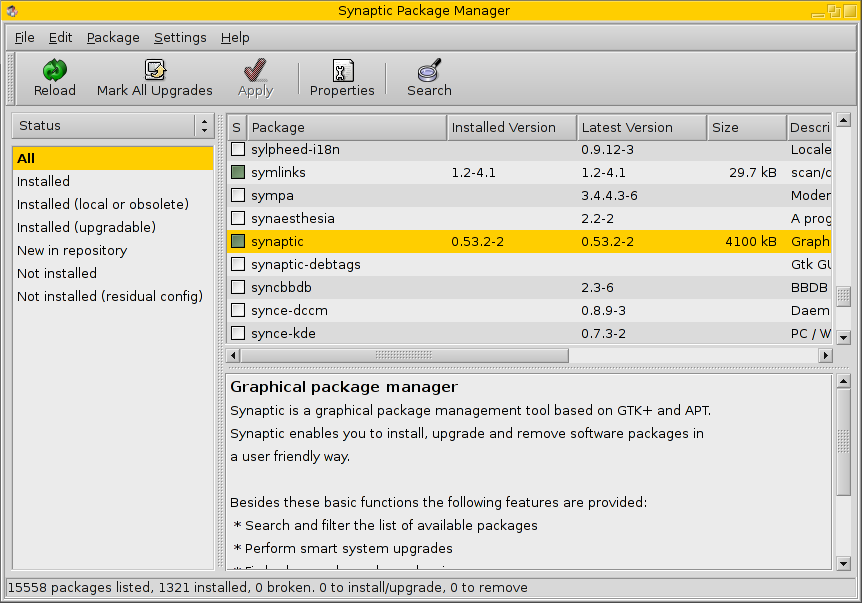
And then get your computer compromised by some malware. The package manager is safer as it only installs from the official repositories. If you want to download from some third party there is an option to add such sources. See some Screenshots -
Re:Snapshot Software for Linux
what about duplicity ? (incremental snapshots, command-line tool, librsync-based, used by "deja-dup"), rdiff-backup and rsnapshot
-
Re:Snapshot Software for Linux
what about duplicity ? (incremental snapshots, command-line tool, librsync-based, used by "deja-dup"), rdiff-backup and rsnapshot
-
rdiff-backup
Take a look at rdiff-backup.
rdiff-backup backs up one directory to another, possibly over a network. The target directory ends up a copy of the source directory, but extra reverse diffs are stored in a special subdirectory of that target directory, so you can still recover files lost some time ago. The idea is to combine the best features of a mirror and an incremental backup. rdiff-backup also preserves subdirectories, hard links, dev files, permissions, uid/gid ownership, modification times, extended attributes, acls, and resource forks. Also, rdiff-backup can operate in a bandwidth efficient manner over a pipe, like rsync. Thus you can use rdiff-backup and ssh to securely back a hard drive up to a remote location, and only the differences will be transmitted. Finally, rdiff-backup is easy to use and settings have sensical defaults.
I can confirm that rdiff-backup is indeed easy to use.
-
Xautomation
Nearest equivalent for X / Linux that I've used is xte, which uses the XTest extension to send keyboard and mouse events to the desktop.
xte is usually included with the "xautomation" package for various distributions.I've also seen people use xvkbd -text to automate keystrokes (often in concert with xbindkeys), but I've found xte works a bit better in many cases, for example, when activating CTRL/ALT/Shift/etc. modifiers.
To complete the package, xprop can also give you some useful window state information and control so you can find and manipulate application windows.
-
Legislative Development with CVS, SVN, Hg, or Git?
Likely the best websites from the US Government...are the Library of Congress site and the Supreme Court site. Both of them are extremely informative, and have a massive wealth of information that is readily available.
Development of legislation is quite byzantine and revision (mis)management during the drafting can make for some very serious readability problems. Currently it is nearly impossible to have time, even for a full-time politician with staff, to have time for their team to individually work through all changes and revisions of a draft of a bill.
Using a version control system (CVS, Subversion, Mercurial, Git) makes it very easy to track individual changes and who made them. It also makes it trivially easy to integrate all the changes and show a snapshot of the current draft or one from any arbitrarily earlier version.
Code bases for large software projects are unwieldy, constantly changing and have many authors yet need full transparency and accountability to succeed. So are drafts of legislation. Using a versioning system in our legislative process is long overdue.
-
Copying and pasting code just to install something
"trying to install almost anything is a pain the ass. Copying and pasting code just to install something...
Couldn't Redmond please come up with some new FUD?
Synaptic -
Re:Future of Internet and firewalls
Actually, it's more like: INTERNET -> PORT22, since just about anything can be sent through an ssh tunnel. And the encryption makes most types of deep packet inspection impossible.
You missed his point which wasn't about the protocol, but the port being used. If you use port 22, it'll be blocked many places because they don't want to allow you to ssh. If you use port 443 it'll be allowed since https is "necessary", even if you're using 443 to carry your ssh traffic. What's sad is seeing other services move to 443 to be more accessible. Most usenet providers offer SSL encrypted NNTP on port 443 (despite having an RFC port specifically for nntps).
But it is much harder to block if they actually use legitimate looking packets for protocols that get out rather then just it's port. So people have encapsulated IP within real HTTP traffic. Better yet they'll use ICMP or even DNS to carry your traffic. I find the DNS one particularly amusing because it uses your nameserver to redirect the traffic even if the host isn't given any outside access.
-
Re:This just gave me a good idea!Yep, and then you don't have to worry about
- Changes in permissions/mtimes/atimes corrupting all your old backups because all of them are hard linked, or alternatively
- Changes in permissions/mtimes/atimes causing an entire file to get copied
There are also other things to worry about. To be fair, the guy who invented --link-dest wrote a backup program called Dirvish so that is a better comparison to rdiff-backup.
-
Re:If you miss the 8-bit era...
Alternatively, you can use the avr-gcc toolchain, which is completely free. It even includes a program capable of talking to JTAG/ICE debugging devices, so you can debug with gdb.
-
Save WinKey, kill Insert
Winkey is very useful.
I have a ton of tiny shell scripts invoked by Win + $key (via xbindkeys):
"Grey+" / "Grey -" -- volume control
G -- google current selection (see xclip (1))
W -- search Wikipedia (or Russian wikipedia with shift)
A -- open terminal
K -- invoke xkill (1)
L -- lock screen
and some moreOn the other hand, the invenror of the Insert key deserves a mousetrap being put right under the light switch in their room.
-
Duplicity!
I'm waiting for the Duplicity plugin!
Encrypted backups, for half the money Amazon S3 charges...
-
Re:fabrice BELLARD
http://bellard.org/
He's also the guy who launched ffmpeg and is working on Qemu, among other things... -
this guy has a pretty impressive track record
For those not previously familiar with Fabrice Bellard, he's known for:
-
Re:Still waiting for a Total Commander equivalent
What you want is an orthodox file manager. There are plenty of other options on Linux besides the ones you mentioned, such as emelFM2, Gnome Commander, or Beesoft Commander. Perhaps one of those will be more to your liking, though I personally find Krusader more than adequate.
-
OS userland
An operating system is the software which provides the basis for everything else that will run in that environment
But if you go that far then Bob the poseur "creates an OS" when he packages the linux kernel with some windows manager.
Not exactly. A window manager just implements an interface defined by ICCCM. "Creating an OS" in the Android or Bob-the-poseur sense would be more like making GNUstep + G.A.P., not just making Window Maker.
-
Re:Tiling
There are a few good tiling window managers that make this a breeze. To some degree it depends on which language you prefer. The following screen shots are from stumpwm, a window manager written entirely in Common Lisp. It has the added benefit of being programmable while it is running, so you can interact with, and test, any new additions or modifications in real time. Anything you want to do like sending windows one place or another, or binding different features to different keys, can be done very easily in a window manager like this. It's very capable out of the box, and it is meant to be extendible arbitrarily due to the powerful programming language it uses.
stumpwm tiling across five monitors at different resolutions
There is also a window manager that has some similar features called xmonad, but it is written in Haskell, so it has a bit of a syntactic learning curve if that matters to you.
xmonad tiling across three monitors
On a side note, it's interesting that the proliferation of Lisp, Haskell, and other powerful functional programming languages has created a demand for a different kind of window manager that is written in, and can be extended with, the language. It's almost as if programmers began to see the limitations of static, C/C++ programmed environments after they started using these languages, and then started to build up new environments more suitable for high-level programming. Is this the beginning of the end for the traditional Unix way of always running back to the C languages? -
Re:Install Win 95/98 on Dosbox and use Dosbox scal
I've not used it myself, but if you were going for a VM solution, then D3D should enable 3D acceleration anyway.
-
Re:WIll this be backported?
"Will this be backported to Ubuntu 9.04?"
Once it's in the main repository you can upgrade using synaptic, else download the tar.gz file and extract to a
su root
tar -zxvf OO.version.tar.gz
make
make install
-
As someone working on a massive project...I'm working on a rather large cross-platform C++ project at the moment. Here are a few tips:
- Use Boost. It's a very liberally-licensed, high-quality library from the people who created the C++ language itself. It contains a ton of cross-platform libraries that do lots of useful things, from threads to regular expressions to writing testsuites and parsing command-line options. If Boost provides a piece of functionality, there's very little reason not to use its version.
- See rule #1.
- If you need cross-platform code that isn't in Boost, at least use the following approach:
- Create a common interface definition
- In separate files, implement the interface in terms of various platforms' primitives
- Keep platform-specific code out of the rest of your program; if you can help it, don't even include platform headers in most of your program
- Use autoconf to handle platform idiosyncrasies. There are a ton of available macros to help detect things about a build platform.
- Write testcases. You should write tests for all your programs, but it's especially important to do it for cross-platform code because it's easy to break something and not notice.
-
Re:Virtualizing is "almost" the answer
There's a guest driver to fix the idle handling under Win98. Get amnhltm.zip from here and install it under the Win98 guest. I originally encountered it for QEMU, but have also used it successfully on MS VirtualPC. I haven't tried on VirtualBox (which is what I use almost exclusively now) because I haven't had to run Win98 in a while.
What I find really lacking from modern virtualizers is Direct3D support. Most virtualizers now have OpenGL support, but that's not enough to run older DirectX games. There's WineD3D, which is a step in the right direction, but it only has DirectX 9 and partial 8 support, which means DirectX 7 games (and any DX8 game I've tried) don't work.
-
Don't use rsync â" at least, not vanilla
Don't use rsync to make backups. Because you don't just want to backup against spontaneous combustion â" inevitably, there will be accidental deletions and the like occurring in your studio. If you use rsync (with --delete, as any sane person would, otherwise your backup server will fill up in days, not years), then when some n00b runs `rm -rf ~/ReallyImportantVideos`, they'll be deleted from the backup too.
Remember that pro photography website that went down, because their "backup" was a mirroring RAID setup? Yep â" they lost all their data on one fell swoop when somebody accidentally deleted the whole lot. Don't make the same mistake.
Use an incremental backup tool. Three that come to mind are rdiff-backup, Dirvish, and BackupPC.
I would think that rdiff-backup would suit your needs best. I currently use BackupPC at home, which is great for home backups, but I think that it's overkill (and possibly a bit limited) for what you want.
Hope this helps!
-
rdiff-backup: like rsync with versioning
You may want to check out rdiff-backup also. It produces a mirror like rsync, and uses a similar algorithm, but keeps reverse binary diffs in a separate directory so you can restore to previous states. However, because it keeps these diffs in addition to the mirror, it's better if you have more space on the backup side.
There are a few different frontends/guis to it but I don't have experience with them.
-
Re:UI polish, documentations
If you were serious about wanting to be the UI designer for a FOSS project, please check out http://explicans.wikidot.com/ and maybe email me or post a message to the mailing list. This project needs a lead designer.
Of course I'm biased, but IMHO this project has the potential to be big and the UI design of it is really interesting.
-
Re:Lack of user-testing
"Setup package! Setup package! Setup package!"
See Synaptic in action
See Synaptic in action
See Synaptic in action -
Re:Lack of user-testing
"Setup package! Setup package! Setup package!"
See Synaptic in action
See Synaptic in action
See Synaptic in action -
Re:Lack of user-testing
"Setup package! Setup package! Setup package!"
See Synaptic in action
See Synaptic in action
See Synaptic in action -
Re:See!
I believe Direct3D already has a software renderer. If not, Direct3D could be rendered via using Wine's Direct3D implementation and a software OpenGL renderer. Issue: this would be slow.
However, VirtualBox, Parallels and VMware seem to implement Direct3D in virtual machines as OpenGL calls passed to the host.
-
Re:Real programming/scripting language
syntax-highlighting editor that can edit files over SFTP is all that's really needed (ok, svn support is nice)
GNU Emacs and (warning: plug) espresso-mode. Emacs supports sftp out of the box using tramp, and of course it interacts with subversion (among other version control systems) elegantly.
-
For programmers . . .As a programmer, I have three questions I ask prospective employers:
- What revision control software are you using?
- What system do you use for tracking bugs?
- Are you familiar with Capability Maturity Model Integration (CMMI)? If so, what level certification have you achieved?
If they respond to #1 with a blank stare or "huh?" I'd advise running for the door. If they are not using any kind of revision control software, and don't know what it is, the place is very poorly managed and will cause you some serious nightmares. All of the places where I've worked, which didn't use revision control, went out of business within a couple years.
Personally, I prefer Subversion, and I converted my prior employer to using it. They didn't understand why I wanted to use it, but they weren't averse to trying something new. After it saved our butts a couple times, they understood perfectly well why I wanted to use it and continue to use it after I left.
The job before that, I used StarTeam. Borland bought StarBase (the maker of StarTeam) while I was with that employer.
My current employer uses CVS. It has its warts, but it works.
For question #2, my current employer uses Bugzilla. It works reasonably well. My prior employer didn't have a bug-tracking system. The second or third web app they had me write was a bug-tracking system, not oriented toward software development but toward the larger company (hospitality). We ended up using a wiki for bug-tracking. StarTeam had a "Change Control" system built into it, so that employer had excellent bug-tracking software.
I've had only one employer who knew what CMMI was (question #3). They could've passed a level 3 certification if necessary. If you're going to develop for the DoD, you used to need a level 4 cert; not sure if that's the case any more.
For those who don't know, CMMI is merely a methodology for ensuring that:- coding standards are in place
- development documentation is in place
- the project is well-managed on, time, responsibilities and risks
- there is a reasonable probability of delivering on-time
It can be tedious, consistent, or both. The better places are the latter, not so much the former.
In short, they should have good, solid answers for #1 and #2, while #3 is a nice-to-have. -
Re:Just remember the first rule of RAID 0
RAID1 is useless for protecting against hardware errors - people use it for the stellar read-performance and for no other reason.
In my experience, RAID1 performance gain varies quite a bit from solution to solution.
For a desktop solution, a system builder can get good results by stroking the drive(s) during O/S installation, then carefully choosing which partitions to use for their various needs (outer vs inner.)
And back it up! My solution has been to install a second drive of same-or-greater size from a *different* manufacturer. It stays spun down most of the day, and is started periodically for backups. (Yes, I've been lectured that drives supposedly last longer when spinning all the time, but I don't buy it - they're generating heat, are subject to g-force shocks, etc.)
I've been happy using rdiff-backup, but there are plenty of backup solutions for Windows, if the OP choose to be proactive about that.
-
Re:Are you crazy?
There's a nice tool for this.
It even allows you to keep an incremental backup history, using a minimum amount of storage.
Simple rsyncing only gives you one copy.
Rsync'ing multiple copies is problematic... matters may change, if (one day), Linux ever implements a filesystem that provides a block-level data de-duplication option.
(To allow you to 'rsync' more backups to more directories, without rapidly consuming excessive amounts of backup machine disk space)
-
Paucity of GUI libraries, for oneTry finding a decent GUI library for Windows, for example. Your choices:
- LablGTK. GTK on Windows. Yuck.
- LablTk. Tk is a toy GUI kit.
- OCaml-Win32. If you have to ask what's wrong with the win32 API, you've never had to use it in a language other than C.
- Some alpha or out of date binding of wxWidgets or Qt for OCaml.
OCaml programs aren't shorter than scripting languages, and they're limited to a curses interface at best. Together with its speed, OCaml gives off the impression of being a language you'd reach for when you write high performance, low interaction programs---like automated financial trading agents. Not many of us do that. And so not many of us use OCaml.
-
Re:Isn't Savannah SaaS?
http://savannah.nongnu.org/projects/savane-cleanup
is the key difference between it and the average SaS.
-
Re:Isn't Savannah SaaS?
Yes 'software as a service' is _usually_ not free, but that doesn't mean it can't be free.
If the service being offered is provided entirely with Free software (including the OS, daemons, and the application itself), which you can obtain under a Free software license, *and* you have access to all the data that software stores on your behalf, then that particular instance of SaS is free.
Go to http://nongnu.org/ and read the very first 3 lines on that page.
Go to -
Isn't Savannah SaaS?
The world is not black and white. And software as a service is here to stay. When would RMS realize that ?
Even RMS's organization offers software as a service: Savannah, a hosted free software development tool suite based on a fork of SourceForge.net's software.
-
Re:I love ARMs...
QEMU has emulation for a numbe of arm procesors and you can run linux etc on it. Even Symbian.
-
Re:No GPL?
Feel free to use the Free Software alternatives instead:
http://www.nongnu.org/construo/
Of course that lacks all the polish and advanced physics of World of Goo.
-
Not as surprise
-
Not as surprise
-
Re:School
You know what I'd like. The opposite.
Specifically, I want a Linux distro for my grandmother. She retired about two decades ago, and used the computer all the time.
The catch is that the computer she used was a simple dumb terminal.
There are lots of people out there, parents of baby boomers, who used that, or a DOS menu shell and TUI apps, their last decade of work before retirement. They don't really know how to use a mouse, perhaps their coordination isn't very good. They don't understand that 'pointing' stuff.
You can get that with gentoo pretty easily. Might take a while to compile, but hey, it works.
However, they can type just fine.
So what I've been constantly tempted to do is find a text-based distro, with pine and lynx and some sort of text menu to run them, for her.
Although I'd really like a graphical one that just mimics a text-one, where everything is doable via keystrokes (Which are shown on screen.), and all apps are full screen. (Possibly this would be best done using command line framebuffer programs, like Links.)
http://www.nongnu.org/ratpoison/ Or just teach them how to use screen.
-
Re:Microsoft Rights Management Server?
We use Concurrent Versions System (CVS). Track changes; make sure only the right people have the rights to get to what they need for their job / entertainment. http://www.nongnu.org/cvs/
-
Re:Script
I don't know, but I really believe that finding programs could be a LOT easier for new users with just a little extra care like a few screenshots and maybe have everything divided into categories like office tasks. multimedia, games, networking, etc. I know most of the folks here really hate on Xandros because of the MSFT deal, but I think there is a lot that can be learned from CnR which is now owned by Xandros. What is nice about CnR is it has BOTH the free and the pay apps with easy to read descriptions, screenshots, ratings, and an easy way to use your CC if you decide to purchase something like Crossover Pro or Cedega.
IMHO it would be a lot easier to sell Windows users on Linux if the default package managers had a nice easy to use interface like CnR. Because trying to figure out what program they need to do a task from these huge lists with sometimes extremely technical descriptions is just going to intimidate someone who is new to Linux. I know that I felt a little overwhelmed the first time I switched my laptop over to Linux with all the choices and not very helpful descriptions, and I have nearly 20 years of tech experience. I can't even imagine how lost someone who had only used Windows for simple tasks would have felt when faced with something like Synaptic.
-
Re:Amazon S3
Don't write these scripts yourself,
tools like duplicity: http://duplicity.nongnu.org/
bring S3 as a target out of the box. -
Re:Why not start with assembly language?
Well, if you insist.
-
Serious regressions
I've experienced serious regressions with Intrepid Ibex. Among them is bad audio due largely I suspect to the new False, I mean, Pulse Audio system. Wine games are largely unplayable unless I disable sound. Then there's the confirmed "won't fix" bug concerning Gnome session (https link to Ubuntu bug tracker here). Now every time I log out I have to manually restart all my applications. I'm not talking about the usual background system stuff but the important end-user programs like Pidgin, Firefox and Gnome Terminal. All in all, this is the most troubling Linux upgrade I've experienced since I switched to a Debian derivative. The last time something like this broke was when I couldn't play Crack Attack because of a Mesa incompatibility in Debian Unstable! And that was fixed within weeks.
-
Re:Git...
I agree. The only thing I would consider changing is to use rdiff-backup instead of rsync in order to make tracking, and restoring revisions more straightforward. Both utilities would do the job though.
-
Re:No great feat
From my experience, biggest challenges in TCP are the all other smaller RFCs written after TCP became STD.
If you look at other projects e.g. LWIP, you will notice that core TCP code isn't that large. Many parts deal with compatibility issues, with security issues and of course with memory management. (Many disregard memory management, yet TCP for effective work has to have quite an amount of memory: otherwise bandwidth would be quite limited.)
From my personal experience, TCP is nothing more than ring buffer, four counters and FSM to track the counters. Rest is optional and can be easily simulated, remaining within RFC requirements. (Yes, I was implementing TCP long time ago for traffic shaping module.)
-
Re:I knew a guy who always had headaches
Does Duplicity do the same?