Slashdot Mirror
Domain: nsf.gov
Stories and comments across the archive that link to nsf.gov.
Stories · 110
-
China Expands Research Funding, Luring US Scientists and Students (npr.org)
An anonymous reader quotes a report from NPR: In the past decade or so, China has been expanding its commitment to scientific research, and it shows. Chinese researchers now produce more scientific publications than U.S. scientists do, and the global ratings of Chinese universities are rising. Five years ago [professor of chemistry at the University of California, San Diego, JaySiegel] became dean of the school of pharmaceutical science and technology at Tianjin University. He says the university president recruited him to build an undergraduate program that would attract students from all over -- not just China. Siegel says the program is taught entirely in English. There's another aspect of getting a pharmaceutical science degree at Tianjin that Siegel expects students from throughout the world to find particularly attractive: The Chinese government plans to offer scholarships to cover the cost for students who enroll. Siegel says this is all part of China's effort to attract international scientists. Of course, there are some drawbacks with working in China. There are internet restrictions, making it difficult to reach certain websites; English isn't spoken throughout most of the country, posing a problem for many foreign visitors; and free speech isn't the same concept as it is in the United States. With that said, "There's no interference politically on the science," says Greg Herczeg, an astronomer at the Kavli Institute for Astronomy and Astrophysics at Peking University.
"We've had no political restrictions," says Siegel. "I know that people talk about them being out there, and I've heard rumors of things. But, for us personally, I would have to say no, I've not had that experience." -
Chan Zuckerberg Initiative Claims It Has Enabled Its Partners To 'Double the Number of Black and Latinx Students and Girls Taking AP Computer Science' (chanzuckerberg.com)
theodp writes: In a Monday blog post, the outgoing Head of Education for Facebook CEO Mark Zuckerberg's Chan Zuckerberg Initiative made the claim that "we've made investments that enabled our partners to double the number of Black and Latinx students and girls taking AP Computer Science." The claim is an apparent reference to the highly-promoted and wildly-successful new AP Computer Science Principles course (dubbed "Coding Lite" by the NY Times), which the NSF and College Board began development on in 2009. Zuckerberg's CZI LLC was created in late 2015. -
PBS Bets $3 Million That Monkeys Are Better CS Preschool Teachers Than Rabbits (edsurge.com)
theodp writes: EdSurge reports that a new PBS show will teach preschoolers how to think like computers. Marisa Wolsky, an executive producer at WGBH Boston, believes television can be a way to teach Computational Thinking. She is in the first stages of creating an animated television show called Monkeying Around [$3,000,000 NSF award] that uses four monkeys to teach the subject. Why monkeys? EdSurge explains, "Initially, Wolsky said her team wanted to use rabbits to teach the kids, but after realizing the animal would need to use its hands, they decided to go with monkeys [Rabbits historically enjoyed success teaching the 3 R's]." In a press release announcing the new pre-K show, WGBH cited "a great deal of national interest in computer science and coding," adding that "it is never too early to start." WGBH is not the only PBS station that's bullish on CS. According to an NSF Award Abstract, "Twin Cities PBS (TPT), the National Girls Collaborative (NGC) and [tech-bankrolled] Code.org will lead Code: SciGirls! Media to Engage Girls in Computing Pathways, a three-year [$2.63 million] project designed to engage 8-13 year-old girls in coding through transmedia programming which inspires and prepares them for future computer science studies and career paths [...] Drawing on narrative transportation theory and character identification theory, TPT will commission two exploratory knowledge-building studies to investigate: To what extent and how do the narrative formats of the Code: SciGirls! online media affect girls' interest, beliefs, and behavioral intent towards coding and code-related careers?" And Code Trip, a PBS series touted by Microsoft that aired in 2016 [$200,000 NSF award], explored computer science opportunities for young people by, as Microsoft explained, following "three students traveling around the country to speak with leaders including Elizabeth Holmes, founder of Theranos, and Hadi Partovi, entrepreneur and cofounder of Code.org." -
PBS Bets $3 Million That Monkeys Are Better CS Preschool Teachers Than Rabbits (edsurge.com)
theodp writes: EdSurge reports that a new PBS show will teach preschoolers how to think like computers. Marisa Wolsky, an executive producer at WGBH Boston, believes television can be a way to teach Computational Thinking. She is in the first stages of creating an animated television show called Monkeying Around [$3,000,000 NSF award] that uses four monkeys to teach the subject. Why monkeys? EdSurge explains, "Initially, Wolsky said her team wanted to use rabbits to teach the kids, but after realizing the animal would need to use its hands, they decided to go with monkeys [Rabbits historically enjoyed success teaching the 3 R's]." In a press release announcing the new pre-K show, WGBH cited "a great deal of national interest in computer science and coding," adding that "it is never too early to start." WGBH is not the only PBS station that's bullish on CS. According to an NSF Award Abstract, "Twin Cities PBS (TPT), the National Girls Collaborative (NGC) and [tech-bankrolled] Code.org will lead Code: SciGirls! Media to Engage Girls in Computing Pathways, a three-year [$2.63 million] project designed to engage 8-13 year-old girls in coding through transmedia programming which inspires and prepares them for future computer science studies and career paths [...] Drawing on narrative transportation theory and character identification theory, TPT will commission two exploratory knowledge-building studies to investigate: To what extent and how do the narrative formats of the Code: SciGirls! online media affect girls' interest, beliefs, and behavioral intent towards coding and code-related careers?" And Code Trip, a PBS series touted by Microsoft that aired in 2016 [$200,000 NSF award], explored computer science opportunities for young people by, as Microsoft explained, following "three students traveling around the country to speak with leaders including Elizabeth Holmes, founder of Theranos, and Hadi Partovi, entrepreneur and cofounder of Code.org." -
PBS Bets $3 Million That Monkeys Are Better CS Preschool Teachers Than Rabbits (edsurge.com)
theodp writes: EdSurge reports that a new PBS show will teach preschoolers how to think like computers. Marisa Wolsky, an executive producer at WGBH Boston, believes television can be a way to teach Computational Thinking. She is in the first stages of creating an animated television show called Monkeying Around [$3,000,000 NSF award] that uses four monkeys to teach the subject. Why monkeys? EdSurge explains, "Initially, Wolsky said her team wanted to use rabbits to teach the kids, but after realizing the animal would need to use its hands, they decided to go with monkeys [Rabbits historically enjoyed success teaching the 3 R's]." In a press release announcing the new pre-K show, WGBH cited "a great deal of national interest in computer science and coding," adding that "it is never too early to start." WGBH is not the only PBS station that's bullish on CS. According to an NSF Award Abstract, "Twin Cities PBS (TPT), the National Girls Collaborative (NGC) and [tech-bankrolled] Code.org will lead Code: SciGirls! Media to Engage Girls in Computing Pathways, a three-year [$2.63 million] project designed to engage 8-13 year-old girls in coding through transmedia programming which inspires and prepares them for future computer science studies and career paths [...] Drawing on narrative transportation theory and character identification theory, TPT will commission two exploratory knowledge-building studies to investigate: To what extent and how do the narrative formats of the Code: SciGirls! online media affect girls' interest, beliefs, and behavioral intent towards coding and code-related careers?" And Code Trip, a PBS series touted by Microsoft that aired in 2016 [$200,000 NSF award], explored computer science opportunities for young people by, as Microsoft explained, following "three students traveling around the country to speak with leaders including Elizabeth Holmes, founder of Theranos, and Hadi Partovi, entrepreneur and cofounder of Code.org." -
Vera Rubin, Pioneering Astronomer Who Confirmed Existence of Dark Matter, Dies At 88 (www.cbc.ca)
Mikkeles quotes a report from CBC.ca: Vera Rubin, a pioneering astronomer who helped find powerful evidence of dark matter, has died, her son said Monday. She was 88. Vera Rubin found that galaxies don't quite rotate the way they were predicted, and that lent support to the theory that some other force was at work, namely dark matter. Rubin's scientific achievements earned her numerous awards and honors, including a National Medal of Science presented by then-president Bill Clinton in 1993 "for her pioneering research programs in observational cosmology." She also became the second female astronomer to be elected to the National Academy of Sciences. -
Feds Spend Nearly $500K To 'Combat Online Trolling' (freebeacon.com)
mi writes: Washington Free Beacon reports: "The National Science Foundation is spending roughly half a million dollars to combat 'online trolling.' A joint project by Northwestern and Northeastern universities is examining how to create 'trolling-free environments' on the internet. The researchers define online trolls as those who try to influence public opinion by boosting 'misleading' and 'inauthentic comments.'" Just how can the "misleading" and "inauthentic" speech be eliminated by the government without violating the First Amendment? "Today almost every browser click that users make is collected by numerous trackers associated with a variety of online services (e.g., advertising networks, online social networks, e-commerce platforms)," a grant for the project states. "Users have often expressed concern about the lack of privacy and control over their personal data. Nonetheless, despite a substantial effort to expose and control this prevalent behavior, the reality is that users keep accepting updated online privacy policies, which in turn grant the gathering of more personal data. This project explores re-using this extensive tracking infrastructure for the benefits of both the users themselves and web services, with a goal of preventing online trolling (scenarios in which various groups deploy tactics to influence public opinion on the internet, by leaving biased, false, misleading, and inauthentic comments, and then artificially amplifying their ratings). The project aims to show how the tracking infrastructure can be re-used as a user 'fingerprint,' allowing a lightweight and privacy-preserving form of identification for third-party web sites." The lead researchers on the project, Aleksander Kuzmanovic from Northwestern University, and Alan Mislove from Northeastern University, said: "Public opinion is of paramount importance in any society. It is thus not a surprise that many governments, political parties, and various other groups deploy tactics to influence public opinion on the internet, a practice commonly referred to as trolling." They say their work could help combat "troll armies" used by Russia and China. -
Has The NSF Automated Coding with ExCAPE? (adtmag.com)
The National Science Foundation is developing a way to create working code using "automated program synthesis," a new technology called ExCAPE "that provides human operators with automated assistance.... By removing the need for would-be programmers to learn esoteric programming languages, the method has the potential to significantly expand the number of people engaged in programming in a variety of disciplines, from personalized education to robotics." Rajeev Alur, who leads a team of researchers from America's nine top computer science programs, says that currently software development "remains a tedious and error-prone activity." Slashdot reader the_insult_dog writes: While its lofty goals of broadly remaking the art of programming might not be realized, the research has already made some advances and resulted in several tools already in use in areas such as commercial software production and education...
For example, the NSF created a new tool (which they've recently patented) called NetEgg, which generates code for controlling software-defined networks, as well as Automata Tutor and AutoProf, which provide automated feedback to computer science students. -
Supercomputers Help Researchers Improve Severe Hail Storm Forecasts (nsf.gov)
aarondubrow writes: Researchers working on the Severe Hail Analysis, Representation and Prediction (SHARP) project at the University of Oklahoma used the Stampede supercomputer to gain a better understanding of the conditions that cause severe hail to form, and to produce hail forecasts with far greater accuracy than those currently used operationally. The model the team used is six times more resolved that the National Weather Service's highest-resolution forecasts and applies machine learning algorithms to improve its predictions. The researchers will publish their results in an upcoming issue of the American Meteorological Society journal Weather and Forecasting. -
Supercomputers Help Researchers Improve Severe Hail Storm Forecasts (nsf.gov)
aarondubrow writes: Researchers working on the Severe Hail Analysis, Representation and Prediction (SHARP) project at the University of Oklahoma used the Stampede supercomputer to gain a better understanding of the conditions that cause severe hail to form, and to produce hail forecasts with far greater accuracy than those currently used operationally. The model the team used is six times more resolved that the National Weather Service's highest-resolution forecasts and applies machine learning algorithms to improve its predictions. The researchers will publish their results in an upcoming issue of the American Meteorological Society journal Weather and Forecasting. -
Fighting Food Poisoning In Las Vegas With Machine Learning
aarondubrow writes: Computer science researchers from the University of Rochester developed an app for health departments that uses natural language processing and artificial intelligence to identify likely food poisoning hot spots. Las Vegas health officials recently used the app, called nEmesis, to improve the city's inspection protocols and found it was 63% more effective at identifying problematic venues than the current state of the art. The researchers estimate that if every inspection in Las Vegas became adaptive, it could prevent over 9,000 cases of foodborne illness and 557 hospitalizations annually. The team presented the results at the 30th Association for the Advancement of Artificial Intelligence conference in February. -
$500K NSF Grant Boosted Girls' CS Participation At Obama Daughters' $37K/Yr HS
theodp writes: On Friday, a paper entitled Creative Computation in High School will be presented at SIGCSE '16. "In this paper," explain the paper's authors, "we describe the success of bringing Creative Computation via Processing into two very different high schools...providing a catalyst for significant increases in total enrollment as well as female participation in high school computer science." One of the two schools that participated in the National Science Foundation-supported project — see NSF awards 1323305 & 1323463 for Creative Computation in the Context of Art and Visual Media — was Sidwell Friends School, which a 2013 SMU news release on the three-year, $500K NSF grant noted was best known as the school attended by President Obama's daughters. Interestingly, in a late-2014 interview, the President lamented that his daughters hadn't taken to coding the way he'd like, adding that "part of what's happening is that we are not helping schools and teachers teach it in an interesting way." Hey, nothing that a $4B 'Computer Science For All' K-12 Program can't fix, right? -
$500K NSF Grant Boosted Girls' CS Participation At Obama Daughters' $37K/Yr HS
theodp writes: On Friday, a paper entitled Creative Computation in High School will be presented at SIGCSE '16. "In this paper," explain the paper's authors, "we describe the success of bringing Creative Computation via Processing into two very different high schools...providing a catalyst for significant increases in total enrollment as well as female participation in high school computer science." One of the two schools that participated in the National Science Foundation-supported project — see NSF awards 1323305 & 1323463 for Creative Computation in the Context of Art and Visual Media — was Sidwell Friends School, which a 2013 SMU news release on the three-year, $500K NSF grant noted was best known as the school attended by President Obama's daughters. Interestingly, in a late-2014 interview, the President lamented that his daughters hadn't taken to coding the way he'd like, adding that "part of what's happening is that we are not helping schools and teachers teach it in an interesting way." Hey, nothing that a $4B 'Computer Science For All' K-12 Program can't fix, right? -
NSF and Federal Partners Award $37M To Advance Nation's Co-robots (nsf.gov)
aarondubrow writes: Today, the National Science Foundation, in partnership with the DoD, NASA, NIH, and USDA, announced $37 million in new awards to spur the development and use of co-robots — robots that work cooperatively with people. From unmanned vehicles that can inspect and fix ailing infrastructure to co-robots that can collaborate with workers on manufacturing tasks, scientists and engineers are developing the next generation of robots that can handle critical tasks in close proximity to humans, providing for unprecedented safety and resilience. This year, the initiative funded 66 new research proposals to 49 distinct institutions in 27 states. -
NSF Antes Up $200K For Spin-off of Microsoft-Funded 'Code Trip' TV Show
theodp writes: The Microsoft-sponsored PBS 'reality' show Code Trip, in which Roadtrip Nation and Microsoft YouthSpark partnered to send three students across the U.S. on a "transformative journey into computer science" is getting a spin-off. According to the National Science Foundation Award Abstract for a Computer Science Roadtrip (CS Roadtrip), $199,866.00 in funding has been awarded for a pilot project that began in October "to design and develop pilot materials for a Computer Science Roadtrip (CS Roadtrip)."
From the abstract: "Through this pilot project, Roadtrip Nation will lay the groundwork and provide proof-of-concept for a CS Roadtrip, leveraging a combination of multimedia deliverables, an evidence-based educational curriculum, and dynamic engagement strategies that will provide critical connections between students' natural interests, positive role models who align with those interests, and corresponding CS educational and career pathways. To that end, the CS Roadtrip Pilot will develop up to four student-facing videos that feature the stories of diverse computing professionals, appropriate for on-air, online, and classroom purposes, along with the appropriate Learning Guides."
The NSF study's Principal Investigator is Roadtrip Nation co-founder Mike Marriner, who explained his company's relationship with Microsoft in a July 30th press release, "Roadtrip Nation is proud to partner with Microsoft's YouthSpark initiative not only to inform others of the many career routes one can take with a computer science background, but also to engage in the much-needed conversation of diversifying the tech field with more pluralistic perspectives." -
Despite $30M Tech Push, Half of US States Had Fewer Than 300 AP CS Test Takers
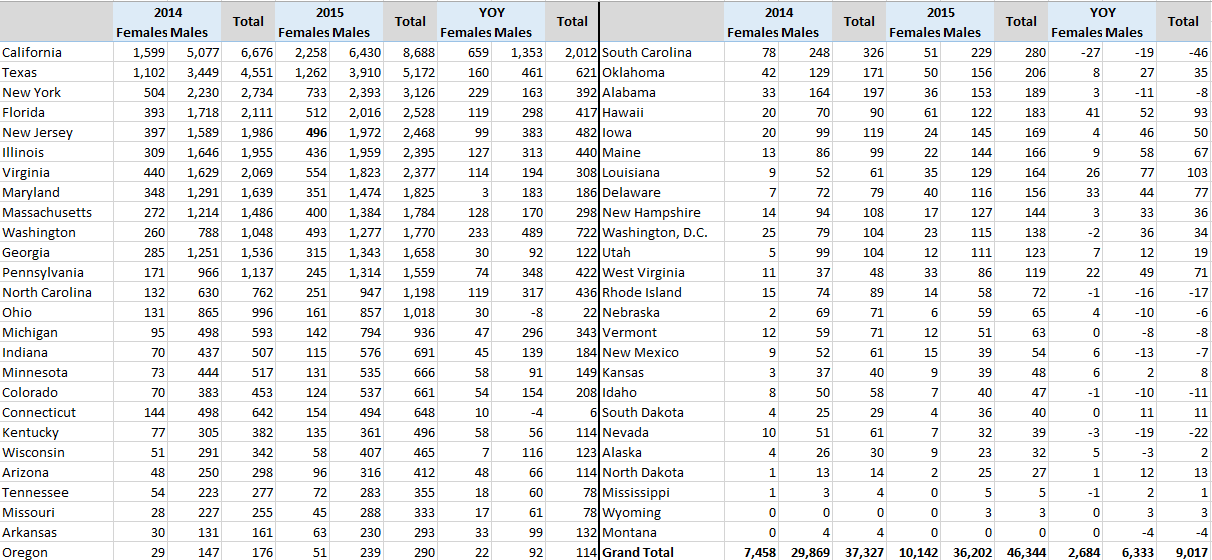
theodp writes: As President Obama was 'taught to code' last December, Politico reported that the $30 million tech-financed campaign to promote computer science education was a smash success. And indeed it has been, at least from a PR standpoint. But Code.org and its backers have long spun AP Computer Science test metrics as a true barometer of CS education success, and from that standpoint, things don't look quite so rosy. The College Board raved about "massive gains in AP Computer Science participation (25% growth) AND scores" in a June tweetstorm and at its July conference, where AP CS was declared the '2015 AP Subject of the Year.' But a look at the recently-released detail on 2015 AP CS scores shows wide differences in adoption and success along gender and ethnicity lines (Asian boys and girls, in particular, set themselves apart from other groups with 70%+ pass rates). And, for all the praise the NSF lavished on Code.org for 'its amazing marketing prowess', half of the states still had fewer than 300 AP CS test takers in 2015, and ten states actually saw year-over-year declines in the number of test takers (if my math is correct — scraped data, VBA code here). -
The Life-Saving Gifts of the World's Most Venomous Animal (newyorker.com)
tedlistens writes: It was a terrible sting off the coast of Hawaii that inspired Angel Yanagihara, a biology researcher, to spend her life studying the bizarre culprit. Comprising some 50 species, box jellyfish are not like other jellyfish: they have 24 eyes, can move with intention and at surprising speed, and have something resembling a brain. They are also considered to be among the most venomous animals on Earth, killing more people every year than sharks do. Once inside the body, its venom acts "like buckshot" on blood cells. One species, the four-pound, nine-foot-long sea wasp, is said to have enough venom at any one time to kill ninety to one hundred and twenty humans.
As ocean currents and biomes change, various species of dangerous box jellyfish have shown up in places where they have not recently been abundant, including Japan, India, Israel, Florida, and the Jersey Shore. But compared to other venoms, research on jellyfish has remained in the dark ages. New methods for collecting venom—including one that relies on beer—along with a better understanding of box-jelly biochemistry may point to better non-antibiotic protections from them, and to novel defenses for humans against other fatal infections from anthrax and the antibiotic-resistant "superbug" MRSA, says Yanagihara. (Venoms are already the basis of a handful of FDA-approved drugs that have generated billions for the pharma industry.) Now the U.S. military is helping to fund Yanagihara's research, and applying a cream she developed to thwart box jellyfish, which have already left serious stings on a dozen Army divers at a training facility in Florida, and forced one diver out of the program. -
NSF Awards $74.5 Million To Support Interdisciplinary Cybersecurity Research (nsf.gov)
aarondubrow writes: The National Science Foundation announced $74.5 million in grants for basic research in cybersecurity. Among the awards are projects to understand and offer reliability to cryptocurrencies; invent technologies to broadly scan large swaths of the Internet and automate the detection and patching of vulnerabilities; and establish the science of censorship resistance by developing accurate models of the capabilities of censors. According to NSF, long-term support for fundamental cybersecurity research has resulted in public key encryption, software security bug detection, spam filtering and more. -
NSF Makes It Rain: $722K Award To Evaluate Microsoft-Backed TEALS
theodp writes: Microsoft has $92 billion in cash parked offshore, so it's kind of surprising to see a $722K National Science Foundation award is going towards validating the efficacy of Microsoft TEALS, the pet program of CEO Satya Nadella that sends volunteer software engineers with no teaching experience into high schools to teach kids and their teachers computer science. Among its Program Changes for 2015, TEALS said it "explicitly commits to provide a core set of curriculum materials that are complete, organized, and adaptable," which should help improve the outcome of the Developing Computer Science Pedagogical Content Knowledge through On-the-Job Learning NSF study schools are being asked to participate in. Meanwhile, CSTUY, a volunteer organization led by experienced CS teachers (including Slashdot user zamansky), finds itself turning to Kickstarter for $25K to fund Saturday Hacking Sessions. So, as Microsoft-backed Code.org — which has also attracted NSF award money to validate its CS program — is fond of saying: What's wrong with this picture? (To be fair to TEALS: it may have Microsoft backing, but it's not strictly a Microsoft effort, and also started out as a pure volunteer effort, as founder Kevin Wang explained earlier this year.) -
NSF Makes It Rain: $722K Award To Evaluate Microsoft-Backed TEALS
theodp writes: Microsoft has $92 billion in cash parked offshore, so it's kind of surprising to see a $722K National Science Foundation award is going towards validating the efficacy of Microsoft TEALS, the pet program of CEO Satya Nadella that sends volunteer software engineers with no teaching experience into high schools to teach kids and their teachers computer science. Among its Program Changes for 2015, TEALS said it "explicitly commits to provide a core set of curriculum materials that are complete, organized, and adaptable," which should help improve the outcome of the Developing Computer Science Pedagogical Content Knowledge through On-the-Job Learning NSF study schools are being asked to participate in. Meanwhile, CSTUY, a volunteer organization led by experienced CS teachers (including Slashdot user zamansky), finds itself turning to Kickstarter for $25K to fund Saturday Hacking Sessions. So, as Microsoft-backed Code.org — which has also attracted NSF award money to validate its CS program — is fond of saying: What's wrong with this picture? (To be fair to TEALS: it may have Microsoft backing, but it's not strictly a Microsoft effort, and also started out as a pure volunteer effort, as founder Kevin Wang explained earlier this year.) -
Congressional Black Caucus Begs Apple For Its 'Trade Secret' Racial Data
theodp writes: In Silicon Valley this week, Rep. Barbara Lee called on Apple and other holdouts among the nation's tech companies to release federal data on the diversity of their work forces. She was with other members of the Congressional Black Caucus to turn up the heat on the tech industry to hire more African Americans. "If they believe in inclusion," said Lee, "they have to release the data so the public knows that they are being transparent and that they are committed to doing the right thing." Apple has refused to make public the EEO-1 data that it routinely supplies to the U.S. Dept. of Labor on the demographics of their workers. In the absence of the race and gender data, which Apple and others historically argued were 'trade secrets' and thus not subject to release Freedom of Information requests, tech companies were free to make unchecked claims about their Black employee ranks (Google's 2007 Congressional testimony) until recent disclosures revealed otherwise. The National Science Foundation was even convinced to redirect NSF grant money specifically earmarked for getting African American boys into the computer science pipeline to a PR campaign for high school girls of all colors and economic backgrounds. -
Well-Played: Microsoft Parlays NSF Video 'Remake' Into National CS K-12 Crisis
theodp writes: K–12 computer science and information technology teachers head to Grapevine, TX this week for the 2015 CSTA Conference. A glance at the draft agenda shows a remarkable number of presenters employed by or tied to two-year-old Code.org, the tech-bankrolled nonprofit that coincidentally sprung up together with Mark Zuckerberg's FWD.us PAC just months after Microsoft called for the creation of a national K-12 CS and tech immigration crisis to advance its agenda. Code.org's shaping of the nation's CS K-12 education began with the release of its tech-billionaire and celebrity-studded, slickly-produced What Most Schools Don't Teach video, which went viral on YouTube after being promoted by politicians, Facebook, Google, and a Microsoft-sponsored theatrical release, sparking a groundswell of interest in expanding K-12 CS education, succeeding where a similarly-themed-and-messaged but decidedly-amateurish National Science Foundation video of real-but-little-known computer scientists failed just months earlier (YouTube Doubler comparison). (More, below.) "The time is ripe to seize that opportunity," declared the ACM's and Code.org's Cameron Wilson, describing how Code.org was forming a coalition with Microsoft, Google, NSF, NCWIT, ACM, CSTA, and others with the goal of changing policy to support CS education. Computer science educators literally applauded Code.org's efforts, which have led to funding of a number of new K-12 CS projects, and may soon make No Child Left Behind Act funding available for K-12 CS education. Despite promises of transparency, details of the relationship of the National Science Foundation, now-NSF partner Code.org, the White House, ACM, NCWIT, College Board, and Code.org's corporate and billionaire backers — including Microsoft, Google, and Facebook — have never really been explained. -
Well-Played: Microsoft Parlays NSF Video 'Remake' Into National CS K-12 Crisis
theodp writes: K–12 computer science and information technology teachers head to Grapevine, TX this week for the 2015 CSTA Conference. A glance at the draft agenda shows a remarkable number of presenters employed by or tied to two-year-old Code.org, the tech-bankrolled nonprofit that coincidentally sprung up together with Mark Zuckerberg's FWD.us PAC just months after Microsoft called for the creation of a national K-12 CS and tech immigration crisis to advance its agenda. Code.org's shaping of the nation's CS K-12 education began with the release of its tech-billionaire and celebrity-studded, slickly-produced What Most Schools Don't Teach video, which went viral on YouTube after being promoted by politicians, Facebook, Google, and a Microsoft-sponsored theatrical release, sparking a groundswell of interest in expanding K-12 CS education, succeeding where a similarly-themed-and-messaged but decidedly-amateurish National Science Foundation video of real-but-little-known computer scientists failed just months earlier (YouTube Doubler comparison). (More, below.) "The time is ripe to seize that opportunity," declared the ACM's and Code.org's Cameron Wilson, describing how Code.org was forming a coalition with Microsoft, Google, NSF, NCWIT, ACM, CSTA, and others with the goal of changing policy to support CS education. Computer science educators literally applauded Code.org's efforts, which have led to funding of a number of new K-12 CS projects, and may soon make No Child Left Behind Act funding available for K-12 CS education. Despite promises of transparency, details of the relationship of the National Science Foundation, now-NSF partner Code.org, the White House, ACM, NCWIT, College Board, and Code.org's corporate and billionaire backers — including Microsoft, Google, and Facebook — have never really been explained. -
Well-Played: Microsoft Parlays NSF Video 'Remake' Into National CS K-12 Crisis
theodp writes: K–12 computer science and information technology teachers head to Grapevine, TX this week for the 2015 CSTA Conference. A glance at the draft agenda shows a remarkable number of presenters employed by or tied to two-year-old Code.org, the tech-bankrolled nonprofit that coincidentally sprung up together with Mark Zuckerberg's FWD.us PAC just months after Microsoft called for the creation of a national K-12 CS and tech immigration crisis to advance its agenda. Code.org's shaping of the nation's CS K-12 education began with the release of its tech-billionaire and celebrity-studded, slickly-produced What Most Schools Don't Teach video, which went viral on YouTube after being promoted by politicians, Facebook, Google, and a Microsoft-sponsored theatrical release, sparking a groundswell of interest in expanding K-12 CS education, succeeding where a similarly-themed-and-messaged but decidedly-amateurish National Science Foundation video of real-but-little-known computer scientists failed just months earlier (YouTube Doubler comparison). (More, below.) "The time is ripe to seize that opportunity," declared the ACM's and Code.org's Cameron Wilson, describing how Code.org was forming a coalition with Microsoft, Google, NSF, NCWIT, ACM, CSTA, and others with the goal of changing policy to support CS education. Computer science educators literally applauded Code.org's efforts, which have led to funding of a number of new K-12 CS projects, and may soon make No Child Left Behind Act funding available for K-12 CS education. Despite promises of transparency, details of the relationship of the National Science Foundation, now-NSF partner Code.org, the White House, ACM, NCWIT, College Board, and Code.org's corporate and billionaire backers — including Microsoft, Google, and Facebook — have never really been explained. -
The Cyberlearning Technologies Transforming Education
aarondubrow writes: The National Science Foundation funds basic cyberlearning research and since 2011 has awarded roughly 170 grants, totaling more than $120 million, to EdTech research projects around the country. However, NSF's approach to cyber-learning has been different from other public, private and philanthropic efforts. NSF funds compelling ideas, helps rigorously test them and then assists in transitioning the best ideas from research to practice. This article describes several examples of leading cyberlearning projects, from artificial intelligence to augmented reality, that are transforming education. -
Ankle Exoskeleton Takes a Load Off Calf Muscles To Boost Walking Efficiency
Zothecula writes We might have started off in the water, but humans have evolved to be extremely efficient walkers, with a walk in the park being, well, a walk in the park. Human locomotion is so efficient that many wondered whether it was possible to reduce the energy cost of walking without the use of an external energy source. Now researchers at Carnegie Mellon and North Carolina State have provided an answer in the affirmative with the development of an unpowered ankle exoskeleton." -
Programming Safety Into Self-Driving Cars
aarondubrow writes Automakers have presented a vision of the future where the driver can check his or her email, chat with friends or even sleep while shuttling between home and the office. However, to AI experts, it's not clear that this vision is a realistic one. In many areas, including driving, we'll go through a long period where humans act as co-pilots or supervisors before the technology reaches full autonomy (if it ever does). In such a scenario, the car would need to communicate with drivers to alert them when they need to take over control. In cases where the driver is non-responsive, the car must be able to autonomously make the decision to safely move to the side of the road and stop. Researchers from the University of Massachusetts Amherst have developed 'fault-tolerant planning' algorithms that allow semi-autonomous machines to devise and enact a "Plan B." -
Google Suggests Separating Students With 'Some CS Knowledge' From Novices
theodp writes To address the challenge of rapidly increasing CS enrollments and increasing diversity, reports the Computing Education Blog, Google in November put out an RFP to universities for its invite-only 3X in 3 Years: CS Capacity Award program, which aims "to support faculty in finding innovative ways to address the capacity problem in their CS courses." In the linked-to RFP document, Google suggests that "students that have some CS background" should not be allowed to attend in-person intro CS courses where they "may be more likely to create a non-welcoming environment," and recommends that they instead be relegated to online courses. According to a recent NSF press release, this recommendation would largely exclude Asian and White boys from classrooms, which seems to be consistent with a Google-CodeCademy award program that offers $1,000 bonuses to teachers who get 10 or more high school kids to take a JavaScript course, but only counts students from "groups traditionally underrepresented in computer science (girls, or boys who identify as African American, Latino, American Indian or Alaska Native)." The project suggested in the Google RFP — which could be worth $1.5 million over 3 years to a large CS department — seems to embrace-and-extend a practice implemented at Harvey Mudd College years ago under President Maria Klawe, which divided the intro CS offering into separate sections based upon prior programming experience to — as the NY Times put it — reduce the intimidation factor of young men, already seasoned programmers, who dominated the class. Google Director of Education and University Relations Maggie Johnson, whose name appears on the CS Capacity RFP, is also on the Board of Code.org (where Klawe is coincidentally an Advisory Board member), the K-12 learn-to-code nonprofit that has received $3+ million from Google and many millions more from other tech giants and their execs. Earlier this week, Code.org received the blessing of the White House and NSF to train 25,000 teachers to teach CS, stirring unease among some educators concerned about the growing influence of corporations in public schools. -
NSF Commits $16M To Build Cloud-Based and Data-Intensive Supercomputers
aarondubrow writes: As supercomputing becomes central to the work and progress of researchers in all fields, new kinds of computing resources and more inclusive modes of interaction are required. The National Science Foundation announced $16M in awards to support two new supercomputing acquisitions for the open science community. The systems — "Bridges" at the Pittsburgh Supercomputing Center and "Jetstream," co-located at the Indiana University Pervasive Technology Institute and The University of Texas at Austin's Texas Advanced Computing Center — respond to the needs of the scientific computing community for more high-end, large-scale computing resources while helping to create a more inclusive computing environment for science and engineering. Reader 1sockchuck adds this article about why funding for the development of supercomputers is more important than ever: America's high-performance computing (HPC) community faces funding challenges and growing competition from China and other countries. At last week's SC14 conference, leading researchers focused on outlining the societal benefits of their work, and how it touches the daily lives of Americans. "When we talk at these conferences, we tend to talk to ourselves," said Wilf Pinfold, director of research and advanced technology development at Intel Federal. "We don't do a good job communicating the importance of what we do to a broader community." Why the focus on messaging? Funding for American supercomputing has been driven by the U.S. government, which is in a transition with implications for HPC funding. As ComputerWorld notes, climate change skeptic Ted Cruz is rumored to be in line to chair a Senate committee that oversees NASA and the NSF. -
NSF Commits $16M To Build Cloud-Based and Data-Intensive Supercomputers
aarondubrow writes: As supercomputing becomes central to the work and progress of researchers in all fields, new kinds of computing resources and more inclusive modes of interaction are required. The National Science Foundation announced $16M in awards to support two new supercomputing acquisitions for the open science community. The systems — "Bridges" at the Pittsburgh Supercomputing Center and "Jetstream," co-located at the Indiana University Pervasive Technology Institute and The University of Texas at Austin's Texas Advanced Computing Center — respond to the needs of the scientific computing community for more high-end, large-scale computing resources while helping to create a more inclusive computing environment for science and engineering. Reader 1sockchuck adds this article about why funding for the development of supercomputers is more important than ever: America's high-performance computing (HPC) community faces funding challenges and growing competition from China and other countries. At last week's SC14 conference, leading researchers focused on outlining the societal benefits of their work, and how it touches the daily lives of Americans. "When we talk at these conferences, we tend to talk to ourselves," said Wilf Pinfold, director of research and advanced technology development at Intel Federal. "We don't do a good job communicating the importance of what we do to a broader community." Why the focus on messaging? Funding for American supercomputing has been driven by the U.S. government, which is in a transition with implications for HPC funding. As ComputerWorld notes, climate change skeptic Ted Cruz is rumored to be in line to chair a Senate committee that oversees NASA and the NSF. -
NSF Commits $16M To Build Cloud-Based and Data-Intensive Supercomputers
aarondubrow writes: As supercomputing becomes central to the work and progress of researchers in all fields, new kinds of computing resources and more inclusive modes of interaction are required. The National Science Foundation announced $16M in awards to support two new supercomputing acquisitions for the open science community. The systems — "Bridges" at the Pittsburgh Supercomputing Center and "Jetstream," co-located at the Indiana University Pervasive Technology Institute and The University of Texas at Austin's Texas Advanced Computing Center — respond to the needs of the scientific computing community for more high-end, large-scale computing resources while helping to create a more inclusive computing environment for science and engineering. Reader 1sockchuck adds this article about why funding for the development of supercomputers is more important than ever: America's high-performance computing (HPC) community faces funding challenges and growing competition from China and other countries. At last week's SC14 conference, leading researchers focused on outlining the societal benefits of their work, and how it touches the daily lives of Americans. "When we talk at these conferences, we tend to talk to ourselves," said Wilf Pinfold, director of research and advanced technology development at Intel Federal. "We don't do a good job communicating the importance of what we do to a broader community." Why the focus on messaging? Funding for American supercomputing has been driven by the U.S. government, which is in a transition with implications for HPC funding. As ComputerWorld notes, climate change skeptic Ted Cruz is rumored to be in line to chair a Senate committee that oversees NASA and the NSF. -
Computer Scientists Say Meme Research Doesn't Threaten Free Speech
dcblogs (1096431) writes "In a letter to lawmakers Tuesday (PDF), five of the nation's top computing research organizations defended a research grant to study how information goes viral. The groups were responding to claims that the government-funded effort could help create a 1984-type surveillance state. The controversy arises over a nearly $1 million research grant to researchers at Indiana University to investigate "why some ideas cause viral explosions while others are quickly forgotten," particularly on Twitter. "We do not believe this work represents a threat to free speech or a suppression of any type of speech over the internet," the letter said. "The tools developed in the course of this research are capable of making no political judgments, no prognostications, and no editorial comments, nor do they provide any capability for exerting any control over the Twitter stream they analyze," they wrote. The controversy over Truthy may be just another sign of the ongoing deterioration between the science community and lawmakers over basic research funding as well as the science itself. -
Designing Tomorrow's Air Traffic Control Systems
aarondubrow writes According to FAA estimates, increasing congestion in the air transportation system of the United States, if unaddressed, will cost the American economy $22 billion annually in lost economic activity by 2022. MIT researcher Hamsa Balakrishnan and her team are making air traffic control systems more efficient through a combination of better models and new embedded technologies. Testing their algorithms at Logan Airport in Boston, they showed that by holding aircraft back for 4.5 minutes, they could improve flow on the runways and save nearly 100 pounds of fuel for each aircraft. -
Brown Dog: a Search Engine For the Other 99 Percent (of Data)
aarondubrow writes: We've all experienced the frustration of trying to access information on websites, only to find that the data is trapped in outdated, difficult-to-read file formats and that metadata — the critical data about the data, such as when and how and by whom it was produced — is nonexistent. Led by Kenton McHenry, a team at the National Center for Supercomputing Applications is working to change that. Recipients in 2013 of a $10 million, five-year award from the National Science Foundation, the team is developing software that allows researchers to manage and make sense of vast amounts of digital scientific data that is currently trapped in outdated file formats. The NCSA team recently demonstrated two publicly-available services to make the contents of uncurated data collections accessible. -
Laying the Groundwork For Data-Driven Science
aarondubrow writes The ability to collect and analyze massive amounts of data is transforming science, industry and everyday life. But what we've seen so far is likely just the tip of the iceberg. As part of an effort to improve the nation's capacity in data science, NSF today announced $31 million in new funding to support 17 innovative projects under the Data Infrastructure Building Blocks (DIBBs) program, including data infrastructure for education, ecology and geophysics. "Each project tests a critical component in a future data ecosystem in conjunction with a research community of users," said said Irene Qualters, division director for Advanced Cyberinfrastructure at NSF. "This assures that solutions will be applied and use-inspired." -
NSF Awards $10 Million To Protect America's Processors
aarondubrow writes "The National Science Foundation and the Semiconductor Research Corporation announced nine research awards to 10 universities totaling nearly $4 million under a joint program focused on secure, trustworthy, assured and resilient semiconductors and systems. The awards support the development of new strategies, methods and tools at the circuit, architecture and system levels, to decrease the likelihood of unintended behavior or access; increase resistance and resilience to tampering; and improve the ability to provide authentication throughout the supply chain and in the field. "The processes and tools used to design and manufacture semiconductors ensure that the resulting product does what it is supposed to do. However, a key question that must also be addressed is whether the product does anything else, such as behaving in ways that are unintended or malicious," said Keith Marzullo, division director of NSF's Computer and Network Systems Division. -
Indiana University Researchers Get $1 Million Grant To Study Memes
An anonymous reader writes with news that the NSF has just awarded a group of researchers a grant to study the life cycle of memes. "Indiana University is receiving nearly $1 million in federal grant money to investigate the genesis, spread, and demise of Internet memes. The grant from the National Science Foundation awards four Indiana researchers $919,917 to for a project called Truthy that will, as the grant's abstract explains, "explore why some ideas cause viral explosions while others are quickly forgotten." (And yes, in case you're wondering, the name was inspired by Stephen Colbert's neologism "truthiness.") The government-funded research is aimed at identifying which memes are organic and which ones are mere astroturf. "While the vast majority of memes arise in a perfectly organic manner, driven by the complex mechanisms of life on the Web, some are engineered by the shady machinery of high-profile congressional campaigns," Truthy's About page explains." -
National Science Foundation Awards $20 Million For Cloud Computing Experiments
aarondubrow writes The National Science Foundation today announced two $10 million projects to create cloud computing testbeds — to be called "Chameleon" and "CloudLab" — that will enable the academic research community to experiment with novel cloud architectures and pursue new, architecturally-enabled applications of cloud computing. While most of the original concepts for cloud computing came from the academic research community, as clouds grew in popularity, industry drove much of the design of their architecture. Today's awards complement industry's efforts and enable academic researchers to advance cloud computing architectures that can support a new generation of innovative applications, including real-time and safety-critical applications like those used in medical devices, power grids, and transportation systems. -
Can Our Computers Continue To Get Smaller and More Powerful?
aarondubrow (1866212) writes In a [note, paywalled] review article in this week's issue of the journal Nature (described in a National Science Foundation press release), Igor Markov of the University of Michigan/Google reviews limiting factors in the development of computing systems to help determine what is achievable, in principle and in practice, using today's and emerging technologies. "Understanding these important limits," says Markov, "will help us to bet on the right new techniques and technologies." Ars Technica does a great job of expanding on the various limitations that Markov describes, and the ways in which engineering can push back against them. -
Taking Great Ideas From the Lab To the Fab
aarondubrow (1866212) writes The "valley of death" is well-known to entrepreneurs — the lull between government funding for research and industry support for prototypes and products. To confront this problem, in 2013 the National Science Foundation created a new program called InTrans to extend the life of the most high-impact NSF-funded research and help great ideas transition from lab to practice. Today, in partnership with Intel, NSF announced the first InTrans award of $3 million to a team of researchers who are designing customizable, domain-specific computing technologies for use in healthcare. The work could lead to less exposure to dangerous radiation during x-rays by speeding up the computing side of medicine. It also could result in patient-specific cancer treatments. -
Is K-12 CS Education the Next Common Core?
theodp (442580) writes In an interview with The Washington Post's Lyndsey Layton that accompanied her report on How Bill Gates Pulled Off the Swift Common Core Revolution (the Gates Foundation doled out $233 million in grants to git-r-done), Gates denied that he has too much influence in K-12 education. Despite Gates' best efforts, however, there's been more and more pushback recently from both teachers and politicians on the standards, GeekWire's Taylor Soper reports, including a protest Friday by the Badass Teacher Association, who say Gates is ruining education. "We want to get corporations out of teaching," explained one protester. If that's the case, the "Badasses" probably won't be too pleased to see how the K-12 CS education revolution is shaping up, fueled by a deep-pocketed alliance of Gates, Google, Microsoft, Facebook, and others. Google alone has already committed $90 million to influence CS education. And well-connected Code.org, which has struck partnerships with school districts reaching over 2M U.S. students and is advising NSF-funded research related to the nation's CS 10K Project, will be conducting required professional development sessions for K-12 CS teachers out of Google, Microsoft, and Amazon offices this summer in Chicago, New York City, Boston, and Seattle. So, could K-12 CS Education ("Common Code"?) become the next Common Core? -
NSF Researcher Suspended For Mining Bitcoin
PvtVoid (1252388) writes "In the semiannual report to Congress by the NSF Office of Inspector General, the organization said it received reports of a researcher who was using NSF-funded supercomputers at two universities to mine Bitcoin. The computationally intensive mining took up about $150,000 worth of NSF-supported computer use at the two universities to generate bitcoins worth about $8,000 to $10,000, according to the report. It did not name the researcher or the universities." -
The Internet's Broken. Who's Going To Invent a New One?
aarondubrow writes: "The Internet has evolved to support an incredibly diverse set of needs, but we may be reaching a point at which new solutions and new infrastructure are needed in particular to improve security, connect with the Internet of Things and address an increasingly mobile computing landscape. Yesterday, NSF announced $15 million in awards to develop, deploy and test future Internet architecture in challenging real-world environments. These clean-slate designs explore novel network architectures and networking concepts and also consider the larger societal, economic and legal issues that arise from the interplay between the Internet and society.
Each project will partner with cities, non-profit organizations, academic institutions and industrial partners across the nation to test their Internet architectures. Some of the test environments include: a vehicular network deployment in Pittsburgh, a context-aware weather emergency notification system for Dallas/Fort Worth, and a partnership with Open mHealth, a patient-centric health ecosystem based in San Francisco." -
Making Graphene Work For Real-World Devices
aarondubrow writes: "Graphene, a one-atom-thick form of the carbon material graphite, is strong, light, nearly transparent and an excellent conductor of electricity and heat, but a number of practical challenges must be overcome before it can emerge as a replacement for silicon in electronics or energy devices. One particular challenge concerns the question of how graphene diffuses heat, in the form of phonons. Thermal conductivity is critical in electronics, especially as components shrink to the nanoscale. Using the Stampede supercomputer at the Texas Advanced Computing Center, Professor Li Shi simulated how phonons (heat-carrying vibrations in solids) scatter as a function of the thickness of the graphene layers. He also investigated how graphene interacts with substrate materials and how phonon scattering can be controlled. The results were published in the Proceedings of the National Academy of Sciences, Applied Physical Letters and Energy and Environmental Science." -
Using Supercomputers To Predict Signs of Black Holes Swallowing Stars
aarondubrow (1866212) writes "A 'tidal disruption' occurs when a star orbits too close to a black hole and gets sucked in. The phenomenon is accompanied by a bright flare with a unique signature that changes over time. Researchers at the Georgia Institute of Technology are using Stampede and other NSF-supported supercomputers to simulate tidal disruptions in order to better understand the dynamics of the process. Doing so helps astronomers find many more possible candidates of tidal disruptions in sky surveys and will reveal details of how stars and black holes interact." -
Do We Really Have a Shortage of STEM Workers?
New pweidema writes "Michael Teitelbaum, a senior research associate in the Labor and Worklife Program at Harvard Law School who has been writing a book on the subject of the current state of employment in science and technology fields, recently spoke at an Education Writers Association Conference about the 'STEM Worker Shortage: Does It Exist and Is Education to Blame?' The National Science Board's biennial book, Science and Engineering Indicators , consistently finds that the U.S. produces many more STEM graduates than the workforce can absorb. Meanwhile, employers say managers are struggling to find qualified workers in STEM fields. What explains these apparently contradictory trends? And as the shortage debate rages, what do we know about the pipeline of STEM-talented students from kindergarten to college, and what happens to them in the job market? An article LA Times summarizes his findings of his findings on the STEM hype: '...some of it comes from the country’s longtime cycle of waxing and waning interest in science; attention seems to focus on science every 10 to 15 years before slacking off. The only forces pushing the idea of STEM doom, he said, are those that have something to gain from it. Mostly those are STEM employers ... that want to pack the labor force with people to suppress wages ... Joining the chorus are universities that want more funding for science programs...'" -
NSF Report Flawed; Americans Do Not Believe Astrology Is Scientific
RichDiesal writes "A new report (PDF) from the National Science Foundation, which we discussed a few days ago, states that roughly 40% of Americans believe astrology to be scientific. This turns out to be false; most of those apparently astrology-loving Americans have actually confused astrology with astronomy. In a 100-person Mechanical Turk study with a $5 research budget, I tested this by actually asking people to define astrology. Among those that correctly defined astrology, only 10% believe it to be scientific; among those that confused astrology for astronomy, 92% believe 'astrology' to be scientific." -
Majority of Young American Adults Think Astrology Is a Science
Hugh Pickens DOT Com writes "Americans have always had a strange fascination with astrology. First Lady Nancy Reagan famously employed the services of an astrologer after the assassination attempt on her husband. Now UPI reports that according to a new survey by the National Science Foundation, nearly half of all Americans say astrology is either 'very' or 'sort of' scientific. Younger respondents, in particular, were the least likely to regard astrology as unscientific, with 58% of 18 to 24 years olds saying that astrology is scientific (PDF). What's most alarming is that American attitudes about science are moving in the wrong direction. Skepticism of astrology hit an all-time high in 2004, when 66 percent of Americans said astrology was total nonsense. But each year, fewer and fewer respondents have dismissed the connections between star alignment and personality as bunk. Among respondents in the 25 — 44 age group 49% of respondents in the 2012 survey said astrology is either 'very scientific' or 'sort of scientific,' up from 36% in 2010. So what's behind this data? The lead author of the report chapter in question, public opinion specialist John Besley of Michigan State University, cautions that we should probably wait for further data 'to see if it's a real change' before speculating. But, he admits, the apparent increase in astrology belief 'popped out to me when I saw it.'" -
Is Computer Science Education Racist and Sexist?
theodp writes "What's wrong with this picture?" asked Code.org at its launch earlier this year, lamenting the lack of Computer Science students in a race and gender reference-free infographic. But as the organization has grown via public/private partnerships and inked agreements to drive the CS curriculum for the Chicago and NYC school systems, the same stats webpage has adopted a new gender and racial equity focus, positioning Computer Science education as "a chance to level the playing field" for women, Hispanic and African American students. The new message is consistent with the recently-forged Code.org partnership with the NSF-funded Exploring Computer Science (ECS, "a K-12/university partnership committed to democratizing computer science") and Computer Science Principles (CSP, "a new course under development that seeks to broaden participation in computing and computer science"). According to The Research Behind ECS, an "insidious 'virtual segregation' that maintains inequality" is to blame for keeping the number of African Americans and Latino/as CS students disproportionately low. So, what might the future of Code.org's proposed equity-based U.S. K-12 CS education look like? "Including culturally relevant instructional materials represented a driving focus of our course development," explained ECS Team members who now advise Code.org. "Cultural design tools encourage students to artistically express computing design concepts from Latino/a, African American, or Native American history as well as cultural activities in dance, skateboarding, graffiti art, and more. These types of lessons are important for students to build personal relationships with computer science concepts and applications – an important process for discovering the relevance of computer science for their own life." And — ironically for Code.org — it could mean less coding." -
Health Exchange Sites Crushed By Demand; Shutdown Blanks Other Gov't Sites
An anonymous reader writes "The launch of a national health exchange site was marred by overloaded servers in several states around the country. In a White House press conference, President Obama said that by 7 a.m., there were over a million users, and he likened the capacity problems to the glitches that Apple experienced after discovering bugs in their rlease of iOS 7. 'I don't remember anybody suggesting Apple should stop selling iPhones or iPads, or threatening to shut down company if they didn't,' the president argued." Meanwhile, a number government websites went blank as a result of the shutdown, instead of simply lying dormant until personnel could return. The National Science Foundation, NASA, the FCC, and the Library of Congress are a few examples.