Slashdot Mirror
Domain: nsf.gov
Stories and comments across the archive that link to nsf.gov.
Stories · 110
-
How Engineers and Scientists Cluster In the U.S.
First time accepted submitter DERoss writes "The National Science Foundation has published a research paper titled Regional Concentrations of Scientists and Engineers In the United States. The lead paragraph contains the sentence 'The three most populous states — California, Texas, and New York — together accounted for more than one-fourth of all S&E employment in the United States.' According to the 2010 census, however, those three states also contain more than one-fourth (26.5%) percent of the U.S. population. In other words, there is no concentration beyond how the general population is concentrated." The clustering is studied with finer granularity than the per-state level, though, and the paper names several places (like the Santa Clara area, and Houston) where such jobs are particularly prevalent. -
International Climate Panel Cites Near Certainty On Warming
mdsolar writes "An international panel of scientists has found with near certainty that human activity is the cause of most of the temperature increases of recent decades, and warns that sea levels could conceivably rise by more than three feet by the end of the century if emissions continue at a runaway pace. The scientists, whose findings are reported in a draft summary of the next big United Nations climate report, largely dismiss a recent slowdown in the pace of warming, which is often cited by climate change doubters, attributing it most likely to short-term factors. The report emphasizes that the basic facts about future climate change are more established than ever, justifying the rise in global concern. It also reiterates that the consequences of escalating emissions are likely to be profound." This comes alongside news of research into one of those short-term factors: higher than average rainfall over Australia. "Three atmospheric patterns came together above the Indian and Pacific Oceans in 2010 and 2011. When they did, they drove so much precipitation over Australia that the world's ocean levels dropped measurably." According to Phys.org, "A rare combination of two other semi-cyclic climate modes came together to drive such large amounts of rain over Australia that the continent, on average, received almost one foot (300 millimeters) of rain more than average. ... Since 2011, when the atmospheric patterns shifted out of their unusual combination, sea levels have been rising at a faster pace of about 10 millimeters (0.4 inches) per year." -
US Astronomy Facing Severe Budget Cuts and Facility Closures
Nancy_A writes "The U.S. astronomy budget is facing unprecedented cuts, including the potential closure of several facilities. A new report by the National Science Foundation's Division of Astronomical Sciences says available funding for ground-based astronomy could undershoot projected budgets by as much as 50%. The report recommends the closure – called 'divestment' in the new document — of iconic facilities such as the Very Long Baseline Array and the Green Bank Radio Telescope, as well as shutting down four different telescopes at the Kitt Peak Observatory by 2017." -
US Losing R&D Dominance To Asia?
bednarz writes "U.S. companies are locating more of their R&D operations overseas, and Asian countries are rapidly increasing investments in their own science and technology economies, the National Science Board said in a report released this week. The number of overseas researchers employed by U.S. multinationals nearly doubled from 138,000 in 2004 to 267,000 in 2009, for example. On the education front, the U.S. accounts for just 4% of undergraduate engineering degrees awarded globally, compared to China (34%), Japan (5%), and India, Indonesia, Malaysia, Philippines, Singapore, South Korea, Taiwan, Thailand (17% collectively). 'The low U.S. share of global engineering degrees in recent years is striking; well above half of all such degrees are awarded in Asia,' NSB said in its report." -
Michael Mann Vindicated (Again) Over Climategate
An anonymous reader writes "Michael Mann, a climatologist at Pennsylvania State University, was one of the central figures involved in the 'Climategate' controversy, which saw many private email conversations between researchers posted publicly. Now, an investigation (PDF) by the National Science Foundation has found "no basis to conclude that the emails were evidence of research misconduct or that they pointed to such evidence." Phil Plait points out that other investigations have found similarly that claims of Mann's misconduct took his statements out of context. 'A big claim by the deniers is that researchers were using "tricks" to falsify conclusions about global warming, but the NSF report is pretty clear that's not true. The most damning thing the investigators could muster was that there was "some concern" over the statistical methods used, but that's not scandalous at all; there's always some argument in science over methodology. The vague language of the report there indicates to me this isn't a big deal, or else they would've been specific. The big point is that the data were not faked.'" -
NSF Funds Mind-machine Interface Center
An anonymous reader writes "The National Science Foundation today announced an $18.5 million grant to establish an Engineering Research Center for Sensorimotor Neural Engineering based at the University of Washington. 'The center will work on robotic devices that interact with, assist and understand the nervous system,' said director Yoky Matsuoka. 'It will combine advances in robotics, neuroscience, electromechanical devices and computer science to restore or augment the body's ability for sensation and movement.' Steve Austin, anyone?" -
NSF Wants To Know How Much Software Really Costs
eldavojohn writes "It's no secret that the actual cost of software is very complicated. Sure, the companies that write software are spending money on it, but when that software is released, it doesn't stop costing money. You can probably think of a number of relatively tiny things that add up — especially if you're a system administrator — like the man-hours spent patching software to avoid a nasty infection spreading quickly. The bigger debt is that old piece of software you paid a bunch of money for back in 1998 that you're critically dependent on, but it has no support and hasn't been updated in years due to any number of reasons. Well, the National Science Foundation paid Gartner almost half a million dollars to find out what it truly costs to bring an organization to a fully supported environment. According to Gartner, this hidden liability or 'IT debt' is at $500 billion worldwide right now, and in five years it will be at $1 trillion. Along similar lines, a company called Cast that makes software quality tools reported that your average business application comes with a million in IT debt (PDF). And if that's not misapplied enough for you, they estimate that the debt is $2.82 per line of code in the application and also that it's on average higher in the government sector." -
The US Economy Needs More "Cool" Nerds
Hugh Pickens writes "Steve Lohr writes in the NY Times that the country needs more 'cool' nerds — professionals with hybrid careers that combine computing with other fields like medicine, art, or journalism. Not enough young people are embracing computing, often because they are leery of being branded nerds. Educators and technologists say that two things need to change: the image of computing work, and computer science education in high schools. Today, introductory courses in computer science are too often focused merely on teaching students to use software like word processing and spreadsheet programs, says Janice C. Cuny, a program director at the National Science Foundation adding that the Advanced Placement curriculum concentrates too narrowly on programming. 'We're not showing and teaching kids the magic of computing,' Cuny says. The NSF is working to change this by developing a new introductory high school course in computer science and seeking to overhaul Advanced Placement courses as well. The NSF hopes to train 10,000 high school teachers in the modernized courses by 2015. Knowledge of computer science and computer programming is becoming a necessary skill for many professions, not only science and technology but also increasingly for marketing, advertising, journalism and the creative arts. 'We need to gain an understanding in the population that education in computer science is both extraordinarily important and extraordinarily interesting,' says Alfred Spector, vice president for research and special initiatives at Google. 'The fear is that if you pursue computer science, you will be stuck in a basement, writing code. That is absolutely not the reality.'" -
The US Economy Needs More "Cool" Nerds
Hugh Pickens writes "Steve Lohr writes in the NY Times that the country needs more 'cool' nerds — professionals with hybrid careers that combine computing with other fields like medicine, art, or journalism. Not enough young people are embracing computing, often because they are leery of being branded nerds. Educators and technologists say that two things need to change: the image of computing work, and computer science education in high schools. Today, introductory courses in computer science are too often focused merely on teaching students to use software like word processing and spreadsheet programs, says Janice C. Cuny, a program director at the National Science Foundation adding that the Advanced Placement curriculum concentrates too narrowly on programming. 'We're not showing and teaching kids the magic of computing,' Cuny says. The NSF is working to change this by developing a new introductory high school course in computer science and seeking to overhaul Advanced Placement courses as well. The NSF hopes to train 10,000 high school teachers in the modernized courses by 2015. Knowledge of computer science and computer programming is becoming a necessary skill for many professions, not only science and technology but also increasingly for marketing, advertising, journalism and the creative arts. 'We need to gain an understanding in the population that education in computer science is both extraordinarily important and extraordinarily interesting,' says Alfred Spector, vice president for research and special initiatives at Google. 'The fear is that if you pursue computer science, you will be stuck in a basement, writing code. That is absolutely not the reality.'" -
Black Soot May Be Aiding Melting In the Himalayas
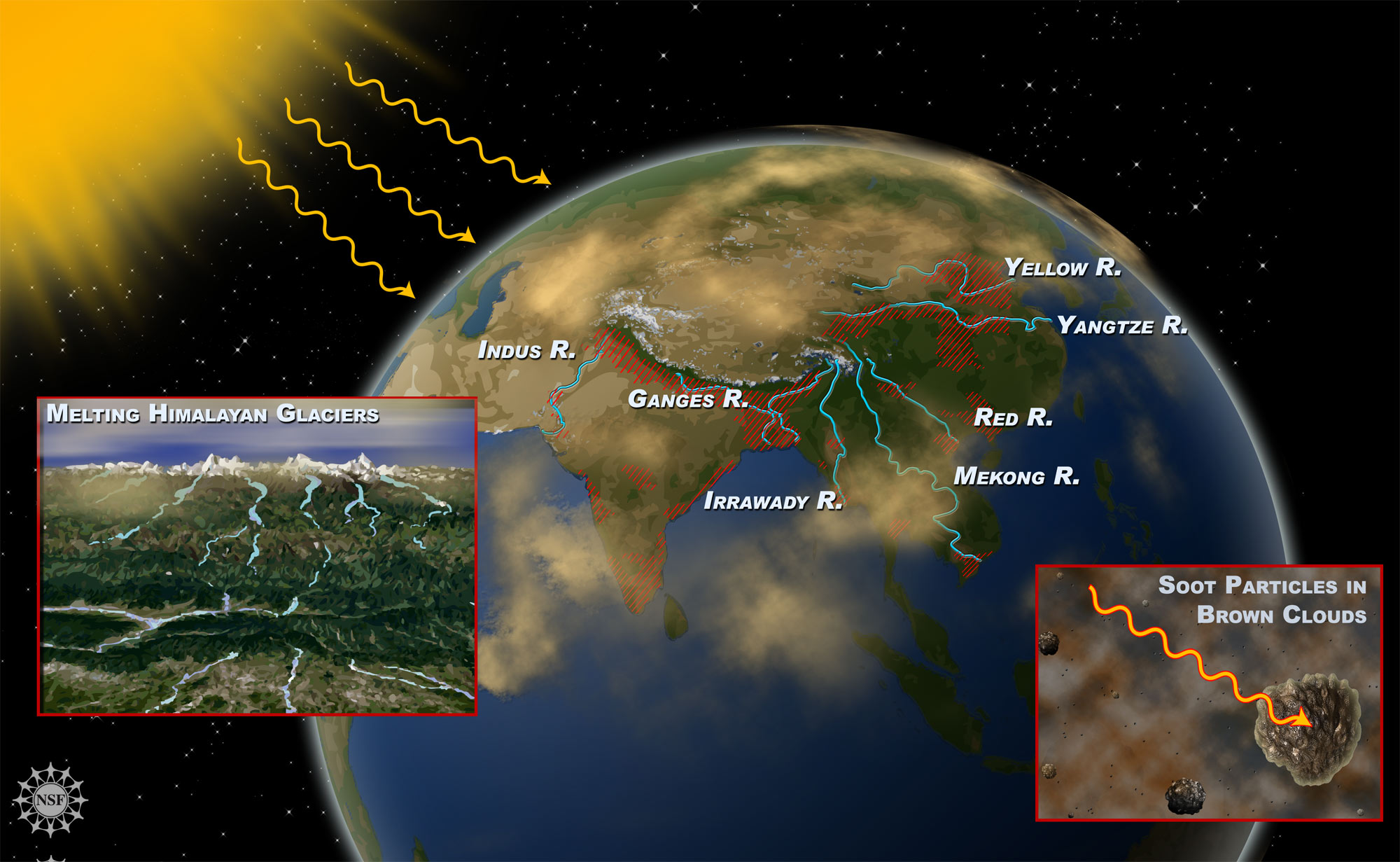
Hugh Pickens writes "The Himalayas, home to some 10,000 glaciers, are the main source of replenishment to lakes, streams, and some of the continent's mightiest rivers, on which millions of people depend for their water supplies. Since the 1960s, the acreage covered by Himalayan glaciers has declined by more than 20 percent with a rate of warming twice the global average over the past 30 years. Now Live Science reports that tiny particles of pollution known as 'black carbon' — and not heat-trapping greenhouse gases — may be causing much of the rapid melting of glaciers in the Himalayas. 'Tibet's glaciers are retreating at an alarming rate,' says James Hansen, director of NASA's Goddard Institute for Space Studies in New York City. 'Black soot is probably responsible for as much as half of the glacial melt, and greenhouse gases are responsible for the rest.' The circulation of the atmosphere in the region causes much of the soot-laden air to 'pile up' against the Himalayas. The soot mixes with other dust from nearby deserts, creating a massive brown cloud visible from space that absorbs incoming solar radiation. As this layer heats up in the Himalayan foothills, it rises and enhances the seasonal northward flow of humid monsoon winds, forcing moisture and hot air up the slopes of the mountain range." -
20th Anniversary of the Dawn of Dot-Com
btempleton writes "It was 20 years ago today when I posted to USENET the public launch of ClariNet, my electronic newspaper service delivered over the Internet. By finding a way around the NSFNet acceptable use policy, ClariNet was the first business founded to use the Internet as its platform for business, and the era of the 'dot-com' had begun. For the anniversary I have written a history of the founding of ClariNet and early internet business, which outlines how it all came down. Readers may also enjoy the included anecdote about what I term 'M5' reliability, where the news system was so robust that, like the M5 computer on Star Trek, even those authorized to do so were unable to shut it off; and a story of the earliest large SF eBook effort." -
Storing Qubits In Nuclei
bednarz writes "Scientists have demonstrated what is being called the 'ultimate miniaturization of computer memory,' storing data for nearly two seconds in the nucleus of an atom of phosphorus. The hybrid quantum memory technique is a key step in the development of quantum computers, according to the National Science Foundation. An international team of scientists demonstrated that quantum information stored in a nucleus has a lifetime of about 1¾ seconds. 'This is significant because before this technique was developed, the longest researchers could preserve quantum information in silicon was a few tens of milliseconds. Other researchers studying quantum computing recently calculated that if a quantum system could store information for at least one second, error correction techniques could then protect that data for an indefinite period of time.'" Here's the NSF press release with pictures of the apparatus. They claim that this technique is promising because it "uses silicon technology" seems a bit of a stretch — the silicon the researchers employed was a painstakingly grown crystal of extremely high purity. -
Japan "Running Out of Engineers"
bfwebster writes "A story in the New York Times reports that Japan, a country that rebuilt itself as a technological power after World War II, now faces an increasing shortage of college graduates with degrees in science and engineering. Says the article: 'By one ministry of internal affairs estimate, the digital technology industry here is already short almost half a million engineers.' The article goes on to point out that the overall trend of waning interest in science and technology has been going on for 'almost two decades' and that the shortage is made worse by the traditional reluctance of Japanese companies to hire and use foreign workers. The US has had a similar trend for quite some time: 'Undergraduate engineering enrollment declined through most of the 1980s and 1990s, rose from 2000 through 2003, and declined slightly in recent years.'" -
Introducing Magnet-Responsive Memory Foam
Roland Piquepaille writes "The U.S. National Science Foundation (NSF) has recently reported that two research teams have developed a new porous foam of an alloy that changes shape when exposed to a magnetic field. The NSF states that this new material is able to remember its original shape after it's been deformed by a physical or magnetic force. This polycrystalline nickel-manganese-gallium alloy is potentially cheaper and lighter than other materials currently used in devices ranging from sonar to precision valves. It also could be used to design biomedical pumps without moving parts and even for space applications and automobiles." -
Microbes Churn Out Hydrogen at Record Rate
FiReaNGeL writes to mention that Penn State Researchers have improved on their original microbial electrolysis cell design bringing the resulting system up to better than 80 percent efficiency when considering all energy inputs and outputs. "By tweaking their design, improving conditions for the bacteria, and adding a small jolt of electricity, they increased the hydrogen yield to a new record for this type of system. 'We achieved the highest hydrogen yields ever obtained with this approach from different sources of organic matter, such as yields of 91 percent using vinegar (acetic acid) and 68 percent using cellulose,' said Logan. In certain configurations, nearly all of the hydrogen contained in the molecules of source material converted to usable hydrogen gas, an efficiency that could eventually open the door to bacterial hydrogen production on a larger scale." -
Single Nanotube Becomes World's Smallest Radio
Invisible Pink Unicorn writes "Researchers at the National Science Foundation have utilized a single carbon nanotube to perform all the functions of a standard radio, acting as an antenna, tunable filter, amplifier, and demodulator. They were then able to tune in a radio signal generated in the room and play it back through an attached speaker. The device is functional across a bandwidth widely used for commercial radio. From the NSF: 'The source content for the first laboratory test of the radio was "Layla," by Derek and the Dominos, followed soon after by "Good Vibrations" by the Beach Boys.'" -
NSF-Funded "Dark Web" to Battle Terrorists
BuzzSkyline writes "The National Science Foundation has announced a new University of Arizona project, which they call the Dark Web, intended to monitor all terrorist activity on the Internet. The project relies on 'advanced techniques such as Web spidering, link analysis, content analysis, authorship analysis, sentiment analysis and multimedia analysis [to] find, catalog and analyze extremist activities online.' The coolest part of the project is a tool called Writeprint, which 'automatically extracts thousands of multilingual, structural, and semantic features to determine who is creating "anonymous" content' with an accuracy of 95%, according to the release." -
Low-Energy Neutrinos Detected In Real Time
Roland Piquepaille sends us word of first results from the Borexino detector in Italy, where an international team of more than 100 researchers has detected low-energy solar neutrinos for the first time. These results confirm recent "theories about the nature of neutrinos and the inner workings of the sun and other stars." In particular, it's now almost certain that neutrinos oscillate among three types, namely electron, muon, and tau neutrinos. The Borexino detector lies almost a mile underground near L'Aquila, Italy, and it sets new standards in the purity of the materials used in its construction. -
Another US Tech Trade Deficit
eldavojohn writes "The United States is suffering again from a massive trade deficit — $38.3 billion in 2006. And it's been going on since 2002. From the press release: 'In 2006, Asia supplied 60 percent of all US imports of advanced technology products. Europe supplied more than 20 percent, and North America more than 15 percent.'" -
NSF Announces Supercomputer Grant Winners
An anonymous reader writes "The NSF has tentatively announced that the Track 1 leadership class supercomputer will be awarded to the National Center for Supercomputing Applications (NCSA) at the University of Illinois at Urbana-Champaign. The Track 2 award winner is University of Tennessee-Knoxville and its partners." From the article: "In the first award, the University of Illinois at Urbana-Champaign (UIUC) will receive $208 million over 4.5 years to acquire and make available a petascale computer it calls "Blue Waters," which is 500 times more powerful than today's typical supercomputers. The system is expected to go online in 2011. The second award will fund the deployment and operation of an extremely powerful supercomputer at the University of Tennessee at Knoxville Joint Institute for Computational Science (JICS). The $65 million, 5-year project will include partners at Oak Ridge National Laboratory, the Texas Advanced Computing Center, and the National Center for Atmospheric Research." -
U.S. Science and Engineering Research Flattens
Invisible Pink Unicorn writes "The National Science Foundation is reporting that the number of published U.S. science and engineering articles plateaued in the 1990s, despite continued increases in funding and personnel for research and development. This came after two decades of continued growth. Since then, flattening has occurred in nearly all U.S. research disciplines and types of institutions. In contrast, Asian and EU research had significant increases in this period. They do point to one positive for the US, however: article quality. According to one of the researchers, 'the more often an article is cited by other publications, the higher quality it's believed to have. While citation is not a perfect indicator, U.S. publications are more highly cited than those from other countries.'" -
Submitting Federal Proposals Requires Windows
Petronius Arbiter writes "The US federal government is requiring that proposals for grants etc be submitted using a common system at http://grants.gov/. That's a good idea, except that effectively, you must use Windows and Explorer. See To operate PureEdge Viewer, your computer must meet the following system requirements: Windows 98, ME, NT 4.0, 2000, XP... PureEdge on Grants.gov will not run within the Firefox browser. They do have a Citrix substitute for non-Windows users. However the site goes on to say "Note that a limited amount of users can access the Citrix Server at any one time... Finally, you will find the best time to work and submit an application via Citrix is during off-peak hours, usually between 10 p.m. and 10 a.m., EST. Finally, if your organization has more than 10 non-Windows users, they want you to add a dedicated Windows box to handle the traffic. For National Science Foundation clients, this is a big step backwards. NSF has had an excellent online system, http://fastlane.nsf.gov/ for years. Fastlane has no bias towards MS. However, by federal edict, NSF people must also use grants.gov." -
Funding Cut For Arecibo Observatory
satorchi writes "In a recent Senior Review conducted by the National Science Foundation, a panel of experts recommended the reduction of funding to Arecibo Observatory, the world's largest radio telescope. Unless other sources of funding are found, Arecibo faces severe cuts in its program, with the prospect of closure around the year 2011. Development of the global project called the Square Kilometer Array (SKA) is cited as a reason to decommission Arecibo, but with the SKA coming online around the year 2020, closure of Arecibo in 2011 is some ten years premature. Until SKA is up and running, Arecibo remains the world's most sensitive radio telescope." -
Not Your Daddy's IT Force Anymore
Quill345 writes "The days of high-paying technology-based jobs right out of highschool are over. As writers for ACM report, the skill-sets required for jobs have grown over time. Academia has responded to the evolution with novel programs recruiting women and integrating IT into MBA programs. And as technology finds its way into every aspect of business life, the NSF is creating a grant program to fund service science, a blend of IT into other industries. Researchers at City University of NY are working on an NSF-funded project to infuse technology into Liberal Arts courses taken by students who are in primary tech-producer or tech-consumer majors. What are these crucial modern skills? Knowledge of laws like the DMCA? Interpersonal and group work skills? Experience with different technology platforms? The ability to discriminate between useful and useless information sources?" -
Warm-blooded Fish?
DIY News writes "Scientists now have direct evidence that the north Pacific salmon shark maintains its red muscle at 68-86 degrees Fahrenheit, much warmer than the 47 F water in which it lives. The elevated muscle temperature presumably helps the salmon shark survive the cold waters of the north Pacific and take advantage of the abundant food supply there. The heat also appears to factor into the fish's impressive swimming ability." -
NSF Reports No Geek Shortage
Baldrson writes "The NSF's report titled 'Graduate Enrollment in Science and Engineering Programs Up in 2003, But Declines for First-Time Foreign Students' (a pdf of the report released for the first time last month) is now available online. In an analysis of the report, Edwin S. Rubenstein of ESR Research states of these latest figures: '4.2 percent of science and engineering PhDs work outside their field of training, chiefly for financial reasons. This further weakens corporate America's claim of a shortage of high-tech workers.'" Interesting to see how things have changed since then. -
First South Pole Flight Commemorated
manganese4 writes "The NSF is commemorating the 75th anniversity of Robert Byrd's first flight to the South Pole as well as a history of airflight and science. 'In honor of Byrd's accomplishment, the National Science Foundation (NSF) today launched a commemorative Web site that chronicles how aircraft make scientific research in the polar regions possible and describes some of the cutting-edge discoveries made because of the logistics support aircraft provide.'" -
First South Pole Flight Commemorated
manganese4 writes "The NSF is commemorating the 75th anniversity of Robert Byrd's first flight to the South Pole as well as a history of airflight and science. 'In honor of Byrd's accomplishment, the National Science Foundation (NSF) today launched a commemorative Web site that chronicles how aircraft make scientific research in the polar regions possible and describes some of the cutting-edge discoveries made because of the logistics support aircraft provide.'" -
First South Pole Flight Commemorated
manganese4 writes "The NSF is commemorating the 75th anniversity of Robert Byrd's first flight to the South Pole as well as a history of airflight and science. 'In honor of Byrd's accomplishment, the National Science Foundation (NSF) today launched a commemorative Web site that chronicles how aircraft make scientific research in the polar regions possible and describes some of the cutting-edge discoveries made because of the logistics support aircraft provide.'" -
CIA Researching Automated IRC Spying
Iphtashu Fitz writes "CNet News is reporting that the CIA has been quietly investing in research programs to automatically monitor Internet chat rooms. In a two year agreement with the National Science Foundation, CIA officials were involved with the selection of recipients for research grants to develop automated chat room monitors. Researchers at Rensselaer Polytechnic Institute received $157,673 from the CIA and NSF for their proposal of 'a system to be deployed in the background of any chat room as a silent listener for eavesdropping ... The proposed system could aid the intelligence community to discover hidden communities and communication patterns in chat rooms without human intervention.' How soon until all IM conversations are monitored by Big Brother? The abstract of the proposal is available on the NFS website." -
CIA Researching Automated IRC Spying
Iphtashu Fitz writes "CNet News is reporting that the CIA has been quietly investing in research programs to automatically monitor Internet chat rooms. In a two year agreement with the National Science Foundation, CIA officials were involved with the selection of recipients for research grants to develop automated chat room monitors. Researchers at Rensselaer Polytechnic Institute received $157,673 from the CIA and NSF for their proposal of 'a system to be deployed in the background of any chat room as a silent listener for eavesdropping ... The proposed system could aid the intelligence community to discover hidden communities and communication patterns in chat rooms without human intervention.' How soon until all IM conversations are monitored by Big Brother? The abstract of the proposal is available on the NFS website." -
2004 Visualization Challenge Winners
ahab_2001 writes "Science Magazine and the National Science Foundation have announced the winners of their second annual Science and Engineering Visualization Challenge. The winners and runner-ups -- in categories including photography, illustration, instructional graphics, and interactive and noninteractive multimedia -- are written up in a collection of articles (accompanied by a slide show) on the Science Web site. There's also information about the competition posted at NSF." -
2004 Visualization Challenge Winners
ahab_2001 writes "Science Magazine and the National Science Foundation have announced the winners of their second annual Science and Engineering Visualization Challenge. The winners and runner-ups -- in categories including photography, illustration, instructional graphics, and interactive and noninteractive multimedia -- are written up in a collection of articles (accompanied by a slide show) on the Science Web site. There's also information about the competition posted at NSF." -
Robots That Transform Into ... Robots
manganese4 writes "The NSF has released a summary of research into the design of robots capable of reconfiguring themselves. A number of videos are provided. The research was conducted at the Dartmouth Robotics Lab. While they are not cockroaches it is still quite a good read." -
Robots That Transform Into ... Robots
manganese4 writes "The NSF has released a summary of research into the design of robots capable of reconfiguring themselves. A number of videos are provided. The research was conducted at the Dartmouth Robotics Lab. While they are not cockroaches it is still quite a good read." -
Robots That Transform Into ... Robots
manganese4 writes "The NSF has released a summary of research into the design of robots capable of reconfiguring themselves. A number of videos are provided. The research was conducted at the Dartmouth Robotics Lab. While they are not cockroaches it is still quite a good read." -
Robots That Transform Into ... Robots
manganese4 writes "The NSF has released a summary of research into the design of robots capable of reconfiguring themselves. A number of videos are provided. The research was conducted at the Dartmouth Robotics Lab. While they are not cockroaches it is still quite a good read." -
Robots That Transform Into ... Robots
manganese4 writes "The NSF has released a summary of research into the design of robots capable of reconfiguring themselves. A number of videos are provided. The research was conducted at the Dartmouth Robotics Lab. While they are not cockroaches it is still quite a good read." -
South Pole Research Station Hacked Twice
Marda writes "It's been known for a while that Romainian cyber extortionists cracked the computer network at the Amundsen-Scott South Pole Station last year. Now SecurityFocus is reporting that another computer intruder penetrated the station just two months before, and cracked the data acquisition system for the Degree Angular Scale Interferometer (DASI), a radiotelescope that measures properties of the cosmic microwave background. It turns out the station was insecure 'purposely, to allow for our scientists at this remotest of locations to exchange data under difficult circumstances,' according to internal reports." -
Low Level Virtual Machine 1.3 Released
RSpencer writes "The Low Level Virtual Machine project has released version 1.3. There are full release notes available. LLVM is a source-language agnostic toolkit for building compilers, optimizers, and jit or interpreted virtual machines. LLVM provides extensive optimization support, three mid-level IR formats (bytecode, assembly, and C++), three backend targets (x86,Sparc,PPC), full documentation, and a very simple and unique design. This new toolkit approach to compiler related tools is quickly attracting new developers who are making significant contributions to the work. Visit the home page where you can learn all the details. LLVM is funded by the National Science Foundation, MARCO/DARPA, and supported by UIUC's Computer Science department and other developers." -
A Plastic Designed For Wearable Electronics
aphexbrett writes "Researchers have developed a new plastic that conducts electricity, may be simpler to manufacture than industry counterparts and easily accommodates chemical attachments to create new materials. This new material could mean easier manufacture of paper-thin TVs and "smart" cloth. Developed by TDA Research in Wheat Ridge, Colo., Oligotron polymers are made of tiny bits of material that possess a conducting center and two, non-conducting end pieces. The end pieces allow the plastic bits to dissolve in solvents and accommodate specialized molecules." -
Open-Source Development 'Faster, Better, Cheaper'
David Hart writes "Faster, Better, Cheaper: Open-Source Practices May Help Improve Software Engineering -- Walt Scacchi of the University of California, Irvine, and his colleagues are conducting formal studies of the informal world of open-source software development, in which a distributed community of developers produces software source code that is freely available to share, study, modify and redistribute. They're finding that, in many ways, open-source development can be faster, better and cheaper than the 'textbook' software engineering often used in corporate settings." -
Open-Source Development 'Faster, Better, Cheaper'
David Hart writes "Faster, Better, Cheaper: Open-Source Practices May Help Improve Software Engineering -- Walt Scacchi of the University of California, Irvine, and his colleagues are conducting formal studies of the informal world of open-source software development, in which a distributed community of developers produces software source code that is freely available to share, study, modify and redistribute. They're finding that, in many ways, open-source development can be faster, better and cheaper than the 'textbook' software engineering often used in corporate settings." -
3D File Manager on Linux Wins NSF Prize
MadFarmAnimalz writes "Science Magazine's reporting on the results of the NSF's Science and Engineering Visualisation Challenge and the first prize in the Illustrations category has been claimed by the Innolab 3D File Manager, which was developed on linux. Apparently this involves arranging data in a ferris wheel type structure." The data is arranged by its relationship with its content, rather than by its physical position on a hard drive or its file system. -
AMANDA Maps Cosmic Neutrinos
Uosdwis writes "Remember those 'little neutral ones', neutrinos? You know those little guys have no charge, are invisible and just about no mass. Well a University of Wisconsin-Madison professor has created an array, burried in the antarctic, to detect them with help from the National Science Foundation and produced a map of nuetrinos in the cosmos. A different method than the tau neutrinos found a few years ago, and show the 'natural' neutrinos are at a higher energy level." -
Linux Reconstructing Tree of Life?
vaderhelmet writes "Wired has a cool story about how the American Museum of Natural History, funded by the National Science Foundation is using Linux to "construct a pattern of relationships that biologists believe links all of Earth's present and past species -- from the smallest microbe to the largest vertebrate that existed during Earth's 4 billion-year history." They're using their very own homemade supercomputer which ranks in at 107 on the Top 500 supercomputers list. Quote from article: "Linux makes it so easy to create a supercomputer."" -
Digital Darwin
An anonymous reader writes "Using genetic algorithms to breed strings of computer code graphically, this week's Nature magazine describes results from Caltech and Michigan State. Their program is Avida. While they mainly mimic mutation, not genetic cross-over [or inheritance (thus wiping away much memory of initial conditions)], their simulations show how a short-term backward step in survival strategies can generate innovative advances. It is not unlike running a maze which necessarily involves testing alot of dead-ends, and thus shares the graphical look of Conway's classic Game of Life." Here's a National Geographic story about this as well, or see their press release. -
The Future of Hard Drives: Ballistic Magnetoresist
Hirsto writes "Found this interesting story about breakthrough research on next generation drives. Here is a link to the NSF press release on this technology which supposedly enables storage densities of greater than 1 terabit per square inch. Devices might be on the market in 7 years, give or take." -
WTC Left Sedimentary Fingerprint
Quixotic1 writes "The NSF announced scientists had found a "distinct fingerprint on the sedimentary record in New York Harbor" due to the destruction of the World Trade Center. The findings were extrapolated from the presence of high concentrations of several elements that make up gypsum, a material used in drywall, and silica, likely from fiberglass." -
Broadband To Hit The South Pole
Albanach writes: "According to this story from the BBC bids are being invited to lay a fibre-optic cable some 1600 kilometres over polar ice, linking researchers at the South Pole with the rest of the planet. Currently, researcher's communications rely upon older satellites that have drifted from their geostationary orbits into ones that are now at least partly visible from the pole. The new cable will be laid on top of the 4km ice cap, and will have to cope with repeated freezing and stretching as the ice moves."