Slashdot Mirror
Domain: nuclearweaponarchive.org
Stories and comments across the archive that link to nuclearweaponarchive.org.
Comments · 166
-
Re:Lets keep this a secretIn the E=mc^2 sense, that is true. But that has absolutely no bearing on the amount of Plutonium you'll have left after a fission event.
Uh no, as the chain reaction starts, the other atoms in the core gain an enormous amount of thermal kinetic energy and the core attempts to vapourise. If it disperses, neutrons are far less likely to hit a nucleus and produce further fission events. If this process is allowed to continue fissile material is physically removed from the path of the neutrons - so some fissile material would never undergo fission.
The outward expansion of the core is unstoppable, it always disassembles the core before the reaction can run to completion - a matter of microseconds. The objective must be to stop the outward expansion of the core for as long as possible by producing an inward pressure of equal or greater force. So modern weapons use a heavy metal tamper around the core to provide a lot of inertia against expansion, and a huge amount of implosion pressure to counteract the outward movement of the core material for as long as possible.
I did some checking, Little Boy was 1.3% efficient, Fat Man was 16% efficient. Apparently normal fission cores are limited to around 25% efficiency, larger ones might be up to 50% efficient. Some of the later US tests that used so-called levitated cores got efficiencies up to 35% - which is pretty damn impressive - in a horribly scary sort of way.
Best wishes,
Mike. -
Re:Barking up the wrnog tree?
"thats funny because you CANT simulate such an explosion since the fusion in a thermonuclear bomb uses plutonium for its destructive force"
Uhhh...no actually a thermonuclear bomb uses a fission device to fill what's called a hohlraum with intense x-rays that compress a source of hydrogen fuel to very high densities and temperatures. This is simulated very closely with a miniature equivalent hohlraum used with high power lasers.
"so...in short...shut up you stupid uneducated "I hate everything that has the word nuclear in it" person"
Inever said anything of the sort, nor would I ever say something so stupid. I was merely pointing out that it's unfortunate that something great like the NIF has to have its justification for being built be nuclear weapons design instead of fundamental physics. -
Re:No easy answer
Foo: I'm in favor of detonating lots of nukes on mars, just to see what happens.
Bar: Not sure, but I think seeing Venus's atmosphere sent outwards a few hundred kilometres would look pretty cool.
Baz: Yeah, maybe they could have a pay-per view special to fund the costs.
Interestingly, I just listened to someone discuss the awesome power of a sight that fewer and fewer people have seen: nuking the Earth.
On NPR's Fresh Air, former Secretary of the Air Force Thomas Reed talked about his new book, At the Abyss: An Insider's History of the Cold War. In addition to his policial role, he was for a while a "consultant to the director of Lawrence Livermore National Laboratory, a well-known center for nuclear weapons research." As such, he helped design nuclear weapons, and was present during their testing.
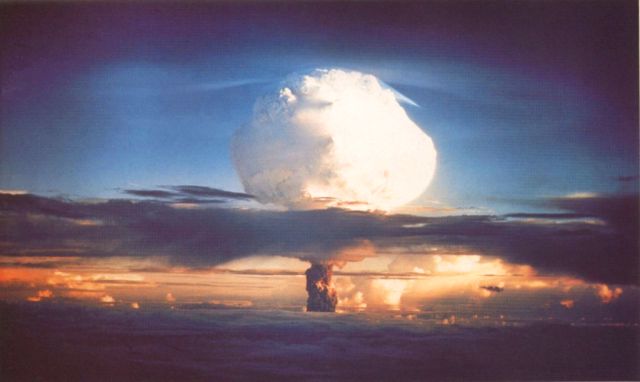
He pointed out that witnessing an above-ground nuclear detonation was itself a life-changing event, and that the experience colored the decisions of all who saw and felt it. The light, he said of a Christmas Island blast, wasn't just bright -- it was all-enveloping, even through the way-beyond-dark goggles. And the instant blast of heat, that made you want to run away, anywhere, just to get away.
But nuke tests are now performed underground, where the awesome power is visible only as instrument ticks and a dimple in the ground. As the old scientists die, there are fewer and fewer people who have witnessed a nuclear blast as it would occur in the above-ground world.
The whole concept is so abstract, we can now discuss the idea of blowing one up on another planet, without even breaking into a sweat. Unfortunately, there are plenty of folks in the militaries of the world who can do the same sort of abstract thinking in reference to their own planet.
Damn, that got a lot deeper than I thought it would... -
Re:No easy answer
Foo: I'm in favor of detonating lots of nukes on mars, just to see what happens.
Bar: Not sure, but I think seeing Venus's atmosphere sent outwards a few hundred kilometres would look pretty cool.
Baz: Yeah, maybe they could have a pay-per view special to fund the costs.
Interestingly, I just listened to someone discuss the awesome power of a sight that fewer and fewer people have seen: nuking the Earth.
On NPR's Fresh Air, former Secretary of the Air Force Thomas Reed talked about his new book, At the Abyss: An Insider's History of the Cold War. In addition to his policial role, he was for a while a "consultant to the director of Lawrence Livermore National Laboratory, a well-known center for nuclear weapons research." As such, he helped design nuclear weapons, and was present during their testing.
He pointed out that witnessing an above-ground nuclear detonation was itself a life-changing event, and that the experience colored the decisions of all who saw and felt it. The light, he said of a Christmas Island blast, wasn't just bright -- it was all-enveloping, even through the way-beyond-dark goggles. And the instant blast of heat, that made you want to run away, anywhere, just to get away.
But nuke tests are now performed underground, where the awesome power is visible only as instrument ticks and a dimple in the ground. As the old scientists die, there are fewer and fewer people who have witnessed a nuclear blast as it would occur in the above-ground world.
The whole concept is so abstract, we can now discuss the idea of blowing one up on another planet, without even breaking into a sweat. Unfortunately, there are plenty of folks in the militaries of the world who can do the same sort of abstract thinking in reference to their own planet.
Damn, that got a lot deeper than I thought it would... -
Re:That sounds bad ass.Off topic, but I'm eating troll bait anyway: You do know that the only reason we're trying to keep China from getting nukes is because in a conventional war, they'd kick our ass, right? Talk about 200 million americans being shocked and awed that they're not divinely special.
You do know that China's had nuclear weapons for forty years, right?
-
Re:not quite right...
I believe that the time that would pass while the core is being compressed and the reaction builds would be plenty long enough for the outwards force of the explosive charges to ruin the capsule, despite the 1-foot gap between the fission device and the container. The fusion reaction might still go, but I doubt it'd be anywhere near its potential.
A 1 foot gap? Modern US weapons are only about a foot in diameter. See:
List of all US nuclear bombs
This is an easy problem to solve. Deformation of the hohlraum (bomb outer casing / "radiation case") will happen, but you just need to make sure it doesn't rupture from the primary's implosion charges before the fission reactions run to completion. If the primary doesn't detonate, the hohlraum will rupture eventually. But that doesn't matter, if it lasts long enough that the primary fires first. Its thickness and strength are constrained by how long it has to hold intact, not with making it survive the internal explosion permanently.Frankly, I suspect there is a lot of deliberate misinformation about constructing nuclear devices out there. I have serious doubts about a tamped implosion device working well, if at all; I'm sure that if it were workable, the folks at Oak Ridge would've tried it long before they started fooling around with explosive lenses. That's probably why we didn't hear very much about the tests India and Pakistan performed.
There is plenty of in depth technical info at the Nuclear Weapon Archive.
Including a detailed FAQ for the Q-filled.
-
Re:not quite right...
I believe that the time that would pass while the core is being compressed and the reaction builds would be plenty long enough for the outwards force of the explosive charges to ruin the capsule, despite the 1-foot gap between the fission device and the container. The fusion reaction might still go, but I doubt it'd be anywhere near its potential.
A 1 foot gap? Modern US weapons are only about a foot in diameter. See:
List of all US nuclear bombs
This is an easy problem to solve. Deformation of the hohlraum (bomb outer casing / "radiation case") will happen, but you just need to make sure it doesn't rupture from the primary's implosion charges before the fission reactions run to completion. If the primary doesn't detonate, the hohlraum will rupture eventually. But that doesn't matter, if it lasts long enough that the primary fires first. Its thickness and strength are constrained by how long it has to hold intact, not with making it survive the internal explosion permanently.Frankly, I suspect there is a lot of deliberate misinformation about constructing nuclear devices out there. I have serious doubts about a tamped implosion device working well, if at all; I'm sure that if it were workable, the folks at Oak Ridge would've tried it long before they started fooling around with explosive lenses. That's probably why we didn't hear very much about the tests India and Pakistan performed.
There is plenty of in depth technical info at the Nuclear Weapon Archive.
Including a detailed FAQ for the Q-filled.
-
Re:damnit, some people just can't shut up.
Frankly, your assertion is very unlikely. Sure, basic physics teaches how to build a fission bomb (although getting the material is really tough unless you have a reactor).
The invention of the hydrogen bomb was done independently at least twice, both by extremely smart specialists, not your BS physics grad.
However, the basic design of the Teller-Ulam fusion bomb is now readily available, including many of the relevant equations. A less detailed source is here.
Because the article is slashdotted, I can't judge what it gives away, but probably not as much as is now readily available (which may be very different from what was available in 1979).
-
The secret has been available for ages
Even if this particular article hasn't previously been available you could always visit nuclearweaponarchive.org to find out the principles behind a Teller-Ulam bomb (and much else, besides). It won't give you the non-deducible R&D results, but neither does this article (in fact, even the Progressive argues that these should not be publically divulged).
-
EM from nukes
To the list of complaints above I would also add that it seems unlikely that people capable of building faster-than-light spacecraft wouldn't know how to make radios that transmitted a clear signal. The amount of break-up and interference in those radio transmissions was ridiculous. And it didn't seem to make it difficult for the characters to understand each other, it just made it tougher for the viewer to hear what they were saying.
It is probably worth pointing out that many of these transmissions are to/from planets that have just had tens or hundreds of nuclear weapons detonated on them. Nukes put out a lot of of EM noise on their own, and even more if they are high enough to couple to the ionosphere. If I was a Cylon, I'd certainly make sure to include a few high-altitude nukes to help cut communications. -
China's had the Bomb for ages
It even has a hydrogen bomb.
-
Re:Um, have you read the paper in the last 10 year
You seem to have left out Russia, which has still has lots of deployed ICBMs (about as many as the US). Russia is more unstable than the US by orders of magnitude, and remains quite paranoid.
Also, the issue of first strike means different things in different conditions. A fourth generation nuke (i.e. low yield, very little fallout) used as a bunker buster is a relatively insignificant event compared to a cold-war style counter-force first strike or a retaliatory anti-population strike.
Furthermore, the political acceptability of anything other than a highly limited, low collateral damage (fourth generation) pre-emptive attack is extremely low in the US, UK and Israel. Even such a limitted attack would have enormous political repercussions in those three countries. The idea that the US is at the top of the list of those politically likely to launch an attack is absolutely insane.
I'd give a quite different order of probabilitites:
India - miscalculation or response to radical Islamic takeover of Pakistan.
Pakistan - result of miscalculation or radical Islamic takeover.
Al Qaeda - using purchased/furnished NK or Iranian (or even Russian) weapon smuggled to civilian target.
Israel - fourth generation pre-emptive strike against Iranian nuclear capabilities.
Iran - (against Israeli population centers - see this and this.) Iran and North Korea have been closely cooperating, trading Iranian money for North Korean capabilities, including long range missiles and probably nuclear weapons. Iran has its own Uranium enrichment facilities sufficient to produce weapons grade Uranium, and North Korea has a supply of Plutonium, and a Uranium enrichment program at an unknown stage of progress. Both nations have local Uranium mines. A large contingent of North Korean scientists are living in Iran, indicating that the nuclear programs may be as deeply coupled as the historic ties between the US and UK in that field.
US, UK - fourth generation strike against deep underground targets in Iran or North Korea), or strategic retaliation against terrorist supporting regimes after an Al Qaeda nuclear attack in the US.
NK - as part of an attempted conquest of the south, as a dying spasm of the regime, or less likely, as a response to a US pre-emptive strike against nuclear facilities and stockpiiles.
China - either as an extension of an Indo-Pakistani conflict, or a Taiwan crisis.
USSR (major counter-force strike against US as a result of a mistake or rogue elements in the SRF)
France - no plausible scenario until about 2050, which it becomes Dar-al-France (Islamic dominated France).
Note that only a few of these scenarios result in major nuclear war, and some (the fourth generation attacks) are only nominally nuclear, in that they are low yield with essentially no residual radiation.
Also note that all of the nuclear powers probably have the capability of using Fusion boosting to create high yield weapons, and many are probably capable of fielding true two-stage thermonuclear weapons.
Fourth generation weapons are speculative. The physics are discussed in one unclassified reference, and the recent defense spending authorization most likely funds some fourth generation research and testing. Such weapons are especially useful for bunker busters (funded) and anti-ballistic missile systems (I hope that the US ABM system is secretly using them).
By far the most deadly threat is STILL Russia. Note that this >a href="http://www.pbs.org/wgbh/nova/missileers/fals ealarms.html">came close as recently as 1995 when a scientific sounding rocket, launched in the arctic, was misinterpreted by the aging Russian radar system as a sub-launched EMP first-phase attack. Yeltsin activated his football and had an estimat -
Re:Sigh...
You mean like this?
-
Fight
Fight evil with science.
Just kidding -
The real solution
...is here.
Just kidding -
Re:Halifax Explosion
Erm... Are you talking tons or KILOtons here? Are you sure that that explosion was 2.5 kton (about 1e13 Joules, and about 1/6th of the Little Boy bomb at Hiroshima), and not 2.5 ton (about 1e10 Joules, and about 1/6000th of the Hiroshima bomb)?
I was under the impression that the 100 ton test in 1945 (to measure spread of radioactive material in a blast) was the largest man-made explosion to that date. This was 100 ton (say, 4e11 Joules).
2.5 kton in Halifax seems an awful lot to me!