Slashdot Mirror
Domain: ornl.gov
Stories and comments across the archive that link to ornl.gov.
Comments · 647
-
Re:Pebble Bed reactors
You're simply misinformed. In any event, thorium is present is higher concentrations in coal than is uranium. Filters do not catch it. Estimates are that 10,000 times as much radioactive material is released from a coal power plant than from a nuclear power plant. This is borne out in cancer statistics in the areas around coal plants, etc. In fact, the uranium released from a coal plant would produce more energy when burned in a fission reactor than the entire mass of the coal it came from in the first place. See this article.
Simple sanity check: How's a coal powerplant smokestack filter going to catch thorium oxide if it's not stopping carbon dioxide? The size of the molecules is not significantly different. Additionally, if it is catching those many tons of thorium and uranium, where are all the nuclear waste disposal people dealing with the spent smokestack filters that by onw are surely clogged with tons of radioactive metal compounds?
Don't kid yourself. Nuclear is clean and safe.
Hydrogen power, on the other hand, is idiotic. Releasing CO2 into the atmosphere is fine as long as it comes from a carbon neutral source. If you were producing methanol from plants and burning that in cars (not farfetched, seeing as several racing leagues use it), it would not matter that CO2 was released, because each molecule of CO2 would be one that was taken out of the atmosphere a few months prior to grow the plant feedstock in the first place. The lack of a carbon in H2 is not an advantage. The very real disadvantages of H2, such as difficult of containment and poor energy/volume, still stand. -
Re:Fun source for fun fact?
Sadly, I was unclear in my meaning - What I should have said is that coal plants release more radioactive material *into the environment* than nuclear plants by a lot. It's simply because nuclear waste from nuclear plants is contained and accounted for, and monitored VERY closely, where nuclear waste from coal is generally unregulated as a by-product - and ignored because the rest of the waste from coal is FAR more harmful (mercury and heavy metals topping the list, acid rain about half way down, nuclear way down at the bottom). It's a loophole in the legislation regulating waste from power production, probably because the vast majority of power in the US comes from coal and it is the best local source of fossil fuel America has. In another form - if a nuclear plant dumped as much radioactive material as a coal plant, people would freak out, because oh-my-god it's nuclear! But because it comes from "coal", it's not the same "nuclear" or something. The _amount_ of radioactive waste from coal (or a nuclear plant) is actually fairly inconsequential, but coal plants still 'dump' more of it.
What I really wanted to point out is that given two power plants, 1 coal, 1 nuclear, the amount of harmful waste coming from the nuclear plant is less in volume and fewer in type (nuclear waste vs. heavy metals, oxides, nuclear, etc. with coal), and therefor easier to deal with. But that's not as fun to say...
My main source was this: http://www.ornl.gov/info/ornlreview/rev26-34/text/ colmain.html
But to be honest, this chain (not just the top, but the whole chain) of discussion is more to my point than... well, my point. http://slashdot.org/comments.pl?sid=178263&cid=147 81847 -
Re:coalCoal byproducts aren't radioactive.
That's the thing. They are radioactive
With the information on that page and a few others, we can do some math, and shed some light on the matter.
"...the average radioactivity per short ton of coal is 17,100 millicuries/4,000,000 tons, or 0.00427 millicuries/ton" (or 4.27 Curies/ton)
Source: http://www.ornl.gov/info/ornlreview/rev26-34/text/ colmain.htmlThe United States consumed 1107 million short tons of coal in 2004
Source: http://www.eia.doe.gov/cneaf/coal/quarterly/html/t 28p01p1.htmlElectrostatic precipitators capture 99.8% of particulates.
Source: http://www.airbornepollutioncontrol.com/jul26_2004 .htmlThus, all coal-burning facilities in the United States release an estimated 4.27 Curies/ton * 1107 million tons * 0.002 = 9.454 Curies of radioactive material every year.
This assumes that all coal-burning facilities in the US are equipped with the efficient particulate-removal devices mentioned above, and that all radioactive material in the coal is solid at flue gas temperatures (neither electrostatic precipitators nor baghouses will capture radioactive gasses).Chernobyl released 7 million Curies of radioactive material in 1986. Windscale in the UK released 20,000 Curies in 1957, and an early accident at the Hanford plutonium processing plant in the US released 205 Curies. Three Mile Island released 17 Curies.
Source: http://www10.antenna.nl/wise/369/3619.html -
Re:coalCoal byproducts aren't radioactive.
That's the thing. They are radioactive
With the information on that page and a few others, we can do some math, and shed some light on the matter.
"...the average radioactivity per short ton of coal is 17,100 millicuries/4,000,000 tons, or 0.00427 millicuries/ton" (or 4.27 Curies/ton)
Source: http://www.ornl.gov/info/ornlreview/rev26-34/text/ colmain.htmlThe United States consumed 1107 million short tons of coal in 2004
Source: http://www.eia.doe.gov/cneaf/coal/quarterly/html/t 28p01p1.htmlElectrostatic precipitators capture 99.8% of particulates.
Source: http://www.airbornepollutioncontrol.com/jul26_2004 .htmlThus, all coal-burning facilities in the United States release an estimated 4.27 Curies/ton * 1107 million tons * 0.002 = 9.454 Curies of radioactive material every year.
This assumes that all coal-burning facilities in the US are equipped with the efficient particulate-removal devices mentioned above, and that all radioactive material in the coal is solid at flue gas temperatures (neither electrostatic precipitators nor baghouses will capture radioactive gasses).Chernobyl released 7 million Curies of radioactive material in 1986. Windscale in the UK released 20,000 Curies in 1957, and an early accident at the Hanford plutonium processing plant in the US released 205 Curies. Three Mile Island released 17 Curies.
Source: http://www10.antenna.nl/wise/369/3619.html -
Re:coalCoal byproducts aren't radioactive.
That's the thing. They are radioactive
With the information on that page and a few others, we can do some math, and shed some light on the matter.
"...the average radioactivity per short ton of coal is 17,100 millicuries/4,000,000 tons, or 0.00427 millicuries/ton" (or 4.27 Curies/ton)
Source: http://www.ornl.gov/info/ornlreview/rev26-34/text/ colmain.htmlThe United States consumed 1107 million short tons of coal in 2004
Source: http://www.eia.doe.gov/cneaf/coal/quarterly/html/t 28p01p1.htmlElectrostatic precipitators capture 99.8% of particulates.
Source: http://www.airbornepollutioncontrol.com/jul26_2004 .htmlThus, all coal-burning facilities in the United States release an estimated 4.27 Curies/ton * 1107 million tons * 0.002 = 9.454 Curies of radioactive material every year.
This assumes that all coal-burning facilities in the US are equipped with the efficient particulate-removal devices mentioned above, and that all radioactive material in the coal is solid at flue gas temperatures (neither electrostatic precipitators nor baghouses will capture radioactive gasses).Chernobyl released 7 million Curies of radioactive material in 1986. Windscale in the UK released 20,000 Curies in 1957, and an early accident at the Hanford plutonium processing plant in the US released 205 Curies. Three Mile Island released 17 Curies.
Source: http://www10.antenna.nl/wise/369/3619.html -
Re:Nuclear waste is scary but...
Nuclear waste is scary, but it is very possible that the CO2 released by burning oil is more dangerous.
It's not just the CO2 from fossil fuels which is dangerous -- coal (the primary source of electrical power) contains a significant quantity of radioactive isotopes. The burning of coal is actually responsible for more radioactive waste than nuclear power, and the radioactive waste from coal goes straight into the atmosphere. -
Re:coalNo, he means radioactive.
Using these data, the releases of radioactive materials per typical plant can be calculated for any year. For the year 1982, assuming coal contains uranium and thorium concentrations of 1.3 ppm and 3.2 ppm, respectively, each typical plant released 5.2 tons of uranium (containing 74 pounds of uranium-235) and 12.8 tons of thorium that year. Total U.S. releases in 1982 (from 154 typical plants) amounted to 801 tons of uranium (containing 11,371 pounds of uranium-235) and 1971 tons of thorium. These figures account for only 74% of releases from combustion of coal from all sources. Releases in 1982 from worldwide combustion of 2800 million tons of coal totaled 3640 tons of uranium (containing 51,700 pounds of uranium-235) and 8960 tons of thorium.
From this paper." -
Re:coal
-
Re:coalSurprise! For example, Coal Combustion: Nuclear Resource or Danger
I wonder if new nuclear plants are one of the surprises Bush was hinting at for reducing dependence on foreign oil?
-
Re:coal
Coal byproducts aren't radioactive.
That's the thing. They are radioactive
While coal burning indeed doesn't produce radiactivity like nuclear power does, there's actually so much radioactive material in it such as uranium that we'd get more power from refining it for the radioactives and sticking it in a reactor than burning it.
There's a former power plant worker out there that's DQ'd for life from working in a nuclear power plant because he absorbed too much radioactivity from his house. The bricks were made from coal ash.
Meanwhile, when you burn the coal, radioactive materials end up not only in the ash but go up the flue. -
Re:Cue the misunderstandings
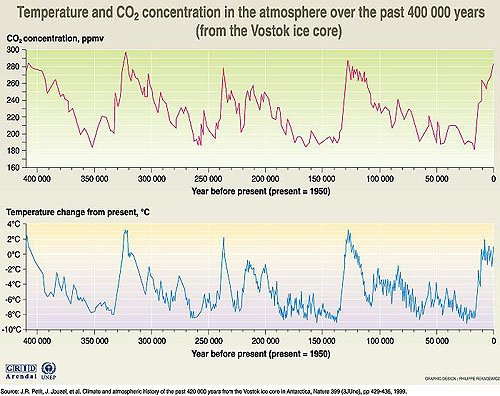
Check out the VostoK data yourself. Here's a nice chart. There's other data that shows the pattern repeating for about 1 M years, but it's not as good, and I don't think we have accompanying CO2 data for that. The Vostok data is an eye opener.
If you find a web site that shows the CO2 levels and temp data side by side, you might be surprised that changes in CO2 levels doesn't reliably lead temperature changes. Sometimes it's clear that there's a common cause for changes in both (if the data is accurate, anyway).
FWIW, we've alread funded bounties in the billion-dollar range for hydrogen storage technologies that would let us wean ourselves off oil. Existing alternatives to oil simply aren't good enough to begin a transition. Once we have something *better* than oil, transition will happen quickly enough, just as it did with wood and with coal. -
Re:Cue the misunderstandings
Check out the VostoK data yourself. Here's a nice chart. There's other data that shows the pattern repeating for about 1 M years, but it's not as good, and I don't think we have accompanying CO2 data for that. The Vostok data is an eye opener.
If you find a web site that shows the CO2 levels and temp data side by side, you might be surprised that changes in CO2 levels doesn't reliably lead temperature changes. Sometimes it's clear that there's a common cause for changes in both (if the data is accurate, anyway).
FWIW, we've alread funded bounties in the billion-dollar range for hydrogen storage technologies that would let us wean ourselves off oil. Existing alternatives to oil simply aren't good enough to begin a transition. Once we have something *better* than oil, transition will happen quickly enough, just as it did with wood and with coal. -
Re:May I suggest?
You mean this one?
-
Re:Interesting...You've just totally missed my point.
Firstly, humans are emitting Gigatonnes of CO2 and other greenhouse gases per year.
Secondly, CO2 concentrations in the atmosphere are increasing.
What do these 2 facts mean, taken together? They mean that humans are contributing to CO2 concentrations.
Thirdly, we know that CO2 levels are significantly higher than even a few hundred years ago - this is a very rapid rise.
Fourthly, we absolutely know that an increase in atmospheric C02 will enhance the greenhouse effect. There is a vast array of historical evidence for this, and also it is basic physics which is well understood.
Pretending that things are otherwise is just a wilful blindness.
We also know that the Earth is warming up extremely rapidly - more rapidly than it has at least for the last 20k years. This should be a matter for huge concern because even a couple of decades of stalling and global-warming-denial in the guise of scientific skepticism can allow for much more serious environmental and economic damage to accumulate.
The rest of your argument I think just misses the point. What you are not taking into account is that although anthropogenic C02 is small compared to C02 from natural sources, those natural emissions have historically been balanced by natural sequestration of C02. The historically new anthropogenic emissions are not, and hence over time these extra emissions are building up and up.
I recommend you check out the website of the Carbon Dioxide Information Analysis Centre, and the Candadian Meteorological Service - which incidentally contradicts your opinion about volcanism:On a global scale, volcanoes release less than 1% of human emissions of carbon dioxide and hence are a minor contributor to changes in its atmospheric concentrations.
Most recent estimates by volcanic experts with the U.S. Geological Survey suggest that, globally, volcanoes release about 150 million tonnes (Mt) of CO2 into the atmosphere each year. By comparison, humans annually emit more than 22 billion tonnes (Gt) of CO2 from fossil fuel combustion alone, and another 6 or so Gt of CO2 from deforestation activities. That is more than 100 times as great as volcanic emissions.Mount Etna, in Sicily, is the largest single volcanic emitter of CO2, estimated at 25 Mt of CO2 per year. By comparison, emissions from Mount St. Helens following its eruption several decades ago were less than 2 Mt of CO2/year.
compare with the 5 Gigatonne figure which the US Dept of Energy gives for US emissions. -
Food for thought
There has been a 19.4% increase in the mean annual concentration of CO2 in the atmosphere from 1959 to 2004.
During the 1959-2002 period, the total CO2 emissions equaled ~220 gigatons; ~14% of the atmospheric CO2 in 1959.
In 2002, Humanity pumped 7 gigatons (6975 megatons) of CO2 into the atmosphere. That is almost 4 times the emissions from 50 years ago (1952: 1795 megatons), and is more than was released from 1751-1886 (136 years: 6732 megatons).
There is a close correlation between Antarctic temperature and atmospheric concentrations of CO2. The extension of the Vostok [antarctic ice core] CO2 record shows the present-day levels of CO2 are unprecedented during the past 420 thousand years.
Cites:
Atmospheric carbon dioxide record from Mauna Loa [ornl.gov]
Global CO2 Emissions [ornl.gov]
Historical carbon dioxide record from the Vostok ice core [ornl.gov]
Earth's atmosphere [wikipedia.org] -
Food for thought
There has been a 19.4% increase in the mean annual concentration of CO2 in the atmosphere from 1959 to 2004.
During the 1959-2002 period, the total CO2 emissions equaled ~220 gigatons; ~14% of the atmospheric CO2 in 1959.
In 2002, Humanity pumped 7 gigatons (6975 megatons) of CO2 into the atmosphere. That is almost 4 times the emissions from 50 years ago (1952: 1795 megatons), and is more than was released from 1751-1886 (136 years: 6732 megatons).
There is a close correlation between Antarctic temperature and atmospheric concentrations of CO2. The extension of the Vostok [antarctic ice core] CO2 record shows the present-day levels of CO2 are unprecedented during the past 420 thousand years.
Cites:
Atmospheric carbon dioxide record from Mauna Loa [ornl.gov]
Global CO2 Emissions [ornl.gov]
Historical carbon dioxide record from the Vostok ice core [ornl.gov]
Earth's atmosphere [wikipedia.org] -
Food for thought
There has been a 19.4% increase in the mean annual concentration of CO2 in the atmosphere from 1959 to 2004.
During the 1959-2002 period, the total CO2 emissions equaled ~220 gigatons; ~14% of the atmospheric CO2 in 1959.
In 2002, Humanity pumped 7 gigatons (6975 megatons) of CO2 into the atmosphere. That is almost 4 times the emissions from 50 years ago (1952: 1795 megatons), and is more than was released from 1751-1886 (136 years: 6732 megatons).
There is a close correlation between Antarctic temperature and atmospheric concentrations of CO2. The extension of the Vostok [antarctic ice core] CO2 record shows the present-day levels of CO2 are unprecedented during the past 420 thousand years.
Cites:
Atmospheric carbon dioxide record from Mauna Loa [ornl.gov]
Global CO2 Emissions [ornl.gov]
Historical carbon dioxide record from the Vostok ice core [ornl.gov]
Earth's atmosphere [wikipedia.org] -
Re:Global Warming??I would think that the DOE numbers would agree with mine. See a webpage of theirs on carbon sequestration for example (please provide a cite to a DOE webpage that contradicts this). Or the EPA . Though I personally like the IPCC TAR as a good place to find a summary of climate change research.
Concentrations of long-lived gases like CH4, CO2, and N2O are fairly well-mixed globally - hemispheric mixing times are on the order of 1 to 2 months, global mixing times are on the order of 1 year (Seinfeld & Pandis, a standard atmospheric chemistry textbook). We measure them all over the place (from the peak of Mauna Loa to Antarctica) and come up with similar results. Google "Keeling" and "CO2" to see information on studies since 1955 in this area.
And yes, water vapor is the most important greenhouse gas. But water vapor concentrations are a function of the state of the system, and most scientists agree that increasing anthropogenic greenhouse gases will lead to an increase in water vapor too. But given that you don't even have basic comprehension of the carbon cycle and our ability to measure concentrations, I would suggest you consider whether your "lick of common sense" may be totally useless without some real scientific understanding to back it up.
-
Re:Is it really us?
Is it possible for you to move a multiton boulder along a flat stretch of land by pushing it yourself? No. However, it is possible to dislodge such a boulder from a precarious perch.
There has been a 19.4% increase in the mean annual concentration of CO2 in the atmosphere from 1959 to 2004.
During the 1959-2002 period, the total CO2 emissions equaled ~220 gigatons; ~14% of the atmospheric CO2 in 1959.
In 2002, Humanity pumped 7 gigatons (6975 megatons) of CO2 into the atmosphere. That is almost 4 times the emissions from 50 years ago (1952: 1795 megatons), and is more than was released from 1751-1886 (136 years: 6732 megatons).
There is a close correlation between Antarctic temperature and atmospheric concentrations of CO2. The extension of the Vostok [antarctic ice core] CO2 record shows the present-day levels of CO2 are unprecedented during the past 420 thousand years.
Cites:
Atmospheric carbon dioxide record from Mauna Loa
Global CO2 Emissions
Historical carbon dioxide record from the Vostok ice core
Earth's atmosphere -
Re:Is it really us?
Is it possible for you to move a multiton boulder along a flat stretch of land by pushing it yourself? No. However, it is possible to dislodge such a boulder from a precarious perch.
There has been a 19.4% increase in the mean annual concentration of CO2 in the atmosphere from 1959 to 2004.
During the 1959-2002 period, the total CO2 emissions equaled ~220 gigatons; ~14% of the atmospheric CO2 in 1959.
In 2002, Humanity pumped 7 gigatons (6975 megatons) of CO2 into the atmosphere. That is almost 4 times the emissions from 50 years ago (1952: 1795 megatons), and is more than was released from 1751-1886 (136 years: 6732 megatons).
There is a close correlation between Antarctic temperature and atmospheric concentrations of CO2. The extension of the Vostok [antarctic ice core] CO2 record shows the present-day levels of CO2 are unprecedented during the past 420 thousand years.
Cites:
Atmospheric carbon dioxide record from Mauna Loa
Global CO2 Emissions
Historical carbon dioxide record from the Vostok ice core
Earth's atmosphere -
Re:Is it really us?
Is it possible for you to move a multiton boulder along a flat stretch of land by pushing it yourself? No. However, it is possible to dislodge such a boulder from a precarious perch.
There has been a 19.4% increase in the mean annual concentration of CO2 in the atmosphere from 1959 to 2004.
During the 1959-2002 period, the total CO2 emissions equaled ~220 gigatons; ~14% of the atmospheric CO2 in 1959.
In 2002, Humanity pumped 7 gigatons (6975 megatons) of CO2 into the atmosphere. That is almost 4 times the emissions from 50 years ago (1952: 1795 megatons), and is more than was released from 1751-1886 (136 years: 6732 megatons).
There is a close correlation between Antarctic temperature and atmospheric concentrations of CO2. The extension of the Vostok [antarctic ice core] CO2 record shows the present-day levels of CO2 are unprecedented during the past 420 thousand years.
Cites:
Atmospheric carbon dioxide record from Mauna Loa
Global CO2 Emissions
Historical carbon dioxide record from the Vostok ice core
Earth's atmosphere -
Re:This is not news.
keep in mind the long-term effects of depleted uranium, not just on Iraqis, but on US forces as well)
It's depleted uranium. What long term effects? If you're really worried about DU, how about getting the non-depleted uranium out of our Coal smokestacks?
I suppose next you're going to tell us that 747s shouldn't use DU beams to maintain structural integrity and airplane balance. I mean, it might be TEH R4D104CT1V3, D000Dzz! Run for the hills! Don't fly, drive, go outside, inside, DOOD LOOK THE HELL OUT FOR EVERYTHING! Oh, and please support the petition to outlaw Dihydrogen Monoxide.
Pathetic. -
Yay for reprocessing!
Many people may not realize that since reprocessing was not carried out from the carter administration until recently, the US has relied on foreign countries for many important nuclides. There are also other advantages to taking this approach.
Tc-99m is a medically important nuclide. Depending on what molecules it is attached to, it can be used in heart scans to detect dead tissue areas, or it can be used to detect different kinds of cancer. This is the most commercially important example, and we have relied on Canada for our supply since the 70s.
Even when only partially "fissed", the energy output of say 1 kg of enriched uranium compared to 1000kg of coal/petroleum is still an awesome amount. And with no atmospheric pollution! Did you realize there is more radioactive pollution from coal plants than from any nuclear power plant? http://www.ornl.gov/info/ornlreview/rev26-34/text/ colmain.html Reprocessing would allow even more energy to be extracted through fusion.
If you took the amount of waste from a nuclear power plant and scaled it to say 100 barrels, reprocessing will reduce this to about 3 barrels. Because useful isotopes can be removed, and short-lived isotopes can also be removed, only the very long-lived stuff has to be buried-or vitrified-or transmutated. The point is reprocessing will reduce the net radioactive waste generated by nuclear power.
Our own domestic source for medical isotopes, less pollution, and less waste...what isn't likeable about reprocessing? -
Chromosomes can merge and still work.If two students were accused of plagarism, and one said "Hey, his essay has 23 paragraphs, and mine has 24, therefore they can't be the same" you'd automatically believe them?
Its not the count, its the content. Chromosomes are just the packaging for genes, and gene duplication or deletion can happen without reproductive failure. Science sees that happening today. Chromosomes' breaking or merging can happen, and as long as the genes are still there it doesn't automatically mean reproductive failure.
Anyways, on your chromosome question: humans have one less chromosome, but all the same genes, because 2 'chimp' genes simply fused together. Human chromosome 2 is chimp chromosomes 2P and 2Q fused together- it even still has all the broken bits of telomeres at the fusion point. Its just like someone combined 2 chapters together in a Word document by only removing the 'chapter break' mark, but forgot to remove all the end and start chapter formatting.
If you compare us with chimps, you see something like:
- Modern Chimps: "Start gene1A gene2A gene3A End" "Start gene4A gene5A gene6C End"
- Modern Human: "Start gene1A gene2A gene3A En"Starf gene4A gene5A gene6B End" thus the evidence points to...
- Last Common Ancestor: "Start gene1A gene2A gene3A End" "Start gene4A gene5A gene6A End"
- Earliest Human Group: "Start gene1A gene2A gene3A End"Start gene4A gene5A gene6A End"
Take a group of "last common ancestors" that's moved away from others (is reproductively isolated). if one of them gets the 2 genes fused, they would have no problem reproducing within the group- the genes still line up. If the group never rejoins other lca hominids, then the fused gene trait gets fixed in the now-speciating group. Note that they're speciating not because they can't interbreed but because they don't interbreed. Later on some ancestral chimp (post lca split) has a change on 'gene6,' as do the humans (but a different mutation) so that we get the 98% similarity instead of identical genes.
You can compare them yourself: check out what it looks like if you line up human and chimp genes next to each other. Not at all different by the plagarism standard. In fact, you can do a letter by letter comparison nowadays: here is the human genome, and here is the chimp genome.
And to cover a few well-refuted but always repeated creationist / ID claims made in slashdot threads, as I summarized elsewhere:
- A transitional species- a missing link- will always itself be a species Because "species" are actual lifeforms, everything else is just a clade- a grouping. So if you have a an animal species that becomes another species, the transitional form can't be anything but a species. This is because evolution is nothing but changes in allele frequency in a population over time, so at no point, with either modern scientists or Darwin himself, was anyone ever expecting to see a transitional form that wasn't itself a functioning, living species. Its not like the transitionals are going to be half-melted blobs melting from human into porcupines, like some frozen outtake from Species the movie.
- There are excellent examples of transitional species Check out Ape to Modern Man. Each one of the 20 main hominids is slightly different from its neighbor, but very different from a few neighbors down. No, the earliest ones could not be confused for modern humans, no matter how much you shaved and suited them up. (Note how you still have some morphological leftover traits-- take a look at your teeth, and notice the giant roots for your tin
-
Re:Makes sense
There's a lot of talk comparing the amount of radioactive waste from coal and nuclear. So I thought I'd compare some numbers. Both of my sources are pretty pro-nuclear, and I only have 2 sources, so it's not super scientific, and it only considers one type of reactor design, and an "average" sample of coal.
http://www.nuclearfaq.ca/cnf_sectionC.htm#p
This article states that 400 000 kg of coal have to be burnt to eaqual the energy of on 20kg Candu Reactor bundle, which is obviously not 100% uranium by weight. But the whole thing glows, so let's call it 20kg.
This article
http://www.ornl.gov/info/ornlreview/rev26-34/text/ colmain.html
States that on average, coal is 1.3 ppm (parts per million) uranium and 3.2 ppm Thorium, so let's call it 4.5 ppm radioactives.
400 000kg * 0.0000045 = 1.8kg.
So Coal does not produce as much radioactive waste as Nuclear. But it also producess 1000 tonnes of CO2 gas, and 5 tonnes of acid gas. Plus 100 tons of more or less inert ash. -
Re:Makes sense
Hell Yeah. Coal puts far more radioactives *into the air* than nuclear produces in a compact, easily stored form. Americans living near coal plants are exposed to *more* radiation than those living near nuclear plants. For a good summary, see
http://www.ornl.gov/info/ornlreview/rev26-34/text/ colmain.html
Acy -
Re:22TB is nothing.
I think the Human Genome is over 3 billion base pairs- so it's more like 3GB (assuming 1 letter = 1 byte). Furthermore, when they sequence genomes, they try and sequence the same area multiple times to insure accuracy- this is refered to as "depth of coverage". In the human genome's case, they aimed for 8x to 9x coverage, thus increasing total raw sequencing data to at least 24GB.
More information at ornl.org -
Re:Wrong - the government *is* concerned"Three fourths of the planet is water and of the land area, man occupies only a small portion."
We may be small, but we have big tools. Our technology allows us to extract and consume billions of tons of oiland coal each year. Is it any real surprise that means we've released almost 300 billion tons of carbon into the atmosphere in the industrial era. You don't need to be an atmospheric scientist to see the trouble we are causing. The atmosphere traps some of the sun's heat and we are effectively putting more insulation into a system where the energy input cannot be readily decreased (a broken thermostat)... There are going to be big effects when you add more energy to a (relatively) closed system. The earth will eventually find a new equilibrium, but I doubt it will be very accomodating to us when it does.
I'm a pessimist, but I also take a very long term view. After all, the first anaerobic bacteria created the atmosphere we breathe - and this would have been a pollution crisis in their world if they could have recognized the evidence and understood the ramifications of it.
So maybe we are creating the next environment for something better than us. Or maybe we'll get some giant dragonflies again:
According to recently developed geochemical models, oxygen levels are believed to have climbed to a maximum of 35 percent and then dropped to a low of 15 percent during a 120-million-year period that ended in a mass extinction at the end of the Permian. Such a jump in oxygen would have had dramatic biological consequences by enhancing diffusion-dependent processes such as respiration, allowing insects such as dragonflies, centipedes, scorpions and spiders to grow to very large sizes. Fossil records indicate, for example, that one species of dragonfly had a wing span of 2 1/2 feet.
My money is on a coming panic at the effects of climate change that leads to an attempt to rectify by seeding the oceans with iron filings to feed the plankton and speed the process of breaking down the CO2. This could lead to another elevation in O2 that starts a planetwide fire and forces life back into the oceans again.
I think the fever metaphor is right on - sometimes fever kills the patient. It is the body's own immune response that creates the real problem. Perhaps life is, on some level, programmed to evolve little monkeys who get good at shooting down the occasional catastrophic meteor impacts (the reason we are so inclined to war, with the star wars missile defense type projects being a sort of holy grail for life's long-term success). Perhaps the earth's 'immune response' is normal in the evolution of a life-bearing planet, and unfortunately in some cases, fatal.
N.B. While I consider myself pagan and have no discomfort with being called a tree-hugging dirt worshipping hippy, at this time I don't necessarily believe in an individual sentience per-se in the earth as Goddess, or even as a single organism. But I am willing to believe that this process happens over and over and over again on many different worlds and that creates the basic protein structures that will tend to evolve in certain ways.
The pathologist Lewis Thomas wrote in response to the Gaia hypothesis that he could not see the earth as a living organism, but he could imagine it as a single cell. And then on our immune systems he said:
In real life, however, even in our worst circums
-
Re:Legalities will be the downfall of America?
Burning coal puts more uranium into the atmosphere than nuclear power does.
Here's a bit of trivia. "These studies concluded that the maximum radiation dose to an individual living within 1 km of a modern power plant is equivalent to a minor, perhaps 1 to 5 percent, increase above the radiation from the natural environment. For the average citizen, the radiation dose from coal burning is considerably less." "On this plot, the average population dose attributed to coal burning is included under the consumer products category and is much less than 1 percent of the total dose." "Radioactive elements in coal and fly ash should not be sources of alarm." ( Radioactive Elements in Coal and Fly Ash: Abundance, Forms, and Environmental Significance )
I do agree that this is somewhat of an issue, though, in that essay that pops up everywhere now (even though it's really old), Gabbard does raise some points, especially with respect to long term accumulation of hazardous materials. But I'm not a chemist, this might be a non-issue. I've briefly searched for more recent material, but so far haven't come up with anything. -
Re:SFU doesn't use bash.
As such it uses ksh, not bash.
-
Re:These would be nice!
The nature link you gave is broken. There's a short article here about the resolution obtainable with a scanning TEM.
-
Re:Yes.
And yet, strangely, in France and Germany, ecologists want to revert to coal plants to prevent nuclear pollution.
It's particularly strange when one considers that coal plants produce more nuclear pollution than nuclear plants. Link from my sig:
Coal combustion: Nuclear resource or danger? -
Wow. It's plausible.
One gallon of diesel has 135000 Btu of energy, or 142 MJ. 10,000 gallons is 1.42 TJ. One acre is roughly 4046 square meters. So (presumably you're talking about annual yields here), each square meter of land will be producing roughly 350 MJ per year.
Peak solar power at sea level is 1 kW/m^2. Let's make the totally unrealistic assumption that the sun shines at peak brightness for an average of eight hours a day, no clouds or anything. That makes 28.8 MJ of solar input energy per day.
Huh. I'm rather stunned. Sure, it bespeaks a significantly impressive efficiency on the part of the algae, but there's likely no perpetual-motion tomfoolery here. Man, I'm going to grow a tank of greasy algae in my backyard! -
No, another example of cut and paste...
This "article" is a press release being marketed as news by the Globe and Mail. Here is my letter to the editor.
Reprinting press releases and announcing them as news in your publication is a pretty sad state of affairs. Your "article" fails to analyze the technology even in a rudimentary fashion. For example, if the reporter had turned on a crticial thinking cell, perhaps he/she would have inquired how a micro-wave based tankless water heater was going to be more efficient than a resistance-based one?
You cannot get around the Physics that it takes 1 BTU to heat a pound of water by 1 degree Farenheit. Tankless electric water heaters have existed for years and are 99.9% efficient at turning electrical energy into heat... just like this microwave technology. So no efficiency gain there, and never mind answering the question where the electrical power comes from in the first place and the conversion efficiency at that end.
How about comparing the efficiency and energy consumption of a tankless electric water heater (of any kind) to a tank-based water heater that uses a heat pump, a desuperator from a geothermal heating system, or perhaps even an indirect water heater fired with a condensing gas boiler? That probably never occured to your reporter because he/she was under orders to secure advertising from Pulsar Advanced Technologies.
Yet, heat pump water heaters have been shown to consume a lot less net energy than their electric competition because they harvest "free" energy from the basement or the ground, even if you account for standby losses. Every kWh put into such a heater produces several kWh of heat. See this press release at ORNL for more information.
And, lest we forget, even regular gas fired water heaters achieve a higher thermal gain per net unit energy put in at the front end than any electric unit... as a typical energy plant is 35% efficient. Most of the energy going into that process escapes as waste heat, and I'm not sure that being dependent on the electrical utilities is any more beneficial than relying on the gas utilities.
Please do better than this in the future.
-
No, Oldest Ice Cores Too Young and InsufficientYou claim:
Recorded climatic history goes back a very long way. Ice cores show a huge amount about climate and give information over thousands of years
"Thousands of years" is too short of a frame of reference when we are talking about hundreds of millions, if not billions of years
From the National Ice Core Laboratory:Ice cores contain an abundance of climate information --more so than any other natural recorder of climate such as tree rings or sediment layers. Although their record is short (in geologic terms), it can be highly detailed. An ice core from the right site can contain an uninterrupted, detailed climate record extending back hundreds of thousands of years[my emphasis].
Even the *oldest* ice core sample is estimated to be only 750K years old. That is still a blink of an eye in geologic time. It can only tell us about recent times. That is not enough to establish normality. How do we know that the last 750K is not abnormally cold or abnormally warm or abnormally volatile? We don't. Consequently, there is no reasonable baseline to establish "normal", unless we make the anthropocentric leap to conclude that our own short time on earth establishes normality.
What we do know, is that there have been repeated wild swings in global climate and CO2 levels (along with other atmospheric gases). Atmospheric CO2 levels were 10 times higher than today's levels at the end of the Triassic and the beginning of the Jurassic. According to this site:Similarly, atmospheric concentrations of carbon dioxide (CO2) in the Early Carboniferous Period were approximately 1500 ppm (parts per million), but by the Middle Carboniferous had declined to about 350 ppm -- comparable to average CO2 concentrations today! Earth's atmosphere today contains about 370 ppm CO2 (0.037%). Compared to former geologic times, our present atmosphere, like the Late Carboniferous atmosphere, is CO2- impoverished! In the last 600 million years of Earth's history only the Carboniferous Period and our present age, the Quaternary Period, have witnessed CO2 levels less than 400 ppm.[my emphasis]
So, if anything, the currently levels of CO2 are abnormally low. However, our anthropocentric bias causes us to see it a normal. Our anthropocentric hubris also assigns importance to our own actions.
BTW... Here are the current concentrations of greenhouse gases.
I don't dispute that we are in a warming trend. Objective evidence establishes that we are. But nature has an established history of going through these gyrations without our help. Are our actions adding fuel to the fire? Perhaps. But the evidence simply does not conclusively establish that man alone is the moving force behind warming trends generally or this one specifically. -
Re:You don't seem to understandIndeed. The article I mentioned gives some figures:
Releases in 1982 from worldwide combustion of 2800 million tons of coal totaled 3640 tons of uranium (containing 51,700 pounds of uranium-235) and 8960 tons of thorium.
Based on the predicted combustion of 2516 million tons of coal in the United States and 12,580 million tons worldwide during the year 2040, cumulative releases for the 100 years of coal combustion following 1937 are predicted to be:
U.S. release (from combustion of 111,716 million tons):
- Uranium: 145,230 tons (containing 1031 tons of uranium-235)
- Thorium: 357,491 tons
- Worldwide release (from combustion of 637,409 million tons):
- Uranium: 828,632 tons (containing 5883 tons of uranium-235)
- Thorium: 2,039,709 tons
At least, with nuclear power, plant operators watch radioactive releases very closely, and we avoid the huge amount of weakly radioactive dust that coal burning plant release routinely.
-
You don't seem to understandRe nuclear waste: yes, there are problems. But even coal-burning power plant create nuclear waste of their own, namely, thorium and uranium rejects. These don't cause any kind of alarm because of sheer ignorance, and the coal lobbies aren't going to raise this issue.
The French and the Dutch reprocess their nuclear waste and convert the waste's plutonium into short-life radionucleides. The technology exists. It's there, it's working, it's available for licensing.
I'd much prefer working at a waste reprocessing plant than breathing the air downwind from a coal burning plant: I'd wok in reducing the amount of deadly plutonium on Earth rather than being content with misspelling words starting with a "c" on slashdot.
-
Re:Pebble bed reactors
Some valid question raised. Let me add (or clarify) some more. What types of waste? Is the waste of a greater volume than the waste we dump into the air by continuing to use coal for power generation? How does France deal with its nuclear waste (they have an extensive program)? What exactly is the lifespan for a pebble-bed reactor?
http://en.wikipedia.org/wiki/Vitrification
http://web.mit.edu/pebble-bed/index.html
http://en.wikipedia.org/wiki/Synroc
http://www.ornl.gov/info/ornlreview/rev26-34/text/ colmain.html
Some answers in these links, but not all of the answers. And the opinions you form will be your own, not mine. -
Re:It'll tell us something about greenhouse gases
Actually, there is evidence concerning this very fact. The research is something like 10-15 years old (heck, I did a report on it in middle school ten years ago and it was old news).
Here's some links, Google for more if you want:
http://www.climateark.org/articles/1999/icecore2.h tm
http://www.climateark.org/articles/1999/icecore2.h tmHere's some good images of analyses of the Vostok core samples from
http://www.androidworld.com/prod60.htm - http://www.androidworld.com/Vostok_Ice_Core.jpg
http://cdiac.esd.ornl.gov/trends/co2/vostok.htm - http://cdiac.esd.ornl.gov/trends/co2/graphics/vost ok.co2.gifUltimately, the data is generally interpretted two ways.
- We're increasing faster than ever before, so it'll be worse than ever before.
- We're not increasing faster than ever before, thus so-called "global warming" is part of a natural cycle.
Just thought I'd mention that =]. Personally, I think it's part of a normal cycle, and that it's pure egotism that humanity can think they're powerful enough to inadvertently destroy a massive ecosystem that has been in place for millions and millions of years. I mean, Australia isn't a whole lot worse off than it was when us Westerners got there, and most people say we really bungled that one. -
Re:It'll tell us something about greenhouse gases
Actually, there is evidence concerning this very fact. The research is something like 10-15 years old (heck, I did a report on it in middle school ten years ago and it was old news).
Here's some links, Google for more if you want:
http://www.climateark.org/articles/1999/icecore2.h tm
http://www.climateark.org/articles/1999/icecore2.h tmHere's some good images of analyses of the Vostok core samples from
http://www.androidworld.com/prod60.htm - http://www.androidworld.com/Vostok_Ice_Core.jpg
http://cdiac.esd.ornl.gov/trends/co2/vostok.htm - http://cdiac.esd.ornl.gov/trends/co2/graphics/vost ok.co2.gifUltimately, the data is generally interpretted two ways.
- We're increasing faster than ever before, so it'll be worse than ever before.
- We're not increasing faster than ever before, thus so-called "global warming" is part of a natural cycle.
Just thought I'd mention that =]. Personally, I think it's part of a normal cycle, and that it's pure egotism that humanity can think they're powerful enough to inadvertently destroy a massive ecosystem that has been in place for millions and millions of years. I mean, Australia isn't a whole lot worse off than it was when us Westerners got there, and most people say we really bungled that one. -
About bloody timeIt's about bloody time these blighters give some thought to nuclear power. You'd have to be a revolting moron not to notice that France, which produces 82% of its electricity with nukes, doesn't quite glow at night and that the French aren't floating belly up down the Seine river.
You have to remember that coal burning plants are not just belching CO2 and sulphuric acid. They are also releasing radioactive dust in the form of thorium and uranium that are present in coal (3.2 ppm thorium and 1.3 ppm uranium). Your typical burner rejects about 20 tons of uranium and thorium a year. Sure, precipitators wash the smoke and decrease the radioactive releases, but then you get to dispose of radioactive sludge. Is that much better than spent nuclear fuel?
Excerpt from the article:
Total U.S. releases in 1982 (from 154 typical plants) amounted to 801 tons of uranium (containing 11,371 pounds of uranium-235) and 1971 tons of thorium.
That's for 1982. Since then, disco died and worlwide coal consumption more than doubled. So for 2000, US coal power plants released about 5000 of thorium, versus zero-zilch-nada for the fearsome, icky nuclear plants.
It's all a matter of managing risks and futures, and frankly, when you take that problem into account on top of CO2 emission, coal plants don't look like a good solution.
Now, I'd gladly blanket the sahara with solar reflectors and generate "clean" power, but 1. The Polisario Front guerilla think they'd ruin the nice desert landscape, and their Kalashnikovs are very convincing, and 2. It cost $5000 to create a kilowatt of solar power capacity when nuclear plants cost $1500/kW including their end-of-life cleanup.
-
fossil fules
The mining of fossil fuels produces trace amounts of some nasty radioactives that escape into the environment. Tonnes of it! http://www.ornl.gov/info/ornlreview/rev26-34/text
/ colmain.html -
Re:Imagine!
In addition/supplement to what the other poster mentioned, there's Oscar: http://oscar.openclustergroup.org/ and there's the C3 stuff: http://www.csm.ornl.gov/torc/C3/index.html. There's also ROX, which we're not using (not because it's bad, but because we used something else, and I can't find a URL now anyway).
We're using parts of those first two systems here, combined with some in-house stuff (which we're planning to release when it reaches an acceptable maturity level). -
Re:Global warming issue
Where did you pull that figure out of?
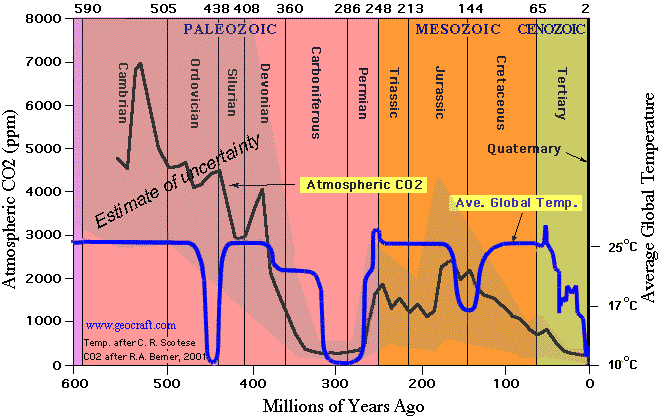
Here is a graph showing CO2 levels and global temperatures over the past 600 million years. The peak is at 7000 ppm, at which time the earth's average temperate was 22 deg. C (71.6 degr. F)
Todays's CO2 concentration is 379 ppm, and todays average global temperature is about 15 deg. C (53 deg. F).
The way I see it, at times the Earth has been a lot hotter on average in the past than it is now. We look to be heading into a warming period. That may be great news for North Dakotans who want mild winters, but not so great for people who already live in hot and humid climates, especially if they are Caucasian. Right now, I live in Florida and there are days where the sun feels like it's burning through my skin when I'm outside for just a few minutes.
Oh, and then there's the small mater of Hurricanes. Who knows how strong they were 100 million years ago. -
Re:Question
Those beowolf[sic.] clusters you've heard so much about? They are running MPI.
They could be utilizing PVM... PVM: Parallel Virtual Machine -
Meltdowns happen
usually b/c the plant runs out of water or the water lines break.
This thing, worst it can do is sink, and that will cool it down just fine.
If you are worried about radiation, well, maybe you should get more concerned about the rads the alternatives to nuclear are spewing into your air every day.
Americans living near coal-fired power plants are exposed to higher radiation doses than those living near nuclear power plants that meet government regulations. -
Re:not THAT unusual
-
Re:not THAT unusual
-
Re:Let Me Educate You (Why Kyoto Sucks and The US
"That graph doesn't mean anything. Have a look at some global ones"
Perhaps if this were an isolated case, this graph would mean very little, but there are many cities in the US experiencing long term temperature declines.
"Early days yet; the target date is 2010. You might notice that those countries are at least cutting emissions (unlike the US)"
Not Spain:
http://cdiac.esd.ornl.gov/trends/emis/spa.htm
Not the UK:
http://www.foe.co.uk/resource/press_releases/uk_ca rbon_dioxide_emission_26022004.html
And not the EU as a whole:
http://news.bbc.co.uk/2/hi/science/nature/4115670. stm
The EU isn't gonna make it to Kyoto compliance. They're not on track, and unless there's some major economic/political disturbance, they're not going to get on track.
"Citation please. The US is actually quite bad at this."
The original article had one, but here is another:
http://www.eia.doe.gov/oiaf/1605/gg02rpt/gas.html
Carbon intensity has been dropping 14.52% per decade 1950-2000 in the US, even with cheap gas during much of that time. -
Re:GENI, reinventing, and incremental change> "What you get in security, you lose in freedom."
One could argue - and many have - that the current Internet does not give you enough of either. Security in the Internet context applies also to the security of the user from eavesdropping or interruption.
Also - please distinguish between government funded projects and research - GENI is research, pure and simple. Right now, there's no blueprint for what the results of this will look like, no deployment plan for rolling out a new, improved Internet. Rather, there's a plan to create a testbed to enable network research to be drastically more innovative and effective than it has been. Like all research, there will be successful projects under this umbrella, and unsuccessful ones. But if you never take the risk, you never have the chance to make amazing discoveries. Say what you want about government inefficiency, it's funding like that provided by the NSF, NIH, and (formerly) DARPA, and their corresponding agencies in other countries over the centuries that has made possible some of the greatest advances in the history of humanity.