Slashdot Mirror
Domain: os2ezine.com
Stories and comments across the archive that link to os2ezine.com.
Comments · 18
-
Re:Yo Linus!
See this page. I will probably add this link to my blog post soon.
-
Re:OS/2 STILL multitasks better than Windoze
I have yet to see any system that allows me to do that sort of multitasking like I could do with OS/2.
I'm going to take a guess that you are talking about RSJ.
The behaviour you describe has nothing to do with the OS's "multitasking" abilities, it's entirely dependent on whether you have a suitable packet-writing driver installed. There's no reason you _couldn't_ do that on NT (or even Windows 9x), if someone bothered to write a driver.
-
Re:The best gaming console wasn't a console
Retrocade wasn't bad for a while, either. Pretty built-in front-end, especially with the topless patch.
-
Re:KOffice 2.0 is FAST!
Since OpenOffice has its own (crappy) crossplatform GUI system, its pretty much a DE in its own right.
Well.... it had its own desktop.
I guess it's still there, they just snipped the wires coming to your dashboard.
-
Re:HackQuake
Just to further a bit on the part of my post where I talked about the Quake source being stolen from Crackdotcom, I managed to find a web page which discusses a bit about that:
Quake for OS/2 - article from 1997
As an added note, Crackdotcom is no longer in business. -
Re:Rock Solid Multitasking?
*Wrong*.
I don't think so. And to tell the truth, I never had version 2, 3 or 4 lockups. I guess I wasn't running the same bad program that everyone else was.
SET PM_ASYNC_FOCUS_CHANGE=ON in the CONFIG.SYS file to fix the single input queue problem. The OS/2 solution detects misbehaved applications that cause system hangs in what is often incorrectly attributed to OS/2 as the Single Input Queue (SIQ) problem. The fix is implemented at the system level as a separate OS/2 thread that monitors the status of the input queue. No modifications of applications are necessary.
From the article here: http://www.os2ezine.com/v1n12/warp4.htm
Enjoy, -
Re:Rock Solid Multitasking?
Yes I remember this. I also remember still having lockups after this. I even invested in Stardock's Process Commander to help with this.
-
Re:Rock Solid Multitasking?
Was it? I was a Warp 4 beta tester and even after the final release, I still had PM lockups.
SET PM_ASYNC_FOCUS_CHANGE=ON in the CONFIG.SYS file to fix the single input queue problem. The OS/2 solution detects misbehaved applications that cause system hangs in what is often incorrectly attributed to OS/2 as the Single Input Queue (SIQ) problem. The fix is implemented at the system level as a separate OS/2 thread that monitors the status of the input queue. No modifications of applications are necessary.
From here: http://www.os2ezine.com/v1n12/warp4.htm
Enjoy, -
Re:The monkey man screeches
I did?
http://slashdot.org/comments.pl?sid=155309&thresho ld=-1&commentsort=0&tid=109&mode=thread&pid=130551 79#13056752
Seems to say otherwise, & shows a history of SmallTalk coming out of the 60/70's timeframe!
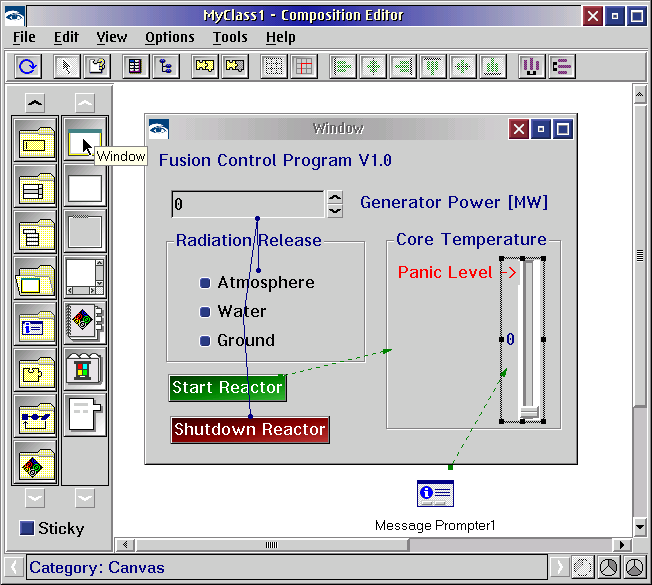
And, it clearly shows photos of it that clearly illustrate a "RAD" environs:
http://www.os2ezine.com/20030916/VAST_Compose.PNG
One that predate your example in Amiga CanDo, which is why I stated you'd have been better off using it for your example (when you clearly were trying to attack me).
Once you were proven wrong, you began your "frothing at the mouth" raging tirade of profanity etc. directed my way, & the page above says all I have to say about that, with iirc, quoted examples of your behavior in that regard.
APK -
Re:The monkey man screeches SMALLTALK - Check it
Smalltalk, a RAD tool, easily also predates Amiga CanDo by a decade and IS 'rad' according to your definitions here and constraints (no platform specifics) & based on your saying this to me -
"THE ONLY FUCKING THING I AM TALKING ABOUT IS RAD... It would. That is the ONE SINGLE POINT I was trying to make. CAN YOU GROK THAT?"
Question is, can you GROK THIS, next?
(And without blowing your cork?? lol... seriously, consider decaf!)
Here is what your FIRST STATEMENT TO ME WAS IN FACT, not what you're saying there which I quoted above:
"You say others talk without facts to back them up after doing the same thing yourself. To use an extremely old example, the Amiga had the CanDo language, which is a little different, but basically a RAD as well. And that's from the 80s (or maybe very early 90s)"
Looked like an OUTRIGHT attack on me! So, you will get facts based replies on me that disprove your points in attacking me.
Kind of tough to deny your own quoted words and profanity directed my way, isn't it at this point?
Well, like I said, here's on earlier than yours, in SMALLTALK from the 60's/70's
FIRST the HISTORY OF SMALLTALK:
http://en.wikipedia.org/wiki/Smalltalk_programming _language
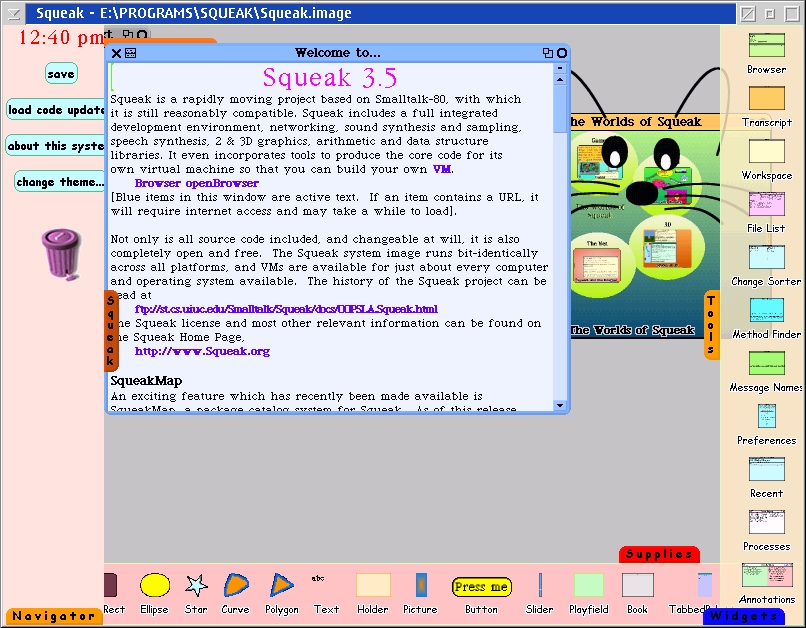
& SQUEAK (which is SmallTalk):
http://www.os2ezine.com/20030916/Squeak_Main.jpg
* Thus, my point is made again, don't you agree?
OK, here we go, facts, histories, & screenshots of SmallTalk the FIRST RAD tool that predates yours which I mentioned to you in fact as what you should have tried to attack me with instead imo:
(Thus, my point is made again, don't you agree? SmallTalk's REALLY the first RAD, and you tried to bust on me and ended up with your you know what handed to you, or aren't the facts here for that?)
AND, IBM "VAST" (Visual Age SmallTalk):
http://www.os2ezine.com/20030916/VAST_Compose.PNG
Which, smalltalk in its history? First of all, CLEARLY predates your Amiga CanDo example by a decade & is "RAD" because it is as you said "VB like" & what I said you should have mentioned first really, here is why:
Screenshots of SmallTalk-80:
http://en.wikipedia.org/wiki/Smalltalk_programming _language
It appears that SMALLTALK (which I mentioned early on) IS the first of them all as far as RAD tools, not your Amiga CanDo!
And again, dude, please, the profanity? It's lame. Facts, win. NOT profanity & name tossing etc. or sarcasm.
AND it really does appear that SmallTalk & its derivants really fit the bill here & predate your Amiga tool.
APK
P.S.=> And, I quoted your first attack on me, which it DEFINITELY was @ that as quoted above no matter how you evade that! Accusing me of not using facts, & here? I most certainly am!
Also? You misinterpreted (or intentionally twisted) what I meant early on anyhow & came up short trying to burn me anyhow!
Above all?
You did not note I said "ONE OF THE FIRST, IF NOT THE FIRST" regarding VB!
Meaning VB may not have been the first, but was one of the first RAD tools, IF NOT FIRST in fact!
For X86 though? Again, I am pretty sure VB may have been THE FIRST! That is unless, like I said above? SmallTalk was there first & there's a GOOD CHANCE it was. After all, & why I mentioned it early on in my first reply to you or second one?
SmallTalk predates both your Amiga CanDO and VB, by 10-20 years in fact in concepts & design frameworks, being "RAD" & "LIKE VB" as you stated as constraints here... apk -
Re:The monkey man screeches SMALLTALK - Check it
Smalltalk, a RAD tool, easily also predates Amiga CanDo by a decade and IS 'rad' according to your definitions here and constraints (no platform specifics) & based on your saying this to me -
"THE ONLY FUCKING THING I AM TALKING ABOUT IS RAD... It would. That is the ONE SINGLE POINT I was trying to make. CAN YOU GROK THAT?"
Question is, can you GROK THIS, next?
(And without blowing your cork?? lol... seriously, consider decaf!)
Here is what your FIRST STATEMENT TO ME WAS IN FACT, not what you're saying there which I quoted above:
"You say others talk without facts to back them up after doing the same thing yourself. To use an extremely old example, the Amiga had the CanDo language, which is a little different, but basically a RAD as well. And that's from the 80s (or maybe very early 90s)"
Looked like an OUTRIGHT attack on me! So, you will get facts based replies on me that disprove your points in attacking me.
Kind of tough to deny your own quoted words and profanity directed my way, isn't it at this point?
Well, like I said, here's on earlier than yours, in SMALLTALK from the 60's/70's
FIRST the HISTORY OF SMALLTALK:
http://en.wikipedia.org/wiki/Smalltalk_programming _language
& SQUEAK (which is SmallTalk):
http://www.os2ezine.com/20030916/Squeak_Main.jpg
* Thus, my point is made again, don't you agree?
OK, here we go, facts, histories, & screenshots of SmallTalk the FIRST RAD tool that predates yours which I mentioned to you in fact as what you should have tried to attack me with instead imo:
(Thus, my point is made again, don't you agree? SmallTalk's REALLY the first RAD, and you tried to bust on me and ended up with your you know what handed to you, or aren't the facts here for that?)
AND, IBM "VAST" (Visual Age SmallTalk):
http://www.os2ezine.com/20030916/VAST_Compose.PNG
Which, smalltalk in its history? First of all, CLEARLY predates your Amiga CanDo example by a decade & is "RAD" because it is as you said "VB like" & what I said you should have mentioned first really, here is why:
Screenshots of SmallTalk-80:
http://en.wikipedia.org/wiki/Smalltalk_programming _language
It appears that SMALLTALK (which I mentioned early on) IS the first of them all as far as RAD tools, not your Amiga CanDo!
And again, dude, please, the profanity? It's lame. Facts, win. NOT profanity & name tossing etc. or sarcasm.
AND it really does appear that SmallTalk & its derivants really fit the bill here & predate your Amiga tool.
APK
P.S.=> And, I quoted your first attack on me, which it DEFINITELY was @ that as quoted above no matter how you evade that! Accusing me of not using facts, & here? I most certainly am!
Also? You misinterpreted (or intentionally twisted) what I meant early on anyhow & came up short trying to burn me anyhow!
Above all?
You did not note I said "ONE OF THE FIRST, IF NOT THE FIRST" regarding VB!
Meaning VB may not have been the first, but was one of the first RAD tools, IF NOT FIRST in fact!
For X86 though? Again, I am pretty sure VB may have been THE FIRST! That is unless, like I said above? SmallTalk was there first & there's a GOOD CHANCE it was. After all, & why I mentioned it early on in my first reply to you or second one?
SmallTalk predates both your Amiga CanDO and VB, by 10-20 years in fact in concepts & design frameworks, being "RAD" & "LIKE VB" as you stated as constraints here... apk -
Re:was a change required?Here's the code it takes to create a simple Dialog Box in OS/2 or eComStation:
call RxFuncAdd 'VInit', 'VREXX', 'VINIT'
initcode = VInit()
if initcode = 'ERROR' then signal CLEANUP
signal on failure name CLEANUP
signal on halt name CLEANUP
signal on syntax name CLEANUP
msg.0 = 1
msg.1 = 'Press "OK" to continue or "Cancel" to exit.'
call VDialogPos 50, 50
rb = VMsgBox('Example Simple Dialog', msg, 3)
if rb = 'OK' then do
msg.0 = 1
msg.1 = 'You pressed "OK" '
end
else do
msg.0 = 1
msg.1 = 'You "Cancel" '
end
call VMsgBox 'Exit Dialog Window', msg, 1
CLEANUP:
call VExit
This can easily be compiled into an exe with REXX2EXE.
Here are pics of the Application:
http://os2ecs.org:5000/ecs/SimpleDialog1.png
http://os2ecs.org:5000/ecs/SimpleDialog2.png
If one likes to code using Visual Environment there is always DrDialog:
http://www.os2ezine.com/20010216/drdialog.html
Application Development is a snap on OS/2 and eComStation!
Cheers! -
Re:I wonder if M$ will reply...
The point was not that they were correct, the point was how successful OS/2 ended up being in the consumer market place.
Unfortunatly, as eye catching as this is, it'll probably do about as much good as IBM's nuns ads
-
Re:Word Perfect for Windows was horrible
>>MS told them that OS/2 was the way to go...
Microsoft never told anyone not to write for Windows; they made the phony argument that writing for Windows was the path to eventually writng for OS/2.
But the phoniness of this argument is best displayed by pointing out that the only program worse than Word Perfect for Windows was Word Perfect for OS/2. It was a completely horrible program that was so slow that it couldn't even keep up with your typing. Even the worst screwball OS/2 zealots didn't try to defend it. -
Re:Virtual PC == Cheating
Only one version of OS/2 was officially released for the PPC, but it lacked networking support and was quickly withdrawn after IBM stopped making PowerPC ThinkPads. When I used OS/2 for x86, there were rumors about the PPC version swirling about. The OS2PPC project was officially put on hold in 1997, and was never revived.
-
Re:the Last Great OS until Mac OS X
The links were stored *in* the filesystem with the objects they affected, instead of a monolithic pseudo-database or oodles of unwieldy text files.
As another ex-OS/2 fan, I hate to break this to you- Extended Attributes, like icons, and certain other qualities of a file- were stored with the file itself, in HPFS. However, those draggable properties- font sizes, window positions, etc- were stored in a "registry" little different than Win9x/NT's.
See the first vaguely relevent hit on Google if you don't believe the claim. I had a small utility suite that could automatically clean useless cruft from the Registry- window opening positions for deleted folders (or positions I didn't really care about), and other such properties. 'Shadows' were also stored in the registry, which explains why you never saw them in the filesystem from the CLI. (Editing the registry was also the real way to remove a 'broken' shadow, though, not knowing of it at the time, I relied on a shredder replacement that did the trick for me- it probably worked through the WPS API, and only had to ignore a check on the properties of the object.)
BTW, if there's one simple thing *NIX could take from OS/2, it would be the 'DELDIR' support- although the BOFH answer would be to mv things to a sticky-set -
Re:Nice propagandaLet me tell you my experience of why Linux has worked on the desktop for me (and why I still don't think its ready for 80% of the population).
Like most of us I've been forced to use a ton of different O/S's at jobs (all investment banks) over the years. The one thing I could never tolerate was unreliability since I HAD to be sure that my trading model / spreadsheet was running when I needed it. As a result the best OS combination for me was Solaris on one box and OS/2 on another (until it was taken away by those bastards in IT) and replaced with the worst OS I have ever used Windows NT 3.51. OS/2 was great because it was super stable and allowed me to hack around as I wished. I didn't need a command line but I did need a good spreadsheet and and groupware (Notes) that I could configure to do what I wanted (I wasn't a programmer, just a tech aware trader). Solaris was great for massive derivative apps and market data but CDE stank as a desktop and I still don't understand how Sun could have not offered something better. The problem with Solaris was that the BOFH admins had locked everything down and we users could touch nothing.
Around that time I installed my first home copy of SuSE 6.2 and spent hours of utter torment trying to get X configured etc.. etc.. Horrible though it might have seemed I loved it suddenly I was in control (however chaotic and dangerous that control was). However I knew that the Sysadmins would never allow me to use it at work. "Freedom of choice for users = more work for Sysadmins" and they, like most people are lazy and want a quiet life. More importantly you need to be weird to want to work high-up in IT support for BIGCO. Success is measured by the size of your budget / empire / office / car not by installing low cost / no cost OSes. These guys want to spend trillions with Sun / MS otherwise how do they justify their big budgets and offices?
A couple of years ago I took a lifestyle choice and quit the megabucks slavery of Wall Street and set up my own software co. I learnt 80% of what I know about technology from wrestling with Linux and I use it now because I feel more free doing it. In the end it was a choice linked to what I wanted in life for myself and others. I now take my son to school before logging in to WindowMaker and clicking on the Konqueror appicon to read
-
Open source not always necessary
Here's an interview with Brad Wardell that talks about Linux and Open Source:
http://www.os2ezine.com/v4n3/wardell.htm
In it, he makes the claim that it's quite possible to enhance and expand an OS without needing the source code. An snippet:
"Many people, particularly Linux advocates, feel that you have to have the source code in order to extend the OS. That's only because of the way Linux was designed."
--
Timur "too sexy for my code" Tabi, timur@tabi.org, http://www.tabi.org