Slashdot Mirror
Domain: pctechguide.com
Stories and comments across the archive that link to pctechguide.com.
Comments · 14
-
If I had a single bit of storage for each article
,....
Seriously, at least 2 to 5 a year since I got on the internet back in 1997?
Always a fun read, never come to fruition.I remember reading about 100GB optical drives in 1999.
https://www.pctechguide.com/removable-storage/florescent-disc-technologyNothing ever comes to fruition
-
50 GFLOPS per Watt = Hard
Just for some reference, an Intel Core 2 Quad can throw down about 50 gflops, but it runs on 95-130 Watts of power. To even come close to this 50GFLOPW number, you'd be designing your own HPC chips for sure.
-
It too, has a single tragic design flaw
Here is an article with a picture of one.
I'm a touch typist, took a class in it in high school. Fingers on the home keys. Left hand rests on ASDF. Right hand on JKL;.
If you move up a row from ASDF, you get QWER. My left pinky is A, move up 1 to Q. My right pointer is on F, move up 1 row to R.
Move up to the next row for numbers. ASDF becomes 1234. Now here's where we get to the mistake. We were taught that your left pointer goes up 2, and towards the middle 1 to get to 5. Likewise, your right pointer goes up 2 and over to the middle one 1 to get to 6.
Notice how the 6 is on the wrong side? When my brain thinks "6", my right pointer wants to see it right next to the 7. It's now the responsibility of my left pointer to be in charge of 456, and my right pointer is now only in charge of 7.
I can't tell you how frustrating this keyboard is to a touch typing programmer. It's as if nobody at Microsoft knows how to touch type.
-
Re:Your claim is incorrect.
No, they have not. Initially, drives were using Base 2.
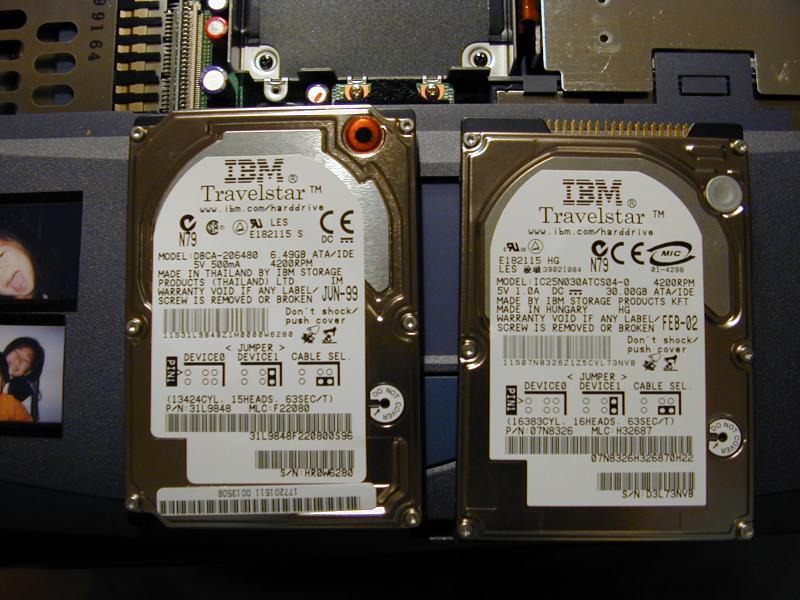
See for example the image with the drive on this page:
http://www.pctechguide.com/tutorials/HardDrive_Reasons.htm
or the hard drive on the left in this image:
http://www.divideby0.com/photos/vaio-f280/pics/DSCN1323.JPG -
Re:Wikipedia is a funny friend.
Ok, the wikipedia link was a little lazy on my part. Anyway, the biggest difference is Inkjets have cartridges filled with liquid ink whereas the Dye Sub printers have scrolls of color that are rolled across the image and are adhered to the paper with a heat process.
You can see an example here:
http://www.pctechguide.com/23oprint_Dye-sublimatio n.htm
After you're done printing with a dye sub, you can take the used scrolls out and see the after image burned into the scrolls. It ends up being slightly wasteful since you'll use, under best cases circumstances, only about half of the color medium. -
Floppy in mainframes.Floppy was first developed in 1967 for updating microcode IBM Mainrame CPUs: http://www.pctechguide.com/16storage_Floppy_disk.
h tmAnd it is still used now for the very same purpose. Mainframes have no USB or CD, only tapes and floppies as removable storage. But, of course, floppy drive in PC is an anachronism.
-
7% increase in 2 1/2 years -- WOW!I hadn't seen any headlines about semiconductor speed advances in awhile, so I was prepared to be impressed by this news, however having read the article and done a little Googling, it would seem to not be so impressive.
CPUs have stalled out at about 4ghz overall clocking, cutting edge transistors seem to be hitting a wall at about 500-600ghz.
Now granted faster gate transitions make for faster CPUs, but multiple gate operations are necessary for each state change, add signaling and propagation delay and who knows what you can really clock the CPU at (I am not an Electrical Engineer).
Here is a page link claiming a record 562ghz transistor switching in Oct. 2002 article
here is another claimed record of 509ghz, Nov, 2003 article
Obviously at odds with the 2002 anoucment. Undoubtedly it should narrow its claim for a specific transistor type.Here is a U of I annoucment calming a record 382 ghz Jan. 30, 2003 article
But expects 700ghz by early 2004 (I'm guessing they didn't make it).Lets assume 562ghz in 2002, so we - drum roll please --- 7.5% increase in speed in 2 ½ years!
This is not going to keep Moore's Law humming along.
Even stranger, here are claims of TerraHertz transistors at Intel in 2002 article
Ironically, while googling for transistor or gate speed will show hundreds of hits, you can't actually find the switching speed for individual gates in a P4 or AMD chip. This stuff seems to be super secret stuff, and only the overall CPU clock it published. I wouldn't be surprised if the individual gates and transistors are transitioning at several dozens of ghz if not a couple of hundred or more. While Moore's Law death claims may have been premature 10 and 20 years ago, they may not be now.
I hope I'm wrong, I want my Holodeck Playstation 5 in 2015.
-
Magneto Optical for me
I use a 4.6 GB Magneto Optical drive for my critical stuff... The drive was had relatively inexpensively on ebay, and so was the media. Here is an overview of the technology for anyone who is unaware:
http://www.pctechguide.com/16storage_Magneto-Optic al_technology.htm
Bacially the disks are magnetic, but only affected by magnetism when they are heated with a laser. The disk is also contained within a hard plastic case which protects the disk very well.
Random bit of trivial... In the Mission Impossible movie with Tom Cruise, they used MO's to trasfer thew data they were getting... -
Re:DVD Player incompatibilies
Not sure of the "reputation" of this site, but I found this article pretty interesting when I was psyching up to purchase a DVD burner. Also, I found this article absolutely fascinating.
-
Re:Only problem with x86 architecture
Here you go. (warning: pop-up hell alert!)
My personal favourite is NLX becuase it's been around the longest, and you could have built a box thinner than these Shuttle PCs a few years ago with it (but that's what happens when you don't market, market, market!).
I guess that's why I just don't get worked up about small PCs. To me they're OLD news. And hard to work inside. I have a half-emply full-tower case for a reason...
>PS why does a motherboard have to be flat? Why not L-shaped?
No reason other than (possibly) longer traces, which at today's speeds could be a bad thing. Not to mention it's usually a bit of a waste of space. -
OS X could leapfrog Windows' performance on x86
Here's a question for you chipheads. Most of you already know the following:
The Pentium Pro [and all subsequent processors in the Pentium family] takes CISC x86 instructions and converts them into internal RISC micro-ops. The conversion is designed to help avoid some of the limitations inherent in the x86 instruction set, such as irregular instruction encoding and register-to-memory arithmetic operations. The micro-ops are then passed into an out-of-order execution engine that determines whether instructions are ready for execution; if not, they are shuffled around to prevent pipeline stalls.
There are drawbacks in using the RISC approach. The first is that converting instructions takes time, even if calculated in nano or micro seconds. As a result, the Pentium Pro inevitably takes a performance hit when processing instructions...
Did Intel leave a door open, to feed micro-ops directly to the RISC core, bypassing the x86-to-micro-op translator? If so, here's Apple's chance to make OS X-on-x86 leapfrog Windows' performance. Windows has to go through that translator to maintain compatibility with pre-Pentium Pro CPUs. Apple has no such required baggage.
All that's required is developing a compiler that cranks out micro-ops instead of x86 instructions. Shouldn't be too hard, as Pentium chips themselves can make the conversion in nanoseconds. -
There are other ways to reach high speeds...Like reading multiple tracks at once... scroll to the bottom of the first link below...
http://www.pctechguide.com/08cdrom2.htm
or
http://www.kenwoodtech.com/72x_atapi.html
-Eric
-
Re:c3d
Well, just some information that I thought would be interesting to add.
Don't you mean "interesting to steal"? Shame on you for trying to pass this off as your own writing. Next time, try giving credit where it's due. -
Re:Laser board as BIG-TV
Right, you can't get back-and-forth motion that fast, so instead you use the same technique that is used in laser printers -- a rotating drum covered with six or eight flat mirrors.
The laser is reflected off of the mirrors on the drum. As the drum rotates, the angle of the laser with respect to the mirror changes, causing the laser to scan in one direction. When the drum rotates far enough, the laser beam drops off the end of the mirror and strikes the next mirror on the drum. This instantly returns the beam to the starting scan position. No back-and-forth mechanical motion is required, only extremely stable and precise rotational motion.
Here is a web page with a drawing of how this works in a laser printer.
Vertical scanning is done the same way. The trick is in keeping both mirror drums rotating at exactly the correct speed and in perfect synchronization with each other.
As a matter of fact, you could probably use the scanning guts of two laser printer to build a laser-projection TV.
Now THAT would be a rockin' hack