Slashdot Mirror
Domain: polymtl.ca
Stories and comments across the archive that link to polymtl.ca.
Comments · 16
-
Re:This is what I'd like to see.
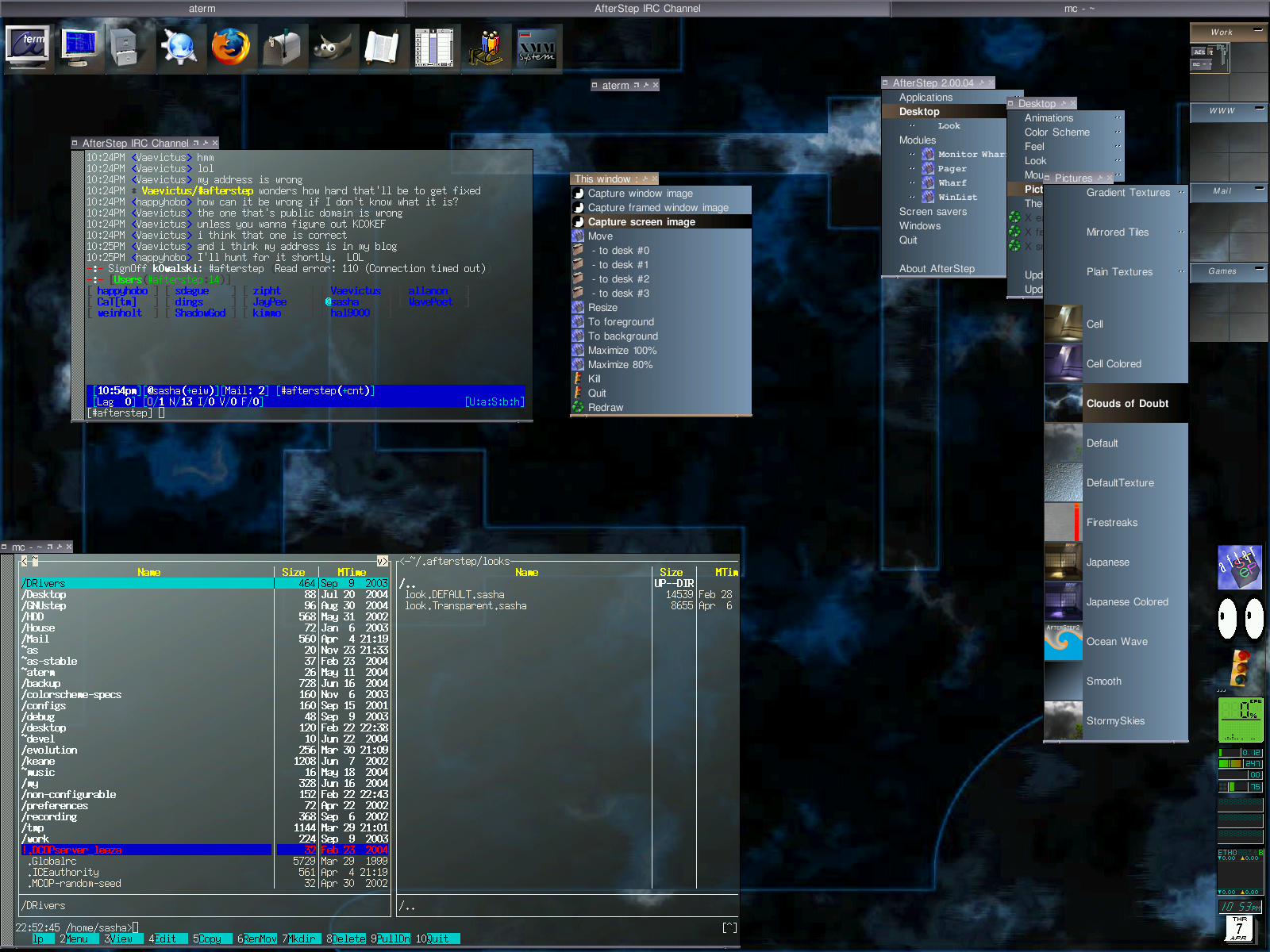
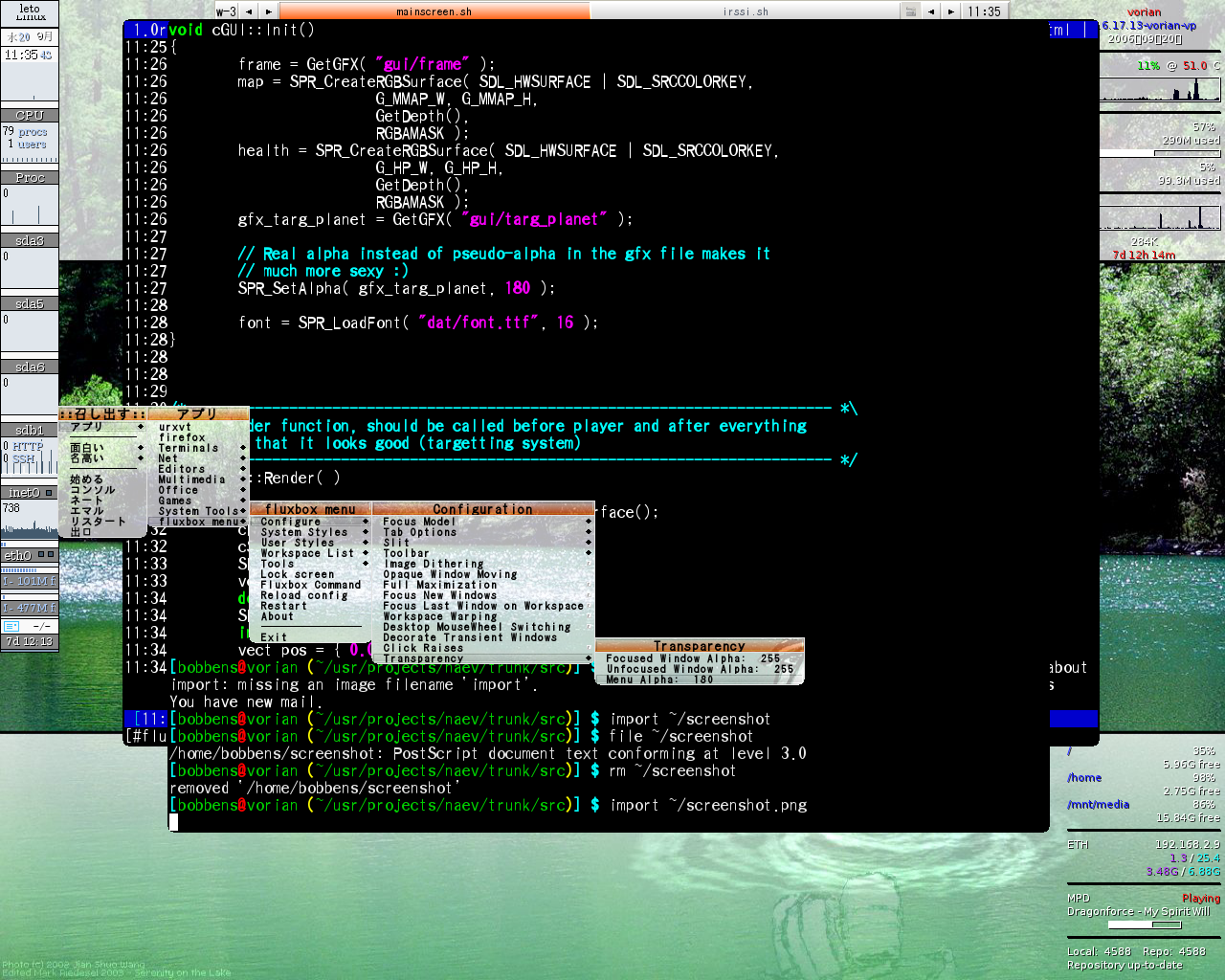
The problem is that the default Ubuntu GNOME window manager is trying to emulate Windows, but it's different, so they think it's going to be like Windows, but are surprised when "Hey, this doesn't work like it does on XP!" You need to give them something better than a Windows UI clone. You're one "apt-get" away from Unix-style WMs available for Ubuntu like AfterStep, FVWM, Enlightenment, or FluxBox. Getting accustomed to classic X window managers (not "I'm copying Windows" window managers) will not only show them "We're not on Windows anymore," but require them to see that there's more to the computing world than Windows.
Imagine you woke up one morning and found yourself in China. It's different, but you know it's different. If people in China act differently or have different customs, the language is different, places have different names, someone can just explain that you're in China, and even if you didn't know a thing about China, you would know that it's a foreign country and you need to learn some new things. New Linux users would understand it better, too. "I'm on Linux, things are different. This makes perfect sense. Why should Linux be exactly like Windows? VHS and Betamax are different, British cars are different, Linux is different too." Now if you suddenly woke up in a place that looked at first glance just like America (assuming you're American), and Wal-Mart becomes the most expensive store, people speak backwards Esperanto, and drive on the left side of the road, you would be confused, and maybe a little scared, wondering why these familiar-looking things suddenly act so strangely. It's the same thing with GNOME.
GNOME gives a false sense of familiarity, which would tend to scare users away. If users say that "Linux" is scary, it's probably because GNOME doesn't act how they expect. They wouldn't even mention something like AfterStep, because they probably don't even know about AfterStep OR know that the window manager could be easily replaced. There's nothing "automagic" about Windows. Windows takes just as much time to learn as any of these, and Windows is so 1995, anyway.
AfterStep
OpenWindows
Enlightenment
WindowMaker
FluxBox
FVWM
Your users (I'm guessing) probably never used anything except for Windows. Maybe the reason why they never got interested in computers is because of the unintuitive Windows 95 interface. Maybe they'd find one of these more intuitive. -
Re:This is what I'd like to see.
The problem is that the default Ubuntu GNOME window manager is trying to emulate Windows, but it's different, so they think it's going to be like Windows, but are surprised when "Hey, this doesn't work like it does on XP!" You need to give them something better than a Windows UI clone. You're one "apt-get" away from Unix-style WMs available for Ubuntu like AfterStep, FVWM, Enlightenment, or FluxBox. Getting accustomed to classic X window managers (not "I'm copying Windows" window managers) will not only show them "We're not on Windows anymore," but require them to see that there's more to the computing world than Windows.
Imagine you woke up one morning and found yourself in China. It's different, but you know it's different. If people in China act differently or have different customs, the language is different, places have different names, someone can just explain that you're in China, and even if you didn't know a thing about China, you would know that it's a foreign country and you need to learn some new things. New Linux users would understand it better, too. "I'm on Linux, things are different. This makes perfect sense. Why should Linux be exactly like Windows? VHS and Betamax are different, British cars are different, Linux is different too." Now if you suddenly woke up in a place that looked at first glance just like America (assuming you're American), and Wal-Mart becomes the most expensive store, people speak backwards Esperanto, and drive on the left side of the road, you would be confused, and maybe a little scared, wondering why these familiar-looking things suddenly act so strangely. It's the same thing with GNOME.
GNOME gives a false sense of familiarity, which would tend to scare users away. If users say that "Linux" is scary, it's probably because GNOME doesn't act how they expect. They wouldn't even mention something like AfterStep, because they probably don't even know about AfterStep OR know that the window manager could be easily replaced. There's nothing "automagic" about Windows. Windows takes just as much time to learn as any of these, and Windows is so 1995, anyway.
AfterStep
OpenWindows
Enlightenment
WindowMaker
FluxBox
FVWM
Your users (I'm guessing) probably never used anything except for Windows. Maybe the reason why they never got interested in computers is because of the unintuitive Windows 95 interface. Maybe they'd find one of these more intuitive. -
Inefficiency of CFLs
The poor Power Factor rating of CFLs means that the power grid must provide more energy to start them. The consumer may save money at home, but unless the power factor of CFLs can be improved, the electrical grid itself will have to be upgraded if we all switch to CFLs.
But there's no "if" because governments have already legislated the elimination of incandescent bulbs!
An explanation of the power factor (search for the heading "Power
Factor and Switching")
http://irc.nrc-cnrc.gc.ca/pubs/cp/lig3_e.htmlMore summaries of problems:
http://www.cours.polymtl.ca/inf1040/2008automne/Olivier_CanadianReviewDec2007.pdf
http://sound.westhost.com/articles/incandescent.htmCurrent research:
http://qnc.queensu.ca/story_loader.php?id=49db90a6e3e3dSearch for "power factor":
http://www.bchydro.com/powersmart/technology_tips/buying_guides/lighting/compact_fluorescent_lamps.htmlHere, you'll see that the "requirement" for "Energy Star" labelling is
a power factor of only 0.50!
http://oee.nrcan.gc.ca/residential/business/manufacturers/specifications/compact-flour.cfm?attr=12 -
Desperately tried to install Enlightenment DR0.13
The very first time I saw Linux, it was about 1997-ish and I encountered Enlightenment DR-0.13 (the one with the ray traced window decorations and the little TV screen virtual desktop managers) running on a monstrous 21" CRT. At a time when Windows 95 was still widely considered a huge improvement in UI design, seeing this "lye-nucks" thing utterly blew me away with possibilities. It was beautiful, it was pure evil... I had to have it.
I spent months in what I would eventually find out is called "RPM Hell" trying to get that evil desktop on my own machine... all in vain. The closest I ever got were some cheap DR-0.13 knock-off themes for various, less fiendish window managers.
To this day, there is a small, ray traced hole in my soul that may never be filled.
-
Re:Makes sense
SystemTap and LTTng are actually more powerful than DTrace (no wonder, they benefited from the experience of DTrace). They're just not yet mainline-ready.
-
Re:Wikipedia has more info about itIt is interesting to note that some of the design (not the neutron absorber Lithium-6) reminds me of the Canadian SLOWPOKE reactor, first built in the 1960's.
More about SLOWPOKE:
Damn those safe, smart Canadians. They might quietly run the world, or at least keep it running. -
Neurotech
Haha- so this is the sort of article that I miss when I sleep? Anyway, I have collected some links that somebody might find useful to go start some more research. Maybe setup a basement lab or something.
-- General
* Irazoqui's neurotransceiver [pdf] [2003] The problem with Irazoqui's device is that it is maybe 1% power efficient, so maybe some electronicists can come around and make some suggestions to improve the coil design and so on. He did his testing on rats, not humans.
* Direct brain interface bibliography from the University of Michigan
* Gleamed from an article below: wireless visual cortex implant publications
-- EEG
* Controlling computers with EEG signals
* EEG via soundcard from OpenEEG
* Wireless EEG
-- Slashdot goodness
* Scientists couple nerve tissue with semiconductors
* Post re: neurosilicon junction with PDF
* Thinkware
* Good post w/ links on neurocomputation
* Brain slice experiments
* Neuroscientists at MIT doing direct neural interfaces- but this post sets things into perpsective as well as this one
* Single neuron recordings w/ ref
* Sorry to dash your hopes, but
* Autonomously adjusting electrodes? and more
* Artificial hippocampus and stimulating neuron growth / neurogenesis
* Implant a chip inside your head- though it does not discuss the specific surgery skills you would need
* Working nerve chip of silicon and snail neurons
* Re: Kevin Warwick- interview- the so-called "Captain Cyborg" since '98 or something
* BrainPort
* Fusing neurons with computers
-- More
* Artificial vision
* The vision quest
* -
Re:Production Issues?
Anyway this kind of technology is far far away from production. I had the chance to work with these shape memory alloys (I made a small walking robot for a resaerch project at University) , and what we can read in the article is only the good side of them. In fact there are too many downsides yet
1. The contraction speed is very fast, but the decontraction is very slow. This is because it's really easy to heat a metal at a high speed, using eather a heat source or electricity (I used electricity cause it's simpler), but to cool it at the same speed, you would need a cool liquid to flow through the wire. And to use two liquids in alternance means that you must have a hydraulic system for each fiber you want to contract/release.
2. The article says these "muscles" are strong. This is not the case. At least they could be used to move a tiny robot insect, but if you need to put the hydraulic cooling thing, forget it.
3. It's really hard to control the exact length of the muscle. Other than "completely long" or "completely short", you have a great time setting exactly the good temperature for a specific length. That is because these muscles have a great hysteresis curve, and two temperatures can give two lengths.
4. That is enough.
For those you are interested and french speaking, here's the article I wrote on the robot I made : http://www.polymtl.ca/lrn/chenier/MuscleWires.pdf -
Montreal's transit planner, online since 1997.
The "Société de Transport de Montréal" (Montreal Public Transit) has had a public transit planner called "Tous Azimuts" (All directions) on their website since 1997. You can access the planner here.
The planner is a collaboration between STM and the Ecole Polytechnique's Intelligent Transport Research Group (in french, english version is incomplete).
Your commute can be planned different ways. You can choose your start and end points using a map, through a text search (street address or street corner) or with lists of important landmarks (tourist, hospitals, schools, government and everything in the middle). It will plan your commute either with your start time or specifying an arrival time. There are options to minimize walk time, exclude taking the train and what not.
All in all it's pretty complete and extremely useful. -
Re:Not a handicap
I know some members of that team and the actual aim is FAR better resolution
The market also seem to have a bigger interest in their research involving the bladder -
Re:Not a handicap
Most people in the US can see just fine and know jack squat about geography anyway.
True. Not to cheapen the kid's plight, but I reckon he ought to concentrate on what he can do with limited vision, and leave subjects like geography until decent prosthetic visual aids (ie implants) are developed (which should be well within his lifetime, given that they have had some success already.) -
Re:Montreal 2600 - bunch of geeks
Or, from the same Montreal 2600 group:
http://step.polymtl.ca/~rv101/movies/badger-xxx.av i
mirror:
http://rv101.dyndns.org/~rv101/pictures/movies/can ada/mar2004/badger-xxx.avi -
Re:Keenspace? Keenspot!
-
GnuCash DOES have OFX support in cvs now
It's not perfect, and does need feedback, but it is there. Standard bank and credit card account are supported. Investement accounts will be when LibOFX (http://step.polymtl.ca/~bock/libofx/) matures. As for bill pay, unless banks start giving TRUE OFX access at large, that is still a long way off.
-
Maybe not canadian doctors but...
There were no actual canadian doctors involved, only a canadian patient... But Canadians are also developping a visual implant similar to the one cited in the article... You can find more info here, or here (in french). (the last article is from 2001... wonder what is happening right now...)
-
Kernel & Extfs Links
If you want to know more about the Linux kernel, but are hard up for cash to buy a book on it, check these links out. They might help...
Concrete Architecture of the Linux Kernel
http://plg.uwaterloo.ca/~itbowman/CS746G/a2/
The Linux Kernel Hacker's Guide
http://khg.redhat.com/HyperNews/get/khg.html
The Linux Kernel
http://www.linuxdoc.org/LDP/tlk/tlk.html
Analysis of the Extfs Filesystem
Analysis of the Extfs Filesystem http://step.polymtl.ca/~ldd/ext2fs/ext2fs_toc.html
________