Slashdot Mirror
Domain: powerlineblog.com
Stories and comments across the archive that link to powerlineblog.com.
Comments · 200
-
Re:enslaved to bias? *chortle*
And CBS did the same thing for Rep. Jefferson in May. It's called a mistake.
-
Kinda biased postIt seems that the law may ne be as clear as the person who posted this lead us to believe. Here is someone who can make legal arguments much more effectively than I (powerline)
I believe the argument here is that cangress cannot make a law that limits constitutional authority granted to the executive branch, this would require amending the constitution. As I put it, they make a much better argument than I. However, I was just hopeing to put this in perspective
-
Re:Limited Government.
They have reduced education and social spending (mostly through crippling unfunded mandates). They have left the science budget the same but selectively trimmed spending on some subjects e.g. Global Warming.
You are either clueless, or making this up.
Education spending has shot up under the Bush administration.... as has social welfare spending.
But when it comes to spying on Americans and invading others no amount is too high and no law apparently can stand.
So, to summarize, you disagree with the policy, and don't understand the law.
This isn't flamebait, I'm being serious,
No you aren't being serious. You are getting things wrong that are trivial to get right. -
And the witchhunt is on, pot vs. kettle
Not about the image that the original post is about, but about what happens after something like this gets out. Read this blog post:
http://powerlineblog.com/archives/014929.php
A fine example of a blogger making a fool of themself, doing the exact same thing they are accusing Reuters of doing. Read my response to it:
----
The only photograph that strikes me as somewhat odd is the bottom image http://powerlineblog.com/archives/Hajj4567.jpg.
The other 4 images are clearly photographs of the same scene. Let me give you my view on the positioning of the photographers in each.
#1 : http://powerlineblog.com/archives/Hajj1234.jpg
This picture was taken with a regular angle lens, say somthing like 35mm, towards a building, across the bridge that is out. The photographer was standing close to the right side of the road (when viewed in this direction). The car in the next picture is out of the frame, to the left of the photographer. The photographer is too far from the actual damage to get a good shot of it. The actual damage is close to the right shoulder of the man in the center of the image, off to the left.
#2 : http://powerlineblog.com/archives/Hajj1245.jpg
This picture has been taken from the opposite side of the road from #1, i.e. the left, shooting in the same direction. The photographer will have used a telelens, say 200mm. This pulls in the distant background and seems to place the pilons in the center of the road closer together. Note the tree white and red pilons, with the overturned fourth. Now look at #1 again, you will notice the same three pilons with the overturned one pointing towards the photographer. Also not that the two palms and the car on the right side of the road are visible in #1 as well, off in the distance.
Again, this picture has been shot across the destroyed bridge, which is now partly obscured by the car and the man. But you can make out the concrete mesh fragments sticking off the right shoulder of the man, to the right.
#3 : http://powerlineblog.com/archives/Hajj2345.jpg
In #3, the photopgrapher has arrived at the collapsed bridge. From this angle, the photographer, shooting with something like the 35mm again, can shoot into the gap, clearly showing the damage. The photographer is now well past the car in #2, but the other car is still visible across the gap. The car in #3 is actually visible in all of the images, as is the building in the background, though very poorly in #1.
#4 : http://powerlineblog.com/archives/Hajj3456.jpg
In #4, the photographer has moved back beyond the overturned car. Or, about as likely, #4 was actually taken before #1. The photographer is now so far back and to the left, that the small watchtower is also in the frame.
The allegations in the piece are sensationalist and don't stand up to scrutiny. The author (and powerlineblog) are doing exactly what they are accusing Reuters of doing: posting material without a critical and sceptical review. If the bottom photo (#5, http://powerlineblog.com/archives/Hajj4567.jpg) was published as a photo of the same incident, that's not right But some of the comments on the other 4 are simply wrong.
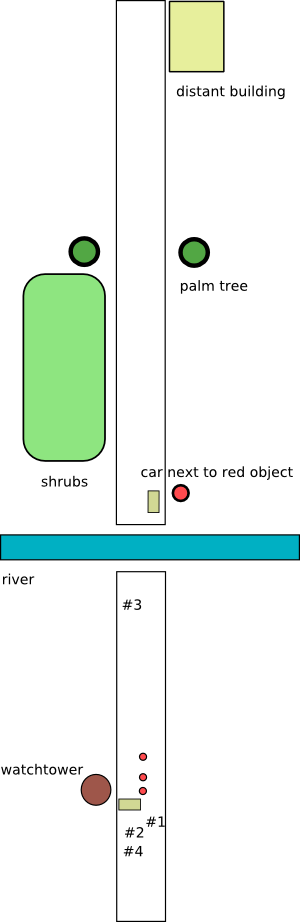
I've included a schematic drawing of the scene as I think it was, for your reference. Note that I was there no more than the author was and that errors in my reasoning or schematics should in no way impact what Reuters and Hajj have to say for themselves.
----
The schematic I'm talking about: http://i86.photobucket.com/albums/k88/Grismar75/i -
And the witchhunt is on, pot vs. kettle
Not about the image that the original post is about, but about what happens after something like this gets out. Read this blog post:
http://powerlineblog.com/archives/014929.php
A fine example of a blogger making a fool of themself, doing the exact same thing they are accusing Reuters of doing. Read my response to it:
----
The only photograph that strikes me as somewhat odd is the bottom image http://powerlineblog.com/archives/Hajj4567.jpg.
The other 4 images are clearly photographs of the same scene. Let me give you my view on the positioning of the photographers in each.
#1 : http://powerlineblog.com/archives/Hajj1234.jpg
This picture was taken with a regular angle lens, say somthing like 35mm, towards a building, across the bridge that is out. The photographer was standing close to the right side of the road (when viewed in this direction). The car in the next picture is out of the frame, to the left of the photographer. The photographer is too far from the actual damage to get a good shot of it. The actual damage is close to the right shoulder of the man in the center of the image, off to the left.
#2 : http://powerlineblog.com/archives/Hajj1245.jpg
This picture has been taken from the opposite side of the road from #1, i.e. the left, shooting in the same direction. The photographer will have used a telelens, say 200mm. This pulls in the distant background and seems to place the pilons in the center of the road closer together. Note the tree white and red pilons, with the overturned fourth. Now look at #1 again, you will notice the same three pilons with the overturned one pointing towards the photographer. Also not that the two palms and the car on the right side of the road are visible in #1 as well, off in the distance.
Again, this picture has been shot across the destroyed bridge, which is now partly obscured by the car and the man. But you can make out the concrete mesh fragments sticking off the right shoulder of the man, to the right.
#3 : http://powerlineblog.com/archives/Hajj2345.jpg
In #3, the photopgrapher has arrived at the collapsed bridge. From this angle, the photographer, shooting with something like the 35mm again, can shoot into the gap, clearly showing the damage. The photographer is now well past the car in #2, but the other car is still visible across the gap. The car in #3 is actually visible in all of the images, as is the building in the background, though very poorly in #1.
#4 : http://powerlineblog.com/archives/Hajj3456.jpg
In #4, the photographer has moved back beyond the overturned car. Or, about as likely, #4 was actually taken before #1. The photographer is now so far back and to the left, that the small watchtower is also in the frame.
The allegations in the piece are sensationalist and don't stand up to scrutiny. The author (and powerlineblog) are doing exactly what they are accusing Reuters of doing: posting material without a critical and sceptical review. If the bottom photo (#5, http://powerlineblog.com/archives/Hajj4567.jpg) was published as a photo of the same incident, that's not right But some of the comments on the other 4 are simply wrong.
I've included a schematic drawing of the scene as I think it was, for your reference. Note that I was there no more than the author was and that errors in my reasoning or schematics should in no way impact what Reuters and Hajj have to say for themselves.
----
The schematic I'm talking about: http://i86.photobucket.com/albums/k88/Grismar75/i -
And the witchhunt is on, pot vs. kettle
Not about the image that the original post is about, but about what happens after something like this gets out. Read this blog post:
http://powerlineblog.com/archives/014929.php
A fine example of a blogger making a fool of themself, doing the exact same thing they are accusing Reuters of doing. Read my response to it:
----
The only photograph that strikes me as somewhat odd is the bottom image http://powerlineblog.com/archives/Hajj4567.jpg.
The other 4 images are clearly photographs of the same scene. Let me give you my view on the positioning of the photographers in each.
#1 : http://powerlineblog.com/archives/Hajj1234.jpg
This picture was taken with a regular angle lens, say somthing like 35mm, towards a building, across the bridge that is out. The photographer was standing close to the right side of the road (when viewed in this direction). The car in the next picture is out of the frame, to the left of the photographer. The photographer is too far from the actual damage to get a good shot of it. The actual damage is close to the right shoulder of the man in the center of the image, off to the left.
#2 : http://powerlineblog.com/archives/Hajj1245.jpg
This picture has been taken from the opposite side of the road from #1, i.e. the left, shooting in the same direction. The photographer will have used a telelens, say 200mm. This pulls in the distant background and seems to place the pilons in the center of the road closer together. Note the tree white and red pilons, with the overturned fourth. Now look at #1 again, you will notice the same three pilons with the overturned one pointing towards the photographer. Also not that the two palms and the car on the right side of the road are visible in #1 as well, off in the distance.
Again, this picture has been shot across the destroyed bridge, which is now partly obscured by the car and the man. But you can make out the concrete mesh fragments sticking off the right shoulder of the man, to the right.
#3 : http://powerlineblog.com/archives/Hajj2345.jpg
In #3, the photopgrapher has arrived at the collapsed bridge. From this angle, the photographer, shooting with something like the 35mm again, can shoot into the gap, clearly showing the damage. The photographer is now well past the car in #2, but the other car is still visible across the gap. The car in #3 is actually visible in all of the images, as is the building in the background, though very poorly in #1.
#4 : http://powerlineblog.com/archives/Hajj3456.jpg
In #4, the photographer has moved back beyond the overturned car. Or, about as likely, #4 was actually taken before #1. The photographer is now so far back and to the left, that the small watchtower is also in the frame.
The allegations in the piece are sensationalist and don't stand up to scrutiny. The author (and powerlineblog) are doing exactly what they are accusing Reuters of doing: posting material without a critical and sceptical review. If the bottom photo (#5, http://powerlineblog.com/archives/Hajj4567.jpg) was published as a photo of the same incident, that's not right But some of the comments on the other 4 are simply wrong.
I've included a schematic drawing of the scene as I think it was, for your reference. Note that I was there no more than the author was and that errors in my reasoning or schematics should in no way impact what Reuters and Hajj have to say for themselves.
----
The schematic I'm talking about: http://i86.photobucket.com/albums/k88/Grismar75/i -
And the witchhunt is on, pot vs. kettle
Not about the image that the original post is about, but about what happens after something like this gets out. Read this blog post:
http://powerlineblog.com/archives/014929.php
A fine example of a blogger making a fool of themself, doing the exact same thing they are accusing Reuters of doing. Read my response to it:
----
The only photograph that strikes me as somewhat odd is the bottom image http://powerlineblog.com/archives/Hajj4567.jpg.
The other 4 images are clearly photographs of the same scene. Let me give you my view on the positioning of the photographers in each.
#1 : http://powerlineblog.com/archives/Hajj1234.jpg
This picture was taken with a regular angle lens, say somthing like 35mm, towards a building, across the bridge that is out. The photographer was standing close to the right side of the road (when viewed in this direction). The car in the next picture is out of the frame, to the left of the photographer. The photographer is too far from the actual damage to get a good shot of it. The actual damage is close to the right shoulder of the man in the center of the image, off to the left.
#2 : http://powerlineblog.com/archives/Hajj1245.jpg
This picture has been taken from the opposite side of the road from #1, i.e. the left, shooting in the same direction. The photographer will have used a telelens, say 200mm. This pulls in the distant background and seems to place the pilons in the center of the road closer together. Note the tree white and red pilons, with the overturned fourth. Now look at #1 again, you will notice the same three pilons with the overturned one pointing towards the photographer. Also not that the two palms and the car on the right side of the road are visible in #1 as well, off in the distance.
Again, this picture has been shot across the destroyed bridge, which is now partly obscured by the car and the man. But you can make out the concrete mesh fragments sticking off the right shoulder of the man, to the right.
#3 : http://powerlineblog.com/archives/Hajj2345.jpg
In #3, the photopgrapher has arrived at the collapsed bridge. From this angle, the photographer, shooting with something like the 35mm again, can shoot into the gap, clearly showing the damage. The photographer is now well past the car in #2, but the other car is still visible across the gap. The car in #3 is actually visible in all of the images, as is the building in the background, though very poorly in #1.
#4 : http://powerlineblog.com/archives/Hajj3456.jpg
In #4, the photographer has moved back beyond the overturned car. Or, about as likely, #4 was actually taken before #1. The photographer is now so far back and to the left, that the small watchtower is also in the frame.
The allegations in the piece are sensationalist and don't stand up to scrutiny. The author (and powerlineblog) are doing exactly what they are accusing Reuters of doing: posting material without a critical and sceptical review. If the bottom photo (#5, http://powerlineblog.com/archives/Hajj4567.jpg) was published as a photo of the same incident, that's not right But some of the comments on the other 4 are simply wrong.
I've included a schematic drawing of the scene as I think it was, for your reference. Note that I was there no more than the author was and that errors in my reasoning or schematics should in no way impact what Reuters and Hajj have to say for themselves.
----
The schematic I'm talking about: http://i86.photobucket.com/albums/k88/Grismar75/i -
And the witchhunt is on, pot vs. kettle
Not about the image that the original post is about, but about what happens after something like this gets out. Read this blog post:
http://powerlineblog.com/archives/014929.php
A fine example of a blogger making a fool of themself, doing the exact same thing they are accusing Reuters of doing. Read my response to it:
----
The only photograph that strikes me as somewhat odd is the bottom image http://powerlineblog.com/archives/Hajj4567.jpg.
The other 4 images are clearly photographs of the same scene. Let me give you my view on the positioning of the photographers in each.
#1 : http://powerlineblog.com/archives/Hajj1234.jpg
This picture was taken with a regular angle lens, say somthing like 35mm, towards a building, across the bridge that is out. The photographer was standing close to the right side of the road (when viewed in this direction). The car in the next picture is out of the frame, to the left of the photographer. The photographer is too far from the actual damage to get a good shot of it. The actual damage is close to the right shoulder of the man in the center of the image, off to the left.
#2 : http://powerlineblog.com/archives/Hajj1245.jpg
This picture has been taken from the opposite side of the road from #1, i.e. the left, shooting in the same direction. The photographer will have used a telelens, say 200mm. This pulls in the distant background and seems to place the pilons in the center of the road closer together. Note the tree white and red pilons, with the overturned fourth. Now look at #1 again, you will notice the same three pilons with the overturned one pointing towards the photographer. Also not that the two palms and the car on the right side of the road are visible in #1 as well, off in the distance.
Again, this picture has been shot across the destroyed bridge, which is now partly obscured by the car and the man. But you can make out the concrete mesh fragments sticking off the right shoulder of the man, to the right.
#3 : http://powerlineblog.com/archives/Hajj2345.jpg
In #3, the photopgrapher has arrived at the collapsed bridge. From this angle, the photographer, shooting with something like the 35mm again, can shoot into the gap, clearly showing the damage. The photographer is now well past the car in #2, but the other car is still visible across the gap. The car in #3 is actually visible in all of the images, as is the building in the background, though very poorly in #1.
#4 : http://powerlineblog.com/archives/Hajj3456.jpg
In #4, the photographer has moved back beyond the overturned car. Or, about as likely, #4 was actually taken before #1. The photographer is now so far back and to the left, that the small watchtower is also in the frame.
The allegations in the piece are sensationalist and don't stand up to scrutiny. The author (and powerlineblog) are doing exactly what they are accusing Reuters of doing: posting material without a critical and sceptical review. If the bottom photo (#5, http://powerlineblog.com/archives/Hajj4567.jpg) was published as a photo of the same incident, that's not right But some of the comments on the other 4 are simply wrong.
I've included a schematic drawing of the scene as I think it was, for your reference. Note that I was there no more than the author was and that errors in my reasoning or schematics should in no way impact what Reuters and Hajj have to say for themselves.
----
The schematic I'm talking about: http://i86.photobucket.com/albums/k88/Grismar75/i -
And the witchhunt is on, pot vs. kettle
Not about the image that the original post is about, but about what happens after something like this gets out. Read this blog post:
http://powerlineblog.com/archives/014929.php
A fine example of a blogger making a fool of themself, doing the exact same thing they are accusing Reuters of doing. Read my response to it:
----
The only photograph that strikes me as somewhat odd is the bottom image http://powerlineblog.com/archives/Hajj4567.jpg.
The other 4 images are clearly photographs of the same scene. Let me give you my view on the positioning of the photographers in each.
#1 : http://powerlineblog.com/archives/Hajj1234.jpg
This picture was taken with a regular angle lens, say somthing like 35mm, towards a building, across the bridge that is out. The photographer was standing close to the right side of the road (when viewed in this direction). The car in the next picture is out of the frame, to the left of the photographer. The photographer is too far from the actual damage to get a good shot of it. The actual damage is close to the right shoulder of the man in the center of the image, off to the left.
#2 : http://powerlineblog.com/archives/Hajj1245.jpg
This picture has been taken from the opposite side of the road from #1, i.e. the left, shooting in the same direction. The photographer will have used a telelens, say 200mm. This pulls in the distant background and seems to place the pilons in the center of the road closer together. Note the tree white and red pilons, with the overturned fourth. Now look at #1 again, you will notice the same three pilons with the overturned one pointing towards the photographer. Also not that the two palms and the car on the right side of the road are visible in #1 as well, off in the distance.
Again, this picture has been shot across the destroyed bridge, which is now partly obscured by the car and the man. But you can make out the concrete mesh fragments sticking off the right shoulder of the man, to the right.
#3 : http://powerlineblog.com/archives/Hajj2345.jpg
In #3, the photopgrapher has arrived at the collapsed bridge. From this angle, the photographer, shooting with something like the 35mm again, can shoot into the gap, clearly showing the damage. The photographer is now well past the car in #2, but the other car is still visible across the gap. The car in #3 is actually visible in all of the images, as is the building in the background, though very poorly in #1.
#4 : http://powerlineblog.com/archives/Hajj3456.jpg
In #4, the photographer has moved back beyond the overturned car. Or, about as likely, #4 was actually taken before #1. The photographer is now so far back and to the left, that the small watchtower is also in the frame.
The allegations in the piece are sensationalist and don't stand up to scrutiny. The author (and powerlineblog) are doing exactly what they are accusing Reuters of doing: posting material without a critical and sceptical review. If the bottom photo (#5, http://powerlineblog.com/archives/Hajj4567.jpg) was published as a photo of the same incident, that's not right But some of the comments on the other 4 are simply wrong.
I've included a schematic drawing of the scene as I think it was, for your reference. Note that I was there no more than the author was and that errors in my reasoning or schematics should in no way impact what Reuters and Hajj have to say for themselves.
----
The schematic I'm talking about: http://i86.photobucket.com/albums/k88/Grismar75/i -
And the witchhunt is on, pot vs. kettle
Not about the image that the original post is about, but about what happens after something like this gets out. Read this blog post:
http://powerlineblog.com/archives/014929.php
A fine example of a blogger making a fool of themself, doing the exact same thing they are accusing Reuters of doing. Read my response to it:
----
The only photograph that strikes me as somewhat odd is the bottom image http://powerlineblog.com/archives/Hajj4567.jpg.
The other 4 images are clearly photographs of the same scene. Let me give you my view on the positioning of the photographers in each.
#1 : http://powerlineblog.com/archives/Hajj1234.jpg
This picture was taken with a regular angle lens, say somthing like 35mm, towards a building, across the bridge that is out. The photographer was standing close to the right side of the road (when viewed in this direction). The car in the next picture is out of the frame, to the left of the photographer. The photographer is too far from the actual damage to get a good shot of it. The actual damage is close to the right shoulder of the man in the center of the image, off to the left.
#2 : http://powerlineblog.com/archives/Hajj1245.jpg
This picture has been taken from the opposite side of the road from #1, i.e. the left, shooting in the same direction. The photographer will have used a telelens, say 200mm. This pulls in the distant background and seems to place the pilons in the center of the road closer together. Note the tree white and red pilons, with the overturned fourth. Now look at #1 again, you will notice the same three pilons with the overturned one pointing towards the photographer. Also not that the two palms and the car on the right side of the road are visible in #1 as well, off in the distance.
Again, this picture has been shot across the destroyed bridge, which is now partly obscured by the car and the man. But you can make out the concrete mesh fragments sticking off the right shoulder of the man, to the right.
#3 : http://powerlineblog.com/archives/Hajj2345.jpg
In #3, the photopgrapher has arrived at the collapsed bridge. From this angle, the photographer, shooting with something like the 35mm again, can shoot into the gap, clearly showing the damage. The photographer is now well past the car in #2, but the other car is still visible across the gap. The car in #3 is actually visible in all of the images, as is the building in the background, though very poorly in #1.
#4 : http://powerlineblog.com/archives/Hajj3456.jpg
In #4, the photographer has moved back beyond the overturned car. Or, about as likely, #4 was actually taken before #1. The photographer is now so far back and to the left, that the small watchtower is also in the frame.
The allegations in the piece are sensationalist and don't stand up to scrutiny. The author (and powerlineblog) are doing exactly what they are accusing Reuters of doing: posting material without a critical and sceptical review. If the bottom photo (#5, http://powerlineblog.com/archives/Hajj4567.jpg) was published as a photo of the same incident, that's not right But some of the comments on the other 4 are simply wrong.
I've included a schematic drawing of the scene as I think it was, for your reference. Note that I was there no more than the author was and that errors in my reasoning or schematics should in no way impact what Reuters and Hajj have to say for themselves.
----
The schematic I'm talking about: http://i86.photobucket.com/albums/k88/Grismar75/i -
Carried away
http://powerlineblog.com/archives/014929.php
This "Bridge too far" just shows that people don't understand lenses. I can't spot anything manipulated in the images but they seem convinced it's a fake... -
Re:Fake or exaggerated?
That's bull. Either Reuters editors are idiots and got pwned or Reuters is implicated in the fakery and anti-Israel propagandas. There are other manipulated photos or fake captions:
YNetNewsan F-16 dropping a defensive flare and a bomb, but the photographer thought the flare was a missile and cloned the bomb and the flare. This is just as bad a cloning job as the smoke one.
Powerline Blog: The same destroyed building was reported twice on Aug. 5 and Jul. 24.
Drinking from home: The same woman got her home flattened twice, on Jul. 22 and Aug. 5.
My Vast Right Wing Conspiracy: A caption said a man was running from a bombed building during an overnight raid, except that the photo was taken during the day.
These are what we notice. How many others that got passed through because the fake job was done better? How would Reuter have managed to pass through these if they had vetted te photos?
Hours after PM Siniora took back the comment when he reported 40 civilians were killed and said instead that only one got killed, Reuters still reported Israel killing 40 civilians. They are not a news outlet, they are a propaganda machine. -
Hezbollah photographer
The bad photoshop work isn't really the story here. It's just what got him fired from Reuters. In one example and yet another, this photographer is acting more as a Hezbollah propaganda operative than a news photographer. He was responsible for one of the most used photos from Qana with the dead child being held up, and as recently as yesterday had a picture on Page 1 of the NYT of an injured Lebonese civilian. He's basically the Peter Parker of Lebanon. It's wouldn't be hard to get the best photos if you were working with the terrorists who control the region!
-
Re:Read all about itHey now, the people have a right to know (tm) and the NYT is just selling ad space^H*16 doing it's part to keep us all informed. Why just a while back, they exposed another sinister terrorist plot to overthrow the legitimate government.
.
http://powerlineblog.com/archives/NYTSecretsS.jpg
I for one feel safer with the NYT exposing all this skullduggery.
-
Free education
Since you seem to be alarmingly confused as to the defintion of "public", here's a lot of detail around what parts of SWIFT were public.
Yeah it's on a right wing site, but I read Kos too and haven't seen anything this detailed on there.
If it was so public how come Belgian's own government didn't realize it was there?
So unless you can find some information countering facts raised there... -
Re:I wish more whistleblowers would come forward
Yeah, thanks for backing up your claim that these leaks are politically motivated
Here you go, maybe you will find this a little less distracting?
And, a little more that is helpful. -
Re:You're seeing the oversight in action
I agree completely, though, that when civil servants take this kind of a risk, something is decidedly rotten.
That is by no means certain.
It could simply mean that they are committed to their own cause, which could be anything from A-F below:
A. Truth, Justice, and the American Way
B. I don't like what's going on, and leaking is easier than filing a complaint through proper channels
C. Embarrassing Bush will help Hillary win, and I probably won't get caught
D. Bring down Bush, no matter the cost.
E. Bring down America, no matter the cost.
F. Other
There is some very interesting information about Mary McCarthy, let go for leaking at NSA. I'm holding out for B, C, or D. Probably a mix.
A map of associations
Some defenders
Is there a bigger pattern? -
Re:get the sources right
-
Re:get the sources right
-
Re:get the sources right
-
Re:One quote please
You're an idiot. The administration's argument the entire time has been that they're violating FISA because they believe that it constrains the president's constitutional powers. (IOW, they're admitting to breaking federal law just like the previous poster has stated.) If you haven't heard it, you've got your head in the sand. I'll do better than give you quotes -- I'll give you quotes in a pro-president blog: http://www.powerlineblog.com/archives/012926.php
-
You mean the legal, constitutional wiretapsA little legal analysis from the lawyers at Powerline:
Finally, in 2002, the United States Foreign Intelligence Surveillance Court of Review decided Sealed Case No. 02-001. This case arose out of a provision of the Patriot Act that was intended to break down the "wall" between law enforcement and intelligence gathering. The Patriot Act modified Truong's "primary purpose" test by providing that surveillance under FISA was proper if intelligence gathering was one "significant" purpose of the intercept. In the course of discussing the constitutional underpinnings (or lack thereof) of the Truong test, the court wrote:
The Truong court, as did all the other courts to have decided the issue, held that the President did have inherent authority to conduct warrantless searches to obtain foreign intelligence information. It was incumbent upon the court, therefore, to determine the boundaries of that constitutional authority in the case before it. We take for granted that the President does have that authority and, assuming that is so, FISA could not encroach on the President's constitutional power. The question before us is the reverse, does FISA amplify the President's power by providing a mechanism that at least approaches a classic warrant and which therefore supports the government's contention that FISA searches are constitutionally reasonable.
That is the current state of the law. The federal appellate courts have unanimously held that the President has the inherent constitutional authority to order warrantless searches for purposes of gathering foreign intelligence information, which includes information about terrorist threats. Furthermore, since this power is derived from Article II of the Constitution, the FISA Review Court has specifically recognized that it cannot be taken away or limited by Congressional action.
That being the case, the NSA intercept program, which consists of warrantless electronic intercepts for purposes of foreign intelligence gathering, is legal.
It's worth noting that all of the cases cited above involved warrantless searches inside the United States. The NSA program, in contrast, involves international communications only, and the intercepts take place at least in part, and perhaps wholly, outside the United States. Thus, the NSA case is even clearer than the cases that have already upheld Presidential power.
And later....The other statute that has been discussed in connection with the legality of the NSA intercept program is FISA. It has been argued that FISA explicitly or implicitly requires the administration to conduct foreign intelligence surveillance only pursuant to the procedures set up under that statute.
As an initial matter, this argument has already been rejected by the very appellate court that is charged with interpreting and applying FISA, in Sealed Case No. 02-001. So, from the standpoint of critics of the administration's program, the argument is a non-starter. -
Feingold is misguided at best
If Fiengold thinks this program is so bad, why doesn't he call for impeachemnt of the President for this issue? No prominent democrat has called for the program to be stopped. Why? Because it is probably legal (read some lawyer oriented blogs in stead of slashdot), and two, the country knows that this a good idea to stop the terrorists by listening to them. If they are talking to Americans, I sure want to know our govenment to know about it.
Here chew on this from Senators questioning retired FISA court judges (notice the phrase
Judge Kornblum: To be admissible, the evidence would have had to have been lawfully seized or lawfully obtained and the standard that the district judge would use is that, depending upon where this is, is the law in his circuit. In most of the circuits, the law is clear that the President has the authority to do warrantless surveillance if it is to collect foreign intelligence and it is targeting foreign powers or agents. If the facts support that, then the district judge could make that finding and admit the evidence, just as they did in Truong-Humphrey.
from:
http://powerlineblog.com/archives/013588.php
Here is another:
Then there's United States v. Truong, 629 F.2d 908 (4th Cir. 1980), where the court sustained the federal government's position, which it summarized as follows:
In the area of foreign intelligence, the government contends, the President may authorize surveillance without seeking a judicial warrant because of his constitutional prerogatives in the area of foreign affairs.
The court explained why the President has the inherent constitutional authority to order warrantless electronic surveillance:
For several reasons, the needs of the executive are so compelling in the area of foreign intelligence, unlike the area of domestic security, that a uniform warrant requirement would, following [United States v. United States District Court, 407 U.S. 297 (1972)], "unduly frustrate" the President in carrying out his foreign affairs responsibilities. First of all, attempts to counter foreign threats to the national security require the utmost stealth, speed and secrecy. A warrant requirement would add a procedural hurdle that would reduce the flexibility of executive foreign intelligence activities, in some cases delay executive response to foreign intelligence threats, and increase the chance of leaks regarding sensitive executive operations.
from with more examples:
http://powerlineblog.com/archives/012975.php -
Feingold is misguided at best
If Fiengold thinks this program is so bad, why doesn't he call for impeachemnt of the President for this issue? No prominent democrat has called for the program to be stopped. Why? Because it is probably legal (read some lawyer oriented blogs in stead of slashdot), and two, the country knows that this a good idea to stop the terrorists by listening to them. If they are talking to Americans, I sure want to know our govenment to know about it.
Here chew on this from Senators questioning retired FISA court judges (notice the phrase
Judge Kornblum: To be admissible, the evidence would have had to have been lawfully seized or lawfully obtained and the standard that the district judge would use is that, depending upon where this is, is the law in his circuit. In most of the circuits, the law is clear that the President has the authority to do warrantless surveillance if it is to collect foreign intelligence and it is targeting foreign powers or agents. If the facts support that, then the district judge could make that finding and admit the evidence, just as they did in Truong-Humphrey.
from:
http://powerlineblog.com/archives/013588.php
Here is another:
Then there's United States v. Truong, 629 F.2d 908 (4th Cir. 1980), where the court sustained the federal government's position, which it summarized as follows:
In the area of foreign intelligence, the government contends, the President may authorize surveillance without seeking a judicial warrant because of his constitutional prerogatives in the area of foreign affairs.
The court explained why the President has the inherent constitutional authority to order warrantless electronic surveillance:
For several reasons, the needs of the executive are so compelling in the area of foreign intelligence, unlike the area of domestic security, that a uniform warrant requirement would, following [United States v. United States District Court, 407 U.S. 297 (1972)], "unduly frustrate" the President in carrying out his foreign affairs responsibilities. First of all, attempts to counter foreign threats to the national security require the utmost stealth, speed and secrecy. A warrant requirement would add a procedural hurdle that would reduce the flexibility of executive foreign intelligence activities, in some cases delay executive response to foreign intelligence threats, and increase the chance of leaks regarding sensitive executive operations.
from with more examples:
http://powerlineblog.com/archives/012975.php -
Re:Military actionI have no problem with people petitioning the government to create a more transparent system, but I also accept that even so, in some cases at least, that transparency may be near impossible. For example, if the means of surveillance used to get the proof necessary to detain a specific prisoner is still in use, and by giving it to the defense team (who you have to admit, is not always made up of the most trustworthy of lawyers) would compromise further use, then I would accept that that that evidence remain sealed, although I would expect that the judge in the case would have full access. From reports I have read, and not necessarily with regards to GITMO cases, there have been some attempts at the "trust us Judge, he's a bad guy" type motions which have sadly been accepted. I would expect the judge who hears this type of case to do his/her due diligence and if it can be shown that they are just rubber stamping the Feds cases, then I would move for the judge to be removed and the case reheard.
I just don't think we should throw the baby out with the bath water which seems to be what so many are demanding.
As for the VX example, I doubt if you would find too many security experts, or law enforcement personnel who would agree with your decision to hesitate. When the table is so slanted in the favor of the 'greater good' as in the scenario I gave (inconveniencing 19 innocent people to prevent the deaths of tens of thousands), there can be no holding back. In instances like these hesitation kills. It may not be comfortable, and of those 19 people I'm sure some would agree with you and demand compensation, but I would guess that in the majority of cases, they would see the police actions as reasonable, barring the use of excessive force of course.
And to clear up the FISA statement, here is the preceding text which I originally left out:"The Truong court, as did all the other courts to have decided the issue, held that the President did have inherent authority to conduct warrantless searches to obtain foreign intelligence information. It was incumbent upon the court, therefore, to determine the boundaries of that constitutional authority in the case before it."
It doesn't really leave a whole lot of room for interpretation. Almost every President that you can think of in modern times have used this power, and unlike the current administration, some went much further than simply monitoring foreign communications (Clinton for example authorized the monitoring and searching of persons and places completely contained within the United States). In pretty much every case it was determined that if the purpose of the searches or surveillance in question was for the collection of foreign intelligence (in Clintons case catching a Russian agent) then the President was within his rights.
I do disagree with a later move, also by Clinton, to expand this power to include simple criminal cases but even though he made the argument that that was within his authority, I don't know if it was ever tested.
Powerline has a good write-up on the legal standing of the warrantless wire taps. And honestly, this was the first detailed legal response I could find with Google; I did not intentionally pick a conservative web site. -
Re:Why is this a Slashdot story?
I don't pretend to be a lawyer. This guy is though.
His analysis seems sound. He doesn't just mention a case, like you did. Actually, he mentions several, and goes on to explain what they say and how it applies to the NSA operation. -
Re:How about hearing from the guy who ran it?And lets supplement your video with some commentary from actual
The Fourth Amendment includes requirements for the issuance of search warrants, and many critics of the NSA program seem to assume that this means that all searches must be executed pursuant to a warrant. This assumption is wrong. There are dozens of situations where warrantless searches have been approved by the courts. The overriding principle is that searches of Americans (defined to include resident aliens) must be reasonable.
One of the many situations where warrantless searches have been approved is when the government is seeking foreign intelligence information, such as information relating to potential terrorist threats. Next to the Constitution itself, of course, the highest authority is the United States Supreme Court. At least three Supreme Court cases have discussed this subject....
and later....
That being the case, the NSA intercept program, which consists of warrantless electronic intercepts for purposes of foreign intelligence gathering, is legal. -
Re:Not going to happen
The Gonzales will just give him the same tripe they've been spouting on TV. Constitution, use of force authorization, blah, blah, blah.
In other words, legal reasons* that you don't like regardless if they are correct or not.
They'll claim it's necessary for "security" and there will be a 5 to 4 vote overturning the order and they'll go right back to doing whatever the hell they feel like.
Does that mean EPIC won't be publishing the list of Al Qaeda suspects, alerting them to flee, as soon as they get their hands on it? That is a relief.
*Like this -
Re:Word games...That IS DOMESTIC spying. The fact that the OTHER party is outside of the US does not mitigate that fact.
Ya, the nerve of some people, trying to make an international incident out of a case where clearly one of two people is in the US. And lets not get into the phone company with their "you call overseas and you pay international rates" thing. Clearly they are in bed with the Bush administration, and have been for at least 50 years. You let them tap one communication that crosses an international border to get to an Al Qaeda member and the next thing you know, two Girl Scouts calling each other in Denver will be grounds for wiretapping.... or something.Filmmaker Andrew Marcus has made a ten-minute video about yesterday's Judiciary Committee hearings on the NSA's terrorist surveillance program; it's been posted at Pajamas Media. The video includes footage of Arlen Specter and Alberto Gonzales inside the hearing room, interviews with Senator John Cornyn and Debra Burlingame, some of the questions Paul asked Ted Kennedy and Dick Durbin, and Paul's concluding summary of the hearings' significance.
It's an excellent recap of the first day's proceedings, with some valuable perspective that is absent from most news accounts. One of the most telling moments is when Debra Burlingame points out that prior to the September 11 attacks, the NSA was surveilling an al Qaeda member in Yemen who placed or received more than a dozen phone calls to and from a number in San Diego. Because these calls involved someone in the United States, the NSA didn't listen to them. It turned out that the "Kahlid" who was receiving the calls in San Diego was one of the September 11 hijackers. In fact, he was one of the hijackers who murdered Debra's brother, the pilot of American Airlines flight 77.
This is what Democrats and the news media call "domestic spying." Do the Democrats really want to return us to the days when al Qaeda could call its American operatives with impunity? Reporting from Capitol Hi -
Re:Amendment IVENOUGH SAID.
You should say, more, like this:There is one relevant constitutional provision that acts as a restraint on the President's inherent power as Commander in Chief. That is the Fourth Amendment, which states:
The right of the people to be secure in their persons, houses, papers, and effects, against unreasonable searches and seizures, shall not be violated, and no warrants shall issue, but upon probable cause, supported by oath or affirmation, and particularly describing the place to be searched, and the persons or things to be seized.
So all searches and seizures of Americans or their property (including, as the courts have appropriately ruled, interceptions of telephonic and electronic communications) must be reasonable. Note, however, that this requirement does not apply to terrorists overseas. A Special Forces soldier can pick a cave arbitrarily and search it. He isn't trying to prosecute terrorists, he is trying to kill them. He doesn't need probable cause.
The Fourth Amendment includes requirements for the issuance of search warrants, and many critics of the NSA program seem to assume that this means that all searches must be executed pursuant to a warrant. This assumption is wrong. There are dozens of situations where warrantless searches have been approved by the courts. The overriding principle is that searches of Americans (defined to include resident aliens) must be reasonable.
One of the many situations where warrantless searches have been approved is when the government is seeking foreign intelligence information, such as information relating to potential terrorist threats. Next to the Constitution itself, of course, the highest authority is the United States Supreme Court. At least three Supreme Court cases have discussed this subject. -
Re:For the love of all that's good...
The issues of law, however, are not so tenuous as you seem to think.
Erm, real lawyers and law professors disagree with you and Al Gore on that point. Try here and here, for example. I'm not saying either post is right on the money, but these are real fancy-pants lawyers throwing around real F. Ctr. Op. fnord. Cit. (3) legal citations. And when the professionals disagree so heatedly among themselves I'd say the legal issues are indeed unsettled, at least until such time as the Supreme Court weighs in on the issue.
This is hardly surprising: the exact point where the Executive Branch's Article II war-fighting powers trump the Legislature's power to make law has been argued for centuries. Did Lincoln have the authority to free the slaves by decree in the absence of any law whatsoever giving him that power? Could Truman seize steel mills hit by a strike during the Korean War to prevent disastrous steel shortages? Scholars still debate. Let us not even get into the delicate question of the famous War Powers Act, which every President, Democrat or Republican, has claimed to be unconstitutional since the day it passed.
In terms of spying on Americans, however, there must be a warrant. Article 4 of the constitution asserts this.
Nooo, the Fourth Amendment (not Article IV) just says there can be no "unreasonable" searches. That may or may not mean a warrant -- the definition of "unreasonable" is up to the Courts, ultimately the Supreme Court. For example, if a policeman sees you stuffing something that looks like a body in a trash bag or 50 pounds of marijuana into your woodshed, does he need a warrant to order you to unlock the woodshed and let him search it? Nope. In a case like that, the Courts have held that the value to justice of allowing the policeman to exercise his reasonable judgment on the spot, and collect evidence that you might otherwise hide, if given time, outweighs any danger to your civil liberties.
Furthermore, the Courts have generally held that the Executive Branch (that's the President, or his designees, like the NSA) has broad authority to search the effects, persons, and, yes, communications of US citizens when they enter or exit the country. You'll have noticed, I hope, that the Customs and Immigration people don't need a warrant or your permission to search your bags, papers, person or car when you enter or exit the country. They can even stop you within the US to search your bags or car for, say, illegal aliens or drugs, if you're near enough to the border. And the postal service can open up packages sent by you to international destinations, or from international destinations to you, to inspect them. They don't need your permission, a warrant or even a specific reason to do so. (The generic reason of making sure the Customs and Immigration laws are being followed is considered good enough.)
We can think of border control and inspection as something like a sobriety checkpoint. As long as the "borderline" over which, if you step, you get inspected, is clear, and as long as there is some reasonable law-enforcement goal served by the inspection, and as long as the inspection does not overly intrude in your daily life, then the procedure has been held to be Constitutional, even in the absence of probable cause or a warrant.
Modern communication, with the binging of messages back and forth across international borders, has made a bit of a mess of our expectations. Fifty years ago, the government read every international cable or telegram as a matter of course. But people expected that. It was an unusual thing to communicate internationally. Nowadays, and especially with the Internet, we tend to think of international communications as pretty much the same as intranational communications. But they're not. We expect the same privacy and legal rights as when we talk to our neighbors. But we shouldn' -
Re:action, intent, and circumstance
The state of the law was summed up by the Second Circuit in United States v. Duggan, 743 F.2d 59 (1984), a terrorism case in which the court, among
action was illegal under all but the most fantastic interpretations of the law
Apparently you missed this:
The state of the law was summed up by the Second Circuit in United States v. Duggan, 743 F.2d 59 (1984), a terrorism case in which the court, among other rulings, upheld the constitutionality of the Foreign Intelligence Surveillance Act (FISA), which was adopted in 1981. The court wrote:
Prior to the enactment of FISA, virtually every court that had addressed the issue had concluded that the President had the inherent power to conduct warrantless electronic surveillance to collect foreign intelligence information, and that such surveillances constituted an exception to the warrant requirement of the Fourth Amendment.
And:
The Truong court, as did all the other courts to have decided the issue, held that the President did have inherent authority to conduct warrantless searches to obtain foreign intelligence information.
-Ref http://powerlineblog.com/archives/012631.php#01263 1
Please. Do at least a LITTLE research before posting. (And yes, I know this is slashdot...)
-john -
Re:What happened to "Government = Evil"?
You might want to look at this regarding the 72-hours provision as well.
http://powerlineblog.com/archives/012770.php#01277 0
-john -
Re:FISA and it's limits
A good post to read about the legal issues here is from powerlineblog at http://powerlineblog.com/archives/012631.php#0126
3 1
The basic premise of the argument is that there have been many court cases that have affirmed the president's right, derived from his preeminance in foreign affairs given to him in Article 2 of the constitution, to use electronic surveillance, even domestic, without a warrant for the explicit purposes of gathering foreign intelligence. Despite having domestic operatives, there is simply no question that al Qaeda is a foreign organization.
The question has centered around whether or not FISA now requires him to get a warrant for such intelligence gathering. The authors argue, successfully in my opinion, that a legislative act, passed by Congress, CANNOT limit the constitutionally derived powers granted to the executive branch. DO NOT FORGET!!! Congress is a COEQUAL branch of government. It cannot limit or take away the president's constitutional powers by legislative act no more than the president can limit congress' powers by executive order. In short, the NSA program, defined in the narrow terms that it has been, is completely legal.
Btw, yes I admit the linked post is a conservative blog; the authors don't try to hide that. It fails to change the legal analysis. -
Re:Why I Love the ACLUSo you could be pretty high on the list, but still have every civilian tagged with a radio bleeper with someone watching their every move.
Although economic freedom as defined in the study doesn't directly map 1:1 into what is understood as "civil rights", it is about freedom for people. Also, I don't think your example of putting radio trackers on everybody is compatible with the idea of economic freedom in the study.Economic freedom is defined as the absence of government coercion or constraint on the production, distribution, or consumption of goods and services beyond the extent necessary for citizens to protect and maintain liberty itself. In other words, people are free to work, produce, consume, and invest in the ways they feel are most productive.
All government action involves coercion. Some minimal coercion is necessary for the citizens of a community or nation to defend themselves, promote the evolution of civil society, and enjoy the fruits of their labor. This Lockean idea was embodied in the U.S. Constitution. For example, citizens are taxed to provide revenue for the protection of person and property as well as for a common defense. Most political theorists also accept that certain goods-what economists call "public goods"-can be supplied most conveniently by government.
When government coercion rises beyond that minimal level, however, it risks trampling on freedom. When it starts interfering in the market beyond the protection of person and property, it risks undermining economic freedom. Exactly where that line is crossed is open to reasoned debate. The goal in the scoring of economic freedom is not to define these extremes-either anarchy or utopia-but to describe the world's economies as they are.
Throughout history, governments have imposed a wide array of constraints on economic activity. Many constraints can be measured by assessing their impact on economic choices. Constraining economic choice distorts and diminishes the production, distribution, and consumption of goods and services (including, of course, labor services).2
One fact, however, is overridingly true: When governments restrict people, their behavior changes, and probably not for the best. Coercion alters choices that ordinary people make. Economic freedom is diminished, and economic growth suffers.
I think that the most controversial part of this won't be the definition, but rather associating the United States with a high ranking as a free society despite the fact that it is legally spying on a small group of people in direct communication with terrorist organizations that have already damaged the US economy to the tune of $100,000,000,000, killed well over 3,000, and are actively seeking to kill at least 4,000,000 Americans. -
Re:Why I Love the ACLU
Well - as long as you're happy with the new US motto:
America: still more rights then North Korea
Aw, shucks! The US is WAY better than that!
In the Index of Economic Freedom 2006 , the US ranks 9th in the world, tied with Australia and New Zealand. North Korea ranks 157th. That is a noticable gap.
Plus, I think you have the motto wrong. It is "In God We Trust"
Of course, it is as easy to be mistaken about these issues as it is about the legality of the NSA surveillance program, which actually has a strong legal foundation. -
Re:Filing lawsuits? I don't understand it.
I don't know which is more shameful, the sorry state of government today, or that so few people think there's a problem. It's sad.
Most people don't think it is a problem for one of two reasons:
1) They think that conducting surveillance on people in direct communication with known members of terrorist organizations that have recently attacked the United States is actually a good idea.
2) They understand that the NSA program is very likely legal, as noted by:
The current Attorney General
A former Clinton administration Assistant Attorney General
The Lawyers at Powerline blog
and others in commentary & response.
High treason is quite explicitly attempting to forcibly overthrow the government. While that might be the effect of the Bush administration, it would be very difficult to prove it as the aim
High treason? Impeachment? right.... -
NonsenseIt is well known by now that the modern interpretation of the Constitution deems any warrantless search of US citizens unreasonable, and therefore illegal according to the Fourth Amendment. Concerns about the implications this may have for intelligence gathering have been addressed by FISA. So far, the only defense of the domestic spying program has hinged on the President's ability to interpret the Constitution as he pleases - clearly an indefensible position.
You are spreading the legal equivalent of urban legends, many of which are also "well known".
President Clinton's former Associate Attorney General, John Schmidt, had this to say:President Bush's post- Sept. 11, 2001, authorization to the National Security Agency to carry out electronic surveillance into private phone calls and e-mails is consistent with court decisions and with the positions of the Justice Department under prior presidents.
The Fourth Amendment includes requirements for the issuance of search warrants, and many critics of the NSA program seem to assume that this means that all searches must be executed pursuant to a warrant. This assumption is wrong. There are dozens of situations where warrantless searches have been approved by the courts. The overriding principle is that searches of Americans (defined to include resident aliens) must be reasonable.
One of the many situations where warrantless searches have been approved is when the government is seeking foreign intelligence information, such as information relating to potential terrorist threats. Next to the Constitution itself, of course, the highest authority is the United States Supreme Court. At least three Supreme Court cases have discussed this subject.
There is plenty of other commentary and reaction as well.
"warrantless domestic spying", eh? You do realize that this is isn't aimed at rival Presidential candidates, but at people in direct contact with terrorist organizations that have attacked the United States, right? I'm astonished you might think that to be a bad thing. -
You might simply be misinformed....... you talk about "wartime authorities under the Constitution" without mentioning that the Constitution only gives the power to declare war to Congress, who have not done so.
The Supreme Court held in 1800 (Bas v. Tingy), and again in 1801 (Talbot v. Seamen), that Congress could formally authorize war by joint resolution without passing a formal declaration of war; and in the post-U.N. Charter era no state has issued a formal declaration of war. Such declarations, in fact, have become as much an anachronism as the power of Congress to issue letters of marque and reprisal (outlawed by treaty in 1856). - Robert Turner, co-founder of the Center for National Security Law at the University of Virginia School of Law, FISA vs. the Constitution
you think that wiretaps which would be a felony when done by private citizens aren't even "unreasonable" when done by the government.
It's unreasonable for the government to conduct surveillance of people communicating with terrorist organizations during wartime? Right..... I imagine that you must have an interesting view on that whole "government monopoly on force" issue too.
you haven't questioned the premise that the unwarranted wiretaps are listening to known al-Qaeda members, even though such wiretaps surely would not have been among the ~0.1% of warrants that FISA has denied.
I guess timeliness and rapid developments would never play a part. Of course, that assumes that under current circumstances it is necessary for the NSA to actually get warrants. Of course, informed legal opinion from liberals and conservatives concludes that the NSA surveillance program was likely legal, and within the President's powers.
.
Old problem, isn't it?And what shall we say about the dark realm of criminality as such? Legal frames (especially in the United States) are broad enough to encourage not only individual freedom but also certain individual crimes. The culprit can go unpunished or obtain undeserved leniency with the support of thousands of public defenders. When a government starts an earnest fight against terrorism, public opinion immediately accuses it of violating the terrorists' civil rights. There are many such cases. - Alexander Solzhenitsyn, A World Split Apart, 1978
I forget, who was it that was filing lawsuits to try to prevent the US government from listening in on conversations of people talking to known terrorists?
.
.
And that was proposed when and where? (Or is this a case of that "...you falsely pretend to think so to score rhetorical points" thing you mention above?)
One final thing: military action and law enforcement are different legal realms. Confusing them leads to no end of consternation. -
Re:Meanwhile, ignored by the media...Maybe this is the story you are looking for?
Further down in the story you link to is this interesting nugget:The three were flush with cash, and moved around constantly between the northern cities of Brescia and Vicenza, the Italian capital, Rome, and the southern city of Naples, police allege. They were also in contact with other terror cells in the northern cities of Venice, Cesena and Milan, as well as the central Italian city of Florence, according to the investigators. They say they also have evidence of the three men being in contact with extremist groups in Norway, France and Britain.
Bourhama is thought to have undergone training at terrorist camps in Chechnya and Georgia and may be capable of making explosive belts used by suicide bombers. He allegedly had in his possession a bottle of "perfume" containing toxic substances, police said.
There seems to be a common thread between the groups in the two stories, but they don't appear to be exactly the same bunch.
I wonder if they were connected in any way to the 20 arrested in Spain trying to recruit Jihadis for Iraq (and who had connections to the attacks in Spain last year)?
Regarding allegations that the NSA's actions broke the law, I don't think you are getting as many facts and contrary views as are available. -
Re:And this has what to do with technology...?
-
Re:Information RetrievalTice had been making noises before he got fired. He was one of those pushing for greater congressional protection for whistleblowers. Hint, hint.
If he wanted to be a whistle blower, he should have gone to the Inspector General, or the proper Congressional committee directly. Hint Hint. That way, if it turned out that those operations were, say, actually legal and part of the President's powers, the operations wouldn't be exposed and our enemies alerted to their exposure. What he actually did was alert our enemies to their vulnerability, cause a political firestorm in the US that is likely to impede future legitimate operations, and put him in the position of seeming to be a "hero" to the uninformed. It is almost as if he had bad judgement, or maybe a complex...
Shortly thereafter, his bosses had him pulled in for a medical exam, where despite having no symptoms, the MO labeled him as suffering from paranoia. This is standard practice in such circles to ensure compliance, and to provide ammo for any subsequent smear campaigns.
Of course. There has never been a member of the intelligence community who betrayed the confidence of the United States, is there? Who could imagine anyone in governmnet service betraying their country, especially now?
By the way, you do have a link to a reputable source showing there was no problem, right?
Just because you're paranoid doesn't mean you aren't doing anything wrong to attract attention.
It's like this. Anyone who believes that the NSA was not spying on their own country, is the real mentally unstable individual.
You should go back and read the articles on this matter again. NSA was not "spying on their own country", they were conducting surveillance on people in the United States communicating with, well, radical Islamist terrorists who want to overthrow Western civilization and install a world-wide Islamic government*. That is a subtle point to be sure, but an important one. What amazes me is that so many people get it wrong.Here's what happened. After 9/11, authorities found a bunch of e-mail addresses and phone numbers in the phones and computers of confirmed terrorists. They tracked down those leads. Most of the people the NSA started eavesdropping on -- about 7,000 -- lived overseas, and their phone calls were to other foreigners living abroad. But, according to Risen's book, "about 500 people" living in the U.S. who were in contact with suspected terrorists had their communications tapped. Risen calls this "large-scale" spying on the American people even though, as the Weekly Standard recently noted, this constitutes "1.7 ten-thousandths of 1 percent of the U.S. population."
Oh wow, theres a book too? Do you suppose the way this has been released was orchestrated to support book sales?
*You don't have to rely on this link. This information isn't hard to find if you are interested in the facts. -
Re:Wiretaps DID Stop Terrorist AttacksAnd he reported that there was no way they could do it -- there was too much security.
I hope you don't think that suggests that he should be let off the hook.
And, btw, where's the evidence that this guy was caught via the wiretaps in question? He was arrested by NYC police, not by federal agents. And there appears to be no information about him beyond this one CNN transcript.
This doesn't directly say, but it is strongly hinted at in some measure, i.e. the new Patriot Act information sharing that is now expressly allowed contributed to his down fall.
There's been absolutely no explanation for why Bush couldn't use the FISA court, just as it was intended to be used. Except that, for some reason, he doesn't think the 4th amendment applies. Despite repeated US Supreme Court rulings stating exactly the opposite thing.
You seem to wrongly assume that the FISA court is the only source of authority for surveillance, and that this was illegal. There are strong arguments on the other side, that the administration's actions were completely legal if seldom used Presidential powers. And keep in mind that both Congress and the Courts were informed that they were doing this.
You have the Supreme Courts views on this, and law on the 4th Amendment wrong:The Fourth Amendment includes requirements for the issuance of search warrants, and many critics of the NSA program seem to assume that this means that all searches must be executed pursuant to a warrant. This assumption is wrong. There are dozens of situations where warrantless searches have been approved by the courts. The overriding principle is that searches of Americans (defined to include resident aliens) must be reasonable.
One of the many situations where warrantless searches have been approved is when the government is seeking foreign intelligence information, such as information relating to potential terrorist threats. Next to the Constitution itself, of course, the highest authority is the United States Supreme Court. At least three Supreme Court cases have discussed this subject.
BTW, there's absolutely no evidence that the FISA court is obstructing the Administration's requests. Just go look at the reports yourself.
I didn't bother looking back further than that, since it's not relevant to Bush's post-9/11 activities. Which just makes his abridgement of the 4th amendment and SCOTUS rulings that much more questionable.
Your investigation into the FISA courts activity didn't quite get all of the interesting facts by stopping just a little too early:The judges modified only two search warrant orders out of the 13,102 applications that were approved over the first 22 years of the court's operation. In 20 of the first 21 annual reports on the court's activities up to 1999, the Justice Department told Congress that "no orders were entered (by the FISA court) which modified or denied the requested authority" submitted by the government.
But since 2001, the judges have modified 179 of the 5,645 requests for court-ordered surveillance by the Bush administration. A total of 173 of those court-ordered "substantive modifications" took place in 2003 and 2004, the most recent years for which public records are available.
Warrant requests rejected
The judges also rejected or deferred at least six requests for warrants during those two years -- the first outright rejection of a wiretap request in the court's history.
Based on what you've presented so far, I don't think your views are well supported by the facts. -
Re:Wiretaps DID Stop Terrorist AttacksAnd he reported that there was no way they could do it -- there was too much security.
I hope you don't think that suggests that he should be let off the hook.
And, btw, where's the evidence that this guy was caught via the wiretaps in question? He was arrested by NYC police, not by federal agents. And there appears to be no information about him beyond this one CNN transcript.
This doesn't directly say, but it is strongly hinted at in some measure, i.e. the new Patriot Act information sharing that is now expressly allowed contributed to his down fall.
There's been absolutely no explanation for why Bush couldn't use the FISA court, just as it was intended to be used. Except that, for some reason, he doesn't think the 4th amendment applies. Despite repeated US Supreme Court rulings stating exactly the opposite thing.
You seem to wrongly assume that the FISA court is the only source of authority for surveillance, and that this was illegal. There are strong arguments on the other side, that the administration's actions were completely legal if seldom used Presidential powers. And keep in mind that both Congress and the Courts were informed that they were doing this.
You have the Supreme Courts views on this, and law on the 4th Amendment wrong:The Fourth Amendment includes requirements for the issuance of search warrants, and many critics of the NSA program seem to assume that this means that all searches must be executed pursuant to a warrant. This assumption is wrong. There are dozens of situations where warrantless searches have been approved by the courts. The overriding principle is that searches of Americans (defined to include resident aliens) must be reasonable.
One of the many situations where warrantless searches have been approved is when the government is seeking foreign intelligence information, such as information relating to potential terrorist threats. Next to the Constitution itself, of course, the highest authority is the United States Supreme Court. At least three Supreme Court cases have discussed this subject.
BTW, there's absolutely no evidence that the FISA court is obstructing the Administration's requests. Just go look at the reports yourself.
I didn't bother looking back further than that, since it's not relevant to Bush's post-9/11 activities. Which just makes his abridgement of the 4th amendment and SCOTUS rulings that much more questionable.
Your investigation into the FISA courts activity didn't quite get all of the interesting facts by stopping just a little too early:The judges modified only two search warrant orders out of the 13,102 applications that were approved over the first 22 years of the court's operation. In 20 of the first 21 annual reports on the court's activities up to 1999, the Justice Department told Congress that "no orders were entered (by the FISA court) which modified or denied the requested authority" submitted by the government.
But since 2001, the judges have modified 179 of the 5,645 requests for court-ordered surveillance by the Bush administration. A total of 173 of those court-ordered "substantive modifications" took place in 2003 and 2004, the most recent years for which public records are available.
Warrant requests rejected
The judges also rejected or deferred at least six requests for warrants during those two years -- the first outright rejection of a wiretap request in the court's history.
Based on what you've presented so far, I don't think your views are well supported by the facts. -
Re:Wiretaps without warrants, that is...
It just shows you Bush's comtempt for the rule of law. They couldn't do what they wanted to do legally, so they just went ahead and did it anyway.
There are strong arguments that what the administration did was legal. You seldom see those arguments strongly presented in the media, if they are presented at all. I would be "shocked" if this had anything to do with certain historical voting patterns and the the irrational hatred of President Bush by some in Amerik^Hca. -
Re:It's dead Jim, but it has been for a while.
Amen: You know the definition of a conservative is a liberal that just got mugged. It is a dangerous world and sometimes the children cry when they can't run into the street. It seems the root issue is about echelon and it's legality. That has been answered by the courts and by historical precedent. Good legal overview here--> http://powerlineblog.com/archives/012631.php A little background of the NoSuchAgency program here--> http://home.hiwaay.net/~pspoole/echelon.html
-
Re:No big deal
I will add a few links for commentary by:
Lawyer & blogger John Hinderaker of Powerline blog
Former Clinton administration Associate Attorney General John Schmidt
A Justice Department response to Congress by Assistant Attorney General, William Moschella
The quick & dirty version is: There is a very strong case this was prefectly legal.
And, of course, Congress was notified of the program. -
Re:I wonder what these are for?
I'm pretty much there with you.
There is no way that President Bush would ask, say, the NSA to do anything illegal is there?
And, although there may be a few renegades, there isn't much of official Washington that would use secrets for political gain.
But then there is the press which has recently developed some badly misplaced priorities, actively supporting and publicizing leaks of sensitive ongoing intelligence and military operations against the enemy over and over again. You would think it would be easy to understand that this harms our national security, yet much of the mainstream media passes over the issue in silence. On the other hand, they have endless energy and interest in a kerfuffle involving no crime.
Maybe the media will start taking the war more seriously if Al Qaeda makes significant progress in their announced goal of killing four million Americans. Or maybe not. If there are more successful large scale terrorist attacks in the United States, aided by the media's disclosure of on-going military and intelligence operations, I expect that the majority of the media won't engage in self-examination, but will rather most likely start banging the drums from the fever swamp. The fever swamp runs deep, and support for the President among the media is thin.
Well, if the other party gains power, maybe things will change... or maybe not.
Thank goodness we are a country where you can still engage in dissent against the mainstream. -
Re:Someone please explain
who needs an extension to the PATRIOT act, when the President can just issue an executive order?
Because the P-Act has to do with domestic wiretaps, etc, leading to arrests. The commander in chief can only order surveillance on international communications in order to gather intelligence that isn't intended to for use in criminal trials.
I assume this is a cheap dig by the uninformed re: the NYT article giving away national secrets. For futher reading see: Carter's and Clinton's use of such survellance powers and the court cases upholding. -
Re:numbers suspect
As usual, the anti-American, rabid Businessweek is talking through their back passage.
This 360 "costing" is exactly what most clear thinking folks suspected : A TOTAL PIECE OF GARBAGE, and yet another attempt by Businessweek to shill for the Japanese company Sony and spread anti-Microsoft FUD, prompted no doubt by the stunning success of the XBOX 360, and another chapter in Businessweek's normal relentless attacks on America and American companies.
The proof?
It's right here, from Merrill Lynch:
""...Our analysis indicates that Microsoft has a significant advantage in terms of cost. Taking Sony's weakened financial condition and Microsoft's deep pockets into consideration, we conclude that Microsoft's Xbox 360 should emerge as the early winner in the next round of the game console wars."
"Competitive pricing [for Microsoft] could hurt margins for Microsoft in the near term, but we think that Microsoft has the potential to exit 2006 with an installed base of 10 million units, with all that implies for more profitable software sales for 2007."
The report also states that ATI (GPU provider), Infineon (memory provider) and Marvel (licensed Microsoft to make an MMOG) could all benefit from an early lead on Xbox 360.
On the cost of goods side, Merrill Lynch believes that the Cell processor will initially cost $160 to make... more than the Xenon CPU which comes in at $100.
The graphics solutions will also be pricey. Both Nvidia's RSX and ATI's GPU will cost about $100 each. Price reductions over time will eventually get the parts to about $30.
Blu-Ray is also cited as an expensive solution for PS3. The cost of the drive is estimated to cost at least $75.
On the RAM side, Microsoft again is expected to have some advantage using GDDR3 given its availability on the open market. PS3's XDR main memory is "not a product that has gained acceptance elsewhere", implying some sort of additional risk or cost.
On the Hard Drive front, it predicts that PS3 will not have one included standard, but like Microsoft, it will be an add-on.
The report predicts that Microsoft will break even in year one of the 360's release and that profits will come in year two. The report predicts that 2 million hardware units will be sold in 2005 with 7 million shipping in 2006."
http://www.next-gen.biz/index.php?option=com_conte nt&task=view&id=1497&Itemid=2
Merrill Lynch make it for costs at launch:
XBOX 360 : $340
PS 3 : $495
I will take the word and reputation of Merry Lynch against to notorious Businessweek , any day anytime.
How can anyone trust an outfit that gets up top tricks like this?
"Yesterday, Business Week published an article by Leo Hindery, Jr., which blamed the Bush administration's telecom policies for communications problems in the wake of Hurricane Katrina. Business Week described Mr. Hindery as a telecom executive, but failed to mention his most notorious association--CEO of the fraud-riddled and ultimately bankrupt Global Crossing--and, more important, made no mention of the fact that Hindery is a Democratic Party activist and fundraiser who was a candidate for Chairman of the Democratic National Committee last year. After my post on the Hindery article appeared last night, pointing out the magazine's curious reticence in describing the author, Business Week quietly changed the description of Mr. Hindery that accompanies the article. It now reads:"
http://powerlineblog.com/archives/2005_09.php
This is merely the latest disgrace and outrageous conduct from the fast sinking Businessweek.