Slashdot Mirror
Domain: rameznaam.com
Stories and comments across the archive that link to rameznaam.com.
Comments · 8
-
Re:Great for 10% of the population
The problem with HVDC is that single lines are point to point, not networked, and substation equipment is tremendously expensive. Though the cost of the actual materials for the lines themselves is relatively cheap, the cost of the dream of the many hundreds of HVDC lines required to partially mitigate intermittancy is super high because of land acquisition. That includes purchase, legal battles galore, and the cost of uncertainty from those battles. Its a tremendous cost nobody wants to talk about. Its simple to say just build a shitload of lines.
Or we could consider a clean energy strategy that maximizes use of the investments already made in the existing grid, which is serving us well every day.
The cost of the HVDC grid was a major point of the paper linked above. The answer, 0,3 cents per kilowatt hour, but saving 1,1 cents per kilowatt hour in reduced generation/peaking hardware capital costs. And yes, it's a grid of long lines with two endpoints, not a replacement for AC grids. It's for moving bulk power long distance, not between local substations.
. Its simple to say just build a shitload of lines.
Because simply saying "build a shitload of lines" gets you an article in Nature?
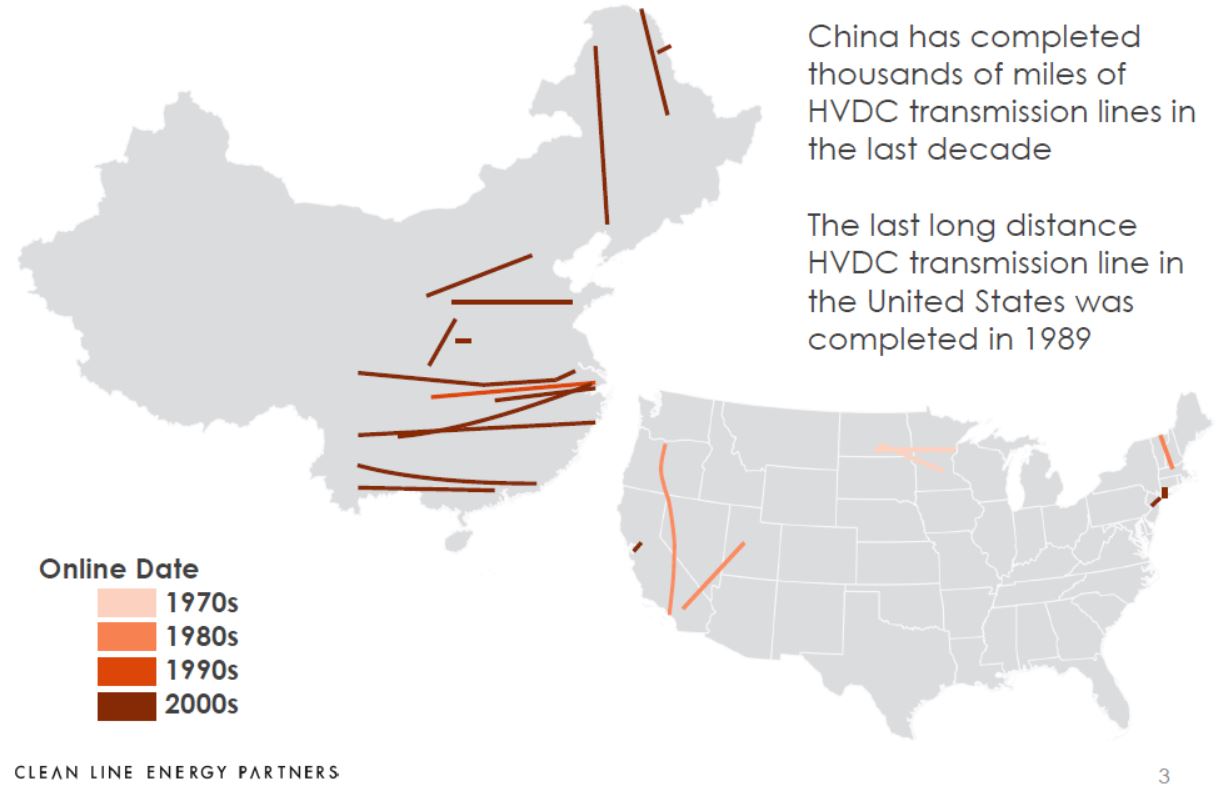
HVDC is not some hypothetically-might-be-good technology, it's increasingly forming the backbone of industrialized nations. The US is falling behind everyone else on this front. Even China is making the US look bad.
-
Re:Cost?
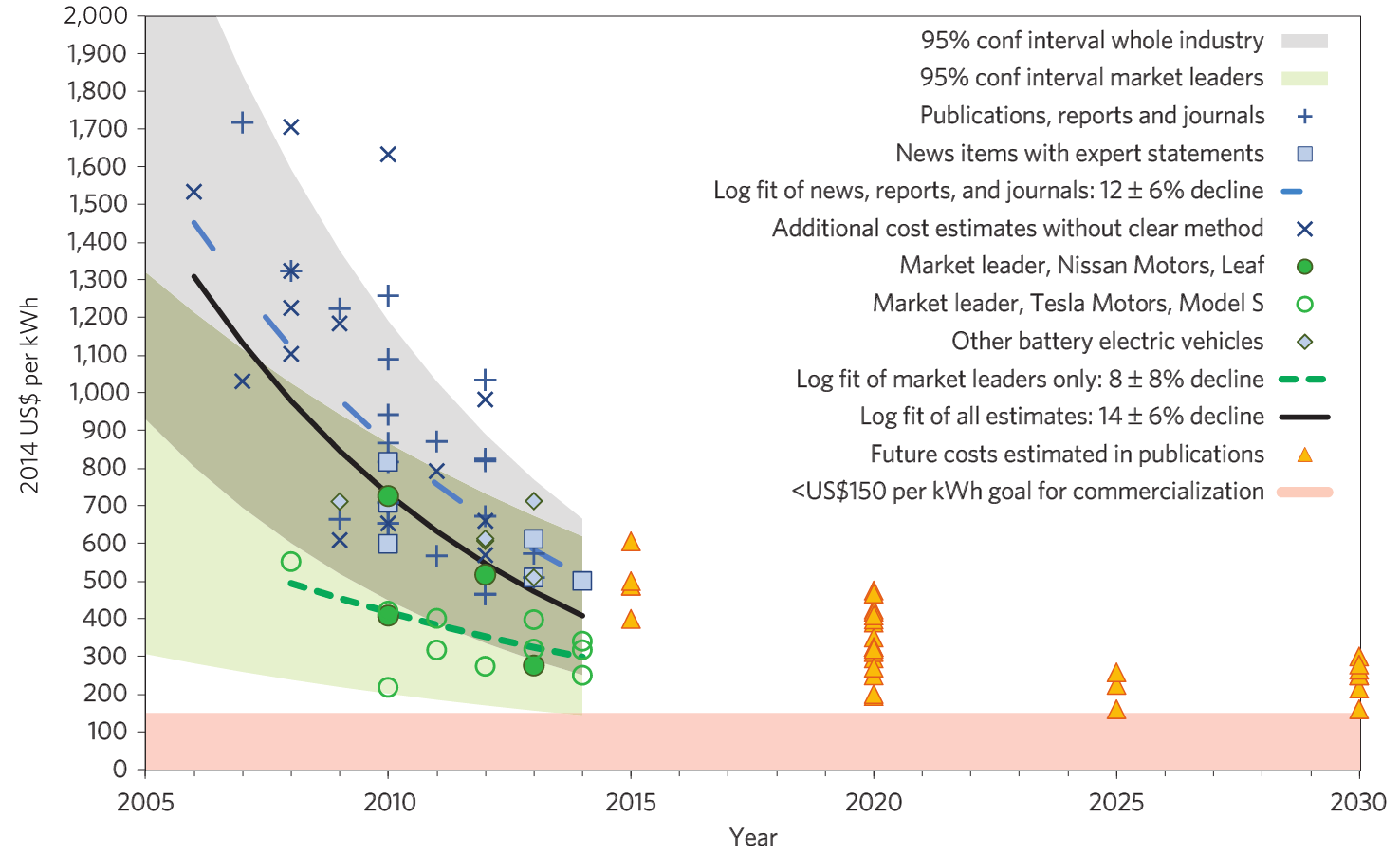
For LiIon storage, Tesla is getting close to $200 per kW hour (uninstalled) http://rameznaam.com/2015/04/1...
-
Re:Lithium demand
Not fast you say, I think you are looking at it wrong:
http://rameznaam.com/2013/09/2... -
Re:From the 'making a virtue of necessity' departm
Solar panels do not need rare earths, they can be made without them, same goes for wind turbines.
"the energy cost of creating solar panels isn't" [falling]: Flat out wrong, see: Whatâ(TM)s the EROI of Solar? | Ramez NaamThe term "rare earth" is an archaic one, dating back to the elementsâ(TM) discovery by a Swedish army lieutenant in 1787. In fact, most (though not all) of the 15 (or 16, or 17, depending on which scientist youâ(TM)re talking to) elements are fairly common; several of them are more abundant in the Earthâ(TM)s crust than lead or nitrogen.
Rare earths are sourced from China because they sell them cheap.
Declining solar panel performance is not an issue, good solar panels decline at less than 0.5% performance per year, that means they will still be going with 50% of their original efficiency 100 years from now.
Energy density is not a problem. See: Land Art Generator Initiative
A huge transition to solar panels will occur for one simple reason: price, solar+battery storage is expected to continue falling to as low as 2c per kWh of solar+battery. -
Re:wake me...
Are you sure that you are jaded or just willfully ignorant?
Show me another technology (besides wind and solar power) that has improved this quickly in the last 10 years. -
Re:The Age of Cyberpunk with its Corporate Sociali
Insomniac ? I hope you don't have that regularly, if so I suggest you do something about that. Less caffeine and less stress ?
OK, I'll be the first to admit it. I'm no expert, I suggest you talk to one.
I'm also not completely sane at this moment, this is the morning after a night on the town, their is still a lot of alcohol in my body.
Anyway, about the topic at hand...
Yes, I do think about it like a pendulum as well and about how far it can or will be pushed in one way (maybe even multiple pendulums). I think most people would really want to avoid full on revolution. Because it's hard to predict the outcome. Take for example the Arab spring. Also look at ISIS/IS/ISIL/Daesh they came out of the chaos largely created by the US (but that is a whole different topic).
Maybe I'm wrong, but I think at least some people in government get it.
Sometimes when I see police in countries like the US get more and heavier arms, I'm thinking someone is preparing for that future in a very negative way.
But let's look at the positive.
Let's take for example the people that claim that automation will take our jobs:
https://www.technologyreview.c...Maybe they are wrong, but one thing is correct, technology can cause a lot of change and it probably will. Maybe even accelerate.
When talking about that, you'd always keep in mind what Voltaire said: Work saves us from three great evils: boredom, vice and need.
Then you look at what people in some governments are trying to do:
https://en.wikipedia.org/wiki/...From a US perspective you'd think it's some kind of socialist system, but a lot of the ideas behind that came from the US from people like: Friedrich Hayek, Richard Nixon and Milton Friedman. Or as Andrew McAfee likes to say with a big smile: frothing-at-the-mouth socialists
In Europe we now have a bunch of organisations, countries and cities looking seriously into this and testing it in real life again.
From a pure technology perspective, I can see technology solving the need problem.
If energy prices do really keep falling like they have with capturing the energy from wind and solar light and heat then it will get easier (=cheaper). Take for example the Sahara Forest Project: https://www.youtube.com/watch?...
Energy storage is also still improving too: http://rameznaam.com/2013/09/2...
They seem to be on a Moore's Law like trajectory.
They might claim to be the first:
http://inhabitat.com/worlds-fi...But automatic milking also has been doing very well for how long ? over 10 years now ?
If you combine: cheap energy, cheap clean water, cheap electronics/communication, cheap energy storage, cheap food production
you get a very potent mix to solve a large part of the problem of need that Voltaire talked about. In the documentary I linked they also talk about cheap health care (I hope so). Those are some very positive trends.Cheap technology also seems to create a more decentralized future, so maybe in that sense Bitcoin/OpenBazaar and solar panels are similar.
I'm from Europe, I personally don't see the state as my enemy like some people in the US or some in Bitcoin do. For example I think of the government as the biggest VC funder/risk taker of them all. Who would spend more than 10 years on fundamental research with a high amount of risk of failure and then give it away for free (simple example: Internet, funded by ARPA now called DARPA. I don't know if it was considered a risky endeavour at the time, but it's an ex
-
Re:Post-scarcity society kicking in.
When you say post-scarcity in other words you are saying abundance:
https://www.youtube.com/watch?...
In this video it's explained how the price of solar power is on a similar Moore's law-track like a lot of electronics.
And if you have cheap solar power, you have cheap power, when you have cheap power can convert salt/unclean water to clean water cheaply. When you have cheap water and power you can grow food pretty darn cheaply.
What they didn't know when they made the video is that energy storage is also on a Moore's law track:
http://rameznaam.com/2015/04/1...The prediction in 2014 was: grid-parity in Germany in summer of 2016
http://cleantechnica.com/2014/...Now that really is abundance:
- cheap electronics
- cheap computing
- cheap decentralized power
- cheap power storage
- cheap water
- cheap food
- we already have cheap software with free- and open source software
- silicon photonics was delayed by one year says Intel, but supposedly we should have cheap networking and other connections too.And they think they can make at least certain parts of health care cheap too.
Now it isn't all great there are big society challenges ahead when automation takes away all the simple tasks and keep moving up the ladder.
-
Re:A first step
"GTAI and Deutsche Bank’s conclusion - based on the price trends of solar, batteries, electricity in Germany, and German feed-in-tariffs - is that ‘battery parity’, the moment when home solar + a lithium-ion battery makes economic sense, will arrive in Germany by next summer, 2016."