Slashdot Mirror
Domain: realclimate.org
Stories and comments across the archive that link to realclimate.org.
Comments · 1,734
-
Re:there is no climate change ? who said that?
Oh how I wish people would stop quoting skepticalscience as if a blog is a scientific resource.
It's kind of sad that you can make so many errors in one sentence. I referenced Skeptical Science because they have articles explaining in more detail exactly what I was explaining. I quoted one of the authors of the paper used by the parent to that post explicitly contradicting the view presented based on that's author's paper. How I wish you wouldn't ignore things that were inconvenient to you.
Skeptical science says exactly would you did, and most of what they say is sourced against another blog(RealClimate.org) which was at least started by a pair of actual scientists, but is still itself not subject to peer review either and really does not belong in your exhibit of evidences.
Isn't this just an ad hominem attack?
This is is what is WRONG with the whole 'debate'.
I would agree that your behaviour is exactly what is "WRONG" with this whole debate.
it very clearly shows temperatures as measured by proxy records matched or exceeded todays temperatures on multiple occasions in the last 2k years.
That would have been interesting if you had backed it up with actual evidence to support the claim. However, all I see is hand-waving and quote-mining. Looking at the graphs in the actual article shows one proxy in the Southern Hemisphere that appears to rival current temperatures at exactly one point.
Look for yourself here. there was considerable discussion, including on on RealClimate in which you'll likely find the assessment agreeable.
It's interesting, but I don't see the relevance here. It does not address the actual issue which is that no actual reconstructions show warming to actually have been higher in the past, so the dismissal of that claim as bogus is reasonable and expected, and the claim that the "current pause" indicates an end to global warming involves ignoring the oceans and wishful thinking.
Everything else you wrote is just pompous puffery. As you indicated above, we could do with less of that.
-
Re: After all the "Adjustments"
There is far too much political crap going on for me to believe it's all man's fault.
Nonesense, there's plenty of unbiased pure science out there, try the WG1 report from the IPCC, it the only report they produce where the text is not negotiable by the diplomats from the ~150 donor nations (of every political persuasion) that fund the IPCC's measly $5M/pa budget. . A huge and very tedious effort goes into creating the WG1 report, none of the scientists are paid a dime by the IPCC. The WG1 report has a remarkable reputation for accuracy and quality, it has been issued 5 times in the last 25yrs, it receives intense global scrutiny every time it's issued, yet nobody has ever found a technical error in any of the final versions, errors such as the infamous glacier glitch have been found in the reports where diplomats have the final word on contents.
If you are like me you will need to listen to some of the more communicative scientists who wrote the reports before you can even begin to understand what the WG1 report actually says in plain english. -
Re:After all the "Adjustments"
And what makes you think that isn't just EXACTLY what they do?
http://lmgtfy.com/?q=raw+clima...
Very first result: http://www.realclimate.org/ind...
Any uniformed suggestions?
-
Re:raw data
http://lmgtfy.com/?q=raw+clima...
First link on page: http://www.realclimate.org/ind...
Any other uninformed questions?
-
Re:Bad Astronomy
True and Zharkova's double dynamo hypothesis doesn't have anything to say on climate change or a mini ice age, just that there may be lowered solar activity for a while. How such low solar activity affects climate has been examined before and what they found was it would only slow global warming down a bit but not stop it. RealClimate had a post on it in 2011.
-
Chumps won't even check out a science WEBSITE
Much less to any actual research
This is OLD NEWS people
honestly, OLLLDDD news
as in FIVE YEARS OLD and has already been figured into the equations for AGW, which is real, and is getting worse. -
Re:Separation of powers or the rule of law, anyone
See level has been rising for 100's of years.
for hundreds of years prior to 1800 sea level was falling. Now it is going up quite fast and accelerating: 20th-Century sea-level rise on the U.S. Atlantic coast is faster than at any time in the past two millennia."
-
Re: Difference between Warmists and Rapturists
You shouldn't have stopped reading with Mann et al's reply, go ahead and read McShane and Wyner's rebuttal [e-publications.org].
The rebuttal is reasonably long (27 pages, not including the details), and I admit I only read some of it. However, I did read that part, and also some commentary on the rebuttal. The commentary seems to affirm that Mann's criticism on that issue was valid and the rebuttal's characterisation was inaccurate.
Regardless of whether it was reasonable for Mann et al 2008 (M08) to exclude those data sets, they did. Any attempt to criticize the statistical method used in M08 would benefit from separating the concerns of what data to include and how the data should be analysed, so the analysis should use the original input data and focus on the difference in the results produced by the methods. Unfortunately for McShane and Wyner, it seems that if you only change the methods or only change the input data, the results are less significant.
The commentary you link is to a blog post by Mann himself in which, unsurprisingly, he declares himself the winner. I'd encourage you to read the full rebuttal despite it's length. Having read both it's full details and Mann's blog post after it seems rather clear Mann is glossing over some very clear and specific details that are devastating to his claims.
-
Re: Difference between Warmists and Rapturists
You shouldn't have stopped reading with Mann et al's reply, go ahead and read McShane and Wyner's rebuttal [e-publications.org].
The rebuttal is reasonably long (27 pages, not including the details), and I admit I only read some of it. However, I did read that part, and also some commentary on the rebuttal. The commentary seems to affirm that Mann's criticism on that issue was valid and the rebuttal's characterisation was inaccurate.
Regardless of whether it was reasonable for Mann et al 2008 (M08) to exclude those data sets, they did. Any attempt to criticize the statistical method used in M08 would benefit from separating the concerns of what data to include and how the data should be analysed, so the analysis should use the original input data and focus on the difference in the results produced by the methods. Unfortunately for McShane and Wyner, it seems that if you only change the methods or only change the input data, the results are less significant.
-
Re:And 4)
Then please explain to me why the 2007 IPCC report manipulated the data (and used old, bad data) in a rather dishonest way that halved the estimated future sea level rise?
They used a low estimate of future temperature increases (lower than the best-fit temperature estimates they reported elsewhere).
They extrapolated out to only 2095 instead of 2100.
They used a model of sea level rise that predicts a past sea level rise that is only 2/3rds the measurements.
See here for a detailed discussion of the IPCC's screwup with sea level rise.
-
Re:suckers
Hydro dams (which don't and can't contribute most of the power in the USA or in the world) cause ocean acidification only to the limited extent that they rapidly increase CO2 in the atmosphere.
Another straw-man. Actually two. Hydro dams have been accused of emitting a "pulse" of CO2 when the plant-covered area behind them is flooded. Perhaps, but no more than if the same area burned in a forest fire. Hardly significant. THEN, the other accusation is that they emit CO2 because organic material falls on them and decomposes at the bottom. Also probably true. BUT... that is no more true of the dam than it is of any other large body of water. Apparently you have something against bodies of water. Do you think we should eliminate lakes because of the CO2 they emit? Because that's basically your argument. And beavers probably flood more total area than hydro dams do. I find that argument truly laughable. [Jane Q. Public, 2015-06-04]
Good grief, Jane. I said limited extent, which is also basically what I say about solar, wind, and nuclear power, while supporting them. I'm not accusing hydro dams of anything. And I certainly don't have something against bodies of water, or think we should eliminate lakes "because of the CO2 they emit"(?!). In fact, my argument has always been that bodies of water aren't emitting significant amounts of CO2.
Once again, you're mistakenly calculating the absolute value of atmospheric CO2 ("400 to 5000 ppm") rather than calculating its rate of change
It wasn't mistaken, it was quite deliberate. Nor was it misleading. I was comparing values from the Cambrian period. It's rather pointless to talk about "rate of change" between Cambrian and now (see chart again), when the time period was > 500 million years ago, and concentrations have had many rises and falls since then. Another straw man. I know your point is partly about rate of change, but it's ALSO about total change. [Jane Q. Public, 2015-06-04]
Despite Jane's hand-drawn schematic, higher atmospheric CO2 concentrations still don't cause ocean acidification unless the concentration increases rapidly. So it was misleading for Jane to compare values from the Cambrian period to learn about ocean acidification.
As Jane says, CO2 concentrations have had many rises and falls over the last 500 million years. That's why I've repeatedly showed Jane Kiessling and Simpson 2010, which concluded that "four of five global metazoan reef crises in the last 500 Myr were probably at least partially governed by OA [ocean acidification] and rapid global warming."
Kiessling and Simpson 2010 isn't misleading because, unlike Jane, they examined CO2's rate of change over the last 500 Myr.
... we are still left with the old quandary (and likelihood) of whether CO2 concentrations lagged temperature rise.
-
Re:Ozone layer is recovering
No one seems to address that possibility.
Is your google broken? This has indeed been addressed (by actual scientists) and the estimate of those impacts are of course refined as models improve.
-
Re:Maybe science went off the rails...
His whole hockey stick temperature reconstruction has been thoroughly rebuked by The Annals of Applied Statistics [projecteuclid.org]
Of course, others disagree with that sentiment. http://www.realclimate.org/ind...
I don't suppose you even looked at the author of the article you linked? I don't doubt that Mann himself disagreed with the disassembly of his paper, I'm not sure linking to a blog post by him refutes the published criticism of his misuse of statistical methods by statisticians.And of course, after the original Mann hockeystick paper, a few dozen more studies have been done that have agreed with his graph.
If by 'verified' you mean results that used similar statistical methods on different datasets. Also, as newer statistical methods have been adopted the trend has changed more and more. Even Manns own latest work notes that the method he has most confidence in, EIV, has the highest historical reconstructed temperature yet. Mann also notes in his recent paper that when calibrating his setup against the years 1900-1950 and verifying the reconstruction after 1950, ALL his methods systematically underestimate recent warming. If you notice the trend, of Manns peers and Mann himself is to repeatedly republishing more and more moderated versions of his original extreme results as his original work is put in check.
-
Re:Maybe science went off the rails...
His whole hockey stick temperature reconstruction has been thoroughly rebuked by The Annals of Applied Statistics [projecteuclid.org]
Of course, others disagree with that sentiment. http://www.realclimate.org/ind...
And of course, after the original Mann hockeystick paper, a few dozen more studies have been done that have agreed with his graph. -
Re:Any materialized predictions? (Re:Sudden?)
Here are several posts at RealClimate on the subject of whether warming has paused or not:
http://www.realclimate.org/ind...
http://www.realclimate.org/ind...
http://www.realclimate.org/ind...
http://www.realclimate.org/ind...There are indications that the PDO is switching to a warm phase that generally favors El Ninos. If that happens temperatures may well move above climate model projections in a few years. It's all a part of the noise of natural variability. As I said before less than about 30 years is too short a time period to make judgements about the temperature trends.
You want to link a journal over a blog please? There is no argument or discussion about the matter. The instrumental temperature record as recorded in the HADCRUT data set used in virtually every climate modelling experiment has a higher linear warming rate from 1950-2012 than from 1998-2012. There is no debate on the matter, that's simply a fact. Any source denying this is very simply being dishonest.
That said, as I pointed out before several times, the energy imbalance at TOA is where the actual greenhouse effect is going on. For pretty near the duration of satellite records there we have seen a consistent imbalance with more energy coming in than going out annually. That imbalance is also agreed to have had no annual trend since 2000 or longer. That means the planet's been gaining energy at the same rate before and after 98 and only temperature has been fluctuating rates. The question of importance is what is the real temp response to that increasing temperature? The linear rate from 1950-2012 or from 1950-1998? That's an active area of study and simply saying don't tLk about it, or it isn't important is just dishonest, as I've repeated a couple times now. The only guys I've seen really adamant about rejecting that are alarmists that want to claim greater than linear warming and catastrophe are near, since the data refutes them they reject or deny it.
-
Re:Any materialized predictions? (Re:Sudden?)
Here are several posts at RealClimate on the subject of whether warming has paused or not:
http://www.realclimate.org/ind...
http://www.realclimate.org/ind...
http://www.realclimate.org/ind...
http://www.realclimate.org/ind...There are indications that the PDO is switching to a warm phase that generally favors El Ninos. If that happens temperatures may well move above climate model projections in a few years. It's all a part of the noise of natural variability. As I said before less than about 30 years is too short a time period to make judgements about the temperature trends.
You want to link a journal over a blog please? There is no argument or discussion about the matter. The instrumental temperature record as recorded in the HADCRUT data set used in virtually every climate modelling experiment has a higher linear warming rate from 1950-2012 than from 1998-2012. There is no debate on the matter, that's simply a fact. Any source denying this is very simply being dishonest.
That said, as I pointed out before several times, the energy imbalance at TOA is where the actual greenhouse effect is going on. For pretty near the duration of satellite records there we have seen a consistent imbalance with more energy coming in than going out annually. That imbalance is also agreed to have had no annual trend since 2000 or longer. That means the planet's been gaining energy at the same rate before and after 98 and only temperature has been fluctuating rates. The question of importance is what is the real temp response to that increasing temperature? The linear rate from 1950-2012 or from 1950-1998? That's an active area of study and simply saying don't tLk about it, or it isn't important is just dishonest, as I've repeated a couple times now. The only guys I've seen really adamant about rejecting that are alarmists that want to claim greater than linear warming and catastrophe are near, since the data refutes them they reject or deny it.
-
Re:Any materialized predictions? (Re:Sudden?)
Here are several posts at RealClimate on the subject of whether warming has paused or not:
http://www.realclimate.org/ind...
http://www.realclimate.org/ind...
http://www.realclimate.org/ind...
http://www.realclimate.org/ind...There are indications that the PDO is switching to a warm phase that generally favors El Ninos. If that happens temperatures may well move above climate model projections in a few years. It's all a part of the noise of natural variability. As I said before less than about 30 years is too short a time period to make judgements about the temperature trends.
You want to link a journal over a blog please? There is no argument or discussion about the matter. The instrumental temperature record as recorded in the HADCRUT data set used in virtually every climate modelling experiment has a higher linear warming rate from 1950-2012 than from 1998-2012. There is no debate on the matter, that's simply a fact. Any source denying this is very simply being dishonest.
That said, as I pointed out before several times, the energy imbalance at TOA is where the actual greenhouse effect is going on. For pretty near the duration of satellite records there we have seen a consistent imbalance with more energy coming in than going out annually. That imbalance is also agreed to have had no annual trend since 2000 or longer. That means the planet's been gaining energy at the same rate before and after 98 and only temperature has been fluctuating rates. The question of importance is what is the real temp response to that increasing temperature? The linear rate from 1950-2012 or from 1950-1998? That's an active area of study and simply saying don't tLk about it, or it isn't important is just dishonest, as I've repeated a couple times now. The only guys I've seen really adamant about rejecting that are alarmists that want to claim greater than linear warming and catastrophe are near, since the data refutes them they reject or deny it.
-
Re:Any materialized predictions? (Re:Sudden?)
Here are several posts at RealClimate on the subject of whether warming has paused or not:
http://www.realclimate.org/ind...
http://www.realclimate.org/ind...
http://www.realclimate.org/ind...
http://www.realclimate.org/ind...There are indications that the PDO is switching to a warm phase that generally favors El Ninos. If that happens temperatures may well move above climate model projections in a few years. It's all a part of the noise of natural variability. As I said before less than about 30 years is too short a time period to make judgements about the temperature trends.
You want to link a journal over a blog please? There is no argument or discussion about the matter. The instrumental temperature record as recorded in the HADCRUT data set used in virtually every climate modelling experiment has a higher linear warming rate from 1950-2012 than from 1998-2012. There is no debate on the matter, that's simply a fact. Any source denying this is very simply being dishonest.
That said, as I pointed out before several times, the energy imbalance at TOA is where the actual greenhouse effect is going on. For pretty near the duration of satellite records there we have seen a consistent imbalance with more energy coming in than going out annually. That imbalance is also agreed to have had no annual trend since 2000 or longer. That means the planet's been gaining energy at the same rate before and after 98 and only temperature has been fluctuating rates. The question of importance is what is the real temp response to that increasing temperature? The linear rate from 1950-2012 or from 1950-1998? That's an active area of study and simply saying don't tLk about it, or it isn't important is just dishonest, as I've repeated a couple times now. The only guys I've seen really adamant about rejecting that are alarmists that want to claim greater than linear warming and catastrophe are near, since the data refutes them they reject or deny it.
-
Re:Any materialized predictions? (Re:Sudden?)
Here are several posts at RealClimate on the subject of whether warming has paused or not:
http://www.realclimate.org/ind...
http://www.realclimate.org/ind...
http://www.realclimate.org/ind...
http://www.realclimate.org/ind...There are indications that the PDO is switching to a warm phase that generally favors El Ninos. If that happens temperatures may well move above climate model projections in a few years. It's all a part of the noise of natural variability. As I said before less than about 30 years is too short a time period to make judgements about the temperature trends.
-
Re:Any materialized predictions? (Re:Sudden?)
Here are several posts at RealClimate on the subject of whether warming has paused or not:
http://www.realclimate.org/ind...
http://www.realclimate.org/ind...
http://www.realclimate.org/ind...
http://www.realclimate.org/ind...There are indications that the PDO is switching to a warm phase that generally favors El Ninos. If that happens temperatures may well move above climate model projections in a few years. It's all a part of the noise of natural variability. As I said before less than about 30 years is too short a time period to make judgements about the temperature trends.
-
Re:Any materialized predictions? (Re:Sudden?)
Here are several posts at RealClimate on the subject of whether warming has paused or not:
http://www.realclimate.org/ind...
http://www.realclimate.org/ind...
http://www.realclimate.org/ind...
http://www.realclimate.org/ind...There are indications that the PDO is switching to a warm phase that generally favors El Ninos. If that happens temperatures may well move above climate model projections in a few years. It's all a part of the noise of natural variability. As I said before less than about 30 years is too short a time period to make judgements about the temperature trends.
-
Re:Any materialized predictions? (Re:Sudden?)
Here are several posts at RealClimate on the subject of whether warming has paused or not:
http://www.realclimate.org/ind...
http://www.realclimate.org/ind...
http://www.realclimate.org/ind...
http://www.realclimate.org/ind...There are indications that the PDO is switching to a warm phase that generally favors El Ninos. If that happens temperatures may well move above climate model projections in a few years. It's all a part of the noise of natural variability. As I said before less than about 30 years is too short a time period to make judgements about the temperature trends.
-
Re:The thankless job of solving nonexisting proble
You might also want to take a look at this post (just came across it with a quick search), which notes that a mainstream projection (in Science Magazine) in 1981 has come in very close to actual warming, but a little lower. Or you could look at this post or this post about projections made in 1990 and 1999 which are also coming out right.
More fundamentally, I'd ask you to take a look at the basics of atmospheric modeling, and point out where you think the mainstream models are wrong. You could start with the American Chemical Society's section on "Atmospheric Warming", particularly the Single-Layer Atmosphere Model and Multi-Layer Atmosphere Model. These are pretty easy to understand, and the underlying principles are at least as well established as the other areas of science we rely on for our high-tech lives. If you can't be bothered to understand the basic physical processes involved, you have no business debating climate science.
-
Re:Corrupted Minds Will Say Anything
Personal experience of an author trying to publish something going against established opinion:
-
Re:Nutz
Your comment has nothing to do with the original claim, that rapid changes does not happen. They do - and the cause is completely irrelevant when it comes to how those changes affect vegetation, animal life or humans. Neither is the paper limited to volcanic cooling events, which you claim, which makes me wonder if you've read it. If you didn't read it - then what is the point in writing a reply?
Additionally, if you claim that there's newer research the last 20 years which disproves the paper then please cite that research.
Sorry, I have read all of it now and poked around a bit. A recent RealClimate summary notes that there is a "well-known tipping point" in the North Atlantic overturning, which is consistent with the findings in the summary paper you linked, but published in 2008. So it looks like we still aren't any less screwed...
-
Re:This is interesting....
Haven't looked at average temperatures anytime recently, have you?
http://www.realclimate.org/ind...
2014 was the warmest recorded year.
-
Re:Models compared to reality
It's not what I say, it's what Gavin Schmidt, James Hansen's colleague and successor as head of GISS says:
Hansen et al, 1988
Finally, we update the Hansen et al (1988) comparisons. Note that the old GISS model had a climate sensitivity that was a little higher (4.2C for a doubling of CO2) than the best estimate (~3C) and as stated in previous years, the actual forcings that occurred are not the same as those used in the different scenarios. We noted in 2007, that Scenario B was running a little high compared with the forcings growth (by about 10%) using estimated forcings up to 2003 (Scenario A was significantly higher, and Scenario C was lower), and we see no need to amend that conclusion now.
- See more at: http://www.realclimate.org/ind...Schmidt should know so I'll take his word for it.
-
Re:Models compared to reality
It's not what I say, it's what Gavin Schmidt, James Hansen's colleague and successor as head of GISS says:
Hansen et al, 1988
Finally, we update the Hansen et al (1988) comparisons. Note that the old GISS model had a climate sensitivity that was a little higher (4.2C for a doubling of CO2) than the best estimate (~3C) and as stated in previous years, the actual forcings that occurred are not the same as those used in the different scenarios. We noted in 2007, that Scenario B was running a little high compared with the forcings growth (by about 10%) using estimated forcings up to 2003 (Scenario A was significantly higher, and Scenario C was lower), and we see no need to amend that conclusion now.
- See more at: http://www.realclimate.org/ind...Schmidt should know so I'll take his word for it.
-
Re:What "historical predictions"?
You didn't read the Real Climate post did you. Regarding Hansen's model it said (my bold):
Finally, we update the Hansen et al (1988) (doi) comparisons. Note that the old GISS model had a climate sensitivity that was a little higher (4.2C for a doubling of CO2) than the best estimate (~3C) and as stated in previous years, the actual forcings that occurred are not the same as those used in the different scenarios. We noted in 2007, that Scenario B was running a little high compared with the forcings growth (by about 10%) using estimated forcings up to 2003 (Scenario A was significantly higher, and Scenario C was lower), and we see no need to amend that conclusion now. - See more at: http://www.realclimate.org/ind...
So scenario C wouldn't match observations if the Hansen model had a sensitivity closer to current estimates.
-
Re:Awesome Models
You'd have a great point, but you don't seem to be able to recognize the difference between rhetoric and science...
This is science. This is rhetoric. Specifically, the latter is a sub-genre of rhetoric known as apologia.
The former might be reasonably construed as dialectic, but now we're getting way over your head. Go smoke another joint an be gone. -
Re:Awesome Models
The models are not garbage. It sounds like your expectation of what they should be in unrealistic. Gavin Schmidt, a person who understands the models because he helps write them (the GISS Model E climate model) wrote this comparison between models and observations in 2013. Weather is still well within the expectations of climate models.
-
Learning Curve
What you are calling a growth curve is often called a learning curve. It is the idea that costs reduce as more of the technology is deployed. People get bright ideas as they work in the field, going to greater scale means more can be produced with less labor, etc... You are correct that nuclear power gets more expensive with time. http://thinkprogress.org/clima... There are technologies where the more common behavior is seen. Wind and solar power are growing exponentially owing to lower and lower cost as more are deployed. At their current growth rates either can replace all the world's energy demand around the year 2035. http://www.realclimate.org/ind...
-
Re: Let it happen
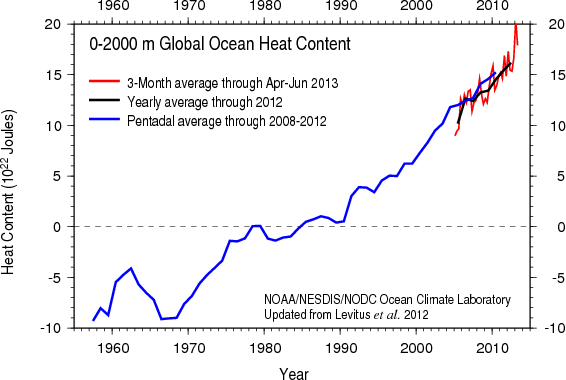
A nuclear bomb has about 6.3e+13 Joules of energy. The ocean has accumulated about 20e+22 Joules since 1980. That's about 3 billion nukes.
-
Re:Whenever you want something other people have..
I don't know, if you sincerely don't understand my request, or are trying to weasel out without losing face (too much).
Here it is again: please, post pairs of links. The first link in each pair shall point to a quantifiable prediction, the second — to its materialization within 80% of the predicted quantity.
In particular I direct your attention to this graph of Arctic sea ice models vs. observations.
That chart references some predictions without links. The dramatic bold red line on it begins in 1950 — is that, when the first predictions were made? Where are they, can I read them?
But, Ok, let's stipulate the prediction really was made. Was it a scientific one — based on a decent scientific theory, or is it one of those "stalled clock" sort of thing, that happens to be correct twice a day? Two questions arise:
- If it were a solid theory linking Global warming to declines in sea ice, why did sea ice grow in Antarctica during the same period? Maybe, it did not grow at quite the same rate, but the overall ice-cover decline is certainly far less dramatic, than your chart shows.
- The second question is, can we trust the cited observations at all — or are they being "adjusted" to, infamously, "hide the decline"? Seems like the latter is the case — the American Thinker article linked to above is rather illuminating: the actual measurements measure area of ice-cover, but the scary charts plot the adjusted extent values, without explanation for the adjustments and their inconsistency. It does not have to be outright fraud — but such measurements are inherently imprecise. Observations are made by satellites and then need to be munged (for "quality control and homogenization") by computer algorithms. Programs, that change over the years (as do the #defines inside them) at the hands of people. People with agendas and the burning desire to convince.
So, after much back-and-forth, you were able to, sort of, cite one very questionable observation (that disappeared since then as the ice returned on both poles since 2012), that may or may not have been predicted... And you want the world to change its way of life based on that?
-
Re:Whenever you want something other people have..
I don't know, if you sincerely don't understand my request, or are trying to weasel out without losing face (too much).
Here it is again: please, post pairs of links. The first link in each pair shall point to a quantifiable prediction, the second — to its materialization within 80% of the predicted quantity.
In particular I direct your attention to this graph of Arctic sea ice models vs. observations.
That chart references some predictions without links. The dramatic bold red line on it begins in 1950 — is that, when the first predictions were made? Where are they, can I read them?
But, Ok, let's stipulate the prediction really was made. Was it a scientific one — based on a decent scientific theory, or is it one of those "stalled clock" sort of thing, that happens to be correct twice a day? Two questions arise:
- If it were a solid theory linking Global warming to declines in sea ice, why did sea ice grow in Antarctica during the same period? Maybe, it did not grow at quite the same rate, but the overall ice-cover decline is certainly far less dramatic, than your chart shows.
- The second question is, can we trust the cited observations at all — or are they being "adjusted" to, infamously, "hide the decline"? Seems like the latter is the case — the American Thinker article linked to above is rather illuminating: the actual measurements measure area of ice-cover, but the scary charts plot the adjusted extent values, without explanation for the adjustments and their inconsistency. It does not have to be outright fraud — but such measurements are inherently imprecise. Observations are made by satellites and then need to be munged (for "quality control and homogenization") by computer algorithms. Programs, that change over the years (as do the #defines inside them) at the hands of people. People with agendas and the burning desire to convince.
So, after much back-and-forth, you were able to, sort of, cite one very questionable observation (that disappeared since then as the ice returned on both poles since 2012), that may or may not have been predicted... And you want the world to change its way of life based on that?
-
Re:Whenever you want something other people have..
Ok, here's another Real Climate post on comparisons between model projections and observations. In particular I direct your attention to this graph of Arctic sea ice models vs. observations.
-
Re:Whenever you want something other people have..
Ok, here's another Real Climate post on comparisons between model projections and observations. In particular I direct your attention to this graph of Arctic sea ice models vs. observations.
-
Re:Whenever you want something other people have..
Ok, here a Real Climate post on Sea Level in the 5th IPCC Report. Figure 3a compares model projections of sea level rise to observations and since the 1950s the observations have been consistently above the mode projections. At the bottom of the post are references to the scientific papers the information was gleaned from. In each IPCC report since the second the sea level predictions have been higher than in the previous report and yet observations continue to be higher still. I guess you may classify those as failed predictions but they failed because it's worse than we predicted, not better.
It always surprises me how people can be so unskeptical of an article like your New American article. The AC did a decent job of addressing it but I'll comment on a couple of the points.
Regarding the global cooling predicted in the 1970's between 1965 and 1979 there were 7 published papers predicting global cooling and 42 predicting global warming. Global warming wins 6:1.
The Himalayan Glaciers melting by 2035 was a failure of proof reading by the relevant experts. The error was in the WG II report and if you look in the WG I report where the real science is laid out you would see nothing to support that.
As to Antarctic ice, yes the sea ice has grown (but not as much as Arctic sea ice has fallen) but the ice sheet, the ice sitting on the Antarctic continent lost and average of 70 Gt/year from 1992 to 2011.
Enough for now.
-
Re:Bias: but for them - not me!
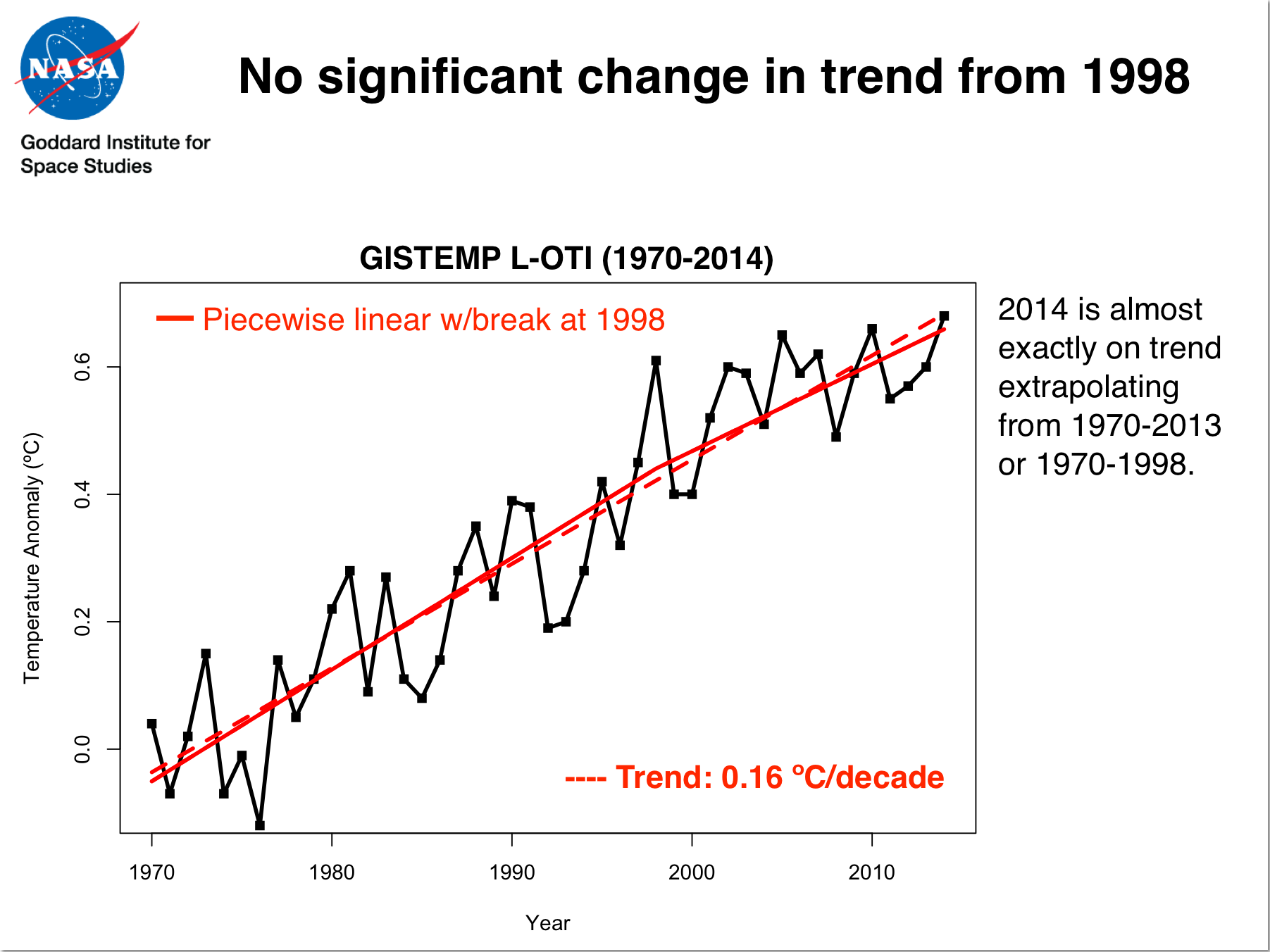
No, he did not compare the 1970-2000 trend with the 2000-2015 trend. That is where YOU are confused. From the RealClimate site: "the underlying long-term trend has not changed appreciably over the last decade or so. (Tamino has a good post on this as well)... 2014 is almost exactly on trend extrapolating from 1970-2013 or 1970-1998".
-
Re:Going down the up escalator
2014 was NOT the hottest year
So which year was? There will always be uncertainty, so we should never say that any year is hotter than another? That's just silly.
"Not that meaningful." I guess I shouldn't expect that kind of plain honesty in a NASA press release. NASA scientists seem more interested in politics and staying "on message".
HA HA HA HA HA! You've swallowed the denier conspiracy theories hook line and sinker! Here's what the head of NASA's climate group said:
This is also despite the fact that differences of a few hundredths of a degree are simply not that important to any key questions or issues that might be of some policy relevance. A record year doesn’t appreciably affect attribution of past trends, nor the projection of future ones. It doesn’t re-calibrate estimated impacts or affect assessments of regional vulnerabilities. Records are obviously more expected in the presence of an underlying trend, but whether they occur in 2005, 2010 and 2014, as opposed to 2003, 2007 and 2015 is pretty much irrelevant. - http://www.realclimate.org/ind...
-
Re:This makes sense nomatter your politik
Methane doesn't last long in the atmosphere
that '25 times as powerful as CO2' statistic is its equivalent over a 100-year period. even though methane may not last long before being oxidized into CO2, during that period it has a much greater forcing.
trust me here, methane aint nothin to fuck with. tightening up leaks is inarguably a good thing.
OH BS;
Methane degrades into CO2, in fact, so in simulations I did (Archer and Buffett, 2005) the radiative forcing from the elevated methane concentration throughout a long release was about matched by the radiative forcing from the extra CO2 accumulating in the atmosphere from the methane as a carbon source.
If the warmistas at realclimate say it ain't the methane, it ain't the methane! Everybody is just freaking becuase there has been no statisically significant lower troposheric warming for over 18 years and OCO is showing that the significant sources of Atmospheric CO2 isn't the evil(tm) westerners but the Chinese, the rain forrests and geological sources.
-
Re:A bit rich
Debunking debunked. Repeating right wing bullshit over and over again doesn't make it more true and less bullshit.
Sorry.
-
Re:Stop trying to win this politically
. Climate "science" on the other hand does exactly what you describe here. It looks at past data and attempts to fit it to a hypothesis. That's not science at all.
You are talking about one small vein of climate science -- and creating and testing models is actually science. It's part of "signal processing". I know you will get distracted by that last comment. So again, and speaking very, very, slowly. Modeling is a tiny part of climate science, and the AGW hypothesis does not depend on it in the slightest. See here and here.
-
Re:Stop trying to win this politically
. Climate "science" on the other hand does exactly what you describe here. It looks at past data and attempts to fit it to a hypothesis. That's not science at all.
You are talking about one small vein of climate science -- and creating and testing models is actually science. It's part of "signal processing". I know you will get distracted by that last comment. So again, and speaking very, very, slowly. Modeling is a tiny part of climate science, and the AGW hypothesis does not depend on it in the slightest. See here and here.
-
Re: Established science CANNOT BE QUESTIONED!
so you obviously dont actually know anything about the NIPCC.
the NIPCC are not actual scientists, and they have not put forward evidence capable of withstanding scientific scrutiny.
the NIPCC cherry picks data that supports them, rather than presenting all the data.
When TFA talks about "conclusions based on a priori convictions"...the NIPCC is one of the groups they are talking about.The sole purpose of the NIPCC is not to present any evidence, nor even survey and report on on the sum body of all the research.
Rather it's sole purpose is to poke holes in the IPCC, something its members are paid to do:On the other hand, according to the Heartland 2012 budget plan, the purpose of the NIPCC report is to critique the IPCC report. According to the Heartland 2012 Fundraising Plan, its purpose is to create a rebuttal to the IPCC report.
In short, the purpose of the IPCC report is to accurately summarize the most up-to-date state of climate science research and understanding, whereas the purpose of the NIPCC report is to try and poke holes in the IPCC report (unsuccessfully, as we will see below).
Second, unlike the IPCC report, the scientists contributing to the NIPCC report are paid for their efforts. The overall Heartland budget for the NIPCC reports from 2010 to 2013 is nearly $1.6 million ($388,000 in both 2011 and 2012), with $460,000 going to the lead authors and contributors ($140,000 in both 2011 and 2012). The 2011 Interim NIPCC report has 3 lead authors (Craig Idso, Fred Singer, and Robert Carter) and 8 contributors (Susan Crockford, Joe D'Aleo, Indur Goklany, Sherwood Idso, Anthony Lupo, Willie Soon, Mitch Taylor, and Madhav Khandekar), most of whom also receive a monthly salary from the Heartland Institute.
Note that Heartland is not the only think tank contributing to the NIPCC report; the Centre for the Study of Carbon Dioxide and Global Change (CSCDGC) and Science and Environmental Policy Project (SEPP) are both listed as contributors on the document's front cover.
Basically these scientists are paid with the specific goal of arguing against the scientific evidence in the IPCC report, whereas the only goal of the IPCC authors is to produce an accurate, comprehensive review of the climate science literature. Indeed, this represents the biggest difference between the IPCC and NIPCC: the former is a comprehensive literature review, while the latter is a very select literature review.
The NIPCC cherry picks data, chiefly that of "skeptics" that support their already made conclusions and goals:
The NIPCC report exclusively examines the literature published by climate "skeptics," whereas the IPCC report examines the work of both "skeptics" and mainstream climate scientists.
The NIPCC repeats and perpetuates bad science and myths, including cliamte myths that contradict each other:
Climate scientists Michael Mann and Gavin Schmidt have also documented a number of the long-debunked climate myths propagated in previous NIPCC reports, which we have rebutted by examining the full body of scientific literature at Skeptical Science (click the links below for the myth debunkings):
-
Re:It is only difficult when fallacious
You know what, we're getting caught up in what models can or cannot do but in the end it doesn't matter. Climate models are just tools to investigate our understanding of the interaction of the different components of the climate system. As I said they will always be imperfect but they are useful. So I guess I'm changing the subject but so be it.
The diagnosis of anthropogenic global warming comes from the basic science of the radiative characteristics of greenhouse gases. That is fundamental falsifiable science that you can't get around. The effects of greenhouse gases in the atmosphere can be measured by taking radiative energy reading starting from the surface to the top of the atmosphere and observing how that changes at different elevations. The effects of the different greenhouse gases are relatively easy to extract from that data.
The scientist who Gore cited whoever that is is late to the parade after Fourier, Tyndall in the 1850's, Arrhenius in the 1890's, Gilbert Plass in the 1950's and James Hanson in the 1970's & 1980's. His change of heart doesn't really change anything else.
Regarding UN reports, the IPCC Working Group I reports were all completely written by scientists involved in the research. Even the Summary for Policy Makers is written by scientists although it gets vetted by politicians. Still nothing gets through it without the approval of the authors of the WG1 full report. The Working Group II and especially the Working Group III reports do have some non-scientists helping to write them but the WG1 report is the critical one to our scientific understanding of climate change.
The politicization of the issue is almost entirely due to people who don't like the implications and proposed solutions. As Upton Sinclair said "It is difficult to get a man to understand something, when his salary depends on his not understanding it."
Can you cite a reference for the Japanese studies? I'd be interested in see what it actually had to say rather than just taking your word for it.
So far as I can see the output of models has generally been pretty good and nothing that has happened has shown the models are just flat wrong. Of course they will be better in the future as we learn more and can apply more computing power to them but they're the best thing we have now so we might as well use them. It seems to me that your expectations for what models are capable of may be a little off. Here is some suggested reading to help you understand them better:
FAQ on Climate Models
FAQ on Climate Models: Part II
Why trust climate models, it's a matter of simple science -
Re:It is only difficult when fallacious
You know what, we're getting caught up in what models can or cannot do but in the end it doesn't matter. Climate models are just tools to investigate our understanding of the interaction of the different components of the climate system. As I said they will always be imperfect but they are useful. So I guess I'm changing the subject but so be it.
The diagnosis of anthropogenic global warming comes from the basic science of the radiative characteristics of greenhouse gases. That is fundamental falsifiable science that you can't get around. The effects of greenhouse gases in the atmosphere can be measured by taking radiative energy reading starting from the surface to the top of the atmosphere and observing how that changes at different elevations. The effects of the different greenhouse gases are relatively easy to extract from that data.
The scientist who Gore cited whoever that is is late to the parade after Fourier, Tyndall in the 1850's, Arrhenius in the 1890's, Gilbert Plass in the 1950's and James Hanson in the 1970's & 1980's. His change of heart doesn't really change anything else.
Regarding UN reports, the IPCC Working Group I reports were all completely written by scientists involved in the research. Even the Summary for Policy Makers is written by scientists although it gets vetted by politicians. Still nothing gets through it without the approval of the authors of the WG1 full report. The Working Group II and especially the Working Group III reports do have some non-scientists helping to write them but the WG1 report is the critical one to our scientific understanding of climate change.
The politicization of the issue is almost entirely due to people who don't like the implications and proposed solutions. As Upton Sinclair said "It is difficult to get a man to understand something, when his salary depends on his not understanding it."
Can you cite a reference for the Japanese studies? I'd be interested in see what it actually had to say rather than just taking your word for it.
So far as I can see the output of models has generally been pretty good and nothing that has happened has shown the models are just flat wrong. Of course they will be better in the future as we learn more and can apply more computing power to them but they're the best thing we have now so we might as well use them. It seems to me that your expectations for what models are capable of may be a little off. Here is some suggested reading to help you understand them better:
FAQ on Climate Models
FAQ on Climate Models: Part II
Why trust climate models, it's a matter of simple science -
Re:And where are all the hurricanes?
I think you may have tinted glasses. I'm a lay person and I certainly didn't get the impression that the sky was falling after reading Mann's essay. Regarding the two other links - Cook isn't a climate scientist and Hanson didn't say anything about tornadoes except that he had been in one and that heat is the fuel for tornados but that we don't yet know if frequency will increase and we didn't have enough data to tell if there has been a trend. On the other hand, look at these links:
David Archer on methane increase: "Is this bad news for global warming? Not really, because the one real hard fact that we know about atmospheric methane is that it’s concentration isn’t rising very quickly. Methane is a short-lived gas in the atmosphere, so to make it rise, the emission flux has to continually increase " - http://www.realclimate.org/ind...
What about that Arctic methane bomb? "Shakhova et al (2013) did not find or claim to have found a 50 Gt C reservoir of methane ready to erupt in a few years. That claim, which is the basis of the Whiteman et al (2013) $60 trillion Arctic methane bomb paper, remains as unsubstantiated as ever. - See more at: http://www.realclimate.org/ind...
The fact that the ice core records do not seem full of methane spikes due to high-latitude sources makes it seem like the real world is not as sensitive as we were able to set the model up to be. - See more at: http://www.realclimate.org/ind...
Here's William Connoly betting against an arctic death spiral (and trying to engage in a bet against arctic ice recovery): http://scienceblogs.com/stoat/...
Here is the head of the NASA climate team explaining why he and others publicly mocked a colleague during a presentation where the colleague suggested that we may be experiencing an arctic death spiral. His excuse seems to include the fact that he was mocking both sides (read further for examples): The negative engagement stemmed both from the “green” end (which we would characterize as “things are worse than they seem”) and from the “blue” end (“things are not as bad as they seem”). We were actively deflecting negative criticisms from both blue and green “wings” throughout both meetings. - https://drive.google.com/file/...
-
Re:And where are all the hurricanes?
I think you may have tinted glasses. I'm a lay person and I certainly didn't get the impression that the sky was falling after reading Mann's essay. Regarding the two other links - Cook isn't a climate scientist and Hanson didn't say anything about tornadoes except that he had been in one and that heat is the fuel for tornados but that we don't yet know if frequency will increase and we didn't have enough data to tell if there has been a trend. On the other hand, look at these links:
David Archer on methane increase: "Is this bad news for global warming? Not really, because the one real hard fact that we know about atmospheric methane is that it’s concentration isn’t rising very quickly. Methane is a short-lived gas in the atmosphere, so to make it rise, the emission flux has to continually increase " - http://www.realclimate.org/ind...
What about that Arctic methane bomb? "Shakhova et al (2013) did not find or claim to have found a 50 Gt C reservoir of methane ready to erupt in a few years. That claim, which is the basis of the Whiteman et al (2013) $60 trillion Arctic methane bomb paper, remains as unsubstantiated as ever. - See more at: http://www.realclimate.org/ind...
The fact that the ice core records do not seem full of methane spikes due to high-latitude sources makes it seem like the real world is not as sensitive as we were able to set the model up to be. - See more at: http://www.realclimate.org/ind...
Here's William Connoly betting against an arctic death spiral (and trying to engage in a bet against arctic ice recovery): http://scienceblogs.com/stoat/...
Here is the head of the NASA climate team explaining why he and others publicly mocked a colleague during a presentation where the colleague suggested that we may be experiencing an arctic death spiral. His excuse seems to include the fact that he was mocking both sides (read further for examples): The negative engagement stemmed both from the “green” end (which we would characterize as “things are worse than they seem”) and from the “blue” end (“things are not as bad as they seem”). We were actively deflecting negative criticisms from both blue and green “wings” throughout both meetings. - https://drive.google.com/file/...
-
Re:And where are all the hurricanes?
I think you may have tinted glasses. I'm a lay person and I certainly didn't get the impression that the sky was falling after reading Mann's essay. Regarding the two other links - Cook isn't a climate scientist and Hanson didn't say anything about tornadoes except that he had been in one and that heat is the fuel for tornados but that we don't yet know if frequency will increase and we didn't have enough data to tell if there has been a trend. On the other hand, look at these links:
David Archer on methane increase: "Is this bad news for global warming? Not really, because the one real hard fact that we know about atmospheric methane is that it’s concentration isn’t rising very quickly. Methane is a short-lived gas in the atmosphere, so to make it rise, the emission flux has to continually increase " - http://www.realclimate.org/ind...
What about that Arctic methane bomb? "Shakhova et al (2013) did not find or claim to have found a 50 Gt C reservoir of methane ready to erupt in a few years. That claim, which is the basis of the Whiteman et al (2013) $60 trillion Arctic methane bomb paper, remains as unsubstantiated as ever. - See more at: http://www.realclimate.org/ind...
The fact that the ice core records do not seem full of methane spikes due to high-latitude sources makes it seem like the real world is not as sensitive as we were able to set the model up to be. - See more at: http://www.realclimate.org/ind...
Here's William Connoly betting against an arctic death spiral (and trying to engage in a bet against arctic ice recovery): http://scienceblogs.com/stoat/...
Here is the head of the NASA climate team explaining why he and others publicly mocked a colleague during a presentation where the colleague suggested that we may be experiencing an arctic death spiral. His excuse seems to include the fact that he was mocking both sides (read further for examples): The negative engagement stemmed both from the “green” end (which we would characterize as “things are worse than they seem”) and from the “blue” end (“things are not as bad as they seem”). We were actively deflecting negative criticisms from both blue and green “wings” throughout both meetings. - https://drive.google.com/file/...