Slashdot Mirror
Domain: roughlydrafted.com
Stories and comments across the archive that link to roughlydrafted.com.
Comments · 990
-
10 Things to Remember About CanSecWest
"The details emerging from the CanSecWest security contest fill out a story that is bigger than the simple "Mac Shot First" headlines convey. This was not a contest where three systems were placed in an equal foot race and the Mac simply lost due to being a slower runner.
"The CanSecWest contest featured a number of security researchers, each with different backgrounds, motivations, and levels of expertise working to exploit flaws in the three systems running Mac OS X, Windows Vista, and Ubuntu Linux. However, rather than being a level contest to expose the flaws in the three systems, it was really a contest highlighting the knowledge and abilities of the researchers, each of whom targeted the platform of their choice."
10 Things to Remember About CanSecWest and Software Vulnerabilities -
Re:Why is /. Linking to Ignorant Clowns on Cnet/ZD
except that I'm not corporate media, and while I might yap on, I do have technical knowledge from experience in IT and development, and I mainly defend engineering decisions rather than present ideas that are only plausible to a trade rag audience.
I know you were just being a hater. It's easy to complain, hard to make a salient point.
iPhone 2.0 SDK: Video Games to Rival Nintendo DS, Sony PSP -
Re:Where is the competition?
If you're programming for fun then yes, do what's easy. If you want to target a platform with a sustainable market for software, then learning Cocoa/Obj-C offers additional reasons for being attracted to it. Money is kind of an important factor for many people in the decisions they make.
Is Number Two Amazon Rivaling iTunes in Music Sales? Haha No -
Re:Where is the competition?
I'm not "jumping up and down screaming" that you should learn another language. I'm saying that you can stick with Java ME while the train passes you because you are irrelevant to iPhone development.
You sound just like the insistent holdouts who pouted that they'd never buy an iPod and liked their PlaysForSure subscription and Dell DJ. I have no problem with that, and don't care what you do. You can complain about "vendor lock in" related to Apple, while tying yourself to a Sun platform that will earn you less money. Just don't flatter yourself with the thought that "Mac/iPhone users" act as a solitary class and expect anything from you personally. It's a free market in the mobile world, and I hope it stays that way.
CanSecWest and Swiss Federal Institute of Tech Deliver Attacks on the Reality of Mac Security -
Reality will disappoint morons.
While the quick win makes for a perfect headline and reflects the Hollywood image of "hackers" that twiddle on a keyboard and almost instantly "access the mainframe" while a counter runs in the background, a more intelligent question is: why did the Mac get hacked first, and why was the attack so quick?
CanSecWest and Swiss Federal Institute of Tech Deliver Attacks on the Reality of Mac Security -
Re:Where is the competition?
Its bad for Java developers, as they'll have to learn a new language and new frameworks. But they'll also have a real market for their apps, and their apps won't look like ass and fail to run on 80% of the phones that are supposed to support Java ME, MIPD etc.
Java ME is build, test on every phone, sign on every phone, sell nowhere.
The iPhone SDK will be build, sign, sell
iPhone 2.0 SDK: Java on the iPhone?
iPhone 2.0 SDK: How Signing Certificates Work -
Re:Where is the competition?
Its bad for Java developers, as they'll have to learn a new language and new frameworks. But they'll also have a real market for their apps, and their apps won't look like ass and fail to run on 80% of the phones that are supposed to support Java ME, MIPD etc.
Java ME is build, test on every phone, sign on every phone, sell nowhere.
The iPhone SDK will be build, sign, sell
iPhone 2.0 SDK: Java on the iPhone?
iPhone 2.0 SDK: How Signing Certificates Work -
Why is /. Linking to Ignorant Clowns on Cnet/ZDnet
1. Some dumbass ZDnet pundit yaps on about subjects he is unqualified to talk about technically, unaware of any of the reasons for the engineering decisions Apple makes, and suggests that the he, as an ignorant asshat, can offer the iPod maker sailent advice on how to deploy the iPhone software platform.
2. ZDnet posts it to Slashdot
3. Slashdot links to it.
4. Profit? *
* no CNet/ZDnet is going out of business. Slashdot is just wasting our time.
CanSecWest and Swiss Federal Institute of Tech Deliver Attacks on the Reality of Mac Security -
Re:Just more FUD
Based on the fact that you scoured an article with the titile "US Mac Market share rises above 8.1%" to find a statistic that shows Apple does not make as many PCs + servers as the top 5 world wide vendors, I'll say you're being disingenuous.
PC market share has always been related in worldwide numbers to flatter Microsoft. Note that the Xbox, Zune and other products that have very little penetration outside the US are never compared to worldwide figures. Why not? Why are pundits working so hard to flatter Microsoft?
Back to reality: Apple holds enough market share in the markets that it participates in to have a presence that logically should expose some security threats. In retail laptop sales, Apple now has double digit market share. Apple doesn't have to have a significant percentage of the PC Server market (which is part of those worldwide PC market share numbers that Gartner/Microsoft like to advertise) in order to face security problems on the desktop. Because Apple has so little representation in the server market, its business is almost exclusively education and home/SOHO users, markets where it has a quite significant share of the market, and one that is growing. Yet we don't see Apple suffering from 10-25% of the malware out there.
If anything, the markets Apple participates in are at greater risk of casual malware threat. Who writes spyware aimed at attacking servers supervised by professional IT staff? Macs are a prime target for spyware/identity thieves, as the Mac user demographic tend to have more money to steal. The fact that Apple's installed base lies directly on top of the most attractive target for malware authors, yet has zero viruses and no significant real world malware problem says more about vulnerabilities than any amount of statistical bullshit churned out by people trying to bait links and suggest that up is down.
Is Number Two Amazon Rivaling iTunes in Music Sales? Haha, No -
Promises, promises ... nothing. Microsoft is over.
Once again, Microsoft is making fantastic promisses that have little to do with their last set. I wonder how many current features will evaporate.
This is not a good way to make money. Vista is a failure and Windows 7 will be an even bigger failure. At a minimum, the next three years belong to GNU/Linux. Users and hardware makers alike know better than to buy into Vista now and people looking for new hardware and software are going to go Linux. By 2010, Microsoft's base will be erroded. The Microsoft game, at long last, is over.
-
Re:Replace Flash/Silverlight by an open standard
Yes it would be so much better to replace HTML with something from the makers of the Win32 API.
Silverlight's attempts to kill Flash will work out about as well as MSN's original effort to replace AOL. By the time it can catch up, there won't be any contest left. The real solution is to improve the HTML spec to the point where we don't need proprietary add-ons. WHATWG and HTML 5 will go a long way in doing that.
H.264 doesn't need a Flash playing wrapper.
iPhone 2.0 SDK: How Signing Certificates Work -
Re:What do you expect?
in the mobile space? Are you saying that Microsoft has a monopoly there?
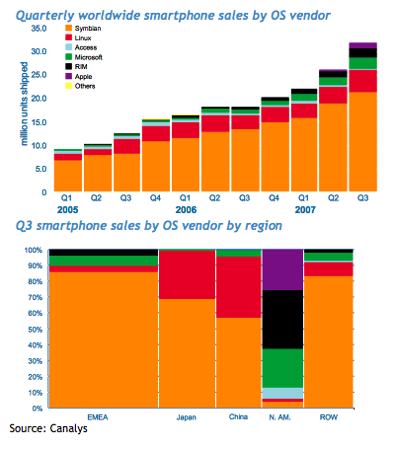
Here's a a smartphone chart by OS that I found...
If you believe it Windows Mobile has 25% market share, which, in my mind, means that they don't have a monopoly and can implement almost anything they want to, because there are -
Re:Good way to turn a positive thing negativeA 6.5% share of what? The cellphone market? In the world? In North America? Bullshit.
Smartphone market? I still find that hard to believe - there are several countries where Blackberry is, but iPhone is not.
Here's a big hint. Sales does not equate to "size of market". If in the final quarter of 2007, the iPhone sold 27% of the smartphones sold, that does not mean every one in four smartphones is an iPhone (I'm also looking at you for a basic misunderstanding of this, Mr Roughly Drafted). As the Wikipedians would say, "[citation needed]".
-
Re:Good way to turn a positive thing negative
Your parent wasn't arguing that it wasn't a 'best-selling phone' (Which it isn't, the best selling in North America would be from RIM)
What GP was trying to get at was that if Apple wanted the iPhone to be a truly competitive and flexible smart phone, the best way to accomplish that would be to open the interface completely to third party apps with the SDK. -
Re:It's an accounting thing
Well no it doesn't if your only experience is being a clerk in a small chain store.
Another thing to consider: your chain's suppliers were likely not developers, but middleman wholesale resellers who took a huge chunk of the box revenue before shipping it to you. Every link in the chain that extorts a cut has to be added up to arrive at the overall retail cut. Apple's App Store only has one link: from the developer straight to iTunes.
Instead of insisting you know everything because you've rung up a retail box, talk to some developers--particularly small developers--who will sign deals to distribute their software that returns them 50% or less (often much less), while leaving them the burden of hosting all support information, handling software updates, and handling theft prevention measures, only to find that the majority of their software is stolen by users who get a cracked serial number on the web. That is, incidentally, a huge part why there is no market for mobile software right now, nor much serious interest in shareware in general.
Now compare that to getting paid 70% for uploading a title in a venue directly visible to millions of customers, promoted by Apple in iTunes, with credit card and hosting included at no extra cost, a slick system for delivering upgrades, and unprecedented protection from wide scale piracy. Rather than selling a few hundred units at $40, you can sell tens or hundreds of thousands of units at $5 and make vastly more money.
But none of this stuff is theoretical: just ask iTunes suppliers now, who make less than a 70% cut and still report being happy with their share. Look at iPod games, which sell for $5 but are rapidly increasing in count. Those developers--including Sega and EA--are clearly not hurting under their arrangement. Apple has sold 4 billion audio tracks and owns 91% of the video downloads business. This isn't exactly an unknown market.
Apple TV Digital Disruption at Work: iTunes Takes 91% of Video Download Market -
Re:It's an accounting thing
Yeah there's lots of small developers making lots of money selling code for Linux. And what a profitable business Windows shareware is.
Of course, we're talking about mobile software here, so adjust your belt to consider that Windows Mobile software is a joke and most Linux phones don't even support development, and in particular open development.
More Absurd iPhone Myths: Third Party Software Panic
"The more than $450 of popular third party software for Windows Mobile listed above is either already provided or is not necessary on the iPhone. That's enough for the iPhone to pay for itself!" -
Re:It's an accounting thing
Yes, and nobody will buy your software from that freebee site because nobody know about it.
Apple is publishing developer's software using the same model as iTunes uses to sign up indie artists who want to sell their music without signing up with a big label. Apple is allowing developers (and musicians) to sign their own work and distribute it with high visibility. That will allow them to sell it at a lower cost, dramatically boosting their volume of sales, reaching a much wider audience, and enjoying a business that is much easier to maintain.
Seriously, anyone crying about a $99 program to get started as a publisher is completely ignorant. Look up how much it costs to develop for a games console ($15,000) or as a Palm or RIM developer. Apple is selling more phones in the US than all of Microsoft's licensees together. That's a huge market, and one hungry for software. There is currently no significant market for mobile software. Apple is going to create it, and the iFund is putting up $100 M to bet that a lot of developers are going to make big money selling $5 titles to tens of millions of iPhone users over the next couple years.
And anyone trying to make a 30% cut sound like a big deal apparently doesn't know that most retail software gives 50% or more to the retailer, leaving the developer to pay for their development, packaging, marketing, and distribution costs themselves from their own half. And if you can't afford it, maybe you should apply for some of those iFund dollars and get cracking on the next big thing.
Apple's iPhone vs Smartphone Software Makers -
Up to your old tricks again
*feeds the troll*
Note, all quotes are from http://www.roughlydrafted.com/2007/08/11/how-apple-keyboards-lost-a-logo-and-windows-pcs-gained-one/
Microsoft's contextual menu key is also typically placed on the right side of the keyboard, making it even more puzzlingly useless for right handed users. They'd have to hit the right side of the keyboard with their left hand while pointing the mouse with their right. What was Microsoft's Chief Architect thinking?
*Some* of us prefer keyboard navigation. Having the "menu" button on the keyboard lets me access my "right-click" menu while typing. I don't even have to move my hands from the keyboard! Also, if I'm in a text input field, I get a "right-click" menu at the position of my text insertion cursor, not my mouse cursor. No awkward keyboard slapping occurs here!
Microsoft also added a special key for opening contextual menus, featuring the icon of a pointer on a menu. The key simply acts like the right mouse button; it's not only superfluous and clumsy for PCs using two button mice, but also less elegant than Apple's convention for using control-clicking to bring up a menu with the mouse.
This is a "user interface familiarity" argument. You lose.
It seems they don't understand why it is useful to draw a distinction between control-C, used to cancel an operation in a terminal environment, and Command-C, used to copy content in a desktop setting. There is no difference in Windows.
Most Windows users never use ^C to terminate a program. MS-DOS folks did, but -last time I checked- COMMAND.COM didn't have a built-in clipboard, so there's no hotkey overlap.
I assume that this is related to the preceding quote? I don't think that that axe is sharp enough. Go on back to your grindstone.
A year later in 1987, IBM released its new vision of the PC, called PS/2; it only offered a standard port for the mouse and another identical but unique port for the keyboard, a mistake that would plague PC users for the next two decades.
If the 'plague' is the lack of distinction between the keyboard and mouse ports, PC97 addressed this... in 1997[1]. So, this plague only lasted a decade.
Most Windows PC users are unaware of the use of either the Windows key or the contextual menu key, and some PC hardware makers refused to add the keys to their keyboards, the most notable being IBM.
Maybe IBM et. al. had a zillion keyboards in their warehouse that they needed to sell, before they started creating ones with new keys on them? Just sayin'.
and since non-technical users had no way to guess that the Command key is represented by an Apple logo and a propeller, the latest keyboards now simply have the word "command" on them.
If you replace 'non-technical' with 'Mac OS newbies', this statement will be palatable. However, why not leave the key as a "propeller" or "cloverleaf"? The symbol is language-neutral. Seems like changing the icon for the key was a step backwards.
[Two "useless" keys are] certainly not the only example of the unsolvable issues for PCs created by
What other "unsolvable" issues are there? Can we get a bulleted list? (I'd rather not slog through the more sensational portions of your blog posts.)
[1] http://en.wikipedia.org/w/index.php?title=PC_System_Design_Guide&oldid=192070503 -
Re:In Apple's defense
Apple isn't in the business of profiting from song/movie media creation. It is a reseller. It is a retail store. WalMart doesn't really care if you bootleg Britney Spears, as long as you don't shoplift the CD. Similarly, Apple doesn't care "financially" that you use some FairPlay track outside of its studio designed license.
However, Apple has legal contracts with the studios that assure them that it will work in good faith to preserve its DRM in such a way that iTunes remains a store and not a source for widespread bootlegging and Internet distribution. This is somewhat silly because every CD sold is more of a source of unrestricted copying than a FairPlay song, and Apple would just as soon sell its tracks DRM free. That would mean Apple doesn't have to police a system that exists to keep honest people honest with some inconvenience, and try to prevent thieves from stealing, which is somewhat impossible anyway.
However, reality means that Apple does have to stop flagrant activity designed to facilitate theft. The iTunes license specifically outlines how songs can be used. The fact that Hymn allows users to violate their contract with Apple at the time of sale does not redefine the contract terms. It does however force Apple to put pressure on Hymn so Apple won't be sued or abandoned by its studio partners for failing to uphold its own resale license.
Anyone crying about iTunes restrictions should be buying CDs. There's nothing more that can be said about that. Nobody has a right to redefine the licensing terms of a product unilaterally just because they want to use it in a different way than it is being offered. If you disagree, remember how butt hurt you get when you read that TiVo or Microsoft whoever is violating the GPL.
If you support the idea of free software enforced by GPL/BSD/MIT style licenses, you have to also respect the licensing rules offered by commercial vendors, and either chose not to use them or use them in compliance with the terms of the agreement.
But there's no honor among thieves, as this thread demonstrates.
Lessons from the Death of HD-DVD
Is Apple Shedding its Final Cut Pro Apps at NAB? -
Re:In Apple's defense
Apple isn't in the business of profiting from song/movie media creation. It is a reseller. It is a retail store. WalMart doesn't really care if you bootleg Britney Spears, as long as you don't shoplift the CD. Similarly, Apple doesn't care "financially" that you use some FairPlay track outside of its studio designed license.
However, Apple has legal contracts with the studios that assure them that it will work in good faith to preserve its DRM in such a way that iTunes remains a store and not a source for widespread bootlegging and Internet distribution. This is somewhat silly because every CD sold is more of a source of unrestricted copying than a FairPlay song, and Apple would just as soon sell its tracks DRM free. That would mean Apple doesn't have to police a system that exists to keep honest people honest with some inconvenience, and try to prevent thieves from stealing, which is somewhat impossible anyway.
However, reality means that Apple does have to stop flagrant activity designed to facilitate theft. The iTunes license specifically outlines how songs can be used. The fact that Hymn allows users to violate their contract with Apple at the time of sale does not redefine the contract terms. It does however force Apple to put pressure on Hymn so Apple won't be sued or abandoned by its studio partners for failing to uphold its own resale license.
Anyone crying about iTunes restrictions should be buying CDs. There's nothing more that can be said about that. Nobody has a right to redefine the licensing terms of a product unilaterally just because they want to use it in a different way than it is being offered. If you disagree, remember how butt hurt you get when you read that TiVo or Microsoft whoever is violating the GPL.
If you support the idea of free software enforced by GPL/BSD/MIT style licenses, you have to also respect the licensing rules offered by commercial vendors, and either chose not to use them or use them in compliance with the terms of the agreement.
But there's no honor among thieves, as this thread demonstrates.
Lessons from the Death of HD-DVD
Is Apple Shedding its Final Cut Pro Apps at NAB? -
Re:!freemarket
HD-DVD discs were not significantly cheaper, and "storing more data" requires comparing fewer layers of Blu-Ray against HD-DVD (asshat!). If manufacturers were so excited about HD-DVD, why was Toshiba the only one making them?
The reality was that industry collectively got behind Blu-Ray back in 2005 long before consumers even had a choice in the matter. Microsoft and Intel hoped to keep HD-DVD going, influenced Toshiba to stay in the race despite its interests in backing Blu-Ray itself, and later pushed Paramount/DreamWorks to sign up as exclusive HD-DVD studios. That was entirely because Microsoft hoped to monopolize the HD video market with Windows Media/VC-1, WinCE-based HDi interactivity, and the Windows-only Managed Copy DRM.
The rest of the industry fought Microsoft on HD-DVD, and the PS3's Blu-Ray pushed the critical mass to bury HD-DVD. Any amount of money paid to Warner Bros. to pull out of the HD-DVD fiasco and kill the format war prior to Microsoft's marketing push at CES was in the interests of consumers, manufacturers, and studios. It also helps rid the world of Microsoft's domination of video codecs and development, and further helps tank Microsoft's plan to tie HD-DVD into Vista and the 360.
Since no significant number of Blu-Ray players have really sold outside of the PS3, your boo-hooing about consumers needing to buy new BR players in order to play the newest spec discs is as retarded as the rest of your HD-DVD talking points.
Lessons from the Death of HD-DVD -
Re:Why Are They Only Targeting Wikipedia
Of course, insisting oneself to be the unassailable voice of reason and demanding that what one believes should be forced upon others makes most atheists indistinguishable from any other religion/ideology. There are rational people who have religious faith and there are hateful, dogmatic, and overbearing atheists.
Everything bad about religion, from enflaming wars to persecuting non-believers to attacking education, has also been perpetuated by fervent atheists such as the intellectual elite who decided to forcibly communize Cambodia.
So get over yourself. Calling yourself an atheist doesn't make you better person, and thinking you have some special override that makes you superior to anyone with a god-centric religion and enlightened beyond everyone else just because you think you know everything just makes you a hypocrite. If you want to be superior, teach people something useful. Claiming you are the Chosen People because your beliefs are different just makes you equally as bad as every self righteous religious asshole who has ever lived.
--
On the subject of Islam, since their prophet was dead and gone by ~800 AD, well before photography, there are no pictures of him, only artistic representations. There are plenty of Christians who think they know what Jesus looked like too (or maybe Jews/Moses, etc) but its all based on artwork, and rarely has any connection to reality. Most paintings of Christ portray him as a fair-skinned European rather than a middle eastern Jew, because they were drawn by Europeans.
That means there is nothing really encyclopedic about putting a Mohammed painting in an article about Islam any more than putting a White Jesus with Blond Hair in an article about Christianity. There is no "censoring" going on; it's just fanboys of a particular group wanting to influence how their product is portrayed. There is no real story here.
Now back to regularly scheduled programming which accuses all of Islam for a Saudi fringe group blowing up the WTC and killing 3,000 people, but absolving all of Christendom for killing hundreds of thousands of unrelated civilians in Iraq and 3,000 US soldiers in a retaliation that had nothing to do with that Saudi terrorist group and everything to do with money.
For the record, I don't believe Islam or Christendom tends to make people better, although I know people of various religious backgrounds who are excellent people. Unfortunately they are a minority. Converting the world to atheism won't make shitty people intelligent, altruistic, or less greedy.
Why Does Microsoft Really Want Yahoo? -
Bullshit posting sounds like Digg
Wow what a surprise that the recording industry is looking after its own interests rather than the clients it sells.
And where is the source for Apple wanting songwriter royalties to be lower? Why would a retailer like Apple care how the RIAA divides up its royalty payments? Apple pays a set wholesale fee, and doesn't negotiate the RIAA labels' business.
This sounds like an inflammatory Digg posting and the majority of the replies sound like knee jerk diggtards. Please, there's already a site for morons. Can't
Why does Microsoft really want Yahoo? -
Re:So Apple is supposed to violate its contract?
The best agreements involve partners who both need each other. Apple needs exclusive partners with the iPhone to push its unique features, gain lower service fee terms, and promote the iPhone. Apple wants providers to benefit from exclusive availability of the iPhone. AT&T had little opportunity to gain on Verizon until it had a unique phone that nobody else could get. I'd imagine that in addition to the 40% defection to AT&T that new iPhone users caused directly, that there was also a large number of people attracted by the iPhone who bought other AT&T phones on family plans or similar "halo" effects. Clearly AT&T is happy.
In Europe, the market is different. O2 didn't provide as good of pricing, but apparently thought the iPhone was helping to bring in new customers (or had the potential to do so) enough to boost its plans dramatically after the initial launch. TFA says Apple would be better off trying to sell its phone without carrier limitations. I'd imagine that Apple exercised some due diligence in examining that course of action long ago and decided against it.
If Apple can keep its current 4 carriers happy, it will have a much easier time expanding its exclusive agreeements to other carriers in other regions. If it starts experimenting with cheating on its current exclusive carriers by allowing or facilitating unlockable iPhones, why would other carriers concede anything to get the iPhone? Apple would end up like Motorola: carriers would all demand the iPhone get cheaper while increasing their service fees. Apple has a big bargaining chip with the iPhone, and is using it to pry open the mobile market.
Saying Apple needs to cater to unlocking customers is a bit like saying The Unions should allow their members to pay dues only if they want to. Sounds good to a moron, but it doesn't really work that way unfortunately. If you want the bubble of protection, you have to pay something for it. If you don't, you live outside the bubble. It looks like most iPhone customers are happy with the bubble. The ~25% that are unlocking appear to be scattered around the world (web stats show iPhones in nearly every country) where there is no bubble.
Apple is selling a desirable product at an upfront price with clearly stated limitations in an industry that prefers to sell inferior phone sets at fake subsidized prices with all kinds of unstated limitations. I think consumers are smart enough to figure out if the iPhone works for them or not without Apple being forced to play the same carrier-centric game that all the other phone manufactures have been failing in.
Is the MacBook Air Another Cube?" -
So Apple is supposed to violate its contract?
Can Apple afford to stick to an exclusive carrier in the future? If for no other reason than consumer choice?"
Can Apple leave its five year exclusive contract with AT&T? If for no other reason that to heed the cautionary woes of a Computerworld writer with tenuous grasp of business and markets?
The problem with wags is that they talk about Apple, Microsoft, AT&T, etc as if they were characters in a play they were writing, apparently unaware of the real world constrains of money, technology, personnel, opportunity cost, and other resources. They write like they're genus for printing ignorant wishful thinking that sounds good only if you don't know what else is involved.
Video Game Consoles 2007: Wii, PS3 and the Death of Microsoft's Xbox 360 -
Re:I really wonder, whats with all the reboots?
And you cowardly took credit for saying nothing and running away from the issues. I guess that means you win. Step up to the windows to receive your plate of bullshit prize and a spoon.
I am humbled for not predicting your limp reply using all caps, and salute your prowess at knock and run distraction trolling.
Pundits Pounce On Apple in a Contest of Epic Idiocy -
Re:Hmmm...
The iPhone has 20-27% (depending on who is counting) market share in US smartphones. So yes, that doesn't count millions of free handsets that do nothing.
As far as WiFi mobile devices, there really isn't anything outside of niche toys currently. Archos and Cowon and Nokia Internet Tablets are fun to play with, but do not represent a volume market. Apple is transitioning the iPod to become that very thing, in a practical package that ships in high volume at a very competitive price.
It will be far harder for competitors to copy the Touch than the simpler iPod, but look how difficult its been for companies to deliver an attractive alternative to the first five generations of the iPod. Even players that delivered better hardware features couldn't challenge the iPod's position because they were held back by shoddy software.
John Dvorak Finally Gets Something Right on Apple -
Re:Does It Really Matter?
Which is the difference: Microsoft taxes the economy without adding value, while Apple introduces products people voluntarily buy.
That's why launching the iPhone successfully was notable, while Vista isn't impressing anyone for doing poorly despite its heavily leveraged and entrenched position as an automatically sold license tax.
How much more money did Microsoft make by releasing Vista? Any? Was it a loss? Why not just release XP SP3 and collect the same revenue? It's not like Microsoft is selling retail copies of the more expensive Vista Ultimate. Also, what's the satisfaction rating for users of each product? What's the likelihood users will buy additional products from the same company?
Pundits Pounce On Apple in a Contest of Epic Idiocy -
Re:Does It Really Matter?
One difference is that Vista isn't being sold only in the US.
The other difference is that Vista isn't an entirely new product entering a competitive market, but merely an adjusted version of a product that enjoys a monopoly position. Even so, it is clearly be rejected in the consumer market, at retail, and by corporations.
Another difference is that Vista is a liberally accounted software license, not a product people buy. So Microsoft can count all the vouchers it handed out as sales, and can count all the PCs that are hit with the Windows Tax as sales, despite the fact that corporations are re-imaging them with Win2k or XP. Many laptops ship with a Vista/XP Downgrade DVD for good reason.
CES: Fear and Loathing in Las Vegas -
Re:Idiots
What connection do you see between file names on the iPod and how iTunes' graphical interface works?
iTunes is certainly designed to guide users into using the iPod as a "pod" of music spun from iTunes' library, and not as an overt file sharing mechanism to copy/paste music between users' libraries. However, that has zero relation to how iTunes lays out the tracks it copies to the iPod.
If Apple were trying to make an ultra secured media library on the iPod, it would have offered no HD disk mode and would have gone beyond simply hiding the music directory. The iPhone/Touch both have no disk mode or simple way to move files off, so that appears to be the direction of the future. But that has no relation to how those files are named.
With Flash storage, there's little compelling need to copy files to the iPhone in disk mode, and less need to copy files back manually. Are you using it as a backup drive for 8GB of your music? That's what Time Machine or some other backup program is for. The only other reason I can see for wanting to move files back and forth is file trading. Am I missing something?
Why Low Def is the New HD -
Re:I really wonder, whats with all the reboots?
Apple has been delivering QT for Windows for over a decade. QT does more than play MOV files, it's a playback and editing architecture.
There is nothing "anticompetitive" about Apple delivering QT for Windows and delivering the entire functionality of QT.
Microsoft decided not to continue to deliver WMP for the Mac, making their WM DRM v10 and later Windows only. It then decided it would be better to support WMA playback (non DRM) in QT by buying and licensing existing QT codecs rather than continuing development for the Mac.
Microsoft's video strategy has been so erratic and vaporous over the last decade that there's no conspiracy theory to blame for Apple not supporting it with plugins. Microsoft made lots of promises about Active Movie and then Direct-branded software that never materialized. Apple has no moral obligation to bend to Microsoft's flavor of the week with DirectShow, which itself is tied to the Windows monopoly. There's also nothing stopping anyone from writing MOV codecs or container support for DirectShow apart from a lack of commercial viability.
So to wrap things up for you: QuickTime works on both the Mac and PC, and is universally used for the vast majority of media downloads. Microsoft has no cohesive strategy, has no significant business in media downloads, and is losing the battle for pushing its Windows Media DRM and WMV-based HD-DVD. So why would Apple need to bail Microsoft out by adding MOV support (container or codec or do you know what you're even talking about?) to whatever Microsoft has trotted out as its current video strategy? You're so simple.
Why Low Def is the New HD -
Re:I really wonder, whats with all the reboots?While you can draw a parallel in abstractions, it's really not the same thing at all.
IE is a program that relies upon a rendering engine Microsoft tightly integrated into the OS in order to make it difficult for competitors to offer a rival browser, and as a way to force development that required IE instead of any browser. In addition, Windows also has graphics capabilities that are tied to its proprietary DirectX software rather than using cross platform standards such as OpenGL. Hmm, obvious bias, but let's keep reading... Apple has a browser, Safari, and provides system wide rendering functions using the WebKit engine. While you can't really tear WebKit out of the OS, it doesn't matter because it poses no real threat to competitive browsers. Apple also has a graphics subsystem, initially QuickDraw and then Quartz, which both served as the models for Microsoft's GDI and its new compositing engine in Vista. Parts of Quartz support the functions of QuickTime, so while you can remove QuickTime on an application level, eviscerating all support for anything connected to QuickTime would also bork the system What... the... fuck? You just described the exact same situation twice with the only difference being names and bias! However, it really makes no sense to associate QuickTime with IE, in large part because there is no anti-competitive basis for QT being integrated into the OS, and no real downside. If you don't use QT, you can stop updating it and there's no problem. If you don't use IE, you're still in danger of security problems Microsoft built into the design, and applications can invoke the IE plumbing to do things you are not aware of and don't want to happen. QT has none of those problems if you don't choose to use it.
Tom Krazit of CNET and Eric Savitz of Barrons Deny the Jesus Phone Wow, yet more uninformed bullshit! Wasn't there a recent security issue which was pinned on Firefox because there was a vulnerability in Quicktime? Oh wait, there was! Because applications absolutely positively can't invoke Quicktime!
How the hell did that get modded up? -
Re:The didn't work out so well for...
Well according to the free market:
- Apple sold 4 billion tracks and is maintaining sustainable profits while growing its music business rapidly in per song sales.
- Rhapsody is stuck with the same niche of music renters and can't find new ones, just like PressPlay and Duet and all the rental losers before it.
Rhapsody did however manage to pull MTV's urge out of WMP and the Zune software, leaving a big hole in Microsoft's trousers. This didn't seem to have much of positive impact on Rhapsody though. Real is now promoting per track song sales.
Rise of the iTunes Killers Myth -
Re:Radio
When you say "a company that can't let in a little competition," are you arguing that:
- Apple has thwarted any retail market for devices that are not iPods, as Microsoft prevented the sale of DOS and Windows alternatives?
- that Apple should be forced to license FairPlay to other companies, like how Microsoft was forced to license Office to rival third parties for resale under different brands?
- that Apple should be forced to fund alternatives to iTunes for use with the iPod, the way Microsoft has enabled integration with Notes clients from Exchange, or CalDAV from Outlook clients, or WiiConnect compatibility from the Xbox 360?
- that the iPod should play WMA DRM, just like Microsoft supports PlayStation 3 games on the Xbox 360?
- that Fairplay should work on PlaysForSure players, just as Microsoft had to support Win32 apps on Unix?
Because any of those ideas would be batshit nuts. What were you really thinking?
And when in recent history has Apple become "even worse than the big bad wolf Microsoft," as I missed the story about:
- two decades of holding back better technology,
- promising vaporware that wasn't delivered for years if ever,
- being charged with monopoly market exploitation and overcharging customers by various states and countries,
- attempting to cover it up political astroturf campaigns uncovered by the LA Times,
- delivering unusable technology at absurd prices,
- raising the price of a desktop OS by 400 percent
- stealing code and violating copyright while advertising anti-piracy campaigns
- tightening spyware-policed phone home DRM on their OS
- starting a format war to control the world's media DRM and push a shitty authoring system like HDi
- working to raise the price of media downloads while killing off all fair use rights like WMA and WMV
- shipping a new OS whose main features revolve around HD DRM policing and OS Activation
- inventing Paladium
- delivering a crappy mobile OS they can't hardly sell but would love to stick the world with
- delivering a proprietary alternative to PDF, JPEG, MP3, H.264, Java, OpenDocument and every other open format with the intent to screw the world with a poorly designed file architecture that forces dependence upon a derelict monopoly
- delivering an open sourced alternative to the NT kernel
- delivering an open sourced, standards based alternative to the IE browser engine
- delivering an advanced graphics compositing engine for Vista to copy 7 years later
- delivering the advanced Cocoa frameworks to power Mac OS X and the iPhone, well ahead of
- delivering a smartphone that blows away the state of the art and forces innovation into a dead industry
- promoting an open alternative to DirectX in OpenGL
- promoting an open alternative to WMA DRM with the MP3 playing iPod
- promoting a mild DRM that offers fair use rights to revitalize the dead music industry
- promoting an end to DRM restrictions in music downloads
- promoting an open alternative to WMV/VC-1 by pushing joint development of ISO MPEG standards
- creating a competitive music player that sells better than DRM obsessed, subscription touting rivals
- creating a competitive operating system that sells better than DRM obsessed, authorization touting Vista
- promoting the use of open file formats such as PDF, PNG, MP3/AAC, H.264, OpenDocument
- promoting a standards based web and working on HTML 5 rather than a Win32/.NET/Flash-based web
- contributing back to the GPL/BSD community in core OS, security, and web rendering
- developing a calendar server and releasing it to the community under the free Apache license
Anyway, that's why there's a difference. Not sure why its so invisible to you. Also, the sky is generally blue on clear days.
Apple TV Promises to Take 2008 -
Re:Hmmm...
The context of "shrink wrapped commercial software" mentioned by the OP was QuickBooks, not an enterprise database server. Oracle is supporting Linux for the same reason IBM is. Those reasons have nothing to do with desktop commercial software.
However, I could grant you that if WalMart/Dell/HP began delivering a common low cost PC alternative running Ubuntu or something similar, there could easily develop a consumer software market. The problem is, the only viable market for such a Linux PC would be a super cheap system, and consumers don't really understand the value of software (ie won't pay for it unless they are forced to do so).
As you point out yourself, most Linux users (or Linux-minded users) don't see any need to buy commercial software, which was my whole point. It's not a value judgement, its just an observation.
Look at the mobile phone software market: no demand, no value apps, everything is over priced junk because consumers won't pay anything for it if they can steal it, and developers who write anything of any value will charge a silly price to try to get something for their work. So Palm OS software games were $15-20 for a shitty game, and more complex apps tried to sell for nearly $100. No market, no demand, no supply.
If Apple sets up an iTunes store for iPod Touch/iPhone software, that might change. Its current $5 iPod games are apparently making enough money to get the attention of EA and other developers who see a market in it. If Apple can get people to pay a little and buy in volume without stealing everything, it will establish a market, create demand, and supply will arrive to meet it.
There is no existing market for Linux on the consumer desktop, and no viable reason to think there will be one that develops. That might not be a problem for the existing users of Linux, particularly if they can get the few apps they need to run using something like Wine. The Mac game market is pretty much in the same boat: a Wine CIDER wrapper is the best bet to get enough games available to make most Mac users happy. the Mac doesn't need and won't rapidly get a big gaming market unless things change dramatically at Apple.
Tom Krazit of CNET and Eric Savitz of Barrons Deny the Jesus Phone -
Re:I really wonder, whats with all the reboots?
QT has flaws, but unless you're using it to play media or have installed web plugins, they are not exploitable, are they? With IE, any app can access the network and do anything, even if you've deleted your blue e icon.
Final Cut Pro and After Effects are QuickTime programs. So retard, you can't use them without using QuickTime. Sorry I didn't point out the color of the sky for you, mr. pedantic asshat. However, you can play all the OGG files you want using VLC without invoking QT, while you couldn't use Netscape exclusively to browse the web prior to the Feds mandating that Microsoft back down, which it did after Netscape was no longer relevant. Nobody is really competing against QT on Mac OS X, and even Microsoft delivers its competing WMA/WMV codecs as QT components rather than a QT replacement.
It's not really clear what you're trying to shout out your ass. If all you can bark about is abstract theoretical postulations, perhaps you should be doing it alone in the dark of your basement where it would make some sense, rather than blowing your nonsense load all over Slashdot for no obvious reason.
Tom Krazit of CNET and Eric Savitz of Barrons Deny the Jesus Phone -
Re:Radio
you're kidding right? A DRM format that continues to deliver its side of the bargain after the business model fails? Google Video, NFL, PlaysForSure, etc ad nauseam.
DRM seems to be a fair way to rent movies temporarily or to buy music you can burn to CDs at any point. Outside of that, its a "trust me!" game that you shouldn't trust past what you can't afford to lose at any moment in time.
Tom Krazit of CNET and Eric Savitz of Barrons Deny the Jesus Phone -
Re:Idiots
Apple doesn't "obfuscate the file on the ipod during the file transfer." If you're thinking of the private file system iTunes copies to the iPod when it copies tracks over (whether MP3/AAC or AAC-Fairplay), what's going on is that iTunes gives all the files identically long, pseudo-random file names to optimize reading and file system transversal on the iPod.
It's not designed to hide anything, only to make reading files and transversing the file system simple. That's why you can browse the hidden directory and copy files back manually. Song files are hidden primarily to prevent users from mucking with the files once iTunes copies them over, so that the software won't have to deal with verifying file system integrity and externally edited files or directories. If Apple really wanted to hide the files or prevent you from getting them off, it knows how to create an encrypted file system disk image.
Modifying the iPod's firmware to play back WMA wouldn't be impossible it seems, but doing so would be legally difficult for a commercial company. Rockbox and Linux can already run on the classic iPods. However, Apple could repeatedly bork every attempt with new firmware updates, just as it did to stop Real from shoving its DRM on the iPod.
Apple is happy having Amazon sell MP3s for the iPod, but they're not going to stand for Helix, WMA or any other DRM system locking up music in a way that takes advantage of the iPod. Also, with Apple now selling two families of iPod, rolling out a system that works on both the Nano/Classic and the Touch/iPhone would be far more difficult for a Fairplay-compatible system like Real tried to do with Helix. They only copied the basic ACC format, no messing with the firmware.
Getting WMA to play on the iPod would require a very sophisticated firmware change, and only the classic iPods are known to have WMA capable hardware. The Touch/iPhone likely only has hardware support for H.264.
Playing ads on the iPod using DRM tracks would be absurd. It would be much easier to just serve up songs as video podcasts running ads or videos with ads, just like TV and the web, where users can ignore ads. Forcing the screen to play would rape battery life though, and who really needs ads to sponsor songs they can get for 99 cents or from CDs they own? A foolish idea all around it seems.
Will Steve Jobs License Apples FairPlay DRM ?
How FairPlay Works: Apple's iTunes DRM Dilemma -
Re:Idiots
Apple doesn't "obfuscate the file on the ipod during the file transfer." If you're thinking of the private file system iTunes copies to the iPod when it copies tracks over (whether MP3/AAC or AAC-Fairplay), what's going on is that iTunes gives all the files identically long, pseudo-random file names to optimize reading and file system transversal on the iPod.
It's not designed to hide anything, only to make reading files and transversing the file system simple. That's why you can browse the hidden directory and copy files back manually. Song files are hidden primarily to prevent users from mucking with the files once iTunes copies them over, so that the software won't have to deal with verifying file system integrity and externally edited files or directories. If Apple really wanted to hide the files or prevent you from getting them off, it knows how to create an encrypted file system disk image.
Modifying the iPod's firmware to play back WMA wouldn't be impossible it seems, but doing so would be legally difficult for a commercial company. Rockbox and Linux can already run on the classic iPods. However, Apple could repeatedly bork every attempt with new firmware updates, just as it did to stop Real from shoving its DRM on the iPod.
Apple is happy having Amazon sell MP3s for the iPod, but they're not going to stand for Helix, WMA or any other DRM system locking up music in a way that takes advantage of the iPod. Also, with Apple now selling two families of iPod, rolling out a system that works on both the Nano/Classic and the Touch/iPhone would be far more difficult for a Fairplay-compatible system like Real tried to do with Helix. They only copied the basic ACC format, no messing with the firmware.
Getting WMA to play on the iPod would require a very sophisticated firmware change, and only the classic iPods are known to have WMA capable hardware. The Touch/iPhone likely only has hardware support for H.264.
Playing ads on the iPod using DRM tracks would be absurd. It would be much easier to just serve up songs as video podcasts running ads or videos with ads, just like TV and the web, where users can ignore ads. Forcing the screen to play would rape battery life though, and who really needs ads to sponsor songs they can get for 99 cents or from CDs they own? A foolish idea all around it seems.
Will Steve Jobs License Apples FairPlay DRM ?
How FairPlay Works: Apple's iTunes DRM Dilemma -
Re:I really wonder, whats with all the reboots?
While you can draw a parallel in abstractions, it's really not the same thing at all.
IE is a program that relies upon a rendering engine Microsoft tightly integrated into the OS in order to make it difficult for competitors to offer a rival browser, and as a way to force development that required IE instead of any browser. In addition, Windows also has graphics capabilities that are tied to its proprietary DirectX software rather than using cross platform standards such as OpenGL.
Apple has a browser, Safari, and provides system wide rendering functions using the WebKit engine. While you can't really tear WebKit out of the OS, it doesn't matter because it poses no real threat to competitive browsers. Apple also has a graphics subsystem, initially QuickDraw and then Quartz, which both served as the models for Microsoft's GDI and its new compositing engine in Vista. Parts of Quartz support the functions of QuickTime, so while you can remove QuickTime on an application level, eviscerating all support for anything connected to QuickTime would also bork the system
However, it really makes no sense to associate QuickTime with IE, in large part because there is no anti-competitive basis for QT being integrated into the OS, and no real downside. If you don't use QT, you can stop updating it and there's no problem. If you don't use IE, you're still in danger of security problems Microsoft built into the design, and applications can invoke the IE plumbing to do things you are not aware of and don't want to happen. QT has none of those problems if you don't choose to use it.
Tom Krazit of CNET and Eric Savitz of Barrons Deny the Jesus Phone -
Re:Hmmm...
Which is why the answer to your previous question about seeing shrink wrapped Linux software anytime soon is: no.
Supply and demand. The core group of people running Linux on the desktop do so for one of three reasons:
- they don't want to pay for or support commercial software (free as in GNU)
- they don't want to pay the Microsoft tax or pay for anything else (free as in five finger discount)
- they don't want to follow the crowd or generally prefer Linux (free as a bird)
None of those reasons really support a commercial market for Linux software. Compare the main reasons why people buy into the other significant alternative PC platform, Apple's Mac:
- they don't want to run Windows (they pay Apple for Mac OS X )
- they want to run something that just works (they pay a premium for hardware/software integration)
- they like the community/brand/marketing (and they pay to join)
It should come as no surprise why the Mac platform has a pretty rich supply of software, despite having less than 10% of the market for computer sales. Take servers and business PCs out of the worldwide PC market, and Apple has a 15-20% share of the consumer market and 50-70% of the education market. Add in 20-27% of the US mobile phone market and 99% of the WiFi mobile media handheld market, and it looks like there'll be a lot more consumer software for the Mac to come.
Why would anyone develop commercial software (let alone shrinkwraped retail boxes) for Linux, given that nobody is using it on the desktop who would also buy retail software? How many copies of Quickbooks could one sell to companies running Linux as a firewall or headless LAMP deployment? It makes sense that IBM is releasing its Lotus Notes and Symphony suite (aka rebranded OpenOffice) for Linux, because it is targeting Linux in the Enterprise and hopes to foster the replacement of Windows desktops with Linux (and Exchange Server with Notes/Domino). It doesn't make much sense for anyone else to release consumer software for Linux.
The Unrealized Potential of Apple's Hybrid Platform: Mac, iPod, iPhone, and Apple TV -
Re:My only question wasn't answered...
Do you have an 8 x 12" blender?
The MacBook Air does stack up well against other ultra thin laptops in its category however, mixing leading performance, graphics capabilities, a full size keyboard and display with an ultra-thin package priced very competitively. And it solves many of the engineering tradeoffs with light and thin laptops in software. So it should blend in well with the rest of the hot selling MacBook line.
How the MacBook Air stacks up against other ultra-light notebooks -
Re:Banish DVD
yes that's why they started offering rental movies from iTunes.
Apple TV Promises to Take 2008 -
Re:"blue ray player" totals
Microsoft pushed HD-DVD because it wanted to push VC-1 (aka Windows Media 9) and HD1 (based on WinCE). The Blu-Ray camp paid to license VC-1, but most titles were initially MPEG-2, and are now transitioning to MPEG-4 / H-264. BR also uses a Java-based titling system rather than Microsoft's HDi.
So the loss of HD-DVD, which Microsoft was also pushing in Vista, was a huge blow to Microsoft's video/embedded operations as well.
Michael Bay (the director of Transformers and other explosion movies) complained that Microsoft was supporting HD-DVD to prevent BR from growing and then jumped to the conclusion that Microsoft was trying to kill both HD disc formats in order to promote its downloads. That was angry speculation, not fact. Bay simply wants to sell his HD-friendly explosion movies on HD, and was pissed that his studio signed up with what was obviously the losing side in HD-DVD.
If Microsoft shot itself in the face with HD-DVD as part of a "crazy like a fox" plot to push downloads over HD discs, it sure wasn't a brilliant play, because now discs will be dominated by Sony's PS3, BR, and H.264, while downloads are already dominated by Apple's iTunes (also H.264). That shuts Microsoft out of the game entirely with WMA, Xbox, HD-DVD, etc.
If you think Microsoft's Xbox Live is competition for iTunes, try to keep in mind that Microsoft has ~15 million 360s (many of which are still on shelves), while Apple has sold +25 million video capable iPods, 4 million iPhones, hundreds of millions of paid iTunes users on PCs, and had taken 91% of the video downloads market even before it began offering movie rentals and HD. Microsoft is in the bottom 1% of TV downloads and is not even in the top 4 of movie downloads, a group that takes up 93% of the market. Again, Apple had 40% of movie downloads even without offering rentals and HD. Microsoft's Xbox Live is somewhere in the 7% of other along with Vudu and Tivo/UnBox and every other minority player.
HD discs do look dead, but that means it's the year of Apple TV, not Xbox Live.
Origins of the Blu-ray vs HD-DVD War
Why Low Def is the New HD
Apple TV Promises to Take 2008 -
Re:"blue ray player" totals
Microsoft pushed HD-DVD because it wanted to push VC-1 (aka Windows Media 9) and HD1 (based on WinCE). The Blu-Ray camp paid to license VC-1, but most titles were initially MPEG-2, and are now transitioning to MPEG-4 / H-264. BR also uses a Java-based titling system rather than Microsoft's HDi.
So the loss of HD-DVD, which Microsoft was also pushing in Vista, was a huge blow to Microsoft's video/embedded operations as well.
Michael Bay (the director of Transformers and other explosion movies) complained that Microsoft was supporting HD-DVD to prevent BR from growing and then jumped to the conclusion that Microsoft was trying to kill both HD disc formats in order to promote its downloads. That was angry speculation, not fact. Bay simply wants to sell his HD-friendly explosion movies on HD, and was pissed that his studio signed up with what was obviously the losing side in HD-DVD.
If Microsoft shot itself in the face with HD-DVD as part of a "crazy like a fox" plot to push downloads over HD discs, it sure wasn't a brilliant play, because now discs will be dominated by Sony's PS3, BR, and H.264, while downloads are already dominated by Apple's iTunes (also H.264). That shuts Microsoft out of the game entirely with WMA, Xbox, HD-DVD, etc.
If you think Microsoft's Xbox Live is competition for iTunes, try to keep in mind that Microsoft has ~15 million 360s (many of which are still on shelves), while Apple has sold +25 million video capable iPods, 4 million iPhones, hundreds of millions of paid iTunes users on PCs, and had taken 91% of the video downloads market even before it began offering movie rentals and HD. Microsoft is in the bottom 1% of TV downloads and is not even in the top 4 of movie downloads, a group that takes up 93% of the market. Again, Apple had 40% of movie downloads even without offering rentals and HD. Microsoft's Xbox Live is somewhere in the 7% of other along with Vudu and Tivo/UnBox and every other minority player.
HD discs do look dead, but that means it's the year of Apple TV, not Xbox Live.
Origins of the Blu-ray vs HD-DVD War
Why Low Def is the New HD
Apple TV Promises to Take 2008 -
Re:"blue ray player" totals
Microsoft pushed HD-DVD because it wanted to push VC-1 (aka Windows Media 9) and HD1 (based on WinCE). The Blu-Ray camp paid to license VC-1, but most titles were initially MPEG-2, and are now transitioning to MPEG-4 / H-264. BR also uses a Java-based titling system rather than Microsoft's HDi.
So the loss of HD-DVD, which Microsoft was also pushing in Vista, was a huge blow to Microsoft's video/embedded operations as well.
Michael Bay (the director of Transformers and other explosion movies) complained that Microsoft was supporting HD-DVD to prevent BR from growing and then jumped to the conclusion that Microsoft was trying to kill both HD disc formats in order to promote its downloads. That was angry speculation, not fact. Bay simply wants to sell his HD-friendly explosion movies on HD, and was pissed that his studio signed up with what was obviously the losing side in HD-DVD.
If Microsoft shot itself in the face with HD-DVD as part of a "crazy like a fox" plot to push downloads over HD discs, it sure wasn't a brilliant play, because now discs will be dominated by Sony's PS3, BR, and H.264, while downloads are already dominated by Apple's iTunes (also H.264). That shuts Microsoft out of the game entirely with WMA, Xbox, HD-DVD, etc.
If you think Microsoft's Xbox Live is competition for iTunes, try to keep in mind that Microsoft has ~15 million 360s (many of which are still on shelves), while Apple has sold +25 million video capable iPods, 4 million iPhones, hundreds of millions of paid iTunes users on PCs, and had taken 91% of the video downloads market even before it began offering movie rentals and HD. Microsoft is in the bottom 1% of TV downloads and is not even in the top 4 of movie downloads, a group that takes up 93% of the market. Again, Apple had 40% of movie downloads even without offering rentals and HD. Microsoft's Xbox Live is somewhere in the 7% of other along with Vudu and Tivo/UnBox and every other minority player.
HD discs do look dead, but that means it's the year of Apple TV, not Xbox Live.
Origins of the Blu-ray vs HD-DVD War
Why Low Def is the New HD
Apple TV Promises to Take 2008 -
Re:DRM?
When you throw in lines like "murder also is not theft -- despite you insisting to the contrary" it only shows you're not really paying attention. Nobody in this simpleton thread referred to murder as theft, and certainly not me. Another poster threw out "speeding is not murder!!" just to use a non sequitur as his rational for stealing intellectual property, apparently because the corollary of "x isn't y" is "up is down" in the minds of the thinking impaired.
The reason we have copyright, patent and other intellectual property law is that many works can be ripped off (ie stolen) without depriving one of an original copy. If I plagiarize your book, you still have your book. I'm still a thief. If I violate the GPL and sell Linux or whatever software you write as closed source to make money, you still have your original code, but I'm still a thief because I used it without your permission as you licensed it. If I clone a million copies of an album you performed and distribute it worldwide, killing your ability to earn money from your efforts, you still have the song in your head and on your master recording, but I'm still a thief.
This isn't fucking brain surgery. Stealing IP is stealing, and doing so is immoral and illegal. There are no hairs to split, just thieves who like to rationalize their behavior so they can continue being thieves while considering themselves righteous.
Analysts, Investors Take Apple to Task For its Best Quarter Ever -
Re:DRM?
Theft is taking something that you don't have a right to take.
A lie is saying something that isn't true.
Speeding isn't killing someone unless you actually do it, although flying through a school zone might be considered attempted murder.
Don't be a simpleton fucknut. Weaseling about with definitions that support theft doesn't make you a better person, it just makes you a hypocrite.
Anyone I've met with a foot to stomp about intellectual property being a fiction is also itching to bitch about their "work" being copied, particularly if its a fricking website design. You can complain about unfair copyright laws, but saying intellectual property doesn't exist or that violating copyright is somehow not theft is just asinine and self-delusional.
Who Was the Biggest Loser at Macworld? -
Re:US, welcome to the world
Qualcomm worked diligently to impede the development of UMTS, despite making millions from its patent licensing of W-CDMA.
While Qualcomm patented lots of W-CDMA, the UMTS standards were developed by NTT DoCoMo as FOMA, and submitted to standards bodies as a 3G replacement for GSM. UMTS was the result, and is mostly compatible with FOMA. Qualcomm is selling chipsets that support UMTS, but only after working hard to prevent the standard from gaining ground.
Microsoft is also now supporting MP3, but only after attempts to replace all music recordings with WMA failed.
EVDO is the incompatible 3G that Qualcomm worked so hard to push in place of UMTS. That's why the US is now screwed with a fractured network between AT&T/T-Mobile and Sprint/Verizon. Obviously EVDO isn't going away now that Sprint/Verizon paid billions to roll it out, but the rest of the world is migrating toward UMTS, and the iPhone offers some potential hope for pushing things toward UMTS in the US as well. That's why Verizon wags are all turning inside out to hate on the iPhone.
But you knew that.
Canalys, Symbian: Apple iPhone Already Leads Windows Mobile in US Market Share, Q3 2007 -
Re:US, welcome to the world
UMTS is the next generation of GSM, and is based on W-CDMA. That makes it a closer relation to Qualcomm's CMDA2000 (the 2G rival to GSM used by Sprint/Verizon Wireless in the US and the common standard in Japan).
However, while 3G UMTS uses W-CDMA rather that GSM's TDMA, it is not supported by Qualcomm. For the 3G of mobile networks, 2G GSM and 2G CDMA2000 carriers were supposed to unify the world under one new standard: W-CDMA UMTS. The U stands for Universal. Such a system would be a lot more like GSM than CDMA2000 in principle: interoperable.
There are problems. For starters, Qualcomm decided to push their own incompatible WCDMA version to rival UMTS, so they'd be assured to make more money. This is like Microsoft using MPEG-4 H.263 as the basis for Windows Media/VC-1, and then using it to compete against the MPEG-4 H.264 standard. Qualcomm hates interoperability as much as Microsoft. Giving either Qualcomm or Microsoft the credit for introducing bastardized versions of standards is questionable.
The other roadblock for UMTS being universal is that it has been built out in Europe and Japan (FOMA) using frequencies that aren't available in the US. That's why AT&T's UMTS isn't the same. A chipset can operate on two different frequencies, but this is still quite a bit more expensive and not widespread enough to be affordable yet, as AT&T's UMTS network is mainly available just in big cities. Slightly worse is the fact that T-Mobile in the US also operates UMTS service on a third set of incompatible frequencies. Having US providers of UMTS fractured between frequencies is preventing economies of scale from working.
In contrast, AT&T, T-Mobile, and European 2G GSM all operate on two out of four different frequency bands, and are common enough that quad-band GSM phones are easy and cheap to build.
A dual-frequency 3G UMTS iPhone could help standardize and cheapen the chipsets required to deliver worldwide UMTS, due to its broad branding, popularity, and common development platform. That could in turn help push other manufacturers toward delivering phone sets that support worldwide UMTS service, and bring things back to the kind of interoperability GSM provided for 2G networks.
Another problem for UMTS is that it requires far more intensive signal processing than earlier protocols, so battery life is a problem when using it. Ubiquitous WiFi might be a better solution.
Readers Write About iPhone, 3G Wireless Networks