Slashdot Mirror
Domain: sandia.gov
Stories and comments across the archive that link to sandia.gov.
Comments · 342
-
FTP and TCP/IP????
Couldn't they have picked better protocols? It seems to be me for reliability and performance that isn't the best of choices. There are alot of other protocols (XTP for example) that the government could have used instead. Although TCP/IP is so commonplace I wouldn't want my 15 million dollar satellite to depend on it.
-
Re:Rad hardened really neccesary...?
There are rad hardened Pentium Processors
Heres some information on radiation hazards for the most used orbits around earth. (LEO / HEO / Geostationary) -
Re:running Linux?
I was initiall thinking UNICOS. However, looking at the specs for ASCI Red ( the predecessor), perhaps they are just going to port the that OS onto the Opteron chips. Since Opterion is x86 compatible that would allow for most of the user software to be moved over without too much of a disruption after perhaps a few kernel level tweaks. May not even require 64 bit mode. ASCI Red only had 256 MB per node you can 6x that and still be well within 32 address space.
I think you are correct in that this is NOT a cluster (the press release hints at this) and so therefore Linux need not apply. It isn't quite NUMA either though. More than likely the want to move the stuff that has been hacked to run fast on ASCI Red to a newer box that will run the same hacked code much faster. (Hence Opteron's backward x86 capatibility being a key factor along with high floating point crunching capacity.).
-
Re:that's because you are an idiot
Without addressing whether he's an idiot or not, he also said it would require completely rewriting the OS. That's not quite true, but it did require some kernel mods, some custom coding of drivers, a completely new way to handle NFS, and many other changes. It is open-source, so you can have a look for yourself if you're really interested.
-
that's because you are an idiotAFAIK, Linux doesn't scale above a small number of CPU's. Looks to me that implementing it on a 16,000 cpu computer would require a complete rewrite of the entire OS.
Here is a 256-CPU IA-64 Linux cluster, #53 on the top 500 list. And here is CPlant, #50. You can find more Linux boxes on the top 500 list
-
Might want to check out what Cray and Sandia
Cray and Sandia say it is a 40 tera*OP* system, not a 100 teraflop one. See what Cray says here and what Sandia says here The really interesting thing is not the processor, but rather the interconnect which seems to be very similar to the torus used in the T3E.
In other supercomputing news, check out what NERSC is proposing for their Earth Simulator Response Proposal. It's a 160 teraflop machine...
-
There are other ways to harness solar power
SunLab's website demontrates one effective way being applied in a few different ways.
-
Nat'l Labs are great for tech
The national labs typically have the latest equipment, best training, and real job security.
Sandia and Los Alamos are great examples of this.
However, for these 2 you will have to LIVE IN NEW MEXICO.
(your living standards may vary, I just like "real" cities)
Sandia
Los Alamos -
Re:Problem with fuel cells
Manufacturers guarantee their panels for at least 15 to 20 years.
See here for more information on photovoltaic degradation.
-
Re:ReiserFS + Desktop
This is exactly right. Changing the underlying data representation is the first step to enabling truly new GUIs. As Gelernter says, it simply doesn't make sense to use a 1960's era data model (the hierarchical file system) on 2002 hardware.
Also, while radical approaches like 3DUIs don't make a lot of sense on top of the traditional file/folder storage model, they become much more compelling when the file system becomes a relational database.
And you are absolutely correct that Microsoft is pursuing this opportunity with a vengeance. By battling for the "Windows desktop", most Linux UI developers are fighting yesterday's battle. Instead, they should be looking forward and trying to beat Microsoft to a truly next-generation environment. -
This Place is Not a Place of Honor
This guy found the link! In addition to the Salon article, it also has a link to the government report (summary-complete pdf which is also well worth reading.
-
Re:Care to shed some light?
I'm not sure what this new Red Storm machine has in the way of individual nodes, but Sandia has some history in parallel computing, dating back to the paper
Gustafson, J.L., G.R. Montry and R.E. Benner. "Development of Parallel Methods for a 1024-processor Hypercube." SIAM Journal on Scientific and Statistical Computing Vol. 9, No. 4, July 1988.
as well as the ASCI Red machine, which, IIRC, was the first machine to break the 1 teraFLOPS barrier.That machine, BTW, was built by Intel out of fastest Pentium chips of the day. I think a later upgrade to Pentium IIs increased its speed to about 3 teraFLOPS.
As far as MP machines are concerned, it could be argued on the basis of the ASCI Red machine that they have a fairly "economical" strategy [I know, I know, it's hard to argue that anything costing $9e7 as being "economical" - but you are talking about buying one of the fastest few computers in the world - rack mounted Athlon MPs could do great until you get up to O(100) processors, but doing the interconnects for O(10000) processors gets to be tricky].
Also there is CPlant, their own (everybody's gotta have one) pet project to build a B----- cluster out of Alpha based machines running a modified Linux.
-
Re:Care to shed some light?
I'm not sure what this new Red Storm machine has in the way of individual nodes, but Sandia has some history in parallel computing, dating back to the paper
Gustafson, J.L., G.R. Montry and R.E. Benner. "Development of Parallel Methods for a 1024-processor Hypercube." SIAM Journal on Scientific and Statistical Computing Vol. 9, No. 4, July 1988.
as well as the ASCI Red machine, which, IIRC, was the first machine to break the 1 teraFLOPS barrier.That machine, BTW, was built by Intel out of fastest Pentium chips of the day. I think a later upgrade to Pentium IIs increased its speed to about 3 teraFLOPS.
As far as MP machines are concerned, it could be argued on the basis of the ASCI Red machine that they have a fairly "economical" strategy [I know, I know, it's hard to argue that anything costing $9e7 as being "economical" - but you are talking about buying one of the fastest few computers in the world - rack mounted Athlon MPs could do great until you get up to O(100) processors, but doing the interconnects for O(10000) processors gets to be tricky].
Also there is CPlant, their own (everybody's gotta have one) pet project to build a B----- cluster out of Alpha based machines running a modified Linux.
-
Re:Care to shed some light?
I'm not sure what this new Red Storm machine has in the way of individual nodes, but Sandia has some history in parallel computing, dating back to the paper
Gustafson, J.L., G.R. Montry and R.E. Benner. "Development of Parallel Methods for a 1024-processor Hypercube." SIAM Journal on Scientific and Statistical Computing Vol. 9, No. 4, July 1988.
as well as the ASCI Red machine, which, IIRC, was the first machine to break the 1 teraFLOPS barrier.That machine, BTW, was built by Intel out of fastest Pentium chips of the day. I think a later upgrade to Pentium IIs increased its speed to about 3 teraFLOPS.
As far as MP machines are concerned, it could be argued on the basis of the ASCI Red machine that they have a fairly "economical" strategy [I know, I know, it's hard to argue that anything costing $9e7 as being "economical" - but you are talking about buying one of the fastest few computers in the world - rack mounted Athlon MPs could do great until you get up to O(100) processors, but doing the interconnects for O(10000) processors gets to be tricky].
Also there is CPlant, their own (everybody's gotta have one) pet project to build a B----- cluster out of Alpha based machines running a modified Linux.
-
More Info and doh!
Since I submitted this story, Sandia National Labs has released their own press release here. Note that they say, it's an MPP (Massively Parallel Processor), but details to come.
What's interesing is that Cray has two machines that might be called MPPs:
1. The T3E with it's single system image, Unicos/mk and Alpha processors.
2. The Linux Cluster.
The SV2 might be called a massively parallel vector machine with potentially thousands of vector processors; However, they likely would have said 'vector' in the initial press release. On top of that, Cray would have trumpeted probably quite loudly they'd sold $90 million worth of SV2 because it helps more systems.. That makes me have doubts whether or not its an SV2.
The MTA doesn't count here either being called a multithreaded architecture rather than a parallel one (semantic hair splitting, yes, but important ones).
Furthermore, Cray is in the process of discontinuing the T3E because of its age.
To make it even more delicious is that Red Storm is mentioned a lot in searches at Sandia in conjunction with Cplant. Cplant uses linux...
So with a little bit of thought that would imply which Cray would be used here?
Saying 'imagine a beowulf cluster of those' might be a bit more accurate than the joke would normally go. -
More Info and doh!
Since I submitted this story, Sandia National Labs has released their own press release here. Note that they say, it's an MPP (Massively Parallel Processor), but details to come.
What's interesing is that Cray has two machines that might be called MPPs:
1. The T3E with it's single system image, Unicos/mk and Alpha processors.
2. The Linux Cluster.
The SV2 might be called a massively parallel vector machine with potentially thousands of vector processors; However, they likely would have said 'vector' in the initial press release. On top of that, Cray would have trumpeted probably quite loudly they'd sold $90 million worth of SV2 because it helps more systems.. That makes me have doubts whether or not its an SV2.
The MTA doesn't count here either being called a multithreaded architecture rather than a parallel one (semantic hair splitting, yes, but important ones).
Furthermore, Cray is in the process of discontinuing the T3E because of its age.
To make it even more delicious is that Red Storm is mentioned a lot in searches at Sandia in conjunction with Cplant. Cplant uses linux...
So with a little bit of thought that would imply which Cray would be used here?
Saying 'imagine a beowulf cluster of those' might be a bit more accurate than the joke would normally go. -
More Info and doh!
Since I submitted this story, Sandia National Labs has released their own press release here. Note that they say, it's an MPP (Massively Parallel Processor), but details to come.
What's interesing is that Cray has two machines that might be called MPPs:
1. The T3E with it's single system image, Unicos/mk and Alpha processors.
2. The Linux Cluster.
The SV2 might be called a massively parallel vector machine with potentially thousands of vector processors; However, they likely would have said 'vector' in the initial press release. On top of that, Cray would have trumpeted probably quite loudly they'd sold $90 million worth of SV2 because it helps more systems.. That makes me have doubts whether or not its an SV2.
The MTA doesn't count here either being called a multithreaded architecture rather than a parallel one (semantic hair splitting, yes, but important ones).
Furthermore, Cray is in the process of discontinuing the T3E because of its age.
To make it even more delicious is that Red Storm is mentioned a lot in searches at Sandia in conjunction with Cplant. Cplant uses linux...
So with a little bit of thought that would imply which Cray would be used here?
Saying 'imagine a beowulf cluster of those' might be a bit more accurate than the joke would normally go. -
Re:I think he's right in a way
gah!!! nedit's my favorite editor, and to think I've been using gub'ment software.
-
We really need more of these!!!
Solar energy is a pratically infinite source of energy, and we have not even begun to tap its potential. Sooner or later we are gonna run out of oil, and solar is the future. this shows that we dont big ugly solar farms to get the same result
So...forget the solar panel approach! Solar Power Towers (harnessing solar thermal energy) are the mostly feasable technology to generate power output in the levels that our modern society requires.The main problem is the terrible efficiency at which the current collection methods operate. It turns out that once you add everything up, you come up with a power/pollution ratio for solar energy which is far above that of fossil fuels.
Sandia Labs Solar Thermal Facilities
IMHO, this technology could be that disrutptive technology (ala GNU/Linux) that could upset the current status quo in energy generation. If these systems were deployed equitorially around the entire globe, it would definitely be a good start to significantly reducing our dependence on non-renewable fuels.
As for solar panels power/pollution ration, I'd be interested in seeing some actual stats. I have heard it stated that there has been an enourmous amount of politics (go figure) surrounding various solar cell efficiency studies sponsered by the DOE since their initial rise to fame in the 70's. The Oil industry has a vested interest in keeping us hooked up to their pipelines.
As with any disruptive technology, there are likely large forces at work to supress it's wide spread deployment. The powers that be have no vested interest in producing non-polluting, cheap energy for the masses. It would shift the power of production away from large industry and back to common man. Of course, this is just my opinion, and I have been known to be wrong.
Also, people like to bitch a lot about the aesthetics of large scale solar installations (of any kind) but they never seem to talk about the blight of fossil-fuel based production plants and pipelines, nor the environmental impact that the latter have. I'd rather have millions of acres of large reflecting mirrors and photovoltaic systems producing renewable clean energy over environmentally damaging fossil fuel systems any day.
EOM
-
Jump from RF to Solid State
Why get all in a lather about RF lighting?
If solid state lighting takes off we'll get great efficiency and no 2.4 GHz spectrum pollution.
-
Re:How did they get a .gov ??
It's a national laboratory, meaning it's run by the government (by the Department of Energy to be precise). The Sandia Labs were once part of the Los Alamos National Laboratory, and both labs were involved in the Manhattan project. Here you can read an overview of the Lab's history.
-
Whoa there tiger
also at that site is the price list. At $642 for each of those Pentium II boards (not including RAM), I think I'll stick with buying "jumbo-mini" Beowulf nodes for the time being.
-
Re:How did they get a .gov ??
From the site:
Welcome to ERI, Embedded Reasoning Institute. ERI is a research facility in Sandia National Laboratories in Livermore, CA. We explore Machine Intelligence applied to embedded processors and sensors in a network. -
What are you thinking??!
This is Sandia. One of those governement labs with supercomputers and stuff. Like ASCI Red, the world's 3rd fastest supercomputer, for example.
They've got an OC-48 2.5 Gbps link to San Francisco. That was in 2000, they may have upgraded since then...
yeah, I know, they may have outsourced the web server to a 56k modem line, but somehow I doubt it... -
Re:What about the XB54?
Theres quite a few links about it. This plasma thing is not that hard to do. It is definitely less technoligically advanced than scramjets. Also, SCRAMJETS would probably use plasma drag reduction too. It is not that hard to do. Plasma shieding can be accomplished with a glorified welder's plasma torch.
Links:
Sandia article
This article provides some good info on plasma drag reduction as well as other hypersonic aircraft subjects.
A Russian plasma page. -
Some useful info about licensing and librariesFor the folks who would rather read the comments than the original news, here are some details about the licensing, straight from this page. This should help answer questions raised by this quote from the article:
The only restriction is that people cannot take the DAKOTA software, change it, and then sell it," Eldred says. "They can, however, design products with DAKOTA and sell their products."
Obviously he was misquoted.Notice that there are several GPLed optimization libraries there. That's GOOD news, since writing that sort of routine for high dimensions is not trivial. So, here's the info:
Open Source Release
DAKOTA Version 3.0 is available for download under a GNU General Public License (GPL).
To initiate the download, first fill out the short Registration Form.
Source code tar files and binaries for selected platforms are available, as well as subscriptions to the user notification email list. Please notify us at dakota@sandia.gov if you experience any difficulties. We have started a FAQ for logging any difficulties encountered in downloading, building, and executing DAKOTA. Release notes are also available.
Supported Platforms and Software Dependencies
DAKOTA runs on most Unix platforms including Sun Solaris, HP UX, IBM AIX, SGI IRIX, DEC OSF, and Linux (PC and DEC). It also runs on the Intel Teraflop machine (ASCI Red) and Sandia's Computational Plant (CPlant). A Windows port is not planned at this time (Windows users might consider VMware for Linux dual-boot or a planned capability for XML-based resource distribution).
A transition from non-ANSI C++ to ANSI C++ has been completed for DAKOTA version 3.0. The ANSI C++ version of DAKOTA uses vector and list templates from the Standard Template Library (STL) available as part of the ANSI C++ standard. This allows the latest DAKOTA source distributions to be built independent of any commercial software (DOT and NPSOL are optional extensions). However, for builds on non-ANSI C++ compilers lacking STL, vector and list templates from the commercial product Tools.h++ from Rogue Wave software can be used in place of STL. This will require either a high-end development environment which includes Tools.h++ (e.g., Sun Solaris Workshop) or a separate commercial license from Rogue Wave.
DAKOTA utilizes the following external optimization libraries:
* DOT (nonlinear programming algorithms from Vanderplaats Research and Development; optional extension requiring a separate commercial license)
* NPSOL (nonlinear programming algorithms from Stanford Business Software; optional extension requiring a separate commercial license)
* CONMIN (public domain nonlinear programming algorithms; no license required for inclusion in DAKOTA distribution)
the following Sandia optimization, design of experiments, and uncertainty quantification libraries:
* SGOPT (stochastic global optimization algorithms; available under GNU LGPL)
* PICO (branch and bound for mixed integer nonlinear programs; available under GNU LGPL)
* OPT++ (nonlinear and direct search optimization algorithms; available under GNU LGPL); OPT++ additionally uses NEWMAT09 (serial vector/matrix utilities; conditions of use)
* DDACE (design and analysis of computer experiments; GNU LGPL in process)
* APPS (asynchronous parallel pattern search; available under GNU LGPL).
* DAKOTA/UQ (sampling, analytic reliability, and polynomial chaos expansion methods for uncertainty quantification; part of the DAKOTA GNU GPL license)
* rSQP++ (large-scale optimization algorithms for simultaneous analysis and design; available under an Artistic license)
the following Sandia utility libraries:
* UTILIB (utility library; available under GNU LGPL)
* PETRA (serial/parallel vector/matrix utilities; available under GNU LGPL)
and the following external utility libraries:
* MPI (parallel distributed-memory communication via message-passing; either the public domain MPICH or hardware-specific MPI versions; no license required)
* PLplot (graphics; available under GNU LGPL)
To the extent possible, all noncommercial libraries will be included in the DAKOTA tar files available for download. DAKOTA uses a flexible configuration management system to configure with any desired subset of these available packages. If any of the commercial packages are desired, then these must be licensed separately for source code (preferable) or target platform object libraries (less desirable, but workable with minor configuration modifications). These distributions are then installed in the appropriate DAKOTA subdirectories prior to building DAKOTA. -
Here is the link to the download page....
...without registration. http://endo.sandia.gov/DAKOTA/licensing/download.
h tml -
Addendum to the article postAs the submitter of this article, I'm afraid I missed a couple of important things.
First, here's a link to the site for the software itself: DAKOTA
And second, as seen on this page, there are two libraries (DOT and NPSOL) required by DAKOTA that are expensive commercial software products. So, in order to make DAKOTA truly free, these libraries will need to be replaced with GPL/LGPL equivilants. I just wish I had the programming skill to help with something of this scale.
There is a third library needed, called OPT++, that is not GPL or an Artistic license. I'm unable to determine what this library is or its terms of use, as the page that the DAKOTA web site links to is no good.
All of the other libraries needed by DAKOTA are GPL/LGPL, with one using an Artistic license.
-
Addendum to the article postAs the submitter of this article, I'm afraid I missed a couple of important things.
First, here's a link to the site for the software itself: DAKOTA
And second, as seen on this page, there are two libraries (DOT and NPSOL) required by DAKOTA that are expensive commercial software products. So, in order to make DAKOTA truly free, these libraries will need to be replaced with GPL/LGPL equivilants. I just wish I had the programming skill to help with something of this scale.
There is a third library needed, called OPT++, that is not GPL or an Artistic license. I'm unable to determine what this library is or its terms of use, as the page that the DAKOTA web site links to is no good.
All of the other libraries needed by DAKOTA are GPL/LGPL, with one using an Artistic license.
-
AI in the real world?I'm sick of people asking "When will we see widespread commercial application of AI". AI researchers often quote the so-called "moving frontier" problem, that is, as soon as an AI application becomes useful enough to solve real-world problems, it ceases to be known as AI and looks a whole lot more mundane.
For example, computer vision -- there are publicly-traded companies out there which have been doing machine vision for YEARS. These systems are used by all major chip manufacturers, most major paper and textile manufacturers, etc. to catch recognize and catch defects in products before they leave the assembly line. Cognex is a $1B a year company -- they exclusively do machine vision and visual pattern recognition for industrial applications.
Another example of a company applying AI would be Virage, who has several patents relating to image/video searching and indexing.
Many investment houses use neural networks to profile and model investments, and plenty of large financials use expert systems and neural networks to for data mining, employee profiling, and so on.
Expert systems have been applied to computer security as well -- Rapid 7 (my company) sells a network security scanner which uses the Jess expert system from Sandia labs. The value of the expert system is, it allows the product to use discovered vulnerabilities to further exploit the network, discovering more vulnerabilities, which enable more probes to be performed, etc.
-
Re:Great news, but still a ways off...
Well, according to conservative monkeys like George Bush, solar is already the way to go as long as it's done in big facilities like the one mentionedhere. Ol' GeeBee likes the way it's being done in an evolutionary rather than revolutionary way. You know --prudence. Nobody move to quickly now and nobody gonna get hurt. What incredible leadership.
It's just that Herbert Walker's favorite solar project isn't photovoltaics, it's solar concentrators --nothing but mirrors. They use them to power plain old steam turbines in the tens of megawatts range. You know, the ones that cost millions of dollars to operate and install. Ol' Georgie, he likes that strategy a lot more than the stuff this story is preaching because that way the power infrastructure doesn't get all distorted by having all these small time know-it-alls get all uppity and start talking all that free power socialist horseshit. It's just like bandwidth in the States. People think it HAS to cost money. They'll lose their jobs if it doesn't. Hell, if power gets too cheap, the Bush's aren't going to have any more ways to raise all that goddam campaign money. They barely cut it with Enron gouging full throttle. If the prices fall any lower, where's their margin gonna come from? You got to keep yer eye on the ball son.
But nanotech, yeah baby. We have to assume it will definitely lead to some interesting shit. Might be revolutionary in more ways than one if it enables end users to much too fast. Wouldn't be prudent.
Photovoltaic is interesting, but there's no reason nanotech won't spill over into thermoelectric stuff too or perhaps some kind of new ways of generating and harnessing plasmas in little MEMS devices. Who knows. But solar works in the here and now at least in the only important sense which is financially. That's one thing nukes will never be able to do.
And even if nanotech energy devices never come to pass. I strongly believe we're going to see a real social revolution when somebody hacks these glucose monitor MEMs microneedles to deliver safe clean IV hits of coke, meth, ecstacy etc and starts selling them on the street. Now there's a market rumored to be bigger than electronics. -
Re:Greenhouse GassesFweeky said:
They could be concidered a terrorist target too; you have to wonder how well a power station would stand up to someone flying a plane or two into it.
Why wonder when a government contractor has already tested it? Scroll down to the "Footage of 1988 rocket-sled test". My previous employer did this and other fun things. -
Re:Greenhouse GassesFweeky said:
They could be concidered a terrorist target too; you have to wonder how well a power station would stand up to someone flying a plane or two into it.
Why wonder when a government contractor has already tested it? Scroll down to the "Footage of 1988 rocket-sled test". My previous employer did this and other fun things. -
Re:Greenhouse GassesFweeky said:
They could be concidered a terrorist target too; you have to wonder how well a power station would stand up to someone flying a plane or two into it.
Why wonder when a government contractor has already tested it? Scroll down to the "Footage of 1988 rocket-sled test". My previous employer did this and other fun things. -
Expert Systems, CBR, etc.
Having done similar work in the past, I'll second what other folks have said about the time and effort to create a rulebase from scratch via interviewing subject matter experts.
I will also agree that as small as the problem space is, an expert system may not be the best fit.
As for CBR, it is a different beast in terms of how you build your solution. You essentially use a set of known cases, or solutions instead of "rules of thumb". And that might be a better fit for this task.
For the record, ArtEnterprise does have CBR capabilities. It's now sold by MindBox.
Also, if you want to experiment with a free expert system, you might want to try Jess. Other folks have already mentioned it, but not provided a link. It's basically CLIPS rebuilt in Java, but it lets you use real Java objects instead of having to use the CLIPS COOL model. -
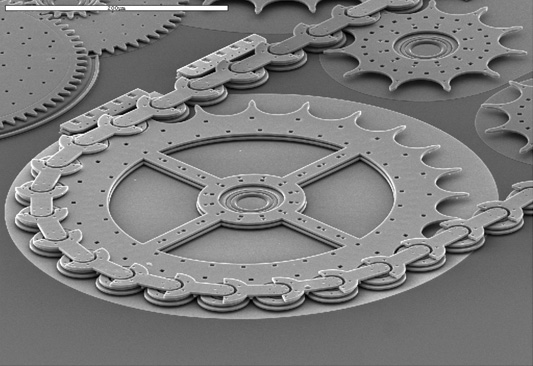
Re:How are these made?
Sandia, creators of this technology, have more detaile information on their web page (which is surprisingly junky to look at, considering) but the parent to this comment is essentially right. Deposition, photolithography (applying, through printing a photosensitive mask then exposing it selectively to light through a filter, which allows selective chemical etching). They do some whach stuff with layers and combined processes though.
-
Cool!Although this kind of stuff is not exactly new, it's still damn interesting.
My mom is an engineer at SNL, and I try to go once a year when they have their open house for families. The place is packed with stuff just as cool as this - supercomputers, particle colliders, nanotech, rockets and sattelites, I could go on and on. Really an amazing place - reading about it doesn't compare to seeing it in person. I highly recommend visiting if you get the chance.
-
Oval gear?
Is it just me, or should they work on rectifying the oval gear problem next?
-
Lots of excellent work...
Look at, for example, MPQC, a parallel quantum chemistry code that several times in recent years has held the record for largest QC computation ever performed (QC is one of the most computationally demanding branches of scientific research.) MPQC is built on a modular library called SC, for "Scientific Computing," which includes all sorts of tools for parallel communications, parallel file I/O, vector and matrix math, etc. SC and MPQC are written in a very O-O style in 99% C++ (a bit of legacy FORTRAN still in there.)
-
Here are several examples of the type you mentionAn AMR Simulation Framework in C++
A Multiphysics Simulation Framework in C++
and many more. I have more to say but I must leave for work to get back to hacking my own OOP engineering code.
Flat5
-
Re:The Diamond Age "Predicted" Electric Paper
OK. After he wrote Snow Crash, the ultimate cyberpunk novel, Neil Stephenson wrote The Diamond Age. Its key plot device was nanotechnology. The funny thing is that these guys are on the verge of making this technology a reality...
-
Re: Did you just guess that that would happen?
You do not get x-ray emission from ordinary electrical sparks such as from fuses.
Yes you get RF emission and visible light and even a substantial amount of UV. But if you knew anything about the EM spectrum that you mentioned in your post, you would know that x-ray photons are a thousand times more energetic than UV photons and the puny spark in a blown fuse at household current could not possibly create x-rays.
The Z-machine at Sandia National Labs uses up to 20 Million amperes!! to pinch its plasma fusion experiments. In order to create x-rays from a pinch you need to heat the plasma in the pinch to millions of degrees celsius; the x-rays are produced by hot plasma radiating its energy through bremsstrahlung emission and the nuclei-electron recombination time during plasma cooling. -
Re:"Pinches"
It may help to think of a(kindof) common result of the pinch effect. In arc welding, if you get just the right setup with enough current at the weld and a molten bit of metal it will splatter the metal everywhere because of the pinch effect.
The pinch effect is created by the strong axial magnetic field created by the current flowing through the material in question. See here for illustrations of magnetic fields. In the case of the article they used two crossed wires which were vaporized to a plasma(therefore still conducting like a wire) by high current. You can picture the strong magnetic field wraping cylindrically around (and squeezing inward with increasing current) the vaporized wire/plasma's axis. At the intersection of the two wires there would then be a small bubble of highly compressed plasma which is heated to extremely high temperatures, as the plasma cools there is a fast plasma "recombination" where the electrons rejoin their nuclei and emit a fast burst of x-rays.
(IANAP so if someone here is, and there is a mistake anywhere feel free to correct me)
If you instead picture an annular array of wires(eg. 10-20 wires) rather than two crossed wires than you can see that the individual magnetic fields of the wires combine into one huge axial field. This is the so called Z-pinch (because the magnetic field is in the "z" axis). These are the pinches used to initiate thermonuclear fusion in machines like this.
As an aside: Sandia used to use an X-Pinch to "backlight" implosion experiments on the Z-Machine with x-rays so that they may be imaged. Recently they upgraded this setup with a more reliable method of x-ray backlighting using ultrahigh power laser pulses to heat a metal foil target that then creates x-rays. The place where I work supplied the laser parts. -
Re:Violet Laser != DVD
-
You have 4 ways to store hydrogen
You can find a chemical to store hydrogen. That is how a battery works, or make a gas. These people are trying to make solid sodium and a possible product is PowerBalls Problem: It takes 2000 degrees to make solid sodium, and they use methane as part of the process....not very renewable.
You can store it as liquid H2. Getting H2 to -432 degrees takes power. And it is dangerously cold. BMW has been using this method in their hydrogen cars. A liter of liquid H2 has 39,000 watts of power. Alot of power in a small space.
You can store it as a compressed gas. At standard temp and pressure, a liter of H2 has 3.5 watts of power. Not alot of power here, is there? As you increase pressure, more H2 will work its way out of your tank, and embrittle the metal.
Finally, you can shove H2 inbetween metal. TiFe was patented in 1988, and automakers plan on selling Hydrogen cars in 2010. (Do the math, what technology becomes public domain?) Contaminated TiFe can be reclaimed (it is just like mining it) Ti Sponge (pure TI) goes for $3.80-$4.50 a pound. A research site Texico owns part of Ovonic has a few patents on this technology also.
Now, which way should one go here? LH2? Compressed H2? Chemical? or metal lattice storage?
Without good, "safe" storage, H2 won't be more than a playtoy. Anytime you generate, store or use power, there is danger. It is the preception of Hydrogen danger (hindenberg) that needs to be addressed. Some pinto drivers know how dagerous gasoline is...yet we 'accept' the dangers of Gas. Oh, wait. gasoline, Natural Gas, Propane are chemically stored Hydrogen! Eeek, the horror! -
So you think you're safe
Connected to the internet? The Sandia National Labs Red Team can break into your computer, right now. Deal with it.
-
This reminds me of my project for my degree...
...I developed a scheduler using JESS, which is a Lisp like language written in Java, which integrates with Java. I did look at Lisp as a candidate solution, but a lot of compilers support the CommonLisp standard to varying levels, which caused some headaches.
The performance using JESS was quite incredible given that it was a language within Java.
I also agree that Lisp is an absolute pig when it comes to readibility, you just get brackets everywhere, and you end up adding more and more. -
This reminds me of my project for my degree...
...I developed a scheduler using JESS, which is a Lisp like language written in Java, which integrates with Java. I did look at Lisp as a candidate solution, but a lot of compilers support the CommonLisp standard to varying levels, which caused some headaches.
The performance using JESS was quite incredible given that it was a language within Java.
I also agree that Lisp is an absolute pig when it comes to readibility, you just get brackets everywhere, and you end up adding more and more. -
Mirror of article in case the site is slashdottedNanotemplates for nanostructures First controllable 2D nanopatterns imaged by Sandia researchers
ALBUQUERQUE, N.M. -- The first vision of a peaceable kingdom in which deposited atoms form orderly, controllable 2-D nanopatterns has been observed by researchers at the Department of Energy's Sandia National Laboratories.
An evolution from droplets to stripes to inverted droplets , predicted by theory, is demonstrated here in successive images by Sandia experimenters.
Download 300dpi JPEG image, 'Kellogg_Fig2.jpg', 172K (Media are welcome to download/publish this image with related news stories.)Pattern control at this level means that nanotemplates could be formed to fine-tune the device characteristics of self-assembling nanostructures. Possibly, characteristics could be tailored for devices like photonic lattices, an advanced method for controlling light and of wide interest to the huge telecommunications industry.
The work, described in the Aug. 30 Nature, produced real-time video of atoms self-arranging themselves in the manner long predicted by a variety of theorists but contrary to ordinary intuition. Thus, such theories generally had been treated with a great deal of skepticism, says Sandia physicist Norm Bartelt: "There was no obvious route for atoms to arrange themselves in predicted patterns."
Says Sandia researcher Richard Plass, "Kinetics say that 10,000 moving atoms should go anywhere. Nobody really expected an assembly would arise."
Observation of the real-time assembly process, along with control over physical factors that influence that process, offer a means of finding out far more about the conditions under which atoms self-assemble than any theory could predict, and thus, how to influence that assembly into more desirable structures.
"There are many control knobs we can turn to create new patterns," says Bartelt. Among them are temperature and material composition.
The researchers observed atoms of lead deposited on a copper substrate forming, first, lead dots, then lead stripes, and then reverse dots -- copper becoming the dot material -- as more lead is added.
Lead atoms are portrayed nestling on a bed of copper atoms as substrate coverage increases.
Download 300dpi JPEG image, 'Kellogg_Fig1.jpg', 508K (Media are welcome to download/publish this image with related news stories.)"The work -- which to our knowledge is the first unambiguous observation of the expected sequence of domain patterns -- helps understand the new physics that manifests itself at these small length scales," says Sandia project lead Gary Kellogg. "New materials with highly specialized properties necessary to meet defense and consumer needs can be fabricated only by tailoring the structure of the material on the nanometer scale. This work provides insight into how nature does this, and how humans can do the same."
Sandia researchers were able to record real-time, real-space images using a low-energy electron microscope (LEEM) that show exactly how the nanostructures are generated, self-assemble, and transform. "The close agreement between experiment and theory allows us to probe the key inter-atomic force parameters involved in the process," says Kellogg.
Theorists long have believed that competing attractive and repulsive inter-atomic interactions can lead to the spontaneous formation of ordered patterns in widely varying chemical and physical systems. Potentially, such patterns could be used as templates for nanostructure fabrications.
"There are precedents for people using these patterns for further growth of quantum dots," says Bartelt. "They can be the starting point of controllable patterns that extend into three dimensions."
Though models have clearly predicted the possibility of controlling any pattern's geometry and order, depending on temperature and amount of secondary metal introduced, experimental verification of these models had remained elusive till now.
-
Mirror of article in case the site is slashdottedNanotemplates for nanostructures First controllable 2D nanopatterns imaged by Sandia researchers
ALBUQUERQUE, N.M. -- The first vision of a peaceable kingdom in which deposited atoms form orderly, controllable 2-D nanopatterns has been observed by researchers at the Department of Energy's Sandia National Laboratories.
An evolution from droplets to stripes to inverted droplets , predicted by theory, is demonstrated here in successive images by Sandia experimenters.
Download 300dpi JPEG image, 'Kellogg_Fig2.jpg', 172K (Media are welcome to download/publish this image with related news stories.)Pattern control at this level means that nanotemplates could be formed to fine-tune the device characteristics of self-assembling nanostructures. Possibly, characteristics could be tailored for devices like photonic lattices, an advanced method for controlling light and of wide interest to the huge telecommunications industry.
The work, described in the Aug. 30 Nature, produced real-time video of atoms self-arranging themselves in the manner long predicted by a variety of theorists but contrary to ordinary intuition. Thus, such theories generally had been treated with a great deal of skepticism, says Sandia physicist Norm Bartelt: "There was no obvious route for atoms to arrange themselves in predicted patterns."
Says Sandia researcher Richard Plass, "Kinetics say that 10,000 moving atoms should go anywhere. Nobody really expected an assembly would arise."
Observation of the real-time assembly process, along with control over physical factors that influence that process, offer a means of finding out far more about the conditions under which atoms self-assemble than any theory could predict, and thus, how to influence that assembly into more desirable structures.
"There are many control knobs we can turn to create new patterns," says Bartelt. Among them are temperature and material composition.
The researchers observed atoms of lead deposited on a copper substrate forming, first, lead dots, then lead stripes, and then reverse dots -- copper becoming the dot material -- as more lead is added.
Lead atoms are portrayed nestling on a bed of copper atoms as substrate coverage increases.
Download 300dpi JPEG image, 'Kellogg_Fig1.jpg', 508K (Media are welcome to download/publish this image with related news stories.)"The work -- which to our knowledge is the first unambiguous observation of the expected sequence of domain patterns -- helps understand the new physics that manifests itself at these small length scales," says Sandia project lead Gary Kellogg. "New materials with highly specialized properties necessary to meet defense and consumer needs can be fabricated only by tailoring the structure of the material on the nanometer scale. This work provides insight into how nature does this, and how humans can do the same."
Sandia researchers were able to record real-time, real-space images using a low-energy electron microscope (LEEM) that show exactly how the nanostructures are generated, self-assemble, and transform. "The close agreement between experiment and theory allows us to probe the key inter-atomic force parameters involved in the process," says Kellogg.
Theorists long have believed that competing attractive and repulsive inter-atomic interactions can lead to the spontaneous formation of ordered patterns in widely varying chemical and physical systems. Potentially, such patterns could be used as templates for nanostructure fabrications.
"There are precedents for people using these patterns for further growth of quantum dots," says Bartelt. "They can be the starting point of controllable patterns that extend into three dimensions."
Though models have clearly predicted the possibility of controlling any pattern's geometry and order, depending on temperature and amount of secondary metal introduced, experimental verification of these models had remained elusive till now.