Slashdot Mirror
Domain: sasg.com
Stories and comments across the archive that link to sasg.com.
Comments · 19
-
New platforms?
Wow, never thought I'd see MS releasing software for the Amiga!
-
Re:Amiga Icons
The Amiga also had this:
http://www.sasg.com/mui/
Which was ahead of anything before or since, I think. -
Amiga Icon sets -proto themes
One of the other points about Amiga icons apart from their animation and arbitrary size that several other posts have mentioned, was that people produced themed icon sets in the 80s and 90s, mainly because the default out-of-box theme was, uh, functional at best (it was designed to be clear on a crappy TV, though).
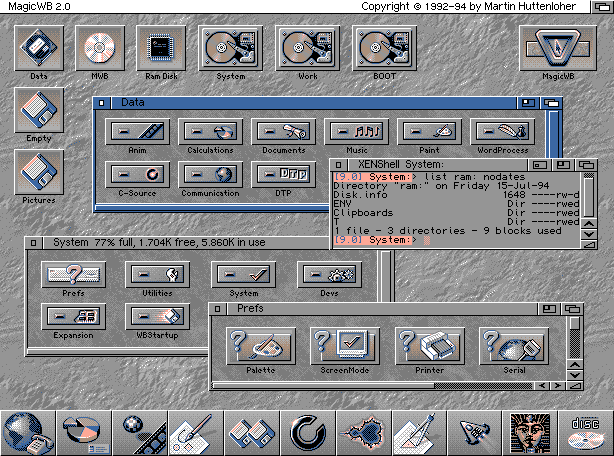
MagicWB was probably the most popular in the Amiga european heyday of the early 90s and widely imitated by third parties. Yeah, it looks kinda crappy now. But boy could it piss off a PC/AtariST/Mac owner back in the day (NeXT users presumably went "meh", not that cognitive dissonance would let them ever admit an amiga 1/10th the price of a NeXT box could hold a candle to their machines)
The later 90s NewIcons set was more about function than prettiness (they expanded icon images to a 256-color palette), but the "newicons style" (colorful isometric, think old KDE only drawn by artists with talent
NewIcons could still hold their own against some iconsets I see today, anyway, especially in the clarity stakes.
Exoticons were NewIcons popular with gamers for obvious reasons when you see the screenshot...
GlowIcons were a NewIcons set and characteristic style third-parties imitated that appeared in the sunset of Amiga era.
NewIcons and GlowIcons inspired clean, elegant default look of later niche-market AmigaOS releases in the zombie-living-death of Amiga era.
-
Re:Ignorance about UIs
Take a look here - that's Amiga MUI which dates before iTunes... Besides, Windows' Explorer had this "drill down" UI function about a decade ago - you know, click on a folder and see its items in the right hand pane. So iTunes and Winamp have added a third pane. What if I write an interface that has a fourth pane? Can I patent that?
Like I said, it's a pretty standard, and very obvious UI solution. -
Re:$4000!
Yeah, but what software on the Amiga is really worth porting to a new OS?
I'd like to see YAM (open source email client), and MUI (GUI toolkit - sadly closed source, but there is an open source clone, Zune).
The only tool I would like would be Bars and Pipes Professional, but then there's no source code for that.
I believe Microsoft released the source code when they brought out the company who developed it, and discontinued it. Check out here.
-
Old skool callout.
The only thing Xen means to me is this.
-
Re:GUI
Nahh. Gtk looks to me like an Amiga MUI derivative...
Amiga MUI was aroung a LONG time before Gtk.
-
It's not the same without the Amiga
Even though I'm typing this from a TiBook, stories like this remind me how much I miss using the Amiga. My A3000 sits on a shelf just above my BSD machine, and I still have my A500 downstairs (or A0.5K as some people liked to call it
IMHO, the Amiga made using computers fun. It wasn't *what* you were doing, but *how* you were doing it (except for those ^#@! guru's) Now that Windows has taken over virtually everything, computers have become just a tool for getting work done, and it's become too routine. Linux and to an extent, MacOS X, have captured a lot of the spirit of the Amiga, and features that I had on my Amiga years ago are starting to make their return (I missed my CLI on my desktop machine!). Yet, it just isn't the same.
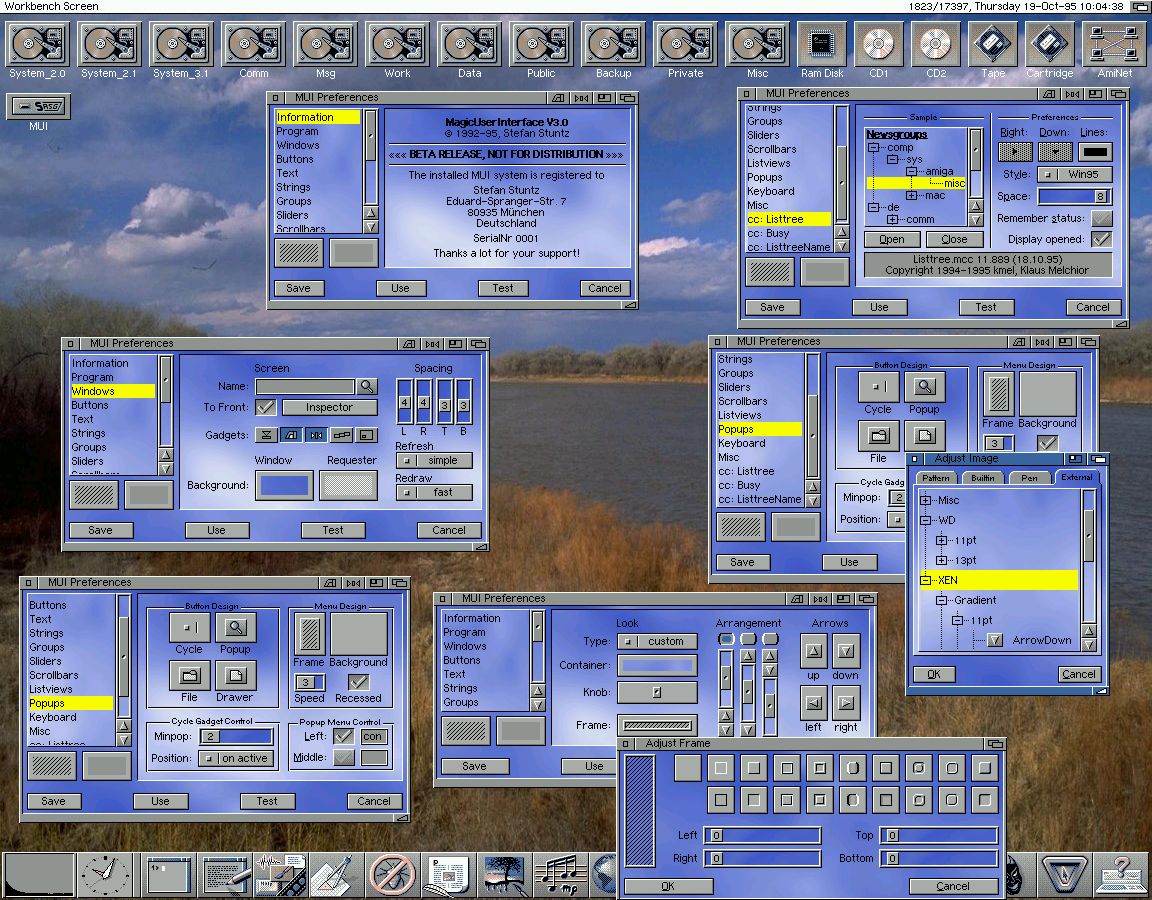
Off topic, SASG still appears to be active. Looking at some of the MUI screenshots, it's interesting to see how similar parts of MacOS X are - back in 1995! -
Re:Still don't get it
This feature (Screens) is one of the major reasons I still use my Amiga daily (in fact, I'm writing this on it!)
An example: My Workbench (finder, ) runs in a medium-resolution (800x600), 24-bit mode in order to make the icons the right size and the text readable. My paint program is set to run in the highest 24-bit resolution my piss-poor gfx card can handle (1280x960). My C IDE is set to run in 1600x1200, 256 colors.
I can launch both applications and toggle through the three screens quickly with the screen depth gadget. In fact, I can launch a game and still toggle screens (with a key press, since the game is fullscreen).
In combination with MUI this feature becomes even more usefull. You can set up any number of screen definitions ahead of time, and select which applications go on what screen. For instance, the graphics program and the picture viewer could both share the high-res, 24 bit screen. The IDE and the text viewer could share the extrememly high-res, 256 color screen. (Normally, each application would either run on Workbench or on its own custom screen.)
Screens are probably the hardest to reproduce likable feature of AmigaOS, but there are tons of others:
- Ram disk that automatically grows/shrinks as needed. Perfect for those temp files.
- Handlers in general, allowing you to very easily create disk-like thingies.
- A shell that's smart enough to realize that when I type the name of a directory, I don't want to execute the damn thing, I want to move to it!
- Any sized icons.
- Icons and disk drawers that remember their position/size. Of course, the Mac has always had this, though apparently there're som problems with OSX.
- RDB partitioning system.
- Assigns, esp. multi assigns.
- The ability to run all my (100's) of old games
- A unique compromise between simplicity and power. Repeat after me Bill and Linus and Steve: user friendliness is not about creating a horrendously overcomplex system and then trying to hide it from the users by pasting a cute graphical shell on top!
- Dozens more points I will not bore you with here.
All of these thing conspire to make me hang on to my dear Amiga, year after year. And the fact that I bloody hate both Microsoft and the PC hardware design.
-
Re:And the competition goes on...
N.B. I'm european:
Funny, KDE looks more "professional" to me - graphically, GNOME looks like a strange rip-off/update of Amiga MUI + ScalOS, the early-1990s "leet european haxor" desktop, while KDE looks more business-like... GNOME applications also seem to have bizarre names, while KDE's are descriptive... -
Re:The whole Amiga mentality
Stardock is great software. I`m also very pleased it is now easy to replace that UGLY microsoft from my desktop. Of course on AmigaOS it was already possible to fully customize the graphic user interface with programs like MUI long before anything similar was available on other platforms. AmigaOS was and IS one hell of an advanced operating system.
-
Interface looks like an X theme.Does it really matter what the interface looks like? If its themable, you can make it look or act however you want.
Other than Amiga colors and the boing ball, what does it have in common with the classic Amiga?
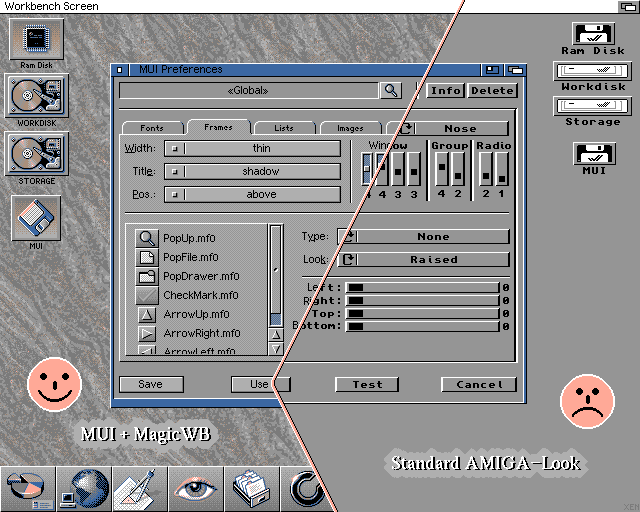
Myself I perfered MagicWB and Magic User Interface on my Amiga, I cant even use UAE without it...
http://www.sasg.com
Some examples for the click impatient
MUI - http://www.sasg.com/mui/preview.gif
MWB - http://www.sasg.com/pic/mwb_preview.gif
Gallery pics - http://www.sasg.com/mui/gallery/Stefan_Stuntz/Pref s.jpeg -
Interface looks like an X theme.Does it really matter what the interface looks like? If its themable, you can make it look or act however you want.
Other than Amiga colors and the boing ball, what does it have in common with the classic Amiga?
Myself I perfered MagicWB and Magic User Interface on my Amiga, I cant even use UAE without it...
http://www.sasg.com
Some examples for the click impatient
MUI - http://www.sasg.com/mui/preview.gif
MWB - http://www.sasg.com/pic/mwb_preview.gif
Gallery pics - http://www.sasg.com/mui/gallery/Stefan_Stuntz/Pref s.jpeg -
Interface looks like an X theme.Does it really matter what the interface looks like? If its themable, you can make it look or act however you want.
Other than Amiga colors and the boing ball, what does it have in common with the classic Amiga?
Myself I perfered MagicWB and Magic User Interface on my Amiga, I cant even use UAE without it...
http://www.sasg.com
Some examples for the click impatient
MUI - http://www.sasg.com/mui/preview.gif
MWB - http://www.sasg.com/pic/mwb_preview.gif
Gallery pics - http://www.sasg.com/mui/gallery/Stefan_Stuntz/Pref s.jpeg -
Interface looks like an X theme.Does it really matter what the interface looks like? If its themable, you can make it look or act however you want.
Other than Amiga colors and the boing ball, what does it have in common with the classic Amiga?
Myself I perfered MagicWB and Magic User Interface on my Amiga, I cant even use UAE without it...
http://www.sasg.com
Some examples for the click impatient
MUI - http://www.sasg.com/mui/preview.gif
MWB - http://www.sasg.com/pic/mwb_preview.gif
Gallery pics - http://www.sasg.com/mui/gallery/Stefan_Stuntz/Pref s.jpeg -
Re:It's good to see a modern, fresh perspective...
This trend is going full circle with the proliferation of applications to which various 'skins' can be applied, producing an entirely new look. This trend has appeared, I believe as a direct result of the advent of dynamic layout methodologies similar to HTML. Let's all remember it wasn't always so.
There are gadget libraries on the Amiga - MUI and BGUI - that have been doing dynamic layout since 1992 when HTML was new (and maybe didn't yet have forms). It always annoyed me that I couldn't easily do this when building a Windows GUI (which, thankfully I haven't had to do for a while now).
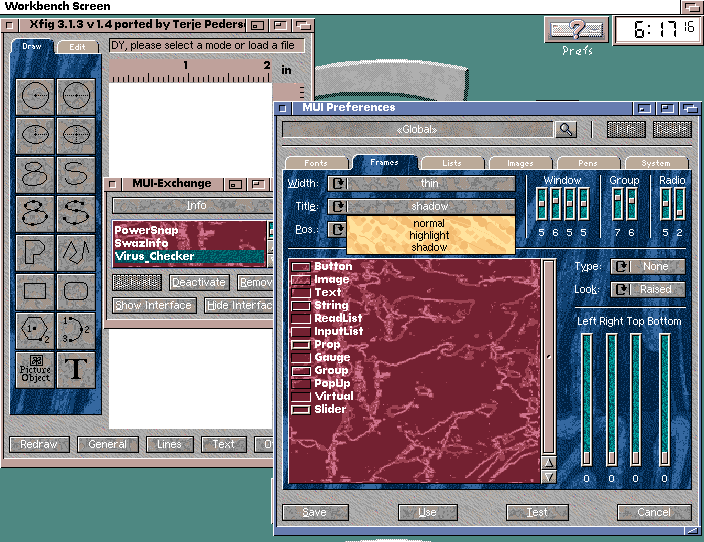
MUI allows a lot of user configuration of both look and feel - globally and specifically for individual applications. It's not exactly skinning, but because so many Amiga applications use MUI this is a much more powerful feature. You can see an example of customised MUI windows on its web site.
-
Re:Dead? It depends on your point of view
However, you can get the GPLed Motif clone Lesstif It's pretty close to complete (It's at least as close to Motif as Mesa is to OpenGL). I expect distros such as Mandrake will include it as standard in the near future - the only reason you don't see it more is because RH don't like LessTif, since it pretty much killed one of their early profit-making schemes, which was selling a commercial Linux Motif implementation.
I actually find Motif a rather well thought-out toolkit, if a little dated. It is NOT hard to program, and some aspects of it DO make more sense than Qt and GTK.
Qt and Gtk fail to learn from earlier developments in GUI technology, particularly the dynamic, per-application themeability, graceful resizing handling etc. that happened on the Amiga with MUI.
I also hate the Qt signal/slot kludge - they should implement it properly (like libsigc does for gtk--) for Qt 3.0 - I'd happily help, if my current employer would let me...
-
Re:Rasterman defumigation?
Yeah, enlightenment started out as a rip off of the amiga UI - right down to enlightenment's wierd kludging of draggable desktops into X windows (they're supported by the hardware on Amigas, and are called "PubScreens", and can be different resolutions and bit depths to eachother and remain draggable, since the amiga had a raster-beam (ever wondered why he's called RasterMan?) synchronised programmable display coprocessor (copper) ).
GNOME/Gtk feel like a poor man's Amiga Magic User Interface, both to use and to program. MUI
ImLib was a rip-off of the Amiga OS DataTypes system, but much less general. DataTypes were plugin modules that could identify and transform between various forms of data, including, but not limited to, images, animations and sounds. If you wanted your amiga program to have general support for arbitrary image types, you just wrote it to derive from the DataTypes classes included with the OS. -
MUI?
SASG homepage with link to MUI